
(Another repost from my own blog) Charles Finney’s 1935 The Circus of Dr. Lao is one weird book with one glorious cover, at least the edition I have (alas, I don’t know the artist).
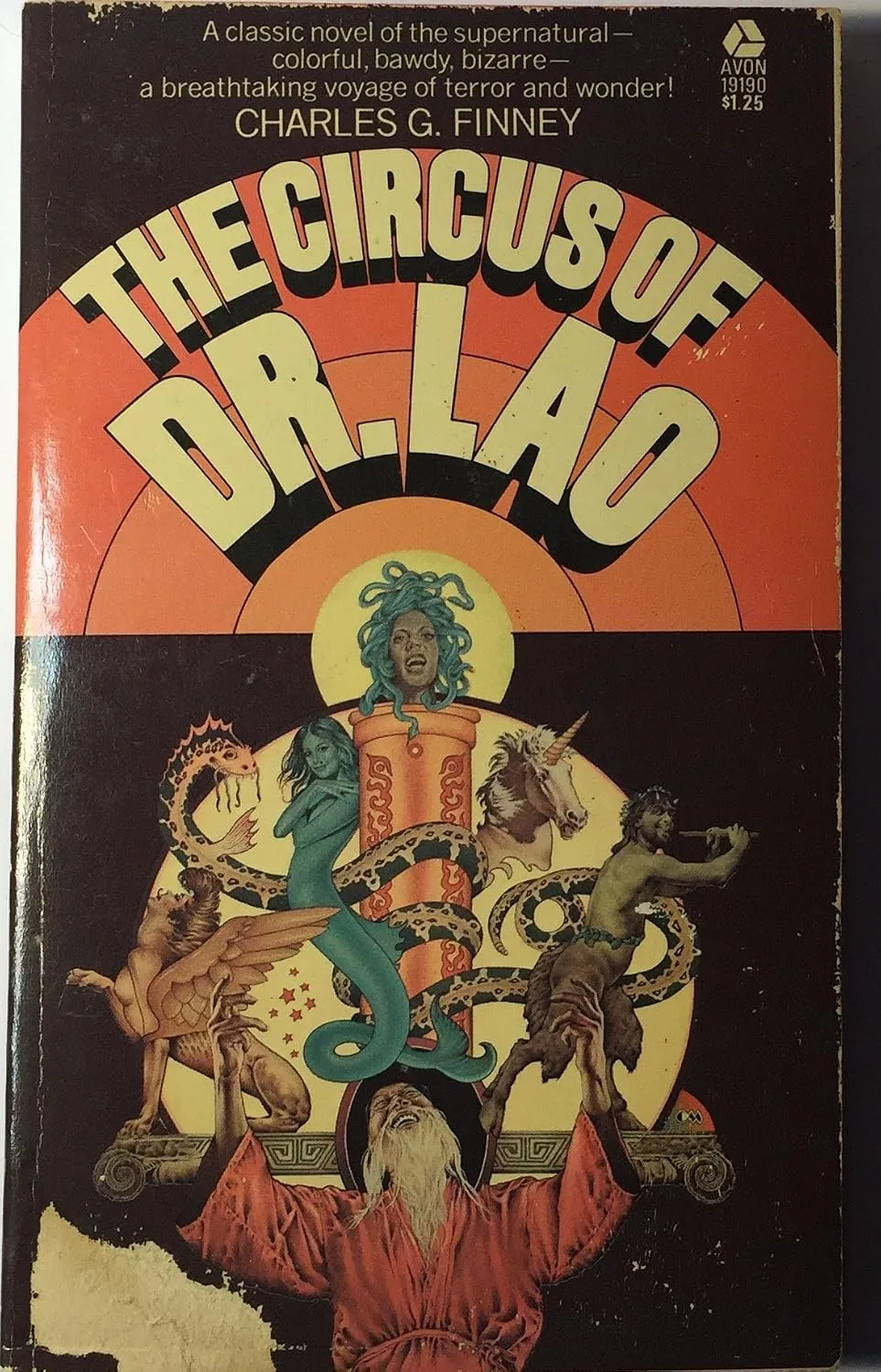
Depression-era Abalone, Arizona is a small, dull, dusty desert town. As the book opens, Abalone is experiencing some excitement for the first time in who knows how long. First the locals see a big newspaper ad announcing the coming of the eponymous circus, then the parade arrives in town. For a small town back then, that was a very big deal… but the Abalone townsfolk are underwhelmed by the circus’ arrival. Just three wagons? A horse with a fake horn on its head? A wagon-driver with fake goat horns, playing a syrinx? Plus a dog painted green, an elderly Chinese man and a furry something — someone? — in one of the cages.
Small and unimpressive as the parade seems, when Lao opens his show that night, there’s a full three-ring circus with sideshow exhibits. And what exhibits! There’s a sea serpent that engages in intellectual conversation about its life history. Medusa, carefully shielded so she’s only visible in a mirror (as you might guess, someone’s fool enough to look closer …). The satyr sexually assaults a prim young woman (she enjoy it because that’s how prim women were supposed to react back then). Two drunk college students cause trouble. Apollonius the seer gives a middle-aged woman a bleak prophecy: she won’t find love, nothing will change, nothing will improve, she’ll simply fade away, losing hope, and then she’ll die (it’s a strikingly sad moment). A sorcerer resurrects a dead man, who runs off immediately — he has important business!
Remarkable as all this is, the locals are phlegmatic and unfazed; from their reactions they’d have been equally satisfied with a tattooed man. They’re witnessing wonders but they don’t find them all that wondrous. Apollonius’ prophecy could apply to the entire town — it’s the kind of dull, listless community doomed to dry up and die as the next generation moves somewhere better.
Finney spins an odd but fascinating story. The Circus of Dr. Lao doens’t have a plot, just a series of incidents, none of which get an explanation. The novel concludes in the same odd tone. We get a “cast of characters” section that includes people who walked on-stage for maybe a page, or were mentioned but never appeared. Then we get a list of unanswered questions: was the furry thing in the cage a bear, or could it have been a Russian? What urgent business did the man raised from the dead have to accomplish?
I bought and read this in college, then reread it recently. I’ve no memory of what I thought of it in college other than “Wow, weird.” Rereading — well it’s definitely weird but I think it’s brilliant in its own way. It also has a couple of racial epithets in casual conversation, plus the sexual assault so if those are dealbreakers, be wary.
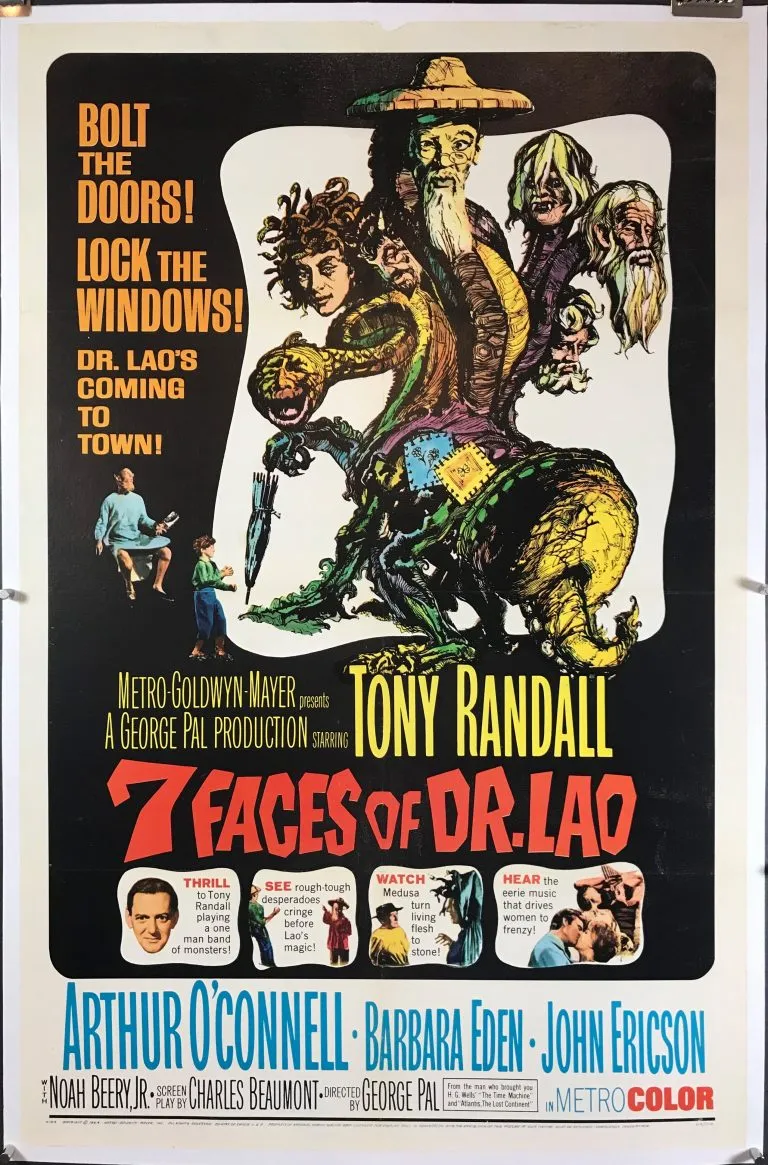
I think it’s probably impossible to film a plotless novel like that and stay true to the text. It’s no surprise that when they did film it as George Pal’s The 7 Faces of Dr. Lao (1964), scriptwriter Charles Beaumont provided a plot to string everything together. Given Beaumont was a regularTwilight Zone contributor, it’s also unsurprising it has a Twilight Zone quality to it, Dr. Lao (Tony Randall in yellowface) showing up and transforming the lives of the locals for the better would have fit right in on Serling’s show. Though that said, Pal’s film also resembles the 1962 film musical The Music Man. Like Harold Hill, Dr. Lao is a traveling trickster who breathes new life into a small town, including inspiring a prim librarian to find love.
This version of Abalone is a dying town and everyone knows it. Cynical Stark (Arthur O’Connell) has offered to buy everyone out so they can leave and start over; newspaper publisher Ed Cunningham (John Ericson) is pushing his neighbors to say no. He’s also pushing widowed librarian Angela Benedict (Barbara Eden) to say yes to a date, without any luck.
Enter Lao and his circus. His satyr (Randall — the “seven faces” means he plays seven roles) loosens Angela up (not quite as rapey as the book scene), the serpent mocks Stark, Apollonius (Randall again) makes his bleak prophecy. Stark’s thugs harass everyone opposing him; somehow Lao neutralizes them.
The end result, alas, feels more like kidvid than a good Twilight Zone episode. The performances are competent but not stellar. Randall playing seven roles doesn’t add much, though “actor plays multiple roles” has its own appeal. It has some charm, the Apollonius prophecy scene is still somber and I do like that Stark has a spark of good in him (“Every time I bet on weakness, corruption, and fallibility, I want to lose — but I always win.”). However I think there’s a better unfaithful adaptation they could have made.
