


“Isn’t there a white knight upon a fiery steed? Late at night I toss and I turn and I dream of what I need”
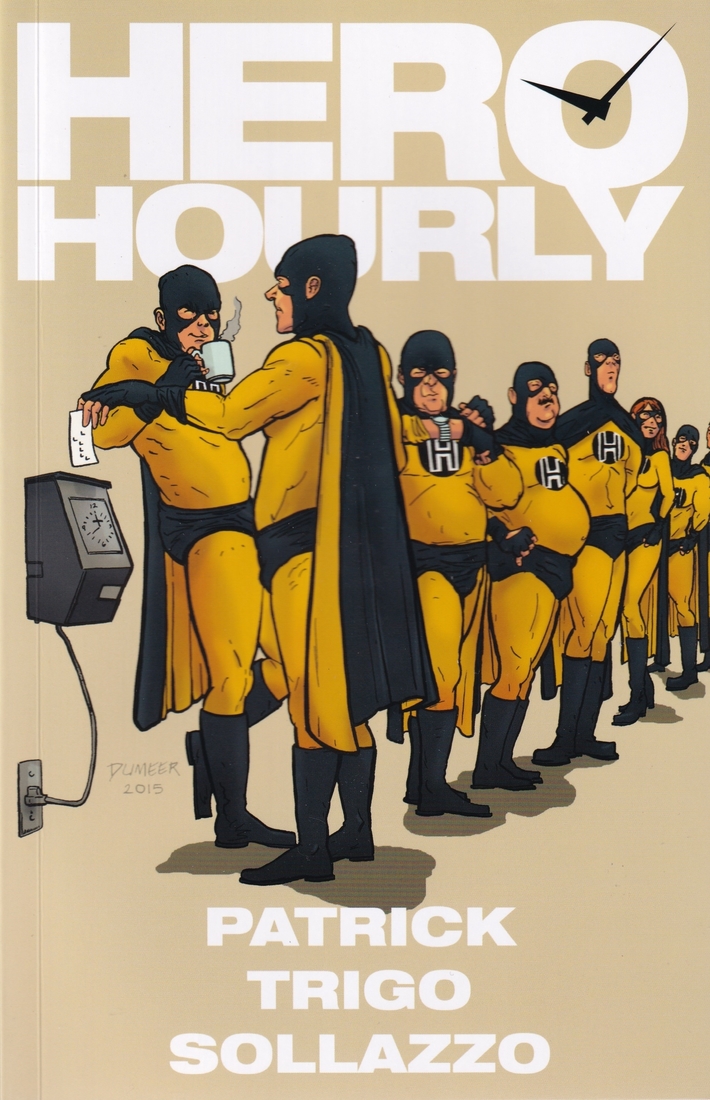
James Patrick (writer), Carlos Trigo (artist), Alex Sollazzo (colorist), Marco Della Verde (letterer), and Brittany Waugaman and Jordan Lowe (editors) bring us Hero Hourly from 21 Pulp, a graphic novel a long time in coming (it appears it was begun in 2015).  Was it worth the wait? Let’s take a look!
I’ve read a few of Patrick’s comics, but not a lot, and he’s a pretty good writer. He comes up with a clever premise in this one, and uses it well: what if someone discovered a “superhero serum” and then marketed it? So we get Saul, a typical smug, young white dude who thinks the world is his oyster when he gets out of college, but after a recession hits, he needs to take any job he can get, so he becomes a “superhero” for hire. It is a comedy, as you might expect, but it’s not completely non-serious, which is interesting.
Saul doesn’t want the job, but he takes it because it’s his only option. Patrick cleverly makes him extremely self-aware, so even though he acts like a douchebag occasionally, he’s very much aware of his privilege as a straight white man (he jokes about it throughout) and when he does act like a douchebag, he knows he’s doing it and tries to change his behavior. So he’s a character who fits in well in a comedic comic, but Patrick can show his growth at the same time. The humor comes from the odd situation he’s in, as the superhero company is, naturally, run like an actual company. Things in a big corporation occasionally don’t make sense at the best of times, but throwing superheroics into the mix makes for a good, humorous story. So we get the difference between what it says in the “handbook” and real life, we get changes to said handbook for seemingly no reason, we get sexual harassment seminars because Saul saves a woman the only way he can – by grabbing her by the breast – and we get people being promoted for no other reason than they kiss ass. 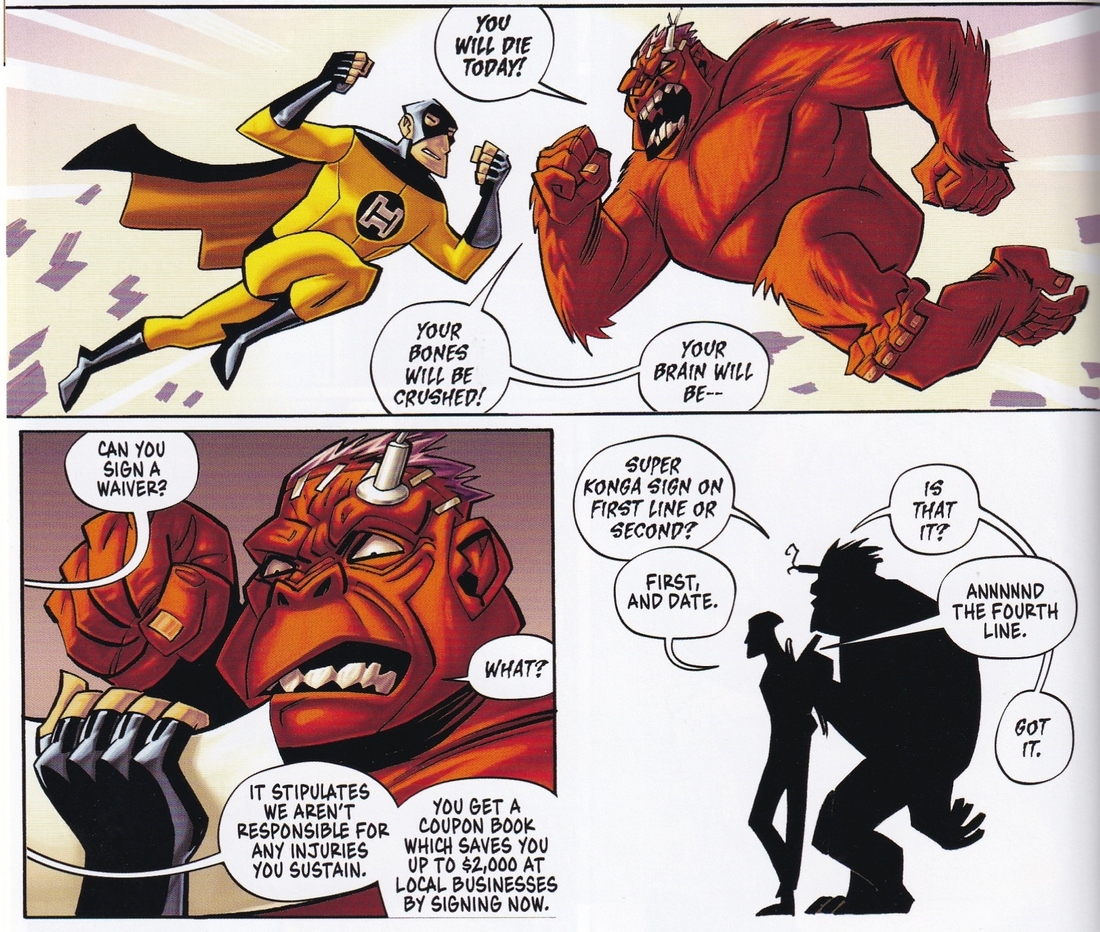 It’s typical corporate culture, but because everyone is dressed in a costume and can fly, it becomes somewhat goofy. Comedy is partly the upending of expectations that are based on experience, and Patrick plays with that a lot. He also focuses a little on one particular villain and his evolution, and while that’s also funny, it’s rooted in the housing crisis of 2008, so the villain is not entirely unsympathetic. He also gives us little asides about how dumb, ultimately, a lot of superhero stories are – it’s not so savage a satire that you get angry for actually reading a superhero story, but it reminds us that these are just entertainment, and perhaps we shouldn’t take them so seriously. Patrick disguises the fact that this is a coming-of-age story – Saul has to learn how to be an adult, a real one, in a world where guys like him have, in the past, skated by because of their social status, gender, and race. Patrick takes him down a peg, sure, but Saul doesn’t become too bitter, instead realizing that the world has changed, and being an adult in the world means doing things differently. It’s that story that makes this more than just a funny comic about “superheroes” who are regular schlubs.
Trigo’s cartoonish art is nice, too. He has a good, bold line and he doesn’t overhatch, so the comedic aspects of the art come through very clearly, and he does well with a “rubbery face” syndrome, showing the effects of violence hilariously. The people taking the serum aren’t all built like superheroes, and Trigo does a good job showing that (the serum gives them strength, but it’s obviously “magic” strength because they don’t develop muscles all of the sudden). He comes up with goofy costume designs, which works with the DIY ethos of the villains, juxtaposing them with the “corporate” superheroes (the villains don’t seem all that bad, they’re just people kind of pushed to the limit by society). Along with this, he thinks about what kinds of clothing the characters would wear, which helps show a bit of their personalities.  He doesn’t take panels off, as he puts things in the background that add to the comedy or he gives us people doing strange things but acting blasé about it, which helps sell the weirdness of it. Sollazzo’s colors are obviously quite rendered, mainly because that’s the way digital colors work these days, but because he’s clearly good at it and because Trigo’s lines are so strong, it works really nicely. The art fits the tone of the book very well, and helps heighten the comedy of it all.
Hero Hourly is better than you might expect, because Patrick, while going for some cheap jokes (that are still pretty funny), is more interested in showing how people make it through a world that isn’t terribly friendly to them, especially if they’re not contributing economically to that society. It’s something we in the States struggle with, and Patrick does a nice job viewing that through both a prism of superheroics and a comedic one. It’s not the deepest book in the world, but it also does have something on its mind, and that elevates it past a more simple joke-telling story (not that there’s anything wrong with that). I would link to it, but it actually does not have an ISBN and I’m not sure if the collected edition is available on Amazon (where the first issue – I’m not sure if parts 2 and 3 were ever released as single issues – has four scathing reviews, for what it’s worth). But if you’re interested, I’m sure you can find it somewhere!
Rating: ★ ★ ★ ★ ★ ★ ★ ☆ ☆ ☆

It will be very hard to find this in Holland. 🙁
Which is a shame because this looks really nice.
Yeah, that sucks. I wonder why it doesn’t have an ISBN? It’s just weird.
Luckely there is Ebay.
Someone in England sells the first issue for a reasonable price.