

Monday I wrote about Marvel superheroes and their love interests as of mid-1971. DC didn’t play up the personal drama as much as Marvel (nor usually as well) but as the Bronze Age supplanted the silver, that was changing. Newer, younger creators were stepping in and some of them were influenced by Marvel’s style. Plus even the older hands at DC such as Julius Schwartz and Carmine Infantino were recognizing the need to make some changes.
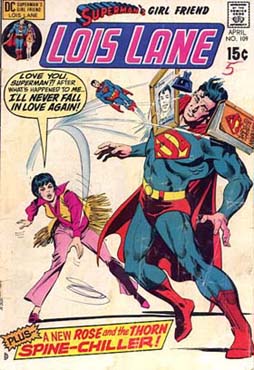 In the Superman Family, the big romance change came in Superman’s Girl Friend Lois Lane #109, “I’ll Never Fall In Love Again” (Cary Bates, Werner Roth, Dick Giordano cover). For most of the Silver Age, Lana and Lois had been in close competition for Superman’s heart, as on this Curt Swan cover —

And in some imaginary stories, it was Lana who marries him (Curt Swan cover again).

In #109, Lana’s former professor uses hypnosis to erase Lois’ capacity to feel love, figuring that will give Lana the edge in their rivalry. Lana talks him into taking the spell off, then decides she’s appeared in too damn many Lana vs. Lois stories. She gives up on Superman, takes a reporting gig in Europe and makes only two appearances in the next six years (not counting Superboy stories).
There hasn’t been a serious challenge to Lois’s status as The One since. Lana did become Superman’s girlfriend for a while, to jibe with Annette O’Toole’s Lana becoming involved with Clark in Superman III (Margot Kidder had questioned the profit-sharing from the first two films; the producers decided to dump her). It never felt like anything but a holding pattern, a pause until Superman’s love life assumed its rightful course.

Batman hadn’t had a serious romance since he was engaged to Julie Madison back in the 1940s; while there’d always been sexual tension 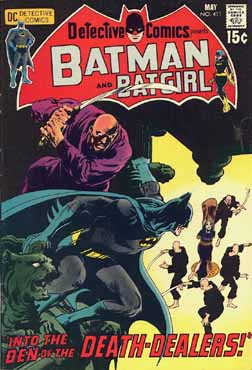 between him and Selina Kyle, it hadn’t come anywhere near a relationship (he did have an intense affair in Brave and Bold #64 but it didn’t last beyond that issue). According to Alan Stewart, Denny O’Neil thought Batman had repressed his sex drive to focus on his need for vengeance; the first woman to cut through his shell was Talia Al Ghul.
She’d appeared as a helpless prisoner of the League of Assassins in Detective #411, “Into the Den of the Death-Dealers” (Denny O’Neil, Neal Adams, Adams cover). As details in his review, O’Neil and Adams were still developing the League of Assassins as a concept and didn’t think of her as anything but a one-shot captive for Batman to rescue. That makes some of her characterization off, given the reveal in Batman #232 (same creative team) that she’s “The Daughter of the Demon.”
(I’ll be writing more about R’as and the Assassins eventually, in case you were wondering). As y’all know, I’m not a fan of O’Neil. I find Talia remarkably underwhelming; she’s more interesting and animated in her first story before the reveal. Regardless, she went unchallenged for several years as the woman who held Batman’s heart, though only appearing irregularly. Then Steve Englehart introduced Silver St. Cloud, following which Len Wein introduced a reformed Selina Kyle as a serious romance for Bruce. Talia hasn’t gone away — she is, after all, the mother of Batman’s child — but I think Team Selina has the upper hand.
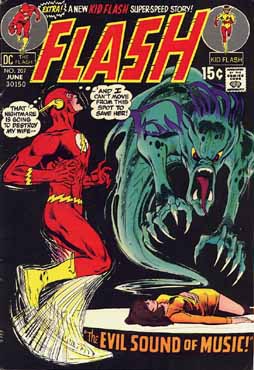 The Fastest Man Alive was, of course, one of the rare Silver Age heroes to marry in the Silver Age. He and Iris are still tight as the Bronze Age launches, even when he’s dragging her to a rock concert in “The Evil Sound of Music” (Mike Friedrich, Irv Novick, Neal Adams cover). Barry it turns out, is a serious rock-and-roll fan, even new hip groups like Washington Starship (read Jefferson Airplane). The plot involves Sargon the Sorcerer, whom Friedrich revived as a Flash-foe, attempting a new ploy to gain magical power — complicated by getting his niece, the group’s lead singer, entangled in his schemes. At the end of the story he’s remorseful enough to be reconsider his recent life choices. When Friedrich uses him again, Sargon’s on the heroic side once more.
As for Barry/Iris, after Sargon’s magic unleashes a demon Flash winds up frozen in place while it moves in on his wife. Fortunately, the power of his love is strong enough to break Sargon’s spell and save her (this synopsis makes it sound much better than it read on the page).
While Barry’s musical tastes have never come up before this story, I like the character detail. Square as Barry comes across, he wouldn’t be the first square guy with cool tastes in music. Like the Wasp having a passion for jazz, it’s a shame nobody picked up on it going forward.
Iris, of course, has never been seriously challenged as Barry’s true love. When Ross Andru became editor several years later, the book made a forced attempt to put their marriage on rocky ground. I never bought it. Then he killed her off and Barry started dating again; even that, ultimately, didn’t kill Barry/Iris (Biris?).
Green Lantern started out the Silver Age in love with Carol Ferris; unlike Barry, his love life hit a rocky patch when she announced her marriage to someone else. Hal quit Ferris Aircraft, became an insurance adjuster, got a new girlfriend Eve, completely forgot about her when Carol asked if he’d take her back. He didn’t, and subsequently found a new girlfriend, Olivia Reynolds.

Olivia was more interesting than Eve. She vanished just as abruptly when the “relevant” Green Lantern/Green Arrow era began (Adams cover).

In #83, ” … and a Child Shall Destroy Them,” (O’Neil, Adams, Adams cover) Carol returns. She’s now in a wheelchair and her wealthy boyfriend Jason Belmore is running a private school where the janitor and a psionic little girl are wreaking havoc (the girl’s powers are what turned Carol into a paraplegic).
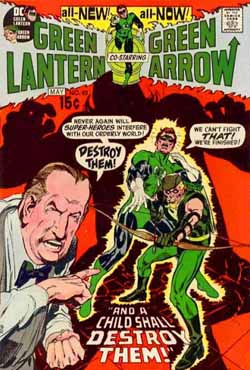
Finally GL reveals his identity to Carol . They got back together — more together than they’d been in the Silver Age. The romantic relationship continues into the next issue, “Peril in Plastic.”
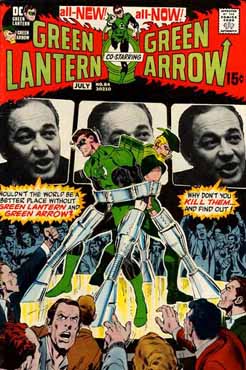
Since then, Hal’s had romances with Kari Limbo (Denny O’Neil’s god-awful Roma stereotype) and the underage Green Lantern Arisia. Nevertheless, the series always swings back to Carol (one thing I liked about Gerard Jones’ run on the series was that he embraced the chaotic train-wreck quality this gives their relationship). I’ve no idea what GL’s love life is like now, having drifted away from the book when Geoff Johns’ work on the title became insufferable. Still, Carol is still who I think of when I think of Hal Jordan in love.

O’Neil also paired off Green Arrow and Black Canary, shown in this Dick Dillin image from JLA a couple of years earlier. First friends, then something more. Unfortunately O’Neil (and Mike Friedrich over in Justice League of America) write Ollie as insufferably sexist; as I’ve said before, it’s hard to imagine them making a hero equivalently racist. Dinah does keep calling him out on it which helps a little; not much. Nevertheless, this would be the defining relationship for both of them, though not the only relationship for either of them (Dinah, of course, was a widow, until she was retconned into being the Golden Age Canary’s daughter). Sooner or later, they’re back in each other’s orbit, though again, I don’t know the current continuity (to the extent such a thing exists any more).

Wonder Woman, of course, lost her sweetheart Steve Trevor when she switched from superhero to martial artist (as foreshadowed on that Mike Sekowsky cover). She would go without a boyfriend until they resurrected Steve in 1976, then again in the 1980s. They got to marry at the end of the pre-Crisis series, then came a very looooong time with no boyfriend whatsoever. Then Superman/Wonder Woman in the New 52 — and the last time I checked, they were back to Steve.
In between there have been lots of false leads. In the period she lost her powers she fell for tough guy detective Tim Trench who turns out to be a rat, then for a British gent who turns out to be an agent of Dr. Cyber. After she regained her powers Diana started crushing on UN special envoy Morgan Tracy, then there were a couple more guys during the 1970s who didn’t take. Rinse, repeat.
She has, in short, gone much longer periods without any sort of romance than most male heroes and many of her romances were written half-heartedly at best. I suspect part of the reason is that unlike a male hero, people have trouble imagining her with someone who isn’t as powerful as she is (hence Superman). Whereas for Steve Trevor shippers (I’ve known a couple) the appeal is precisely that he’s a heroic military man who’s comfortable playing second fiddle to a woman tougher and more heroic than he’ll ever be.
