
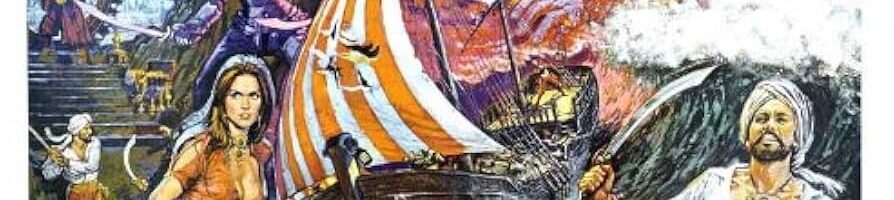
Usually I do ten movies a post with these, because I have to cut it off somewhere and I’m constantly watching movies, but today I miscounted, so there are eleven movies! Aren’t you lucky????
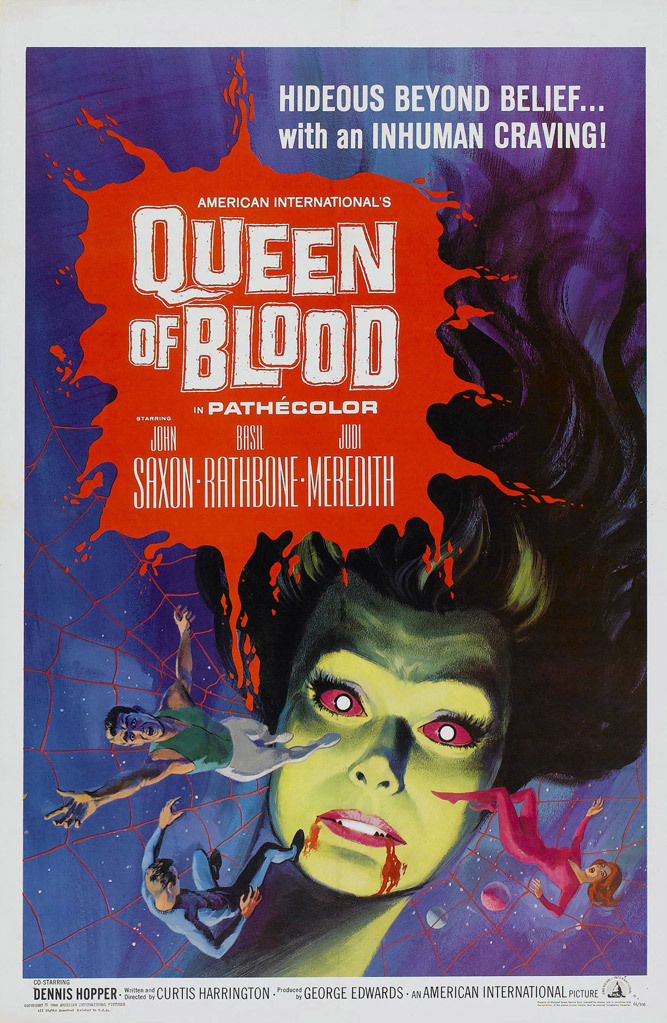 Queen of Blood (1966). This is a fascinating movie, even though it’s not terribly good. Producer Roger Corman bought a bunch of Soviet sci-fi movies with the intention of dubbing them into English to make some quick cash, but he found they were chock full of anti-‘Murican propaganda, so he lifted the (rather well done) special effects scenes and long shots of interesting machines out of the movies and got writer/director Curtis Harrington to write a story around them. The result is a bit clunky — in the Soviet scenes, no one talks and everything is a bit darker so we don’t see faces — but not bad, and it does look better than Corman could have afforded on his own. Unfortunately, the movie isn’t that good — it’s mildly entertaining, sure, but still a bit ridiculous. In the far-off future of 1990, Earth gets a message from an alien civilization saying they’re sending an ambassador, but the spaceship crashes on Mars, so we humans send a rescue mission there. Astronauts Robert Boon, Judi Meredith, and Dennis Hopper (!!!) are the first to arrive, but they find only a corpse. They have some problems with their ship, so astronauts Don Eitner and John Saxon (!!!) head off, but they end up on Phobos, where they find Florence Marly (she was in her late 40s at the time, so the fact that she’s kind of a femme fatale is kind of neat), the sole survivor of the alien embassy (it seems she left the main ship in an escape pod). Eitner has to stay on Phobos because their own escape pod seats only two people, so Saxon takes the alien to Mars to join the others, and they blast off for Earth with their “specimen.” Easy-peasy, right? Except … the alien is a space vampire, and she starts killing crew members and draining their blood. That’s not the worst set-up, except they know immediately what happened and … do nothing about it? They’re so focused on getting her to Earth that they’re willing to accept the deaths of their friends, which is weird. Saxon, playing the Sigourney Weaver role, wants to shoot Alien Vampire Lady out into space, but the others convince him otherwise. When they reach Earth, Dr. Basil Rathbone (!!!) wants to study the alien … and her eggs, which couldn’t possibly go horribly wrong, could it?!?!? The story is wonky, the acting isn’t great (Meredith does a lot of supposedly meaningful staring off into the distance, but it comes across as her being bored and/or forgetting what she’s supposed to be doing), but it’s still not a terrible way to spend 80 minutes or so. It’s neat to think about the behind-the-scenes stuff as you’re watching!
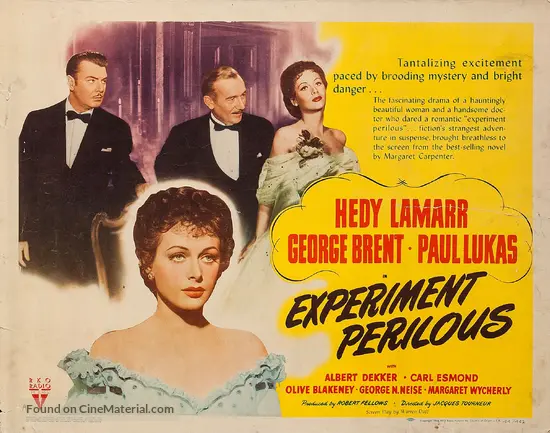 Experiment Perilous (1944). The term “gaslight” has entered the vernacular thanks to the 1944 movie starring Ingrid Bergman, Charles Boyer, and Joseph Cotten, but no such cachet has attached to this movie from the same year, which shares a good bit of plot DNA with Bergman’s flick. It’s not as good as Gaslight (which isn’t a great movie, either, but it’s better than this one), as it’s a bit more mealy-mouthed than that one — it’s never exactly clear what Paul Lukas, in the “Charles Boyer” role, is doing — but it’s certainly not a bad noir-ish movie. George Brent, playing a doctor (which is important), meets a woman on a train who tells him she’s heading to New York to see her brother and his wildly beautiful younger wife. Brent thinks there’s something off about the woman, but nothing too bad. She arranges to have her luggage delivered to his hotel, because she says she doesn’t want to live with her brother anymore. Later, Brent goes to a party and hears that the woman died while she was at her brother’s. His friends all know the brother, Nick (Lukas) and his wife, Allida (the rather haunted Hedy Lamarr — perhaps throughout the filming she kept wondering how a man would steal her invention of the high-speed internet!), so one of them introduces Brent to them. Lukas wants Brent to take Lamarr on as a patient, because he’s afraid she’s losing her mind. Of course, Lukas is … well, he’s doing something to Lamarr to make her feel crazy and claiming it’s just her — if only there were a term we could use to describe this!!!! Brent sent on the dead woman’s luggage, but one of her cases got switched with his, so he’s able to read her diaries and he gets a better picture of Lukas and Lamarr, and he decides he’s in love with Lamarr (I mean, who isn’t in love with Hedy Lamarr) and that Lukas is fucking with her mind. It plays out about how you’d expect, which is part of the problem. The other problem is that it’s never clear what Lukas is doing. There are hints that he’s unable to perform sexually, but of course they’re not going to come out and say that in 1944, and there are hints that Lamarr has found solace in the arms of another man, but nothing ever comes of that, so we’re really unsure why Lukas is messing with Lamarr’s mind. Lukas and Lamarr do good work, Brent is just kind of there, and the movie has a cool look, but doesn’t quite cohere. Still, it’s not a bad way to spend 90 minutes or so!
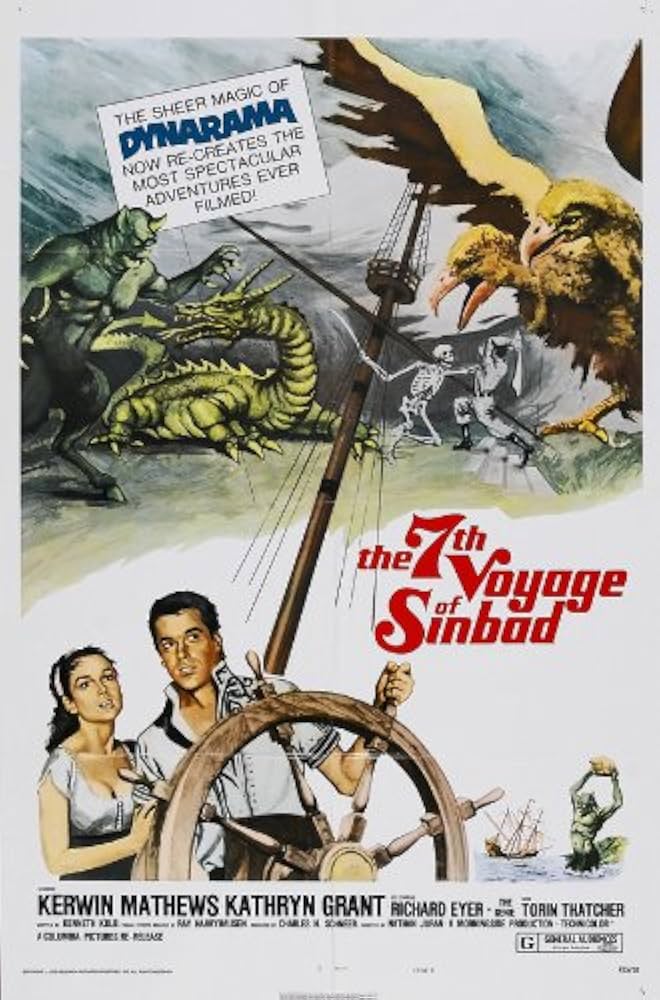 The 7th Voyage of Sinbad (1958). You don’t watch this movie for the acting or even the plot, you watch it for the very fun Ray Harryhausen special effects, but … I still have to talk about the acting and the plot. Kerwin Mathews as Sinbad is nice to look at, but he’s so wooden they might as well have put a cardboard cut-out where he is and it wouldn’t have made much of a difference. Kathryn Grant is a tad better as his love interest, but not by much, and they have no chemistry together, so the few times they make out it’s really uncomfortable, as they don’t seem like they want to be in the same room together (Mathews, it seems, was gay, so maybe he just couldn’t pretend that much???). Torin Thatcher, in addition to having a Top Ten Name, is sinister as the villain, but he’s no great shakes in the acting department anyway. But, such is life. The plot is silly, too: Sinbad is sailing from Princess Parisa’s homeland to Baghdad, where he plans to marry her to cement the peace between the two nations (but it’s more than that, of course — he lurves her!). They stop at an island to get food and water and discover it’s populated by Cyclopes and a magician, Sokurah, who’s being menaced by a Cyclops. They rescue the magician, but he drops his magic lamp (with requisite genie), so he wants to go back, but Sinbad says nuh-uh. When they reach Baghdad, Sokurah keeps bugging the sultan to send an expedition back, but the sultan says nuh-uh. Parisa’s father shows up for the wedding (hilariously, I might add, because it seems like Sinbad’s voyage from Parisa’s homeland was fraught with danger and took a while, but Parisa’s dad, traveling from the same place, just … shows up?) and Sokurah tells their future, predicting bad things and enmity between them. They know he has power (he briefly transformed Parisa’s lady-in-waiting into a giant snake), but they still don’t accede to his wishes, instead banishing him for saying such bad things about their futures. They give him a day to get out of Baghdad instead of just chucking him right out of the city, so he sneaks into Parisa’s bedchamber and shrinks her to about six inches tall, which causes the enmity he prophesied. Imagine that! They don’t think he did it — Sinbad finds him and begs him to help instead of thinking, “Hey, maybe that unpleasant magician had something to do with this!” Of course, the only cure is a potion Sokurah must prepare … back on his island. He gets his way! To go on such a dangerous journey, Sinbad recruits … a bunch of death row prisoners? That seems like a bad idea, and of course they mutiny immediately (Sinbad, dashing as ever, eventually thwarts them). They get to the island, fight a bunch of monsters, get help from the genie, and defeat Sokurah. Of course! As silly as it is, we’re here for the Harryhausen, and he doesn’t disappoint. The Cyclopes are neat, the snake woman is cool, the roc (the giant bird whose eggshell Sokurak needs for the spell) is harrowing, the dragon guarding Sokurah’s castle is fun, and the skeleton that engages Sinbad in a sword fight is very keen. It wasn’t Harryhausen’s first movie, of course, but it’s the first one when he had the money and control to make his visions come to life, and he does a good job with it. It’s a nice movie to check out on a lazy weekend afternoon, which is when I watched it!
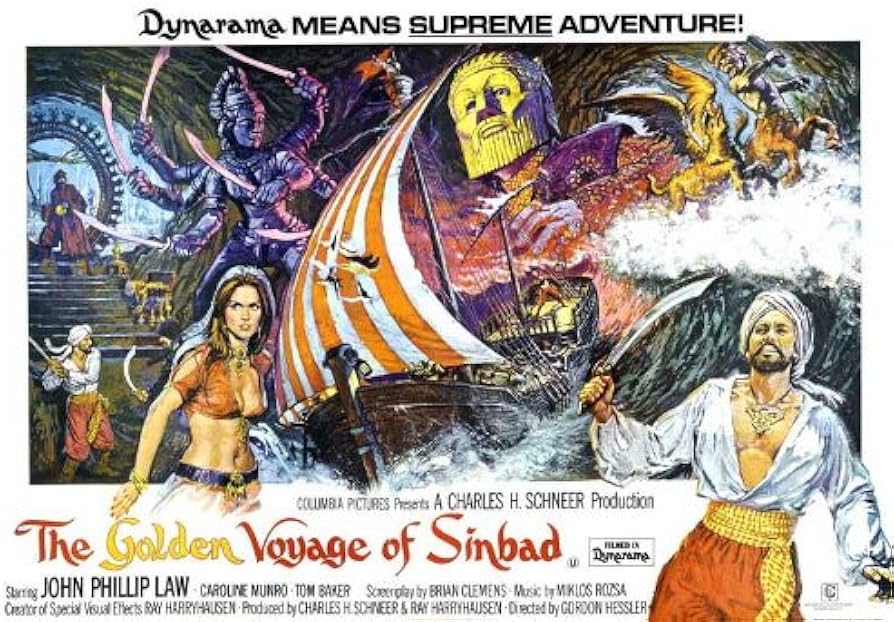 The Golden Voyage of Sinbad (1973). Yes, a while back TCM was not only showing Sinbad movies, but also highlighting Ray Harryhausen, so I watched two of his Sinbad movies in quick succession (the third, Sinbad and the Eye of the Tiger, sounded worse than these, so I skipped it … although I’m sure Jeff Nettleton will tell me why I shouldn’t have!). This is slightly better than The 7th Voyage of Sinbad, mainly because the effects are better (which shouldn’t be surprising, as it’s 15 years on from the previous one) and the acting is slightly better, too. John Phillip Law isn’t going to dazzle anyone with his acting skills, but he tries to be a bit more exotic than Kerwin Mathews, although he doesn’t seem to have any more chemistry with his lady co-star than Mathews did, and when your co-star is Caroline Munro, you ought to have more chemistry with her! Tom Baker (yes, that Tom Baker) is a better villain than Torin Thatcher, as he’s a bit more of a well-rounded character than Thatcher’s Sokurah. Baker’s Koura pays a physical toll when he uses his powers, and he does seem to appreciate his manservant, Ahmed, who’s devoted to him. Martin Shaw, who plays Sinbad’s right-hand man Rachid, looks like he just came from playing guitar with The James Gang and adds some nice “what the fuck is Sinbad doing” energy to the whole thing, which the movie needs. The story is standard: Sinbad gets a piece of an amulet that his entire crew says is bad luck, but Sinbad scoffs at them and wears it as a necklace … and immediately gets all the bad luck in the world. He is attacked by Koura, who wants the amulet, but he escapes and heads to a city which is ruled by a vizier wearing a golden mask because his face is horribly burned. Vizier Von Doom has another piece of the amulet and tells him they need to get the third, because if Koura gets all three, he’ll gain absolute power. Oh dear! The third piece is on the island of Lemuria, so Sinbad and his crew head there, and Koura follows them. There are your Harryhausenian monsters, including the famous statue of Kali, who fights them with six swords; the figurehead on their ship comes to life; there’s a one-eyed centaur and a griffin*, and there is … a green-skinned tribe that worships Kali, for some reason? I guess Harryhausen and Charles Schneer, the producer, had a bit more money to work with, because the movie does look a bit more authentic than the 1958 movie (Schneer was also the producer of that one), and the story isn’t quite as dumb. Munro is stunning as usual — they keep her in very tight, very small tops that accentuate her boobs and bare her belly, and then they keep her sweaty for no good story reason (but, I mean, there’s a reason, just not a good in-story one). It’s just another fun Sinbad movie, and who doesn’t love one of those!
* As always when I see anything to do with a griffin, I instantly think of “The Griffin and the Minor Canon.” I can’t help it! Recently, we watched a show in which a few churchmen wore those hats with the wide, flat brims, which the minor canon wears in this story. Just something else that reminded me of this tale. I can’t get it out of my head!!!!
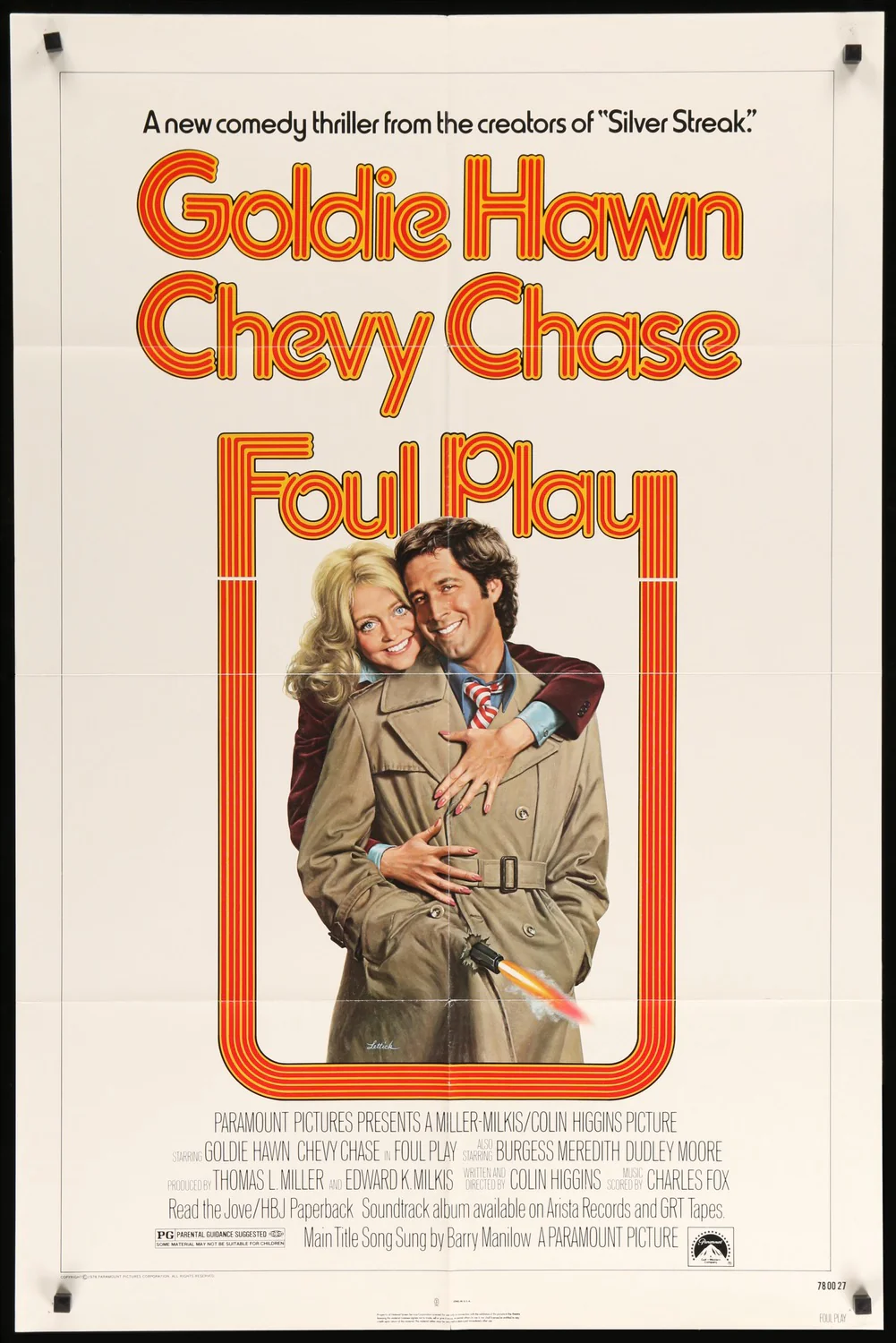 Foul Play (1978). This is a quasi-spoof of Hitchcock movies, as Goldie Hawn finds herself caught in an assassination conspiracy and for the longest time, nobody believes her because the evidence (namely, the dead bodies) keeps disappearing, and it’s pretty good. Hawn is a librarian who picks up a hitchhiker on her way back to San Francisco from an engagement party for a friend of hers, and he’s being chased by bad dudes. He gives her a pack of cigarettes with film inside, which is obviously something incriminating against them, and makes a date with her later that evening, presumably so he can get the film back. When he does show up, he’s been shot, and he dies a few moments later, but not before he says some cryptic things to her. She runs out to get the manager, but by the time she returns, the bad guys have removed the body and all evidence of the crime, and the manager doesn’t believe her. Later, a dude breaks into her apartment to get the film, but she manages to stab him with knitting needles before one of the assassins kills the dude. She passes out, and when she wakes up, the police are there and the body and all the evidence has disappeared again. Eventually, she’s able to convince the cops that something is afoot, and they try to figure it out. It’s a goofy movie at times, which isn’t surprising because Hawn can do goofy very well, and her love interest, the cop in charge of the investigation, is Chevy Chase, who can also do goofy quite well. They don’t have a lot of chemistry together, mainly because this is the 1970s, when it didn’t matter if men and women had chemistry, they were just expected to hook up as quickly as possible, but they do try, and their romance is somewhat passable. Hawn is better simply dealing with stuff on her own, as she encounters a wildly horny Dudley Moore more than once, causing him great embarrassment (his apartment is so very Seventies-porn chic, but he’s just not terribly suave with the ladies), beats up Billy Barty (for perfectly valid reasons!!!), and tries to elude the assassins who think she knows a lot more than she does (the film in the cigarette packet turns out to be a serious MacGuffin). There are many, many plot holes: Why is Chase at the engagement party at the beginning? How can the bad guys disappear a corpse and clean up the blood so quickly in a very crowded theater without anyone noticing? How did they do the same in Hawn’s apartment? What exactly was the plan to kill their target before Hawn disrupted it and they had to go with Plan B? What was on the film that was so incriminating? But it’s fine, because the cast is pretty good — Brian Dennehy is Chase’s partner, Burgess Meredith is Hawn’s landlord and kick-ass protector (I’m not kidding), and Eugene Roche is his typical 1970s dickhead (Roche is the perfect 1970s dickhead) — and the action zips along nicely. The first-time director, Colin Higgins, made only two more movies: 9 to 5 and The Best Little Whorehouse in Texas. That’s quite a trifecta! Anyway, it’s fine, but nothing special. I like “time capsule” movies that are really emblematic of their time period, and this is certainly one of those!
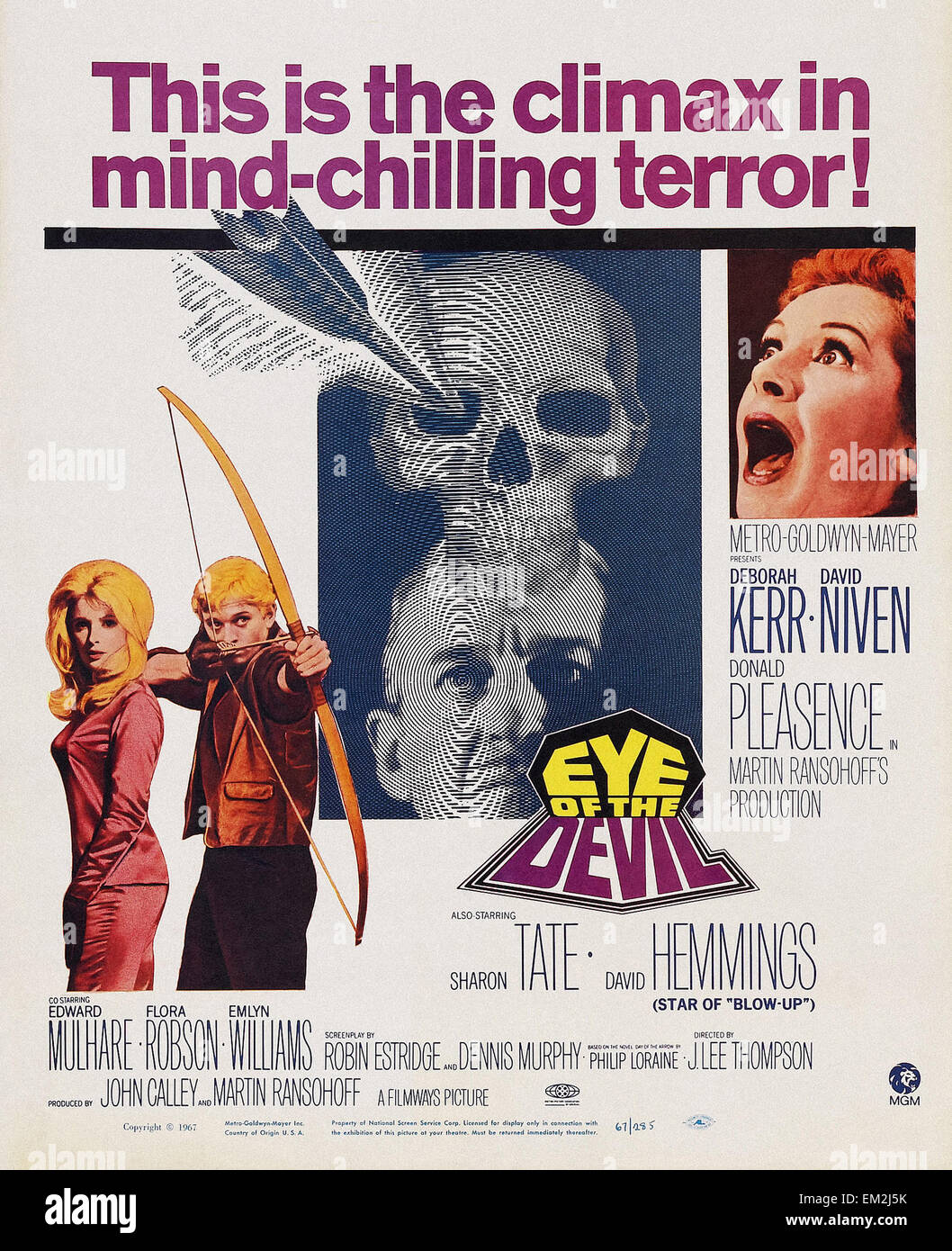 Eye of the Devil (1967). It’s always interesting watching old horror movies — from before the beginning of the Golden Age of Horror, which began, I think we’ll agree, with Halloween — and realize that writers back then couldn’t make their characters any less stupid than more modern writers. It’s always been a problem in horror! It dents this movie quite a bit, which is creepy and atmospheric and features some very cool cinematography in a very cool location — the Château de Hautefort in south-central France — but is hindered by Deborah Kerr’s hysterics (this is, of course, in the era before we could have women not screeching in a horror movie, and she screeches a lot) and the nonsensical plot. David Niven is a French aristocrat living in Paris who suddenly needs to head back to his ancestral home. He explicitly tells his wife, Kerr, not to come, and it seems like he’s very worried about her safety and, especially, the safety of his only son (his daughter is largely ignored, although Suky Appleby, who plays her, has some fun with the role … and now I’ve seen every movie Appleby ever appeared in, as I watched Bunny Lake Is Missing a while back and it was her only other role). Does she listen to him? Of course not — there wouldn’t be a movie if she did! She heads to his village, where everyone is acting very strangely, of course. Weird things start to happen, Niven tells her again that she ought to leave, his old friend Edward Mulhare (who, of course, I always associate with Knight Rider) tells her to leave when he shows up on his way to Spain, the weird priest, played by a very creepy Donald Pleasance, tells her to leave, Flora Robson, playing Niven’s aunt, tells her to leave, and Sharon Tate, doing a marvelously weird job in her film debut, tells her to leave and even almost kills her by hypnotizing her and almost making her walk off the parapet, but does our hero leave? Of course not!!!!! It turns out that Niven is practicing a pagan religion that Pleasance is in charge of and the entire town is involved in, and in order to keep the vineyards from succumbing to drought, the head of the family — at this point, Niven — has to sacrifice himself. Kerr thinks is a very bad idea, but here’s the thing: Niven is fine with it, nobody in the town is really trying to kill Kerr (Tate’s attempt notwithstanding, which doesn’t seem to be sanctioned by Pleasance), and they pretty much just want her to let them do what Niven wants to do. So it’s a weird plot — you’d think it would be more about Niven trying to get away and Kerr needs to help him, but it’s really not that, as Niven is a willing participant. While the story is kind of dumb, the movie looks cool — apparently, it’s the last movie MGM made in black and white, which really helps with the atmosphere, as color would not have helped the tone of the movie at all — and the actors are interesting. They dubbed Tate’s voice, oddly, but her presence is just nice and eerie, while David Hemmings does his kind of disaffected weird thing that he does so well in Blow-Up (this was filmed before that movie but released afterward). Director J. Lee Thompson is interesting — he made The Guns of Navarone and Cape Fear before this and some Planet of the Apes movies after this — and he clearly knows what he’s doing, and the movie looks neat. It’s just that the central figure is kind of dumb, and it’s frustrating.
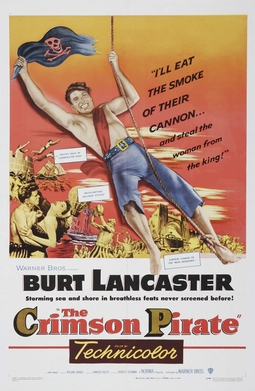 The Crimson Pirate (1952). Back when I watched The Flame and the Arrow, both Fraser and (who else?) Jeff Nettleton told me I should watch The Crimson Pirate, and so I did — it was finally on TCM, so I could check it out! This came out a few years after The Flame and the Arrow, and it’s not as good as that one, unfortunately, because it’s a bit too goofy for me, at least. It’s supposed to be more comedic, of course, but it’s still a bit too goofy. But it’s not a bad movie, just not great. Because it’s more of a comedy, there are more plot holes than you usually get because they’re going for swashbuckling more than seriousness. Burt Lancaster is our pirate, Captain Vallo, who sails around with his band of pirates and his loyal sidekick, Ojo, who’s played by Nick Cravat, Lancaster’s long-time buddy. Lancaster got Cravat in his swashbuckling movies because he had done acrobatic stuff with Cravat before he became a movie star, so they did these movies with a lot of stunts, having a grand old time (Cravat is mute in both these movies because he had a thick Brooklyn accent, which never seemed to bother a lot of movie actors in those times — Tyrone Power, notably, played different nationalities in different time periods and never even tried an accent). Lancaster has a complicated scheme to make a lot of money, part of which involves capturing the rebel leader on a small Caribbean island (the bad guys, it seems, are Spanish, but they’re never identified as such) and selling him to the bad guys, but he falls quickly in love with the rebel leader’s daughter, the comely Eva Bartok, and so he joins the rebel side after his crew mutinies against him because he’s not acting piratical enough (Torin Thatcher, who I’d never heard of until I saw his Sinbad movie up above, is the mutinous first mate). What’s so weird about this movie is that the tone is ridiculously light yet both sides slaughter a lot of characters. Bloodlessly, of course, but at the end, the rebels are just firing cannons into masses of soldiers and killing them all, while the soldiers gun down citizens carelessly and just don’t care. It’s very weird. Lancaster and Cravat are having a blast, running around doing their own stunts and showing off, and the movie looks very cool. The sets are great, the cinematography is excellent, and the action scenes work very well even if so many people are dying. The bad guys are dastardly, craven, and foolish, Lancaster is square-jawed and decent, Bartok is attractive and actually has some things to do (although she does become a bit too damselly-in-distress in the end), Cravat is an excellent physical comedian, and the scientist who helps Vallo in his struggle (James Hayter) is wildly ahead of his time. I don’t love the movie, but it is fun to watch. And hey, Fraser likes it more than I do, so there’s that!
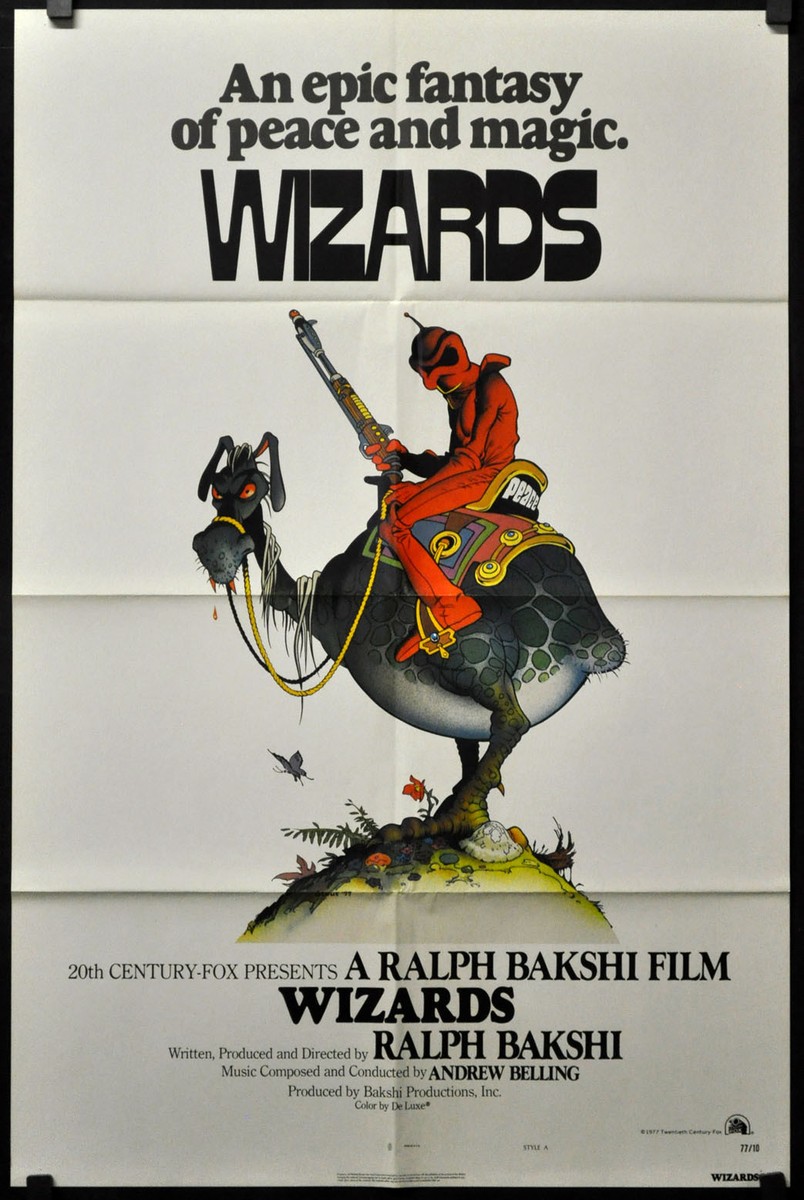 Wizards (1977). I had never seen Wizards, so I figured it was time to check it out, even though Greg Hatcher always said Bakshi ripped off Wally Wood so very much. I mean, sure, but if you’re going to rip someone off, it might as well be Wood! (I mean, he definitely rips off Vaughn Bodē, but nobody ever says that, do they?) Bakshi is not a great filmmaker, and this movie is not terribly good, but Bakshi was interested in making things look cool, and the movie does look cool most of the time. It takes place millions of years in the future, after human civilization has been destroyed in a nuclear war, and we get the rise of mystical creatures like elves, fairies, and wizards. The two wizards are brothers, Avatar (the good one) and Blackwolf (the bad one), and their battle is the crux of the movie. Avatar wants everyone to learn magic and live in peace, while Blackwolf wants to use technology and take over the world. Blackwolf keeps digging up technology from our time, and eventually he finds a movie projector and a movie of … Nazis? Apparently, his minions are cowards and run away too often, so he shows them Hitler ranting and the German war machine doing its thing, which somehow makes them braver? Plus, he’s able to project this somehow so the good guys see it, and they’re frozen with fear. It doesn’t make any sense, but … ok? Avatar, an elf named Weehawk, and Avatar’s protégé, the fairy Elinore, team up to go to Blackwolf’s castle and destroy the projector. They take along a robot assassin who killed Elinore’s father, the president, but is reprogrammed by Avatar to be a good dude, even though Weehawk doesn’t trust him. It’s an absolute mess — the plot is weak, the story meanders around and doesn’t make much sense, the bad guys are goofy (which is kind of fun, sure, but also kind of weird), and the characters are inconsistent and kind of ridiculous. It does, however, look pretty neat — the animation is pretty good and rough and even a bit wonky, but it works contextually. The paintings that make up the landscape are neat and twisted and harrowing, Blackwolf’s city/castle is terrifying and Bosch-like, and a good deal of the story is narrated over still illustrations, which are drawn beautifully by Mike Ploog. Bakshi uses non-animated soldiers for some scenes (the ones where he needs masses of soldiers), but he shades them and colors them weirdly so that they look animated, and it’s pretty cool. The blending of animation and practical effects is pretty cool, too — Bakshi uses actual smoke and weather effects a lot, and it works well with the animation. Still, it’s more of a cool experiment in animation rather than a good movie, if that’s your thing. It’s about 80 minutes long, so even though it’s not great, it’s short!
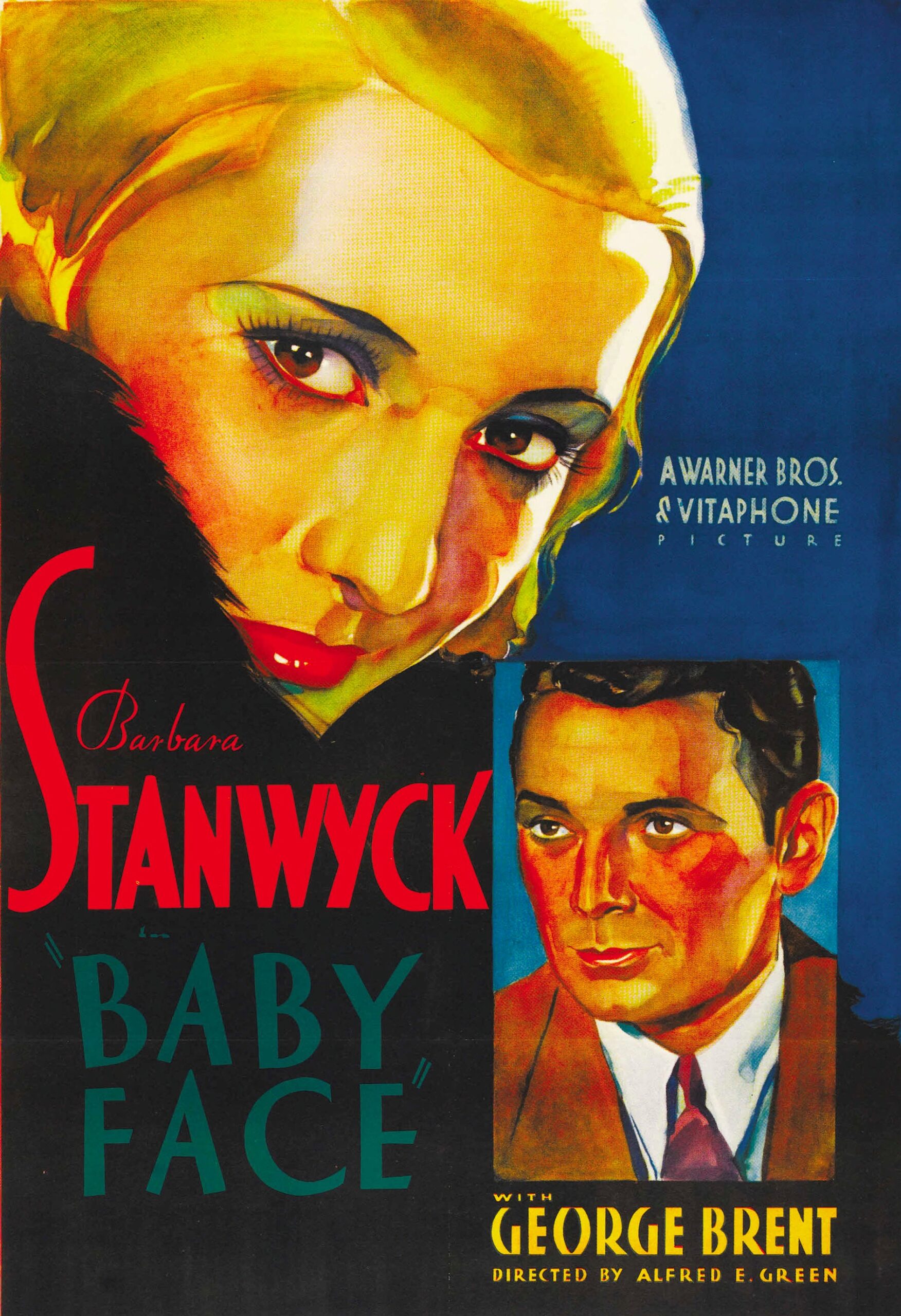 Baby Face (1933). In this terrific (for most of it) pre-Hays Code movie, Barbara Stanwyck fucks her way to the top of New York society because … an old German cobbler told her that’s what Nietzsche would have done? Yes, it’s true! Stanwyck plays Lily, who lives and works in a speakeasy run by her lecherous father in Erie, PA. He, apparently, has been pimping her out for some time (Stanwyck was 25 during filming, but it’s unclear how old she’s supposed to be in the movie) to make some extra cash, which doesn’t make her happy. The only man who’s kind to her, the cobbler (who definitely would have joined the Nazis had he lived in Germany at the time), tells her that Nietzsche wouldn’t allow these lesser men to hold her down and that she should move to the big city and use her womanly wiles to get ahead. After her father’s still explodes and kills him, she and her only friend, Chico (Theresa Harris), hop a train for New York. When a railroad bull finds them, Stanwyck begins her ascent by fucking him in exchange for transport. Once in New York, she fucks a dude to get a job, and then continues fucking her bosses up the social ladder, until she’s fucking the president of the bank, played by George Brent. Along the way, she meets (but doesn’t seem to fuck) a youthful-looking John Wayne (he was 25 at the time), who’s fun to see. Brent originally does not fuck her, as it seems he’s wise to her ways, but he does send her to their Paris branch because she’s at the center of a scandal involving the bank (her former lover shot her current lover, then himself). He goes to Paris a bit later and finds out she’s actually stuck to the job, which makes him fall in love with her even though she seems as cynical as ever. Unfortunately, by the end, she really does love him, and the happy-ish ending feels a bit tacked on. Stanwyck is magnificent, as she always is (how she never won an Oscar is stunning), even as young as she is here, as she dominates the men in the movie so well and never apologizes until the very end, and even then, she makes you feel the unearned change of heart because she’s such a good actor. In a perfect world, she and Harris would have realized they love each other and taken off with all their ill-gotten gains, but a white woman falling in love with a black woman was too risqué even for the pre-Code days! It’s a bit shocking to watch this movie today, because the Hays Code, which came into effect the following year, really did censor so much, so while there’s nothing wildly explicit in this movie, they do not hide the fact that Stanwyck is fucking all of these guys and not caring a whit about any of them (until the very end). It’s kind of refreshing. I like to think that Linda Fiorentino watched this movie before she went out and did The Last Seduction, because that’s the kind of vibe I was getting from Stanwyck in this movie. Anyway, this is nice and quick — it’s about 75 minutes long — and it’s just really interesting, not only because of the very fact of Stanwyck’s character but the utter lack of racist attitudes toward Chico. Stanwyck is always loyal to her and refuses to abandon her, and Harris’s race is never brought up. She’s the maid, sure, but it feels like she’s the maid just so she can hang around with Stanwyck instead of being shunted aside. Check out this movie if you want to see how they made movies before everyone started clutching their pearls and thinking of the children!
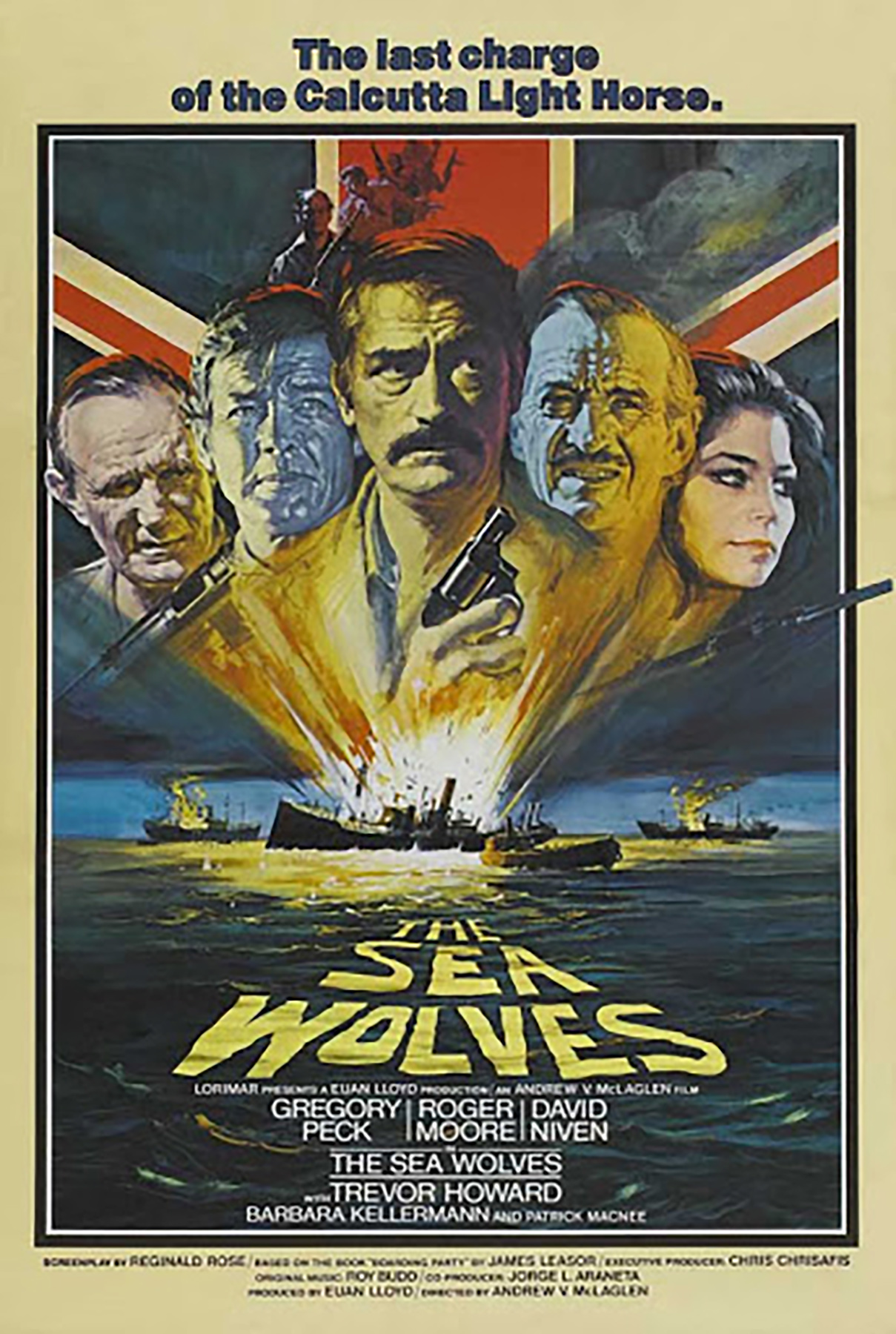 The Sea Wolves (1980). If Jeff Nettleton hasn’t seen this movie at least five times, I’ll eat my hat! (Note: I won’t.) This is a classic World War II action movie (when it was released, apparently snooty people said it was woefully out of date), based on a true story that had just been declassified a few years earlier. Gregory Peck and Roger Moore are soldiers in India in 1943, working for the Special Office, which meant they got to be spies more often than not. They discover that the Germans are using Goa — a neutral Portuguese colony — as a base to send coordinates of Allied ships to U-boats, which can then sink them. They can’t be seen violating Portugal’s neutrality, so they enlist a group of civilians — the old veterans of the Calcutta Light Horse, lef by David Niven — for an off-the-books operation. They steal a ship and pilot it into Goa’s harbor, board the German ship, and stir shit up. It’s a decent movie — it does feel a bit outdated, I must admit, but it’s not a deal-breaker — that apparently did not do well at all at the box office. So sad! Peck and Moore spend a lot of time trying to figure out what’s going on in Goa (complicated by Moore romancing Barbara Kellerman, who might as well be wearing a T-shirt that reads Pop Culture Rule #1 on it), and the actual operation doesn’t start for a while, which is nicely done by the filmmakers because we have to understand why the British High Command would allow old dudes on such a dangerous and important mission. The action parts are pretty good, although their plan of having the old dudes pretend to be on a drunken adventure never really comes up, so it’s weird they spend so much time preparing for it. Peck, playing a British dude, does a strange accent, but then again, Peck always sounds a bit weird in his movies, and he does a pretty good job. Moore, making this movie between The Spy Who Loved Me and Moonraker, simply acts like Bond — he’s a spy, after all, and there’s a woman to seduce! The old dudes, Niven and Trevor Howard and the rest, have fun with their roles, as well. The movie was filmed in Goa and India, so it looks very good, although everyone kind of looks like they’re in the 1970s, not the 1940s (this seems to be a problem with that decade, as by the 1980s, it seems filmmakers were trying a bit harder to make people look period-specific), but that’s something we’ll just have to live with. It’s a pretty decent war movie, if that’s what you’re in the mood for!
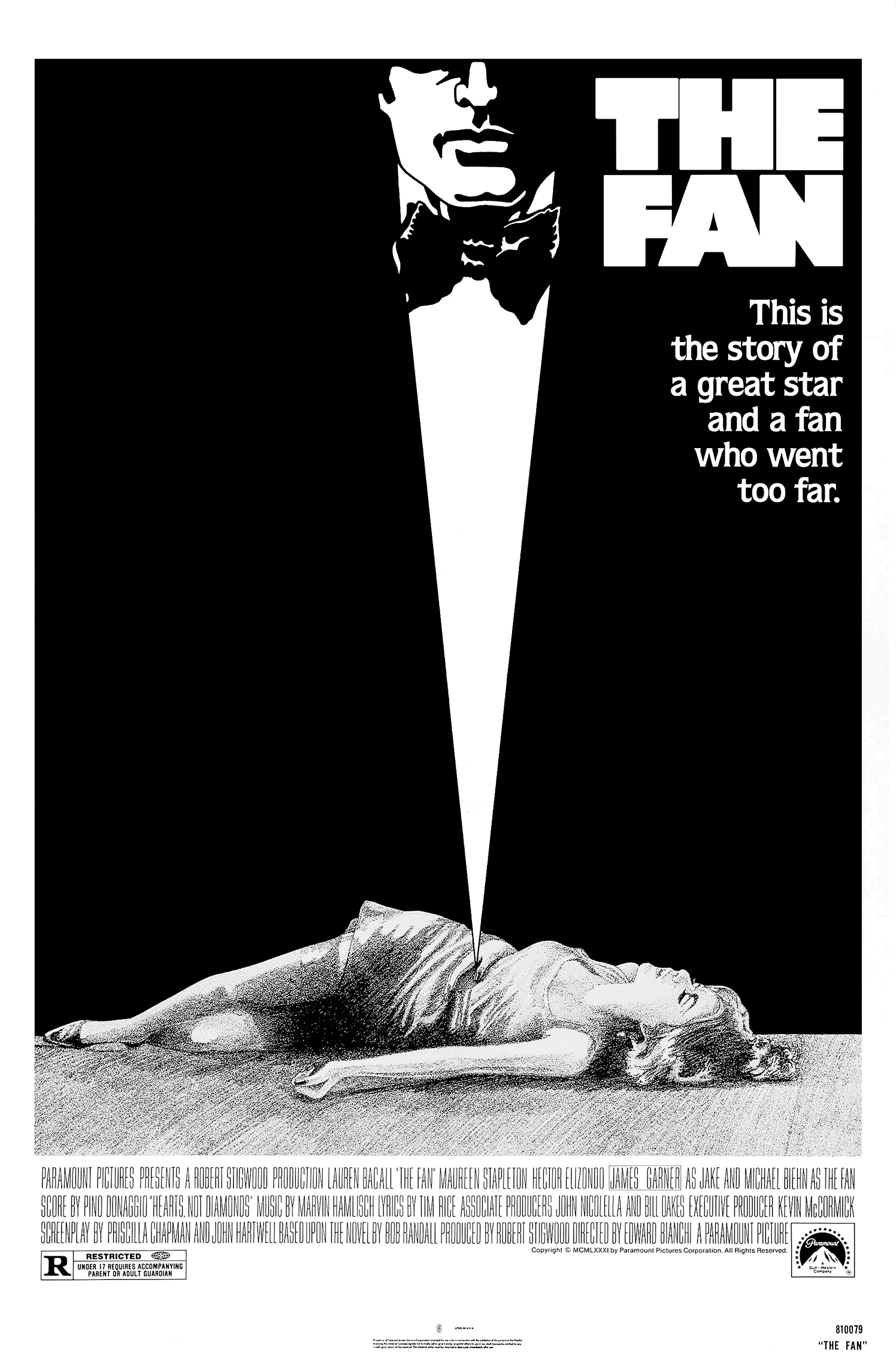 The Fan (1981). If you just read the description of this movie — crazed fan of an aging star goes crazy — you might think it’s just a junky thriller, and in some aspects, it is. But then you look at the cast list and blink a bit, because Lauren Bacall is the aging star, James Garner is her ex-husband who still kind of has a thing for her, Maureen Stapleton is her secretary, Héctor Elizondo a police detective, and Michael Biehn is the crazy fan, and you think, “Well, that’s worth a look, with that cast.” The movie did not get terribly good reviews and bombed at the box office, but it’s better than you might think, even if it is fairly predictable. But, I mean, it’s about a crazy fan, so we kind of know how it’s going to go. Bacall plays herself, basically (they use many old photos of her in the movie), an aging star who still has cachet, signing up to do her first musical (the signature tune received a Golden Raspberry nomination for Worst Original Song, and it’s not great, but it’s not terrible) and getting annoyed that Garner has hooked up with a much younger woman even though they’re divorced. Biehn is a record store employee (hilariously wearing nice slacks and a sweater over a buttoned shirt in what appears to be a cutting-edge place — Dana Delany, in her movie debut, has a brief cameo as his co-worker, and she’s decked out in New Wave glory) who types letters to Bacall that become increasingly intimate, even though she’s never seen them — Stapleton reads them and answers them, trying to get Biehn to go away. He, of course, becomes unhinged and starts attacking people in her life, beginning with Stapleton (whom he does not kill, oddly enough — he does kill some people, but only later), and Bacall gets police protection in the form of Elizondo and Anna Horsford, who’s still working fairly steadily, so good for her! Biehn is remarkably good at avoiding detection — I get this is the age before cameras everywhere and cell phones and such, but he breaks into Bacall’s apartment comically easily (and even comments on how easy it was) and he fakes his death — because the police are too close to him — fairly easily, too (this might be the most diabolical thing he does — he goes to a gay bar, picks up a dude who looks vaguely like him, and kills him and burns his body, leaving behind a fake suicide note). Still, Biehn is pretty great in the role — he’s always had an intense stare, and here he uses it malevolently — and Bacall, who was in her mid-50s and actually playing a woman her age — does a nice job showing how vulnerable famous people are, plus the way she survives is pretty clever. Garner is wasted, sure, but that’s the way it is. We do get some interesting stuff about fame and aging in Hollywood/Broadway, so there’s that. The movie is beautiful, too — there’s a shot of Biehn sitting on a bench that’s filmed from high above him, and it excellently illustrates his isolation, and the final shot of the movie is really nice, too, as despite thwarting her stalker, Bacall is still on the downside of her career and there’s no guarantee her new romance will take. It’s not a great movie, but it’s fairly entertaining. And it has that fun cast, plus Griffin Dunne in a short cameo and Dwight Schultz, who later played Murdoch on The A-Team, showing up as the musical’s director. Plus, as you know, I love me a movie set in the shithole that was New York in the 1970s/early 1980s, and we get a lot of that here!
Well, that’s it for now. Any thoughts? Should I actually try to watch movies from the 21st century every now and then? I’ll get to them, one of these days!

Of these, I’ve only seen two, one of them The Golden Voyage of Sinbad, which I recall liking well enough. However, since you mentioned it, I thought Sinbad and the Eye of the Tiger was better.
The other was Wizards, which I saw in the theater when it was first released with a bunch of school buddies. At the tender of age of about 9*, we thought it was one of the coolest things we’d ever seen. However, when I watched it again in college with a few other pals, we were not nearly as impressed – as you said, it’s a mess, but it is visually compelling.
* Yeah, we were definitely too young to be seeing that, but – and I may have recounted this story before – we went for one of my friends’ birthday. His mom was pretty cool, although I’m betting she later kind of regretted taking us to see that one. Esp. since it was playing in a double feature with Damnation Alley (starring George Peppard and Jan Michael Vincent); two of my friends had to cover their eyes during the cockroach scene…
I haven’t seen any of them. 🙁
But Queen of Blood made a click with me because of Phobos.
A great song from Voivod 😉
https://youtu.be/9szZSe7X0IY?is=xe743IyrTKfYO_Dm
That’s a fun double feature, sir. Damnation Alley is definitely the better movie!
Eric: Always with the music. Never change, sir! 🙂
Foul Play and The Crimson Pirate are great fun.
The world of cinema could always do with more Pirates.
I know that Depp’s pirate franchise did fine, but I do wonder why there aren’t more pirate movies. I guess it’s just too expensive these days.
Not if you CGI the ships, though quite frankly, if you can’t swing from the rigging, what’s the point? The genre was largely killed by a succession of failed attempts, across the 1970s and early 80s, with Swashbuckler (which I quite like), The Pirate Movie, Yellowbeard (which has some funny moments) and Roman Polanski’s Pirates. Plus failed romantic adventure spoofs, like Star The Revolution Without Me and Cheech & Chong’s The Corsican Brothers. Plus, Star Wars kind of stole the swashbucklers thunder. That said, The Ice Pirates, a sci-fi/pirate spoof comedy is a lot of fun, apart from Bruce Villanch, who was never funny delivering jokes as writing them.
Swashbuckler was a fun film. And a great cast — Robert Shaw, James Earl Jones, Genevieve Bujold, Peter Boyle, Beau Bridges.
Pirate Movie was a mockbuster before the term was coined, a very er, loose adaptation of Pirates of Penzance to hopefully sucker some of the viewers anticipating the faithful adaptation with Rex Smith, Kevin Kline and Linda Rondstadt.
I thought that it was an interesting idea that the “superweapon” in Wizards was all about morale rather than simply killing people.
I note that both 70s Sinbad films included a “Bond Girl” and a “Doctor” (so Eye of the Tiger has Jane Seymour and Patrick Troughton). One of the more humanoid of the big monsters in Eye of the Tiger wasn’t only a Harryhausen effect but also sometimes portrayed by a rather tall man – Peter Mayhew (who played Chewbacca in the same year)
The best thing about Eye of the Tiger is Jane Seymour, who made the dialog sound almost Shakespearian. I much prefer Golden Voyage. Baker’s always a good villain.
I remember Wizards. I wasn’t impressed then, doubt my opinion would improve any now.
I adore Streisand. Baby Face is fun and she’s awesome but she had better stuff ahead.
The Crimson Pirate is wonderful fun. Steampunk before the term existed. And Lancaster and Cravatt were amazing.
I have a soft spot for Foul Play because I watched it when “shy retiring person finds love” was something I could identify with. Aside from that it’s a fun film.
Did you mean to type “Streisand”? Is that (gasp!) the Streisand Effect?!?!?
No I did not. Shouldn’t have typed when I was tired. Stanwyck! Though Streisand is awesome too.
Both Crimson Pirate and Flame and the Arrow are unusual swashbucklers. As the book “Swordsmen of the Screen” points out, for all the usurpers and tyrants the heroes overthrow, the genre rarely objects to monarchy per se: it’s just a matter of getting the true king on the throne or replacing the evil vizier with a good one, In Crimson Pirate the island will apparently achieve independence rather than waiting for Spain to send out a better governor.
I remember you mentioning that about both movies. It is a interesting nugget, because it’s so unusual.
Of these, I think I’ve only seen Foul Play, which is fun, in the way all those 70s/80s comedic thrillers are fun.
Queen of Blood doesn’t sound as good as Lifeforce. Wizards looks cool. Sea Wolves sounds like a more geriatric version of The Ministry of Ungentlemanly Warfare, which I just watched. I will definitely have to watch The Fan; I love a grody NYC movie.
The Sea Wolves is a more historically accurate adaptation, than Ministry of Ungentlemanly Warfare and a classier one, too. Not necessarily better, though, although the acting is, in my book.
Trust in Allah; but, tie up your camel! Wow, I feel famous, now! You are deeply in my wheelhouse with this installment. I saw 7th Voyage, in part, when I was a kid, on a weekday afternoon movie, in the 70s. I came in on the part where Sinbad battles the skeleton and it scared the Kool-Aid out of me! That scene stuck with me for years. Saw the others on network tv, after their releases. Golden Voyage is my favorite of all of the Sinbad films, largely due to Tom Baker, though Caroline Munro is the next breast…best…thing about it. Law also is my favorite Sinbad, as he actually tries to make him sort of Arabic. You really should watch Sinbad and the Eye of the Tiger (which really needs the Survivor song for the opening titles!). I can give you two reasons: Patrick Trought and Jane Seymour. The 2nd Doctor is Melanthias, a Greek scientist/alchemist, who lives in a temple which was filmed at Petra, in Jordan (the same as the Grail Temple, In Indiana Jones and the Last Crusade), who aids Sinbad in restoring a prince, who hs been cursed by a witch (the villain of the film). Seymour is the sister of the prince and Sinbad’s love. It’s another earlier Seymour role (though after Live and Let Die) and she is stunningly beautiful and a better actress than Munro. Peter “Chewbacca” Mayhew is a mechanical minotaur, serving the witch. Patrick Wayne is no great shakes in the acting department (Douglas Fairbanks Jr was the only decent actor to play Sinbad that I have seen) and his American accent is really out of place; but, it is good fairy tale fun.
Torin Thatcher is awesome in anything. He chews so much scenery that you just marvel at him. And if you can’t see the awesomeness of The Crimson Pirate, you have lost touch with the childhood delight of watching the Looney Tunes on Saturday mornings (well, in my generation, before they censored them off tv). It’s dumb, but extremely fun dumb. Pirate movies are supposed to be dumb action movies, with a bit of romance to keep it interesting. James Hayter was later in one season of the British tv staple Are You Being Served? as Mr Tebbs. I love the ingenuity of his inventions and the cartoon mayhem they bring. Yes its bloodless, because it is a cartoon of a film and I always see it in those terms. I like it better than The Flame and the Arrow, which takes itself a little too seriously, especially since it rips off both Robin Hood and William Tell, without doing either justice. I love Burt Lancaster, one of my favorite Golden Age actors. he could play any style, from serious drama to cartoon mayhem and be believable. His circus background made him the perfect swashbuckler and I have always said that if they had done Captain America, in the 1950s, he should have had the part. He could do the physical stuff and do the rousing patriotic speeches.
I enjoyed The Crimson Pirate, certainly, but I was just surprised that they resorted to wholesale slaughter (bloodless, sure, but still) when it was so kind of goofy. It was more the weird tonal shift that kind of messed with me than anything. I mean, it’s weird that nobody ever gets shot in GI Joe cartoons or The A-Team, but that’s they’re thing, right? It would have been weird if suddenly, in season 3 of The A-Team, Hannibal and the guys just straight-up massacre a bunch of bad guys.
Part 2: I have seen The Sea Wolves Many times and own it on DVD. Its one of three films, directed by Andrew V McLaglen (son of actor Victor McLaglen, John Wayne’s buddy and sparring partner, in The Quiet Man), starring Roger Moore, which included The Wild Geese and ffolkes (aka North Sea Hijack aka Assault Force). ffolkes (it is not capitalized) is the best of the three, as Moore actually gets to play a character with personality and rises to the occasion, and it has Anthony Perkins, as the villain (and James Mason, as an admiral); but, this one is filled with great character actors. Wolf Kahler, of Raiders of the Lost Ark, is one of the Germans. I first saw the film on Cinemax, when I was in high school. McLaglen and producer Euan lloyd’s films (Lloyd also produced a film called Who Dares Wins aka The Final Option, with Lewis Collins, of The Professionals, on UK tv) were very much in the vein of 1960s action war films, like The Guns of Navarone and Where Eagles Dare and The Dirty Dozen, but done in the dawn of the 80s. They have a very Conservative outlook; but they succeed in being entertaining, if not deep. The Wild Geese actually has some interesting debate about the future of Whites and Blacks in Africa, from the mouth of Winston Ntshona, a leading anti-apartheid actor in South Africa, and it also has his co-star, John “King T’Chaka” Kani, as one of the mercenary soldiers. Ntshona’s character carries on the dialogue with a South African mercenary, played by Hardy Kruger (the character was Rhodesian, in the novel and the film was done around the time that majority rule came to Rhodesia and Robert Mugabe came to power, renaming the country Zimbabwe). That film stars Moore, Richard Burton and Richard Harris, who all managed to stay sober to film it. Also has great character work from Jack Watson (The Devils Brigade) and Kenneth Griffith (Four Weddings and a Funeral), the latter as a camp gay medic. Stewart Granger portrays their financial backer, a slimy merchant banker.
As for Wizards, I am part of the minority that brings up how much is ripped off from Vaugh Bode, though Bakshi swipes from both Bode and Wood, in equal measures, though I would say more from Wood’s Wizard King than Bode’s work, beyond a few characters and designs. Mark Hamill voices one of the soldiers in it, which is a plus. It is more of a visual treat, in stages, than much of a story, which is my take on most of Bakshi’s work. He has some stunning sequences in American Pop, but it is long and ponderous and the ending doesn’t work as well. Wizards is probably his best story, apart from Lord of the Rings, but you can see the money run out, as that one progresses.
I’ve been wanting to watch ffolkes for a while. I guess I should add the other McLagens to my list.
Part 3: Foul Play is fun, but Chevy Chase never really has chemistry with any of his female leads (maybe Beverly D’Angelo), probably because no one seems to get along with him. However, Hawn is great in most things (even ones with bad scripts, like Bird on a Wire).
The rest I haven’t seen, except that I have seen segments of The Fan. If memory serves, it was kind of a comeback for Lauren Bacall, who hadn’t done many roles, in a while. I would be interested to see baby Face, as I have found that I quite like Barbara Stanwyck, in that era. It is strange to watch her early roles, after mostly knowing her from The Big Valley and seeing her playing sexy femme fatales and even strippers (burlesque dancer) in Lady of Burlesque, based on a mystery novel by Gypsy Rose Lee. She was quite the sexpot, in that era, but with real acting chops that those of the 50s and 60s (and up through today) lack.
The Corman thing at least looks interesting. It brings to mind Antonio Margheriti’s Gamma One series, from Italy, which mixed horror and sci-fi, on a small budget. There are similar films of the same era, which used a lot of the same elements. The best are War of the Planets and The Wild, Wild Planet, with Tony Russel and Franco Nero, in his younger days. Margheriti’s space station and concept was then used for an MGM-Toho production, The Green Slime, which has American actor Richard Jaekel. They are very watchable, if not classics.
Eye of the Devil sounds much better than the other David Niven “horror” film I could name: Vampira aka Old Drac. It’s an attempt to do a sort of camp Hammer horror film, with Niven as Dracula, who tries to steal the blood of a group of models to revive his love, but it gets mixed up and she gets the blood of an African-American model. It’s not good and not remotely funny and gets rather racist, including….spoiler……Niven in blackface, at the end of the film. Love at First Bite was a much funnier attempt at a Dracula comedy and even handled racial jokes better.
Thanks to perennial festive and school/bank holiday repeats in the 80s, I’ve seen the 70s Sinbads, and probably the earlier one. I liked the Tom Baker one best, I think.
Funny, in my head I grouped together Sea Wolves and Wild Geese (along with N.Sea Hijack as its distant adventure cousin), as “twilight of the war film which still has WW2 age people making and starring in it”, not realising that they’re directed by the same guy. Thanks, Jeff!
From what I read, the Sinbad film to avoid may be the 1980s Italian Sinbad of the Seven Seas starring Lou Ferringo.
McLaglen does a great job with his action films and they have great characters within them. He gets a lot more out of Roger Moore than the Bond films did, especially ffolkes. In that film, Moore is Rufus Excalibur ffolkes, a freelance security expert, with his own team of what are essentially Royal Marine Commandos (probably all ex-Royal Marines & Special Boat Section), who is tasked to study the security of several North Sea oil platforms, to devise how terrorists might attack them and advise on defenses. Tony Perkins plays such a terrorist, who masquerades as a journalist, with his cohorts also supposed to be international press, as they travel on a supply ship, to the platforms. They hijack the ship, then plant explosives on the support pylons for the drilling and refining facilities. ffolkes then has to implement his plans to stop them. Jack Watson is in it, too, as the ship’s captain. ffolkes is a gruff character, a deep misogynist (thanks to growing up with several sisters), a heavy whiskey drinker, who speaks his mind and wouldn’t know how to spell “politically correct.” Probably the closest Moore ever came to a character role.