
(It’s been another hectic week so it’s reprints from my own blog this week)
 One of the sad but inevitable parts of growing older is watching Great Masters of Science Fiction from my teen years turn into Dead Writers It’s A Shame Kids Don’t Read Any More. This isn’t about changes in attitudes or writing style, though those play a part; I think people simply enjoy reading writers who are currently putting out new work. When I read Arthur C. Clarke’s 1953 novel Childhood’s End in the early 1970s he was still a Modern Master and the book was a name to conjure with. Today? I have no idea. For the purpose of this post I don’t need to.
Back when I was working on The Aliens Are Here, I watched the 2015 SyFy adaptation as part of my research. Inevitably I then read the book for comparison. For this post, I’ll tackle the book first.
We begin in the near future of the 1970s, as a rocket expert contemplates how close we are to putting a man into space (in the introduction, Clarke reminds us this came out four years before Sputnik — nobody anticipated us putting a man into space within a decade). When spaceships descend into Earth’s atmosphere, the scientist realizes his dreams are dead: alien first contact makes all our efforts to develop space flight obsolete.
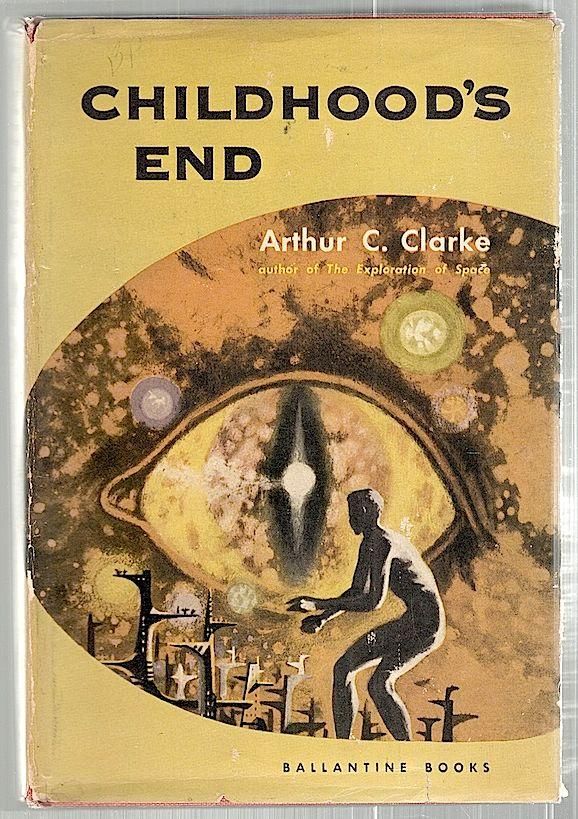
The aliens are the Overlords. Working through the UN, the Overlord Karellen (the most fun character in the book, with a pronounced sense of humor) eliminates hunger, disease and want, stops wars and smoothly takes over administration of all the world’s nations. Nation states fade away; crime dies out, as everyone’s needs are now met. The small resistance movement against the Overlords goes down easily. Earth enters into a golden age of peace and plenty, but with a lotus-eating quality to it. Lots of amateur scientists but nobody doing groundbreaking research (I wonder if Raymond Jones’ “The Unlearned” was a counter-argument to this book); lots of amateur artists but nobody with the drive to create great works. Jan, a black scientist, contrives to visit the Overlord home planet and discovers space is too overwhelming, too vast for human beings. We have no place there (a recurring theme in the era’s SF).
Finally we learn the real reason the Overlords came. The next generation of human children are born psionic, developing a hive mind like The Midwich Cuckoos. They ultimately destroy the Earth — Jan, the last normal human, stays to record events for the Overlords — and head out into space. There they will join the Overmind, the cosmic intellect the Overlords serve. The Overmind has uplifted countless races this way and brought them into its greater hive mind. Humanity is dead and our offspring have gone far beyond us. It is truly … childhood’s end.
All I remembered of the book from first reading was the fate of humanity and the shock when Karellen reveals himself: Overlords look like Satan so they hold back from the big reveal until their control is secure. I can see why that’s all that stuck with me. This is primarily a setting story, a look at the last years of Earth. There are only a few standout characters — Karellan, Jan and Stormgren, the UN Secretary General who serves as central character for the first part (most of his scenes are quite engaging). There’s no real conflict: the transformation of our civilization is almost sedate. There’s way too much exposition about how the Overlords manage Earth, the nature of the Overmind and Jan’s trip into space. No, we don’t see it, we get it recapped later.
There’s also a lot of stuff happening that needs exposition. In 1953, maybe readers accepted that nations would quietly accept the 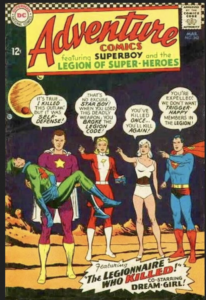 Overlord’s benevolent oversight; I don’t recall having a problem with it when I read it two decades later. There was a sense that the United Nations was just the first step towards the kind of United Earth we see in the Silver Age Legion of Super-Heroes.
I’m more skeptical now. As liberal evangelical Fred Clark points out writing about the Left Behind books (which assume the UN Secretary General is already some kind of world supervisor), people don’t let go of their old ways that easily. Karellen does discuss his methods for dealing with resistance at one point; showing that in action would have helped me buy it.
The age of the book shows in some of its politics. Karellen describes himself as a benevolent colonial administrator That probably sounded acceptable back when the British Empire was still a going concern. Not so much today. At one point Clarke mentions that with racial hatred faded (another hand-wave I’m unconvinced by), people casually use the n-word for blacks without any racial intent. I presume Clarke meant this as an unsettling demonstration how different this future is. It doesn’t work.
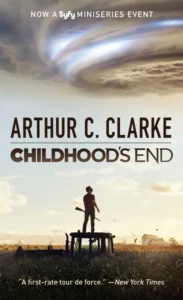
The miniseries makes a variety of changes. Stormgren (Mike Vogel) is now a Midwestern farmer, picked as alien envoy for no discernible reason. I wonder if that’s because so many conspiracy theories now swirl around the UN on the right, though I don’t know how many politically paranoid nutjobs would be watching this any way. Karellen is largely humorless and doesn’t look particularly Satanic. In fairness, trying to make an alien both plausible and Satanic is a challenge; in the book my imagination did the work.
There’s a lot of added material, such as a subplot in which Stormgren and his wife learn Karellen sterilized them so their hearts wouldn’t be broken by what’s going to happen to the children. I could have done without that. Overall, it was a solid adaptation, but it suffers from some of the same flaws as the book — the takeover’s still too easy, presumably the reason for the added drama. A bigger problem is that this isn’t as fresh as it was in 1953. 2001: A Space Odyssey covers many of the same themes, for instance. Still, I’ll give SyFy credit for bringing a major classic of the genre to the screen.

I read Childhood’s End in high school and I can’t say it was a positive experience; not because of the writing; but, it is such a depressing concept. Maybe I was to steeped in heroic fiction, because I kept waiting for something to counteract what was happening and it never really does. The move towards a hive mind, to me, is comparable to Jack Kirbys concept of “anti-life,” in his 4th World books (especially in The Forever People, when he introduces Glorious Godfrey). Total subjugation of the mind and free will, even in a more benevolent form of a shared consciousness. I like a healthy balance of individualism and collective society, though I am more of a loner, by nature. I like to socialize; but don’t live for it. I am comfortable by myself.
I have to wonder how much influence the book had on Alan Moore’s finale for Miracleman (or Mavelman, if you prefer)? Similar situation, where Miracleman basically takes over government and eliminates nuclear threat, then want and disease, creating a utopia for people to pursue whatever they dream. Of course, he left a serpent dormant in this utopia, since Kid Miracleman is still alive, in hyperspace, while his human counterpart, Johnny Bates, is dead. You get a similar sense that mankind pretty much just gives up striving and that the children become unrecognizable, to the parents, certainly as Neil Gaiman picked up the story, in The Golden Age. I did chuckle at Moore’s support group for ex-dictators.
I’m not a fan of Hive Minds either though the book, as you say, is somber enough that part doesn’t leap out at me.
I was greatly impressed when I read Theodore Sturgeon’s “Meeting With Medusa” because humanity also becomes a hive mind but he pulls it off as a happy ending (we don’t lose our individuality but at the same time we join into something bigger).
In the Roswell High series by Melinda Metz (the basis for the Roswell TV series) it turns out the alien families fled to Earth because their culture is a hive mind and you do not get to refuse merging. They didn’t want that for their children.
I read the slightly longer, novel version of that Sturgeon story, with the unfortunate title “The Cosmic Rape” (the title of the novella, by the way, is “To Marry Medusa”). It is an interesting take on the hive-mind idea, but I still found the conclusion a bit troubling.
I read “Childhood’s End” in high school as well (I was really into Clarke at the time and read a number of his novels and short stories at the time); I recall also being less than impressed with it, mostly because the idea of apparently benevolent aliens lifting humanity up seemed to be a bit anticlimactic. The deeper implications of this, as well as the whole overmind thing, kind of flew over my head.
When thinking about this whole concept, though, I couldn’t help being reminded of a short story by Terry Bisson, “I Saw the Light,” which sort of turns the central idea on its head, i.e., the suggestion is that humans used to be the pets of a highly-advanced, benevolent alien race who left us to fend for ourselves for our own good.
There’s a short story by Raymond F. Jones that I’ve wondered might be partly a response to Childhood’s End. Benevolent aliens offer to sell us their massive scientific knowledge and Earth’s governments figure they can meet the price if they stop funding scientific research. Earth’s scientists eventually demonstrate that the aliens have hit the “we know everything, no point in asking more questions” state of mind and that humans can do more than placidly accepting their wisdom (the aliens are in fact well-meaning, just wrong).