
And this time the culprit is the U.S. government!
 THE PLUTONIUM FILES: America’s Secret Medical Experiments in the Cold War by Eileen Welsome is a grimly detailed reminder that movie mad scientists performing unsanctioned experiments on unwilling subjects aren’t something B-movies made up.
In the aftermath of WW II Americans were as unsettled by the A-bomb’s power as everyone else. As Paul S. Boyer discusses in By the Bomb’s Early Light, the U.S. was the only nation with the nuclear bomb — but how long would that last? What was to stop some other nation from doing to New York or Chicago what we did to Hiroshima? Scientists and government leaders meanwhile were desperate to understand the effects of nuclear radiation — how dangerous was it?
The government, as Welsome recounts, commissioned multiple scientists and doctors to get answers. Their guinea pigs: Americans. Terminally ill patients got plutonium injections. Pregnant women got shots of radioactive iron. Doctors sprinkled radioactive material on orphans’ breakfast cereal. The military had soldiers march close to ground zero at atomic test sites, then closer, then closer still — would there be a point at which they passed out and became unable to fight?
This ghastly regimen of experiments came to light during the Clinton years when his Energy Secretary, Hazel O’Leary, declassified most of the studies. I heard about it then so the book wasn’t news to me. Even so, the details are bloodcurdling. A mix of Cold War security needs, pressure, classism (the guinea pigs were poor nobodies) and ambition (“If they said no, you didn’t get to do your project.”) drove doctors to violate both medical principles and Atomic Energy Commission guidelines.
That detail was a surprise to me: the media response when this first blew up was that “standards were different then.” Nope — the AMA, horrified by Nazi “medical” research, had established protocols requiring informed consent as early as 1946. As one doctor said, however, it wouldn’t have been good for their careers to assume the protocols applied to them; better to wrap yourself in the flag and forge ahead.
After O’Leary brought this to light — she’s the closest thing to a hero in this — there came a spate of attempts to have the government do a deep investigative dive or provide financial redress. Those efforts went nowhere; one investigative commission concluded that yes, there had been some wrongdoing, but it scrupulously avoided blaming any individuals or research institutions involved. Why tarnish the names of important people for some foolish mistake that was decades old?
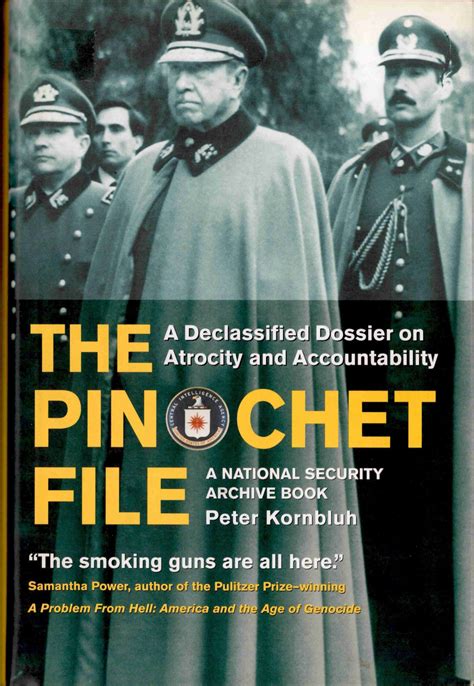
I also knew the broad outline of events in THE PINOCHET FILE: A Declassified Dossier on Atrocity and Accountability by Peter Kornbluh. Once again, reading the details was horrifying. In the early 1970s, Chile elected socialist Salvador Allende as president. Our president was Richard M. Nixon, veteran anti-communist Cold Warrior; while nobody in his administration thought Allende was a threat to us, Nixon couldn’t stomach a government in the Americas turning socialist. The CIA and other agencies worked hard to prevent Allende’s election; when that didn’t work, we set out to stage a coup. The CIA funded his opposition, financed the equivalent of a Chilean Fox News and had an anti-coup military leader kidnapped (he wound up dead). Eventually Augusto Pinochet took over as military dictator.
You will be shocked to learn that all our efforts to support democracy in Chile — the nominal reason for our activities there — stopped as soon as Pinochet was in power. As the old phrase goes, he was a murderous bastard but he was our murderous bastard. When the takeover erupted into violence our embassy wouldn’t even help Americans stranded in Chile; when they learned one American had been murdered by the regime, they didn’t tell his family. This continued on through the Ford and Carter presidencies; even when Pinochet had an opponent murdered on American soil, we didn’t say boo. This is an amazing book but it’s grim (and infuriating) as hell.

I’m not sure if the Chilean situation or the Iranian situation is worse in 20th century American history. I think Chile was a bit worse, because Allende was probably going to be a better leader, but for subsequent world history, I think the Iranian coup was probably more impactful. Man, it sucks to be an American sometimes! 🙁
And Pinochet seems to have been more a monster than the Shah. But yes, the impact of overthrowing Iran lingers on.
And this, among other similar stuff done by the US for a long time, is why lots of latin americans give the US the side eye when they US government says that they are promoting “democracy” anywhere
I’ve heard that.
In the same vein I roll my eyes when Republicans (mostly) rant about how this US leader or that is coming across too wimpy — the world has to know we’re ready to fight dammit! I don’t think anyone else on Earth has any doubts.
oh yeah, everyone else KNOWS that the US is a lot of things but “too wimpy” is not one of them. Republicans seem to use that argument only when a there is a democrat president, but for some reason once the presidency flips then immediately the US is the strongest ever and the best of the best at fighting and has always ever been the best.