

A controversial writer, but is this a controversial comic???
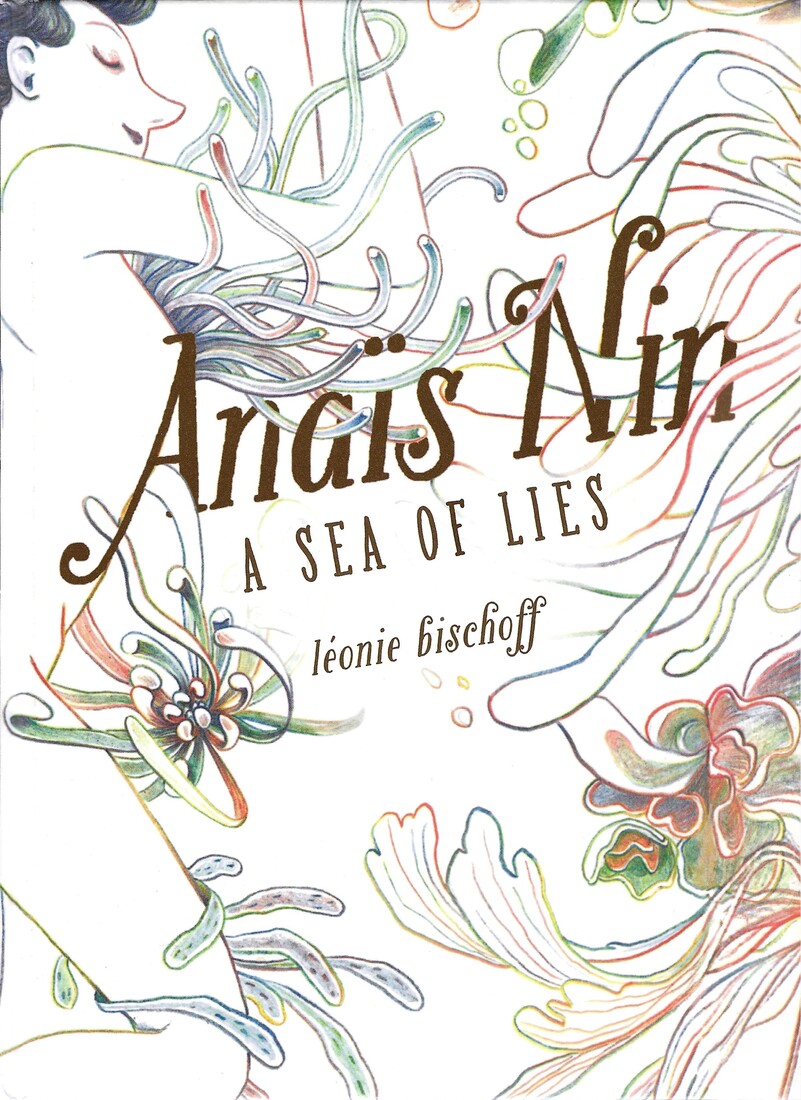
Anaïs Nin: A Sea of Lies by Léonie Bischoff (writer/artist) and Jenna Allen (translator).
Published by Fantagraphics, cover dated 2020 (English translation 2023).
I mean, I guess there are SPOILERS, although this is about a historical figure who did not hide many things. And click the images to make them bigger!
There is, appropriately enough, a lie at the center of Léonie Bischoff’s marvelous memoir of one of the most controversial writers of the 20th century. At the end of the book, which comes at some point before 1939, when Nin left Paris and spent the rest of her life in the U.S., Bischoff notes that Nin has reconciled her different aspects of her personality and has come to an understanding with herself and the men in her life.  She is married (and remained so until her death) to Hugo (Hugh) Guiler, a banker (at the time), to whom she is a typical, middle-class wife. She is a lover of Henry Miller (Bischoff calls her “Mrs. Henry Miller,” although they never married), with whom she “drinks bad wine, and dances to the radio.” By contrast, “Miss Nin,” we are told, “runs around Paris to meet one lover or another.” Finally, “Anaïs” writes and writes. She and Miller meet Lawrence Durrell, with whom she may or may not have had an affair, and Anaïs is happy. Her final narration reads, in part, “I no longer want to flee or conceal myself.” It is a triumphant ending, as even though she would live another 30+ years, in this book, she becomes who she would be. And yet … the lie is that it also feels like a tragedy, and it’s unclear if Bischoff meant this or if I, as a dull, middle-class man, am reading too much into it. It feels like Nin could not be her true self, even if she’s living as if she is, because her entire existence still seems to be defined by men. Not only that, but by sex with those men. Nin, of course, is famous for her erotica, and as a person who was at the forefront of a movement to be more frank about sex, her life feels admirable. Yet, based on this book, there’s something of her life that feels as if it conforms to a stereotype, and that’s the tragedy lurking within Nin’s moment of triumph at the end. Nin couldn’t have been aware of this, of course (none of us are), and I’m not sure if Bischoff is, but for this reader, it’s there. It doesn’t take away from the excellence of the comic, but it does make it more poignant. It adds a complicated dimension that feels slightly unexplored but nevertheless imbues the entire text with a rich, melancholy layer of meaning beyond just what Bischoff expects us to get from this comic.
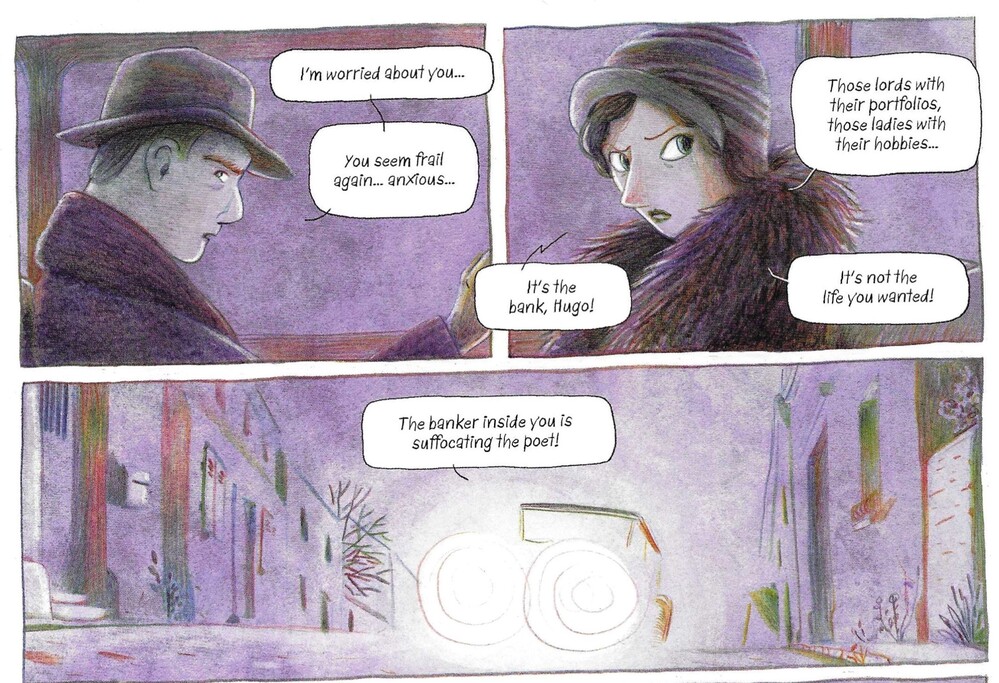 Nin’s entire life was complicated, but Bischoff only focuses on a narrow portion of it — a small slice of the 1930s, although she compacts events from earlier times in Nin’s life to fit the narrative (you could almost say that Bischoff herself is lying to us). Nin and Hugo moved to Paris in 1924, so the book should begin in 1927, but Nin very quickly meets Miller, who has read her essay on D.H. Lawrence, which wasn’t published until 1932. So the early parts of the book fly by, but then Bischoff settles down into the narrative. Even early on, though, she makes it clear that Nin is defined (and defines herself) by the men in her life. Her husband is a banker, and his friend at a dinner party says that it’s time for them to have children because they’re financially stable. This motif comes back at the end of the book, when Nin has an abortion/miscarriage because not only is it Miller’s child, but also because she is not willing to be a mother.
This idea, of a man telling Nin what she should be, is not really prevalent throughout the book. The men in her life are generally wildly supportive of her, which makes the tragedy of the book that much more pointed and poignant. Hugo never stands in her way — he encourages her to create, he never comes between her and Miller (and Bischoff leaves it unclear whether he knows what she’s doing with Miller and other men, but he’d have to be wilfullly blind to not know), and while he’s upset that she doesn’t want to keep the baby, he supports her decision to end the pregnancy. 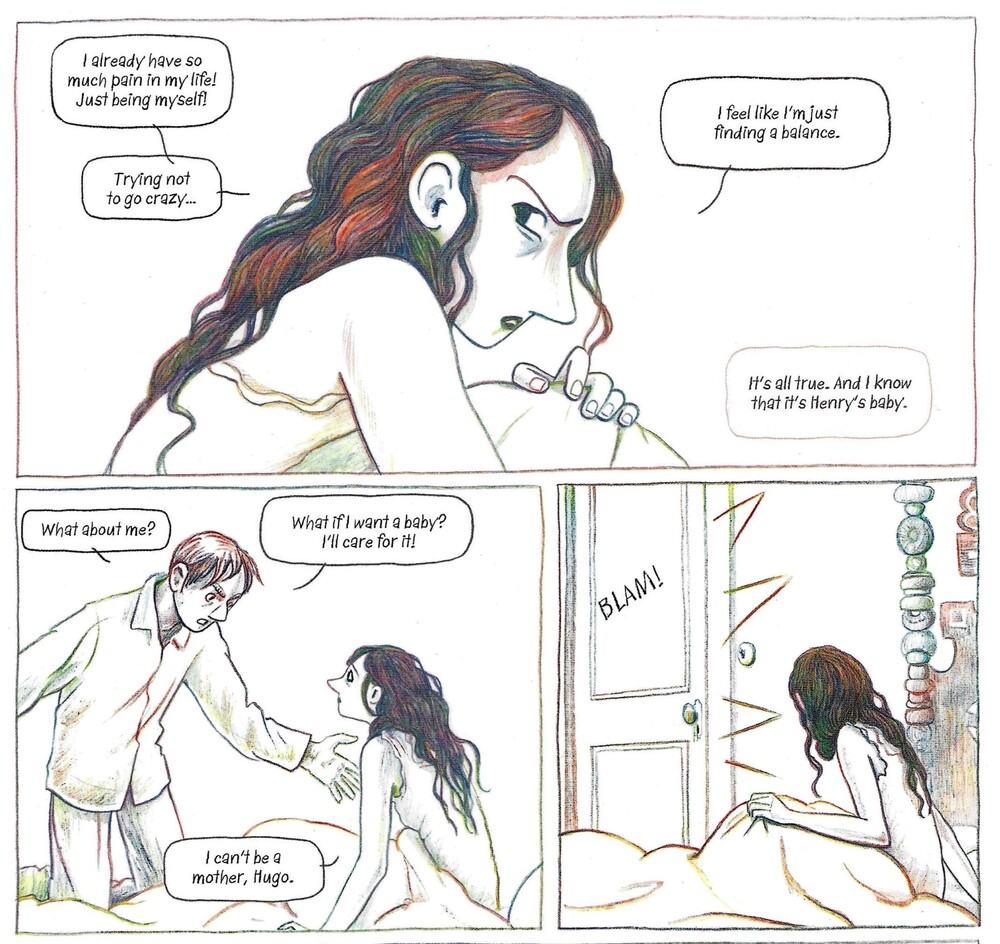 Miller, meanwhile, is always pushing her to write, and she comes out of her shell when she’s with him and is able to explore her sexuality. She is not a woman who seems to be oppressed. Yet that is the contradiction of this comic and, it feels, of Nin’s life. Despite her talent and yearning to be free, she is bound by the society in which she lives, as are Hugo and Miller and the other men she encounters. There’s a sense of these people being unable to break out of the shackles that society has created for them, even if Nin is able to live a life as freely as she does. She takes flamenco lessons, and her instructor tells her she should go on tour because she’s so talented. “What’s really holding me back from performing?” she thinks to herself. “My Catholic upbringing, certainly … A woman on the stage is a whore.” Later, of course, the flamenco instructor declares his love for her, and she allows him to take some small liberties with her. She flirts with her cousin, Eduardo (who may have been invented; I can’t find anything about him), who’s a closeted homosexual yet speaks glowingly of his therapist, Dr. Allendy, who’s helping him “take greater interest in the company of women.” Later, she and Eduardo make love, as he can’t get her out of his mind. She writes that she’s “tormenting” him, despite the fact that she has done nothing to lead him on. She has sex with him partly, she writes, to help him “overcome his distaste for the female body.” She visits a publisher who seems interested in her Lawrence essay. He instantly tries to have sex with her, claiming that her interest in Lawrence means that she can’t be innocent. She feels that she “owes” him some sort of sexual gratification, even though, again, she has done nothing to lead him on. As she becomes more confident, she becomes bolder, and when she has sex with Dr. Allendy, it’s clear she is the one in charge.
 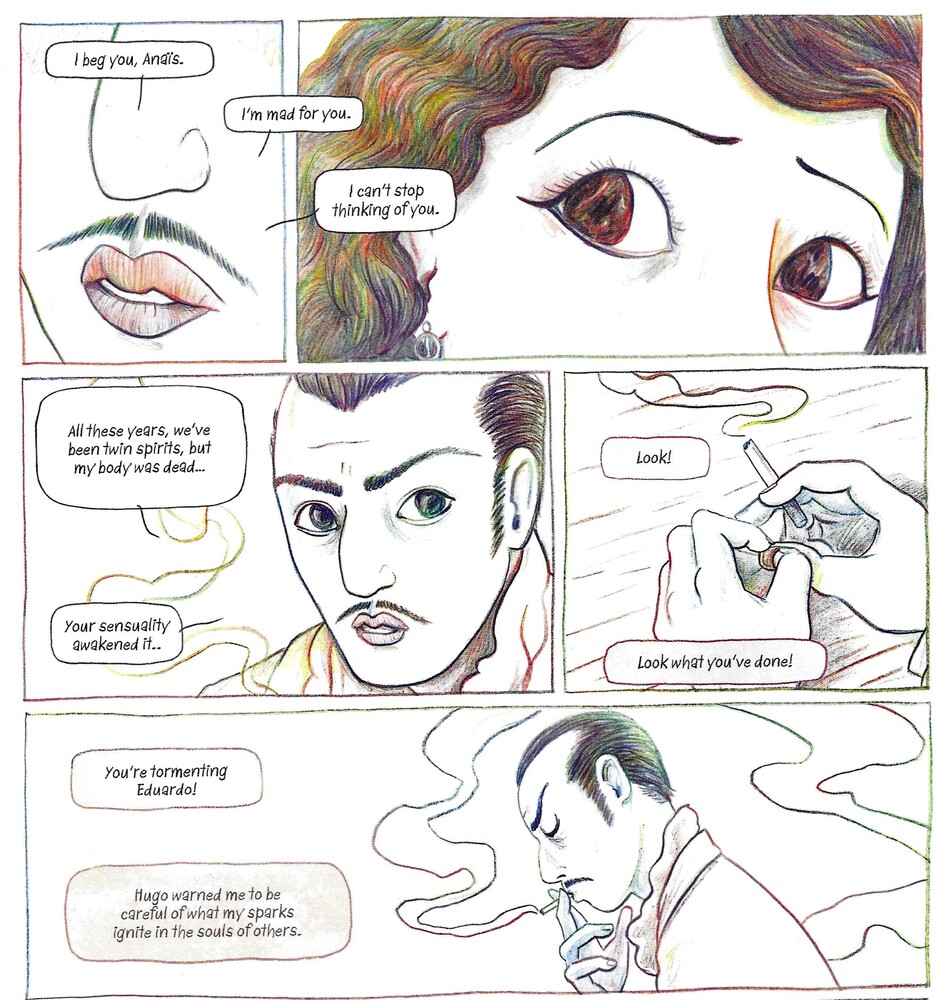 However, it’s also clear that, while she has become more of the initiator, the doctor was originally in a position of authority, and she responds to that. This is most obvious in her relationships with the three main men in her life.
Nin’s husband, Hugo, is a banker, as I noted above. That’s not all he was — after the time frame of this book, he became an engraver, with some of his images accompanying Nin’s writings, and then an experimental filmmaker. Only a hint of this is in the book, with the focus on his strangely unconditional love for his unconventional wife. It’s clear that Nin feels a bit constrained by the middle-class life she’s living, but, as usual with artists, they need to live, too, and Nin could be so unconventional because Hugo was making the money she needed to survive. Later in life, Nin became the breadwinner (as — shockingly — Hugo’s experimental films made no money), but it’s always frustrating that writers seem to portray the people who make money so the artists can be artists with such disdain. Nin doesn’t think of Hugo that way, but the tone of the book is fairly clear on the matter. Hugo becomes angry only when Anaïs is obsessed with June, Henry Miller’s wife, as he tries to take a bracelet June gave her away and ends up quasi-raping Nin (it’s clear she does not consent, but it’s also clear she does not protest). As he tries to take the bracelet, Nin narrates: “I would have loved to submit to his strength, as is expected of a woman. But it was too late. Loving June had awakened my masculinity. I no longer believed in my own submission.” Anaïs has been trained to be a dutiful lover, but meeting June and becoming obsessed with her — it does not feel like love, no matter what Nin narrates — has changed her. Later, when she and Hugo make love, she gets on top of him, which he thinks is grand. She does this partly because, earlier in the book, she has bemoaned his lack of eroticism in their lovemaking, and she wondered if he was “too modest to dare to explore his own sexuality.” She loves him, but wants to have different sexual experiences, and she wonders if her life would be easier if she’d been born a man. This envy of masculinity is an expression of a yearning for freedom, but it’s tragic that Nin needs to desire a change in gender in order to get that freedom. 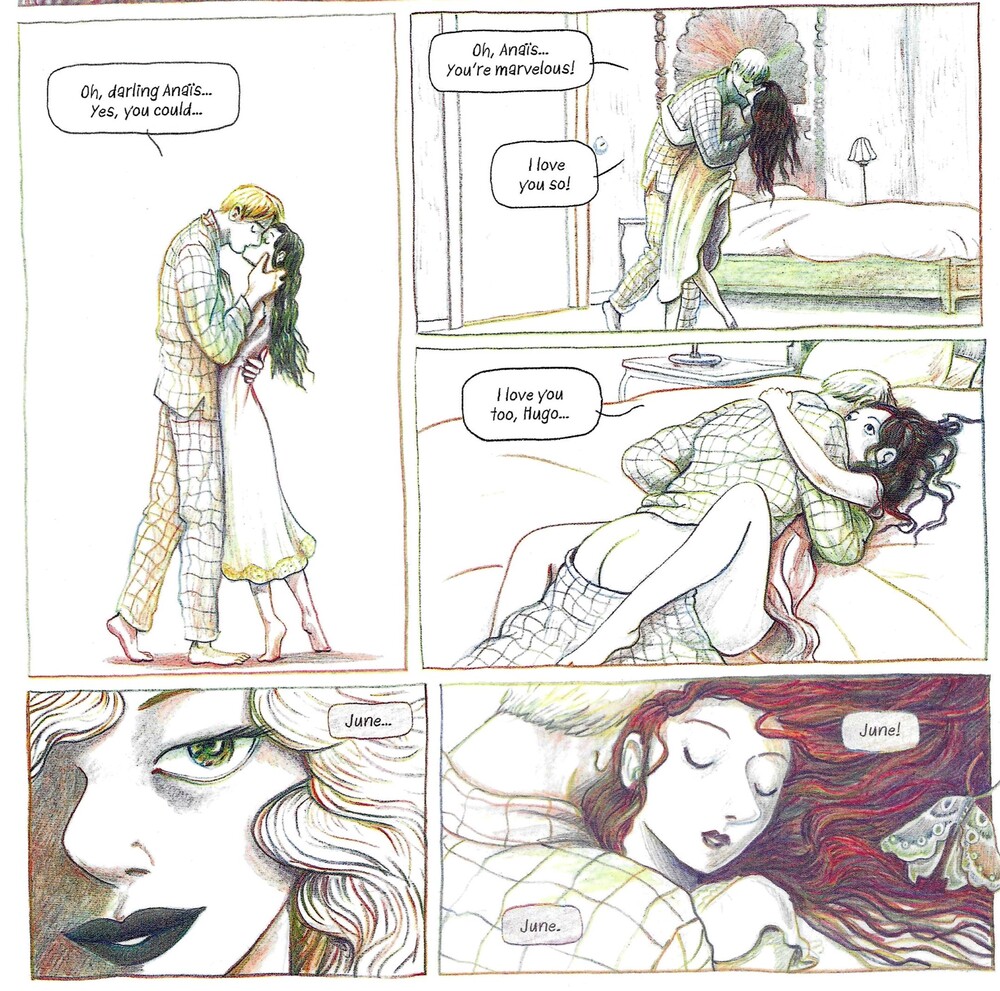 Toward the end of the book, he says that he was looking into neuroses, and his wife has all of them. Anaïs thanks him for taking care of her, telling him, “People suffer from their madness because that’s all they know how to do. Artists plunge into madness, wear it like a costume, and discover other lives … I am what I am,” and Hugo tells her he loves her for it. It’s a seemingly triumphant denouement to their romance in the book, but it ends a bit darkly when, right after this meeting, Nin narrates, “I gave Hugo the Anaïs of his dreams. Through the version of the diary that I wrote for him … Through my looks, my voice, my gestures … Even our new understanding, which gave each of us one night of freedom a week, sustained him. I am a mirror for the desires of men.” This final thought makes Nin’s “understanding” with her husband feel a bit less joyful and freeing and more like yet another secret she will keep. Everyone hides parts of themselves, true, even from those closest to them, but what’s painful about it in Nin’s case is it feels as if she has no choice. Her marriage works for her and Hugo, it’s true, but she still needs to keep up appearances for society. She still can’t break free.
Her relationship with Hugo, however odd, does feel somewhat healthy. In the comic, her relationship with Henry Miller, which is presented as a good thing, feels much less so to the reader. Miller, who was 12 years older than Anaïs, meets her after he’s read her essay on D.H. Lawrence, an essay, he says, is “so powerful [he] couldn’t believe it was written by a woman,” which is almost the first thing he says to her. On the same page, he mispronounces her name as “Annis,” which can be excused, perhaps, the first time, but he never corrects himself, which feels like a power play on his part. They begin to work together, and then Anaïs meets Henry’s wife, June, and becomes deeply obsessed with her. June isn’t in the book that much (she and Miller divorced in 1934), but after she leaves France, Henry speaks about her and Nin, and it’s clear that he has some deep resentments toward women. “Henry’s afraid of June’s power,” Nin narrates, “I hate him a little for that.” 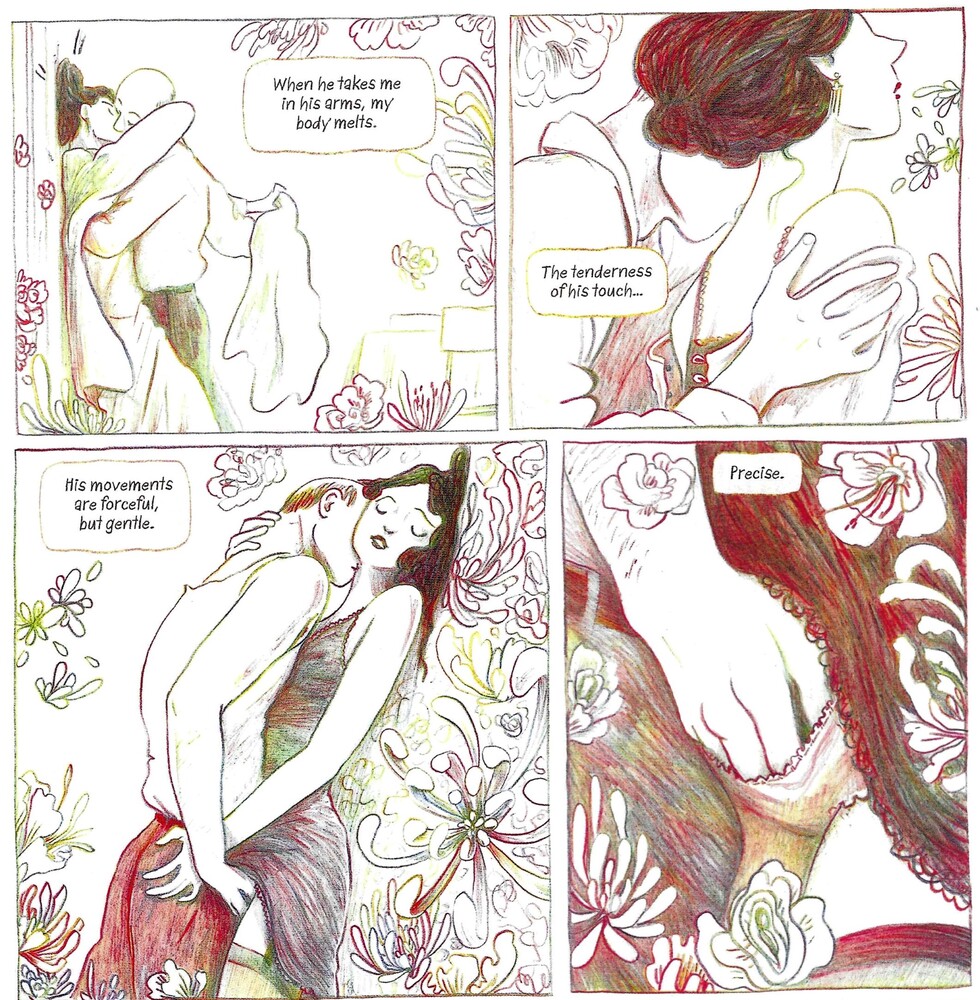 She does begin an affair with Henry, which, it seems, is one of the reasons why June leaves him (in real life, it was very much a reason, but in the comic, it’s more muted), but June, as we see, isn’t above having affairs as well. Anaïs and Henry seem good for each other, as they inspire each other, but the question of money comes back into it. June mentions that Anaïs has been giving Henry money (which is, of course, not hers, but Hugo’s), and it’s true that Nin helped finance Henry’s Tropic of Cancer, the book that put him on the map. Henry never discusses the money — he’s like Nin, in that money means nothing to him because someone is always willing to give him some — but it hangs over their relationship, because it’s not clear how much Henry regards Anaïs as a real person (she notes that he has put her on a pedestal) and how much he regards as a muse. She never criticizes his writing, yet he offers her advice, despite the fact that at that point in their careers, they were both about equal in success. The power dynamic between men and women still existed in their relationship, no matter how unconventional Henry Miller was for his time.
The final major relationship with a man in Nin’s life was the affair she had with her father, who abandoned the family when she was a child but re-entered her life in the 1930s. Obviously, this is the most disturbing affair in the comic, not only because of its incestuous nature, but because of the power Nin’s father holds over her. Throughout the book, Nin allows older men in positions of authority to take liberties with her, and Bischoff presents this as part of Nin’s journey to sexual self-discovery, which I have no doubt it is. It’s also a disturbing pattern, as she does not feel like she can be an equal to these men because she’s a woman. She notes this with both Hugo and Henry — she does get snide with Henry when he backhandedly compliments her work, but she also defers to him as a smarter and better writer, which does not appear to be the case — but it’s clear from her thoughts as these men pathetically and desperately try to steal moments from her that she does not think that she can resist, even if she wants to. When she visits her publisher, she narrates:
He says with my refined face and my defense of Lawrence, I can’t be that innocent. No man ever believes in my innocence. It’s true that I had consented to a kiss. He sat me down on the couch and put his penis in front of my mouth. I jumped up like I had been slapped, and he laughed at me. He was a better kisser than any man I’ve ever known. I felt sorry for the desire I had provoked and I allowed him to relieve himself by rubbing between my thighs. I owed him that.
When her flamenco teacher expresses his love for her, she writes:  “He says I inspire him. So, partly out of charity … I let him kiss me through the fabric of my underwear.” Later, she has sex with her therapist: “His body was heavy, massive. He liked spanking. His kindness touched me. And his vulnerability. He thinks I should leave Henry. And that I’m wasting my energy feeding his creativity rather than my own. He’s jealous.” All of these men are older and have some kind of authority over Nin, yet none of the affairs are presented as traumatic from her point of view. They’re just things she has to do to exist in a world of men. All of them lead her to her father, who left when she was 10 and has been out of contact with her for two decades. He sends Nin’s mother a letter to let her know he’s moving back to Paris, which her mother thinks is only to mock her (as he’s married to a woman 20 years younger than he). She sees him in the audience at her flamenco recital, which throws her. She tells Hugo, “I heard his voice … ‘How can you parade yourself around like this, like a whore?’ The tone of his voice when my brothers and I did something foolish … and when he beat us.” She has never told her husband this, saying that the memory just came back to her, which is a clever conceit by Bischoff, because it introduces the smallest bit of doubt into the reader’s mind about the veracity of her recollection. Later, she talks to her analyst about him, saying he liked to take nude photos of her when she was a child, but she “was happy he was interested,” but of course, it led to him molesting her. She dreams of him as a giant with the sun for a face, implying his over-sized presence in her life. Then, of course, she meets with him again, which forms the crux of the latter part of the book.
It’s not just the incest that’s disturbing about their relationship, although that should be enough. It’s also the idea of Nin once again sublimating herself to an older man, even when she believes she’s in control. When she discusses her father and his molestation to her analyst, she tells him, “I’ve had this fear of being too skinny, of not being a real woman … My breasts, for example. They’re so small. I’m afraid I’m abnormal. Could you give me your opinion? As a doctor?”  She opens her shirt, catching him off-guard. In the window behind her, Bischoff draws her alter ego, the devil on her shoulder who tells her to do “bad” things, smiling evilly. So how complicit is Nin in the incest? Bischoff writes it so that Nin wants to have sex with her father as much as he wants to have sex with her, but it’s also clear that she is much more damaged than he is, and he is manipulating her as much as he always did. He is cruel and uncaring, ignoring everything but his own desires. “I must have seemed distant when you were a child,” he says, “Your mother was a harpy … She badgered me about everything, accused me of cheating …” When Nin points out that he was, in fact, cheating, he admits it, but, he says, “She had no dignity. No sense of humor, either!” The arrogance is palpable, but Anaïs, sadly, has been groomed to appreciate this. “He’s like a lion in a cage. All that power, constrained by inactivity,” she narrates when she visits him, as his bad back does not allow him to move too much. But what power does this pathetic man have? He has power over impressionable women who have never known anything better, and he uses it to seduce his daughter. “My consent was boundless,” she narrates while they have sex, but something keeps her from enjoying it completely. “Why can’t I feel pleasure?” she asks herself. “He is so much freer and braver. The man I had searched for my whole life, who had marked my childhood for life, who had haunted me …” This is tragic, but it’s warped how Bischoff presents it, as if it would be a good thing for Nin to experience pleasure by fucking her father. Nin eventually stops the affair not because she’s disgusted by the immorality of it, but because even her father cannot live up to the twisted ideal she has of a man, an ideal created by that father. He orders her to omit him from her diaries, almost desperately, and she realizes he’s as small and timid as other men in her life. When she visits him at his home and meets his wife, she has nothing but contempt for him.
  His house is “very dark. Very bourgeois. Very old. Made in his image.” He seems, she thinks, “older … In his little armchair. With his little wife playing nurse. When I look at a photo of him as a young man, I realized that I was in love with a ghost.” The younger man is the ideal, she realizes — the one who photographed her and molested her when she 10 or 11 years old. Nin has been so trained by this man that she believes his abuse was love, and she’s been searching for it ever since. A man like Hugo, who does seem to love her extremely unconditionally, earns her disdain because he’s unwilling to commit unlawful and immoral acts. Anaïs, in the end, can only love on the margins. By the end of the book, she seems to have found a balance, but it certainly does not feel like a triumph.
It really is a beautiful book, as you can tell, and that’s part of what makes it so ugly, in a way. Bischoff does not, I think, want to portray Nin in this fashion, and perhaps my reading of it is completely wrong. Bischoff’s art helps create a glorious and gorgeous world, one in which Nin, despite clear mental distress, is not shown as a victim, and it’s what makes the tone of the book so jarring. Bischoff uses colored pencils — or a digital facsimile of such — to create a world in which the characters themselves — Nin most notably — are imbued with color, a world that feels magnificent and sensual and full of sexual possibilities. Her Anaïs is like a frail bird, with hair wound around her head in ornate arrangements most of the time, which makes the moments when it flows down around her body all the more mesmerizing. Her alter ego, the devil on her shoulder, has marvelous hair that leaps from her head, and Bischoff draws her just slightly sharper than the “real” Anaïs, implying her nastier disposition. Bischoff’s free-flowing style is well suited for this story, in which Nin pushes against the boundaries of society through dance and sex, as she becomes serpentine quite often, almost bending around impediments as she learns more about herself. Nin’s interior world is drawn wonderfully, as Bischoff fills it with flowers and sea creatures and occasionally goes far more abstract as Nin loses bits and pieces of herself.  The seduction scene with her father is harrowing, as Bischoff switches to a black background and very thick lines with very little detail, so they almost become like primitive cave paintings, and the effect is striking. It is an absolutely stunning work of art, and the fact that it clashes a bit with the tragic parts of the story make it even more haunting.
I could be, I realize, completely off base with my assessment of this comic. It could be what it feels like Bischoff wants it to be: an unconventional woman finding a way to live in a society that doesn’t want her to be unconventional, and finding happiness that way. While I think Nin had some clear issues that she did not resolve in this book (if she ever did), I also think that her circumstances were tragic, as she simply had few options for living outside of the social norms and so she took one path, which may have been good for her. What is clear is that this is a powerful and beautiful book, and it tackles ideas that we don’t often find in comics, and it does so quite wonderfully. While I see it as a tragedy and others might see it as a triumph, we can agree that it’s an excellent comic. You can find Anaïs Nin: A Sea of Lies on Amazon, and if you use that link to get it or anything else, a tiny bit of it goes to the blog. If you don’t want to get it at the Bezos Empire, I completely understand. But hey, you can get it directly from Fantagraphics, too! And be sure to check out the archives for even more interesting comics!
