

Continuity implants of the Silver Age were often unremarkable, more like showing details of someone’s backstory they just hadn’t brought up before. Learning in Flash #126 that Barry Allen had a girlfriend before Iris, for instance. Technically his romance with Daphne Dean is a continuity implant but it’s so unremarkable — how many people don’t date someone else before meeting their spouse? — it doesn’t feel like one.
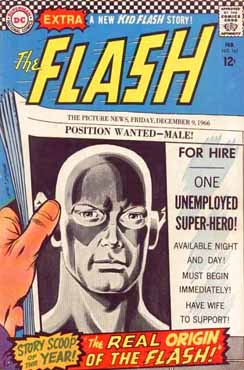
At the other extreme we get stories so dreadful everyone agrees to forget we ever read them. Flash #167 gave us “The Real Origin of the Flash” (Gardner Fox, Carmine Infantino, Infantino cover) which turns out to be that an inept angel, Mopee, caused the lightning bolt that turned Barry into the Flash. However the accident violated Mopee’s cosmic rules so he has to take away Flash’s speed unless Flash can retroactively fix the problem.
The story doesn’t violate continuity or have any major effect on the Fastest Man Alive going forward. Nevertheless it feels utterly wrong. DC promptly retracted it and nobody ever saw Mopee again (even Grant Morrison, when he recycled other whimsical characters like Aquaman’s water-sprite buddy Quisp in an issue of Justice League, didn’t touch Mopee). Silver Age buff Commander Benson says (I don’t have the link) that some fans even use “Mopee story” as a shorthand for “we refuse to accept this stupid reboot, ever.”

Likewise Action #370, revealing Superman lived a century in another dimension before landing on Earth, met widespread rejection. Like Mopee, nobody bothered specifically retconning it out, everyone just ignored it.
1971’s Flash #203, “The Flash’s Wife Is a Two-Timer,” (Robert Kanigher, Irv Novick, with a Neal Adams cover) is a different  kettle of fish. For starters, it’s a continuity implant to a supporting character and those are rare. Even rarer, it’s not “Oh, this is the man I almost married before I met Barry” but a continuity implant that amounts to a secret origin.
Barry returns home from work only to discover a cryptic note from Iris, saying she’s been pulled 1,000 years into the future. Which isn’t that weird for the DCU, but Barry is still knocked for a loop. Stepping onto the cosmic treadmill, he travels after her and arrives in a dystopian future where water is a scarce resource and Laos, through a fluke, is the dominant super-power.
Iris reveals that when it looked like nuclear annihilation was inevitable, her parents, Eric and Fran Russell (a tribute to science fiction writer Eric Frank Russell?) sent her back through time. She landed in the West’s back yard while they were grieving the loss of their infant daughter. Taking it as a sign, they brought up Iris as their own and never told her the truth. This may sound weird to some readers now, when open adoption is so common, but not telling adoptees they had birth parents was a lot more common back then.
Iris recently stumbled across the amulet her parents sent back in time with her, asked Professor West about it, and learned the truth (which is how she new how far she was traveling in time). Now all Flash has to do is defeat the Laotian tyrant, Sirik the Supreme, who intends to claim Iris as his tribute. Piece of cake! Irv Novick shows he has more flare for super-speed battles than Ross Andru ever did.

This could easily have gotten memory-holed — and indeed, after Flash #210 later in 1971, I don’t recall it coming up for the rest of the 1970s. Then, when Cary Bates finally wrapped up Barry’s series, he revealed Iris’s death in #275 had instead transported back to her parents’ time. She and Barry reunited and lived happily ever after until the Crisis killed Barry off.
 Even after that, Iris’s future backstory remained a part of the series. Barry, it turns out, impregnated her, and she gave birth to the short-lived future heroes the Tornado Twins depicted on this Neal Adams cover (their only pre-Crisis appearance, IIRC). They, in turn, gave birth to Impulse and XS. Plus when Iris returned to the present and started hanging out with Wally off and on, her knowledge of what was coming became a running element of the series.
One more noteworthy thing about @203 is Superman’s guest appearance. The story opens with Superman complaining about the loneliness of living as an alien on Earth.

Barry ends this issue saying that with Iris having more or less come from another world, he gets Superman’s angst. Superman replies that at least she has Barry — maybe if he had someone in his life, he wouldn’t feel so alone!
The final panel acknowledges this story was inspired by Superman’s origin, which makes me curious about the train of logic here. “Bob, you got a story for next issue?” “Um … wait, Superman was rocketed away from a doomed planet, what if Iris were rocketed away from a doomed future? Only it’s still there so she and Barry can go back to visit!”
Plus the idea that Superman sees himself as homeless is odd, even pre-Crisis (John Byrne’s take on Superman as more American than Kryptonian has been one of the more lasting elements of his reboot). It’s well established that while the pre-Crisis Superman grieves his home planet but he’s always embraced life on Earth — and as Le Messor pointed out here a couple of years back, Superman is as at home in Smallville as he would be back on Krypton.
Nevertheless it’s one of three books cover-dated February 1971 that play up the Man of Might as the loneliest superhero, the others being Forever People #1 (I’ll get to that one soon) and Justice League of America #87 (that’ll come later). As far as I know, if there was a conscious plan to make Superman more alien, nothing came of it. Which is just as well because angsty Superman doesn’t work for me.

I knew about the future Iris thing as a means of bringing her back from the dead, but I didn’t realize it was set up years previously. Silly, but I think it fits the world of the Flash (and I kept waiting for the TV show to get around to it).
Oh yes, it works. And while I didn’t think of it at the time, it would indeed have fit all those time-travel games on the CW show.
This is one of the Silver Age changes that bugged me the most — maybe even more than the Mopee “revelation.” “Everything you know is WRONG” stories have always irritated me, even when they’re done well (see Swamp Thing/Alec Holland), mostly because they usually invalidate some central part of a character’s premise for the sake of a “shocker” story that really doesn’t add anything to the character. Jor-El and Lara chose to send their only son from their doomed planet to Earth. Having that journey interrupted with baby Kal slipping into another dimension and living a hundred years before he turns back into a baby and resumes his trip to Earth — just typing those words makes me roll my eyes — does nothing to enhance the mythos of Superman. It just muddies the story for no good reason. Similarly, the “reveal” that a terrorist had been responsible for Krypton’s destruction instead of the planet blowing up by itself just diminished Jor-El’s role in Superman’s origin story, and all for a one-off story in which the terrorist was killed off and never figured into the Superman mythos ever after. (Which is just as well; otherwise, Kal would have spent all his time moping about what a lousy scientist his dad was.)
A superhero’s supporting cast exists by and large to serve as a contrast to the lead character, to be the ordinary people surrounding an extraordinary figure. To my mind, they need to be ordinary so our extraordinary lead can hide among them, pretending to be ordinary himself or herself in that character’s secret identity, and also so the lead has someone to save in his or her super-persona. It’s all well and good for Lois or Jimmy or even Perry to get super-powers for a story because it’s a novelty that flips the status quo on its head and you know the character will go back to being ordinary by the end of the story. Having Iris be from 1000 years in the future and sent back to our time to save her from some future catastrophe, aside from being a kind of random concept (and an inane one, though YMMV), and having it be a permanent change, makes her anything but ordinary. Even without super-powers, she’s exceptional in a way that sets her apart from regular people and lessens the contrast between her and super-powered Barry and Wally. (One reason I’ve also never been a fan of Carol Ferris as Star Sapphire.) I hated to see Iris murdered late in the run of The Flash, but I may have hated it more that she was resurrected using this idea that she was originally a native of the 30th century.
Interesting thoughts. I didn’t have a problem with the resurrection seeing as Flash was folding anyway.