
I dislike arranged marriages. There are some mistakes for which one should not be able to blame one’s parents. (Salman Rushdie, from Shame)
COMICS
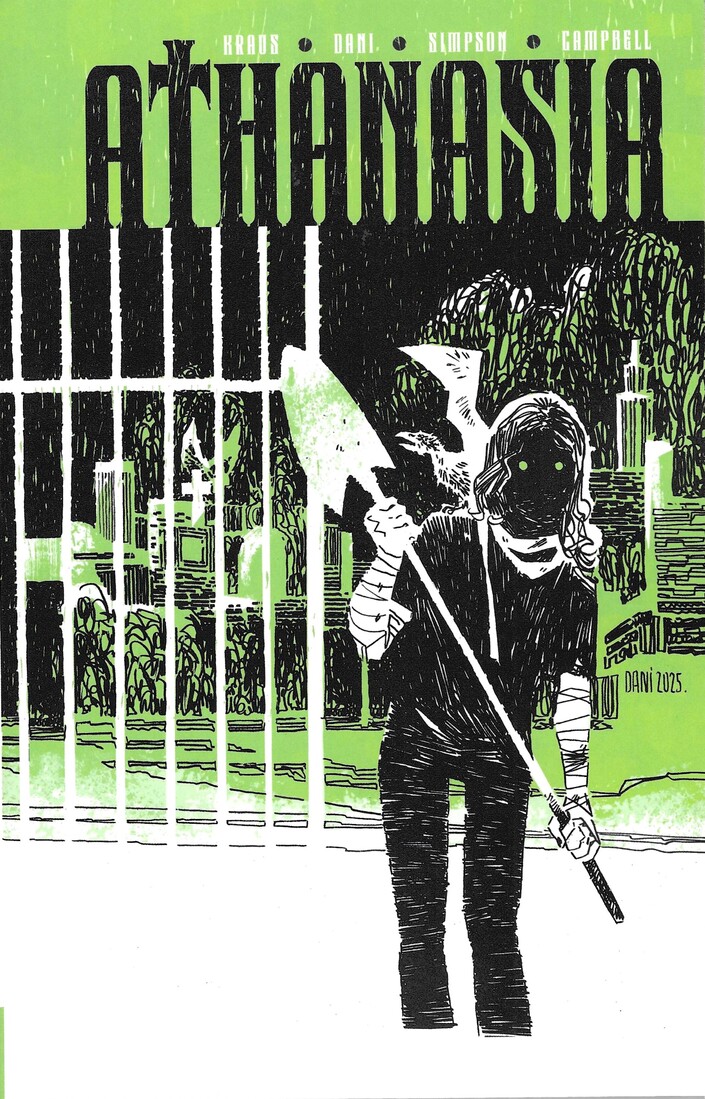 Athanasia by Daniel Kraus (writer), DaNi (artist), Brad Simpson (colorist), and Jim Campbell (letterer). $29.99, 241 pgs, Vault Comics.
Kraus is a novelist and screenwriter (he co-wrote The Shape of Water), and it appears this is his first comic, which is pretty impressive, because he does a very good job with it. Athanasia is a bleak, parodic take on superheroes, and while there’s kind of a happy ending, it’s still pretty downbeat for most of the time. (That’s not to say it doesn’t earn the happy ending, and it’s not a completely cheery happy ending, but it’s still not as gloomy as the rest of the book.) Kraus sets the book in Venture City, which is home to the Justice League-esque Dynamic Guild. The Guild has been around for decades, and people in Venture City read comics and watch movies based on their real-life exploits, and radio talk show hosts discuss the heroes on their shows … it’s very meta, in other words, but, I mean, it’s not like Marvel and DC don’t do this, it’s just that Kraus shows how baked in the concept of entertainment based on superheroes would be if superheroes actually existed. Because of this, the Guild is a corporation, and they have public relations, and they protect their image — you know, just like real-world corporations and celebrities do. They have built a cemetery for their dead, too, and that’s where our protagonist, Forrest Molson, comes in. She’s a fourth-generation groundskeeper of the cemetery, which she works with her dad (her grandfather is still alive, but he’s retired). Forrest should be in college, but she dropped out of high school because of a tragedy in her family — her sister’s accidental death — and her subsequent addiction to pills because she believes her sister’s death was her fault (which is sort-of was, but also sort-of wasn’t). She’s bitter about her situation and bitter about the fact that superheroes spend their time fighting supervillains instead of dealing with the real problems of the world … again, nothing groundbreaking here, but it’s still a decent plot point. One night, in a rage, she damages one of the monuments to a fallen hero in the cemetery, and discovers that when they die, whatever “stuff” made the superheroes super has oozed out into the soil and can be collected. When Forrest touches the stuff, she temporarily gains the powers of the hero … with some twists, of course, but basically, if she uses the “Flash’s” ooze, she can run fast. Forrest, of course, decides to become a vigilante, taking down men who abuse women. Of course, it all goes horribly wrong.
The book is a meditation on grief, as Forrest has definitely not worked through hers over her sister, but it’s a lot of other things, too. Everyone in the book is keeping secrets, not just Forrest, and these secrets have consequences. Her best friend, who’s still in high school and trying to get an athletic scholarship, doesn’t want to see her because she is not good for him, as her grief and addiction always come first, but he’s hiding something from her that has wider ramifications. Another friend, on whom she’s had a crush, is also hiding something from her, and Forrest does not handle it well when it comes to light. Her father and grandfather are hiding secrets, too, and when we find out what they are, it becomes clear that they definitely should have told her about them. But, in their own way, they’re all dealing with grief, and nobody handles it well. Forrest becomes more and more unhinged, and it’s a tragedy, because as with so much fiction (and, you know, life), if everyone was more willing to be open and honest, everyone would probably be much happier. The story staggers toward a somewhat inevitable conclusion, but it works very well in the context of the book. Kraus does a nice job balancing the bleakness with moments of grace, as Forrest is certainly not a villain, she just takes some wrong turns, and Kraus shows how noble sacrifice can be in helping someone get over a tragedy. There’s also a lot about overcompensating and how it can mask your pain and how complicated “doing the right thing” actually is. Kraus brings in the “internet” culture, too, with the radio talk-show host, whom Forrest calls every so often to update her progress. It’s not a big part of the book, but Kraus does a nice job showing how people would react to a more violent, more gray-shaded vigilante into this world of primary-colored heroes. Would Forrest be a hero or a villain? It’s a tough conundrum that Kraus doesn’t attempt to unravel, just introduce and allow us to puzzle it out ourselves.
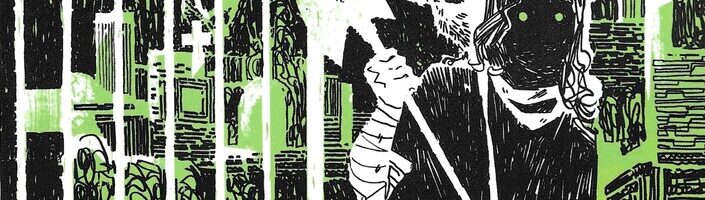
DaNi’s art is stupendous, possibly the best I’ve seen by her. The first image looks like it was done with one line (not quite, but it does look like it) on an Etch-a-Sketch, and a lot of the book looks like that –- as if she simply noodled around without taking her pencil off the page until she had rendered an astonishingly detailed drawing of something. When she’s not using parallel lines in a simplistic fashion to create something complex, she’s using negative space brilliantly and dropping holding lines and adding big blocks of black to build an impressionistic masterpiece. When she draws the flashback showing what happened to Forrest’s sister, she does so in a child-like fashion, using simpler shapes and fewer and bolder lines, and when she draws the superheroes of the city (who don’t show up that often, but they do show up), she uses something like pointillism, but with an almost clumsy and thick dot technique (it’s not “clumsy” as in bad, just like she’s deliberately making it less fine than traditional pointillism). It works very well to make the superheroes seem removed from the world and almost a shared dream of the population. She uses beautiful hatching as Forrest begins to go down her path, slowly showing how haggard and harried she has become. DaNi has been a good artist ever since she started doing American comics, and this is her most amazing work yet, I think.
Athanasia is a superb comic. There’s a lot going on in it, plus it’s a terrific thriller/action adventure to boot. Give it a look!
Rating: ★ ★ ★ ★ ★ ★ ★ ★ ★ ½
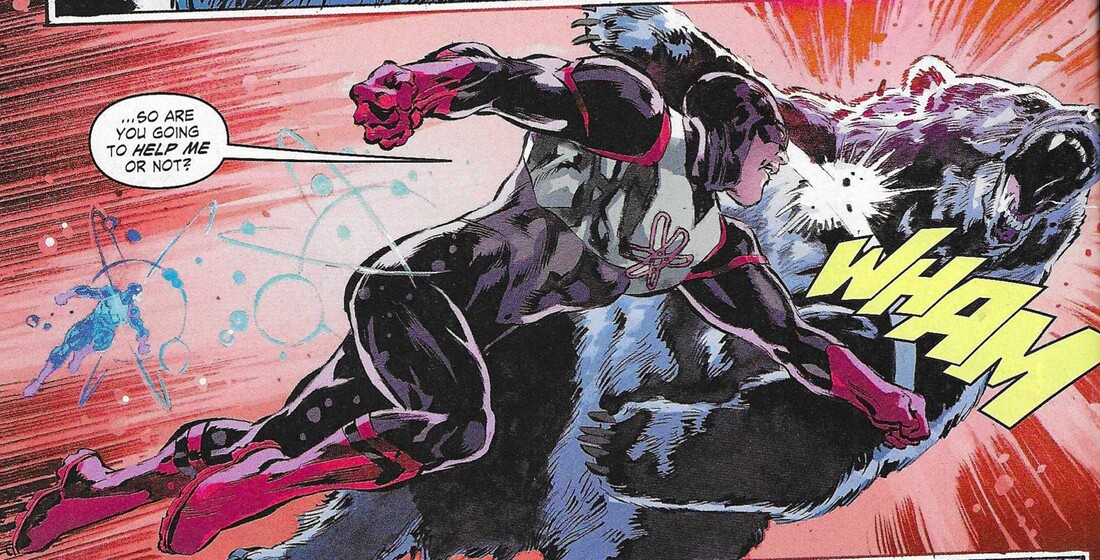
One totally Airwolf panel:
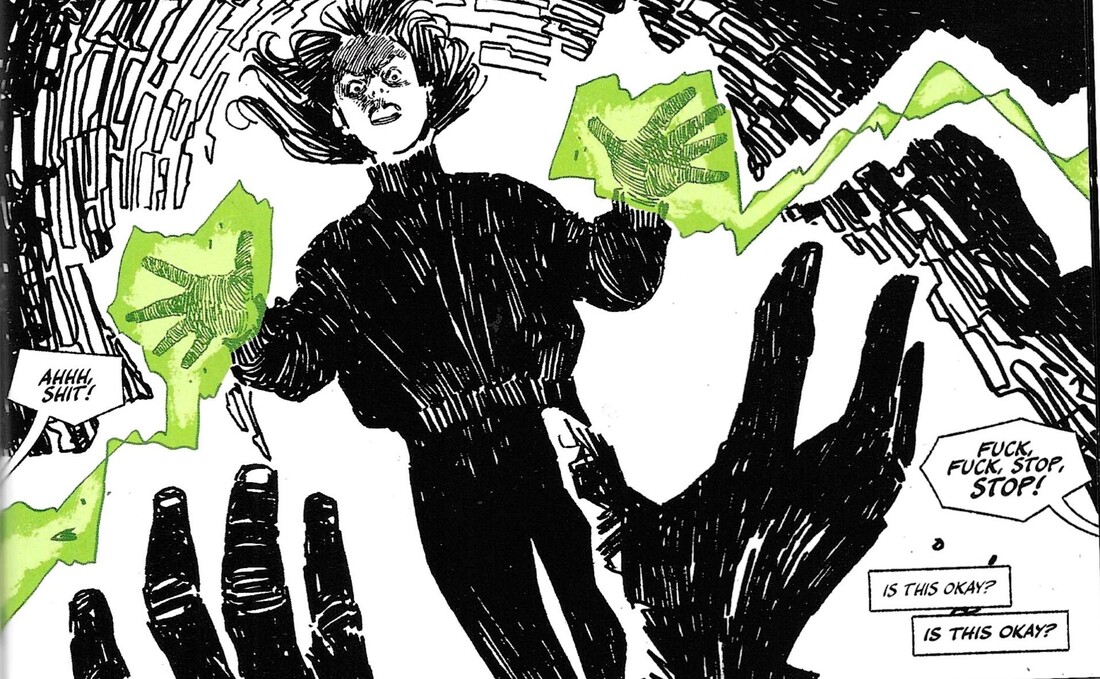
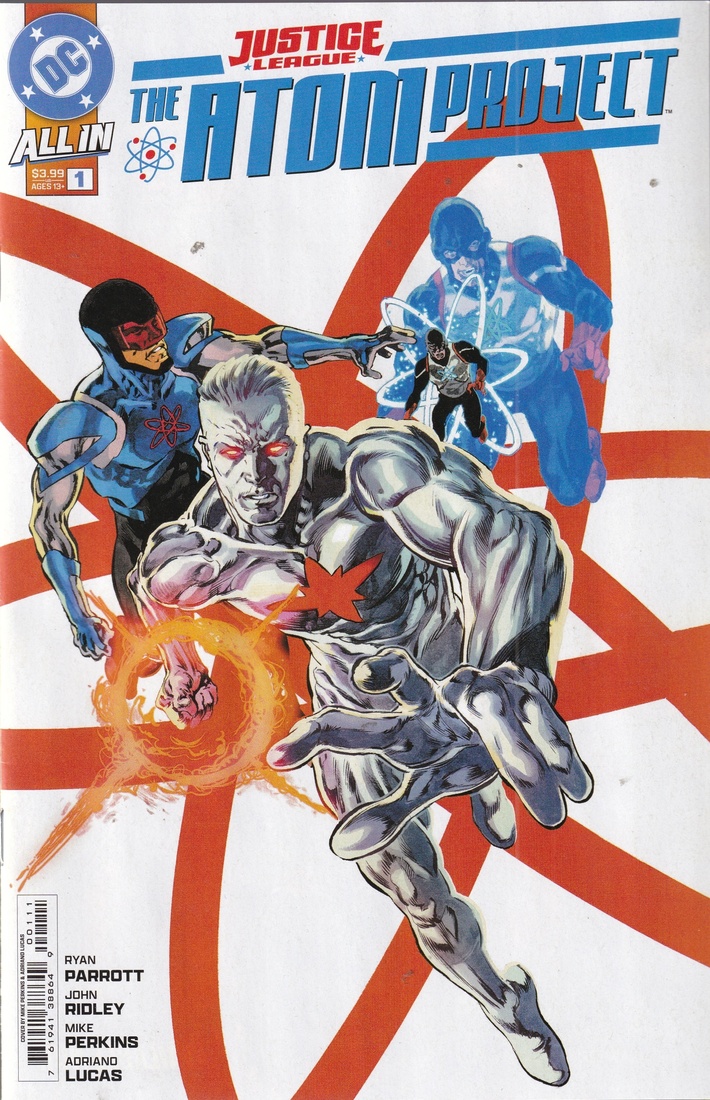 Justice League: The Atom Project by Ryan Parrott (writer), John Ridley (writer), Mike Perkins (artist), Adriano Lucas (colorist), Wes Abbott (letterer), and Matthew Levine (collection editor). $17.99, 120 pgs, DC.
I don’t quite get this whole “losing powers/switching powers” thing DC is doing right now. It’s one of those vaguely cool ideas that falls apart the minute you start thinking about it, and you know me –- I’m thinking about it! In this series, both Atoms are trying to restore powers to the right people, and Captain Atom somehow becomes the possessor and distributor of them, which means the U.S. military –- which can still command him, because he’s still active duty? –- wants him to give them to soldiers. Bad things happen, Major Force is involved, “Inferno” is involved (and no, I’m still not giving away what their deal is, even though it’s stupid), and in the end, everyone learns a valuable lesson about trust and Mr. Belding buys them all ice cream. It’s fine.
But … I don’t get the powers thing. Amanda Waller figured out how to scramble them, I guess, and some people didn’t get them back. Ok. But … I mean, does DC really want to poke the bear of “what are powers” that much? How can you take away … let’s say Flash’s powers? He was doused in chemicals and struck by lightning. I assume there was something in his DNA that allowed him to run fast rather than suffering horrible chemical burns and dying quickly. If you “take away” his powers, how do you do that? Was it some kind of magic wand that we shouldn’t investigate too much (I didn’t read Absolute Power, so I’m actually curious)? Characters in the DCU get their powers in different ways, so how could they lose them and even get them switched with others? Captain Atom is able to absorb them, but again, what are they? Is it just energy floating around that some people can access but others can’t? Why? I know we’re not supposed to question these things in superhero comics -– Bruce Banner wasn’t incinerated because of … reasons! –- but when the powers-that-be start messing with them, it makes me wonder about them. This mini-series does not provide many answers.
But it’s fine. Perkins does nice work on the art, the female Dr. Light shows up (I always liked the female Dr. Light, but she never has much to do, does she?), and it has a nice, 1970s, man-on-the-run vibe to it. I miss Big Shaggy General Eiling, and I don’t know why DC has reverted him to human (I know he was part of Captain Atom’s cast, but couldn’t DC just replace him with some other officious, slightly villainous general?), but that’s just me. This is mildly entertaining, but that’s about it. Such is life.
Rating: ★ ★ ★ ★ ★ ★ ½ ☆ ☆ ☆
One totally Airwolf panel:
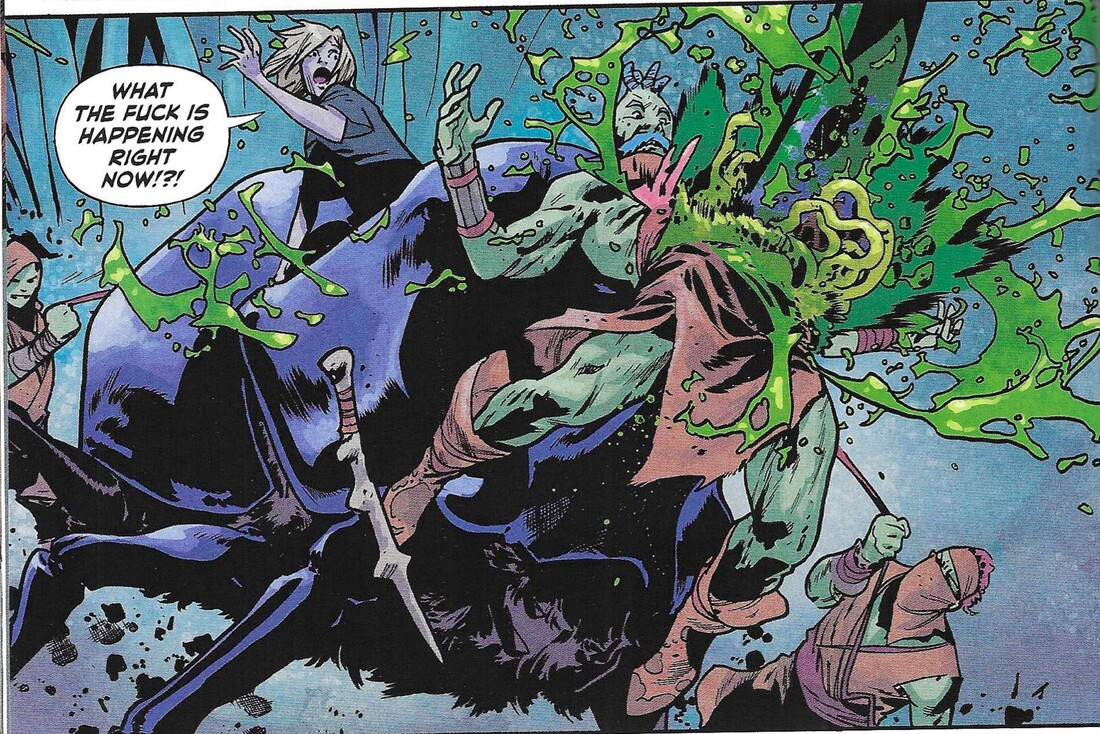
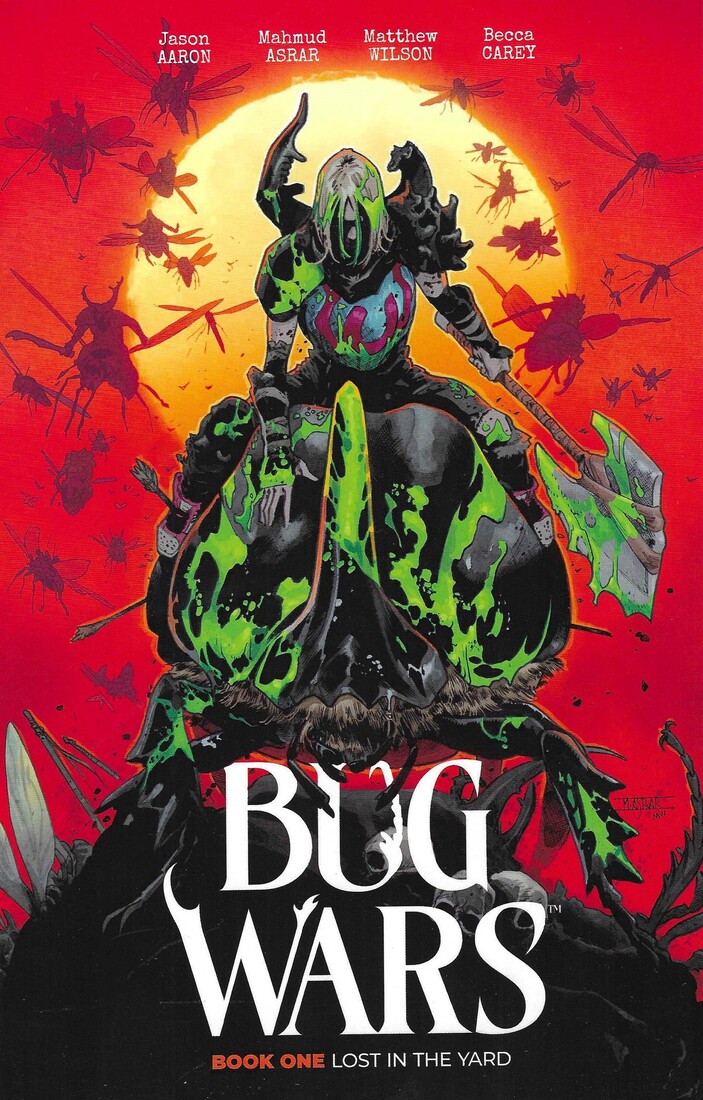 Bug Wars volume 1: Lost in the Yard by Jason Aaron (writer), Mahmud Asrar (artist), Matthew Wilson (colorist), Becca Carey (letterer), and Heather Antos (editor). $16.99, 178 pgs, Image.
I go back and forth on Aaron, as I think he needs to stay away from superheroes but he does do other things quite well, so he’s writing a fantasy sword-and-sorcery thing here, and he had some practice with that with Conan, so I thought this might be pretty good. And hey! this is pretty darned good! The main character, Slade Slaymaker (which, yuck), moves back into an old family home with his mother and older brother. They lived there years earlier, but Slade’s dad was found murdered weirdly in the basement, so they moved away. The dad was an entomologist and he was killed by insects, which messed up the older brother, who now hates insects. Slade still digs them, and when his brother freaks out and tries to kill all the ones that Slade takes care of, Slade touches an old amulet stuck in the walls of the house and shrinks to insect size, and he discovers that there are human-like creatures in the house’s yard that fight wars with each other and use insects as riding beasts or beasts of burden or, you know, food sources. The “mytes,” as the human-like creatures are called, know all about Slade’s dad, and many of them respected him, and Slade becomes kind of a messiah-figure among a lot of them. Of course he does!
In many ways, this is a standard s-‘n’-s fantasy kind of story, but Aaron tells it very well. The mytes he creates are fascinating, as they resemble insects in many ways, so they look a bit like humans but often act like insects. Slade, obviously, has no idea what he’s supposed to do, and part of the story is him figuring it out, as he’s able to use the magic in the amulet, but he doesn’t quite know how to activate it. The mytes want to destroy something that’s destroying them, and Slade thinks they’re talking about his brother, and they are … sort of. It’s a clever thing (I won’t ruin it, but it’s fun), and it goes into another reason why the book works well: Aaron doesn’t cut Slade off from his “big” life, so the book remains a bit more grounded than you might think. In a lot of these “fish out of water” fantasy stories, the person from our world goes into another world and we never hear about the “real” world until the very end, but Aaron keeps checking in on Slade’s mother and brother, and he never lets us forget that Slade is moving through a backyard of a house. Slade eventually embraces his “messiah quest,” true, but he’s still a kid, and Aaron does a nice job balancing the fantastical with the issues in his family problems. It’s well done, especially because Slade’s father is so revered by the mytes, which is something, obviously, that Slade’s dad did not tell his family about. So both worlds blend into each other a bit, and it’s clear Aaron is going to do more with that as the book goes forward.
Asrar is stupendous, of course. His mytes are weird and a bit creepy and human enough that we can relate to them but insectoid enough that they’re a bit repellant (I know, we all love all of God’s creatures, but insects are fucking icky), and the actual insects are really done well. He does a wonderful job with the scale of it all, as we’re reminded at crucial times how small Slade is, which is neat. The section with Slade in the spider lair is very creepy, and when things get apocalyptic in the final issue, Asrar is marvelous at showing it in all its awful glory. Asrar is excellent at action, and his fight scenes are wonderfully choreographed. He gets to get really gory, too, which I’m sure he had fun with. Back in the day, when Jay Faerber got Asrar to draw Dynamo 5 for him, I wrote something about how the Big Two need to snap him up. They did, and he did great work for them, and I’m glad he’s at a point where he can do something weird and wild like this instead of just drawing a random superhero title. The art is amazing, as I figured it would be.
This is a good start to what Aaron clearly wants to be a long epic. We’ll see where he goes with it, and I’m looking forward to it!
Rating: ★ ★ ★ ★ ★ ★ ★ ★ ★ ☆
One totally Airwolf panel:
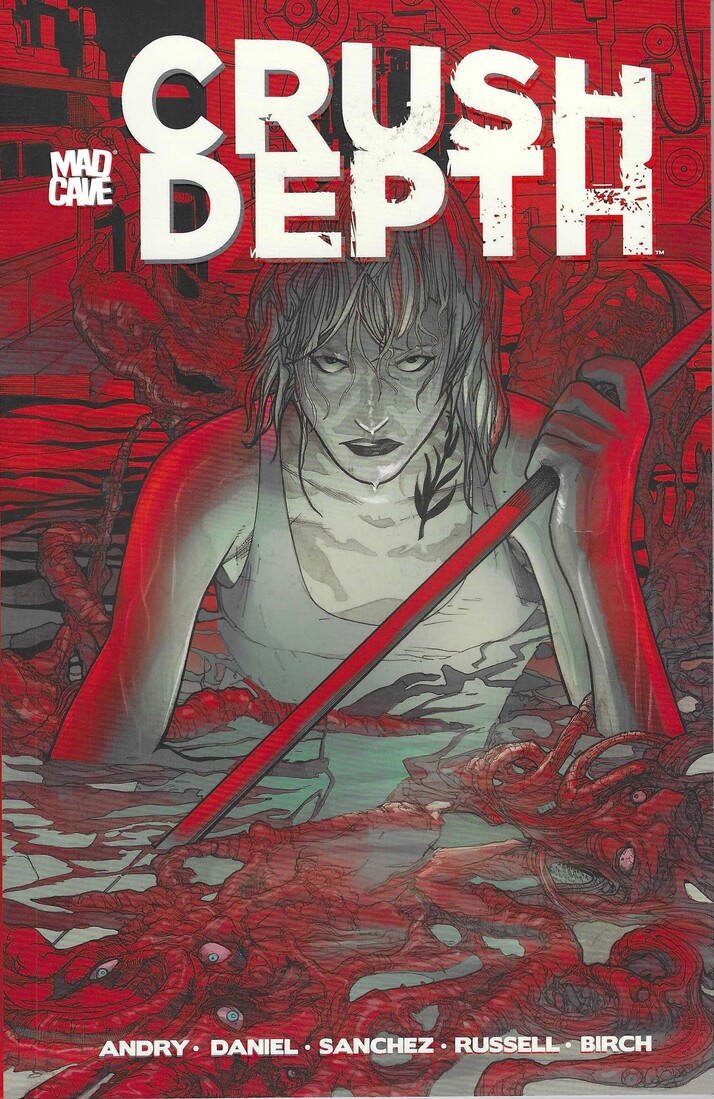 Crush Depth by David “DB” Andry (writer), Tim Daniel (writer), Alex Sanchez (artist), Kurt Michael Russell (colorist), Jason Finestone (colorist), Justin Birch (letterer), and James B. Emmett (editor). $17.99, 110 pgs, Mad Cave Studios.
This is a fairly standard monster story, as the writers don’t do much to make it unique or unusual — it’s fine, but nothing special. There’s a submarine that’s been underwater for a decade as the world has fallen apart, and when they receive a distress signal, they bring something evil on board that starts killing everyone. It’s your standard “Alien” story, which is fine, but there’s nothing really more to say about it. As with a lot of these kinds of stories, the early victims are so anonymous that it just doesn’t matter, and there’s supposed to be some kind sibling rivalry between the submarine captain and his brother that doesn’t go very far. Sanchez does a decent enough job with the art, and he gets to draw some weird shit, but it’s also not elevating the story too much. It’s a standard horror story, and it’s fine, but it’s nothing to write home about.
Rating: ★ ★ ★ ★ ★ ½ ☆ ☆ ☆ ☆
One totally Airwolf panel:

 Dark Empty Void by Zack Kaplan (writer), Chris Shehan (artist), Francesco Segala (colorist), Agnese Pozza (color flatter), Justin Birch (letterer), and James B. Emmett (editor). $17.99, 120 pgs, Mad Cave Studios.
This is another fairly standard science-fiction/horror story, as a psychologist is called by her estranged husband (they’re not officially divorced yet), who’s working in a secret lab in Alaska, to come help him with a problem. He is part of a team that created a small black hole in their lab, and a person came through the black hole into our reality. Oh dear. So Joy heads off and tries to help the person, who simply wants to come back through the hole to her home. Joy, Colson, and a military team (of course there’s a military team) take her into the gravity well of the black hole, and bad things start to happen. Of course they do! It’s not the worst plot, and Kaplan does a nice job trying to make it a bit more humanistic, but it’s still generally just a standard sci-fi/horror story. It’s predictable, sure, but it’s entertaining, so there’s that. The art is fine, and Shehan does some nice things with the effects, especially at the end when Kaplan goes a bit “2001” on us, but there’s nothing terribly special about it. Kaplan does not have Joy say something like “WHAT THE FUCKING HELL ARE YOU DOING CREATING A BLACK HOLE IN ALASKA, YOU FUCKING TOOLS?”, which would have been fun, because they don’t seem to be doing it to solve any problems on Earth, but just to figure out what the hell’s the deal with black holes, which, who fucking cares at this point in our history — they’re way the fuck out there, so maybe try to solve more immediate problems?!?!?! I just always get annoyed when scientists are doing stupid things and nobody says anything about it. I mean, Jeebus — a black hole in Alaska? Who thought that would be a good idea?
Dark Empty Void is fine. It’s nothing special, but it’s fine.
Rating: ★ ★ ★ ★ ★ ★ ☆ ☆ ☆ ☆
One totally Airwolf panel:

 The Department of Truth volume 6: Twilight’s Last Gleaming by James Tynion IV (writer), Martin Simmonds (artist), Letizia Cadonici (artist), Jordie Bellaire (colorist), Aditya Bidikar (letterer), and Steve Foxe (editor). $16.99, 145 pgs, Image.
I still like The Department of Truth, but it does seem like Tynion is smelling his own farts a bit with it, and it’s frustrating. Martin Simmonds can’t finish more than three issues in any six- to eight-month period, apparently, so he does three issues in this, with Cadonici handling the other three. It seems that Tynion only wants Simmonds to draw the “main story,” which is fine, but that means when he actually gets Simmonds, shit ought to happen. In the first three issues of this trade, a lot of people talk to a lot of other people, and it’s not particularly interesting. As you know, I don’t love the plot churn of many Marvel and DC comics, but, I mean, you can’t go completely in the opposite direction, either, with all your characters agonizing over what they’ve done and what they’re going to do, especially because they, you know, don’t do anything in these three issues. Lee Harvey Oswald is grumpy because the yutes are taking over, even though he approved their big plan, and instead of accepting that the oldsters can’t always cling to everything and eventually the torch must be passed, he makes a deal with the devil … the Big Dumb White House Devil, that is, and no, we don’t see his face, but it’s obvious who Tynion means. Yawn. I mean, it’s not the worst plot development, I guess, but it took three issues to get there, and it feels like it could have been handled in one. But that’s just me. In the next three issues, Tynion comes up with … something evil from the internet! I mean, he’s never come up with that idea before! This is just another sidebar story, as it takes place some years ago and is basically there to let us know why the demon of the book is the one we have and not this other one. I mean, yawn again. It’s not a bad story — things happen! — but it feels pointless, as if Tynion wrote it because he knew he wouldn’t have Simmonds for a while.
I know that making comics is hard, and Simmonds might actually have to, you know, make money elsewhere, and I’m fine with that. I’m fine with Tynion stretching himself thin, too, because, again, he needs to make money. But he’s stretched himself really thin, it seems, and his books feel like they’re suffering. A few years ago, Tynion seemed on the cusp of becoming a really good writer, and while his ideas are still good, maybe trying to write a dozen books at a time isn’t the best idea? The combination of an artist who probably isn’t the fastest and probably has to take other work and a writer who’s got a lot of irons in the fire isn’t doing this book any favors. I’ll get the next trade, sure, and we’ll see where it goes from there, but it’s on some thin ice.
Rating: ★ ★ ★ ★ ★ ★ ½ ☆ ☆ ☆
One totally Airwolf panel:
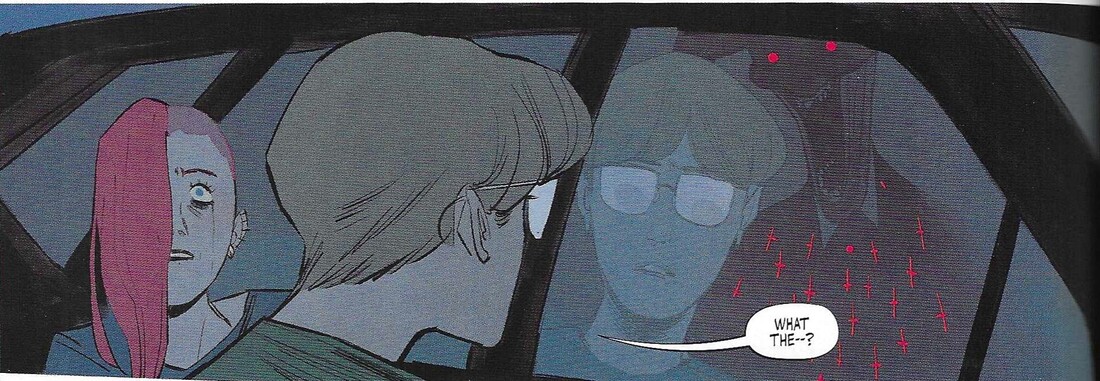


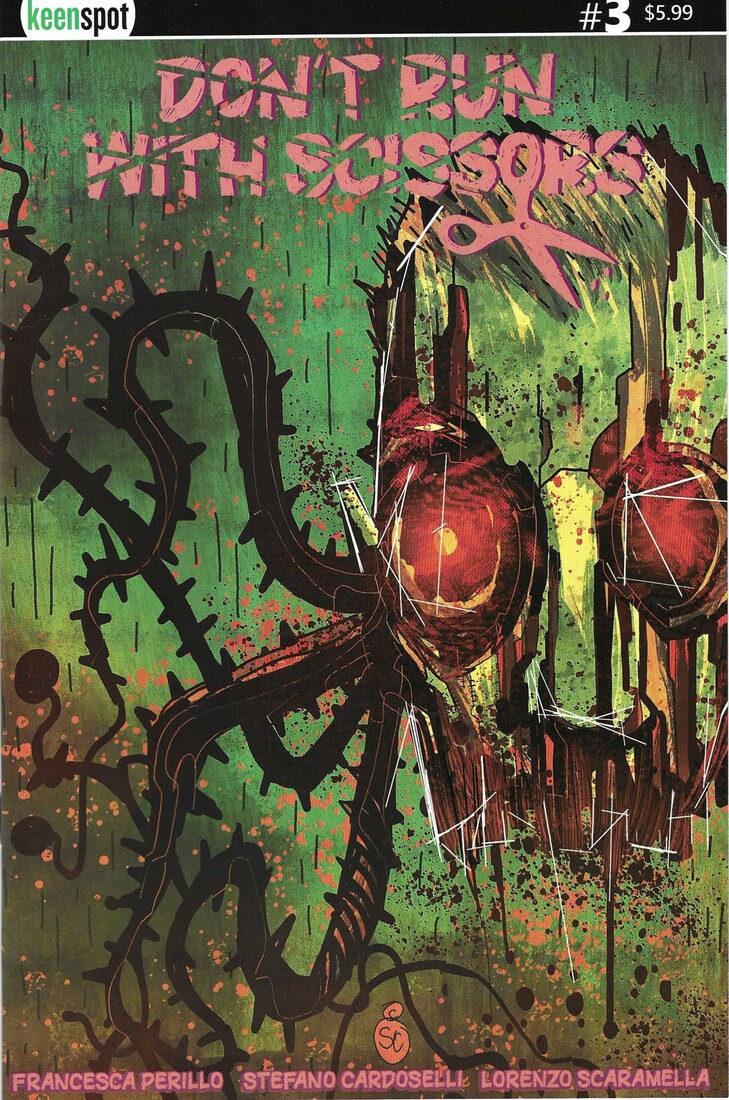
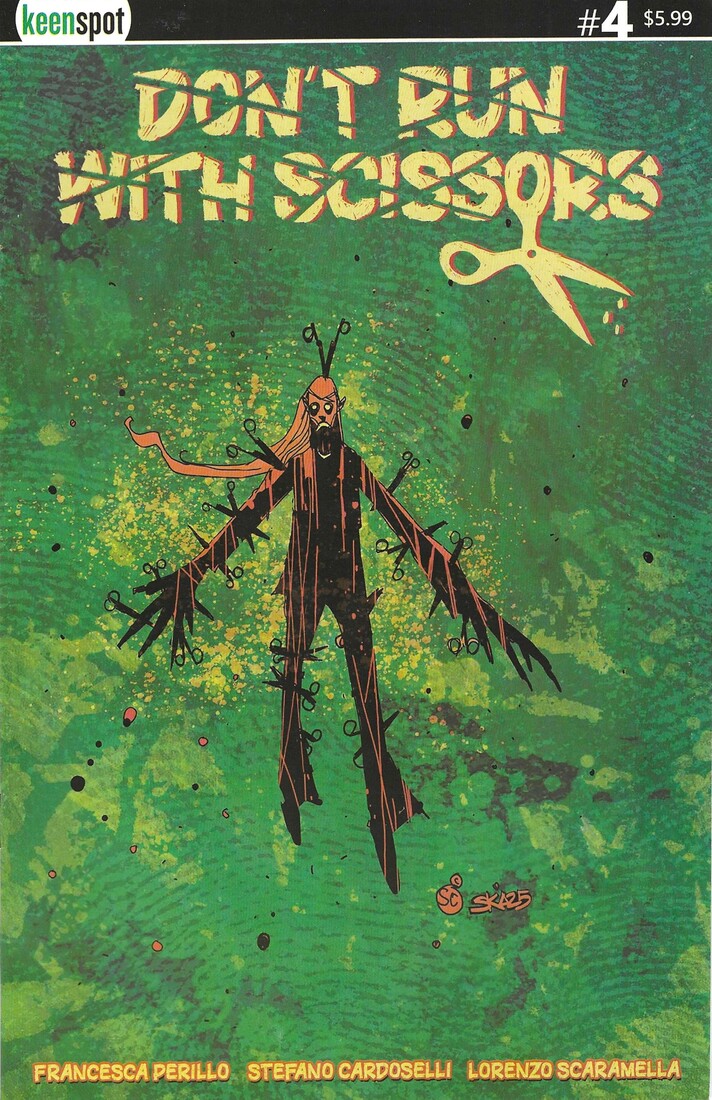
Don’t Run With Scissors #1-4 by Francesca Perillo (writer), Stefano Cardoselli (artist), and Lorenzo Scaramella (colorist/letterer). $23.96, 80 pgs, Keenspot Entertainment.
Hey, it’s another Stefano Cardoselli comic that I can’t defend, because it’s pure junk food, but what goofy, glorious junk food it is! This time around, the sheriff of a small town (called “Spellbound,” because why not?) almost runs over a young woman running down the road with a bunch of wounds on her face and arms, and he can’t figure out what happened to her. He lets her go home, and it happens again! Meanwhile, the sheriff can’t sleep, and he’s having weird dreams about weird creatures. I wonder if that’s linked in any way to what the woman is going through? Oh, and there are zombies. Who kill with scissors. Hence the title.
It doesn’t really matter what’s going on — it’s ridiculous, sure, but still entertaining — and Perillo doesn’t do much in terms of character development or anything, although the end of the story does get a bit poignant. This is, as usual, just a vehicle for Cardoselli’s rambunctious, wacky, violent, exuberant artwork, and he delivers. So many heads getting stabbed with scissors! Such a weird creature in the sheriff’s dream! So many artful panels that let you know that, yeah, Cardoselli does know what he’s doing, even if he enjoys drawing ridiculously proportioned people (women with tiny waist and big boobs, strange men with too-long arms) and heads exploding and getting gashed with blades. As always, I will never defend a Cardoselli comic except to say that if you’re just looking for the goofiest grindhouse shit around, you should at least take a look at one of his comics. Literally any one will do!
Rating: I dunno — it’s trash, but who cares, right?
One totally Airwolf panel:
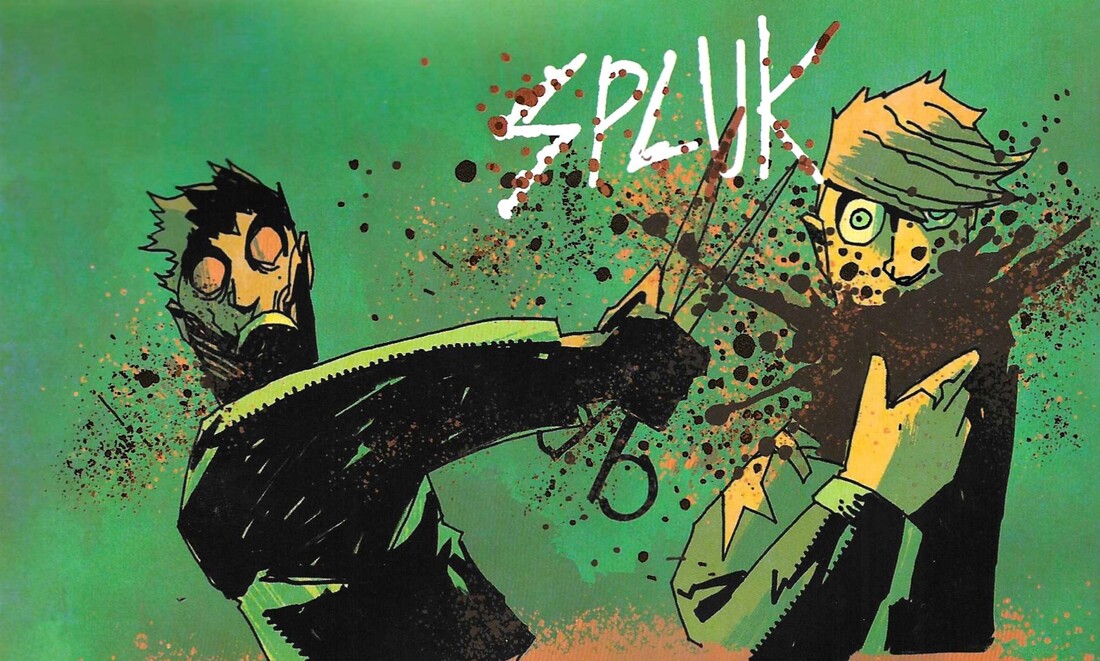
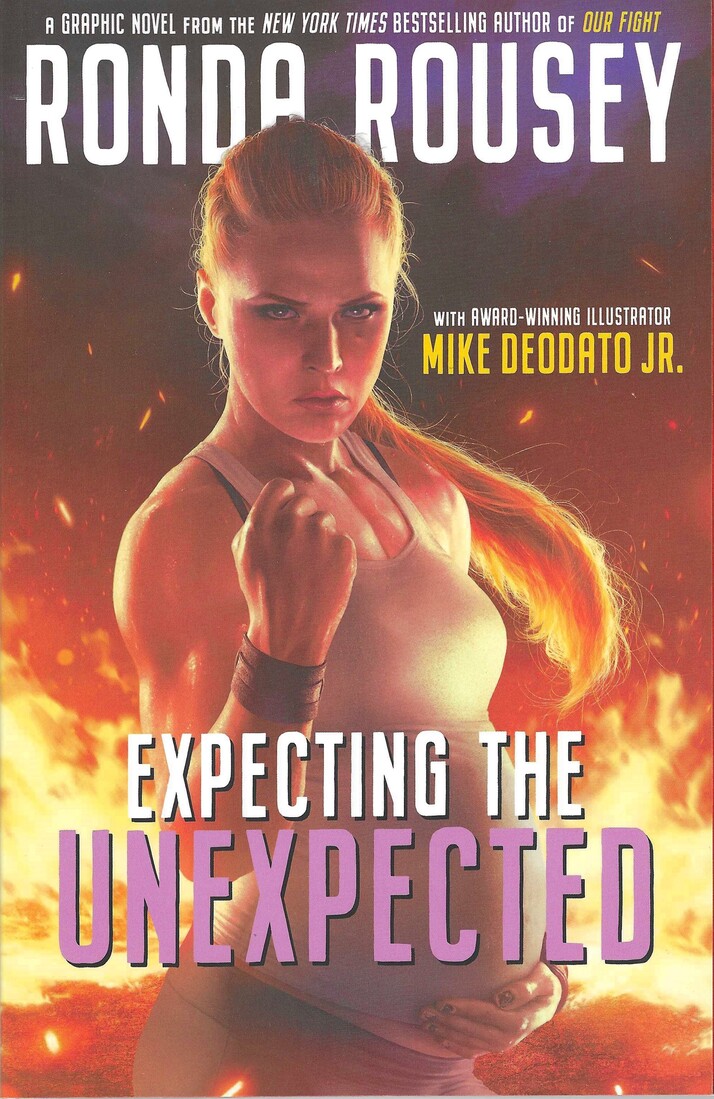 Expecting the Unexpected by Ronda Rousey (writer), Mike Deodato Jr. (artist), Marco Lesko (colorist), and Sal Cipriano (letterer). $18.99, 153 pgs, AWA Studios.
The guy at my comic book store shook his head sadly when he was selling this to me, because of Rousey, of course, and I could not really defend myself, except that I noted I really like Deodato, which I do! And I figured, this can’t be that bad, can it? And, you know, it’s pretty decent — nothing great, of course, but still pretty decent. Rousey is credited as sole writer, so I guess we have to accept that she did, indeed write this, and she gives us an assassin who looks suspiciously like Rousey herself (I mean, that’s Deodato, but I imagine there’s a reason he did that) who gets a salaried job at a place that employs assassins, but immediately her boss tries to kill her, plus another assassin who wanted to leave the company and that’s not allowed, I guess. Anyway, she hooks up with the other killer and gets pregnant, and so she’s trying to stay alive, she’s tracking down the father (it’s a one-night stand, but then she decides she should probably find him), and she’s trying to decide if she should have an abortion (of course, she decides to keep the baby, because people in pop culture don’t have abortions anymore), and there is a lot of action, of course. It’s goofy, sure, but it’s very high-octane, and Deodato does his very cool thing that he does these days with his art, which is structure the pages in a very neat way, using the panel borders in interesting ways to break up bigger spreads so we focus on certain things and placing panels that are focusing on small things as part of the larger palette. You might not like his style, which is fine, but the dude structures pages really well.
The weird thing about the book is how funny it is, and how Rousey, who clearly wants to play this character in a movie, makes her kind of a jerk. The reason her boss wants to kill her is hilarious and very relatable yet so very petty, and it feels like something a true villain would do. Her relationship with the father is well done, too, as they don’t get along very well and have to figure out if they can live with each other, and it’s done better than what we usually get with people who bang once and the woman gets pregnant, which I never love. It’s kind of nice that “Mom” (before she gets pregnant, she wears a prosthetic to appear pregnant so people don’t suspect she’s a killer) is kind of a jerk, and I’m kind of impressed that Rousey wrote it that way, especially as she wants to play the character in a movie.
Anyway, it’s better than I … expected (sorry, had to be done). And the art is very keen. So, that’s nice.
Rating: ★ ★ ★ ★ ★ ★ ★ ½ ☆ ☆
One totally Airwolf panel:
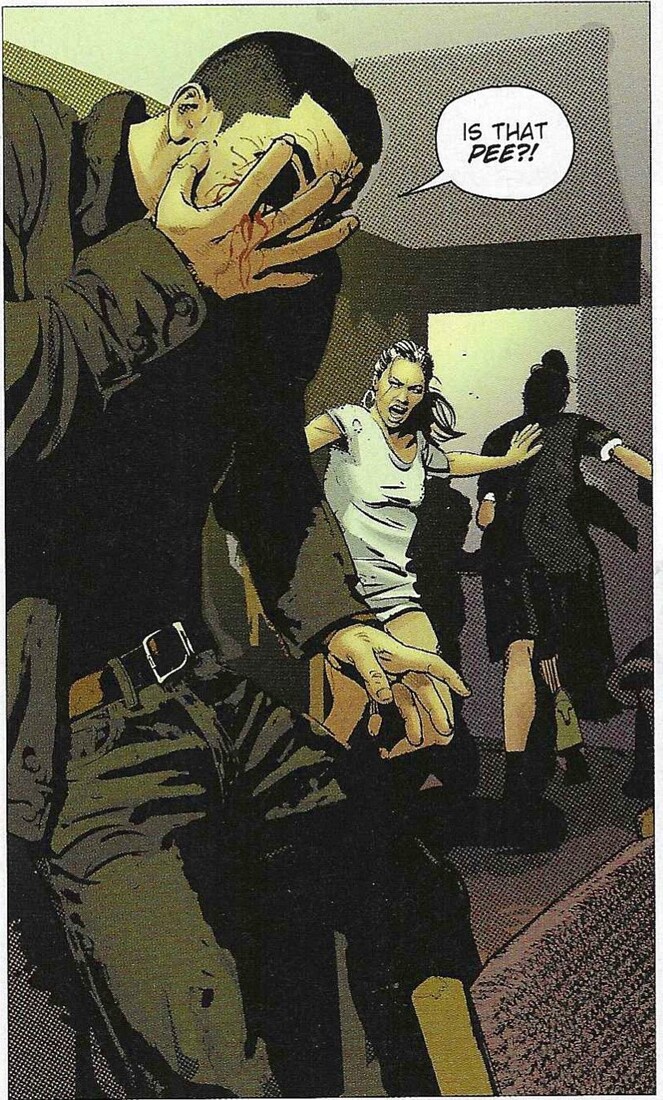

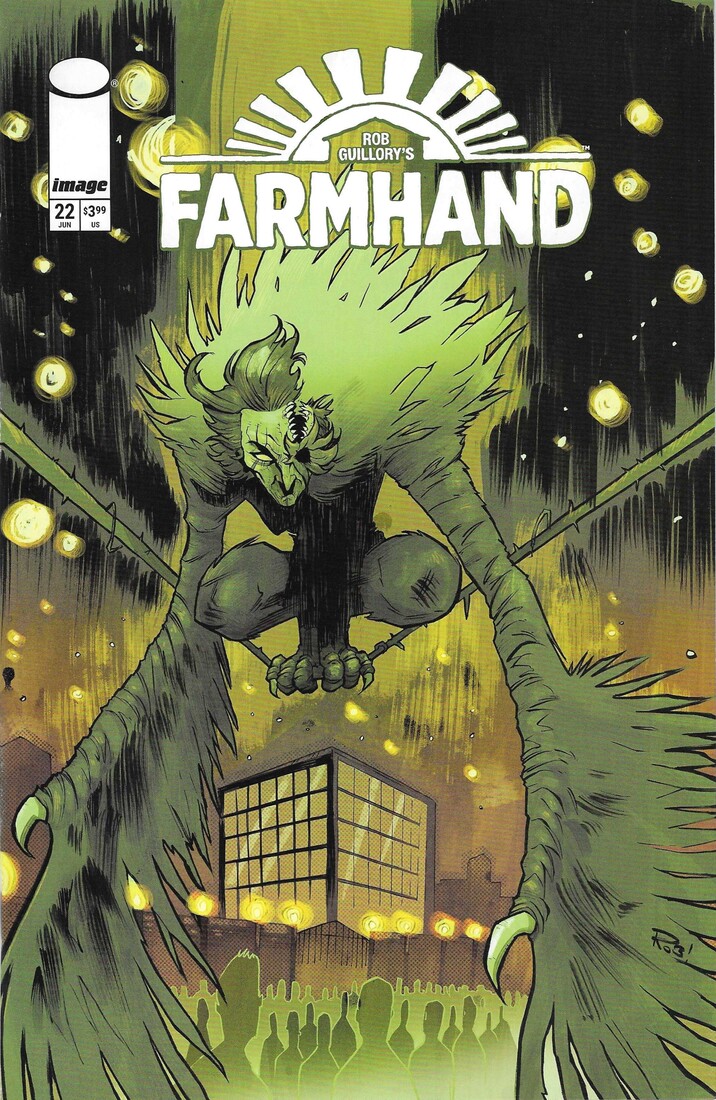
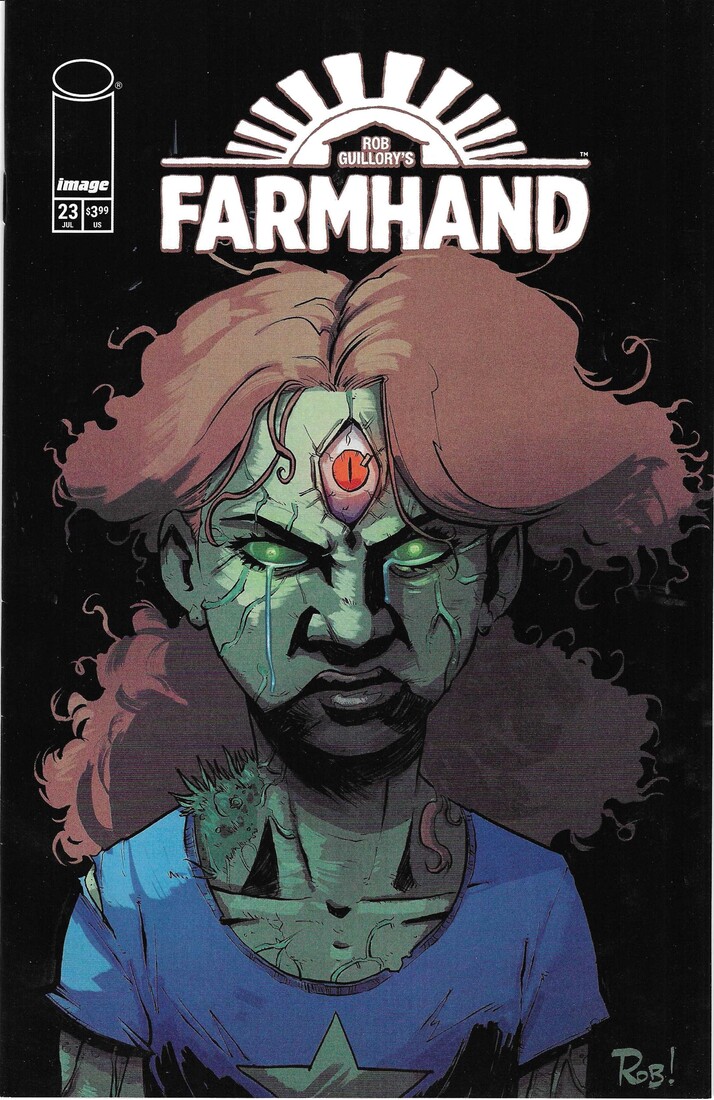
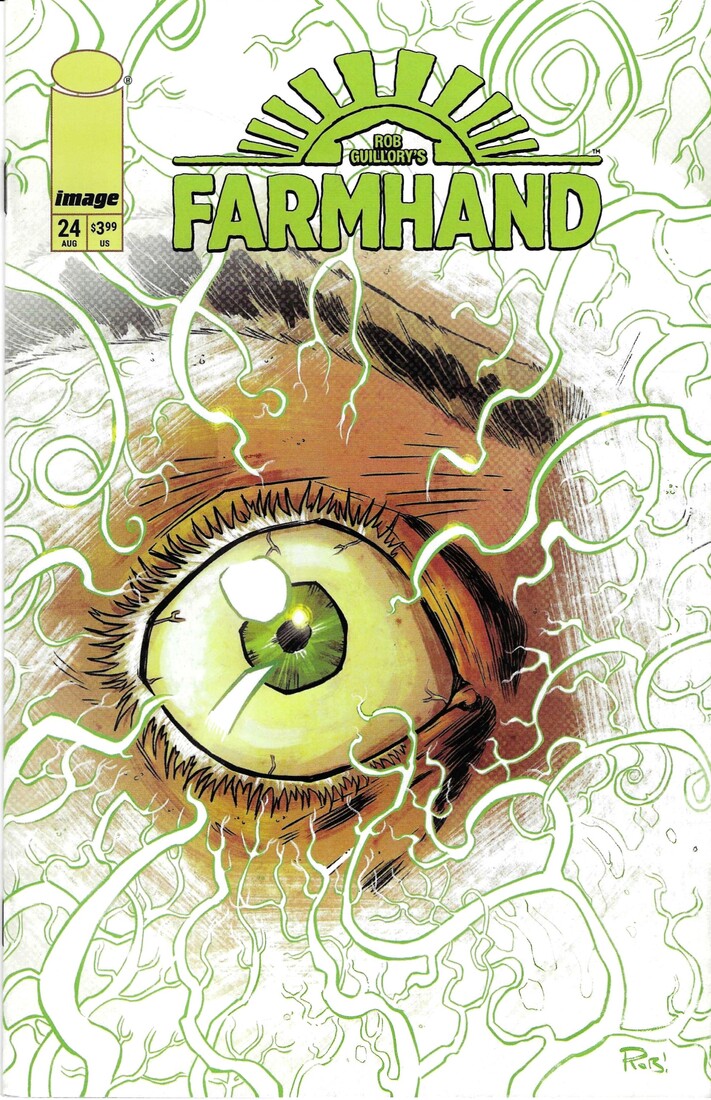


Farmhand #21-26 by Rob Guillory (writer/artist), Jean-Francois Beaulieu (colorist), and Kody Chamberlain (letterer). $23.94, 156 pgs, Image.
It took Guillory a LOT longer to finish this than he thought it would, some of it due to the pandemic (issue #15 came out in April 2020, and Guillory thought he’d be back in six months, which is about what the gaps were between each arc up to that point … and issue #16 came out almost exactly two years later) and some of it due to other factors that Guillory doesn’t get into (after the fourth arc finished with issue #20, it took almost three years for this final arc to come out), but it’s none of our business. I mean, if you started getting this, you probably stuck with it, and when you sit down to read the entire thing, are you really going to care that it took seven years to come out rather than four? I think not!
One thing you do notice as you re-read this (which I did, because, I mean, it’s been a while) is some of the subtler things. The early issues were printed on much better paper, and while the latter issues don’t suffer too much because of the thinner paper, it’s an interesting (what I hope was a) cost-cutting measure. Guillory’s long-time colorist, Taylor Wells, left the book after issue #12 (Guillory has nothing but praise for her, so I assume it was an amicable leaving), and it’s interesting to look at the art change. Jonathan Treece colored one issue, and he was not a good fit with Guillory’s art, as it just felt heavier when Treece was coloring it. Rico Renzi finished that arc, and Renzi had a lighter touch, so the art looked more “Guillory-esque.” Beaulieu came on board for the final 11 issues, and due to the two-year gap, I don’t know if Guillory changed his style or if Beaulieu did something different, because the lines look a bit lighter and the coloring is a bit more rendered, adding a bit more texture to the clothing, for instance, than we’ve seen in Guillory’s art before. His inking, it seems, is clearly lighter, but I don’t know if that’s the result of him using a lighter touch or Beaulieu overwhelming it with the colors. If I ever see Guillory again at a con I’ll have to ask him.
As always, I have to admit that I like Guillory as a person, so I’m never sure how objective I can be, but I enjoyed Farmhand quite a bit. In case you’ve forgotten, it’s the story of a dude who discovered a seed that can grow into any body part, so our farmer — Jedidiah Jenkins — goes into business helping people become whole again. His son, Ezekiel, and Zeke’s family — his wife and two kids — return to Louisiana at the beginning of the book after many years away … and then things get weird. The implants begin acting strangely, there’s an old friend of Jedidiah who begins acting strangely, the local plant and animal life begin acting strangely … lots of strange things, in other words. Obviously, by the time this arc comes around, things have gone apocalyptic, and Guillory pulls it all together quite well and wraps it up how we probably expect, but also with some nice twists and turns along the way. I certainly don’t want to give the plot away!
What is most interesting about the book is the way Guillory writes about race and the legacy of racism. Guillory’s black, in case you don’t know, and he lives in Louisiana, so presumably he’s steeped in the checkered history of the region, and Farmhand, while it remains a horror/adventure book at its core, has a lot to say about race, even if Guillory, unlike so many other writers today, manages to keep it mostly as subtext. One of Jedidiah’s ancestors was lynched in the town, a town he founded to provide a haven for free blacks, and that horrible event is woven into the narrative in sometimes unexpected ways. This is a story about reconciliation, ultimately, as Zeke and Jedidiah need to reconcile with each other and their pasts, but Guillory’s use of farming metaphors — which aren’t always metaphors but become metaphorical when we look at the bigger picture — speaks to the experience of black people in the country, not just the experience of Zeke and Jedidiah. By keeping it personal, Guillory makes it more universal, without beating us over the head with it. I know, shocking — it can be done! He certainly doesn’t let white people off the hook, but he’s also able to see that nobody is really to blame for their ancestry, even if so many people think they are. Guillory is Christian, and there’s a strong Christian strain running through this book (the “good” kind of Christianity that believes in forgiveness, not the “kill the homos and sluts” kind of Christianity), and Guillory does a nice job linking that to the country’s often unpleasant history. The book is deeper than you might expect, which is kind of keen.
Plus, you know, there’s a giant evil tree. So there’s that.
I hope Guillory continues to be able to do his own thing, because while I haven’t loved everything he’s written, it’s clear he’s pretty good. I also hope he doesn’t abandon art like so many artists before him who transitioned to writing. His art is very keen, and I always want to see more of it!
Rating: ★ ★ ★ ★ ★ ★ ★ ★ ☆ ☆
One totally Airwolf panel:

 Howl by Alisa Kwitney (writer), Mauricet (artist), Rob Steen (letterer), and Cory Sedlmeier (collection editor). $17.99, 100 pgs, Ahoy Comics.
Kwitney, who has written some neat things in the past few years, gives us a fun twist on Invasion of the Body Snatchers, as the aliens decide to infect beatniks in Greenwich Village in the late 1950s because they figure out that if you get the weirdos in a society first, it’s easier to get the rest of them. That’s not a bad idea (it’s copped a bit from the 1970s Invasion, in which Leonard Nemoy — who gets a small shout-out in this book — is a hippie guru), and Kwitney does a nice job with it, as her protagonist, Ziva (who’s based on her own mother), is trying to live her own life, resist her mother’s attempts to get her to live a more traditional Jewish life, but is also trying to deal with a kind of a douchebag beatnik who makes her toes curl but isn’t that good for her. If you ignore the alien stuff, this is a pretty good domestic drama about a “tortured” artist who’s abusive to his girlfriend (not physically, just verbally) and whether she should stay with him (obviously not, but it’s not as easy as that, of course). Of course, the idea of the aliens trying to force conformity is part of this, but because these are beatniks, Kwitney does some interesting things with it. Plus, the ending is not what you’re expecting, so that’s nice, too, as is the way the aliens can sort-of be stymied. The invasion part is creepy, certainly, but Kwitney does a nice job with the social aspects of it, because Invasion of the Body Snatchers lends itself pretty well to that kind of thing. And Mauricet does a very good job with the art. he has a very good 1950s beatnik aesthetic that doesn’t go overboard into parody but clearly shows that the people of Greenwich Village were a bit outside the mainstream, plus his creepy alien stuff is very creepy. Joy’s boyfriend is a 1950s sci-fi writer, so Mauricet gets to do a few panels showing the nifty “Wally Wood” vibe of 1950s comic book sci-fi. It’s a very nifty-looking book, which is nice.
I’m sure there’s some kind of reference to the Ginsberg poem that I missed, and that’s why Kwitney called it this, but I don’t care too much. Howl is a neat sci-fi/horror story. If that’s your thing!
Rating: ★ ★ ★ ★ ★ ★ ★ ½ ☆ ☆
One totally Airwolf panel:
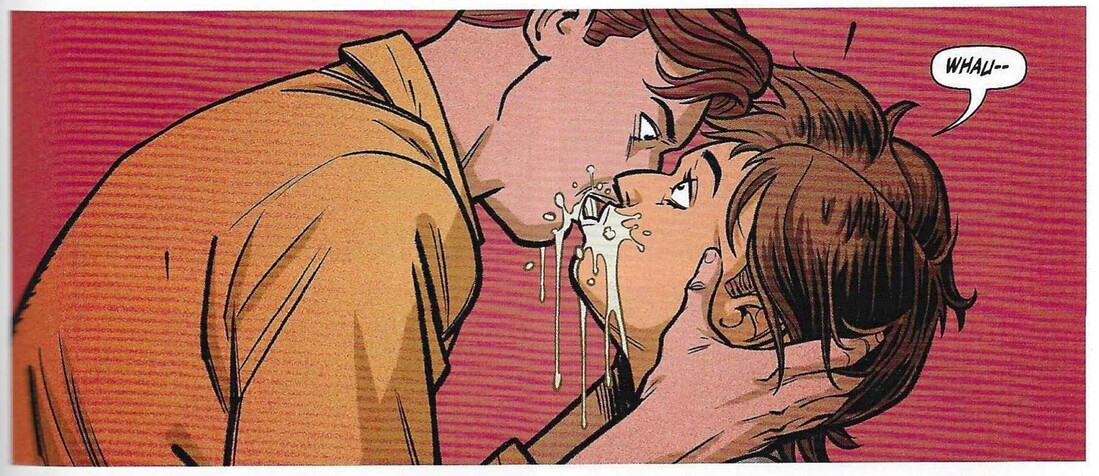
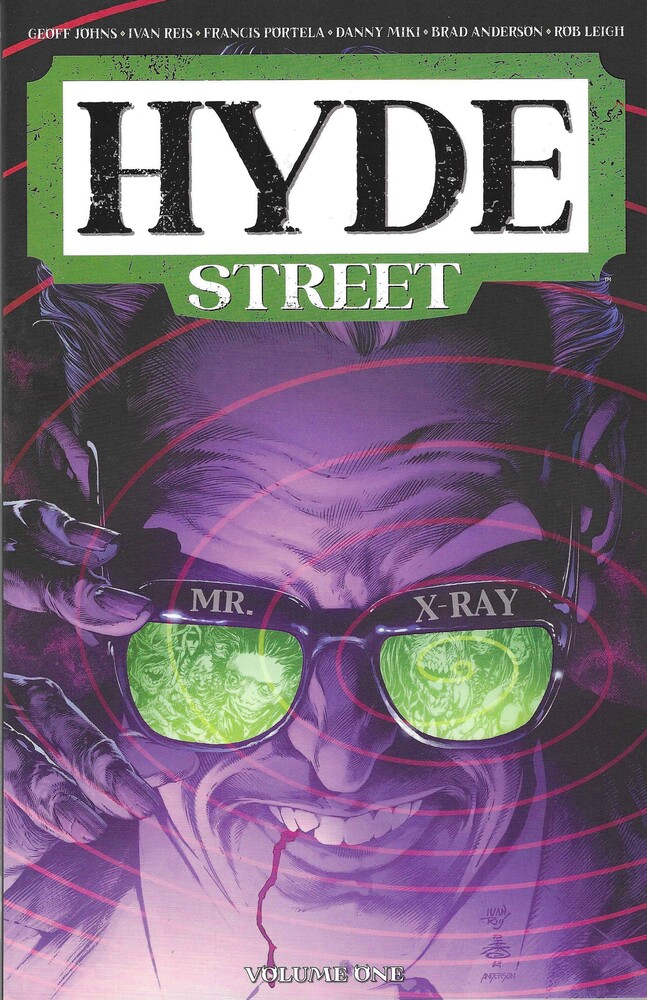 Hyde Street volume 1 by Geoff Johns (writer), Ivan Reis (penciler), Francis Portela (artist), Danny Miki (inker), Brad Anderson (colorist), Rob Leigh (letterer), and Brian Cunningham (editor). $14.99, 171 pgs, Image.
As this confusing time in our country’s history continues, as I’m actually a fan of Geoff Johns now and it’s forcing me to question all of my life’s choices, we get the latest trade from Ghost Machine, which is his nasty little horror book set on a street where bad people deliver souls to a mysterious “Scorekeeper” so they can leave the street. There are a bunch of them, and they usually end up delivering really ugly souls — a woman who poisoned her daughter and husband; a serial-killing cop; a thief dressed as Santa Claus; a group of obnoxious (and, as it turns out, heartless) tourists; a different serial killer. Despite this, it’s still less unpleasant than a lot of Johns’s superhero comics, which confuses me. Anyway, our protagonists are Mr. X-Ray, who cared more about selling crappy products to people than his own daughter; Pranky, a vicious Boy Scout who loves being on Hyde Street; Oscar Oddman, who was about to play Frankenstein’s monster in a Abbott and Costello movie before circumstances took him to the street; and Glee Goodbody, who drove a woman to her death as an aerobics instructor in the 1980s. There are others, but those are the main ones in this volume. As we discover, Pranky has more than enough souls delivered to leave the street, but he has nowhere to go and he enjoys being sadistic to the people who wander onto the street, so Mr. X-Ray is trying to come up with a scheme to take him out, because Mr. X-Ray very much wants to leave so he can find his daughter. Oscar, meanwhile, doesn’t want to play the Scorekeeper’s game, so he has delivered no souls and he stops Pranky from doing it when he can. Glee, meanwhile, is trapped in her health store by some kind of crippling anxiety, but she’s managed to come close to the number required to leave and is also angry at Pranky for “stealing” some from her. Johns gives us nasty retribution, sure, but what’s interesting about the book is that the people doling out the punishments, as horrible as they’ve been, have a lot of pain in their past or they’re desperate to be better, so they’re not just torturers. Even Pranky, who’s very malicious, isn’t completely irredeemable, and that makes this more psychologically satisfying than if the book had just been evil people wrecking other, more evil people. Johns obviously has a long-term plan for the book, and it’s more interesting than you might expect. Reis is a terrific (if slow) artist, and he does very good work here, creating a rich, full world of Hyde Street, using softer pencils and Anderson’s rendering to create a nice, nostalgic world (there’s a terrific homage to Norman Rockwell in the book) that belies the evil beneath (and on) the surface. Portela draws issues #5-6, which feature Glee Goodbody’s story, and his sharper, crisper lines seem to fit the 1980s timeframe a bit better, and while I’m sure Portela was there because Reis was unable to keep up, I wonder if Johns made sure that if he needed a fill-in, he got Portela for that particular story. It seems to work with his harder artwork a bit better than it might with Reis’s softer pencils. I dunno.
Anyway, it’s another good comic from Johns and Ghost Machine. I know, I’m as disturbed by it as you are!
Rating: ★ ★ ★ ★ ★ ★ ★ ½ ☆ ☆
One totally Airwolf panel:

 Into the Unbeing volume 2 by Zac Thompson (writer), Hayden Sherman (artist/colorist), and Jim Campbell (letterer). $19.99, 107 pgs, Dark Horse.
I didn’t love the first volume of this series, but it was kind of keen, so I figured I’d get the second (and final, it seems, although it does end with a bit of a tease for more) volume and see what’s what. Thompson doesn’t quite explain everything satisfactorily, and it devolves a bit to a big fight against the freaky monsters, but it’s still pretty decent. The first issue, in which we learn the “secret origin” of the weird thing Hildur met inside the giant fossilized body, is even creepier and weirder than the earlier chapters, and Thompson keeps piling on after that, as out heroes keep coming across weirder and weirder shit as they try to get out of the body. Unfortunately, as I noted, it ends in almost a big “superhero” fight, which is fine but somewhat unimaginative, and then Thompson gives us a bleak-as-fuck stinger at the end to let us know that, yeah, shit is bad. I mean, I get it — shit is bad — but the way Thompson kind of tacks on an explanation without really exploring it makes me wonder if the book got canceled and wasn’t planned to be this short (8 issues). I mean, it could have been 9 or 10 and Thompson could have added a bit more context, but who knows what’s going on at Dark Horse HQ in beautiful Milwaukie, OR. Anyway, Sherman, as usual, is stupendous on art, using panels that look like they exist inside a body, as they bend and mold them to fit the creepiness of the story. The monsters Sherman creates are weird and wacky, and they have a nice penchant for making the quiet stuff as terrifying as the bolder stuff. Sherman has been working hard recently, and it’s very cool to see, because their art is so unique and fun.
I wish this had been better, but such is life. It’s not terrible, just a bit disappointing. But the art is cool!
Rating: ★ ★ ★ ★ ★ ★ ★ ☆ ☆ ☆
One totally Airwolf panel:

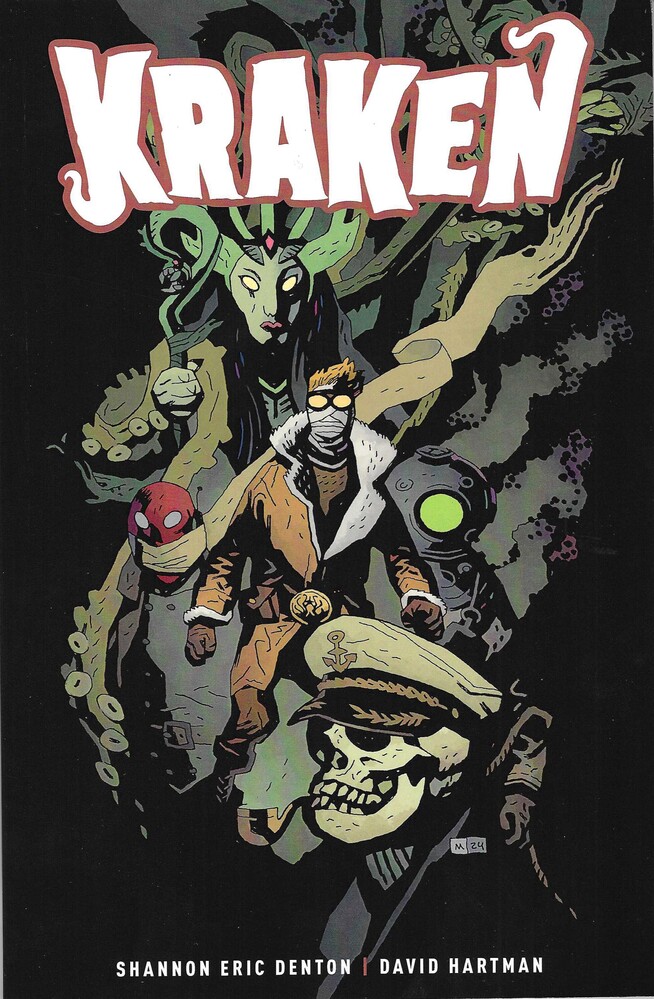 Kraken (volume 1?) by Shannon Eric Denton (writer), David Hartman (artist), Kristen Fitzner Denton (letterer), and Ibraheem Kazi (editor). $17.99, 104 pgs, Titan Comics.
You’d be forgiven for thinking this is part of the Hellboy-verse, based on the fact that it’s set in the 1930s and features some weird supernatural stuff and that Mike Mignola drew the cover, but it’s not, and that’s fine. You’d also be forgiven for thinking this is an Atomic Robo comic without the Atomic Robo — it’s not quite as funny as that book, but it has a lot of the same elements, but a story set in the 1930s with adventurers and supernatural weirdness didn’t originate with Atomic Robo, so we shouldn’t hold that against Denton. (N.B.: I really miss Atomic Robo.) In 1931, adventurers led by Captain Kraken and his wife (Kraken’s first name, which only gets used once, is “Dale,” which kind of cracks me up, and his wife is named Jen, but she’s not in the book all that much) are fighting against the weird Baron Black and his pirates in the Pacific somewhere, and when Kraken tries to escape, he flies into a weird portal that the Baron opens in the sky. Oh dear. Three years later, he returns, but he’s been changed a bit — Denton makes it kind of clear what happened to him but also keeps it coy for a while, so I won’t spoil it. He wants to get back with his wife, but he also wants to get Baron Black because he’s not sure how his wife will handle his changes. He and his friend Luis team up with other adventurers (lots of adventurers wandering around the Pacific in the 1930s), and they thwart a kidnapping scheme of the Baron’s and his mistress, an even more powerful supernatural entity. Oh, and there are Nazis, of course. The back-of-the-book blurb makes it sound like the Nazis are behind the kidnapping scheme, but they’re really more just adjacent to it — still evil, but not the drivers of it. It’s a fun adventure — there are monsters, and weird dimensions, and a talking pirate head (that speaks in EC-type script, which is a clever touch by Denton’s wife, who letters this), and lots of action. Hartman (who is not, I have it on good authority, this guy … and dang, he’s 90 years old these days!), does a nice job with the art — he has a clear, somewhat angular style, and he does some fun things with perspective during the action scenes that make them more interesting. He designs some neat monsters, using some rougher lines and a bit more hatching to make them look more out of place in the world, which of course they are. It’s not great art, but it’s pretty good, and that’s fine.
Denton can’t get to everything in this volume, so the final few pages set up another story, and I will get it, not only because I like Denton personally, but because it’s a fun comic. I hope to see it soon!
Rating: ★ ★ ★ ★ ★ ★ ★ ☆ ☆ ☆
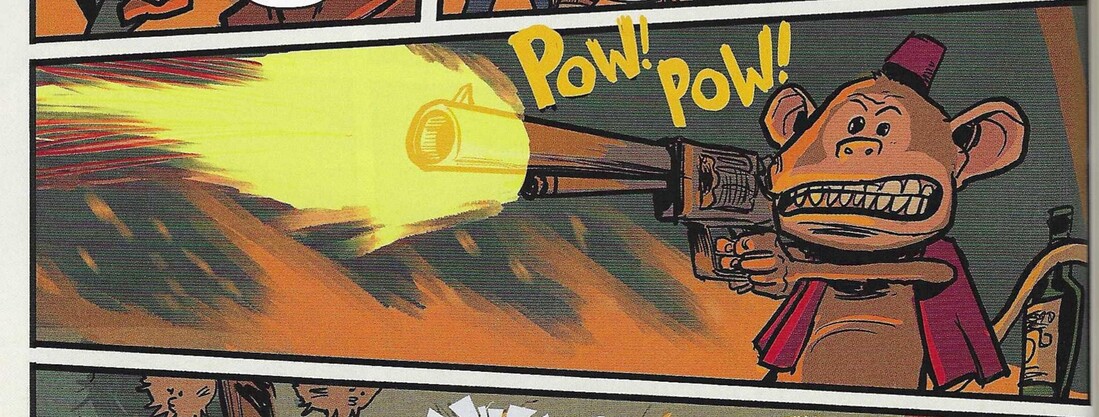
One totally Airwolf panel:
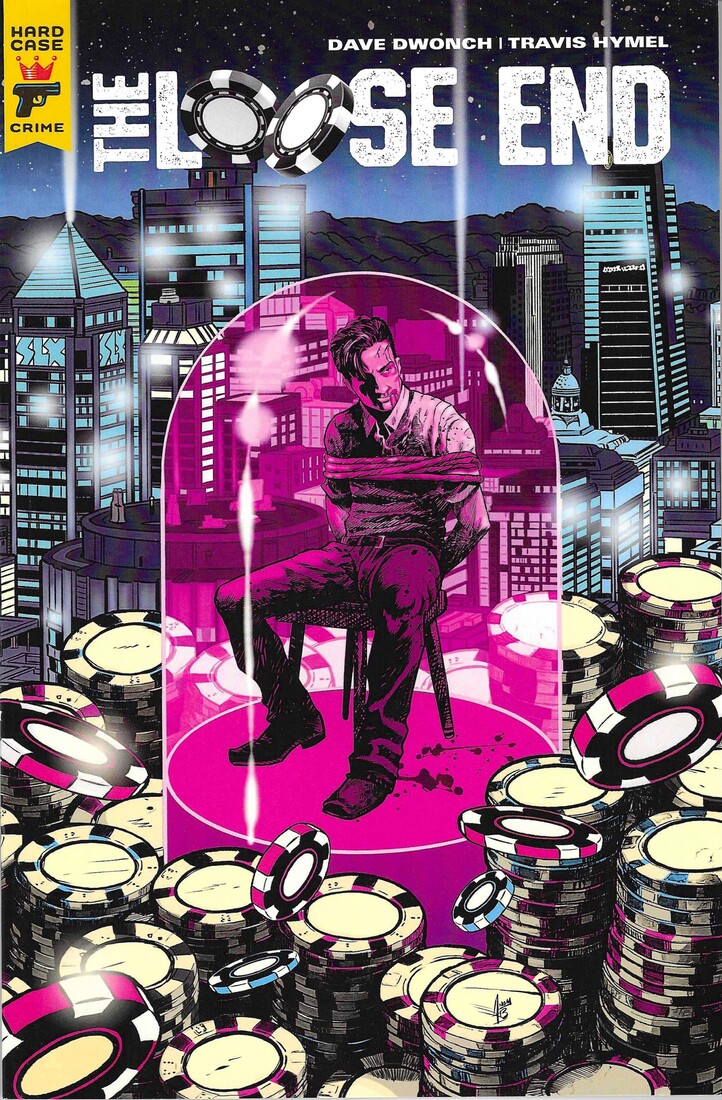 The Loose End by Dave Dwonch (writer/letterer), Travis Hywel (artist), Geraldo Filho (colorist), and Charles Ardai (consulting editor). $17.99, 100 pgs, Titan Comics.
Dave Dwonch doesn’t do that many comics (or, if he does, I’ve just missed them, but I’m friends with him on Facebook, so I do keep up with his work to a degree), but he’s a good writer who always has a lot of fun with the comics he does write. This book is a more savage satire of Hollywood than it first appears, and it’s very cynical, too, which actually keeps it from being quite as good as it could be, because it gets pretty dark in places, and it jars with the overall tone a bit too much. Still, it’s a pretty fun crime thriller. Our protagonist, Steven, can’t get a real job in Hollywood as a screenwriter even though his best friend, Diedrich, has become a big star. Steven gambles too much, and he gets in debt to a crime boss who wants him to kill a producer for him because the producer raped the crime boss’s daughter. Diedrich has invited Steven to a weekend party in Mexico with the producer and some of his friends, and Diedrich tells Steven it’s his chance to get a meeting with the producer … of course, only Steven knows that he’s supposed to kill the producer, after which the crime boss will forgive his debts. It all goes sideways, of course, because the Hollywood dudes want more cocaine and they end up shooting it out with the drug dealers, who work for a very powerful cartel boss, who now wants to kill them all. It’s all action, all the time!
As I noted, it’s a pretty good satire, as Dwonch does a nice job making these guys both complete douchebags and actually pretty competent at getting out of trouble because they’ve been “practicing” it for years. In a few instances, they go “Home Alone” on some bad guys, and it works pretty well. It can be a funny book, too — the reason they get in a shootout with the drug dealers is both funny and extremely stupid, and it happens because of the douchebaggery of the Hollywood people, something about which they can’t seem to help. Steven is along for the ride, trying to be the good guy but always giving in to his demons, and he’s also not as adept at fighting back because he’s just a writer instead of an action star (implies Dwonch, the writer — see? very cynical). There are some nice twists and turns, too, leading to a evilly cynical ending, which feels both depressing and right, because that’s how Hollywood works. The reason I don’t love it is because the producer is truly a vile person, but once the cartel boss shows up, it’s like we’re supposed to forget about that and cheer for him, because he’s a silly white guy being menaced by swarthy people? I don’t know — you don’t really root for any of the Hollywood types in the book, because they are assholes, but at the same time, they face something even worse than their dickery, so we hope they get out? It’s a weird tone, especially because the producer is, as I noted, such a vile person (Dwonch is not a white guy, by the way, so it’s not like he’s just defaulting to “white guy = good” … or “white guy = bad,” either). Anyway, other than the producer, the other guys are just standard fratbro assholes, so it’s fun to see both bad things happen to them and to hope they can get away. They’re like a bunch of Rob Gronkowskis. You may think Gronk is a bit of an asshole, but you don’t want to see the cartel bury him up to his neck in the desert, do you?
So, it’s a fun action comic. Hywel’s art is serviceable but unspectacular, and Dwonch has a jaundiced view of everyone who works in Tinseltown, clearly (even though he, you know, does). It’s worth a look!
Rating: ★ ★ ★ ★ ★ ★ ★ ☆ ☆ ☆
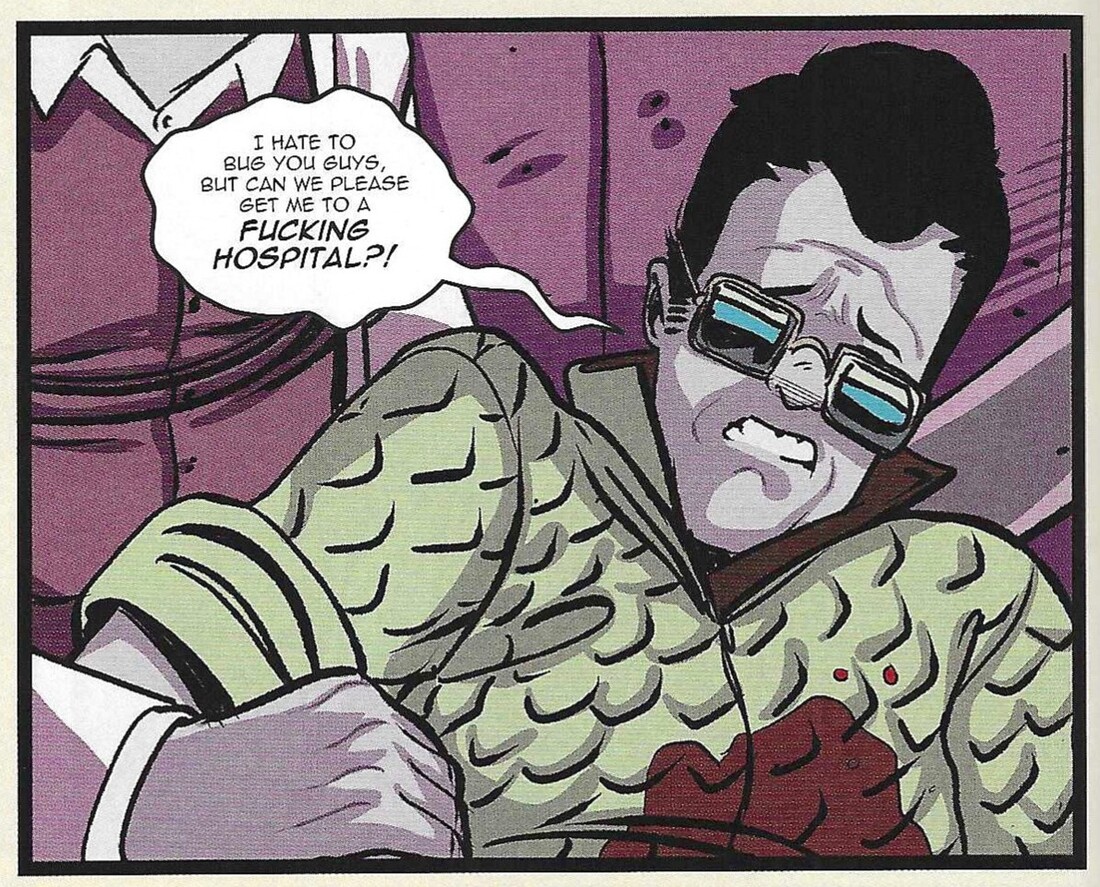
One totally Airwolf panel:
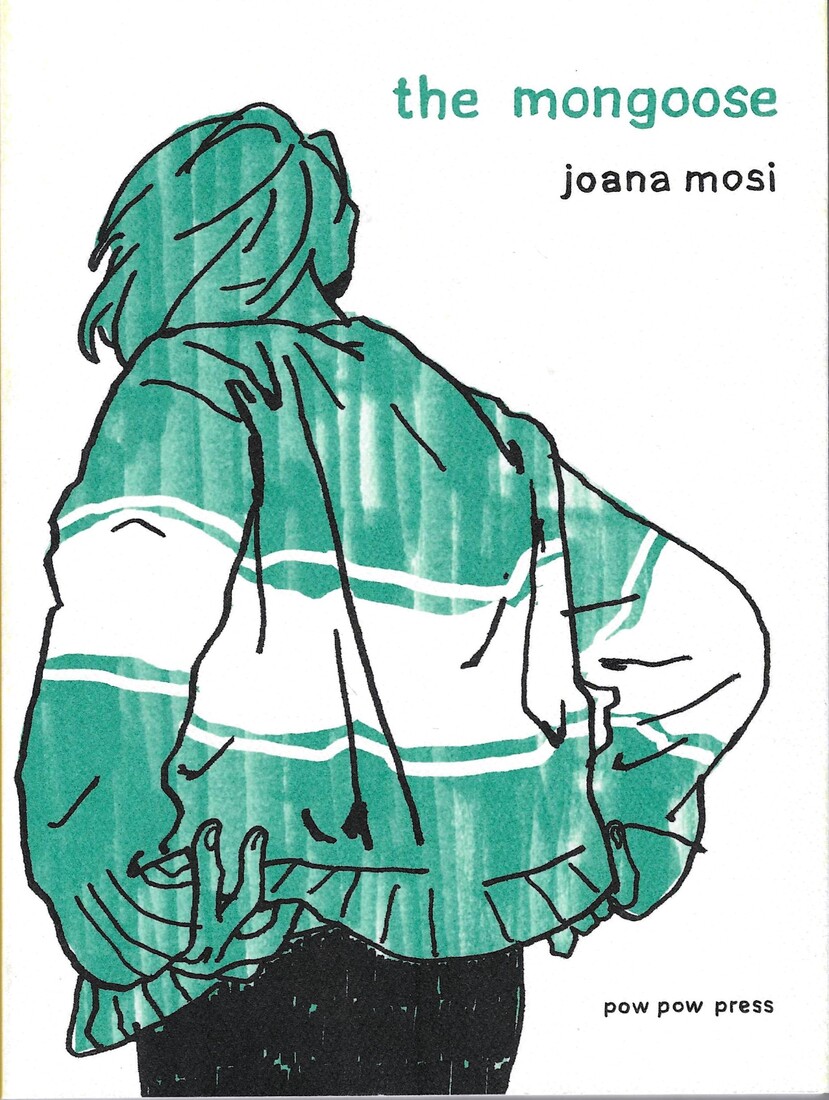 The Mongoose by Joana Mosi (writer/artist). $29.95, 184 pgs, Pow Pow Press.
Up above, Forrest Molson dealt with grief by stealing superpowers and becoming a vigilante. In The Mongoose, Júlia deals with in a very different way: by trying to rid her garden of a mongoose … which may or may not exist. The Mongoose is a “realistic” book, though, so of course it’s not going to involve superpowers!
This book takes place in a small seaside town in Portugal, where Júlia has retreated after the death of her husband (we don’t learn this for a while; we only know there’s been a tragedy in the family). She tends a small garden, but at the beginning of the book, something has torn it up, and Júlia becomes convinced it’s a mongoose. Now, I don’t know about you, but I associate mongooses almost exclusively with India thanks to “Rikki-Tikki-Tavi,” but apparently you can find them in southern Europe, as Júlia tells anyone who will listen. She lives with her brother in the house they grew up in — her mother lives elsewhere, and it’s clear returning to her childhood home is supposed to be therapeutic for Júlia — and she doesn’t deal with her grief. Her mother is motherly, of course, and while her brother sits around and plays video games all day (it seems that he was a designer at some point, but it also appears that the video-game world might have passed him by), Júlia thinks about how to get rid of the mongoose. Her mother and other relatives aren’t terribly sympathetic to her plight, and even her brother, who’s kinder than the others, gets a bit annoyed with her quest, especially because she hasn’t actually seen the mongoose. She’s a teacher, and she does eventually go back to work, but she’s distracted, of course. It’s a big ol’ metaphor, naturally, but Mosi does a good job with it. Júlia talks around her issues, deflects when anyone comes close to it, and finally has to deal with it. Even then, Mosi keeps it low-key, which makes it more effective, and leaves things ambiguous at the end, as life is. Júlia doesn’t completely deal with her grief, nor does she trap the mongoose. Does she get confirmation that it is a mongoose? Well, that would be telling, wouldn’t it? The book, like grief, lingers, because Mosi understands that even dealing with such a catastrophic event doesn’t make it go away, and Júlia — and the rest of us — have to accommodate this new reality. Life goes on, to coin a phrase.
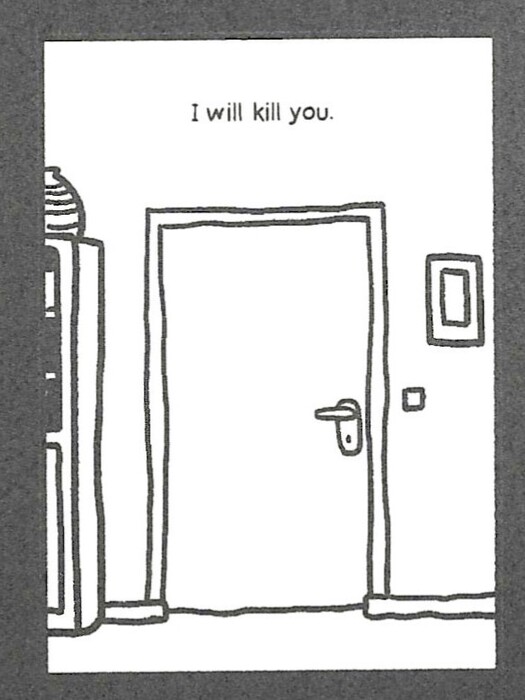
The book flap quotes a review describing Mosi’s “pictogram-like graphic approach,” which isn’t a bad way to discuss her art (they also compare it to Chris Ware, but we don’t need to deal with that). Her line art is somewhat simplistic — a thick, bold line with almost no hatching and basic black and white, and she often draws characters’ faces with no or very minimal features, but it’s not rudimentary. The layouts are superb, as she draws out the small moments of tension between Júlia and her mother, for instance, using small panels to focus on seconds between words and other small body movements of the characters. She loses Júlia’s features occasionally (except for her pinprick eyes) to show the distance between Júlia and what we would consider “reality” — she’s been checked out for a while, and when she has to engage with the banality of life, Mosi shows that she is not interested. She often faces the characters away from the “camera,” as well, which also distances the reader — or Júlia — from them, and it’s a clever trick. The mongoose — such as it is — is the most detailed thing in the book, as Mosi drops in panels of the creature at certain places and makes it scratchier and rougher than everything else in the book. It dominates Júlia’s mind, so of course her perception of it would be more detailed than the rest of the book. There are moments when Mosi switches to gray washes, and it’s a good shift for what’s going on in the book at the time, so it hits hard. It’s not quite “beautiful” art, but it’s impressive how well it gets the job done.
The Mongoose is a nifty comic. It gets under your skin and makes you think about how we live, which is never a bad thing. Comics make you think, people!
Rating: ★ ★ ★ ★ ★ ★ ★ ★ ☆ ☆
One totally Airwolf panel:
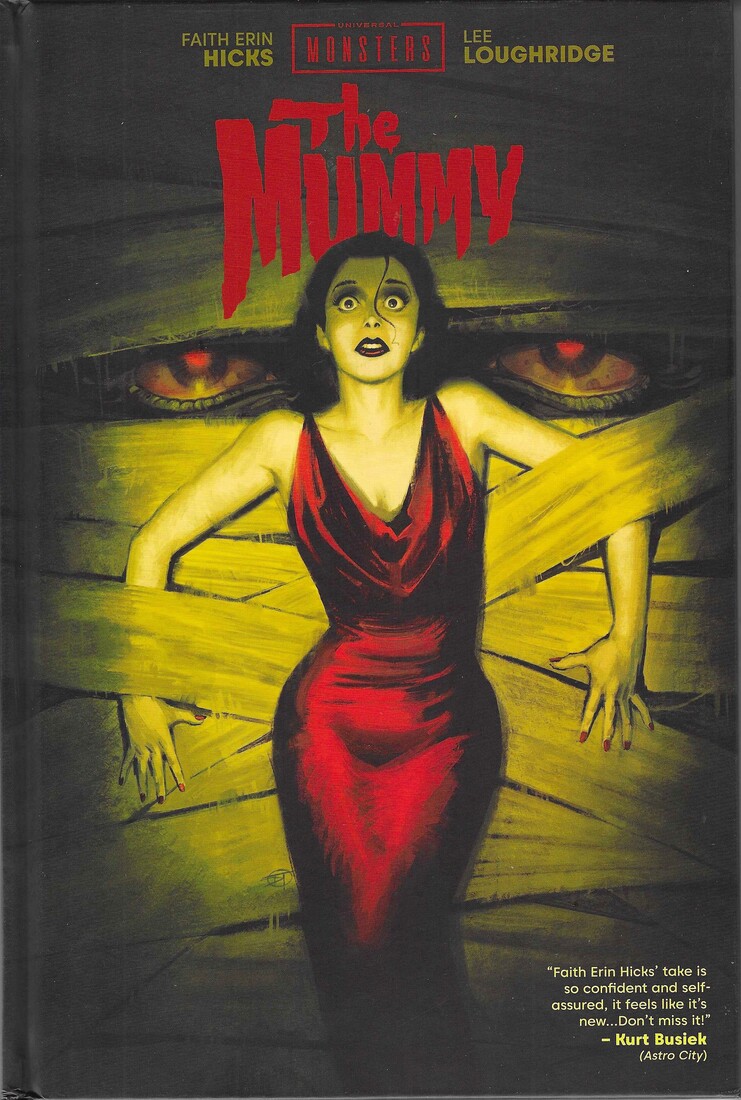 The Mummy by Faith Erin Hicks (writer/artist), Lee Loughridge (colorist), Hassan Otsmane-Elhaou (letterer), and Alex Antone (editor). $24.99, 98 pgs, Image.
I still haven’t seen the Boris Karloff movie, but that’s why Wikipedia exists, and it seems like this is pretty much a note-for-note telling of the movie, although there’s some stuff from Helen Grosvenor’s childhood that may or may not be in the movie. I’m not entirely sure what to say about it — Imhotep gets resurrected, a decade later he discovers that Helen exists and she bears a resemblance to Ankh-Es-En-Amun, so he tries to force his paramour’s soul into Helen’s body (Ankh-Es-En-Amun is sort of already in her body, so she’s more than willing to help Imhotep). Foolish mortals get killed, Helen fights back, the mummy isn’t a mummy all that much (you gotta show Karloff’s handsome mug!), and all’s well that ends well. Hicks is a decent writer, but she doesn’t quite need to do too much here, and her art seems like it wouldn’t be a great fit for a kind of Gothic horror, but it is a bit of a romance, so her softer, more rounded line works pretty well for the story. Her 1920s/1930s Egyptian aesthetic is very good, which is nice. It’s a pretty good comic. I guess there’s not much more to say.
Rating: ★ ★ ★ ★ ★ ★ ★ ☆ ☆ ☆
One totally Airwolf panel:

 Olympos: Nullhunter by Michael Walsh (writer), Gustaffo Vargas (artist/writer, issue #7), Aaron Losty (writer, issue #8), Laura Dragon (color flatter), Artyom Trakhanov (spot illustrations), Becca Carey (letterer), and Chris Hampton (editor). $21.99, 231 pgs, Image.
This was released as just Nullhunter, but for some reason, Image released the trade with the “Olympos” as a prefix, and I’m not sure why. It’s a sci-fi rendering of the Labors of Hercules (or Herakles, if you’re old-school), which is fine, but did Walsh and Image think that “Nullhunter” didn’t reflect that, so they added the “Olympos”? But that doesn’t really explain it either, and are people going to buy this because it’s a sci-fi rendering of the Labors of Hercules? I doubt it. Anyway, this is entertaining, but that’s about it. Clay is a soldier for a planet-spanning empire called Olympos (his boss is called “Zays,” which is, you know, Zeus), and at the beginning, we find out his wife and son are dead and he might have killed them? I mean, Hercules did it, and Walsh implies that it happened the same way, but there’s also some hints that it’s something else. Anyway, he’s messed up, but of course this is a sci-fi story, so they fix him up and give him all sorts of robotic attachments and turn him into a superhero, and then Zays sends him out on missions that look suspiciously like the Labors of Hercules. Eventually, Clay figures out that maybe something hinky is going on with Zays and his family, so he does something about it.
As I noted, it’s a decent enough entertainment. Walsh does some clever things to transfer the mythological creatures to a futuristic setting — the Hydra is a bunch of dudes who are linked to a single dude’s consciousness, for instance — and he does some fun things with where Clay goes, like they go to the planet N3M-3A to fight the lion of “Nemea.” I’m not sure why Walsh didn’t write issues #7 and 8 — they’re not significantly different in tone from the rest of the book — but the comic moseys along nicely, with Clay fighting very tough foes and overcoming tough odds. Vargas’s art is very nice — this galaxy looks a bit clunky and ragged, which fits the tone of the book nicely, and his action scenes are nicely choreographed. He uses some interesting page layouts, too, which is nifty. The book is crowded with nice details, and there’s a good, lived-in feel to the various places. Vargas does a really nice job creating the various creatures so that they look vaguely like their mythological analogs but still fit into the sci-fi setting, which is a nifty trick.
Walsh has written some cool things, and there’s nothing really wrong with this story. It’s just a bit predictable — even Clay’s final conflict with Zays, which Walsh tries to make a bit different, fits into a standard trope situation. Nullhunter is fine, but it feels like it could have been more epic, and it just isn’t. Too bad.
Rating: ★ ★ ★ ★ ★ ★ ★ ☆ ☆ ☆
One totally Airwolf panel:
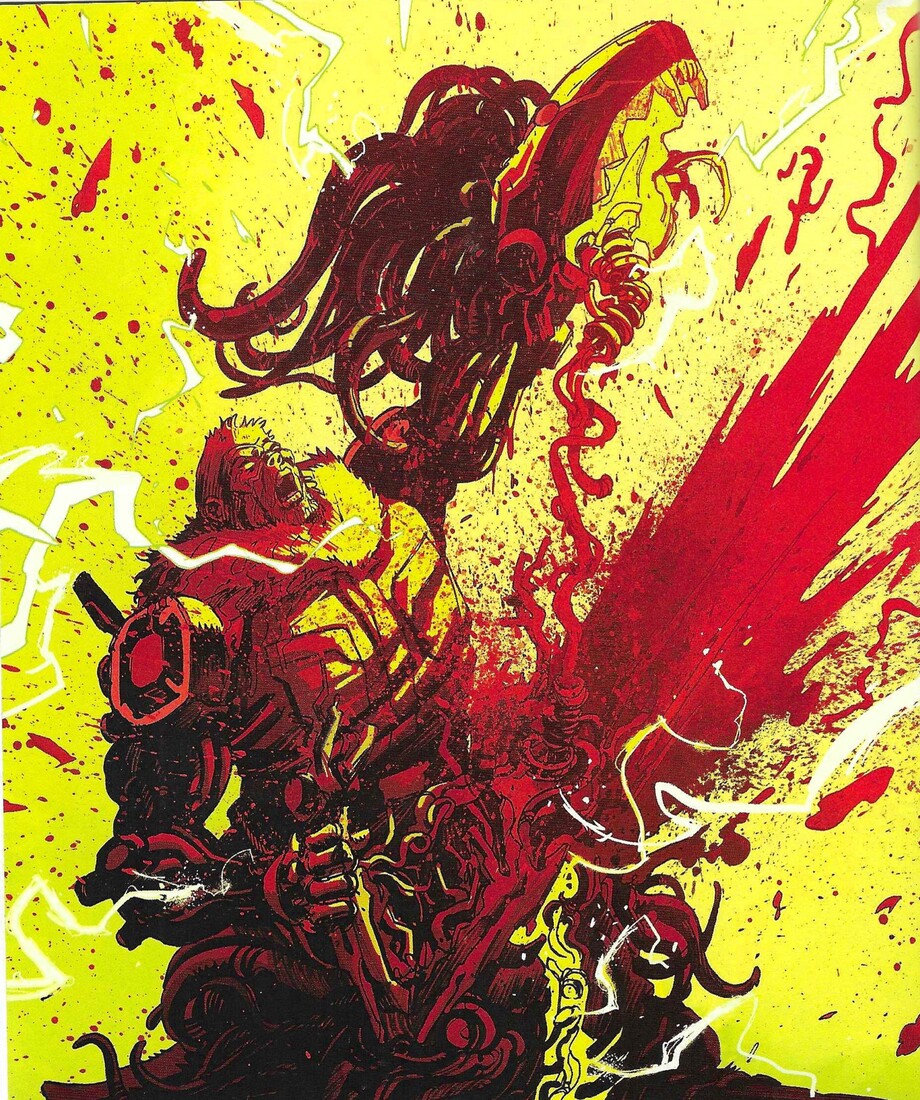
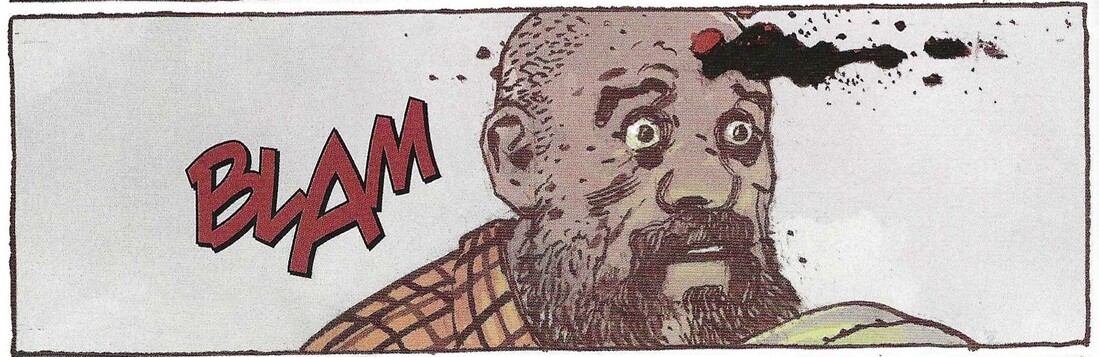
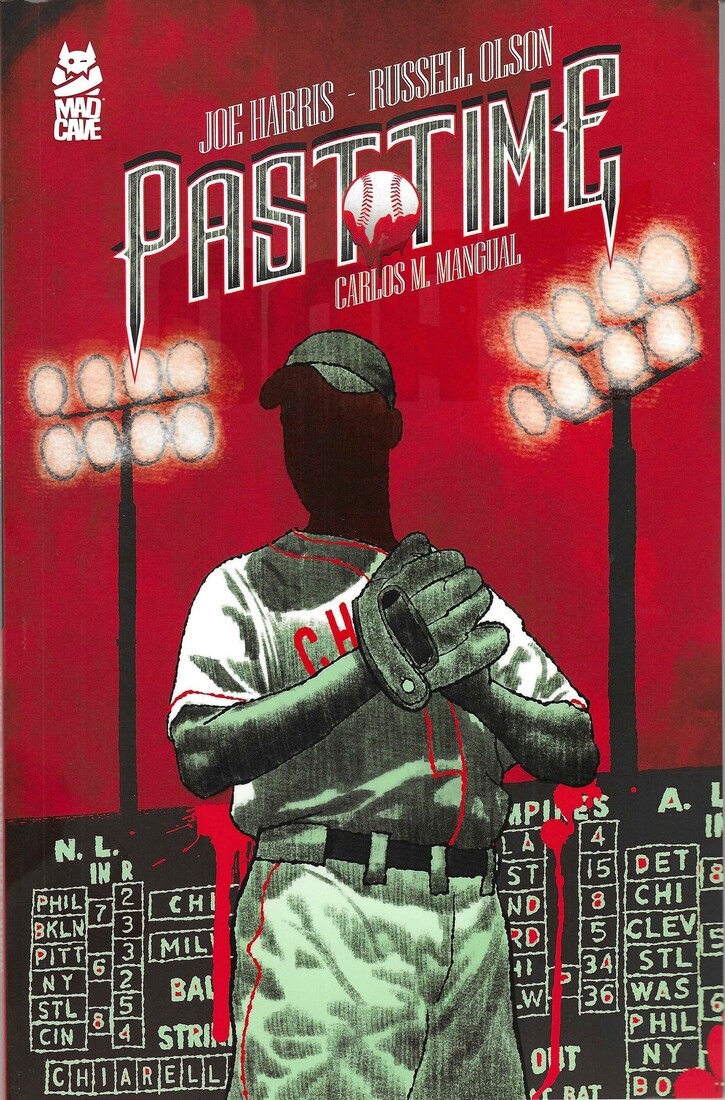 Past Time by Joe Harris (writer), Russell Olson (artist), Carlos M. Mangual (letterer), and Mike Marts (editor). $17.99, 122 pgs, Mad Cave Studios.
Harris gives us an interesting story, as we begin in 1988 with a sportswriter interviewing an elderly, blind, black man on the first night that lights were used at Wrigley Field in Chicago (a game against Philadelphia that got rained out). The writer is interviewing the old dude about a guy called Henry Hayes, who dominated a barnstorming circuit in the early 1920s and then disappeared. His subject, Ronny, knew the dude, and he tells his story to the writer. Henry, it turns out, is a veteran of World War I, and in the trenches, he was turned into a vampire. He tries to resist the vampirism inside him, but he can’t, and he’s trying to live his life, and he thinks playing night baseball will help him out. The barnstormers are playing under the lights in the 1920s — it didn’t come to the major leagues until the 1930s (the Phillies also played in the first night game in MLB history), but the technology was there earlier — and Henry hooks up with a team and turns out to be an excellent baseball player. Ronny finds out about Henry and tries to get him to leave, because Henry brings bad stuff with him, but, of course, it’s not going to be that easy!
It’s a fun monster story, and Harris does a nice job making Henry sympathetic — the dude didn’t want to be a vampire, and now that he is, he can’t help do some evil things, people! Ronny is an interesting character, because he understands Henry’s situation fairly well, being a black man in the 1920s, but he also doesn’t want him to go around drinking blood from innocent people. The baseball stuff is pretty well done, too, as I always think it’s funny when writers don’t know the sport they’re writing about and get some small details wrong, but Harris seems to know the game pretty well (a character that comes to scout Henry is named “Stengel” and is hanging out in the Polo Grounds in 1923, which makes me think Harris knows his history), and the sports scenes are neat. Olson does a decent job with the artwork, and he does a good job hiding the violence, as Henry himself is ashamed of what he is, so Olson makes sure it’s all in the shadows. He uses a thick, rough line with good spot blacks, and Olson does a nice job making it feel like a rough barnstorming tour across the Midwest. His sports scenes work pretty well, too, so that’s nice. Overall, this is a an entertaining comic that has a nice twist on the vampire story. Nothing wrong with that!
Rating: ★ ★ ★ ★ ★ ★ ★ ½ ☆ ☆
One totally Airwolf panel:

 Phantom Road volume 3 by Jeff Lemire (writer), Gabriel H. Walta (artist), Jordie Bellaire (colorist), Steve Wands (letterer), and Greg Lockard (editor). $14.99, 100 pgs, Image.
I know this might sound like damning with faint praise, but it’s kind of impossible to review individual trades of Phantom Road, much less individual issues. It’s clear that Lemire has a big ol’ plot in mind, and all we can do is see if he pulls it off, and then we can judge the entire work. Most comics these days do that, sure, but they don’t go for quite as long a burn as Lemire has done for this book, so we can deal with the incremental stuff a bit more. Not Lemire, though — he has his MacGuffin, he has his characters, they’re on a quest, and all we can do is follow along with them. If you dig the quest, you’ll probably stick with this to the end, and if you don’t, you probably bailed already, because it’s not like it’s changed all that much since the first few issues. This collection, for instance, goes back to 1977 and FBI guy Donald Weaver, the father of our protagonist, and we find out how he became involved with the weird “Road in the Other Dimension” that Theresa Weaver has been dealing with for the first ten issues. I mean, it’s a nifty story, and it’s good to get some history, but I don’t know if it needed to be an entire arc, but again: slow burn. It’s still an intriguing horror mystery, and Lemire brings it back around to the present in the final issue, and we’re ready for more! Walta and Bellaire continue to do good work, and I’m just going to wait for the next trade. There’s just not that much to say about it!
Rating: ★ ★ ★ ★ ★ ★ ★ ☆ ☆ ☆
One totally Airwolf panel:


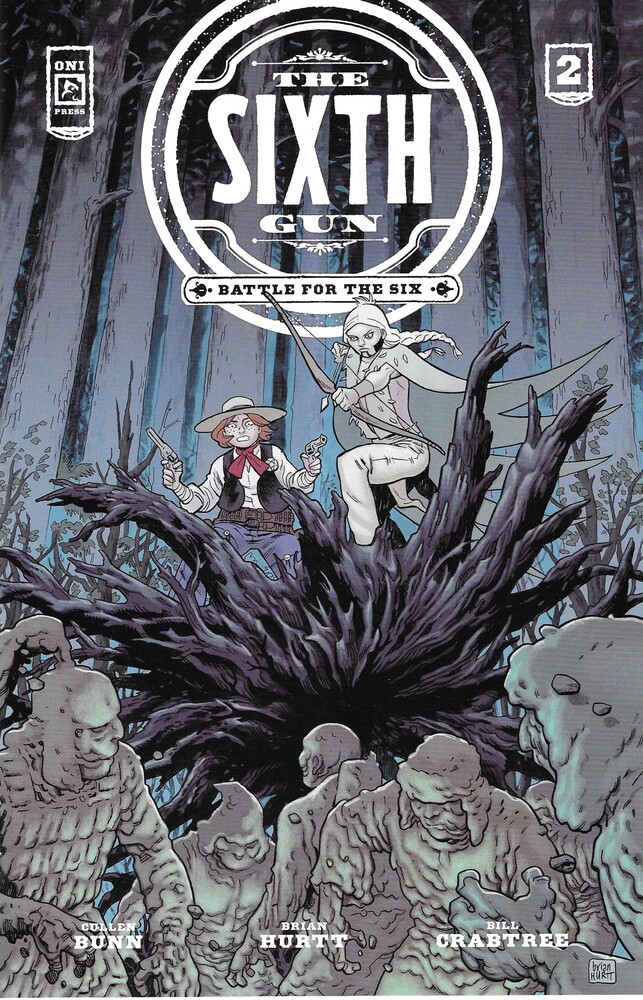

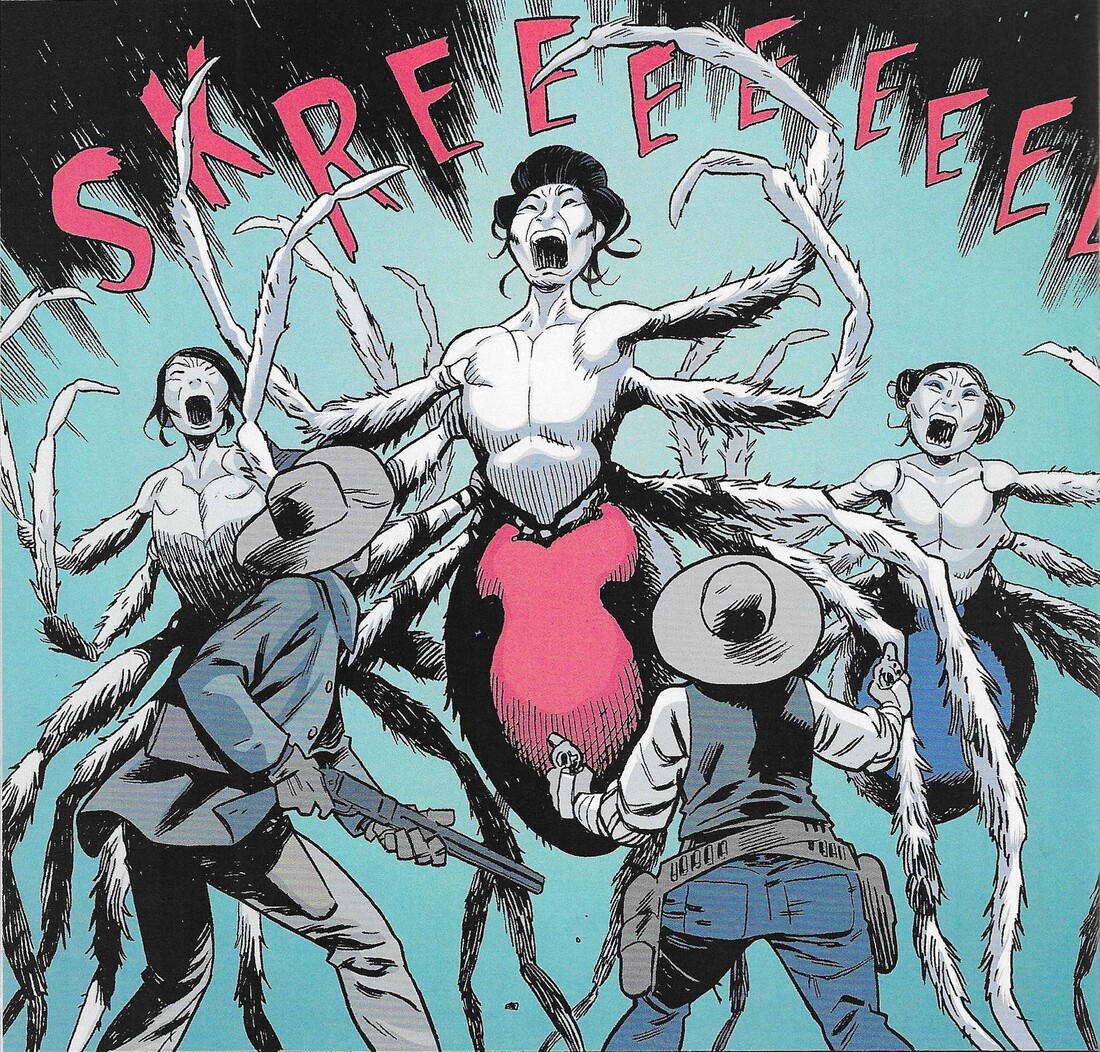
The Sixth Gun: Road to the Six #0 and Battle for the Six #1-3 by Cullen Bunn (writer), Brian Hurtt (artist), Travis Hymel (inker, issues #2-3), Bill Crabtree (colorist), Crank! (letterer), Azat Sayadi (assistant editor), and Bess Pallares (editor). $22.96, 114 pgs, Oni Press.
Yes, the price is pretty high — $5 for the zero issue, and $6 for the other issues — but each issue of the “main” story is 30 pages long (which is why, perhaps, that Hurtt needed an inker, and it’s a testament to the fact that I read too many comics that I actually noticed the slight shift in the art — Hywel’s a bit heavier-handed than Hurtt, and Hurtt’s crisp line gets a bit dulled when Hywel comes on to ink; it’s still very nice art, but there’s a noticeable difference), and the zero issue is 24 pages, and the paper stock on the regular issues is very high quality, so there’s that. I get the sticker shock, but at least Oni shows you where the money is going.
The Sixth Gun was one of the better comics of the 21st century, and Bunn was able to end it on his own terms, I assume the way he wanted to, so why he and Hurtt are returning to it is beyond me. I’d say “money,” but then I remember that this is comics and that’s laughable, but maybe? I won’t spoil the end of the first series, but Bunn does have some ideas about what happened next, and there are a few characters from the old series showing up, but also a bunch of new ones, and Hurtt’s art is terrific as always. The six weapons are still a thing, and that’s a bit disappointing, because they were such a thing in the first series, but Bunn does some different things with them, so it’s not just a retread. It’s also clear that this is another epic, so four issue (the zero issue features three vignettes that are introductory and so not completely necessary, but not not necessary, either) is not close to enough to tell this story, which makes me think we’ll get a bunch of short series, each with a nice new #1 issue, every so often. I’m content to wait. It’s hard to really review this, because while it’s full of nice action, it’s also very much set-up, so … it’s good, but frustrating? Sure, let’s go with that.
Rating: ★ ★ ★ ★ ★ ★ ★ ½ ☆ ☆
One totally Airwolf panel:
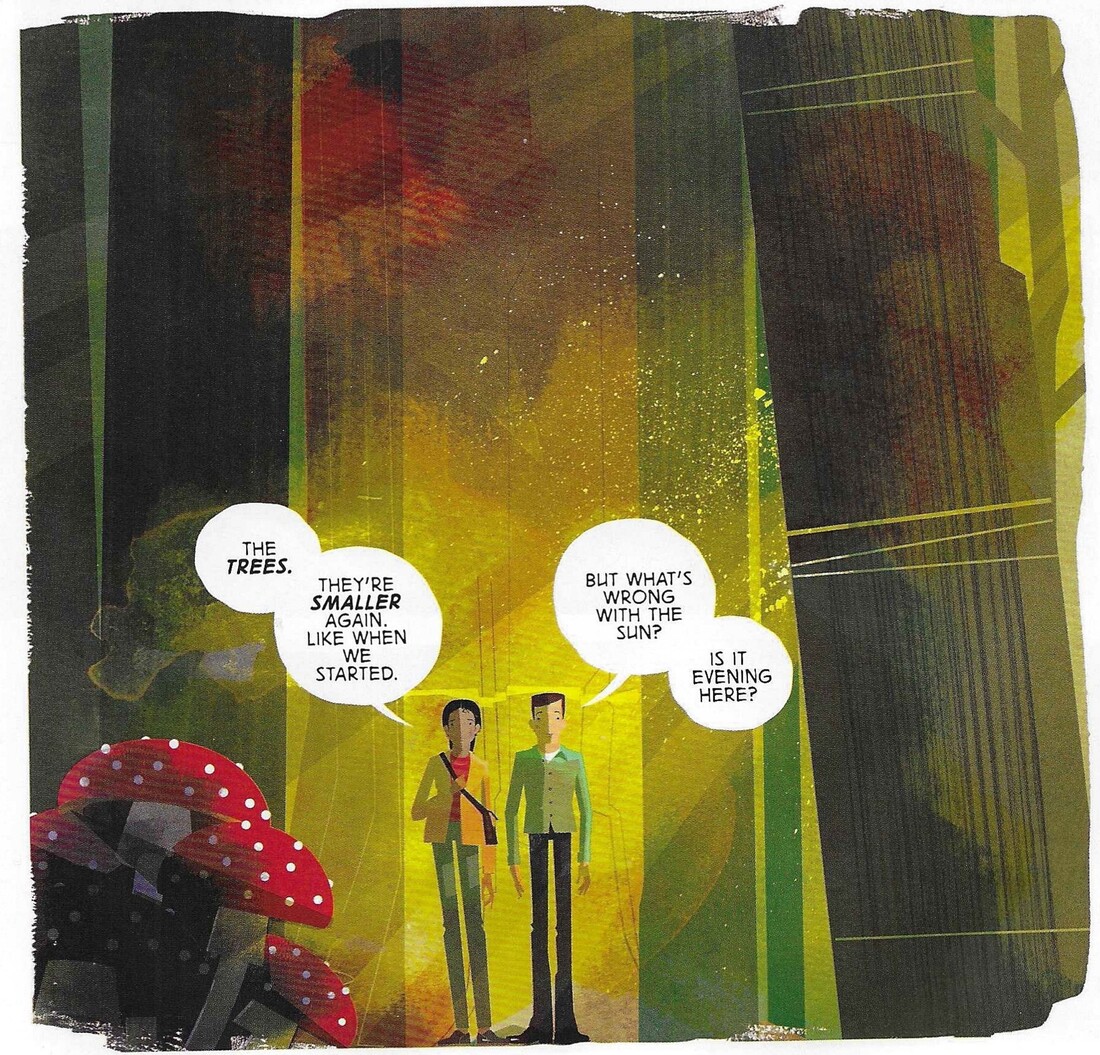
 The Space Between the Trees by Norm Konyu (writer/artist). $19.99, 101 pgs, Titan Comics.
I very much enjoyed The Junction, the last Konyu comic I read (he did a kids’ comic after that, which I skipped), so I was looking forward to this. It’s not as good as The Junction, but it’s still a pretty good creepy story, so that’s nice. He sets the story in the Pacific Northwest, with two people — Mark and Meera, who are there on the cover — driving through the forest visiting homes to see where they want to live and bemoaning the “progress” they see, which means clearing the forest so developers can put up more cookie-cutter houses. Mark mentions that he spent a lot of time in the area when he was a kid (his relatives lived near there), and it’s depressing to see the trees getting chopped down. We think it’s going to be about that, but then the road disappears, their car plunges into the forest, and things get weird, as they can’t find their way out of the woods. I don’t want to give away too much else about the plot, because it’s fun to watch as Konyu unfolds the story and makes it all fit together, but there’s obviously something in the forest, and they have to figure out if it’s malevolent or not or whether it doesn’t care about them at all. It never becomes too dark and depressing, but it doesn’t exactly end happily, and Konyu does a nice job leaving us with lingering questions that are, of course, meant to make us stop and think about What Happened and What It All Means. I don’t always love ambiguous endings, because sometimes they’re too ambiguous, but it feels like Konyu manages to walk that fine line between mysterious and prosaic, and it works quite well.
Konyu’s art, which reflects his animation background, features lots of simple shapes and straight lines, but like a lot of very good artists, he can change the emotion of his characters by making tiny changes, and as Meera and Mark get deeper into the mystery, he does a good job showing how it’s weighing on them. The squared-off housing and the conical pines are a nice contrast between civilization and wildness, and Konyu does it well without cluttering the page too much. His coloring makes the book — so many deep greens and blues, which are set off by the sinister reds that slowly invade the scene, and when the two people experience something odd, Konyu smears the colors a bit to make the moment a bit more unsettling and upsetting. Konyu’s style appears simplistic, but there’s a lot going on in the artwork that makes you appreciate the entire package even more.
It’s another good comic from Norm Konyu. It could be a trend!
Rating: ★ ★ ★ ★ ★ ★ ★ ½ ☆ ☆
One totally Airwolf panel:
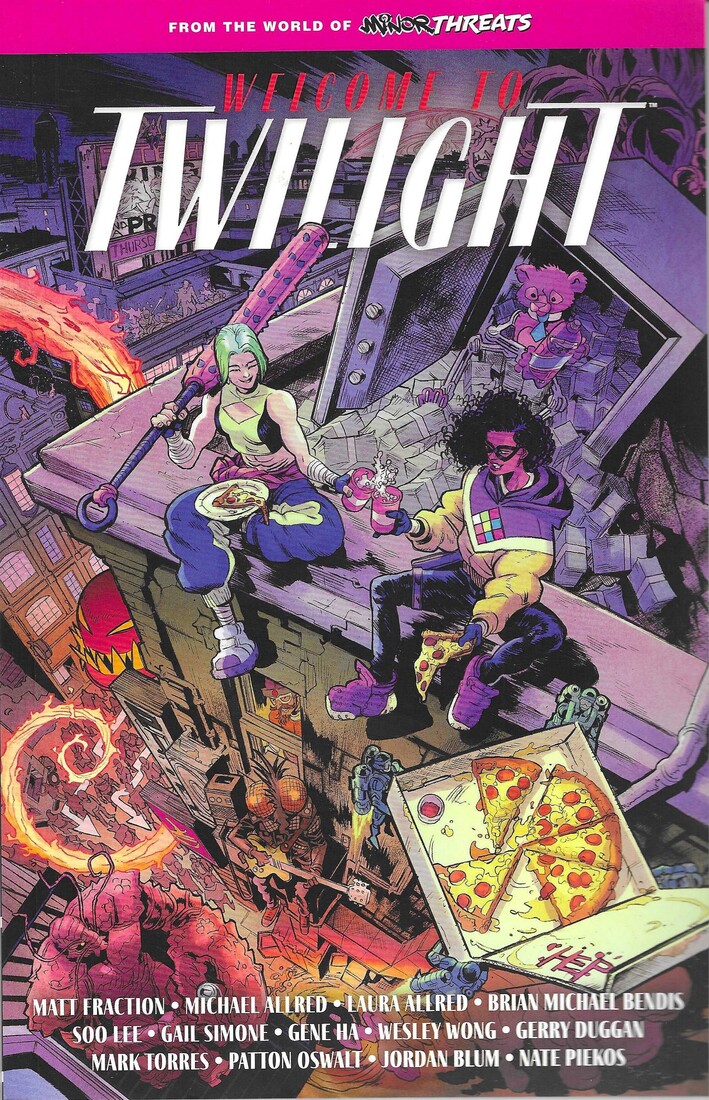 Welcome to Twilight: From the World of Minor Threats by Matt Fraction (writer), Brian Michael Bendis (writer), Gail Simone (writer), Gerry Duggan (writer), Michael Allred (artist), Soo Lee (artist), Gene Ha (artist), Mark Torres (artist), Laura Allred (colorist), Wesley Wong (colorist), and Nate Piekos (letterer). $19.99, 87 pgs, Dark Horse.
This is an anthology set in the Minor Threats universe, and it’s pretty good. Fraction and Allred tell a story of a dude born with wings (but he can’t fly) who becomes an actor and is, in the present, doing appearances to keep making money. He falls in lust with a woman whose husband is a gangster, and he decides to rescue her, which of course goes kind of badly. Two villains who used to be best friends reunite when one asks the other for a favor, and they’re able to rekindle their friendship. A has-been superhero (who happens to be a human-sized lobster) and other has-beens get a chance to be heroes again, and should they take it? There’s a dude who goes around Twilight City cleaning up the messes that supervillains create, and when he gets involved with a person he should probably avoid. The stories are pretty good, and the art is good (I don’t love Lee’s work here, even though I’ve liked her stuff in the past), and like the other Minor Threats books, there’s definitely a sense that these characters are aware of the clichés of the superhero genre. Crab Louie is at conventions, bemoaning his fate, and Simone has some fun with that. The Cleaner has some wacky situations to clean up, but it’s still serious. It’s a fun comic — I wonder how much it’s going to fit into the larger universe (Patton Oswalt and Jordan Blum assisted with plotting, so obviously it’s going to fit in somewhere), but we’ll have to see!
Rating: ★ ★ ★ ★ ★ ★ ½ ☆ ☆ ☆
One totally Airwolf panel:

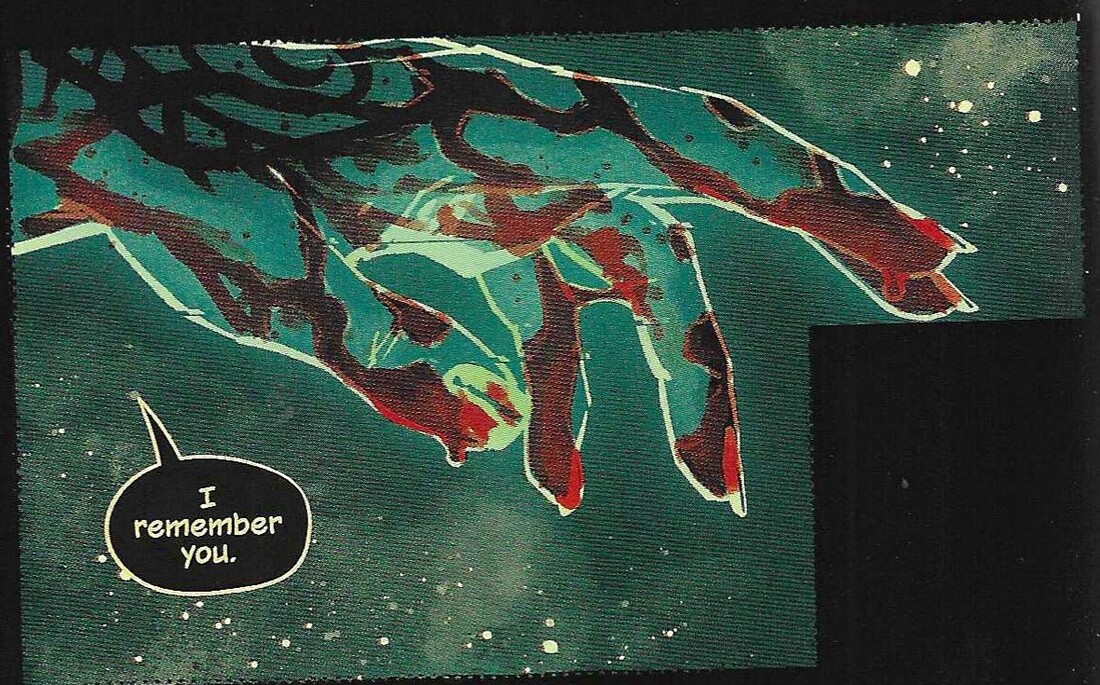
 W0rldtr33 volume 3 by James Tynion IV (writer), Fernando Blanco (artist), Jordie Bellaire (colorist), Aditya Bidikar (letterer), and Steve Foxe (editor). $16.99, 117 pgs, Image.
Speaking of “secret origins showing up in volume 3s of series” (as I was, with regard to Phantom Road), in this volume, we get … the secret origin of Naked Evil Internet Chick! Yay! What’s in the water there at Image, as writers seem to think about 10-15 issues in is where we need to get a secret origin, and so … here we are. Hey, guess what? Naked Evil Internet Chick’s origin is really, really boring. She’s annoyed that her brother and her brother’s friends won’t let her play in the Secret Evil Internet, so she breaks in and gets seriously fucked up. It was 1999, Sammi — couldn’t you have just listened to Smash Mouth and left well enough alone? And now the world’s destroyed. Good job. Always listen to Smash Mouth, people!
Then Tynion takes us to 2049, when the world is destroyed, and shows us a nice utopian society where everyone loves everyone else, and one of the W0rldtr33 dudes says that it’s all groovy and that’s the way it should be and wouldn’t everything be nicer if we could be like that utopia, even though it gets wiped out pretty quickly once the Evil Internet Hive Mind finds it. Oh well. Life goes on, to coin another phrase.
I still enjoy this series, and Blanco has a lot of fun with the art in this collection, as Sammi goes into the Evil Internet and finds out that, well, it’s pretty fucking evil, but it does feel like Tynion is trying too hard to make a Serious Statement™, and it comes off as a bit goofy. I don’t know if Tynion has it in him — his best work seems to be just straight fucking weird-ass horror, and while that can describe W0rldtr33 to a degree — it’s the internet, people, but it’s eeeeeeevillllll!!!!! — it seems like he’s trying to make it about more serious stuff, and it’s not working completely. I know, in Department of Truth he’s trying to make a different Serious Statement™, but he leans so far into the ridiculousness of it all that it feels like it’s working better (although, as I noted above, he seems to be stuck there, too). Anyway, here he’s trying to say … something about the internet, but it’s unclear what it is and he’s not doing it well anyway. I don’t know — it’s not that the internet is bad or anything, but … we should watch it like a hawk, maybe? Maybe he’s just telling us to listen to more Smash Mouth. That could be it.
Anyway, it’s a weird comic with very cool art, and I’ll keep getting it for now. I just don’t trust it. Much like I don’t trust the Evil Internet!
Rating: ★ ★ ★ ★ ★ ★ ½ ☆ ☆ ☆
One totally Airwolf panel:
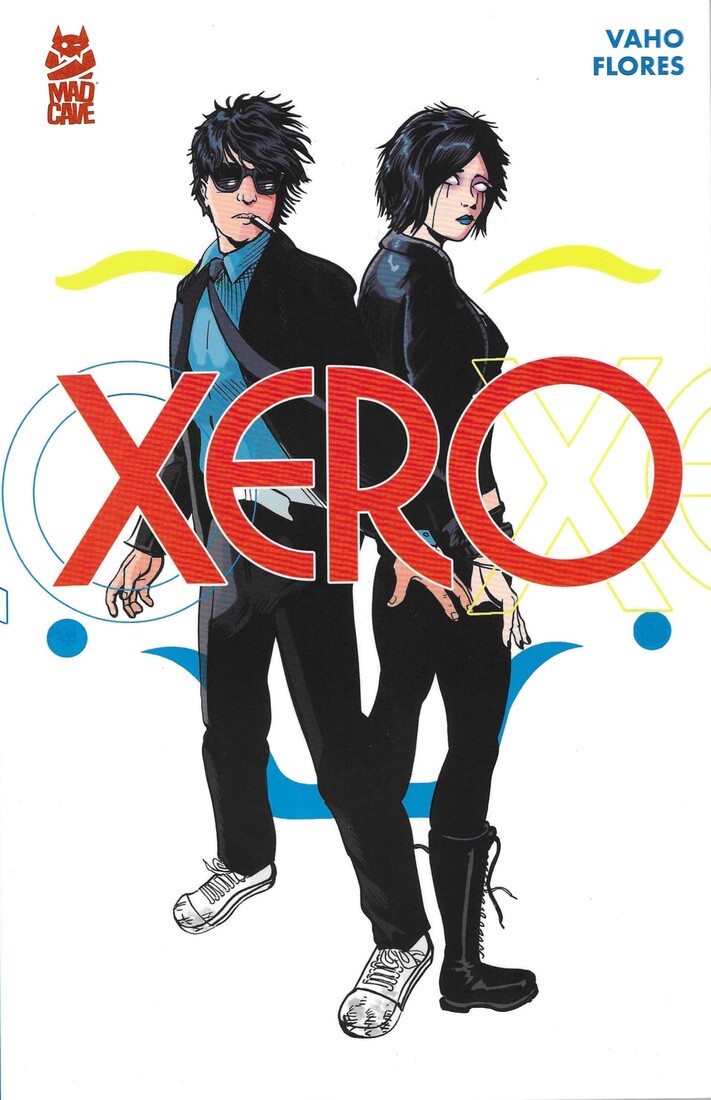 Xero by Vaho (writer), Felipe Flores (artist/colorist/letterer), James B. Emmett (editor), and Marla Eizik (editor). $19.99, 124 pgs, Mad Cave Studios.
This is a disappointing comic, and it might be a “me” problem, but it seems like it promises something that it doesn’t turn into, and it’s a bummer. In the beginning, the titular hero lives in a mall, and we learn early on that everyone lives in the mall and never leaves, and it seems like Vaho was going to make this kind of a social satire, and it really isn’t. Xero leaves the mall and finds out what’s outside, and it turns into a space invasion that’s not really an invasion and a weird fight with relatively dull bad guys and good guys and the good guys aren’t really that good but it seems like Vaho wants us to believe they are and it’s just not terribly compelling, unfortunately. Before Xero leaves the mall, there’s an odd despair and ennui about his life, and there’s something sinister going on with women who are pregnant, but then Xero leaves the mall and he kind of accidentally becomes an action hero. It’s nice that Vaho keeps him kind of inept and somewhat uninterested in being an action hero, but it’s also not terribly well done. It’s bizarre, sure, but it’s only the trappings of bizarre-ness, and it’s fairly conventional. It’s disappointing because it feels like it could be more of a nasty look at consumerism, and while Vaho does make some feints toward it later in the book, it’s only there early on, and it just goes away too much. Oh well. Flores’s art is weird and wild and very bright, and it works pretty well. He does some nice thin lines with the consumerist sections and a bit rougher hatching with some of the weirder stuff. He gets to do some wacky stuff, and it keeps the book afloat as the story kind of goes sideways. Anyway, it’s a bit disappointing. Oh well.
Rating: ★ ★ ★ ★ ★ ½ ☆ ☆ ☆ ☆
One totally Airwolf panel:

BOOKS
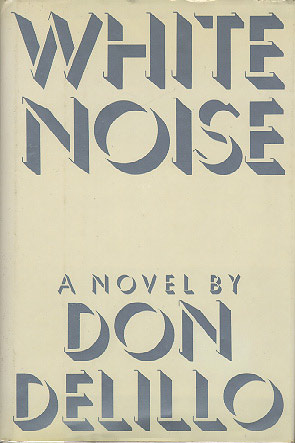 White Noise by Don DeLillo. 326 pgs, 1985, Viking Penguin Books.
I mentioned this book recently as one of my candidates for the Great American Novel, and I would have said so even if I hadn’t been reading it to my daughter at the time, because I like it so much. This is probably the … fourth? time I’ve read this, and it still holds up really well, as so much of what DeLillo wrote about in the 1980s is still plaguing us today, and in some cases, has become more intense. His book, which stars Jack Gladney, a professor (of Hitler studies, a class he invented to make himself indispensable) at a hoity-toity college in a small, rural town, is a ridiculously incisive look at modern America. Gladney is part of a typical fragmented family — he and his wife, Babette, have many children with several different people, some of whom live with them, and their family seems happy enough (Babette has a toddler, Wilder, whom I thought was Jack’s kid, but apparently it’s not, so they haven’t been married more than a couple of years). The first part of the book is almost like a strange family comedy — the book can be quite funny — as Gladney tries to deal with his kids, who are extremely precocious, and he meets and befriends Murray Siskind, a New Yorker who becomes a weird oracle as the book moves along. The second part of the book deals with “the airborne toxic event” — a very small reason I like the band so much is because they’re named after it — as a cloud of some chemical floats over the town, causing an evacuation. In the third part of the book, Gladney has to deal with the fact that he’s supposedly contaminated by the chemicals and so is going to die, but it might take decades, while he and his wife confront their fear of death, as she takes some untested medication and Gladney goes down a dangerous rabbit hole trying to figure out what it is and how she got it. That’s the bare bones, but the book is really about consumerism, fear, dislocation and isolation, and the loss of community in the country. Despite everyone being together, nobody seems particularly close, and Jack’s family seems to have lost basic knowledge because they’re overwhelmed with trivia — his son, Heinrich, seems particularly affected by this, as he knows so much he’s almost paralyzed by knowledge. Throughout the book, DeLillo adds dialogue coming from televisions and radios, and he drops in lists of brand-name products seemingly randomly, which makes the narrative a bit disjointed (deliberately, of course, but still). As I noted, it can be a very funny novel, but DeLillo also goes to some dark places, as Jack can’t seem to reconcile all the information he’s receiving throughout the book and it drives him a bit toward madness. It never gets too dark, but it does delve into some of the psychology of the lonely, which, of course, is even more relevant today, in the much more isolated world that we inhabit than Jack did in 1985. DeLillo has always been interested in plots (the novel he wrote after this one is about the JFK assassination), and in this book, he works through what plots mean and how they drive people as he prepares for a book about the ultimate plot in the next book. It’s interesting re-reading this after reading The Names, his previous novel, and then moving on to Libra and Mao II, his next two novels, because they deal with the same themes, but it feels like in White Noise (which, after all, won the National Book Award), he synthesizes all these ideas bumping around in his mind a bit better than in the other books.
White Noise is my favorite book of all time, and whenever I re-read it, it just reinforces that ranking. It’s absolutely brilliant, so if you haven’t read it yet, now’s the time!
Rating: ★ ★ ★ ★ ★ ★ ★ ★ ★ ★
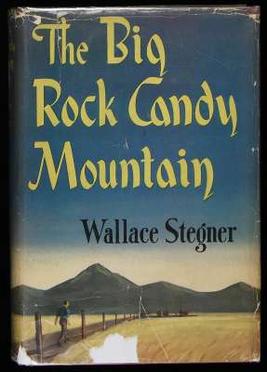 The Big Rock Candy Mountain by Wallace Stegner. 563 pgs, 1943, Doubleday & Company, Inc.
This is Stegner’s fifth novel, published when he was 34, and it’s apparently a bit semi-autobiographical, as Stegner moved around a lot when he was a kid, including Saskatchewan and Utah, which are some of the locations in this book. It’s a good book, although I don’t love it as much as Angle of Repose, which, I mean, won the Pulitzer Prize, so there’s that. It’s the story of Bo and Elsa Mason and their two kids living their lives from 1904 until the early 1930s in the West, from Minnesota to the Dakotas and up to Canada and out to Los Angeles. It’s pretty bleak, as Bo is desperate to make a ton of money and doesn’t necessarily care how he gets it and who he hurts to get it, and he ends up running booze throughout Prohibition and actually making a good amount of money, but kind of at the cost of his marriage and fatherhood. Stegner does a good job switching points of view throughout the book — there are 10 sections, and Stegner switches from Elsa to Bo and even to Chet and Bruce, their two sons, as they grow older. Elsa is the POV character early on, and she gets swept up by Bo’s charisma, which she doesn’t discover until too late has a dark side that he can never shake. Elsa just wants to protect her sons, and Bo just wants to make money, and those two goals are not always in sync, and that’s where the tragedy comes from. Chet is more “manly” while Bruce is definitely effeminate (he’s not gay, but he’s “sensitive”), but Bo doesn’t know how to relate to either of them, even if he thinks Chet is a “better” son. This is a very well written book — Stegner evokes the West so well, as these people move around to many different locations and we feel their poverty and desperation so well, as well as their sadness at their isolation when they actually get some money. Bo is not the greatest person, of course, and it’s easy to hate him, but Stegner makes it harder to do, because it’s clear that Bo can’t escape his past and what happened to him in his childhood, and it’s nice that Stegner shows that Bruce, as he grows up, is trying to break from that cycle. This is long before psychoanalysis became a thing, of course, as it was written in the early 1940s, but Stegner does a nice job with Bruce and his self-analysis and his relationship with his father. Chet is not reflective at all, and it’s interesting that his story is more tragic than Bruce’s. This is a very good family drama, as it’s clear that Elsa would have been happier without Bo, and Bo probably would have been happier without Elsa, but they’re basically trapped by society, even in the wild West, and in the 1930s, Bruce is beginning to understand that sometimes, you need to escape that trap. It’s not a happy book by any means, but it’s a powerful one, and Stegner does a good job showing the kind of “middle age” of the country, when the frontier was closed but people hadn’t quite figured out how to settle down yet. He doesn’t make a big deal about it, but he does leave it subtextual, and it makes the story a tale of America as well as a family epic. If you haven’t read any Stegner, I’d still recommend starting with Angle of Repose, but The Big Rock Candy Mountain is quite good.
Rating: ★ ★ ★ ★ ★ ★ ★ ★ ☆ ☆
 In Defense of Elitism: Why I’m Better Than You and You Are Better Than Someone Who Didn’t Buy This Book by Joel Stein. 308 pgs, 2019, Grand Central Publishing.
This isn’t a bad book, but it is a bit shallow, as Stein is a comedy writer (to a degree) and so he goes for jokes more than in-depth analysis, but his analysis isn’t actually terrible, but I kind of wish it had been a bit more in-depth. Stein argues that elites are necessary, which seems obvious, but he’s writing in the post-Trump era, so elites are under attack more than they’ve ever been (he notes times in the past when people like Nixon were anti-elite, but it’s much worse now). I wonder what he thinks now, some years on, when the anti-elite attitude in the country is worse than ever (he actually mentions pandemics and vaccines, but I can’t believe even he thought it would turn into what it did in 2020-21). Stein begins the book by spending some time in Miami, Texas (it’s just down the road from Canadian, Texas, don’t you know), which overwhelmingly voted for Trump (Stein, I think, finds the one person in town who didn’t vote for Trump) and so he believes they will be anti-elite. Of course, he finds that the people are fairly normal and some of them have been pretty well educated, but his point is that the people there, like a lot of people, “go with their gut.” They call it common sense, and sure, common sense is fine, but expertise is still a thing, and Stein does not point this out to the people in Miami who actually are experts in things that they don’t necessarily go with their gut. When he returns to Los Angeles, he gets more into what elitism means and why it’s important, and he points out that the anti-intellectuals aren’t actually populists, they’re just a different kind of elite. He has an interesting meeting with Scott Adams, who has really gone over to the dark side of anti-intellectualism, and he talks a bit to Tucker Carlson, who’s the “elite” kind of person who pretends he’s not. He also goes into some things about how intellectuals can get back to the good side of these Trump voters, and it’s about what you think — basically, stop being so snooty — but he doesn’t really get into the racism and sexism of these anti-intellectuals. He allows the people in Miami to reveal themselves as racists, but he doesn’t get into the fact that while, yes, intellectuals need to be less snooty, but a lot of the anti-intellectuals have a deep-seated hatred of anyone who is different than they are, and there’s nothing to be done about that. Adams, for instance, is too far gone down the rabbit hole of conspiracy theories to even argue with. Stein’s lighter touch makes the book funnier, certainly, and he does kind of identify some interesting problems with intellectuals and anti-intellectuals, but because he doesn’t dig too deeply, the book feels a bit slighter than it could (or should) be. It’s still funny and interesting, but it is weird to read a book that criticizes Trump and his ilk from his first term now that his second term has gone even worse and stranger than his first. Depressing, but weird.
Rating: ★ ★ ★ ★ ★ ★ ½ ☆ ☆ ☆
TELEVISION
The Gilded Age season 3 (HBO). More ridiculously, gloriously clothed rich women in this season, of course, but the show is moving along nicely. George Russell (Morgan Spector) is trying to build/own a railroad that runs from Chicago to Los Angeles (in the 1880s, L.A. was not a big town and I’m not sure any robber baron would have tried so hard to get to it, but I guess we can claim that Russell is so prophetic that he knew in 20 years it would be a major city), but he’s leveraged to the hilt and the obstreperous Arizona mine owners whose land he wants to buy are being douchebags about selling, so he’s even less in the mood for his wife’s (Carrie Coon) social machinations, as she tries to get her daughter, Gladys (Taissa Farmiga) married off to the Duke of Buckingham (in a shocking move, Gladys has no interest in marrying the duke, but once she does, she figures out that being a duchess ain’t so bad). Mrs. Russell is slowly taking over the main spot in the social hierarchy from Lina Astor (Donna Murphy) because Mrs. Russell thinks that excluding divorced women who did nothing wrong is wrong, while Mrs. Astor thinks divorced women should be shunned at all costs. Over at the old-money house, Ada (Cynthia Nixon) and Agnes (Christine Baranski) are getting used to the fact that Nixon is now the head of the household, while Marian (Meryl Streep Jr.) is smitten with the Russells’ son, Larry (Harry Richardson), but their romance is rocky for the dumbest of reasons. Peggy (Denée Benton) is also finding romance, but she’s also still involved in the suffragette movement, despite her beau’s mother (the deliciously evil Phylicia Rashad) thinking that black people shouldn’t get involved in that fight. Rashad also finds out about Peggy’s past, which she uses to drive a wedge between her son and Peggy, because of course Peggy’s family isn’t good enough for hers. The show does a nice job this season showing that black society could be as heirarchical and petty as white society, so … good job? It’s dazzling as always, and the costuming is superb, and Coon dominates the proceedings (all the actors are good, but Coon is a force of nature), and I’m only annoyed a little by the historical … not inaccuracies, per se, but the fact that Julian Fellowes has decided that racism isn’t that big a thing? I mean, it’s certainly present, and Peggy and her family deal have to deal with it, but Nixon and Baranski and people of their ilk seem remarkably open to hanging out with black people, and I’m unsure if it would be that easy. I’m not sure, but it’s nice that Fellowes has taken steps to show that barriers can be broken down, I’m just not sure it would have happened in 1880s New York as … easily as he shows it’s been done. Maybe it was — I wasn’t around then. Anyway, it’s a fun show. Nothing groundbreaking, but fun.
Astrid season 3 (PBS). Sara Mortensen and Lola Dewaere keep on keepin’ on as Astrid and Raphaëlle, and they have such a good relationship that it makes the show a lot more interesting than your standard “cop show with outside consultant” formulaic show. Astrid keeps trying to expand her world, and she moves forward in her relationship with Tetsuo, the nice man she met in season 2. She has to figure out how to be in a romance, and while it’s not the biggest part of the season, it’s a very charming one. Meanwhile, Raphaëlle is pining for one of her co-workers, which is extremely annoying, but it also doesn’t take up too much time in the season, so it’s all right. Astrid is also taking classes to become a police officer, because she’s not allowed to work on cases anymore unless she is an actual cop, so she’s trying to navigate that, as well. The cases remain fine, and Astrid finally solves her father’s murder, which is nice. I don’t have too much to say about this show and this season — it’s a charming cop show with two very solid leads, and the writers do a nice job with Astrid’s autism and how she’s dealing with the expansion of her world. PBS is a bit behind (the show is up to 5 seasons, but PBS just aired season 3), so I look forward to them airing more seasons in the near future!
Professor T season 4 (PBS). It’s a transitional period in the lifespan of this show, as three cast members left at the end of season 3 and another is only present very briefly in this season, so they add three new ones (one of whom showed up briefly at the end of season 3, but she’s new enough). It’s also interesting that Ben Miller, our hero, doesn’t work with the police as much in this season, as he’s trying to figure out his own life. The tragedy at the end of season 3 affected him deeply, and he and DS Winters (Barney White) haven’t been able to get past it, so a lot of this season is about them processing their grief, which works pretty well, especially when Winters finally comes to terms with it. It makes the season a bit odd, because the main character is off doing his own thing so much and only occasionally intersecting with the cops, but the cases are still interesting and Miller does a nice job making Professor Tempest a sympathetic odd person. Even though he misses social cues and treats people indifferently, over the course of the series he’s tried to be better, and in this season, he seems to make some breakthroughs, which is nice. In past seasons, it seemed like a lot of the cast revolved around the professor, but in this season, the characters seem to branch out a bit — the new constable, Rhian Blundell, barely interacts with the professor at all, and she has her own story arc to go through, while the dean and the professor’s aunt rekindle a long-fallow romance, which tangentially involves him but not too much. It has made the series a bit better, I think, because it feels more like a real world, and while the professor’s insights into the crimes remain fairly crucial, both DC Highsmith (Blundell) and DS Winters show that they’re very capable crime-solvers. It will be interesting to see where the show goes next!
The Marlow Murder Club season 2 (PBS). This charming series returns with more episodes and more murders, as I guess it was pretty popular, so it got expanded. It’s still charming, and the scenery is wonderful, of course (it’s filmed in Marlow, which is not too far east west of London), and the actors have very good chemistry together. Samantha Bond, Jo Martin, and Cara Horgan as the amateur detectives are very fun, and while there was a bit less about Natalie Dew’s personal life this season, her character’s promotion was made permanent, so that’s nice. The cases remain interesting — there’s a good locked-room murder as the first case; a man with no connection to Marlow is found dead in a cul-de-sac in town and no one knows why he’s there; a member of a sailing club is killed across the river from an important archaeological site — and we get enough about the ladies’ lives — Suzie’s daughter goes off to university, Becks seems to be having an affair (but she’s not, because it’s not that kind of show, but it’s hinted at so there’s a bit of tension), Judith discovers things about her great-aunt, whose house she lives in — that the non-mystery stuff remains interesting. As far as “cozy mysteries” go, it’s quite nice. A nice way to spend some time!
Nautilus season 1 (AMC). It seems like a television series starring Captain Nemo would be a no-brainer, so I’m surprised it took this long to get around to it, but here we are. It’s an origin story, as it’s set in 1857 (Twenty Thousand Leagues Under the Sea is set in 1866), and the British East India Company is secretly building the Nautilus, using designs stolen from Gustave Benoit (Thierry Frémont) and Nemo (Shazad Latif), both of whom they’ve forced to work on their creation. Nemo steals the sub and heads to the open sea, and he snatches Humility Lucas (Georgia Flood) from the ship that’s taking her to Bombay for her wedding to a dissolute lord (Cameron Cuffe, who plays the role as far more fun than he should, given that Lord Pitt is kind of a monster). Nemo wants to destroy the Company because they killed his wife and daughter, and he also wants to find treasure to finance his revenge, while the Company — represented by the despicable Director Crawley (Damien Garvey) — is trying to kill him and get their sub back, especially because the British government doesn’t know about it and they’d like to keep it that way. It’s all very dramatic!
This is a decent adventure show, so that’s nice. Latif does an ok job, and he and Flood have pretty good chemistry, although I do wish they hadn’t made them romantically involved so quickly (it comes late in the day, but they’re obviously pushing it the entire time), mostly because it takes away a bit from Nemo’s grief and it also seems to make Flood less of a character — her father trained her in engineering and she’s as capable as anyone, and she inches toward “simple love interest” as the show goes on. The best character, by far, is Céline Menville as Loti, who’s hired by Flood’s mother to get her to Lord Pitt. Menville is having the time of her life tearing into the role, and Loti has a far more interesting life than we know about so far. The crew is pretty good — they’re all people who have been hurt by the Company, so they want revenge, and the cast does a pretty good job making it clear that they don’t always trust Nemo, while Nemo needs to learn how to be a good captain. The British are interesting, too, as they’re not just evil dudes. Lord Pitt might be an asshole, but he has taken time to learn several Indian languages (which the other British don’t know, because it’s not English, so who cares?) and he can be charming. Jacob Collins-Levy as the captain of the ship taking Flood to India seems like an asshole, but it’s clear he’s more honorable than everyone else. Luke Arnold as another Company soldier has some secrets that concern Nemo, and he does a good job veering between quasi-good guy and quasi-villain. There are some fun guest stars — Richard E. Grant, Anna Torv, and Noah Taylor among them — and the special effects are … fine, but not superb. The historical inaccuracies bothered me a bit, and the Nautilus employs the Game of Thrones teleportation device to zip around the world, it seems, but overall, it’s a fun show. It’s not clear if it’s getting a second season, but I’ll watch it if it does.
Only Murders in the Building season 5 (Hulu).
The silliness of the premise of this show has become a nice metatextual comedic reference, as a few characters talk about it throughout this season and the teaser for the next season (of course there’s a next season; the show is popular!) takes it to a hilarious extreme. I always like shows that kind of are aware of pop culture around them, even if it’s self-referential, so I appreciate it, and the show doesn’t go overboard with it.
At the end of last season, the doorman of the Arconia was found dead in the courtyard fountain, so this season is about that death, although the police don’t think it’s a murder to begin with and our intrepid team needs to prove that. They do, of course, and we get a season that strives for topicality, as three suspects are billionaires who are show themselves to be sociopaths pretty early on. Christoph Waltz, Logan Lerman, and Renée Zellweger (that’s TWO-TIME OSCAR WINNER Renée Zellweger, a fact I have trouble wrapping my head around) play the billionaires, and they have a lot of fun with the roles. Bobby Cannavale plays one of the victims, an old-school gangster who bought the house used in The Godfather because he wanted to be old-school so much; Téa Leoni plays his wife, who seems pretty happy that he’s dead; Dianne Wiest plays the dead doorman’s wife, who seems upset about it but … maybe she’s not?; Keegan-Michael Kay turns on the smarmy charm as New York’s mayor (Kay has to be bummed about James Franklin getting fired as coach of Penn State, because his imitation of Franklin is spot-on, plus he went to Penn State, so there’s that); and Beanie Feldstein shows up as an old friend of Mabel’s who’s become a pop star. Of course, there’s a lot of red herrings and false leads and whatnot (although it seems that one very important clue should have been easier to suss out, once we find out what it means), and there are bigger stakes this time around, as the Arconia itself might not survive, but it all works out in the end. As always, Martin and Short are the goofballs, with Gomez the straight man, and therefore it’s so much easier to like Gomez, because her problems seem more relatable than Short’s and Martin’s, as they lean into the cartoonishness of it all. I mean, it’s fine when they go through shit, and they both do, but Gomez continues to be the stealth MVP of the entire show, and when she does go comedic, it’s even funnier because she — Mabel, I mean — isn’t very good at it. It’s interesting to see stabs at relevance — the sociopathy of billionaires, the replacement of humans by AI (there’s a robot doorman in this season whose presence is contentious), the prevalence of the surveillance state and what that means when it’s privatized, the alliance between government and big business, the monopolization of content — but, as usual, the show doesn’t get too deep in the weeds and remains a fun murder mystery series. I look forward to the next season!
Task (HBO).
From the creator of Mare of Easttown, we get another really fucking bleak crime drama set in the Philadelphia suburbs! I mean, yes, it’s bleak, but Brad Inglesby is really good at making crime dramas, and this doesn’t feel quite as bleak as the Kate Winslet show, so … progress! Tom Pelphrey is a garbageman whose brother was in a motorcycle gang and who was killed by other gang members (although it hasn’t been completely confirmed at the beginning of the show), so he is robbing drug stash houses belonging to the gang to get back at them (he has a bigger plan, but we don’t know that yet). Mark Ruffalo is an out-to-pasture FBI agent who gets put in charge of a task force to investigate because no one thinks it’s going to go anywhere (a plot point that quickly gets ignored) and so they can put him in there. In one robbery, everything goes horribly wrong, three people are killed, and Pelphrey takes the kid of two of the victims home with him, because of course he does. He and his fellows also don’t get the money because the deal hadn’t gone through yet, so now he has a shit-ton of fentanyl, which he does not want. He has to figure out what to do with it, Ruffalo needs to make his weird task force work (there are detectives from two different police forces and a statie), and the motorcycle gang is gunning for Pelphrey. There’s a mole inside the gang, there’s a mole inside the police (whether it’s in the task force or just in the FBI isn’t known early on), and things just keeping get worse. It’s very tense, exciting, occasionally violent, and there’s a lot more going on about families and forgiveness than you might expect. Pelphrey is living with his kids and his niece in a house that belongs to her, which bugs him, while Ruffalo — an ex-priest — is dealing with a family tragedy that has put his adoptive son in prison and left his adoptive daughter and his natural-born daughter in an emotional bind. Meanwhile, the cops on the task force aren’t the top of their class, although they show as they go along that they figure it out. The people you expect to die do die, and it’s not that hard to figure out the cop mole once one character is eliminated, but such is life. The cast is superb — Ruffalo and Pelphrey are excellent, while Emilia Jones as Maeve, his niece, is astonishing, and Thuso Mbedu, Alison Oliver, and Fabien Frankel as the task force members are excellent. Inglesby is from the Philadelphia area (his father played basketball at Villanova and briefly in the NBA and ABA), and this show is set and filmed in Delaware County to the west of the city, and it’s absolutely gorgeous (at one point the characters go north to Locust Lake, which I have swum in, and I’m not positive they were actually there, because it is kind of far north of where the rest of the show is set). It’s an intense show, sure, and occasionally the characters are really dumb (don’t take your masks off in a robbery unless you’re positive no one is around to identify you!), and the morality of it kind of cracks me up (as I noted, the people who need to die end up dying), but it’s still a very good show. Check it out!
**********
I forgot to list how much money I spent in September, so here we go!
3 September: $99.21
10 September: $190.83
17 September: $127.48
24 September: $107.53
Total for September: $525.05 (’24: $690.42; ’23: $528.08; ’22: $862.76; ’21: $855.20)
1 October: $136.18
8 October: $204.24
15 October: $128.39
22 October: $274.98
29 October: $107.50
Total for October: $851.29 (’24: $987.11; ’23: $859.84; ’22: $860.22; ’21: $662.60)
YTD: $5240.72 (’24: $6010.88; ’23: $5779.10; ’22: $8992.21; ’21: $6859.07)
September was a smaller month, and October was a bit bigger, but I’m still far behind the pace of the previous four years, despite comics’ prices going up. I’m trying to cut back, I swear, and it seems it’s working at least a little bit. That fourth week of October was a nasty one — Titan actually had a Conan Omnibus for a change, so that jacked up the price. Oh well.
**********
Ok, I’m going to try to catch up on some of the music suggestions you guys had for me back in March 2024. Yes, I’m still trying to catch up! First up, Derek’s suggestions. He offered the Beths’ “Master of a Dying Field” first, which I quite enjoyed, so let’s take a look at the rest of his choices.
First, we have Noah Kahan with “Northern Attitude.” Despite the band being impossibly hip hipsters (beards, a mandolin, a dude sitting on a weird drum kit), it’s a pretty good tune — the recorded version, which is the second video, is a bit more slickly produced, and I like the live version better. When Kahan begins to “rock out” (a very relative term, I can assure you), it becomes a better song, just because the music is a bit more fun. It’s not really a sad song, but it is a bit melancholy, and the line “I was raised on little light” is pretty clever. I don’t mind Hozier, but I don’t love the way he sings the verse he does in the recorded version. I don’t know why, it just doesn’t hit well for me. Still, a nifty tune.
Next up is “Vampires,” by The Midnight, which was released in 2016. I mention this only because if you stumbled across it in the wild, you would definitely think it was released in 1987. It’s suuuuuper-fucking retro, in other words (the video is just scenes from a 1987 anime, because the songwriters know how fucking retro this is). It’s not a bad song at all — the sax part itself might make everyone who hears it pregnant, and while there aren’t many lyrics, they’re pretty keen: “They say we come from nothing / And to nothing we’ll return / And in between is gravity / And bridges left to burn.” Tyler Lyle, the singer, even sounds like a singer from the 1980s — he wanted so badly to be on the Some Kind of Wonderful soundtrack! This is a neat tune.
Fugazi’s “Break” is the first song on their fifth album, and while Ian MacKaye might be the coolest dude in music history, I don’t love this song, mainly because I don’t love instrumentals, as I pointed out last time I did this. Technically, there are lyrics in this song, there’s basically only one line. It’s not a bad song, because Fugazi is a good band, and Joe Lally’s bass is killer, but I don’t generally put instrumentals on my phone. Still, you can check it out below!
We get another short sax solo in “Sometimes” by Nick Lutsko, a pretty terrific song about the way life fucks with you. It zips along with cool lyrics: “You’re no hero to this story / You’re just another wretched pawn / Who bought his tickets to the sideshow / And then slept through the alarm” and has catchy but slightly unsettling music behind it. The use of footage from Freaks in the video, below, adds to the ambiance. I don’t have much to say about this song. I dig it.
Bill Reed hit me with Jason Isbell and the 400 Unit’s “Save the World,” which you can listen to below. It’s a good song, but something is off about it, and I can’t quite put my finger on it. It’s as if Isbell is singing slightly off-syncopation with the music, and maybe that’s the point, but it feels weird. Plus, although I know nothing about music (well, I can read it to a degree, but not too well), it feels the time signatures shift between the verses, the bridge, and the chorus, and it doesn’t shift as seamlessly as it could. I don’t know — the song is about the shitty state of the world, and so maybe it’s meant to be disjointed, and I do like the song, but it’s just a bit off. I do like that Bill describes their album as “wall-to-wall bangers,” because I don’t think of Jason Isbell as a “banger.” Maybe I need to listen to more of his stuff!
I wanted to get some more music examined, but, as usual, things got away from me this month, and I just didn’t get to it. I will try to do more in November!
**********
I wasn’t in as crappy a mood this month as I was in September, hence the reviews instead of capsule stuff and me ranting. I could certainly rant, of course, but I guess I won’t. I’m still looking for work, and that’s not going well, and things are moving slowly along with my daughter and what we’re going to do with her, but that hasn’t been resolved yet, so I won’t get into it. I hope everyone is doing well, because we all need to have some good things in our personal lives, don’t we, given what shit is going on in the greater world? As I noted, we’re still making sure the blog’s lights stay on, so I will point you to Amazon if you’re interested in picking up Athanasia (it’s really good, people!) or if you want anything else, and we’ll get a piece of it! Thanks for reading, everyone!

Bug Wars was pretty good, though much more R-rated than I thought it’d be. Just read Into the Unbeing volume 1. Intriguing premise, but I’m much more in it for the art. Volume 2 is on the to-read pile.
Hemmed and hawed about Howl and Past Time and ended up passing due to budget. I don’t think I heard about Athanasia, but DaNi is a recent new favorite, so I’ll have to check it out.
I read the trade of Ewing and Lieber’s Metamorpho, which is probably the most fun I’ve had reading comics this year. Still loving Deniz Camp and company’s Ultimates series. Midway through Assorted Crisis Events right now and enjoying it. Ward and Veras’ Two-Face series was interesting, but I wish it stuck around longer to really explore its dual premises.
Broke this up into piece because the spam filter kept getting me.
Atomic Robo is still going! You can read it online or buy the hardcovers directly from the website (or support their Kickstarters).
Isn’t the evil internet just “the internet”?
Marlow Murder Club is maybe *too* cozy a mystery, but I watched it. I haven’t seen the last Nautilus yet, but it grew on me– reminiscent of the Verne-inspired Around the World in 80 Days show with David Tennant, which I loved. I did not make it past the first episode of Task, which I’m sure is good (and I liked Mare a lot) but didn’t grip me. Ruffalo ain’t selling the Phillyisms!
I did not know that about Atomic Robo. Now I have to go check it out!
Come on — we’re on the internet right now, and we’re not evil! 🙂
I forgot about Atomic Robo. This happens to me from time to time. I have the first six trades, then I read the rest online and it has been like 3 years or more since I read Atomic robo, so I guess is time to catch up(and maybe buy those hardcovers)
Dagnabbit, Greg! I want your write up of the latest Power Fantasy, haha!
In all seriousness, I’ll definitely have to check out Athanasia – I’ve started a new job just now, after a year of looking for something decent, so I’m trying to keep my spending somewhat close to where it has been for the past year, to build the aul finances…but I can definitely pick that up!
Sorry, sir — it’s just the beginning of the arc, so I’m not reviewing it! I did read it, though, and enjoyed the big! reveal!
I’m happy you got a job — it’s so stressful looking for one!
I read the trade of Bug Wars and surprisingly enjoyed it as Aaron usually sucks, I’m still recovering over the trash that was Batman Off-World.:
I picked up Kraken but it’s currently on my shelf of shame, I’ll get around to it eventually.
I’m still following the NFL, but my word the Dolphins suck this year, how did go so wrong so quickly?
The ‘SAN DIEGO’ Chargers also continue to be frustrating, awesome one week and terrible the next, such is life.
As long as the Bills don’t make the Super Bowl I can live with it!
Aaron has done some good stuff, but I agree that his superhero work isn’t that good.
I think it’s been going wrong for the Dolphins for a bit, but they were able to cover up the cracks. I mean, they were happy Fangio left town because he was too hard on them, and he goes and wins a Superbowl. We’ll happily take Phillips, though, so thanks for that!
I’ve never trusted Harbaugh. I know he won a national championship, but I’ve just never trusted him. Good coach, but something about him makes me think he’ll never succeed completely.
I’m not sure who’s going to beat Buffalo this year. I mean, I’d rather Buffalo than the Ravens or Patriots, but I’m not sure. You might be hoping for the wrong thing!
Hey, a long column, yay. Guess I know what I’ll be reading it during the week.
I have good news(for me): I got a job, finally!.
I’m not super excited because it’s a call center and I used to work in one for a spell and I ended really burned out, but what the heck, finding job was hard so maybe now that I’m older and not-wiser I will not burn out so easily. Guess we’ll find out.
I haven’t bought any comics and barely read anything this month, but I wanted to at least share decent news. I want to hear more about that Conan Omnibus(I miiight buy those, eventually. If this job doesn’t crash and burn)
About looking for jobs, I had some luck at the beginning of this year doing stuff for those companies that want people doing stuff for their AI thingies. Maybe is not the best, but who knows, it might be useful. I found the most success with a company called Telus AI(I have been with them for like 4 years now, low pay, not that many hours available but really, really low brain power required) and Outlier(better pay, better hours, but loads of tutorials and tests you have to take) who knows. I really don’t like AI stuff, but hey, the world IS going to burn even if I don’t use it, so at least I was getting paid while everything is burning up)
Excellent, sir. Congratulations!
Right now, I’m trying to focus on finding teaching jobs, but yeah — I may have to expand my search soon. That’s not a bad thing to know about, even though I loathe AI.
I enjoy the Conan Omnibuses, but I’ve only read a few because they’re so packed. It might be a while before I can actually sit down and get through them …
Checked out Hyde Street and Farmhand from Hoopla.
“I mean, does DC really want to poke the bear of “what are powers” that much? ” A fair question but it’s not like this is a new issue — doesn’t every power-stealer/duplicator raise that? Or Animal Man being able to duplicate “animal powers” which as Morrison pointed out aren’t powers of any sort. While I’m not interested in checking out the book I doubt that would bother me much.
Ayyy, some Fugazi. Nice pick, whoever it was! Never heard this one as I don’t have this album (End Hits?), so look forward to it. Sweet ‘n’ Low is a good instrumental of theirs.
P.S.: Marlow is sort of west of London (NW—ish, in leafy commuter belt Buckinghamshire), defo not east. It’s very posh. As a very general rule, west/west of London is more posh, east/east of is more working class. Damn Yankees! 🙂
Dang, I know where Marlow is — I meant to type that London isn’t too far east of it and got screwed up. Sorry about that! 🙂
I guessed it was a senior moment. Heck I’d struggle to name much in Arizona past Phoenix — let alone where anything is! You guys do have just a tad more geography than our small island.
Yeah, but Great Britain has far cooler names than we do! 🙂