

[Not a lot of comments for this post from 23 August 2014, which probably isn’t surprising given it’s about a British war comic from 35 years before. I still haven’t read Charley’s War — I really should get on that. Enjoy!]
Charley’s War, specifically.
I have written more than once about Titan Books and their really stellar program of reprinting classic British war comics, and every time I’ve done so, someone asks me either in the comments or through email, “Why haven’t you talked about their amazing hardcovers of Charley’s War? That was the best British war comic ever and …” followed by several pages’ worth of explaining to me why Charley’s War is genius and there was clearly something wrong with me for not saying so in print.
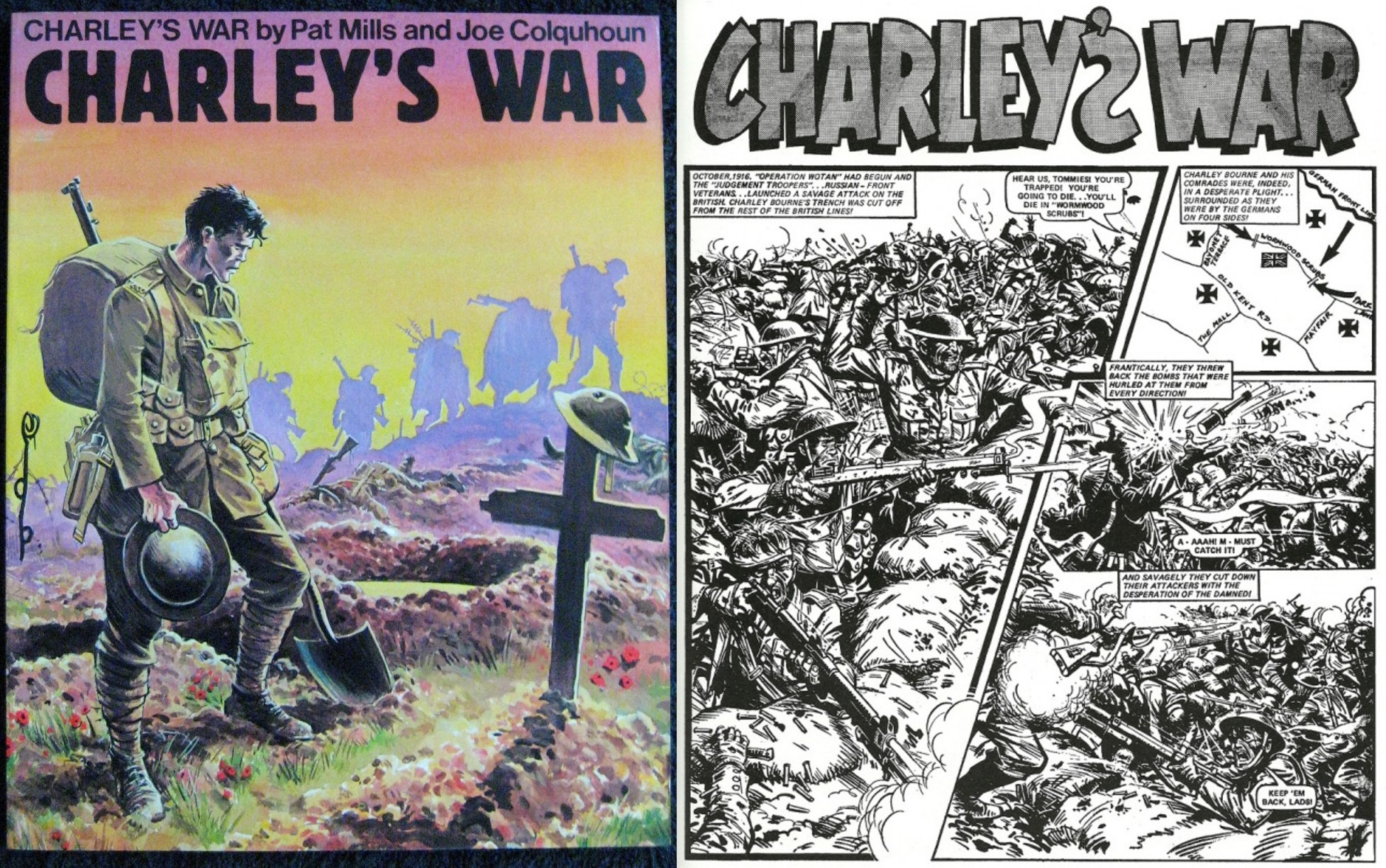
The answer to why I never wrote about the strip is simple. Despite this persistent myth that we read EVERYTHING here at CSBG, we really don’t. I had never read Charley’s War, and though it was kind of on my get-to-it-someday list, my review pile is fairly large on any given day, and my to-read shelf of shame is piled waist-high with books I already have here in the house. I wasn’t going to go looking for more for the pile.
But I never have to, because the pile has taken on a life of its own now. Titan had me on the list for the reprint volumes from Battle and the new omnibus collection of volumes one through four of Charley’s War just arrived. So I figured, okay, I guess I can take a hint, and settled in to educate myself about Charley and his War.
Charley’s War is the story of young Charley Bourne, who enlists in the British Army at the age of 16, at the onset of World War I, lying about his age to do so. He is quickly thrust into the forefront of the action, and promptly loses all that youthful patriotic zeal as he watches his friends cut down in battle on his first day.
And that set the tone for the strip. Charley’s War is all about the clash between the ideals of those who think war is a noble human endeavor and the reality of those poor slobs who are actually on the ground fighting it. We are with Charley through the Battle of the Somme, the unleashing of the new tank brigades, zeppelin raids on London … and all presented with an unflinching eye towards what regular people go through as governments play out their games of strategy and conquest.
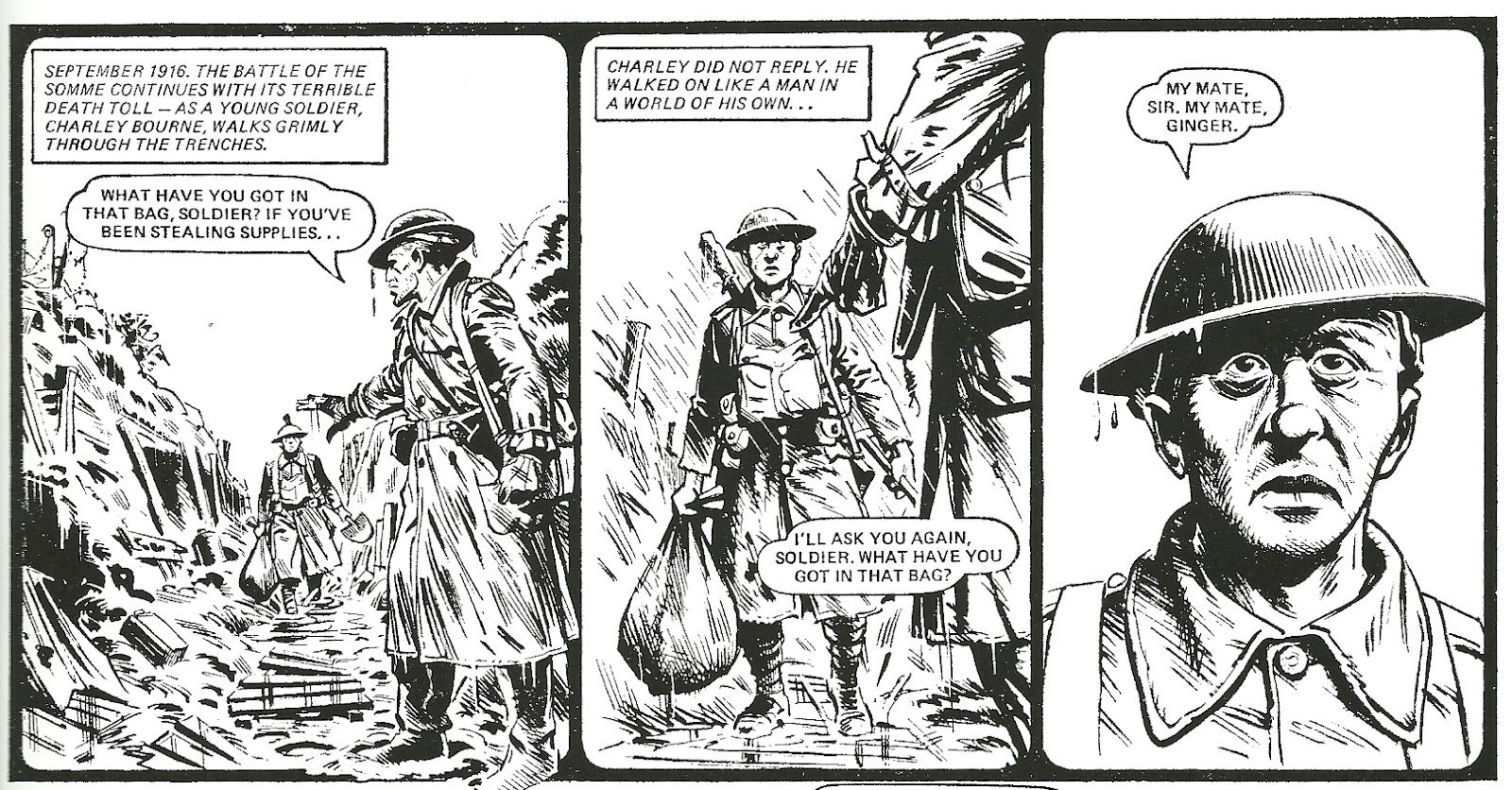
Charley’s War was serialized in weekly chapters from 1979 to 1985. The strip was written by Pat Mills and illustrated by Joe Colquhoun for most of its run, and meticulously researched by both. Though it’s supposed to be about Charley’s experiences in the trenches, the story occasionally wanders off to focus on other characters, but the through-line is always the same — war is not noble, no matter what they tell you. It’s dirty and bloody and brutal, often foolish, and sometimes even weirdly funny.
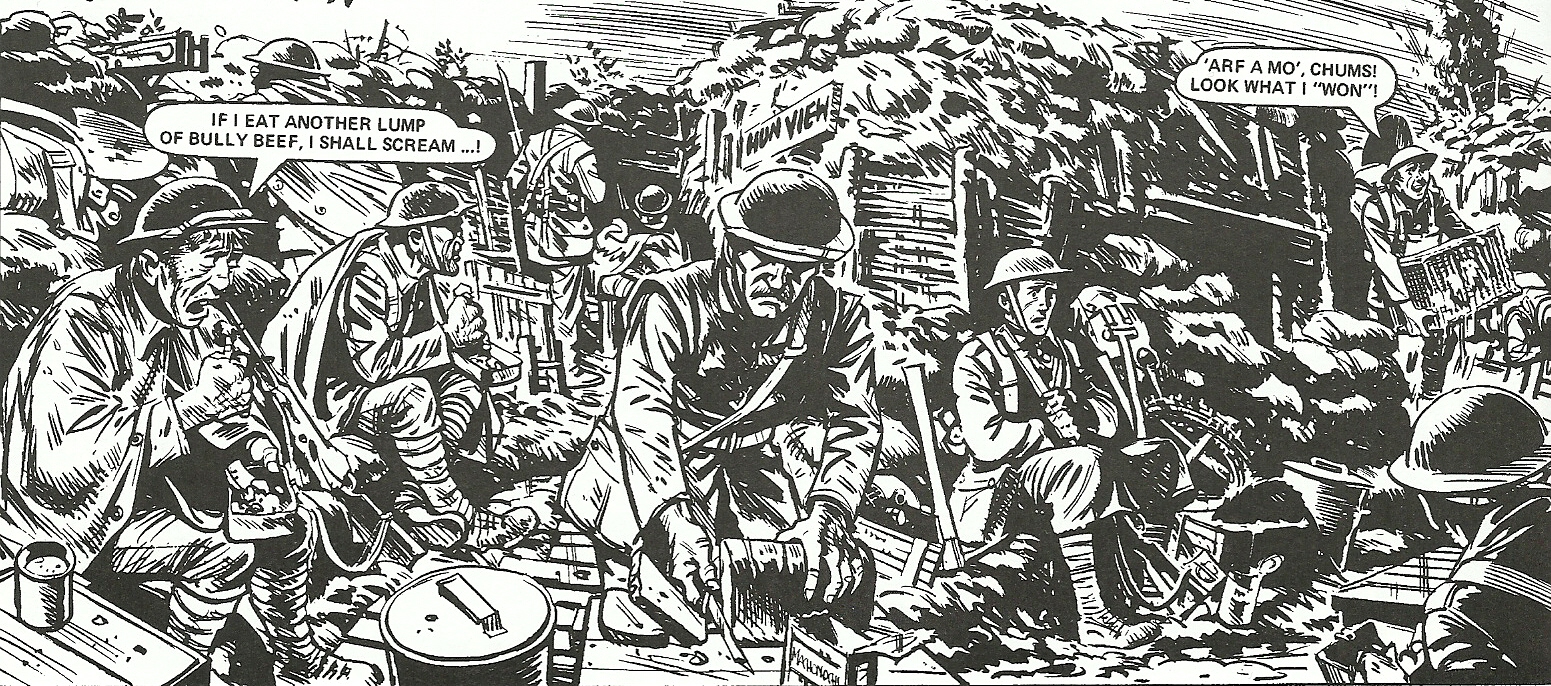
Mills was occasionally criticized for letting his pacifist views bleed through into the work, but that presumes an agenda that I don’t think is there. These historical events happened as documented and they were pretty awful and sending teenagers ill-equipped to handle them compounds the crime; if you do the research on what we put kids through in the trenches during World War I, you end up a pacifist just through revulsion.
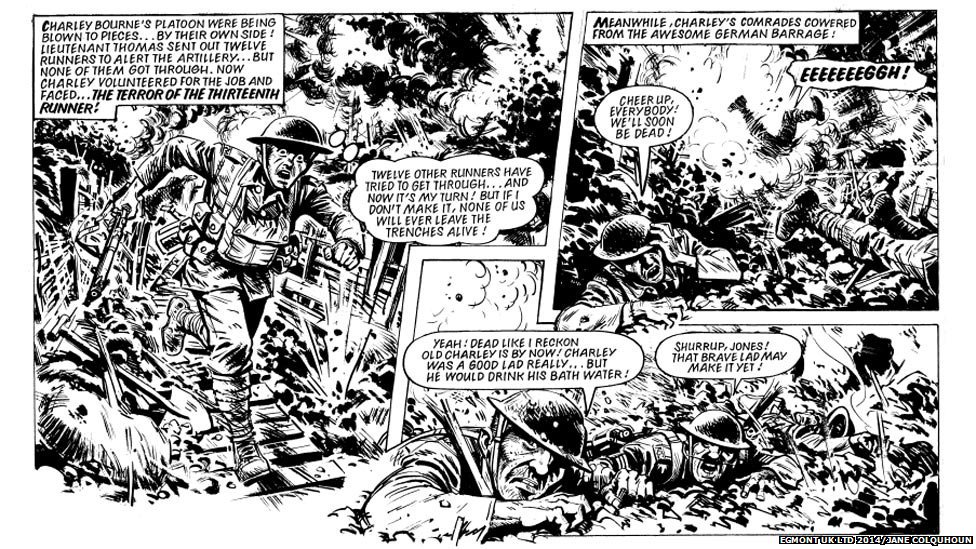
Mills’ plan was to take Charley all the way up to the beginning of World War II, but he ended up leaving the strip over creative differences. Artist Joe Colquhoun stayed on with new writer Scott Goodall and followed the adventures of the older Charley as he enlisted again to fight World War II alongside his son, but the new take didn’t last. Colquhoun’s health was failing and it was agreed that, really, no one else could draw Charley’s War and so the strip ended in 1985.
So is it genius? I don’t know, but it’s pretty damn good. Pat Mills’ sensibility towards war stories is so different than the Robert Kanigher-Joe Kubert war comics I grew up on from DC, and the weekly four-page superdense chapter format is so odd for an American reader, that it took some getting used to for me. But it was completely worth the effort once I fell into the rhythm of it. I couldn’t put the book down, and the artwork is stunning. Colquhoun’s style has a very Kurtzman-esque, EC war comics thing going on.
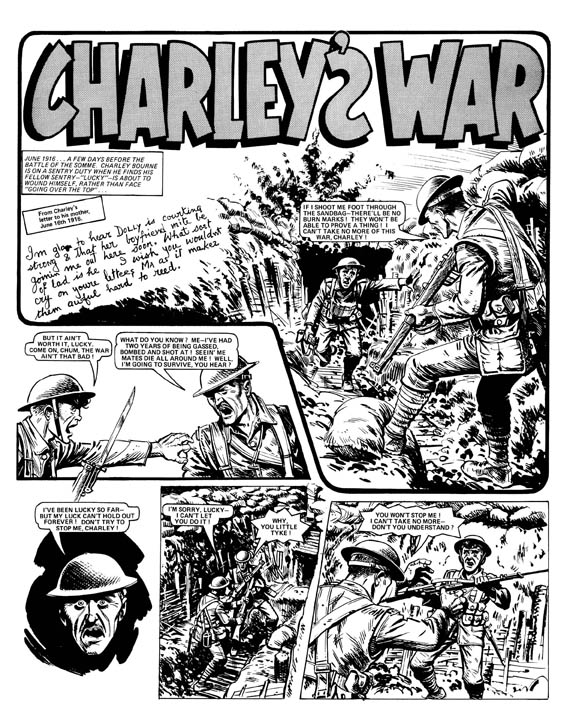
The entirety of the Pat Mills run is collected in ten handsome hardcover volumes from Titan, but I think I like the omnibus format better.
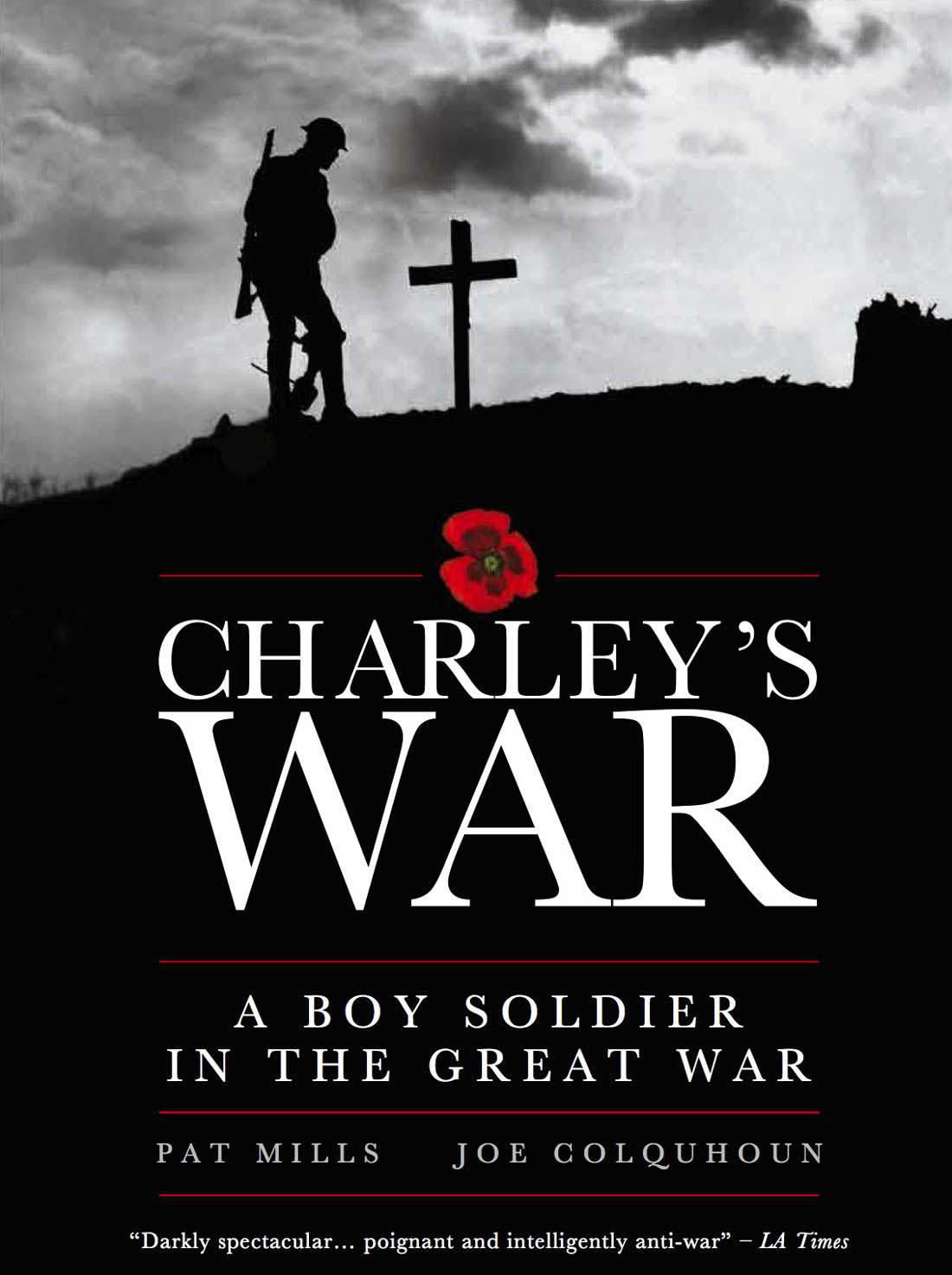
Charley’s War: A Boy Soldier In the Great War puts all of volumes 1 through 4 of Charley’s War between two covers in one classy trade collection for $24.99, which would be a steal in itself, but there are also chapter-by-chapter annotations from Pat Mills himself in the back. It’s a great jumping-on point and the art from Joe Colquhoun has been completely re-mastered — but NOT Photoshopped or re-colored, thank God, it’s all here in gritty black and white as God intended.
So there you go. I did finally get around to Charley’s War and yes, it’s every bit as good as everyone said it was. I trust honor is satisfied now.
See you next week.

As I remarked before, the idea of Mills filtering in pacifist views flies against much of the writing that came out of the war, from soldiers of it. Eric Maria Remarque served int he German army, in the trenches and was forever changed. He created the seminal novel, All Quiet on the Western Front, out of those experiences. He, like many others, were filled with patriotic zeal, to go off to war and fight for Kaiser or King & Country, for rather poor reasons and they saw endless death and slaughter, lost so many friends, and then had to live with it after. He channeled that into anti-war fictions, while others, like Adolf Hitler, failed in life and grew resentment until they perpetuated another war, while railing about betrayal from those elsewhere. Remarque was banned by the Nazis and forced into permanent exile, in Switzerland, but it didn’t stop his writing. His A Time to Live and a Time to Die features a German soldier, from the Eastern Front, returned to Germany on furlough, who finds his family missing, after their city and home are bombed by the Allies, a favorite teacher is under suspicion of being involved in the anti-war movement. A school friend joined the party and lives well, while the average German suffers with food rationing, bombing, suspicion and death. Remarque found nothing noble in war and he portrayed that in his work. Charley’s War is the same. Even Sam Glanzman’s USS Stevens and A Sailor’s Story, even with the humorous moments, shows that war is a terrifying thing, not to be idealized. he has passages in the second volume of A Sailor’s Story, of ships going down in a typhoon, of damage by kamikaze attack, off Okinawa and the ships lost in such attacks. He doesn’t make it a grand, noble spectacle. Kanigher, too often, did that, though less so when working with Kubert, who portrayed humanity, in his art. Enemy Ace was a better representation of that, but Sgt Rock was a bit of a mix of the two ends of that spectrum. Then again, Kanigher never experienced combat, while Glanzman did. Mills, to my knowledge, never did, either; but, he also had a rather dim view of the glorification of “heroes,” and it shows in Charley’s war and, in a more extreme form, in Marshal Law.
I’ve only read the first volume of Charley’s War but it is indeed excellent.
Pat Mills didn’t leave Charley’s War over “creative differences.”
From a 2014 interview at https://downthetubes.net/looking-back-on-charleys-war-an-interview-with-pat-mills/
Steve: Charley’s War: The End finishes in 1933. Can you tell us why you elected not to continue writing the story into World War 2?
Pat: I had intended to, but I needed a research budget to interview veterans in order to sustain its anti-war quality. World War 2 is much harder. The Establishment really works at it to protect its memory as a just war, which is open to debate. Anyway, I couldn’t get the extra money – more out of disinterest than for political reasons – so I left. Joe was coming up to retirement so he asked me if I minded him continuing with another writer. Of course I didn’t, but the other writer’s stories were not well received and Charley’s War in World War 2 ended soon after Dunkirk, I think.
Steve: Although the story did continue with a different writer, Joe’s artwork for those stories is well regarded. Is there any chance of that being reprinted?
Pat: I’ve suggested to Titan that the pages might feature in an Art of Joe Colquohoun collection. It’s interesting that the readers of Charley’s War felt so differently from fans who like the art. For the readers, the story as a whole was everything. It would be easy for fans to obscure the voice of Battle readers as opposed to aficionados who discovered the series much later and I’m not sure actually understand what the series is really about.
I’m halfway through V1 of “The Definitive Collection,” and it’s both very good and exhausting to read, given the nature of storytelling within that format.
Every few pages, I’m hammered again with whatever awful thing happened to characters I cared about in the final page of the last chapter!
But again…I can see so much of the GEnnis-is of Garth’s sensibilities in every chapter.
I don’t think I read Greg’s column first time around so this is a delight. As I’ve said before, Charley’s War is one of the best of our British strips, up there with Judge Dredd, Dan Dare and Dennis the Menace. Mills was a Boomer (b. 1949?), so indeed never saw combat.
Joe Colquhoun was an amazing artist who has an Apex Edition (2000AD publisher Rebellion’s version of the Artist’s Editions) of CW coming out about now. His inking was on a par with Brian Bolland’s peak work on Dredd, etc.
Colquhoun also drew in “Battle” the first two years (1977 to ’79) of Johnny Red, an RAF flyer who fights with the Russians, which is coming out in a new Rebellion collection, with no doubt a forward by Garth Ennis who wrote notes for previous J.R. collections.
In a brave move, Battle’s editor switched Joe from Johnny Red to start drawing C.W. when it began in 1979.