
As Greg Hatcher has remarked in many of his columns, we live in an age when an astonishing amount of old comic book material is available. I completed my set of DC’s original Secret Six on eBay (art by Frank Springer) —

— and I own trade paperbacks collecting Omega the Unknown and Skull the Slayer. As I said in the Skull post, I don’t regret passing up any of these books back when they came out but I’m happy to have the complete run now.
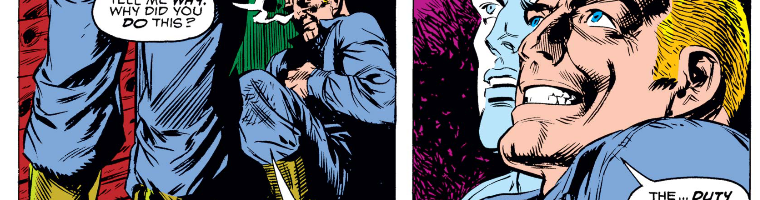
 The saga of one John Kowalski discovering that War Is Hell is included in the second Marvel Horror Omnibus [edited after Alaric alerted me to this in comments]; I settled for reading it on the Marvel app. I discovered I do not regret never glancing at it on the stands, and have no desire to own it in trade paperback (or hardback) form.
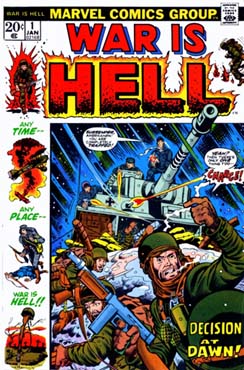
War Is Hell (Herb Trimpe cover) started in 1973 as one of Marvel’s many Bronze Age reprint books. For the first six issues it reprinted random stories from Marvel’s 1950s war comics. Then we got two issues of Sgt. Fury reprinted, then they decided to switch to new material.
I’m not a war comics fan so I never paid any attention to the reprint issues. Even so, the catchphrase on the cover (“Any Time — any place — war is hell!”) stuck in my head. Likewise the announcement that “John Kowalski lives and dies again and again, in every issue of War Is Hell!” stuck with me. Not to the point it prompted me to read the issues recently, though I can’t for the life of me remembered what did prompt me.
The first story, “War Is Hell,” credits Tony Isabella (plotting), Chris Claremont (scripting), Dick Ayers (art) and Roy Thomas (editor). We open with the Nazi invasion of Poland in 1939 —
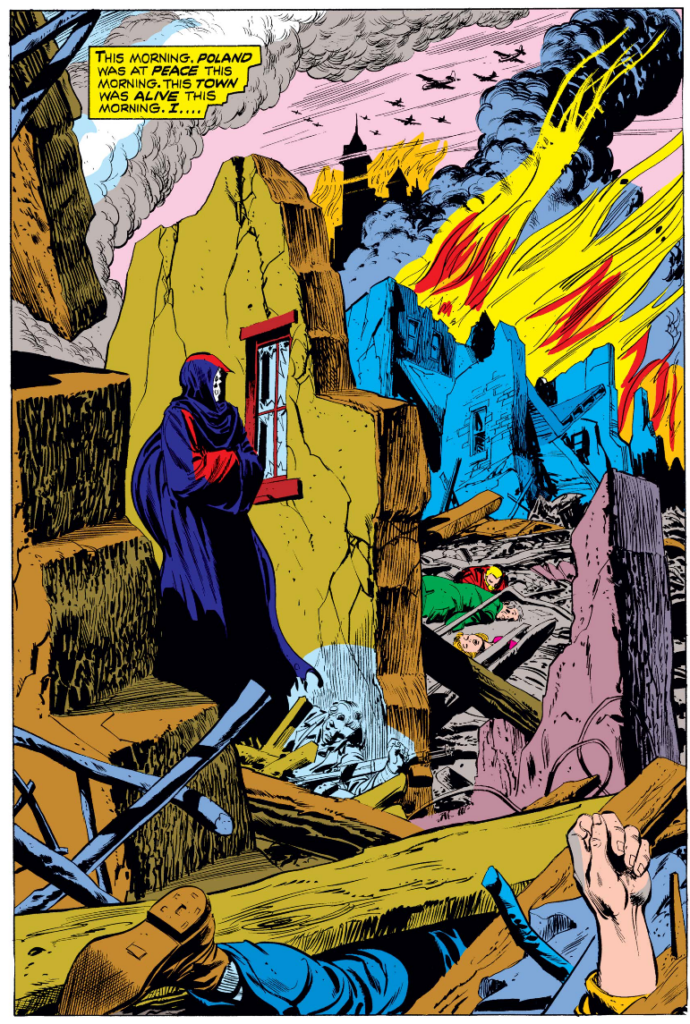
— and Death walking amidst the bloodshed (it’s even better in the two page spread in the comics). We then flash back to learn the history of our hero, USMC Sgt. John Kowalski, Medal of Honor winner. And also — a traitor?
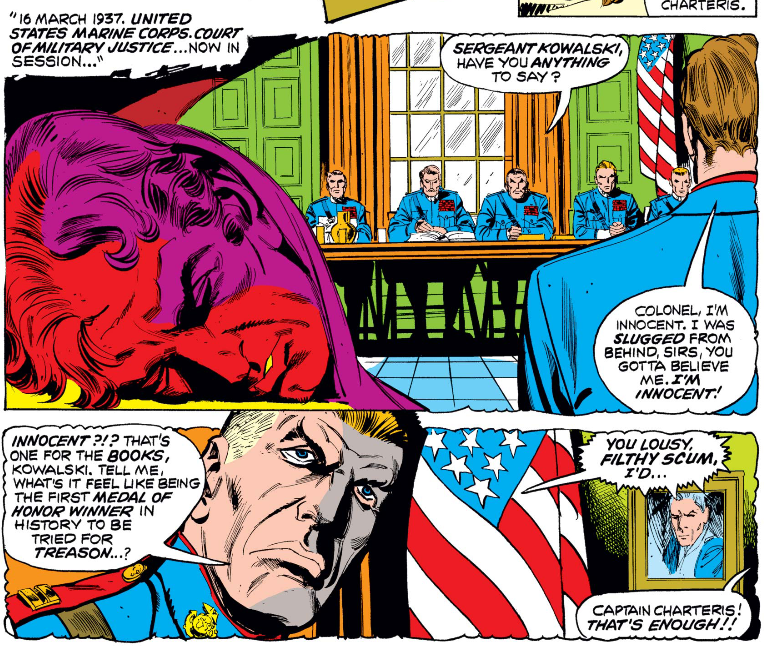
As the United States is not currently at war, the court martial decides rather than a death sentence, they’ll dishonorably discharge him, strip him of his rank and — as he came over here as an immigrant child — deport him to his mother country, Poland.
I find this implausibly soft treatment for a convicted traitor. However I can accept it for purposes of setting up the series. After arriving in Poland Kowalski settles in, working for his relatives in a town near the German border. A member of the German underground shows up, warning the blitzkrieg is imminent.
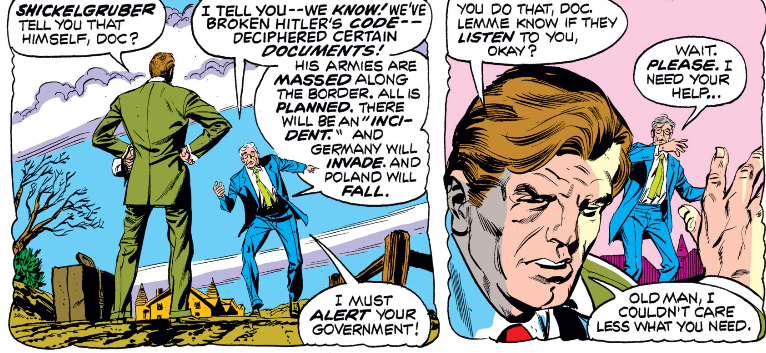
Bad call, Mr. Kowalski. After the German forces demolish the town, the old man tells Kowalski the carnage is all his fault and he must pay!
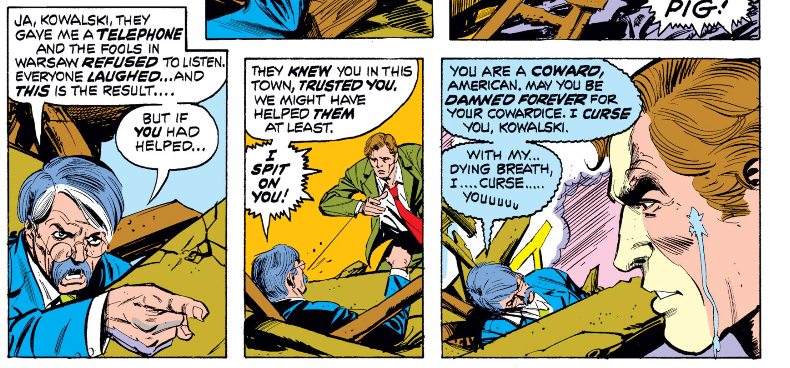
This seems a little unfair. Yes, Kowalski made a bad call; still it’s hard to believe he could have changed events much. And nothing about his actions indicates cowardice. Indeed, a few minutes later he rushes into danger save a little girl
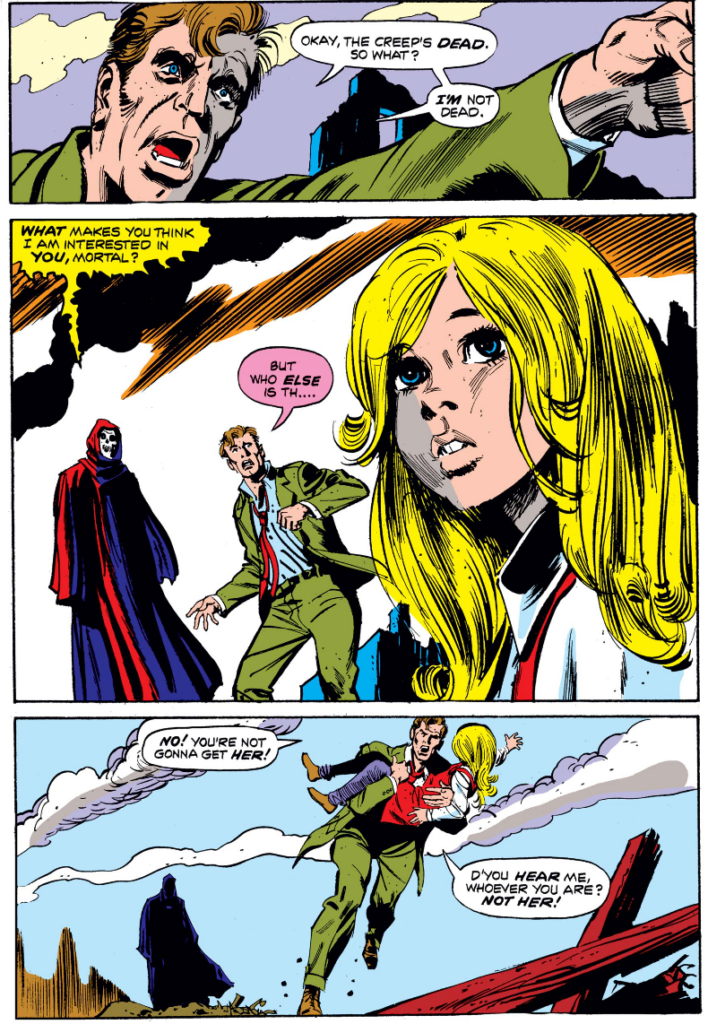 He gets the girl to safety. Strange, why can’t the soldiers see him?
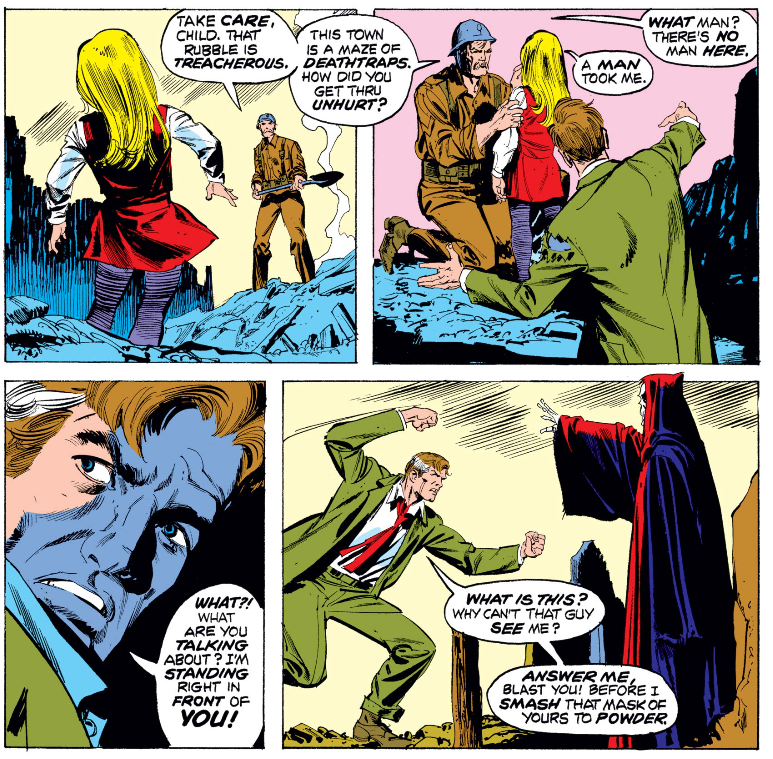
He’s dead, Jim. You probably figured that out. And despite his efforts, the girl dies too. War, as they say, is bad for children and other living things.
Kowalski’s actions give the lie to the charge of cowardice (not to mention he did win the medal of honor). Nevertheless, Death decides to make the old man’s curse a reality. A coward, it’s said, dies many times; now Kowalski will pay that price.
In #10, “The Corridor,” (same creative team, Gil Kane cover, Len Wein now editing) we learn what that means. The Nazis are allowing a few Poles to flee the 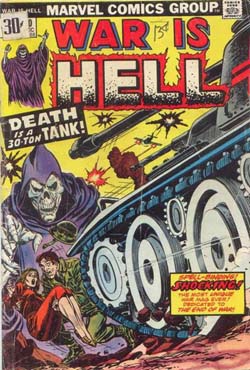 blitzkrieg down a nominally safe corridor. A Jewish family man dies evacuating his family; Kowalski then quantum leaps into the guy and revives him. He doesn’t have much say in what happens, however — his host body’s memories and personality are revived too and Kowalski’s just along for the ride except when the plot says otherwise (er, moments of extreme crisis). Although the host body’s son wants them to stay and fight, the father ultimately decides it’s more important to get his family to safety. He dies doing so, freeing Kowalski’s spirit for its next body hop.
In subsequent issues — now entirely written by Claremont — Kowalski leaps into a Finnish officer fighting a losing battle against Russian invaders; a Nazi charged with rounding up Norwegian Jews; a British fighter pilot; and an Italian officer in the North African desert. Like an anthology-comics host, Kowalski provides bitter, angry commentary on the action — did you know war is hell? Well, did you? — while having very little influence over events. One reason for that, I suspect, is that it makes it easier to show the Axis side of things. If Kowalski dominated his hosts, one assumes the Italian and German officers would be acting differently.
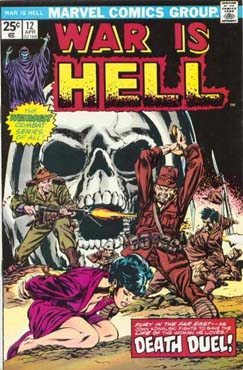
The only one where he has a personal stake is #12, “My Love Must Die” (Claremont, Don Perlin, Kane cover), Kowalski wakes up as a cruel Japanese officer in occupied China. We learn that some years earlier Kowalski fell in love with Tsuin, a Chinese woman, only to have their relationship fall apart. Now Kowalski’s host body is torn between either killing Tsuin or inflicting, as they say, a fate worse than death. Complicating things is that Kowalski unknowingly put a bun in her oven. Death informs Kowalski he can save Tsuin or their son, not both. Asserting control over the Japanese officer, Kowalski saves both, thwarting Death for the only time in the series’ seven issues.
It’s a surprisingly clunky story from Claremont. Kowalski has absurdly little reaction to the reveal that he has a child. And while the Italian and the German officer are shown to be good men on the wrong side — the German saves the Jews he’s been ordered to cage —
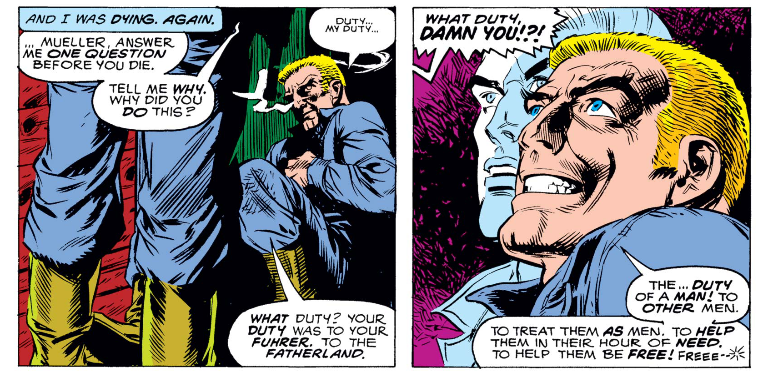
— the Japanese officer is a fiend. It’s uncomfortably close to WW II stereotypes: Germans were good men enthralled by a monstrous ideology, the Japanese were monsters.
I’m not a war-comics fan so I can’t really critique the book’s merits as a war comic. The series certainly drives home the message that life in wartime is nasty, brutish and short, but Enemy Ace made that point with more style and better stories. Kowalski’s ghostly presence was, I assume, meant to provide a continuous character to root for while allowing the series free range to go anywhere — any theater of operations, any side, any individual. Instead I think his presence made more of a distraction, like why is Death even bothering with him?
Possibly him being an alleged traitor would have tied in to that. It should have tied in to something — it’s too big a detail to leave as a loose end. If it wasn’t significant, they could certainly have come up with a simpler backstory (“I didn’t think visiting the town where I was born would get me killed. Hitler’s talk of European war was just talk.”). However the treason’s not even mentioned after the first issue; when Kowalski gives us his origin in a later issue he simply mentions that he was gunned down on the first day of WW II. I’m guessing either Claremont or Wein decided to ditch that aspect. I don’t think that was a good call.
Then again, it’s not likely dealing with it would have made me like the book.

The War is Hell stories were in fact collected in the second Marvel Horror Omnibus (Marvel Horror Omnibus Lives Again!).
Thanks. Obviously I didn’t check closely enough, will amend now.
Wow, a Marvel comic I’ve never heard of! I like this premise– with some tweaks, they should bring it back with Garth Ennis and let him go nuts.
It didn’t leave much of a mark, though Claremont brought Kowalski back as an avatar of Death when he was writing Man-Thing (no explanation how he went from Cursed to Black Racer, so to speak).
Yeah, I first encountered the character in those Man-Thing (Vol. 2) stories.
Marvel UK reprinted it in their series forces in Combat. it was an odd anthology series which also featured Rom, Sgt Fury, Kull, Master of Kung-Fu, Rawhide Kid, Machine Man, Golem plus British strip Wulf the Briton and an original comedy series I was Adolf’s Double
I will mention that Garth Ennis used the War is Hell title for a story about the Phantom Eagle
I saw the Phantom Eagle story on the Marvel app. Didn’t have the time to read it though.