

Back when CBS’ The Incredible Hulk was on the air, I was in college and didn’t have convenient access to TV (my freshman dorm had one set, down in the basement). I caught an episode when I was home on break and decided I didn’t care for it.

The episode, “Never Give a Trucker an Even Break,” has David Banner (Bill Bixby) unwittingly embroiled in a battle between a pretty trucker (Jennifer Darling) and a gang of hijackers — a battle the latter would win except David keeps getting angry and hulking out. It struck me as a story that could fit into any of TV’s wandering-hero series, except with the Hulk as a deus ex machina.
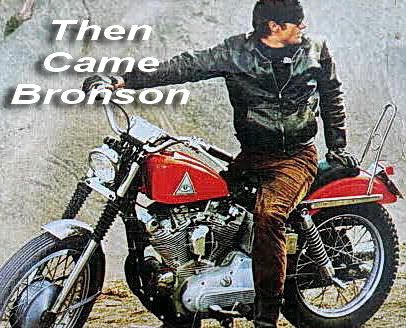 Wandering heroes were a thing in the 1960s and on into the 1970s. Route 66. Then Came Bronson. Run, Buddy Run. Characters criss-crossing the country, arriving in small towns or big cities, having an adventure or a romantic encounter, then moving on. I’m not sure if the popularity reflects the 1960s zeitgeist or the flexibility it gave writers in terms of stories.
Most significant for the purpose of this post was The Fugitive, a smash hit which ran from 1963 to 1967. Richard Kimble, convicted of the murder of his wife, travels across country hunting the one-armed man who really killed her, pursued by the cop who thinks Kimble’s guilty as sin. That template — wandering hero is both pursuer and pursued — would inspire lots of later television science fiction. The Immortal, The Phoenix, Starman and a bunch of TV movies that never went to series. And The Incredible Hulk. David Banner is constantly searching for a cure; he’s also constantly hunted by Jack McGee (Jack Colvin), a tabloid reporter who investigates Hulk sightings.
As part of my research for Watching Jekyll and Hyde, I rewatched the initial TV movie pilot, then the first season. I like the show much better than I did when it was on the air. I suspect part of that is that this kind of wandering hero on the run isn’t as common as it used to be. And, of course, that it’s a good wandering hero show. Like lots of TV people in the last century, producer Kenneth Johnson cringed from the thought of doing a comic-book show; unlike most such creators, he went ahead and made a good show.
The Incredible Hulk (1977) was the movie that started it all. A year earlier David Banner lost his beloved wife (Lara Parker of Dark Shadows) in a car crash. Since then he and his research partner Elaina (Susan Sullivan) have been studying why and how some people exhibit superhuman strength in a crisis enabling them to save lives. David would very much like to know why he couldn’t do that when it counted. Eventually the two scientists find the answer: a specific gene, stimulated by gamma radiation from sunspots. David has the gene; the gamma radiation wasn’t there.
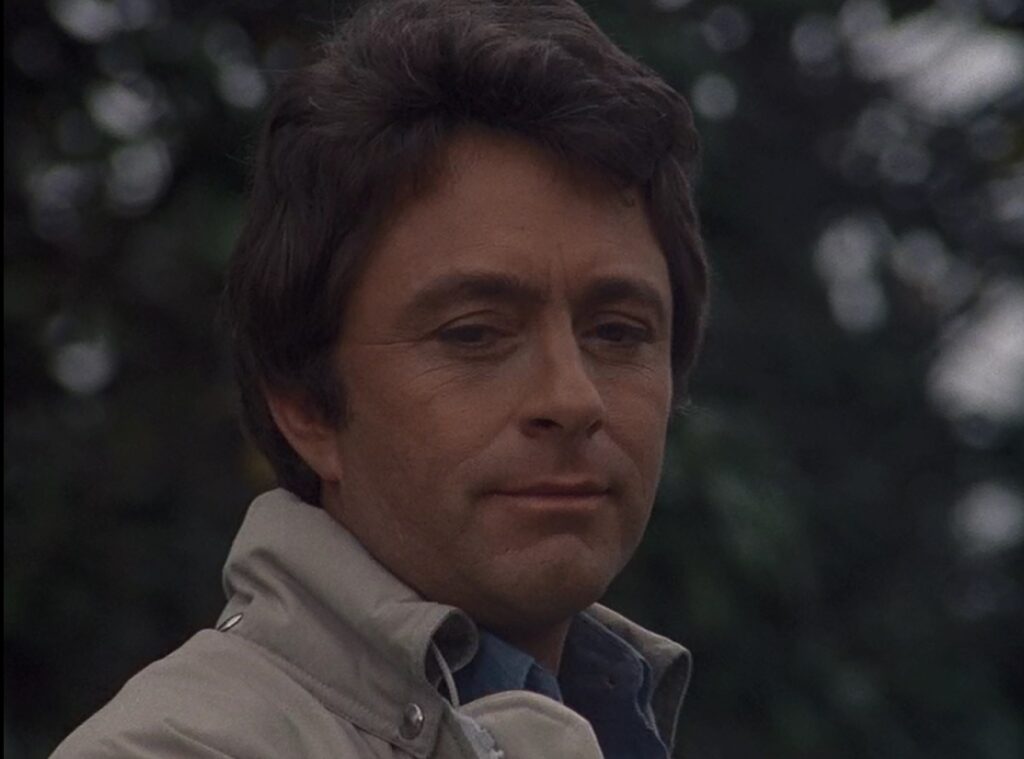
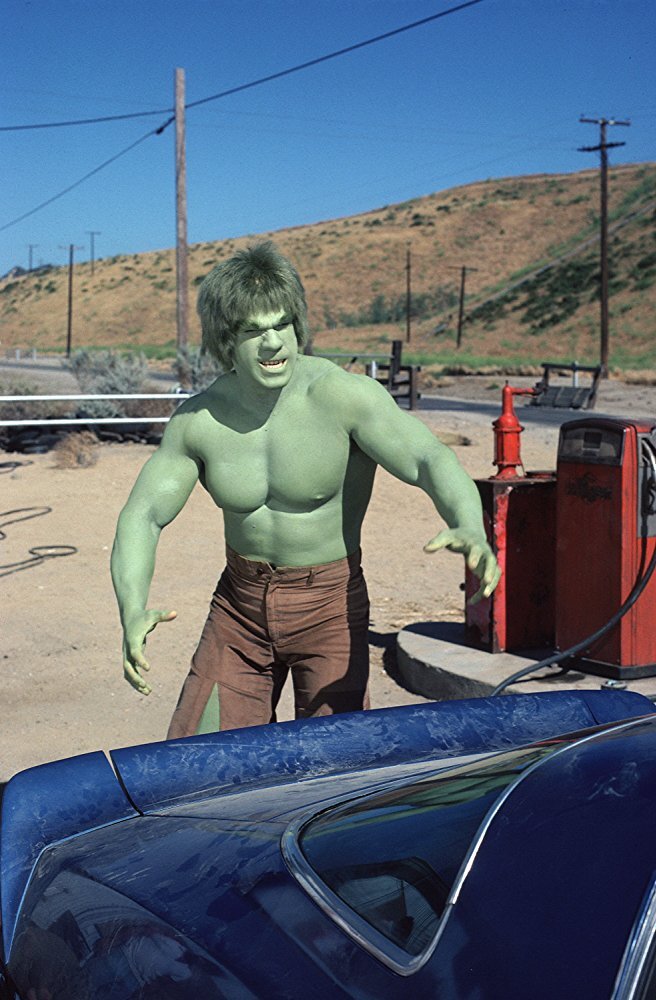
David puts this to the test by using the lab equipment to dose himself with gamma rays late at night, when he’s alone (the weakest moment in the film — I see no reason he couldn’t have waited). Unfortunately it’s set to give off way more radiation than the controls say, so David gets a massive, king-sized overdose. Driving home in the rain, his car gets a flat; he gets increasingly frustrated trying to change it, his heart races, his blood pounds … and the Hulk is born.
That’s bad enough. By the end of the movie, McGee’s screw-ups have brought about Elaina’s death, the Hulk appears responsible; and David is supposedly dead. He chooses to stay that way while he hunts for a cure.
It’s a good film. The acting is good, the special effects are well-executed and the Hulk is more impressive than I remembered. It also establishes that despite his rage, the Hulk is still David and “David Banner doesn’t kill.” That makes it easier to root for him.
 By contrast the follow-up TV movie, A Death in the Family, AKA Return of the Hulk, is the kind of story I thought the whole series was. David gets a gig working on a wealthy young paraplegic’s estate. He discovers her widowed stepmother is paying the family doctor to poison her, which is why the young woman is in a wheelchair. It wouldn’t take much to turn this into a Fugitive episode.
The series that followed is much better. The shows are well written and Bill Bixby delivers a great performance as David. He’s compassionate, decent and as Greg Hatcher once put it, he comes off horrified whenever he comes to after hulking out, forced to wonder what he destroyed this time. When I rewatched the trucker episode what sells it isn’t the story, it’s Bixby. It’s David Banner’s utterly baffled smile as he tries to figure out what insanity he’s become embroiled it.
Lou Ferrigno’s Hulk is more than the deus ex I thought. Multiple episodes show that like his comic-book prototype, he’s capable of being tender and protecting the innocent. The show’s special effects do make his feats of strength impressive. It’s easy to see why this rseries an five seasons (followed by multiple TV movies) where most Marvel live-action shows of that era flatlined.
That said, the wandering hero aspect doesn’t completely work. Even allowing for hitchhiking, David seems to jump across the country way too fast for a penniless drifter (today New York, next week San Diego)! Despite still grieving his wife, and then Elaina, he’s constantly falling in love with the women he meets, two in the first season alone. And McGee’s obsessive pursuit is unconvincing, not to mention I can’t buy his tabloid employer underwriting all his travels — it’s not like he gets that many sensational scoops. He’s simply a plot device to keep David on the run.
The show is also dated in a way I didn’t expect. David is a vagabond in an era when it was possible to walk in off the street and land a job waiting tables or pushing brooms. No background check. No requirement you list every job you’ve had all the way back to your college days. Today even the grungiest jobs often require paperwork that would have come with a security clearance back in the 1970s. That’s not a weakness in the show but it sure jumped out at me when I watched it.
As I bought the DVD set, I look forward to catching the rest of the run.

I’m pretty sure that in one episode of Castle, his mom (Susan Sullivan) is watching the Hulk movie and commenting on being in it (she plays an actor on the show), which I thought was a fun bit of metacommentary.
I watched several seasons of Castle, did not remember that detail. But yes, nice touch.
That “Trucker” episode is notable for reusing extensive footage from “Duel”. I read somewhere that an outraged Steven Speilberg put restrictions in all his future contracts to keep that from happening again. I’ve always had a soft spot for this episode, though I’m glad the series’ experiment with comic episodes didn’t go further. The phone booth scene certainly dates it.
The early Hulk episode had great cinematography, which keeps them from feeling quite as dated. Later ones, not so much.
There was an episode where David was trying to get a fake ID, and others where he managed to have a driver licenses with an alias. Still, that fact that he made it to Hawaii in one episode was a little hard to accept even then.
I enjoyed the wandering hero aspect. It would have been nice for the show to occasionally revisit characters, but it only did so once (other than McGee’s boss who recurred a couple times).
Early on there were attempts to do more with McGee by having more close calls and integrating him into the stories and not just having him show up after the Hulk had appeared. That ran out of steam pretty early in the run, unfortunately. Imagine if the show was produced now, with everything having season-long arcs. Presumably the McGee storyline wouldn’t be as wasted.
Given the ease of recording something like a Hulk rampage I wonder if it would be public knowledge he existed or everyone would dismiss at as an AI hoax.
There was one episode in Season 3 focussing on McGee (Bill Bixby was unavailable) in which the newspaper’s publisher retires and his daughter takes over tying to move to more serious journalism.
Series 4 tried to shake things up a bit with a few stories moving away from the “wandering hero” with a radioactive meteorite, a cure attempt going badly wrong, a mercenary laying a trap for the hulk, and an earlier hulk. (played by Dick Durock who had a later comic-related role as Swamp Thing)
My friend Ross has mentioned some of those later episodes. I thought about catching them but after chatting with him (he’s a big fan of the show) he convinced me I’d seen enough to write this section of Watching Jekyll and Hyde.
If you can watch “Dark Side” [Season 4 episode 4] – I would suggest watching it – If I remember rightly, the Jekyll and Hyde influences may be especially significant in that.
(And if you go to the more literal versions of Jekyll and Hyde – I thought the 2007 series with James Nesbitt was good)
I do have the complete Hulk set. However the book is done. I did catch the James Nesbitt (I’ve seen it before) and I agree it’s good. Nesbitt does an amazing job switching from sane to psycho.
It’s also one of three in this century that have Jekyll and Hyde communicating by leaving taped messages or texts, making me wonder if that will be a thing going forward. at least in contemporary versions.
Although I stopped watching the show regularly some time in its third season, I watched it pretty faithfully up to that point for one, single reason: Bill Bixby. As noted, his performance just sold it so well – which was a big thing for the young me, as I was initially a bit put off by the fact that the show was virtually nothing like comic book series.