
“There you sit, sitting spare like a book on a shelf rusting; not trying to fight it”
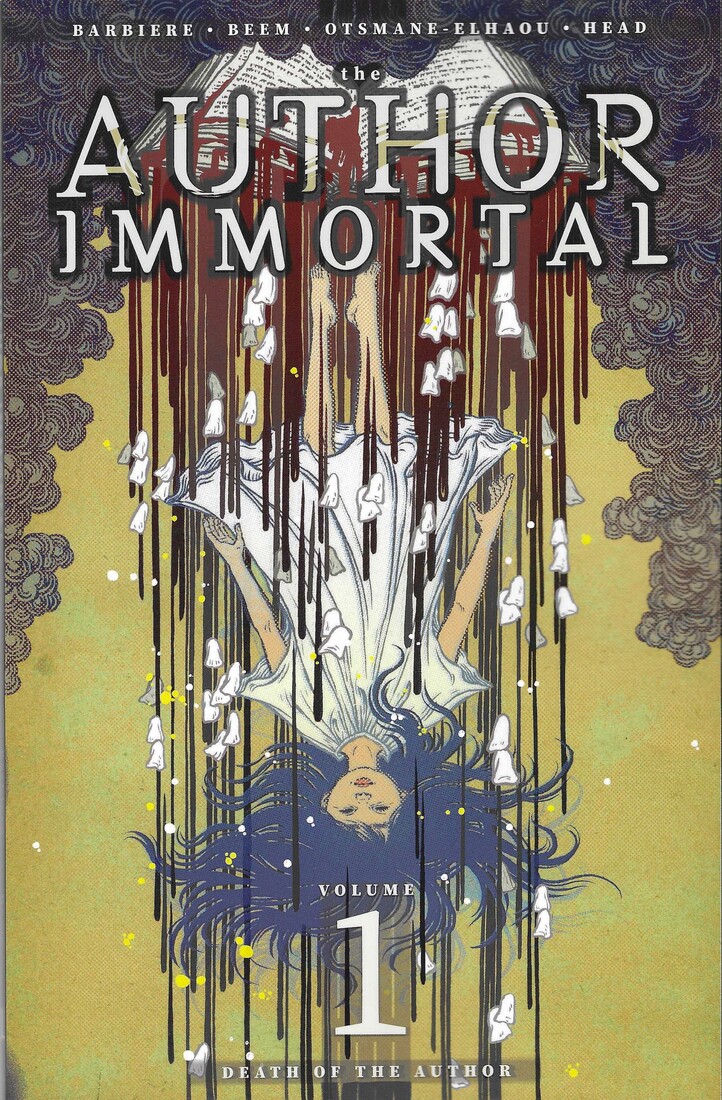
Frank J. Barbiere has written plenty of comics, but he’s never written a great one, as far as I can tell. He seems more of an “idea” man than someone who can really make a story sing, but your opinion may be different, of course. It’s too early to tell if The Author Immortal, his latest, will change my thoughts about him, but it’s off to a good start. 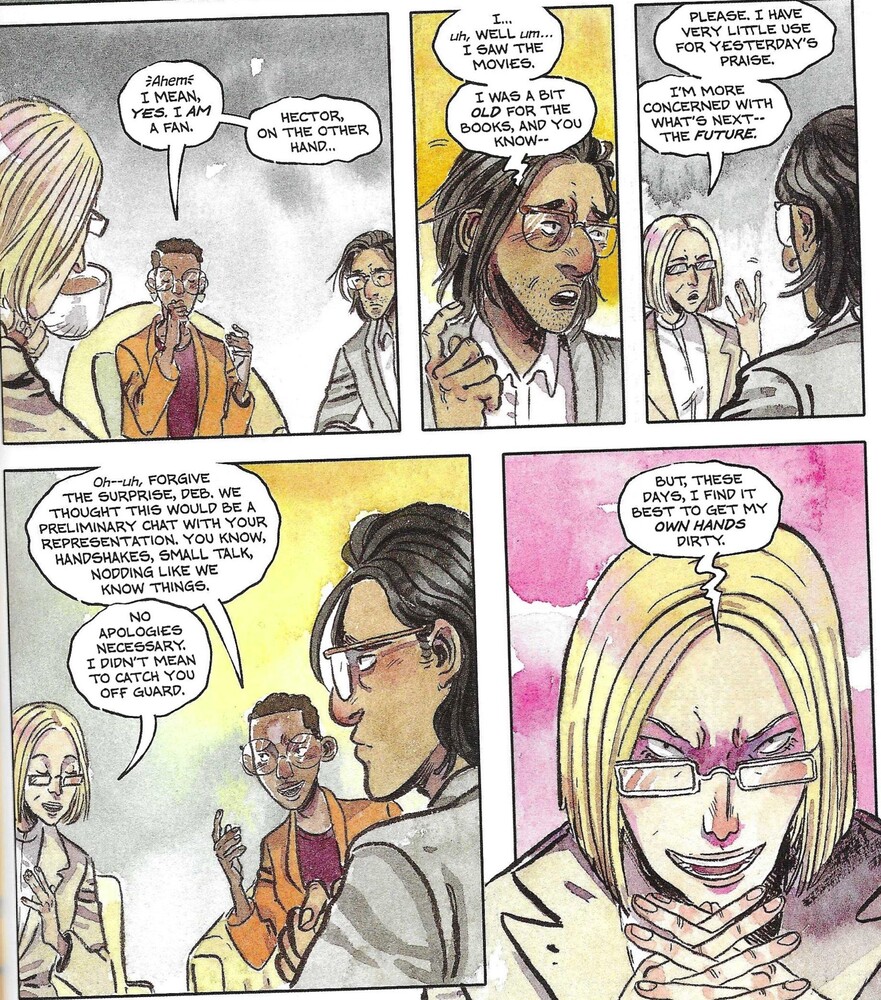 It’s drawn by Morgan Beem, lettered by Hassan Otsmane-Elhaou, and edited by Arden Ripley. Image published it, it costs $16.99, and it’s 130 pages. Let’s have a look!
Barbiere takes a tried-and-true formula — what if a fictional book was actually kind of real? — and puts a decent spin on it. The story begins in 1953, as a famous fantasy writer kills himself with a strange quill/knife as he looks at his daughter, who appears to be trapped in amber inside his large library. He narrates about some things that presumably will be explained at some point, although they aren’t here, and we learn later that he “disappeared,” so even though it’s clear he stabs himself, something happens to his body. We find out later that he wrote 12 volumes of the series, the first one pre-dated Tolkein, and the main character of the book is named after his daughter or vice versa (she’s obviously younger than 18, which is how long he’s been writing the books, but she could also be in suspended animation). Meanwhile, in the present, a strange, inky monster is killing people (which seems to get dropped as a plot point, but I assume Barbiere will get back to it later, as well) and Hector Ramirez, the world’s leading expert on the fantasy author, gets an offer from … well, J.K. Rowling. I mean, it’s “Deborah Luckwell” (loaded last name there), but it’s Rowling. She invites Hector and his fiancée, Sheila, to a meeting to hire him as a co-writer, as she’s planning on revamping the old fantasy novels (it seems like her career has taken a bit of a hit due to her disgusting personal politics) and wants him, as the leading expert on the author, on board. He heads off to England with his kid, Al, a trans boy who does not get along with their father at all (who still calls them by Alethea, which is, of course, the author’s daughter’s name). 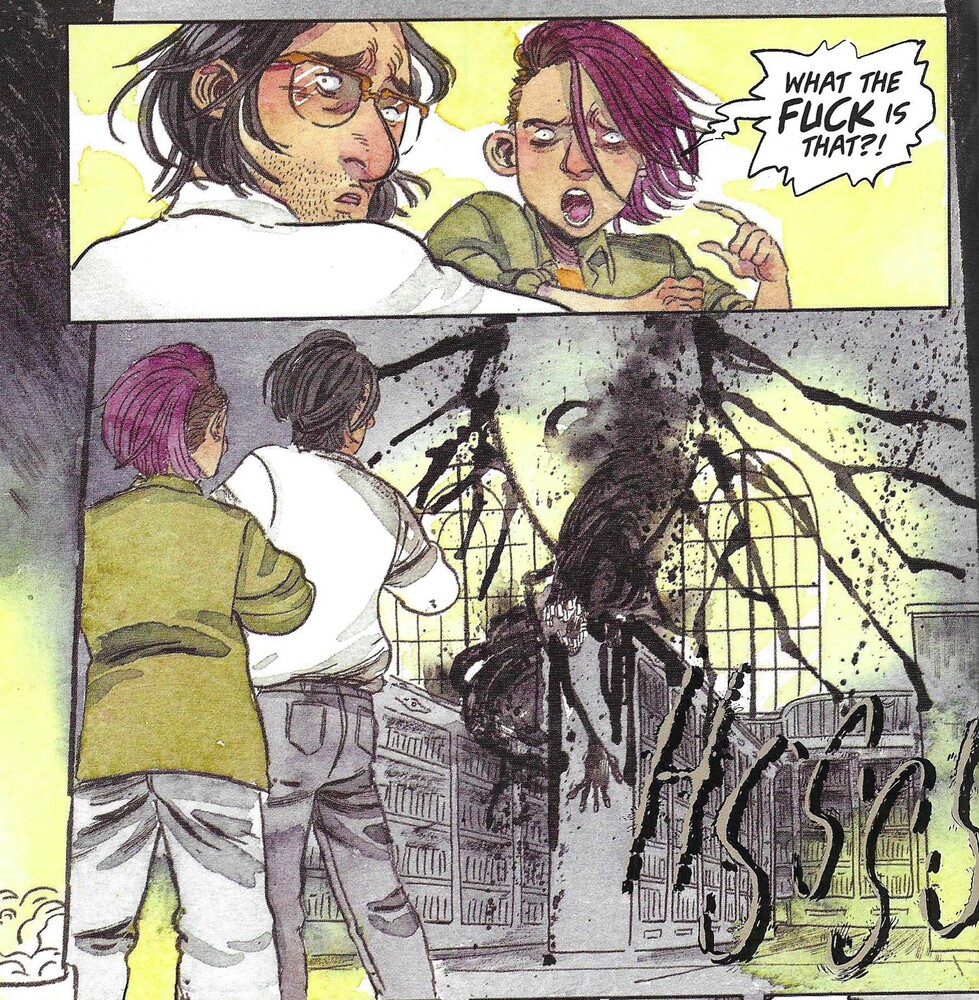 When they get to England, they find the library and the daughter in amber, but the inky monster attacks them, Hector finds the quill/knife, and they both get sucked into the dimension of the book, where the main character, Alethea, is now a grown-up barbarian bad-ass. Because of course she is!
It’s a pretty good set-up, and Barbiere does a decent job with it. Hector and Al are separated, so they encounter different things in this world, which allows us to see a good amount of it. Alethea thinks Hector is an evil wizard, while Al ends up at the court of the Harlequin King, where they think things are groovy because no one judges them, but they soon learn that all is not exactly well. Both of them are familiar with the books, so they both figure out they’re kind of inside a fictional world, even though it has changed significantly since the final volume came out. Both are “infected” with the ink, which, when Alethea grabs Hector, gets into her and shows her images of a life she doesn’t remember, while Al seems to be able to cast spells without really understanding what they’re doing. They come back together at the end of the volume, but Al still does not like their father because he’s still kind of feckless, and Hector still doesn’t know how to relate to Al even though he says he accepts their transition. This leads to a nasty confrontation that separates them again and sets the stage for the rest of the series. It’s not the most original plot in the world, certainly, but Barbiere does a pretty good job zipping through it. As I noted, he’s a good “idea” man, so this idea works pretty well and it’s clear he’s thought it out. Even back in the “real” world, Deborah Luckwell is up to something, and she’s trying to rope Sheila into it. So there are a lot of plates spinning, and so far, Barbiere is spinning them nicely. The problem with Barbiere is that he always comes up short with the characters, and he does so a little here. Hector is such a stereotype it makes my teeth hurt — he’s divorced, and it’s clear he got divorced because he was cheating with Sheila (who’s a good deal younger than he is, of course), and now he’s cheating on Sheila with one of his students (which we find out on the third page on which he appears, because Barbiere wants to load up on clichés early on!), and Sheila finds out late in the book, so that will be something going forward. 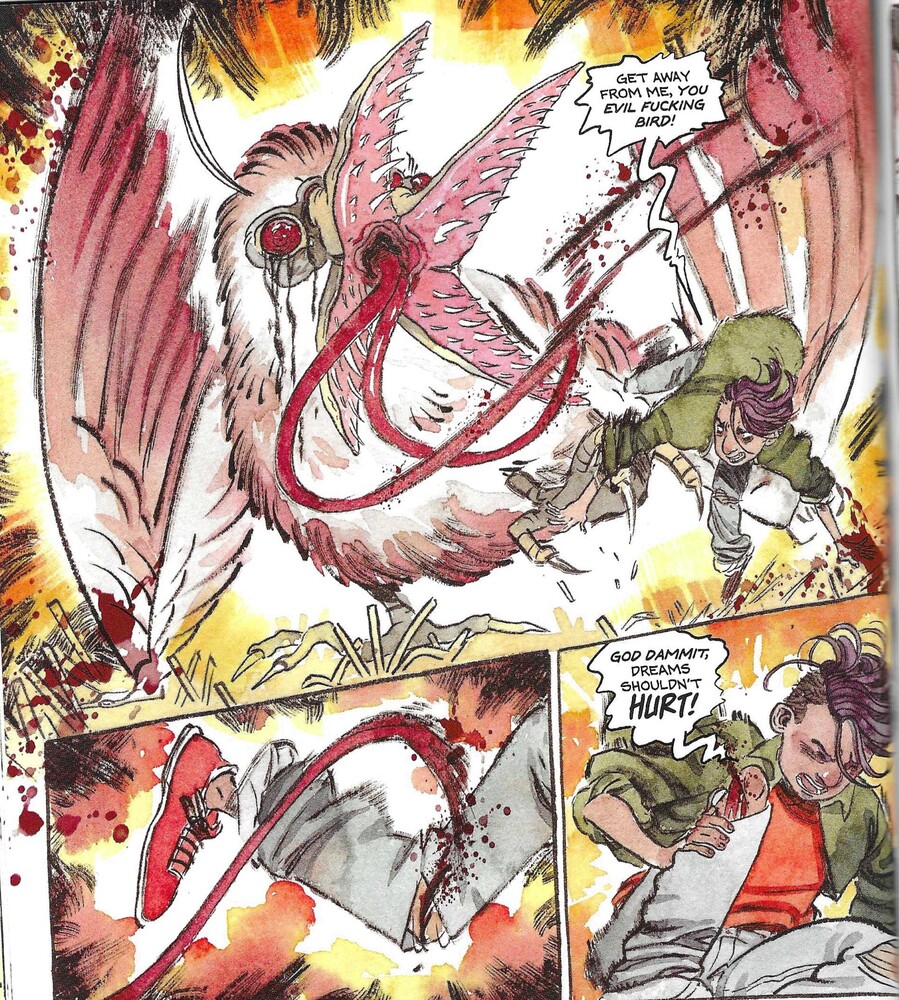 He’s timid and easily manipulated, he doesn’t stand up for his kid, and he doesn’t listen to Al at all. There is, of course, a brief instance with a bigoted mother who doesn’t like her daughter hanging out with Al, and of course, Luckwell, being a Rowling analog, is a horrible human as well. Sheila is slightly more sympathetic, but she’s also sycophantic around Luckwell and allows that to cloud her judgment. There’s a subtext about celebrity culture that’s not terrible and is unfortunately appropriate but also feels a bit clichéd, because of course a character would be slobbering all over a celebrity even though that celebrity is clearly a horrible person. It’s frustrating, because, like so many other stories in the world, Barbiere could put just the tiniest more thought into this and make it less stereotypical, but he takes the path of least resistance. It weakens the book — not too much, but enough that I worry about it going forward. I guess we’ll just have to see.
Beem has sort of an Andrea Mutti/Tyler Crook thing going on in her art, which is not a bad thing at all. She has a slightly cartoonish vibe to her work, but that helps because the book is very kinetic, and her fluid line works nicely with that. She creates a weird, fictional world with some truly odd and menacing animals, and she does a nice job contrasting them with the “book,” as the world of the book is … nicer? than the world Hector and Al discover. This is clearest with the Harlequin King, who’s weird in both incarnations, but Beem does a nice job making him a bit more eerie in the world Al finds as opposed to the original version in the “book.” Beem does a tremendous job with the inky monsters, who are vaguely defined (because she splatters ink on the page a bit) except for their horrific teeth, which float in a body of blackness. There’s a terrifying spidery woman who shows up in the middle, and Beem does a marvelous job with her, plus she adds webs around the edges of the panels to make the scenes even weirder. 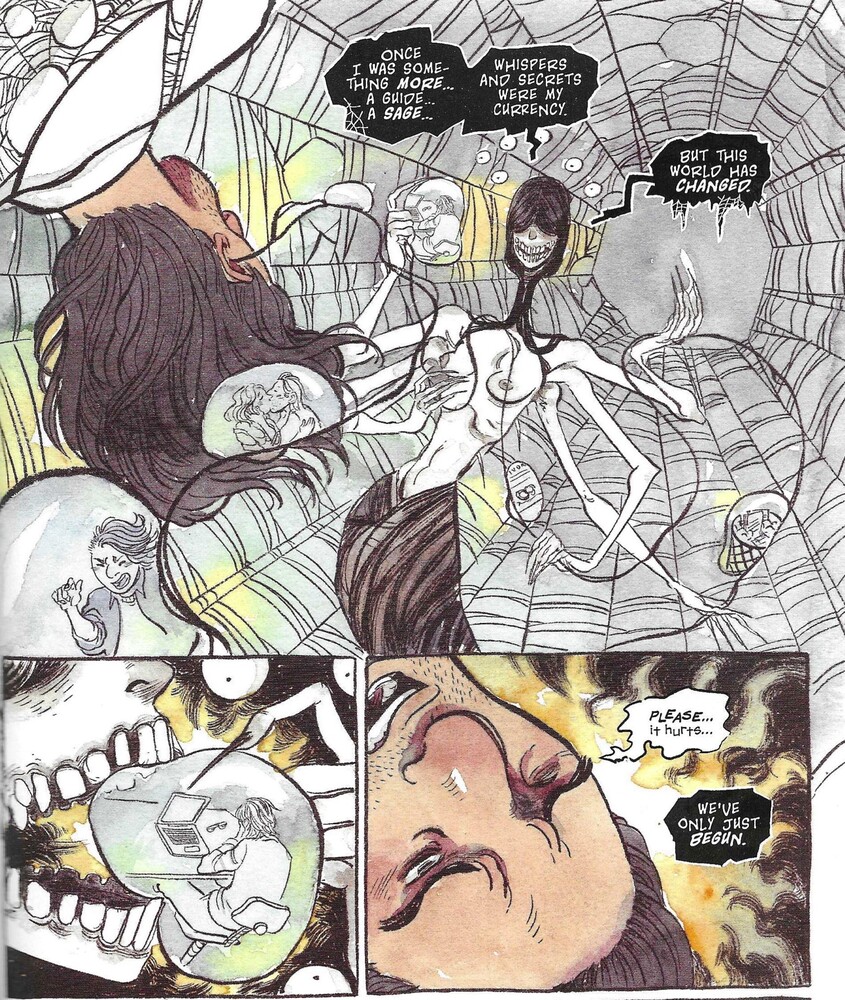 Her Luckwell is excellent, too, as she’s very modern and sharply edged, which sets her outside the “real” world, with Hector’s dishevelment and Sheila’s stylish exuberance. Alethea is a fun-looking character, as it looks like she cobbled together her outfit and armor from various sources, which feels like the way she’s been living. Al is a nice character, too — Beem does a nice job showing how they both shrink inside themselves at times because they’re still not completely comfortable in the world, but she also shows how Al slowly accepts who they are and what they can do. Beem does good work with the coloring, too, as she uses watercolors, which makes the ink monsters work well and the blood pop nicely. She does beautiful work with brushes, too, making the work a bit rough and tough even though her line work is a bit thinner. It’s a really nice-looking comic.
I guess this book seems to be impressing a lot of people, and that’s cool — it seems a bit designed to please critics, as people like the whole “fantasy world is really real” thing (I do too, to be clear) and everyone likes to hate J.K. Rowling, so there’s that. I’m not that high on it, but I do enjoy it quite a bit. I’m curious where Barbiere goes with it and if he can overcome his worst writing tendencies. Will he?!?!? It’s a good start, though, so I’ll see where it goes!
Rating: ★ ★ ★ ★ ★ ★ ★ ½ ☆ ☆
