
Let’s skip those hitchhiker books, shall we?
I think I’m going to have to SPOIL some things here, so beware! I don’t want to, but I need advice from our readers, and it won’t work unless I SPOIL things! If you haven’t read these books, you can go a bit further into this post — I promise I’ll put up a SPOILER alert when I’m really going to get into it!
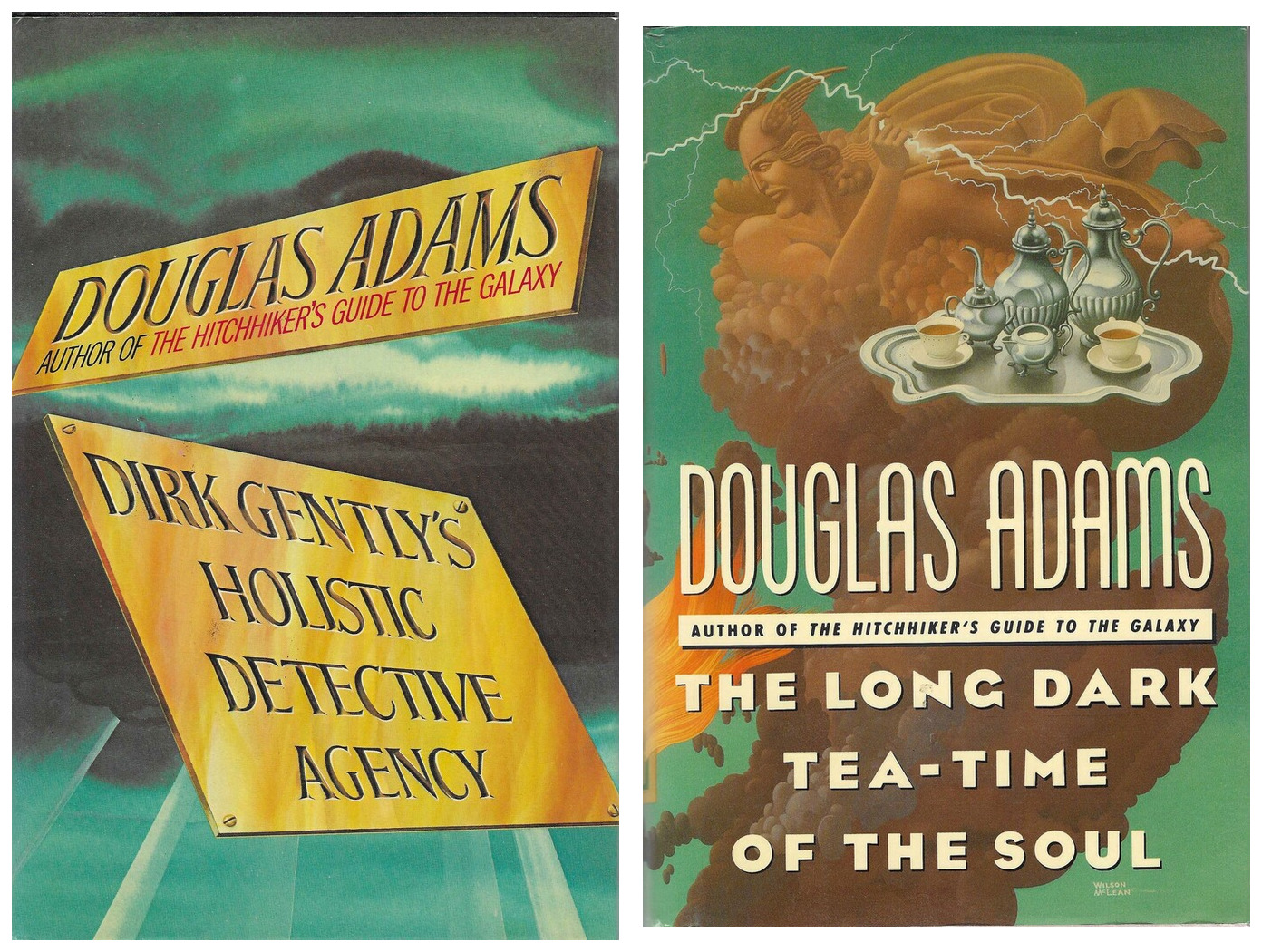
Like a good nerd, I like The Hitchhiker’s Guide to the Galaxy and its sequels as much as the next person, and consider it one the funnier books I’ve ever read. I liked the original trilogy and especially So Long, and Thanks for All the Fish, but man, Mostly Harmless kind of pissed me off because it’s so evilly cynical and Adams ditches Fenchurch, who’s kind of awesome. The end of the “trilogy” almost — not quite, but almost — retroactively ruins the earlier books for me. After the first four books of the Hitchhiker’s series, Adams turned to his two Dirk Gently books (technically, I suppose, the posthumously published The Salmon of Doubt is a Dirk Gently book, but I haven’t read that and I guess it’s kind of not really a Dirk Gently story anyway). Dirk Gently’s Holistic Detective Agency and The Long Dark Tea-Time of the Soul came out in 1987 and 1988, respectively, and I have them both in nice first-edition (well, first-edition American versions) hardcovers, because by 1987, I was a fan of Adams and wanted to check out his new stuff. Not to be heretical, but I like these books more than the Hitchhiker’s series. I have some problems with both of them, but Adams had become a better writer in the few years since the original trilogy was done (which might be why I like So Long, and Thanks for All the Fish — it’s a wonderfully written book), and while the Hitchhiker’s books are undeniably funnier, the Dirk Gently books are very funny, too, and often more subtly than the adventures of Arthur Dent and Ford Prefect were. Plus, I just like detective fiction, and Adams puts his astonishingly weird and clever spin on detective fiction in these books. I wish he had written more of them, but perhaps they didn’t make as much money as he thought they would or they were harder to write than he thought they would be (the plots are very convoluted), but at least we have these two!
One of the excellent things about the first book is the absence of the title character for a long stretch to begin the book. Dirk doesn’t show up until Chapter 13 (page 83 in my version), and even then, we don’t know who he is at that point. He had been mentioned before, but he doesn’t show up, which allows Adams to introduce Richard MacDuff and Reg and the Electric Monk and Gordon Way, which allows us to get into the story very well before Dirk bustles in with his utterly chaotic nature. It’s an interesting way to do it, as we need to know a lot of stuff before Dirk comes in, as he tends to dominate things once he shows up. In the second book, Dirk is in the story a bit earlier (Chapter 3, page 33), but in the first two chapters, we get quite a bit about Kate Schechter, whose dilemma drives the plot. In both books, Dirk is simply there to interpret what’s happening to Richard and then Kate, which he can do because he’s such a good investigator (or because he accepts things that other cannot), and Adams does a nice job making sure he’s not the complete focus. Dirk is a force of nature, but Richard and Kate keep the books grounded.
The plots are very fun, too. In DGHDA, Richard MacDuff’s employer (and brother of his girlfriend, Susan), Gordon Way, is killed one evening, and that ties into, well, a lot of other things. In TLDT-TOFS, Kate encounters Thor at a ticket counter at Heathrow and gets involved in god-like things, while Dirk takes on a client who insists he has to be at his house early one morning, and when Dirk oversleeps, the client ends up dead and Dirk feels some guilt about it. The cases are linked, of course, but I don’t want to say more about them! Adams takes his time meandering around, much like his titular detective, who believes in the interconnectedness of all things and therefore often simply follows random cars, for instance, in the hopes that they will take him somewhere he needs to go (which, as this is fiction, often works for him). Adams comes at things sideways, which makes the journey fun, as we’re getting all sorts of seemingly random things happening and then, later (sometimes much later), they come back around and we get what’s been happening. Adams doesn’t hold our hands, either, which is nice — when Gordon Way is murdered, for instance, we can figure out who killed him from context clues, but Adams takes his time coming out and even obliquely referring to it (Way’s death isn’t the primary mystery of the book, so it’s not terribly necessary to hide who the culprit is). When Dirk figures things out, we can stop and think, “Oh yeah …” because it all makes sense, even if it’s “impossible” (Dirk does not reject impossibilities, as he specifically disagrees with Sherlock Holmes in this regard). Adams weaves clever stories, but, as with his more famous books, it’s the way he tells them that’s a good amount of the fun. Here are two examples of his writing, one from each book. I didn’t try to find the best ones, I simply opened the books at random and used the first passages I saw. It’s not difficult to find clever turns of phrase or interesting ways of describing things. (In the first passage, “Svlad Cjelli” is Dirk. He changed his name at some point and it’s never quite clear why, although some unpleasantness during his Cambridge days is probably the reason.)
Dirk turned.
Framed in the doorway stood a tall dark figure.
The tall dark figure appeared to be not at all happy with what it saw, to be rather cross about it, in fact. To be more than cross. It appeared to be a tall dark figure who could very easily yank the heads off half a dozen chickens and still be cross at the end of it.
It stepped forward into the light and revealed itself to be Sergeant Gilks of the Cambridgeshire Constabulary.
“Do you know,” said Sergeant Gilks of the Cambridgeshire Constabulary, blinking with suppressed emotion, “that when I arrive back here to discover one police officer guarding a sofa with a saw and another dismembering an innocent wastepaper basket I have to ask myself certain questions? And I have to ask them with the disquieting sense that I am not going to like the answers when I find them.
“I then find myself mounting the stairs with a horrible premonition, Svlad Cjelli, a very horrible premonition indeed. A premonition, I might add, that I now find horribly justified. I suppose you can’t shed any light on a horse discovered in a bathroom as well? That seemed to have an air of you about it.”
“I cannot,” said Dirk, “as yet. Though it interests me strangely.”
***
A door flopped opened, wobbling perilously on its one remaining hinge, and there emerged from the car a pair of the sort of legs which sound-track editors are unable to see without needing to slap a smoky saxophone solo all over, for reasons which no one besides sound-track editors has ever been able to understand. In this particular case, however, the saxophone would have been silenced by the proximity of the kazoo which the same sound-track editor would almost certainly have slapped all over the progress of the vehicle.
The owner of the legs followed them in the usual manner, closed the car door tenderly, and then made her way into the building.
The car remained parked in front of it.
After a few minutes a porter came out and examined it, adopted a disapproving manner and then, for lack of anything more positive to do, went back in.
Adams does this constantly — he looks at things in an odd way and gives us weird descriptions that can often be funny but also just give us a nice, skewed view of the universe. Combined with the outlandish plots, and the books are just a delight to read. I re-read them every once in a while, and they never fail to make me happy.
However … here I need to SPOIL some things, because I need your help. If you’ve read up to here and haven’t read the books yet but are now intrigued, look away if you don’t want to be SPOILED! But if you have read the books, read on, and maybe you can help me, because something vexes me about both books, really, but the first one in particular:
I don’t get them. I don’t get the ending of Dirk Gently’s Holistic Detective Agency, and I only slightly more get the ending of The Long Dark Tea-Time of the Soul. And, sadly, the internet is not helpful.
Ok, so I know what happens at the end of the first book, I just don’t get why it works. They take the alien back in time to his spaceship, because he gives them a sad song about all his buddies dying and they want to help fix it. Then they realize that the alien is going to “fix” it by destroying whatever evolved into humans, and they can’t have that. So they go to visit Coleridge and make him forget the rest of Kubla Khan (“the second, and altogether stranger, part of the poem …” as we read on page 44 in my version, which early on leads us to realize that this world is slightly different from our own), which solves the problem. I get all that. Buy why? What was in the poem that helped the alien, and how did its lack thwart the alien? Adams never says, as far as I can tell, but maybe I’m missing it. I have read the book several times, and I always look for it, but I can’t figure it out. Can anyone explain? Similarly, in second book, Odin sells his soul to the Draycotts. Sure, I get that. What I don’t get is how Dirk resolves the situation. The Draycotts are killed, sure, but it’s resolved before that, and I’m not sure how. It doesn’t really appear that anything has changed, but when the Draycotts are killed, the contract becomes null and void, is that it? If that’s true, the entire book becomes kind of pointless — I mean, it’s still fun to read, but Dirk, like Indiana Jones, doesn’t really do much to affect the plot. Maybe I’m just d-u-m. It’s certainly possible.
Can anyone help me out? Anyone out there who has read the books and understands them? I mentioned Adams’s oblique writing style above, and 99% of the time, it’s perfectly charming, but when it comes to explaining what happened — especially in the first book — it falls apart a bit. I just want to get it!
(I should note that these books have been “adapted” into two different television series. I haven’t seen the first one, but the second one, which aired on AMC here in the States, was … well, it wasn’t bad, but it was not great, either, and it had only the loosest connection to the books — it was set in the Pacific Northwest (Seattle) and Montana, and Dirk was once involved with the CIA. They keep the quirkiness of his methods, but it’s just … strange. Samuel Barnett, who was in his mid-30s at the time, looks too young to be Dirk (even though he’s Dirk’s age), and he lacks the chaotic energy that Dirk has on the page. I can’t imagine it’s an easy role, and Barnett, like the show itself, isn’t bad, just off somehow. Elijah Wood is fun as his hapless assistant, though!)
Anyway, if you’ve read the Hitchhiker’s “trilogy” and enjoyed it, you might check these out. They’re better written, still very funny (although perhaps not as laugh-out-loud gonzo funny), and they have interesting plots that go places you’re very much not expecting them to go. Have fun!

For ‘Dirk Gently’, near the end they take the alien engineer back to the dawn of the human race, but strictly speaking only as a ghost inhabiting the human body of Michael.
It’s described earlier in the book that the ghost can only take over human being through a process of gradual influence and suggestion.
With Michael, the ghost used the mind-expanding imagery of the poem ‘Kubla Khan’, which in that timestream was fully complete and (I think…) describing aspects of the alien civilisation that Coleridge dreamt/visualised.
By going back in time to interupt Coleridge (like what happened in our ‘real’ world) the poem was never completed so the alien ghost could never take over Michael in the first place.
Wow, if that’s true — and I’m not saying it’s not — then I did not get that at all. I mean, I knew the ghost was possessing Michael and that the poem described the alien civilization, but I did not get that ruining the poem meant the ghost couldn’t take over Michael. I guess I’m just dim!
I think the “magic of poetry allows spirit to manipulate receptive host” explanation is my understanding of the ending too, although chrisbird articulated it better than I could have from memory. It’s maybe the most elliptical thing Adams ever wrote. When I first read it as a teen who had no familiarity with Coleridge, I was mystified twice over.
For Tea-Time, I think the critical path to the ending goes like this:
Somewhere in the middle of the book, Kate goes to the Woodshead Hospital and meets Odin, and also discusses his situation with one of the administrators who mentions a bequest contract as one of the options they offer. Then there’s more plot and detective work for a while.
Nearing the end, Dirk finds his way to Valhalla and has an epiphany about what the Draycotts have done, with the deal for Odin’s soul (negotiated via Toe Rag) and their ability to profit from their use of his powers. The Draycotts actually came there to tear up the contract, because they didn’t like the collateral effects (the murder of the record executive) happening in their neighborhood, and they’ve already gotten everything they wanted out of the deal and handed off the soul anyway.
Thor, having distracted those in charge of restraining him with his challenge at Valhalla, takes Kate off to Norway to rip open a mountain and find the proof in the contract he was looking for the whole time. This satisfies him but is otherwise irrelevant, because:
Back in Valhalla, the male Draycott gives his monologue about his capitalist sociopath perspective, and also fills the audience in (kind of) on how the whole thing began. Then, offscreen, Dirk acts in place of Toe Rag to negotiate a conclusion in which Odin gets his soul back but loses his place in the retirement home. Odin doesn’t care for this but has little choice.
Kate and Thor arrive after Dirk has left and been run over by a bike. Thor confronts Odin and destroys the contract, but it’s null and void at that point anyway, so Odin is busy wallowing in dejection. He just wants his nice linen bed back. Kate, who I think already went to the Woodshead Hospital earlier in the book, knows that there is a neat solution: Odin just has to promise his “entire estate” to them on his death. This will surely be soon because of his evident frailty, so they’ll agree to care for him indefinitely. The Woodshead administration has plenty of assurance that the estate will be significant, since the Draycotts have been paying handsomely for his care without issue up until that point.
Again, offscreen, (presumably) Kate brokers the new deal with the Woodshead where Odin gets care in perpetuity and that is all tied up. The jet fighter Thor transformed into an eagle turns back into a jet fighter and serves justice to the Draycotts, because of the interconnectedness of all things. And Dirk’s guilt-fridge births a new god of guilt which destroys Toe Rag and his reaper minion at its moment of inception, again because of the interconnectedness of all things and also the tectonic underlying social strain of British society in the 1980s.
So Dirk takes one critical action in the climax, negotiating the end of the contract in a way that sets Kate up to right things later, though he has no way of knowing it will turn out that way. And the consequences of his earlier actions tie up another loose end. Not quite a plot where things would have gone the same without the viewpoint characters–Kate is more critical with her understanding of the modern world, to put the pieces together and mend things between Odin and Thor–but again a scenario where Dirk is less driving the plot than following it along.
I think it’s easy to assume that Dirk amounts to something like an authorial self-insert for Douglas Adams, with his combination of arrogance and deprecation and making-it-up-as-he-goes approach. But as I read back through the book Thor’s frustrated rage began to seem very personal. I wonder if Adams was trying to arrange care for a senior relative or loved one during the writing of the book.
That’s an excellent summing-up, sir, and I appreciate it. I do wish a bit more of it had been in the text, but such is life!
For ‘Teatime’… I can’t remember…
Probably I never properly understood it also.
Love these books. Tea-Time was the first Adams book I read, and shortly thereafter came upon the Hitchhiker’s Guide Omnibus, and the rest was history. Adams was a huge influence on my own writing, even though my creative writing professors tried to beat it out of me.
Dirk Gently’s Holistic Detective Agency might be my favorite of Adams’ works. I first encountered it in audiobook form, read by Adams himself– and I recommend a listen if possible. Adams really knew how to deliver his prose, and it’s a delightful experience.
It’s been years since I reread these, so I can’t help you on the endings, though you’ve inspired me to revisit. Especially now that I’m a Doctor Who nerd and will catch all the references (Adams ripped off his own scripts to City of Death and the at-the-time-unfinished-and-unreleased Shada for the first Dirk book.)
Salmon of Doubt is very much an unfinished early draft. A nice curio but definitely incomplete.
I thought the Samuel-Barnett-led series, which I am afraid I must tell you was created by Max Landis, was solid. I really liked Fiona Dourif’s holistic assassin character. Weirdly it ties into Landis’s own bizarre secret shared universe, alongside American Ultra and Mr. Right, with secret government programs bestowing weird powers on weirdo protagonists.