

No, it’s not about Iraq!
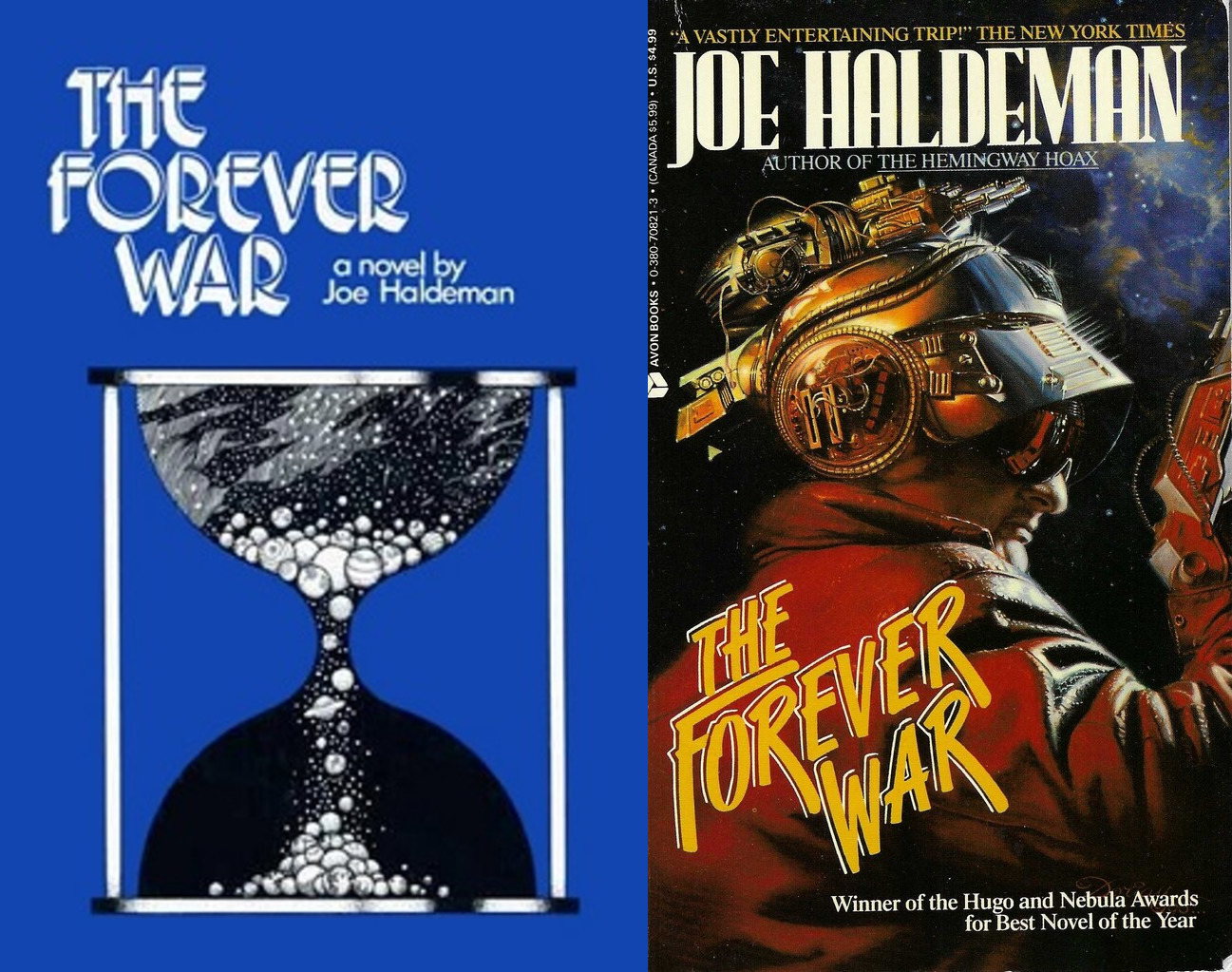
I’ve noted before that back when I was a teenager, before I had status and before I had a pager, I read a good deal more science fiction than I do now. I was never so crazy into it like a certain Other Greg or others who have trod these halls, but I did enjoy a nice sci-fi book every now and then. One book I found in my meanderings through the shelves of the Warminster Public Library was The Forever War by Joe Haldeman. I do own a copy (see above), but I hadn’t read this in probably 35 years, so I figured I’d crack it open and give it a look!
If you had asked me some years ago what my favorite science fiction book was, I would have thought long and hard about putting this one on the top or at least very near the top of the list, but re-reading it, it doesn’t quite have as big an impact on me. It’s still a good book, don’t get me wrong, but it doesn’t hit me in the right spot anymore. I think this is because of a few reasons: it does take a while to get going, and when I was a lad, Haldeman’s world-building felt more impressive, while now I’m more of the mind that he should have gotten to it a bit more quickly; the very idea of a “forever war,” which is first used in this book (well, not in the book — nobody says it — but in the title), is so common and, more pertinently, part of the real world, that the clever idea of Haldeman’s depresses me more than it once did. I’m aware that this is a “me” problem, but, I mean, who the hell else am I going to be? The fact that this concept didn’t stay in fiction but migrated into the real world means I read this with a bit more chagrin than I did when I was 16.
The concept is this: the book begins in 1997, and humans have encountered aliens (they call them Taurans) whom they’d really like to kill, because of course they do. William Mandella (the name is loaded; Nelson Mandela was still in jail in the 1970s, and I imagine Haldeman was vaguely referring to him, and a “mandala” represents the infinity of the universe, so I imagine Haldeman had some of this on his mind with the naming of his main character) is a private in the army that’s being sent out to fight the aliens on the other side of the universe. Of course, this means that while he doesn’t age very much at all, back on Earth, years and years and years will pass. It doesn’t matter to most of the soldiers, because they die horribly in combat. Mandella survives, though, which is why the book is about him, and he needs to deal with the changes on his home planet!
Haldeman does nice work with the science, as far as I know — even if he’s not correct, it certainly feels like he is. The spaceships that transport Mandella and the troops across the galaxy use wormholes, or something like it — he calls them “collapsars,” and they allow almost instantaneous travel, which of course messes with the relativistic effects of time. The book takes place over a little over a thousand years, and Haldeman does a nice job digging into the psychological effects on Mandella as he zips ahead centuries without aging. Haldeman also notes the way the war is being fought, as the battles take place over vast distances occasionally, which Haldeman uses to build tension, as the soldiers seem to be able to track missiles quite well, but at the same time, they often can’t move fast themselves (gravity being what it is), so they can’t always do anything about it. He also does a nice job explaining the technology the soldiers are using, and how they figure out how to use it and how deadly even it can be. They fight on planets that are not conducive to, you know, life, and Haldeman does a nice job with showing how these places can be lethal. As I noted above, for a while early on in the book, it feels like he’s doing a bit too much of this without actually getting too the action, but I can’t deny that it is well done — again, at least as far as this dumb science person can tell. Later on, when he focuses more on Mandella and some other characters, the science-y stuff seems to be blended in a bit more, and it feels more elegantly done. Meanwhile, he also does some interesting things with the way Earth changes over the centuries. The biggest thing is the prevalence of homosexuality. Back in the 1970s, of course, we thought that the population explosion was going to wreck everything. To be sure, everything is wrecked these days, but it’s not exactly due to over-population, but back in the Seventies, everyone thought the world was going to be packed with far too many people very soon. In the book, this is “fixed” by governments (and eventually, the world government, because in science fiction, there’s always a world government) by the encouragement of homosexuality so people won’t reproduce. Haldeman, like, it seems, a lot of people at the time, believes that people choose their sexuality, as he uses words to imply that people were “encouraged” to be gay, which sounds odd these days but also doesn’t feel dismissive or anything. Haldeman doesn’t offer any moral judgments on this — tellingly, perhaps, Mandella has no interest in sex with other dudes, but he’s not terribly put out by others who do, either. Eventually, humanity figures out how to make babies without sex, as they always do in science fiction stories, and most people are gay, and it’s kind of interesting. There’s also a language barrier, as the languages evolve over a millennium and Mandella has trouble understanding the new people he meets, because his language hasn’t changed. It’s a neat sociological conundrum, and Haldeman does a nice job with it.
Mandella watches people who are from his own time die, and eventually he’s the oldest person in existence, as he outlives everyone else in his original platoon. Haldeman, continuing with the somewhat cavalier attitude toward sex, points out that the soldiers hook up with each other often, which is not surprising given the fraught circumstances in which they find themselves. Eventually, Mandella forms a romance with Marygay, and after one of his tours, they end up back on Earth, which is no longer a nice place for them. Haldeman shows how the society has changed so much that they don’t fit into it anymore, and Mandella and Marygay end up re-enlisting because they’ve become institutionalized to the army. They believe they can stay together and stay out of combat, but neither of those things happen, and when they’re separated (meaning they’ll never see each other again because of time dilation), it’s quite gut-wrenching. We do find out what happened to Marygay, but I’m not going to say anything more about that!
Of course, there’s a lot of action in the book, and Haldeman, as I noted, figures out how wars might be fought on planets with differences in atmosphere and gravity. The fighting scenes are well done, because there’s an air of unreality about them, which works for the various settings. One thing I remembered when I re-read this about how the war ends is that it felt the tiniest bit like a cop-out, and reading it today, it still does, but it also feels a bit more realistic than it did when I was but a lad. It’s kind of a bleak ending, to a degree, but it’s also something that I can believe would happen here on Earth, because humanity is so very, very stupid. Haldeman also channels the Vietnam Rage that people were feeling pretty well — this isn’t as satirically patriotic as Starship Troopers (the movie), to use another “war against an implacable enemy” story, but the government does get a bit underhanded when they’re training Mandella and his fellow soldiers, and Haldeman looks a bit askance at all of it. It’s not too surprising, given the cynicism among the populace at the time (and Haldeman was about 30 when he wrote this, so he wouldn’t be inclined to be nostalgic about a government that had its citizens’ best interests at heart).
This is Haldeman’s best-known and most-celebrated book, so it’s not surprising the library had it and I read it when I was a kid (and I don’t know if I just happened to see it and think it would be a good read, or if someone recommended it to me). I still like it — perhaps not as unequivocally as I did when I was a kid, but still — and it’s a cool book to read after 50 years, because so much of it still feels far too relevant for comfort. Haldeman is still kicking (he turned 83 this year — he’s about a month younger than my dad and a month older than my mom), and he’s written a bunch of books in his life, and maybe I’ll get to some more of them! (This book, it seems, has sequels or other stories set in the same universe, so there’s that.) For the time being, though, you can check out The Forever War and get bummed out that we apparently haven’t learned a damned thing!
