
Today I’m looking at a book that was actually written for adults … but I read it, of course, when I was a teenager. The library was a glorious place for me back in the late 1980s!
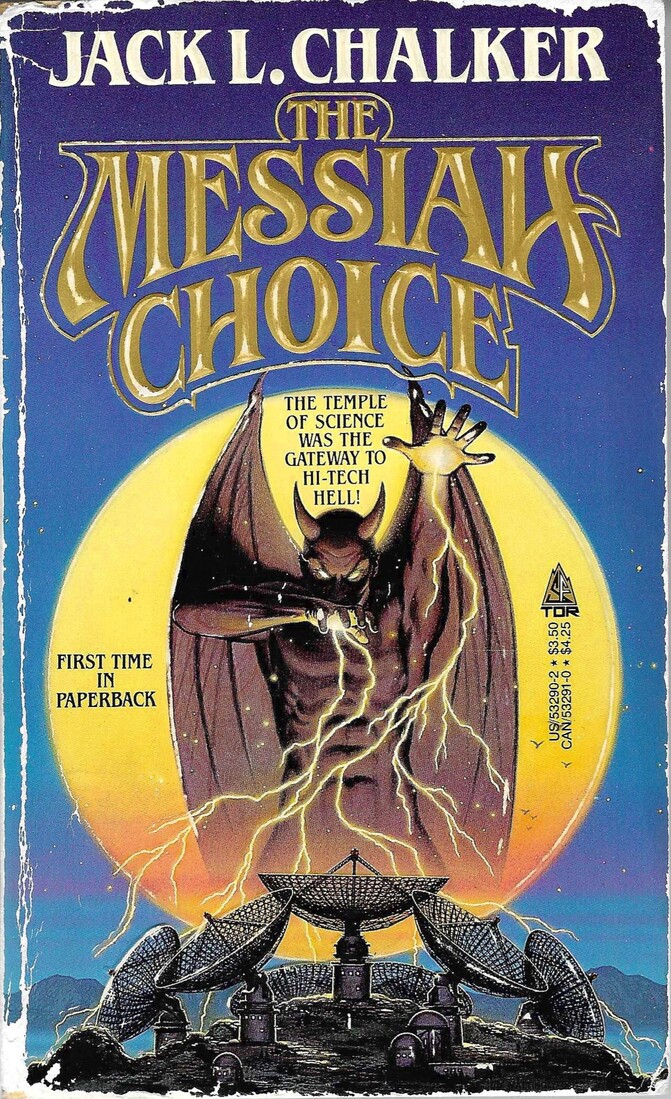
Jack L. Chalker was a fairly prodigious science fiction writer, but The Messiah Choice, which was published in 1985, remains the only book by him I’ve read. I know I read it in high school, so no more than four years after it was published, and I liked it a lot, but never got around to reading anything else by Chalker. I think I re-read it again once, maybe, and I’ve had a nice used copy of it for several years, so it was time to read it again as part of my new, award-winning series, Revisiting Old Favorites! (N.B. This series has, as yet, not won any awards. They have to be coming soon, though, right?)
One reason, I think, that I haven’t read other Chalker books is because the dude liked series. His “Well World” series runs to seven books (plus, I guess, three ancillary novels); “Four Lords of the Diamonds” goes to five books; the “Dancing Gods” series comes in at seven books; the “Soul Rider” series contains five books … sheesh, you get the idea. By nature, I’m just not a “read all the books in a sci-fi series” kind of dude — I don’t know why, but very rarely do I have the patience to go through an entire series of books. Sorry, nerds, I’m just not built that way. He did write several standalone books, of which this is one. Back in the day, I was kind of fascinated by anything that had a Christian/religious bent (I still am, a bit, but not as much as I used to), so the name of this book probably stood out (why did I read The Jesus Incident by Frank Herbert???? you guessed it, the title!). Who doesn’t love a good Messiah Choice, after all!
This book is pretty bonkers, and reading it again today, I still love it, although there are some parts of it that … well, it’s not that they haven’t aged well, it’s that they haven’t aged quite as well as we might like, although that’s not really Chalker’s fault, as he was working within the cultural framework as it existed in the mid-1980s (I don’t want to spoil a 40-year-old book, so you’ll forgive me for being vague). As for the plot: Sir Robert McKenzie, a super-kajillionaire who runs, basically, the world’s largest corporation, Magellan, is murdered in spectacular fashion on the Caribbean island he owns and which is the nerve center of the company. He’s chased onto the beach by an invisible monster and squeezed to death, which brings Greg MacDonald, a security expert on Magellan’s payroll, to the island to investigate what happened. It turns out that Sir Robert had a daughter, Angelique, no one knew about, to whom he left his entire company and fortune. Of course, Angelique is much younger than Greg (he’s 35, she’s 21), and of course she’s devastatingly attractive, but she’s also a quadriplegic, which is a good plot point by Chalker. She wants to know what’s going on, of course, but she’s also a pretty devout Catholic, and she wants to know if Sir Robert was killed by supernatural forces conspiring with the devil. Yep, it’s just that kind of book. The actual plot, which deals with the corporation and how it’s run and what power it has, feels far too familiar today, and while Chalker had plenty of examples from corporations of the time, I wonder how he would have felt if he had survived to see our current state of business and politics in bed together. Sigh. I hate when sci-fi writers are so on the nose.
One of the reasons I could never be a good sci-fi writer is because of the first part of the equation: the “science” part. Most good sci-fi writers have a good grasp of what’s going on in the world of science, and in this book, which is basically set in the present day of 1985, Chalker is quite good at looking at the technology current at the time and extrapolating out just a little bit — not too much, though, so what he envisions is remarkably what we have today. Sir Robert has devised a supercomputer, which is called the System for Artificial Intelligence Networking and Telecommunications — SAINT. As a character points out, they probably came up with the acronym first and worked backward, and it’s possible that should have clued some people in. Chalker doesn’t do a ton with the AI of it all, but he gets into a bit, and it’s remarkably prescient. He never names an “internet” or “world wide web,” but he had to have known that things like it were in the developmental stage at the time (I’m not sure how well known the DARPA stuff was at the time, but it was out there, and my dad remembers talking to a dude who worked for AT&T in the late 1970s about cellular technology, which was pretty advanced even then), and there’s some stuff about that in the book as well. Chalker does a good job balancing out the science stuff with the supernatural stuff, because of course not many people believe the supernatural stuff. The main villain, for most of the book, is someone called The Dark Man, and while he exhibits supernatural powers, Greg and others aren’t ready to believe he’s really an emissary of Satan. Angelique, who was raised Catholic, is more willing to believe, and a few characters make the point about voodoo — if you believe it, it works on you. Even when The Dark Man seems to change Angelique into a completely different person, the skeptics in the book try to figure out how he did it scientifically, not supernaturally. It’s well done by Chalker, because it keeps the book grounded.
Interestingly enough, Greg isn’t really the main character of the book. We think he’s going to be, and he is kind of the protagonist, in that he drives the action-adventure plot of how to figure out who killed Sir Robert, what they want, and how to stop it because it’s sinister, and when they return to the island after being away from it, he takes center stage. For long stretches, though, he’s not in the book — he escapes from the island when he realizes that there’s a vast conspiracy targeting him. Angelique remains on the island (Greg leaves her because he knows the sinister forces need her alive, and he can’t get her away because she is, after all, in a wheelchair), and her transformation is the heart of the center of the book. The Dark Man gives her the use of her body back, but transforms her into an African queen from the Stone Age, unable to speak except in her own language. Her old nurse, a nun named Maria, threw in with The Dark Man in exchange for permanent youth, but Angelique brings her back to the side of angels and they formulate a plan to escape the island themselves. Angelique taps into pre-Christian power, and while she’s tormented by the fact that it comes from The Dark Man and is therefore demonic, she relishes the thrill it gives her, and Chalker does a nice job showing her journey through this temptation (temptation, naturally, is a big theme in the book). They want her to remain virginal, of course (it’s the reason she was paralyzed in the first place), because virgins are very important in Christian iconography, but she’s fallen in love with Greg, naturally, so that’s part of her journey, as well — what should she do about her feelings, and will Greg reciprocate them now that she’s an unintelligible black woman? (Chalker uses the word “primitive” a lot, but it’s clear he’s not using it pejoratively, just to indicate that her personality has shifted to something pre-civilization.) What dates the book quite a bit is the ideas about sexuality, to a degree — Chalker isn’t regressive by any means, but the idea that society would freak out if a white dude hooked up with a black woman is kind of lurking in the background, and there’s a whole bit at the end … about something I don’t want to spoil, but it’s wild, all right, and reflects the attitudes of people in the 1980s without really being as bad as you might expect. Sorry, I just don’t want to be any more specific, but it’s part of what makes the book so bonkers.
It’s an exciting and interesting book — it’s well written, and Chalker keeps things zipping along while also spending some nice time with philosophical arguments and what it means to have free will and if sacrifice means anything and what would cause you to betray your principles and all that. It doesn’t quite go where you expect it — at the cataclysmic conclusion, Greg does not play the hero in the way we expect, which is pretty cool. The denouement is wild, too, as Chalker gets into sex a bit more than he has already (there’s not a lot of sex in the book, but there’s a good amount of talking about it), and it’s … well, it’s something, all right. You’ll just have to read the book to find out what!
I like books that delve into Christian stuff, because Christianity is such a big part of history and it’s kind of weird, too, so it’s just ripe for fiction. Chalker thinks about how the Apocalypse might come in a technologically advanced world, and while he’s certainly not the first or the last to do it, he does it quite well. He leaves just enough doubt in the characters’ minds about what’s going on that it adds a nice edge to the narrative (we as readers are, of course, unfazed by supernatural stuff in our fiction, but if we experienced some of the things Greg does in our own lives, we might desperately look for scientific explanations!). Plus, it’s just a good adventure thriller. I don’t know if I’ll ever get any other books by Chalker, but I’m glad I read this book!

He has at least one other standalone, “The Devil Will Drag You Under,” which i recall was fun.
I enjoyed Chalker’s stuff back in the 1970s and early 1980s. His late 1990s stuff — a return to the Well of Souls and a new cyberspace series — was a lot less fun. I think it retroactively colored my memories of his earlier work.
I never saw this one. Sounds very Chalker. I might go look for it.