
About two years ago, I joined the local library’s Genre Book Club. The premise is that rather than read the same book for each meeting, everyone reads the book of their choice in the genre chosen for the month: history, romantasy, poetry, graphic novel, horror, Western, etc.
The first meeting didn’t go well; 20 minutes in I got a call from TYG that Wisp was sick so I headed home (don’t worry, turned out it was nothing). After that I wasn’t able to make a meeting for months; they were Tuesday nights and that’s also the night my writing group meets. Eventually they switched to Wednesday and I became a regular. I do a lot of my socializing over Zoom these days so it’s nice to have an occasional in-person gathering.
The relevance to today’s post is that next month’s genre is cyberpunk. That doesn’t fill me with much enthusiasm. Most cyberpunk authors (Wilhelmina Baird, Bruce Sterling) leave me cold. William Gibson is good but his vision of the future in Neuromancer has aged poorly. In Gibson’s dystopia the Internet is inaccessible except to powerful corporations and hackers, who are cool, street-smart punks in shades and leather jackets.
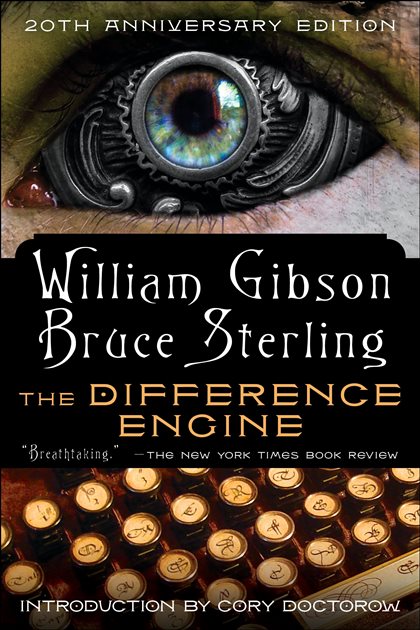
That still left some options, like the Victorian cyberpunk thriller The Difference Engine. I’ve never read it and probably should as it’s the basis for the entire steampunk subgenre, even if Wild, Wild West got there first. Instead I decided to go with a graphic novel. Just as Jim West and Artie anticipated steampunk, Deathlok the Demolisher, who debuted in Astonishing Tales #25, is prototype cyberpunk. I’d always meant to read it on the app so why not now?
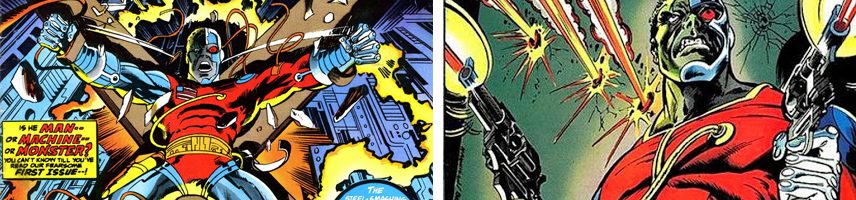
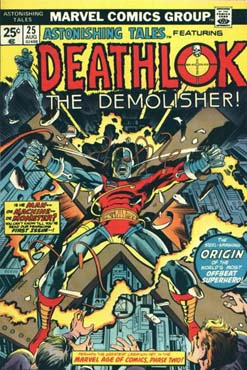 Reading confirmed my sense that the 1990s setting is prototype cyberpunk. Cyborgs. Burned out cities. Anarchy in the streets. Computer surveillance everywhere. A hero with a computer in his brain (Deahtlok’s constant arguments with “‘puter” are what I remembered most from flipping through issues on the spinner racks). Sinister schemers oppressing the helpless masses.
At the story’s center is Luther Manning, former Army officer, killed in battle and resurrected as a cyborg controlled by a computer implant. Major Ryker, who has dreams of becoming the “god machine” he thinks humanity needs, wields Deathlok as a super-strong, deadly weapon to eliminate his adversaries. In a now amusing note, the cyborg is programmed by punch cards inserted into his arm card-reader; co-creators Rich Buckler and Doug Moench understandably couldn’t imagine the computer revolution ahead.
(Buckler became much more pissy about giving Moench credit as the years went by. You can read the details here).
Manning’s humanity isn’t so easily suppressed though (is anyone surprised?). He regains control, with the ‘puter reduced to a nagging voice in his head. Now Luther’s goals are twofold: take down Ryker and regain his humanity. Subsequent stories have him navigate through the violent streets of burned-out New York, thwart Ryker’s attacks on him —
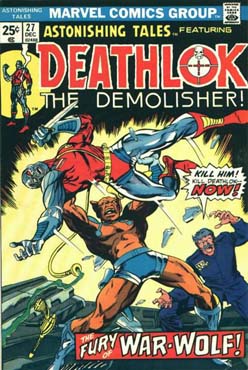
— and discover that after his “death,” his wife married his best friend. Manning also encounters other players: resistance fighters, the CIA, the mysterious Godwulf and Ryker’s even more sinister brother, Hellinger.
To Buckler’s credit (and that of his collaborators) this was different from anything else coming out from the Big Two at the time. It was meant to stand independent of the mainstream Marvel Universe; as with the Eternals, Marvel insisted on eventually tying them together. As with Eternals, that was a mistake.
To the creators’ discredit, the plotting becomes increasingly confused and blurry as things progress. Nina, Ryker’s girlfriend, appears in one issue, then discovers Ryker’s a cyborg himself (his brain is wired up to his all-powerful omnicomputer). Ryker plugs her into the omnicomputer enabling it to wield the robot weapons it controls with human-level reflexes. After her first appearance she spends the entire series comatose.
I was also annoyed by the reveal that the struggles between Ryker and the other factions are about control of New York, nothing more. Even Ryker’s omnicomputer, with its all-seeing surveillance, doesn’t look any further. When the villain talks about becoming “the god machine” it calls for a big, ambitious canvas. What we got was a turf war.
The final issue before cancellation was a compromise tying Deathlok into the MU. By this point Ryker has gone down, Manning’s 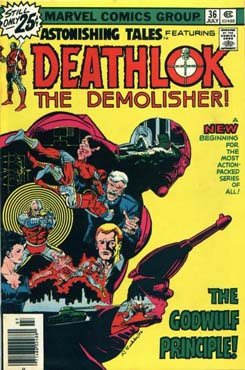 mind has been transferred to a clone body (the Deathlok body is too decayed to function without the cyborg parts), yet Deathlok somehow retains the same mind. Luther Manning would have gone on to more adventures in the 1990s; Deathlok was to go back in time and have adventures in the MU of the 1970s
The latter plot happened, though I doubt it’s the way Buckler imagined it. Deathlok gets sent back to the present, becomes a pawn of Mentallo and the Fixer in an issue of Marvel Two-in-One and winds up being sent to assassinate the president. He would keep popping up in MTIO until eventually he ends up a pure robot killer, his human side gone. Then his computer side gets blown to bits. RIP.
(This made me reflect that MTIO become something of a dumping ground over the years where obscure characters got a second chance or failed series got wrapped up: Skull the Slayer, Spider-Woman, Modred the Mystic, Quasar and Deathlok).
A few years later, J.M. DeMatteis, writing Captain America, tackled the question of how America fell apart so fast. Luther travels back in time, finds Deathlok is now a cyborg killer in the employ of Roxxon Corp., and dies restoring his other self’s humanity (Luther’s Aaaah, I’m Just A Clone angst doesn’t work for me but it does resolve the dual Mannings). Deathlok and Captain America defeat Hellinger in the future after which Cap averts Roxxon’s plan to wipe out all New York’s superheroes, the event that led to Earth-Deathlok.
Reading that made me think of the late Mark Gruenwald and his theory of branching timelines in the MU. The idea that timelines can branch at key moments is an old one in SF, and even in comics. Gruenwald took it further, asserting that every clash of titans, every fateful decision goes two ways. If Marvel Comics show Cap beating the Red Skull when he wielded the Cosmic Cube, it’s 100 percent guaranteed another timeline exists where the Skull conquered.
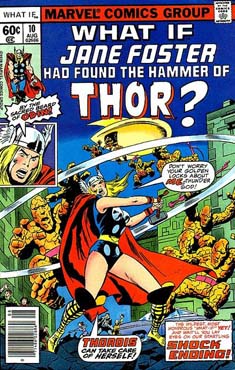 This doesn’t work for me at all. As Larry Niven said in his short story “All the Myriad Ways,” if every outcome happens, life is meaningless. Captain America never beats the Red Skull without losing. Gwen Stacey dies but she also lives. The Fantastic Four defeat Doctor Doom but he also kills them. Nobody accomplishes anything because they fail every time they succeed. All we’re seeing is the timeline where (usually) the heroes win. Owlman makes the same point as Niven in the DCAU movie Crisis on Two Earths: the entire universe is pointless, we can’t achieve anything. Perhaps that’s why the early issues of What If—? emphasize that the Watcher isn’t showing us alternate histories but parallel worlds that were never part of ours.
It’s a fine line between “reality occasionally splits” and “reality always splits” but it’s a significant one. And I think Gruenwald wound up on the wrong side of it.

The original Deathlok is one of those series I’ve wanted to read forever. I finally started it on the Marvel app last year but I’ll admit I’ve found it slow going. I’ve haven’t gotten too deep into the run but would really like to see it through. I did read those DeMatteis Cap stories with Deathlok ages ago because I’m a big fan of J.M.’s Cap.
Given all the other options on the Marvel and DC app, I don’t know I’d have gotten it all read if I hadn’t had the book club incentive.
I read the whole Deathlok saga (i.e., from Astonishing #25 through the DeMatteis/Zeck story arc in Cap) a little over a year ago; my overall impression was that I liked the earlier material for all of its flaws, and thought the whole concept was pretty much ruined by folding it into the larger Marvel universe – so we’re definitely in agreement there.
As to that conclusion in Cap, even though I commend DeMatteis for taking on such a task, it didn’t work for me. I recall that one of my main problems is that everything seemed a little too pat, and I didn’t like that he had Deathlok become a leader of some kind of rebellion, which seemed to be a rip-off of the Killraven concept.
The problem with Niven’s thesis that life is meaningless, if every outcome is possible doesn’t hold up, unless you experience all of those possibilities as one consciousness. The moment you commit to a choice, you commit to that path. You can contemplate the alternate outcome, but you can’t really experience it because you chose the other path. So how is life meaningless, unless you can somehow shift to the alternative path? To me, that is the same as saying what is the point of living, when you know it ends in death? Living is the whole point, experiencing your world. The same is true of your world when you commit to a decision; you experience only that path, not the alternatives. Really, all realities are possible until you commit to a decision,
I reviewed Deathlok over at the Classic Comics Forum. It’s one of my favorite 1970s series, along with Killraven, Master of Kung Fu (the Moench & Gulacy run), Panther’s Rage and the Englehart & Rogers Batman. It is definitely better early on, then meanders a bit, before getting to the conclusion, then the trip back through time. Without Moench, though, it doesn’t work, a point that seemed lost on Buckler. Looking at his track record beyond that series you can see how, as, aside from his work at DC, his later career consisted of mediocre to awful comics for the Archie Red Circle line and then bottom feeders Solson (now there was a trainwreck of a company). Hell, Rich even swiped his own character for illegal use at Solson, in the mesmerizingly bad Reagan’s Raiders.
I tried the 90s revival but it lacked the personality and ended up more generic “grim & gritty”. For my money, the only good use of Deathlok, post the original series, was the album cover for Iron Maiden’s Somewhere in Time, with Eddie-as-Deathlok.