

There is no one so belligerent as a confirmed pacifist. (William Gerhardie, from God’s Fifth Column)
COMICS
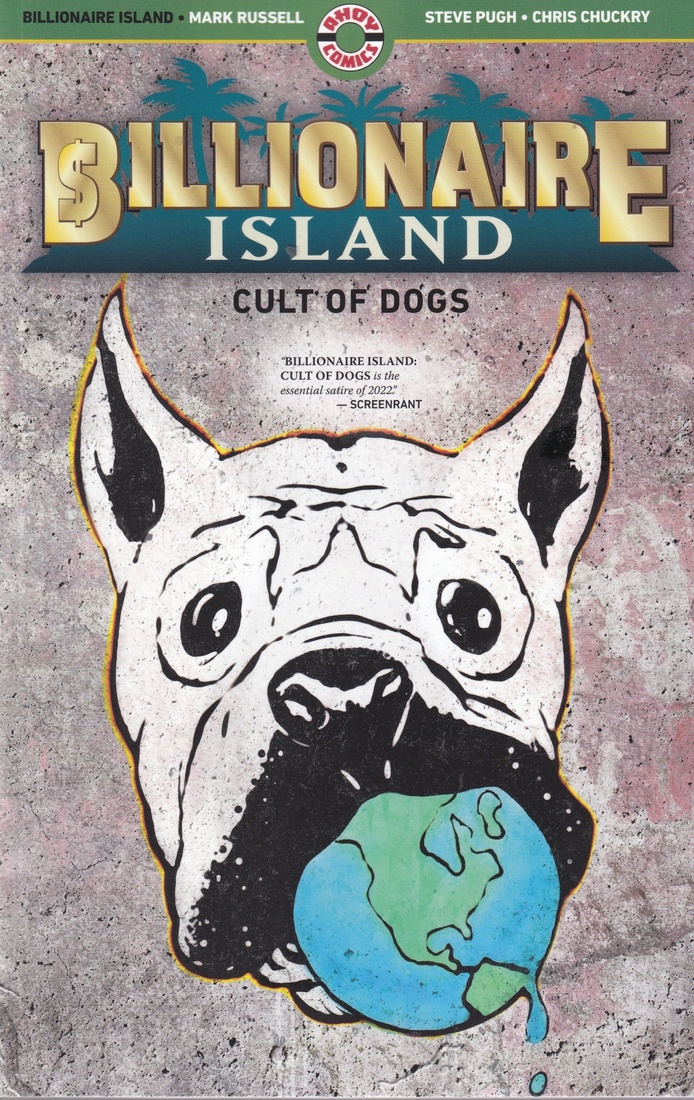 Billionaire Island: Cult of Dogs by Mark Russell (writer), Steve Pugh (artist), Chris Chuckry (colorist), Rob Steen (letterer), and Cory Sedlmeier (collection editor). $17.99, 120 pgs, Ahoy Comics.
The Current King of Satire, Russell, is back with a sequel to Billionaire Island, which ended with the island getting destroyed, so … kind of hard to do a sequel? Never mind that, says, Russell, and shows the fall-out from a bunch of billionaires getting killed to death and a dog inheriting their collective money. Shelly Bly, the reporter from volume 1, is back, but this is a bit more broad-ranging than volume 1, which was confined to the island, after all, and Bly, while important to the plot, isn’t quite as important (of course, Russell had a lot on his mind in the original, too, so she wasn’t the complete focus, but she’s less of one in this volume). This is still a very good comic, and it might be a bit more savage and bleaker than the original, if that’s possible. The global economy has collapsed, along with the United States, and communities have re-organized themselves to deal with that, and the one person who got a lot of money from one of the dead billionaires (that the dog didn’t inherit) is a decrepit old man tended to be a very shady caretaker. Russell has fun tearing at the roots of our society, but he also has a bunch of asides that highlight the problem of money, from the bubonic plague (which killed so many people that wages went up) to a cynical retelling of the Jack and the Beanstalk story. Russell is very good at making you laugh while depressing the hell out of you, because while the situations he often puts people in are ridiculous (the final issue of this comic has people dressing up as dogs and berating a person), they’re all too relatable if you look past the metaphors and apply it to the “real” world. Sure, people don’t die in incinerators if they lie, but truth has become a fungible commodity, so you can see the appeal of burning liars to ash. I certainly don’t want to give away too much, so I’ll just say that if you like Russell’s caustic brand of humor, this is right up your alley. Russell has done better work (his work on The Flintstones remains a high water mark), but he still knows what he’s doing, and we laugh at his work because we don’t want to cry. Pugh, obviously, is superb. When is he not?
Rating: ★ ★ ★ ★ ★ ★ ★ ½ ☆ ☆
One totally Airwolf panel:
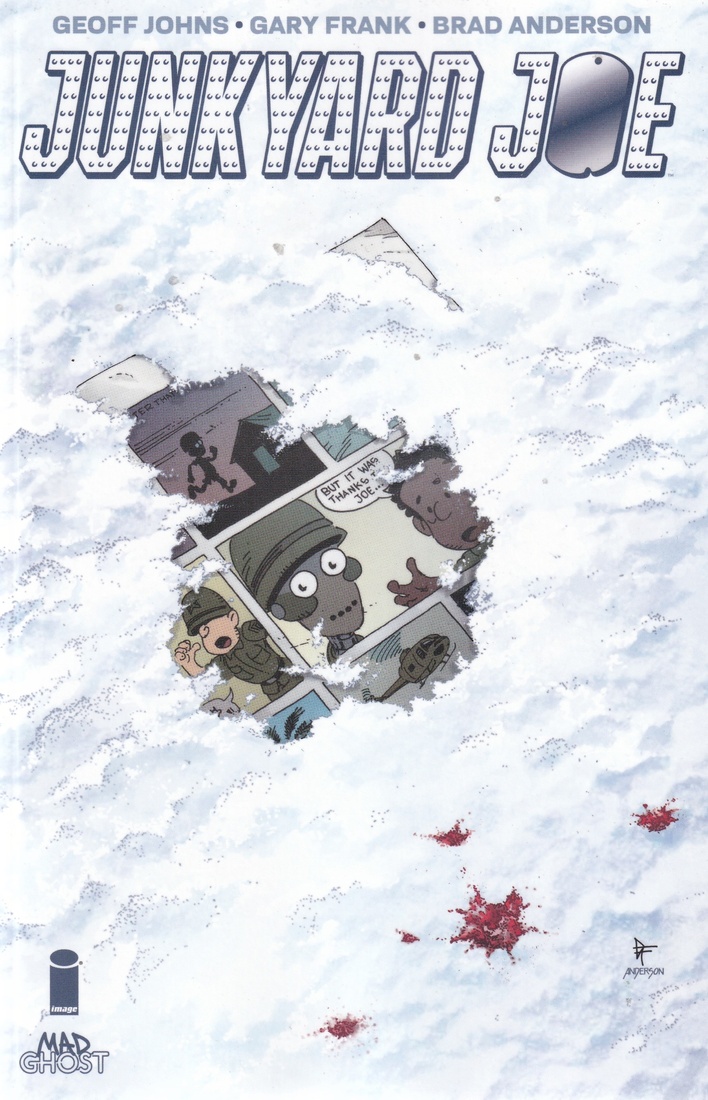 Junkyard Joe by Geoff Johns (writer), Gary Frank (artist), Brad Anderson (colorist), Rob Leigh (letterer), and Brian Cunningham (editor). $14.99, 147 pgs, Image.
Johns is doing his “Unnamed” shared universe thing, and I liked Geiger well enough, so I thought I’d read Junkyard Joe, which is about a robot soldier. It’s a pretty good idea: in 1972, the government uses an experimental robot soldier to see if they can win the war in Vietnam, but when something goes wrong (from their point of view), they shut it down, and the only survivor of the platoon the robot was placed with is encouraged to stop talking about it, so he starts doing a comic strip about it instead. Fifty years later, the cartoonist, Morrie “Muddy” Davis, retires the strip and, basically, prepares to die because his wife died recently and he has nothing to live for. One night, Joe appears on his front porch. This freaks him right the fuck out, as you might expect, as he had tried to hard to convince himself that Joe didn’t exist. He doesn’t know why Joe is there, but, naturally, bad dudes are looking for Joe and they’re willing to kill anyone who stands in their way. Meanwhile, a new family – a widowed father and his three kids – moves in next door, and eventually, they’re drawn into the drama and put in danger. It feels very familiar, of course, but Johns manages to keep it lively and interesting, mainly because of the weirdness of Joe, who doesn’t really seem to want to be a killing machine. Davis is an interesting character, too, because he’s older and grumpier and just looking for a reason to die, and Joe and the family next door keep giving him reasons not to. Johns falls into clichés, of course – you know that thing where everything seems peaceful and someone gets killed out of the blue that’s a staple of both war movies and crime dramas? Sure you do! Johns does that TWICE in this book, because the first issue is a war story and the rest is sort of like a crime drama. But it’s still a pretty good, entertaining story, and anytime you can get almost 150 pages of Gary Frank art, that’s nothing to sneeze at. I don’t know how Johns is planning on bringing this shared universe together (there’s a hint about it in this book), but so far, he’s 2-for-2, so I guess I’m on board for now!
Rating: ★ ★ ★ ★ ★ ★ ★ ☆ ☆ ☆
One totally Airwolf panel:

 Something Is Killing the Children volume 6 by James Tynion IV (writer), Werther Dell’Edrea (artist), Miquel Muerto (colorist), AndWorld Design (letterer), and Eric Harburn (editor). $14.99, 110 pgs, Boom! Studios.
Tynion has reached Bendis Levels of Decompression with SIKtC, and I’m not sure I like it. Early on, it felt like he was doing a good job moving the plot along, but volume 5 began a new part of the story, and then we get to volume 6, which continues that story but doesn’t finish it, simply setting up for what I hope is an apocalyptic volume 7, but Jeebus this thing is moving slowly. I mean, seriously – almost nothing actually happens in these five issues. Early on, Erica is recovering from volume 5, and then the sheriff gets involved, and then the agent hunting Erica convinces the sheriff that Erica is the bad guy, but the agent doesn’t want to kill Erica, just make her life miserable, so when she gets Erica alone in the interrogation room at the police station, she tells Erica what evil things she’s going to do and pin on Erica, and then she does it … but we don’t see it, we only see the aftermath. That’s certainly not a bad narrative technique, but in an arc where so little happens, it feels like Tynion is just fucking with us. Only at the end, when we’re gearing up for the next part of the story, does something happen, so that’s nice. It’s not like there’s even a lot of good conversations about … I dunno, something. There’s a tiny bit of that, but this volume is mostly just moving pieces around, and it’s very frustrating. I do like the overall story, and so I’ll probably check out volume 7, but Tynion is on a bit of thin ice here with me. I’m sure he cares!
Rating: ★ ★ ★ ★ ★ ★ ½ ☆ ☆ ☆
One totally Airwolf panel:

 The Trident of Aurelia volume 1: Inheritance by Lee Moyer (writer/painter), Melissa Spandri (artist), Venetia Charles (flat colorist), Tom Orzechowski (letterer), and Justin Zimmerman (editor). $12.99, 92 pgs, Battle Quest Comics.
Meanwhile, in this comic, the plot barrels along, destroying everything in its way, leaving you a bit dizzy. It’s certainly a different tack than Tynion is taking! We get a set-up: Orianna is an orphan in an island city ruled by a fanatical religious cult who killed her father (her mother, like all good mothers in fairy tales, died in childbirth). She’s been able to avoid the same fate because they won’t kill children, but she’s grown up now, and she knows they’ll be coming for her because she’s a foreigner – her father was a diplomat for the old empire, which has vanished somehow and the cult has cut off contact with the outside world. Orianna knows about the history of the city and the empire, but that doesn’t do her any good when the cultists come for her and throw her in prison, where she meets an old dude who knew both her father and mother. Before she can learn too much about that, she’s dragged away and “married off” to the “red god” – the water around the island turned red years before, which is partly connected to the empire’s disappearance – which means she’s thrown into the ocean. Oh dear. As she sinks to the bottom, she sees a glowing trident (just like the title of the book!) and when she grabs it, she’s transformed into a mermaid, approached by several other mermaids, told she’s the heir to their throne, and gains the memories of her mother, the former queen. END ISSUE #1!!!! Yes, that’s all in the first 20 pages – Moyer doesn’t waste any time, damn it! So we think the book will be about Orianna learning about her heritage … nope, she gets up to speed really quickly. Then we think it will be about the the mermaids braving the labyrinth to save their kingdom … nope, they get through that pretty easily, although they do have to fight giant crab monsters along the way. Is the book about the final battle with the leviathan at the center of the maze? I mean, you’d think so, but you’d be wrong. Finally, they find out what’s behind the cult in the first place and why the empire went away, and they still have time to redeem the cultists a bit. There’s a lot going on, in other words. Moyer does a nice job with characterization on the fly – it’s not the greatest work, as it’s a bit clunky in places, but it gets the job done and doesn’t impede the plot churn too much. It’s an old story, of course – the forgotten princess reclaims her heritage – and because it’s a modern work, Moyer can tweak it a bit, with some lesbian stuff (just proclamations of love, nothing more – this is a YA comic) and some subversions of paradigms, but he doesn’t deviate too much from the template, because it’s a good template, after all. Spandri does nice work with the pencil art – as this is Andrew Kafoury’s publishing concern and I’m Facebook friends with him, I saw a lot of the raw pencils, and they’re quite good – and Moyer is a fine painter, so the book is sumptuously drawn and colored. Spandri does a nice job making the world a bit exotic, both on land and in the water, and Moyer keeps it nice and bright. It does feel a bit rushed, as once we find out what’s going on, it’s resolved a bit too quickly, but overall, it’s a fun story. It’s the first of what I assume they hope will be a broad epic, as we get a tease for the next story set in this universe, so let’s hope they can follow through!
Rating: ★ ★ ★ ★ ★ ★ ★ ☆ ☆ ☆
One totally Airwolf panel:
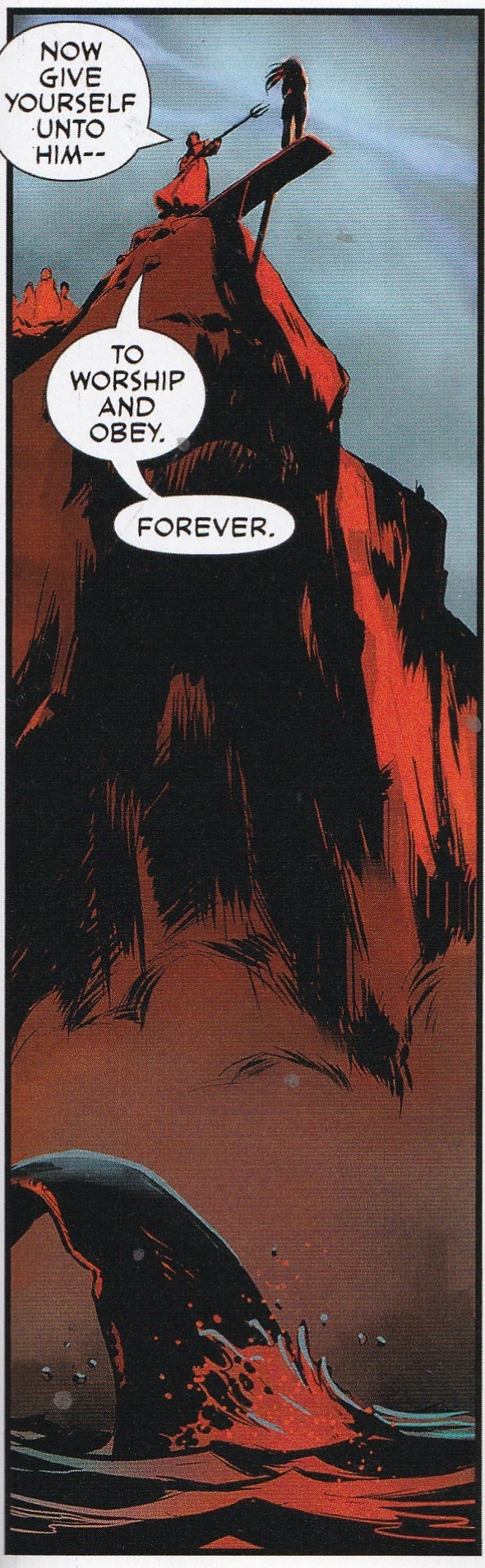
 Wonder Woman Historia: The Amazons by Kelly Sue DeConnick (writer), Phil Jimenez (artist), Gene Ha (artist), Nicola Scott (artist), Hi-Fi (colorist), Arif Prianto (colorist), Romula Fajardo Jr. (colorist), Wesley Wong (colorist), Annette Kwok (colorist), Clayton Cowles (letterer), and Andrea Shea (collection editor). $29.99, 194 pgs, DC.
Am I going to be contrary about the Eisner Award winner for Best Single Issue of 2022? Well, of course I am! (I will not be contrary about the Best Penciler of 2022, because holy shit is Jimenez’s work amazing.) Let’s go!
I have never been a big fan of Kelly Sue DeConnick, as you may or may not know. “So, why,” you might ask in a huff, “are you buying her comics, you putz?” Well, I’m glad you asked, random internet reader! I don’t hate her work, certainly, and she can do some interesting stuff, and I knew this book looked amazing, so I figured I’d give it a chance. And a chance I gave it! However … it’s just fine. Nothing special, sadly. My objections to it are several:
1. I mean, do we really need it? Yes, we don’t really need any comics, or any entertainment at all, really, but this is an origin story of the Amazons, which seems to be … unnecessary? Maybe? My point is not that we need or don’t need it, but because of the way DeConnick presents it, it becomes unnecessary. No, I don’t know what I’m talking about yet. We’ll get there together!
2. Back in the day, George Pérez and Greg Potter gave us an origin of the Amazons, and it was quick and fine. A bunch of women didn’t like how they were treated, so they appealed to the goddesses, who gave them their own island without any men and immortality. It was short, sweet, and perfect. The only Amazon anyone cares about is Wonder Woman, so nobody cares how the rest of them got to Themyscira. I’m sorry, but that’s just a fact. So why do we need three super-sized issues to get to Diana’s “birth” (which takes place on page 193 of 194 pages)?
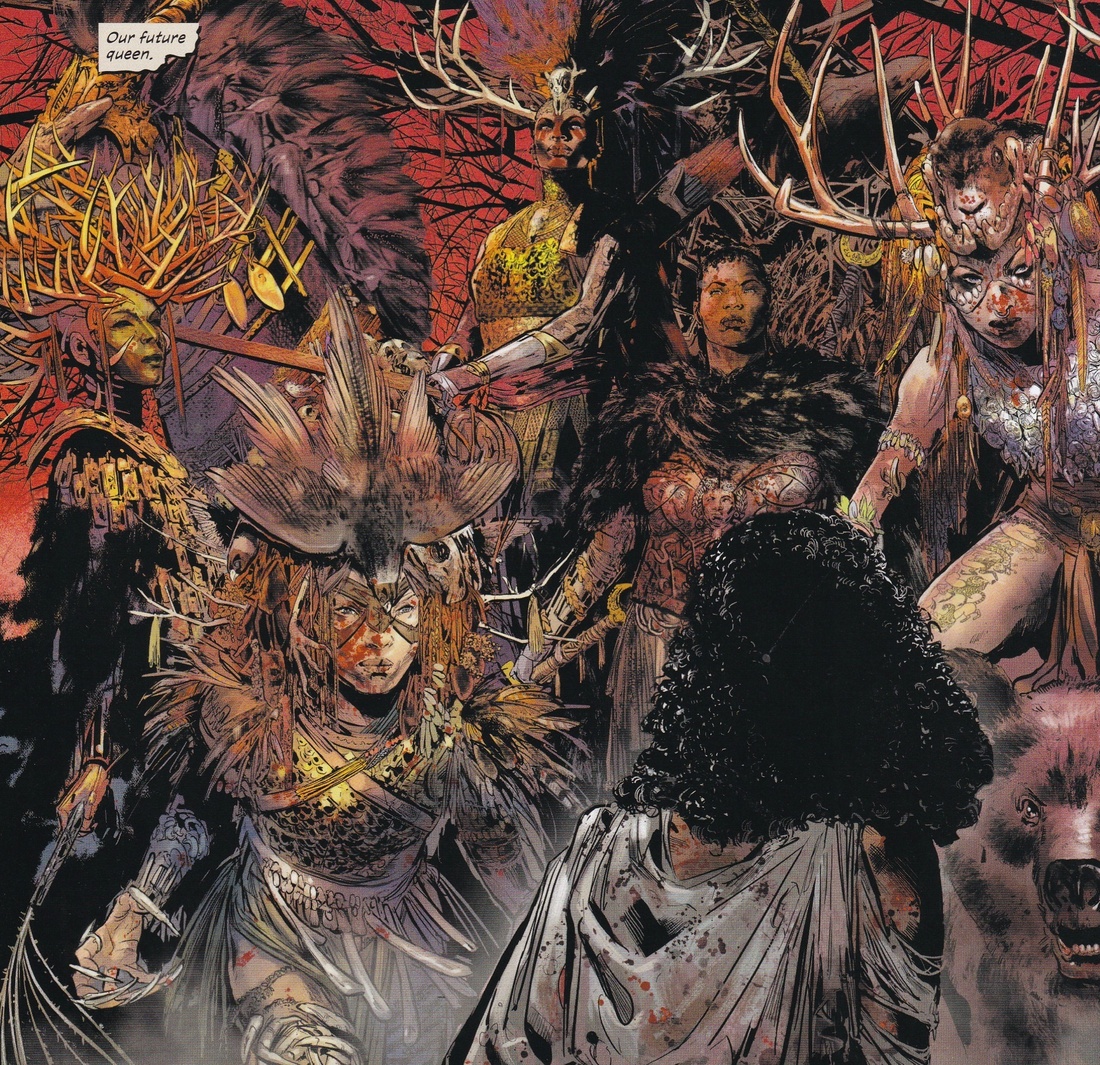
3. Ok, on the off chance that anyone cares about the Amazons, DeConnick unnecessarily screws up their origin. See, originally the Amazons were a group of women who were tired of being mistreated, so they asked the goddesses for help and rose up and fought for their freedom and were rewarded with Themyscira (as I just wrote about above, but it’s worth repeating). Perfectly fine. In this book, the goddesses are upset by the treatment of women, so they appeal to the gods, and Zeus tells them to pound sand. So the goddesses – Aphrodite, Artemis, Athena, Demeter, Hecate, and Hestia, but significantly not Hera – get together and create their own group of women – 30 of them, 5 for each goddess – and those are the Amazons. Then they go out in the world to rescue women, including Hippolyta, who becomes the main character and forms her own group (“tribe”) of women that she saves. As a punishment for this rebellion against the gods, they are confined to Themyscira.
There’s a big difference here, and I don’t think it works in DeConnick’s favor. One reason I don’t love DeConnick’s writing is that, like a lot of writers these days, she is unsubtle about her soapboxing, and it detracts and distracts from her narrative. She’s very heated about the treatment of women, and there’s certainly nothing wrong with, but she’s not terribly subtle about it. Because of this, she has to rant a bit about how the goddesses feel about the way women are abused, and then she has to have the gods dismiss it as nothing. That fundamentally misses the point about Greek gods and goddesses and even gods and goddesses of other polytheistic religions, as they weren’t “human,” so to speak, so they did not act like humans, and they were created for a specific function, so they had personalities only so much as they could fulfill that function (yes, I know they were constantly meddling in human affairs, but that’s a metaphor, people!). But let’s say for the sake of argument that the goddesses really are upset by the general treatment of women. They create women who have never known suffering, because they’re created fully formed. Um, what? Writers today, especially those on a soapbox, are very concerned with agency. We mustn’t take away someone’s agency, and for the most part, I agree (obviously there are going to be exceptions). Except … all DeConnick does here is take away agency. The goddesses create a race of extremely competent women who have never experienced what the women they are advocating for have experienced. The Amazons then go and rescue women from slavers. Eventually, they train them and turn them into a fighting force, but then the gods smack them down and imprison them (Hippolyta has to make a choice about that, but I’m not going to get into that here). Themyscira is a prison, not a paradise, and they have no agency about it. It’s unclear if DeConnick really wanted the ending to be as downbeat as it is, but it is clear that she wanted this to be an inspiring story, and parts of it are. But again, the women in the story are rescued by more powerful people, and while in the original story they appealed to the gods and you could argue that is giving up their agency, at least they appealed and they rose up and they triumphed. In this book, the goddesses decide that they’ve had enough, and they create a race of super-women who drag the more prosaic women out of the mud. The super-women, of course, make Diana look less super, because, of course, we still haven’t forgotten Syndrome:

Am I thinking about this too much? Probably, but DeConnick obviously wants us to think about this (except, you know, positively). It just feels off, mostly because of what I mentioned above, and a little bit because it feels historically unsound. The entire idea of slavery in ancient Greece (and the ancient world itself) was far different than what we think of (still shitty, but different), and DeConnick doesn’t really get into the way society was stratified and organized (not that I want her to, but, I mean, she brought it up), and it makes the book feel a bit shallower than I think she wants it to be. It’s frustrating. It’s not a bad adventure comic, but whenever a writer has a message they want to get across, they have to be careful how they disseminate it. DeConnick really isn’t, and it weakens the book significantly.
The art, not surprisingly, is wonderful. When Gene Ha’s is the “weakest” chapter, you know you’re getting good art. Jimenez’s depiction of the deities and Olympus is stunning, and Scott gets to draw a lot of warfare between the Amazons and the men sent to punish them. Ha’s might be the “weakest” because he doesn’t get as much to do as the other two and his stuff is mostly set on Earth, but it’s obviously very good, because Ha is a good artist. I don’t have a lot to say about the art, but Jimenez’s Eisner is richly deserved and the rest of the art is fabulous. It’s amazing how well some people can draw if you allow them the time, right, DC? But we have to keep pumping out those 20-page monthlies with no consideration to the look of the finished product!
I really wanted to like Historia, and it’s certainly not a bad book. It just feels like, as so often happens these days, the message interferes with the story, and in trying to give the Amazons a new origin, DeConnick made the regular women – you know, the ones for whom she’s advocating – less important in the narrative. But, as usual, maybe I’m just a dummy. It’s very possible!
Rating: ★ ★ ★ ★ ★ ★ ½ ☆ ☆ ☆
One totally Airwolf panel:
BOOKS
 The Seven Wonders of the World: A History of the Modern Imagination by John and Elizabeth Romer. 244 pgs, 1995 (2005), Michael O’Mara Books Limited (Barnes & Noble Books).
My version of this book is from 2005, reprinted by Barnes & Noble, which I picked up one time when I was perusing the store and it looked neat. And it is neat! The Romers produced this in conjunction with a television series, and it’s a interesting way to look at ancient architecture – they write about the idea of wonder and imagination and how it formed through building marvelous things and writing about those marvels, down through the ages. They look at the famed wonders – the statue of Zeus in Olympia, the Colossus of Rhodes, the Pharos lighthouse in Alexandria, the Mausoleum in Helicarnassus, Babylon’s Hanging Gardens, the temple to Artemis in Ephesus, and the Pyramids – from a myriad of viewpoints, getting into who built them, how they were built, what innovations were required to build them, whether they existed at all (in the case of the gardens, which are the most elusive of the ancient wonders), and what they meant to the people who lived while they were still around and what they meant to successive generations. It’s a comprehensive book, as the Romers get into the architects and designers, the rulers of the places, the religious aspects of some of the wonders, and the way people viewed the “Western” wonders – the Greek ones – as opposed to the “Eastern” ones – the Pyramids and the Hanging Gardens. They examine the evidence about the wonders, some of which is more prevalent than others – Artemis’s temple has been heavily excavated, while, as I noted, there’s doubt whether the gardens actually existed – and try to determine what some of them actually looked like – the Colossus, for instance, almost certainly did not straddle the harbor as seen on the cover. Through the writing about the wonders, from the Alexandrian Greeks through the Romans and Western Europeans, they get into the way the wonders spurred imagination and creativity, serving as inspiration for odd flights of fancy about their function and creation. Others, naturally, were inspired to create their own wonders, and in the final chapter, the Romers focus less on the Pyramids and more on how the Pyramids and other wonders have become part of our common cultural mileau and what that means. It’s an interesting book, with a lot of reproduced drawings and photographic plates, lots of neat factoids (the Mausoleum is the first in history, as it was named after the king buried in it, Mausolus), and some really fascinating ideas. They even get into how and why the wonders were destroyed – some naturally, some by people – and what that says about the way people view the past. It’s a pretty keen book.
TELEVISION
Marie-Antoinette season 1 (PBS). Emilia Schüle plays the title character in this interesting period piece, which takes place over about a decade – the 1770s, essentially – and ends with “Toinette” giving France an heir, which didn’t happen until 1781 (although the final scenes are a bit dreamlike, so it’s unclear if it’s just foreshadowing because we know she did, eventually, give birth to a son). It’s a good show, but not great, as we get a bit too much modern sensibility in it – I’m a bit tired of shows set in history where the people – usually high-born women – talk about freedom all the time, as if that wouldn’t have been beaten out of them from the day they were born. I’m sure that as the daughter of an empress (Maria Theresa of Austria), Marie Antoinette was used to getting her way, but I’m also sure that as the daughter of an empress, she would have been schooled in diplomacy much more than she’s shown here, so that her dealings with, say, Madame du Barry (played with a bit of bite by Gaia Weiss), would have been less fraught (as it appears they were in real life; drama wins out!). It’s not a terrible thing that showrunners want to focus on less-known parts of history, and marginalized groups certainly need to have their voice heard, but then, what often happens is that rough edges get sanded away, and we have Strong Independent Woman fighting against the system, which becomes boring. I doubt that Marie Antoinette was as … obnoxious as Schüle makes her out to be – it’s a pretty good performance, as Schüle is trying to break the mold of Versailles, which demands a rigidity that she simply doesn’t feel, I just don’t know if it’s in any way historically accurate, but it doesn’t feel like it is. I assume I’m the only one who cares about this!
The acting is pretty good (James Purefoy as Louis XV stands out, as Purefoy conveys a good dichotomy between charming and monstrous), the sets and costumes are sumptuous, and it was filmed at the locations, which is pretty keen. I’m always annoyed by historical dramas focusing on characters whose lives are about to be uprooted, especially in revolutions, because the focus is usually on them and when the upheaval comes, it’s out of nowhere. There’s a bit of Antoinette’s relationship with the common folk, and it seems like they’re trying to show that Louis XVI was a decent king in the beginning, but there’s still very little about life outside the bubble of nobility, so if the show continues and the revolution comes, I imagine it will feel like a surprise to not only Louis and Marie but the viewers, too. Other than that, the cattiness of life at Versailles is portrayed well, and there’s a lot to recommend it … and there are some things that ding it, too. Such is life.
Lucky Hank season 1 (AMC). Bob Odenkirk plays a tenured college English professor at a tiny university in semi-rural Pennsylvania who, in the first few minutes of the first episode, criticizes one student’s writing, then all of his students’ writing, then himself, then the university at which he works, which is the inciting event in this series, which is based on a novel. Odenkirk is a generally unpleasant person – not a cruel person, but kind of a jerk, because he hates himself and assumes everyone hates him and themselves, as well – but he’s funny, and the show is one of those dramadies that all the kids are talking about. His wife, played sedately by Mireille Enos, does a nice job counter-balancing him, and the teachers in the English department – of which he is head – are archetypal and a bit stereotypical, but the actors do good work making them interesting. Hank’s father, a famous novelist, has retired from teaching at Columbia, and Hank is feeling bad about himself because he only wrote one novel and can’t start another one. His father abandoned him and his mother, but he finds out she’s been communicating with him, which upsets him. Meanwhile, his adult daughter has never quite left the nest, as she and her dopey husband are always coming to him for money. His wife gets a job opportunity at a great school in Manhattan, and Hank hems and haws about leaving his shitty job to join her, which is the crux of the show – comfort versus newness, and the attendant pros and cons with both of them. But it’s a false dichotomy, because Hank isn’t really comfortable, he’s just lazy, and it’s a bit frustrating watching him twist as she goes off and tries to make their lives better while he gets caught up in the stupid pettiness of university politics. Despite that, the pettiness of university politics is the best part of the show, precisely because it’s so ridiculous but everyone takes it so seriously … and it is, to a degree, as university president Kyle MacLachlan (wonderfully vile) is claiming that the legislature is going to cut the budget so Hank needs to fire one or two of his teachers. That adds a layer of seriousness to things, but generally, it’s very funny seeing these people fight their stupid little wars – Suzanne Cryer (famous for yada-yadaing sex in Seinfeld) as the poet who gets published in The Atlantic is the best, but all the teachers are excellent – and it makes the relationship stuff between Hank and his wife and daughter not as annoying, because it is a little annoying. It’s a pretty good show, and it’s only eight episodes, so if you’re looking for a decent comedy/drama, this might be it.
The Marvelous Mrs. Maisel season 5 (Amazon Prime). The final season of The MMM is a bit uneven, but it’s not terrible, as some reviews have said. It’s odd – I’ve read some reviews in which the person reviewing it doesn’t seem to be watching the same show I was or had never seen the show before. One reviewer was mad because Midge is suddenly shown as a horrible mother, but she’s always been a horrible mother. That same person was annoyed because the “quirky” side characters weren’t quirky anymore and who cares about Midge’s ex-in-laws and the show should focus on Midge and Susie, but the side characters have always been integral to the show and the work done with Midge’s parents, for instance, finally pays off in this season, although perhaps the reviewer thought it wasn’t worth it? A reviewer was grumpy that Midge kept screwing up but kept getting chances, which is fair, but a lot of people screw up and get second and third chances, and the show goes out of its way to point out that a) Midge is funny; b) Susie works really hard to get her opportunities; and c) Midge is attractive, which might be the most important factor. That’s not nothing, and I think the show does a good job commenting on this aspect of society without being too, too obnoxious about it. The loss of Stephanie Hsu (because she’s too big a star now?) is annoying, as she is shunted aside easily, and the loss of Luke Kirby as Lenny Bruce (who shows up a few times, but isn’t a presence as much) is frustrating because he’s very good but also probably necessary. The show jumps forward in time in this season to show how Midge’s life turned out, and it’s kind of annoying for most of those moments (Midge becomes successful and alienated even more from her kids, both things we could have easily anticipated), except it does give us episode 6, “The Testi-Roastial,” which takes place in 1990 and has Susie getting roasted at the Friars’ Club and we get flashbacks to how her friendship with Midge blew up – it’s a superb episode, and it almost – almost – mitigates the use of flash-forwards. Anyway, the cast is very good, as usual – Tony Shalhoub really does nice work this season – and it’s still an interesting look at a woman who wants to do something but the world doesn’t want to let her (actually, two women, because Susie). It’s often very funny, it’s often frustrating (I understand that’s a feature of Amy Sherman-Palladino shows, so there you go), and it always looks great. It’s a pretty good show.
**********
Let’s take a look at the money I spent in June!
7 June: $73.75
14 June: $99.75
21 June: $206.48 (Sigh – the Terry & the Pirates book came out this week, and it’s $100, so that jacks up the price)
28 June: $170.93 (Sigh – the Marvel July 1963 book came out this week, and it’s $100, so that jacks up the price)
Total for June: $550.91 (June 2022: $839.57; June 2021: $598.36)
YTD: $3100.83 (At this point in 2022: $5518.10; 2021: $3769.89)
Here’s a breakdown of what I bought by publisher and format:
Ahoy Comics: 1 (1 trade paperback)
Archaia: 1 (1 graphic novel)
Battle Quest Comics: 1 (1 trade paperback)
Boom! Studios: 1 (1 trade paperback)
Clover Press: 1 (1 “classic” reprint)
DC: 3 (1 “classic” reprint, 1 single issue, 1 trade paperback)
Del Rey: 1 (1 graphic novel)
Fantagraphics: 2 (1 graphic novel, 1 single issue)
Greenwillow Books: 1 (1 graphic novel)
Image: 6 (1 “classic” reprint, 2 graphic novels, 1 single issue, 2 trade paperbacks)
Marvel: 1 (1 “classic” reprint)
NBM: 1 (1 graphic novel)
Viz: 1 (1 manga volume)
Z2: 1 (1 graphic novel)
Here are the numbers for each format, so far:
4 “classic” reprints (23)
8 graphic novels (27)
1 manga volume (6)
3 single issues (54)
6* trade paperbacks (68)
* Keen readers will note I only reviewed 5 this month. The sixth is the latest volume of Copra, but I fell behind on that, so I didn’t read the latest volume. Oh well.
The publishers so far this year:
Abrams ComicArts: 1 (1 graphic novel)
AfterShock: 2 (2 single issues)
Ahoy Comics: 2 (2 trade paperbacks)
Archaia: 1 (1 graphic novel)
AWA: 3 (3 trade paperbacks)
Battle Quest Comics: 2 (2 trade paperbacks)
Beacon Press: 1 (1 graphic novel)
Black Caravan: 2 (2 single issues)
Boom!: 6 (6 trade paperbacks)
Clover Press: 1 (1 “classic” reprint)
Conundrum Press: 1 (1 graphic novel)
Dark Horse: 27 (5 “classic” reprints, 6 graphic novels, 11 single issues, 5 trade paperback)
DC: 20 (3 “classic” reprints, 13 single issues, 4 trade paperbacks)
Del Rey: 1 (1 graphic novel)
Epicenter Comics: 1 (1 “classic” reprint)
Fairsquare Comics: 1 (1 trade paperback)
Fantagraphics: 5 (1 “classic” reprint, 2 graphic novels, 2 single issues)
First Second Books: 1 (1 graphic novel)
Floating World Comics: 1 (1 graphic novel)
Greenwillow Books: 1 (1 graphic novel)
HarperCollins: 1 (1 graphic novel)
Helvetiq: 1 (1 graphic novel)
High School Heroes Productions: 1 (1 graphic novel)
Image: 39 (1 “classic” reprint, 2 graphic novels, 15 single issues, 21 trade paperbacks)
Lev Gleason: 1 (1 graphic novel)
Living the Line: 3 (3 graphic novels)
Mad Cave: 4 (1 graphic novel, 2 single issues, 1 trade paperback)
Marvel: 22 (2 “classic” reprint, 6 single issues, 14 trade paperbacks)
NBM: 1 (1 graphic novel)
Oni: 3 (2 graphic novels, 1 trade paperback)
Penguin Books: 1 (1 graphic novel)
PS Artbooks: 4 (4 “classic” reprints)
Rebellion/2000AD: 4 (3 “classic” reprints, 1 trade paperback)
Roaring Brook Press: 1 (1 graphic novel)
Silver Sprocket: 1 (1 graphic novel)
Titan Comics: 3 (1 graphic novel, 2 trade paperbacks)
Vault: 4 (4 trade paperbacks)
Viz Media: 6 (6 manga volumes)
Z2: 1 (1 graphic novel)


In the “classic” reprint world, I finally got DC’s collection of José Luis García-López’s Batman work, which came out in April (my retailer simply missed it when I ordered it, but it was easy to get once I mentioned it to him). It’s keen. Shockingly, the only Marvel book I got this month is their latest mega-collection of every book they released in a certain month, with June 1963 getting the treatment this time around (first Avengers, first X-Men, first Patsy and Hedy Annual!!!!!). Image has the Megaton Archives, with art by Jackson Guice, Angel Medina, Erik Larsen, and Rob Liefeld, and it’s a nice-looking book. Clover finally got the fourth volume of Terry & the Pirates out, which doesn’t fit on my scanner. So sad!
**********
It’s inching closer to football season, and schools and pro teams are doing their PR stuff, and this post has many questions about the PR department of Mississippi State. There is some nightmare fuel in their schedule release graphic!
In other collegiate sports news, the Stephen F. Austin bowling scandal isn’t too big a deal, but the main person’s reactions are a bit weird.
The general Big Ten blog I read is often interesting, but this post is both interesting and depressing. It doesn’t say anything about the internet that I haven’t thought over the past few years, just distills it nicely. I do wish our own blog were more popular, of course, but other than that, we have a nice little corner here, and it would be nice to keep just providing interesting and free content for you guys, because not everything has to be monetized. Sigh.
**********
June wasn’t a great month for me. I ended it at the same weight as I began it, although I did lose quite a bit in the beginning of the month, gained it back and then some, and then managed to get back down to where I started. So I’m still down 5.3 pounds on the year, which is not bad but not as much as I wanted. Summers are not good for exercise here in the desert – the torpor really gets to you, man – so I hope I can just lose a little bit in July and August before the weather starts getting a bit more tolerable and I can start doing a bit more. We shall see.
Other than that, not much is going on. My wife got a raise, which was nice. I should say she got an adjustment in her salary, as when she was hired, she was making far less than what she had been at the company that laid her off, but the new company told her there would be overtime and their bonus structure was a bit more liberal, so she would be able to make up the shortfall. In May she worked a lot of overtime, but the mortgage industry is recovering, and the company was able to hire enough people to be fully staffed by June, so the overtime went down. The woman who hired her had promised to try to get her a “raise” back to her old levels, and while it’s not quite as much as she was making, it’s much closer, plus the bonuses are still good, so she’s back about to where she was last year, before she got let go. So that’s nice.
Other than that, things are quiet here. It just started getting really hot (May was remarkably un-hot – not cool, you understand, but not as hot as it sometimes is), and while that sucks, it’s what you get living in the desert. My wife and younger daughter are going to Puerto Vallarta at the end of July to hang out with my parents, my sister, and her kids, so that should be nice for them (and for me – my older daughter will be at school or sleeping, so I have the house to myself). Now that my younger daughter is a graduate, she’s a lot less stressed, which is nice, and it will be fun for her to see her cousin, with whom she gets along famously.
How’s everyone? Enjoying the summer? Getting ready for the orgy of fireworks that characterizes the U.S.’s birthday (even if you don’t live in the States, you should still celebrate, you ungrateful jerks!)? I hope you’re all doing well!

After this week my daughter is finished with school, and hopefully passed school. We’ll know it before the end of the week.
I completed the Utrecht Cycling Tour to celebrate that my hometown organized the start of the Tour the France 7 years ago. It was 100 km with a lot of wind which made it quit a challenge. A good friend of mine is diagnosed with colon cancer (stage 1 or 2 of 4) so that really sucks. He’s just 8 months older than me so that hits home.
COMICS: Why yes. Copra 7, Miracleman 5 and X-Men Omnibus 5 and with that one the omnibus collection is complete for me. I’m now reading the first omnibus.
CONCERTS:
6/6 Gojira. After liking this band last year I gave it another shot. The show was great again but I’m not a big fan of mosh pits and this band wants them a lot so I had to go to the back to watch it without getting bumped.
Shirt: no, I’m not going to buy one for € 45. That’s insane.
6/7 Muse. We don’t agree about there last album (I think it sucked but the wife thinks otherwise, what does she know 🙂 ). What we do agree on is that the concert was absolutely amazing. We got a good spot in the golden circle so our place in front of the stage was not to crowded and even my wife had a good few. Happy us.
Shirt: yes, we both bought a nice version (choice of 4 different shirts).
6/14 Voivod. Another one I had to visit alone because it’s to heavy according to my wife. I had a talk with the band in april and it was nice that they recognized me during the concert. At the end of the last song Rocky (the bassplayer) held his bass high up so I could touch the strings. A really nice gesture which made me feel like 17 again.
Shirt: of course. I got a long sleeve with the Dimension Hatröss cover.
6/16 Dance With The Dead. It was the first time we saw this American band. We both had a great time but after just 1 hour the show was finished. It’s all instrumental and there was no talking between songs so we were a bit sad it ended so soon.
Shirt: no, they had some but not for a (almost) 60 year old to put on.
6/23 + 24: Midsummer Prog Festival.
It’s a festival at the Openlucht Theater Valkenburg (look it up in Google, very beautiful IMO) with this year bands from Belgium, Norway, Finland, Italy, England, Poland and even some guys from the states. Highlights were Kingcrow (It), MEER (Nor), Frost* (Eng) and The Windmill (Nor). The Dear Hunter (USA) were playing a nice set but had no merch with them unfortunately. After the show most bands mingle with the audience so I got some cd’s signed and some pictures taken with band members.
Shirt: yes, the festival shirt and the Riverside tour shirt.
Just 2 concerts next month and if all goes well I’ll hear this week if I got the job. They like me but it has to be discussed with higher management.
As always, dang, you go to a lot of concerts! That’s awesome.
I hope you get the job!
Fingers crossed Eric, I hope you get a job.
There is this famous concert/event in Mexico called “Corona Capital” or something like that. I checked the list of names and I recognized like 5 out of 60 or so(so, the big headliners of the event) and I thought of you. I kinda like the idea of concerts more than going to concerts, but that Muse one sounds like a cool time
Because of your comment I looked at the Corona Capital Festival line-up. Like you I don’t know much of the bands. Some headliners of course but apart from those just Metronomy. We’re old 🙂
Off topic:
I read stuff like East Of West, Manhattan Projects and currently old Judge Dredd (the b/w Titan Books) in 1 stint but when reading Marvel comics (like FF or X-Men) I have to stop after reading 4 or 5 issues. Do you have the same? If so, with which comics?
It depends on how old the Marvel stuff is. Back before they wrote for the trade, it’s definitely a lot to get through in each issue, because they’re usually overstuffed with writing. So I get where you’re coming from. Also, Hickman’s stuff – East of West, Manhattan Projects – is designed to be one big story, so it’s easier to simply move to the next chapter. At least that’s my view of it!
Yeah. It’s old Marvel. FF by Byrne, X-Men by Claremont for instance.
Like Greg, If it’s a really old Marvel/DC comic, I have to stop after only one. But in that case I just rotate them. I have some Essentials with me(Spiderman, The Phantom Stranger,Brave and the Bold, Flash, etc) And when I re-read those I read an issue a week, but I read one each day, otherwise they are too much for me.
Same thing happens if the comic is really depressing, but at the moment I’m not in the mood to read depressing stuff
I fell behind on my comics reading a bit, but I’m still working my way through the works of Mark Russell. I made it through Billionaire Island v1, so looking forward to v2. The problem with some of Russell’s satirical works is that the real world has gotten so ridiculous it’s catching up to what he’s writing– and the stories don’t seem as ludicrous as they should.
TV-wise, I made it through Ted Lasso s3– which has a bit of a saggy start before really nailing the back half of the season. I don’t get all the complaints (of s3 or s2). I’ve started in on Severance now while also working on Mythic Quest s3. And I’ve sampled some other Apple series, though nothing is really hooking me yet.
Also finished this latest season of Superman & Lois. This season has been great, but I think it’s lost a step with the last couple episodes, which introduce Lex Luthor. And I’m not thrilled by most of the cast losing their series regular status next season.
Movie-wise, I’m still on my nerd stuff. Rewatched Spider-Verse 1 (better than I remembered!) and then caught Spider-Verse 2 (great, though it peaks early). I picked up the 4K box set and rewatched all the ’80s/’90s Batman movies (’89 is a masterpiece, Returns gets better with age, Forever did not hold up, and I secretly kinda like & Robin). That was mainly prep for The Flash, which brings back “my” Batman, Michael Keaton. I thought it was pretty good, actually. Not great, but better than at least half of the DCEU movies.
This was technically July, but I also rewatched Indiana Jones and the Kingdom of the Crystal Skull– third time’s the charm, I guess, as I liked it better this time. The new color grading definitely helps, and I didn’t even hate Shia Lebeouf this time. Then I took in Indiana Jones and the Dial of Destiny, which I also thought was enjoyable.
So that’s two nostalgia-bait sequels bringing back my favorite heroes of 1989 that look set to lose a lot of money and which had a lot of bad word of mouth, but which I thought were Good, Actually.
I watched a lot of other crap too (I have a Letterboxd mostly so I can remember my own opinions at https://letterboxd.com/reedwatches ). One weird thing I watched that everyone but me hated was The Jesus Rolls, that sort-of-spinoff of The Big Lebowski starring and directed by John Turturro, which is a real fever dream of a movie. But I liked it.
Also, I saw Billy Bob Thornton and the Boxmasters in concert. Weird show! But I dig their sound. Apparently they have their own one-shot comic book that came out in 2017.
Oh, right, and on Apple I also watched Schmigadoon s2, aka Schmicago. The musicals they’re sending up this time are way more in my wheelhouse, and yet– I didn’t get that same thrill I got from the first season. There are some excellent numbers in there, though, don’t get me wrong.
Yeah, that’s true about Russell. Sigh.
I haven’t watched any of the stuff you’re writing about! Well, I mean, the old Batmans, of course, but otherwise, nope. And Batman & Robin is the hottest of garbage, sir! 🙂
Flash looks very cool, but I’m not impressed with a time travel story that’s been done over and over, but I’ll get around to checking it out.
Dial of Destiny looks stupid, but not a terrible stupid. The idea of kill off Shia LeBeouf is annoying – fathers and sons don’t have to hang out together all the damned time, so just throw a line in there about him surfing in Bali or something!
This month I didn’t really read that much. I was kinda stressed out in my job. It was the third month and I was worried they might let me go. All the jobs I had begin with a 3 month trial, this was no different but I’m still employed so yay. Also this job has a more flexible schedule but it demands more brainpower so most days this month I just wanted to veg out once I finished my shift.
But I did finish some home projects so I got that going for me I guess.
We started watching a new anime called “Oshi No Ko” that I didn’t knew anything about except that it was from the same author of Kaguya-sama so I knew that I had to watch it. It’s about a pop-idol in Japan but I won’t spoil anything in case someone wants to watch because this thing twists and turns so much. Be warned that the first episode is like 90 minutes long(the rest is 22 minutes or so for each episode)
Maybe next time I’ll get some books, fingers crossed!
I’m glad you kept your job. Employment stress is awful, and it’s too common!