
[As we read these comics with the hindsight of Morrison’s non-binary revelation, some things become a lot clearer, of course. Back in 2006, I was definitely not as tuned into the correct terminology or even how to discuss some of these things, so I do hope there’s nothing offensive in these posts. You can check out the original post here, where you’ll find some good comments about my annoyance with the word “magick” (which I still hate)! Enjoy!]
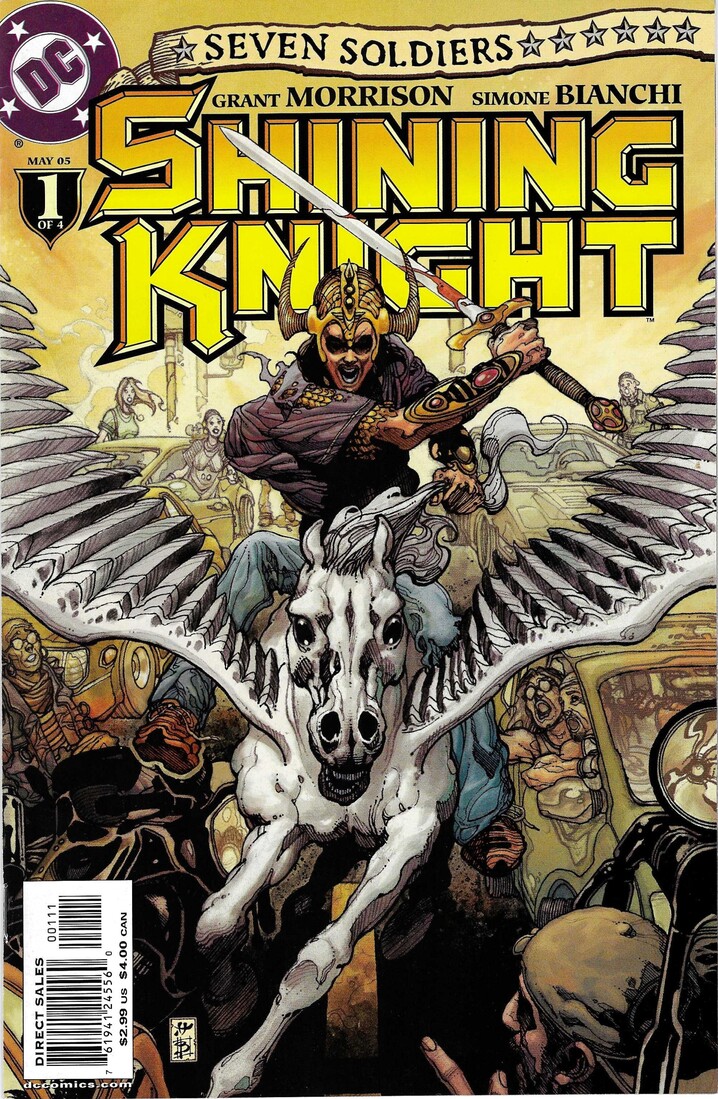
If you’re going to start your mini-series off with a bang, you might as well start with Lancelot rallying the troops of the Round Table! Such is the opening splash page of Shining Knight #1, which gets the seven mini-series of Seven Soldiers off with a rousing start. So let’s dive in! As usual, SPOILERS SPOILERS SPOILERS! I can’t stress it enough!
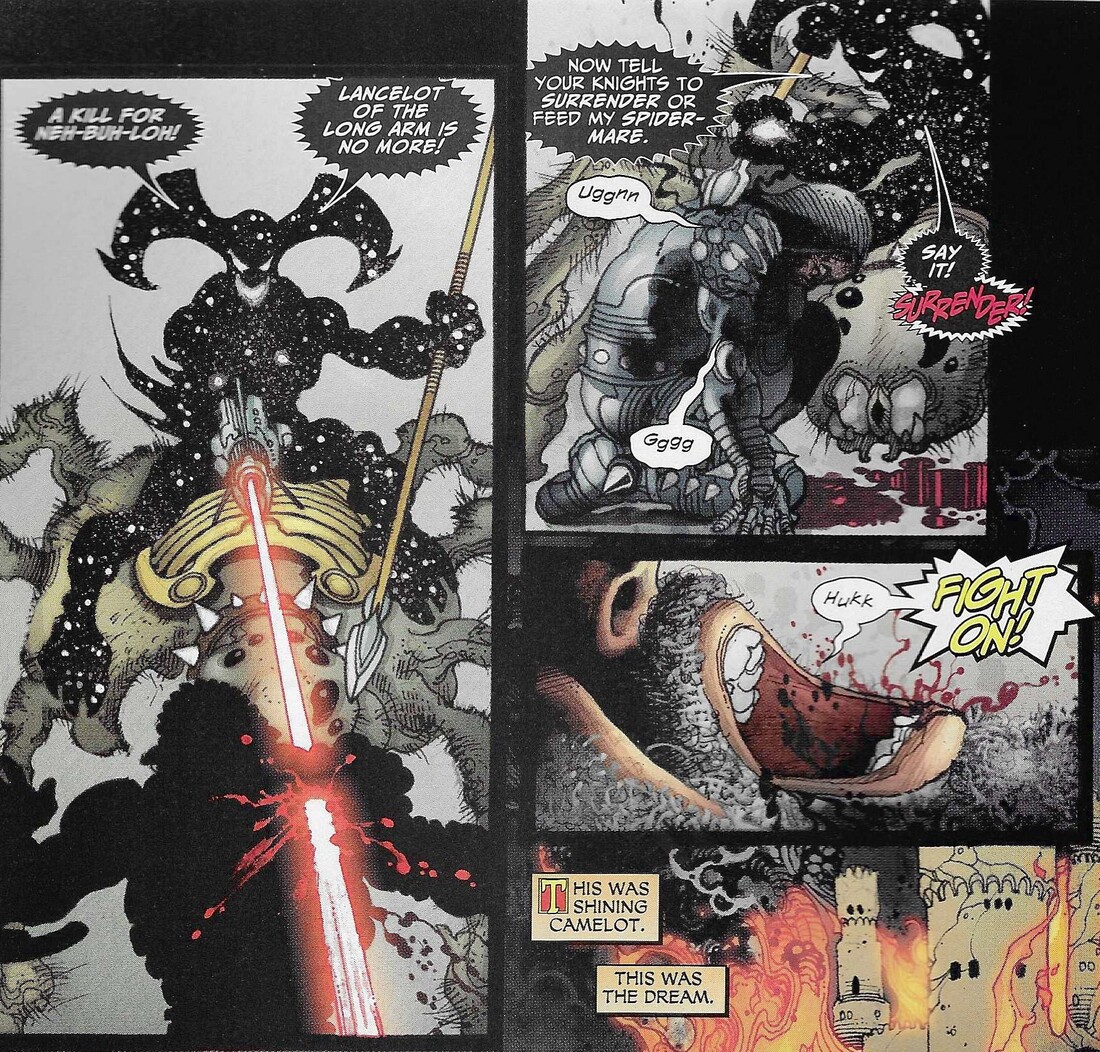
The knights of the Round Table are fighting the Sheeda. The narration reads: “From the far, unspeakable land of the vampire sun they came, from eternal Summer’s End on Sheeda-side. With weapons against which no defense had yet been invented, they came.” We see the Sheeda riders, who are full-sized, riding weird worms and firing lasers at our heroes. So far we have very little information about the Sheeda. With hindsight (and the hints Morrison has given us — the vampire sun, Summer’s End), we should figure out that they might just be from the future. We see who stands against the Sheeda: Gawain, who is silent and attended by hawks; Lancelot, he of the broken heart; Caradoc the peace-lover; Peredur, who was blinded by the light of the “holy cup,” yet somehow gained celestial senses unknown to ordinary men (he should become a superhero!); Bors, the laughing knight; and Galahad, the giant killer. Notice that there are six of them. And they’re losing. Neh-buh-loh, our old friend, shows up, riding a spider, and blasts Lancelot through the shoulder. He tries to get Lancelot to surrender, but Lancelot doesn’t play that shit! So the Sheeda continue the carnage.
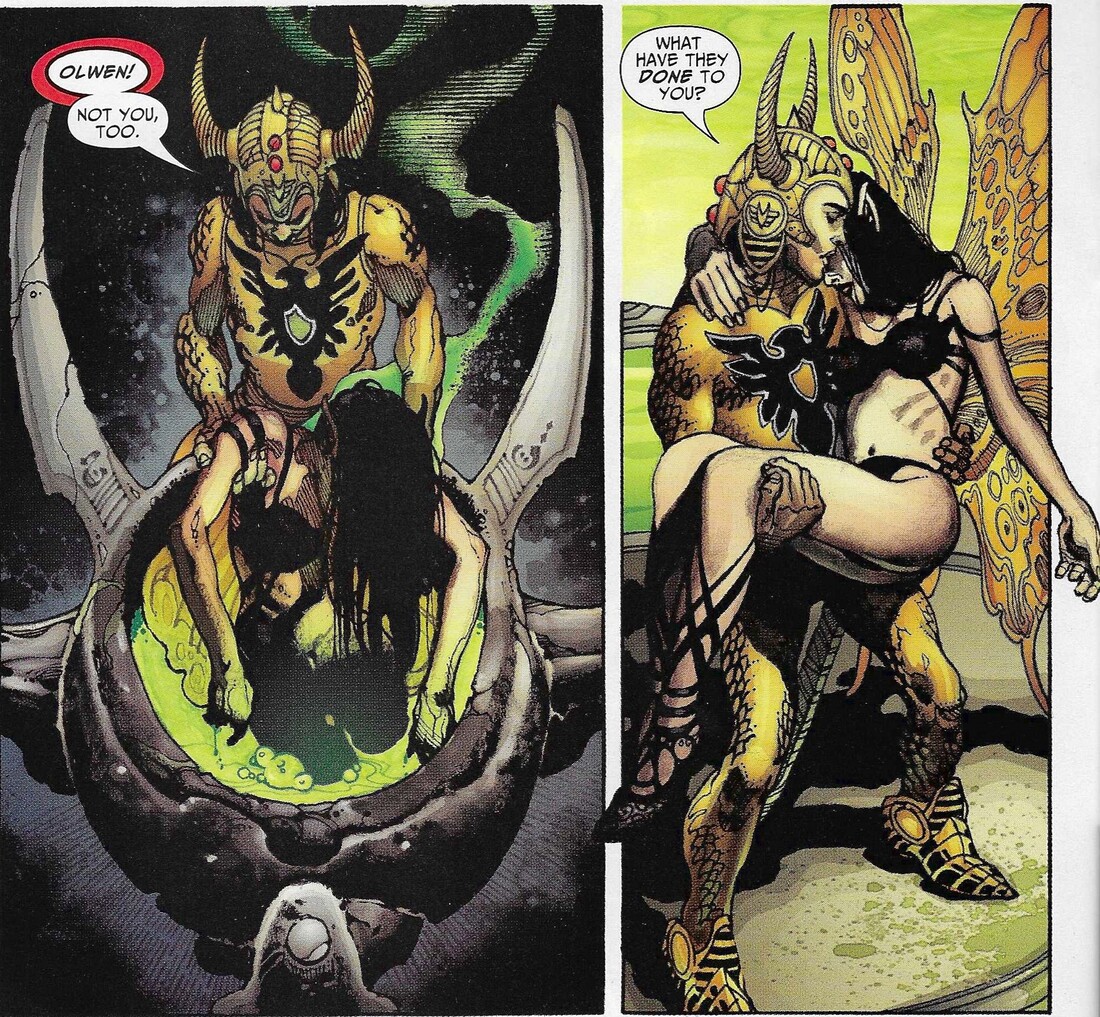
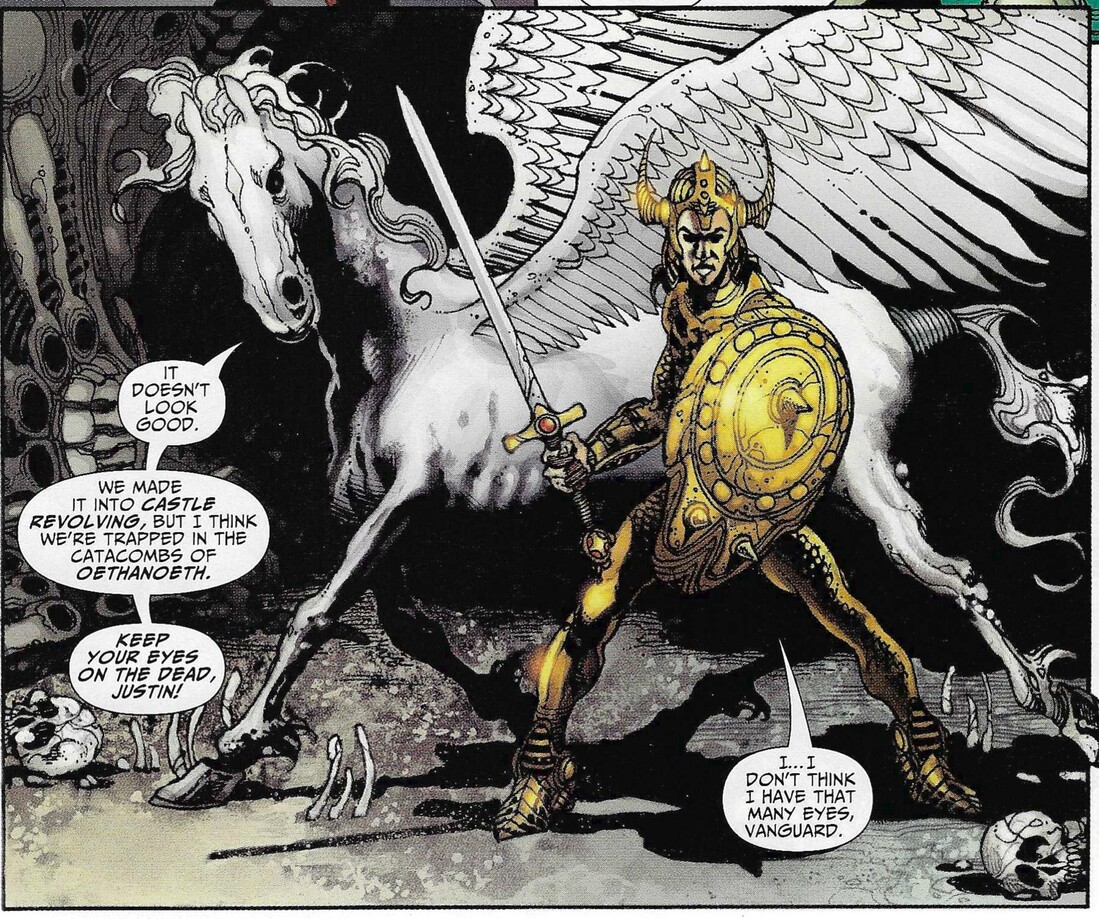
A totally creepy chick watches and calls it the “harrowing of Avalon.” She exposits that the ground will be fallow for ten thousand years, and the people will need to relearn their secret sciences and magicks (blech — that’s not how it’s spelled!). She promises that they will never learn to fight the Sheeda, and that the Sheeda will return to “rape the shining kingdoms that rise from Camelot’s ashes.” Before the bad guys can leave, however, we see the Seventh Knight: Justin and his flying horse, Vanguard. They are in Castle Revolving, but they are trapped in the “catacombs of Oethanoeth.” Vanguard tells Justin to keep his eyes on the dead, because the Sheeda use the bones of their victims to build a maze in the catacombs. Vanguard says to get through, they’ll need a “true lantern,” which puts me in mind of a certain group from Oa. The lantern does shine a green light, but it doesn’t go much further, so it’s strange that Morrison even put it in there. What could it mean? Justin fights the reanimated corpses of Arthur and other dead knights, and he breaks through and makes it to the “inexhaustible cauldron,” also known as the “Undry.” According to Justin, it “sang once in Murias, at the mighty Dagda’s table. It brings the dead to life and heals all wounds.” That will be handy to have down the road, more than likely. Justin drags a winged girl from the cauldron — Olwen, whom he knows. Olwen is an old figure in Welsh legend, but otherwise isn’t terribly important. She does, however, give us an important piece of information — the Sheeda queen is named Gloriana Tenebrae, which means, in Latin, something like “boasting darkness.” (Gloriana is also the name of the title character of Edmund Spenser’s poem “The Faerie Queen.”) So far we’re not terribly concerned with the presence of Latin in Arthur’s time, but when it becomes clear this is thousands of years before Latin existed as a language, it becomes a bit problematic. Anyway, the queen shows up and tells Justin she has been corrupted by her time with the Sheeda, and she tells him to come with her. At her side she carries Caliburn, Arthur’s sword, which she cannot draw because she is not pure at heart. That’s no problem for Justin, as all of Avalon’s soldiers are pure, so he pulls the sword out and stabs her. She has blue blood, which possibly is Morrison’s literal interpretation of an aristocrat. Why the hell not? Justin also makes reference to the sword being “the first of the treasures you stole from us,” and he wants the cauldron, which presumably is another one. These treasures will link in to the series very heavily. If you guessed that there are seven of them — well, that wasn’t too hard a guess, was it? Interestingly enough, Morrison also links the Queen to the evil stepmothers of fairy tales, as she bites into an apple as she mocks Justin (calling him “pretty,” which is foreshadowing, I should think) and calls herself the “fairest of them all!” She fights back until Vanguard shows up with the lantern, which blinds her enough (with its pure light) for Justin to break free and seize the cauldron. This causes the Queen no small amout of consternation, and she tells him he doesn’t know what Castle Revolving truly is. Justin throws the cauldron in the surrounding pool, whose waters “flow through time itself,” meaning the cauldron will be lost somewhere in time. As Justin tries to get Olwen out, she stabs him with her dagger. Oh, snap! That ain’t Olwen, it’s a Sheeda disguised as Olwen! Vanguard drags Justin into the water to follow the cauldron, because it’s their only escape. They burst out of the underbelly of the castle (a new birth?) and into a modern city. They land, hard, in the middle of a street, where the cops show up and handcuff him. Vanguard appears to be dead. One of the cops looks at a feather from his wings and says, “This is sick. No wonder I have bad dreams.” Significantly, perhaps, a young boy is the only one who saw the castle, and his mother tells him to hush. We learn that Justin has fallen into Los Angeles, where they do not understand the Welsh-like language he speaks. “Arwyr y roi” probably means “Arthur the King,” while “arach Avallach, Ystin” means “knight of Avalon, Justin.” I don’t know what “llamin” means. Anyway, the cops drag him away, leaving Vanguard bleeding in the street. Which I don’t think is very nice of them.

Of the seven mini-series, this is concerned the most with legends, obviously. The legend of Arthur is very old, and we learn in later issues that it is older than we think. The Queen, siginificantly, makes mention of the world taking ten thousand years to recover from the harrowing of Avalon. What we don’t realize is that she is speaking literally, which places this version of Avalon even further in the past than the Late Antique period (c. A.D. 400-500, when the “historical” Arthur is supposed to have lived). Adding to the confusion is the fact that the Sheeda are obviously far more technologically advanced than Arthur’s knights, which makes their origins that much more muddled. Are they aliens? Possibly, but then why did they not stay and rule the earth? Are they fairies from another dimension? This is the most likely explanation, and one that seems to have been the most popular at the beginning of the series. The fact that they use lasers and are allied with an adult universe (Neh-buh-loh shows up in only two panels, but I don’t care — I love him like I love Brad Pitt, so any appearance by him is all right by me) seems to negate that notion, however — don’t fairies use magic and shit? And why does Morrison (deliberately, it seems) bring in a green lantern? I know this series takes place in the actual, regular DC Universe, but it seems like an unnecessary tease.

Morrison sets up these legendary figures and brings Justin forward in time in order to bring the myths to the modern day. It’s not a big stretch to say that superheroes are American legends, and by linking superheroes to legends of the past, Morrison is drawing a clear line between the Knights of the Round Table and the present JLA or, if you will, Seven Soldiers. This line means that Justin will be there to continue the fight against the Sheeda, even if others in the team (which, remember, will not meet) remain reluctant. Justin is a figure from myth, but he has seen the damage that the Sheeda can do, and therefore he is an eyewitness when the Sheeda reappear. Without him, we have threats and proclamations, but no reason to believe the Sheeda are anything but a bunch of people who happened to kill a bunch of Z-list superheroes. Hell, I killed a bunch of Z-list superheroes before breakfast this morning — and I was wearing a bathrobe! Justin brings authenticity to the threat of the Sheeda.
The secret of Justin’s gender makes this issue a bit more interesting. What is “Justina’s” connection with Olwen? “She” [Olwen, that is] doesn’t appear much in the book, but when Justin takes her from the cauldron, there is a concern that seems more than just merely a knight doing his duty. We see an echo of Shelly Gaynor and her “perverse” lifestyle — although Justin expresses his love for Galahad in later issues, here he appears to have some intimate connection with Olwen, too. It’s a minor thing, but it’s interesting to note as we pass by.
This is, again, a fine place to start the main saga, because it gives us an excellent look at what the Sheeda can do, and it brings in the Queen, who is the primary villain of the series. It also draws parallels between the heroes of a lost age and the heroes of the present age. Can we make a connection between the Knights of the Round Table and the Justice League? Well, sure, why the hell not? You’ll notice the corpse of King Arthur has an orange tunic on that looks suspiciously like the outfit worn by another Arthur. Can we make the connection between the Knights of the Round Table and the Seven Soldiers of Victory? I’m sure Morrison wants us to. The idea of legend and characters rising up to become legendary will show up again, but here it finds its genesis in the series. Morrison also echoes the failure of the Six Soldiers to defeat the Sheeda. Their failure becomes even more pathetic when you consider that the Knights of Arthur (and, by implication, the JLA) failed. What common thread links the groups that will not link the Seven Soldiers? That’s a good question. Luckily we have many days to examine it.
Hmm. I just realized I said nothing about Bianchi’s art. Silly me. I will say that his Queen of Terror is truly terrifying, as she is sexy without being obnoxiously so, and her sexiness only makes her scarier. The opening battles scenes are magnificent, with dozens of participants packed into the panels and the blood flying as the Sheeda overrun Avalon. The biggest problem I have is with Justin. I’ve been staring at his face every time it appears, and I can’t see anything remotely feminine. Am I supposed to? I know that’s the only way we can learn his true gender, because the rest of his body is in armor, but it looks very masculine, and even looks harsh in a few panels. It’s strange, because I would have expected him to be more androgynous, so when it’s revealed that he’s actual a female, you could go back and say, “Ohhhh, there it is!” I don’t. Other than that, this is a beautiful comic to look at, and Bianchi is a good fit for this most “mythic” of the mini-series — his detailed pencils, coupled with the lush colors of Nathan Eyring, really pop off the page. [I was much more ignorant back in these days, so I hope you’ll forgive me for some of this paragraph!]
There are annotations here, but they’re not that great. As usual, if anyone has read any good reviews, mention them in the comments and I’ll edit them in!
Next: The Manhattan Guardian! (Yes, I’m doing them in the order they were published. Deal with it! It’s the way The God of All Comics wants it, and who are we to argue???)

I started reading them a few months ago, in the intended order but due to everything that´s happening now with Nicoline we both lack the energy to read (she without, me with pictures 😉 ) for the moment. I’ll try to get back on track soon with this.
I think I read Seven Soldiers through the 2 collected editions DC put out.
Must be over 5 years ago at least, other than Klarion the Witch Boy, I can’t remember a damn thing about it to be honest.