
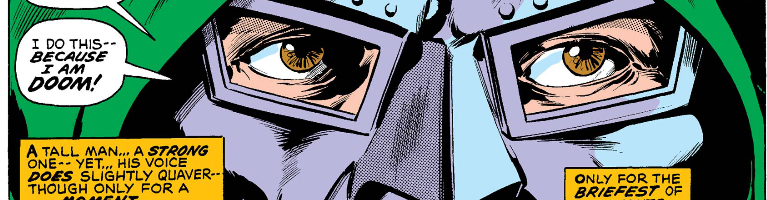
As y’all must know, Damage Control was a series by Dwayne McDuffie and Ernie Colon dealing with the company that cleans up after superhero battles, alien invasions, giant robot clashes, etc. In the second issue they face a problem: Doom is one of many people who has them on retainer but he hasn’t paid in a while. How do they get him to settle his account?
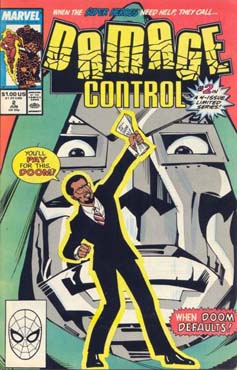
The answer is simple: ask for the money. It turns out one of Doom’s lackeys has been embezzling the cash; Doom pays up, 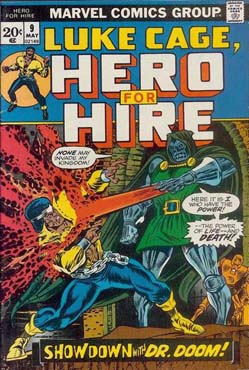 then exiles his lackey. It’s a fun story … but I don’t buy the rationale behind it.
McDuffie said the story was pushback against Luke Cage, Hero for Hire #9, the well-known tale (Steve Englehart, George Tuska, Billy Graham on the cover) in which Luke charges into Latveria to collect $200 Doom owes him for services rendered the previous issue. Doom stiffed him on the bill; sweet Christmas, Cage ain’t putting up with that.
McDuffie’s point was that Doom would never do that because evil though he may be, he’s a man of honor. Which had me scratching my head because that wasn’t at all my impression of Doom. My Silver Age reread has confirmed my sense of Victor Von Doom: the classic Lee/Kirby version is a double-crossing bastard.
In Fantastic Four #6 he plots to kill Sub-Mariner as soon as their team-up has destroyed the Fantastic Four. In #23 he recruits the Terrible Trio with an offer of $5,000 apiece. After they’ve captured the FF he instead traps the trio in another dimension to wait until he needs them again. The multi-part FF#84-87 shows Doom is a ruthless tyrant in his homeland, one who will punish the slightest hint from one of his subjects they’re not blissfully happy to be ruled by him (good thing we don’t have leaders with egos that fragile in the real world!).
Now, though I’m up to late 1971 and I can see a different Doom emerging. Not a hero, nor even an antihero, but not a complete monster either. First we have Astonishing Tales #8, the last story in Doom’s feature there before Ka-Zar took over the entire book. “… Though Some Call It Magic,” (Gerry Conway, Gene Colan) opens with Doom and Boris preparing for something sinister, ominous and yes, magical.
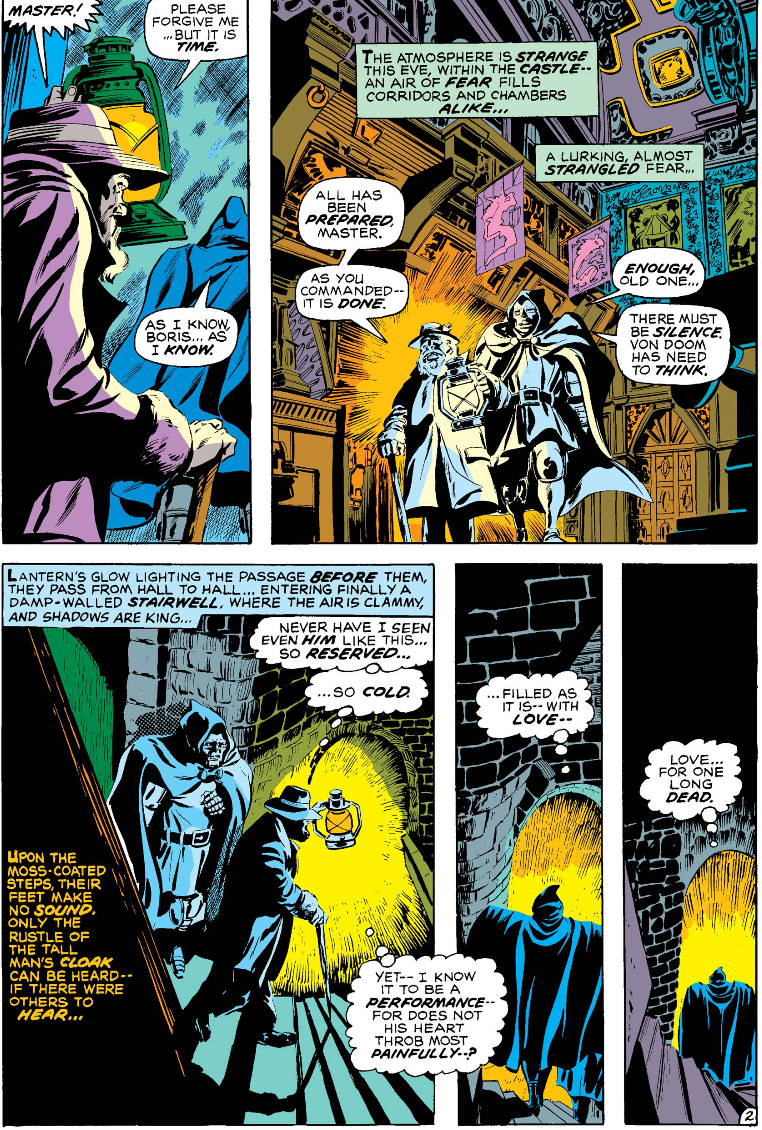
The Latverians, like the superstitious Eastern European stereotypes they are, assume the worst.
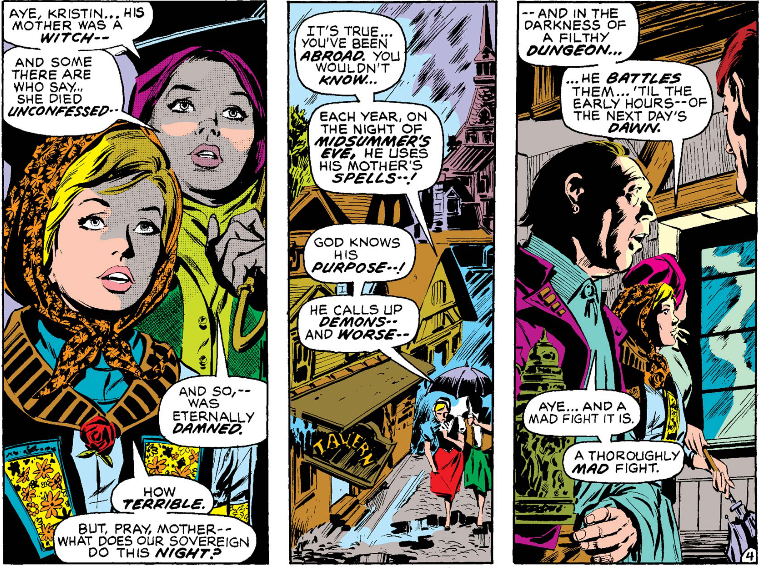
Kristin’s mother is correct, Cynthia von Doom died with her soul burdened by black magic. Doom’s purpose this night is not evil however, but to open a gate into hell and fight to save Cynthia’s soul.

Doom’s been doing this for a while. It never works.

Doom, however, loves his mum. He will try again.
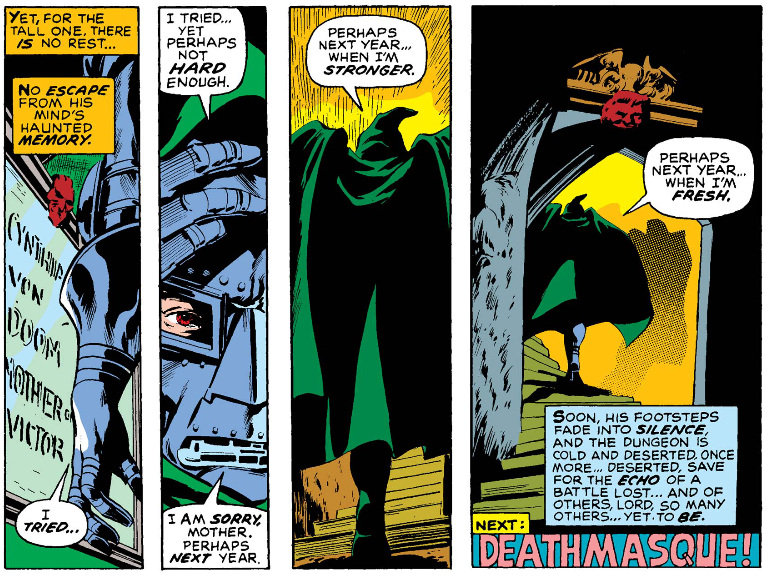
This is, I think, the most humanity Doom had ever showed at that point. It works for me (though Roma, witches or not, did not get “von” in their names, as it’s a title of the nobility. I’m guessing Doom took the “von” for himself, then gave it to his mother, establishing the illusion he’s born to the throne).
A second chink in Doom’s armor shows in Incredible Hulk #143-4. The plot has Doom offer Bruce Banner sanctuary in Latveria, then brainwashing him to build a nuclear device for his glorious leader, Victor von Doom. Dr. Doom then plans for the Hulk to transport the bomb into a hostile neighboring nation — a launch system nobody can intercept — and thereby eliminate a threat to Doom’s rule.
Into the middle of this in #144, enter Valeria. No, not Valeria Richards; this was a Roma girl Victor had loved in his youth, as detailed in “This Man … This Demon,” (Roy Thomas, Larry Lieber) in Marvel Super-Heroes #20. In the past, Victor walked away from love in favor of power; in the present, Diablo captures Valeria as bait to bring Dr. Doom into his clutches. Doom ultimately defeats his foe, of course, but his ruthless gloating convinces Valeria the young man she loved is gone. Now it’s she who walks away, telling Victor not to seek her out again.
Turns out in #144, “The Monster and the Madman” (Roy Thomas, Gary Friedrich, Dick Ayers) he didn’t listen.

Doom wants it all — world dominion and the love of a good woman. So, of course, he lies.

Turns out he’s right, though. She’s no fool.

What she did was to let Bruce regain his mind and thwart Doom’s scheme. The outraged monarch condemns Valeria to trial for treason. Then a pissed-off Hulk shows up and smashes things.
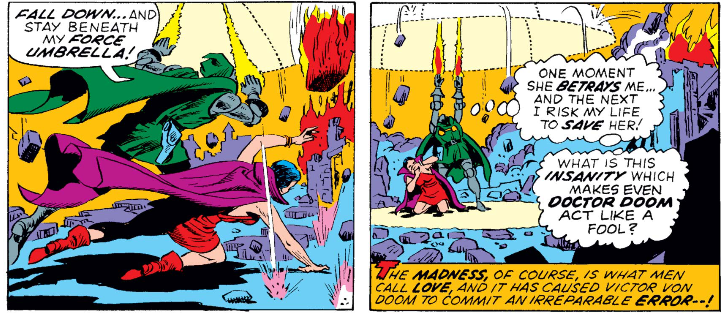
By giving Valeria some brains and personality this relationship gets a lot more interesting. I’d have loved to see Valeria keep turning up — not necessarily every story, but she adds an interesting complication to Doom’s ambitions. However nobody showed any interest in using her again until Mark Waid killed her off in his Fantastic Four run.

Speaking of Fantastic Four, here’s the third story I wish to write about, FF #116, “The Alien, The Ally, and Armageddon” by Archie Goodwin and John Buscema (who provides the cover above). It’s the finish of the Overmind arc, which I will blog about soon. For the purposes of this post, all you need to know is that Overmind is the science fiction version of Thor’s foe Mangog. He’s the last survivor of an imperial race, enhanced by having his entire people, a billion strong, pour their minds into his before their end.
By this point in the arc, Reed has become Overmind’s slave. New York has fallen to the alien’s control. He’s beating the crap out of Ben and Johnny while Susan tries and fails to find allies. Until it occurs to her that with the world facing doom, maybe the last, best hope is … Doom.

Like I said, I don’t recall Doom showing much in the way of honor or nobility before. Did this means the “man of honor” idea was already in play? Or did Goodwin think it worked better for the story than Sue saying “if we die, you die”?
Suffice to say the Thing and the Human Torch don’t take this sudden team-up well.

However they realize under the circumstances, beggars can’t be choosers.
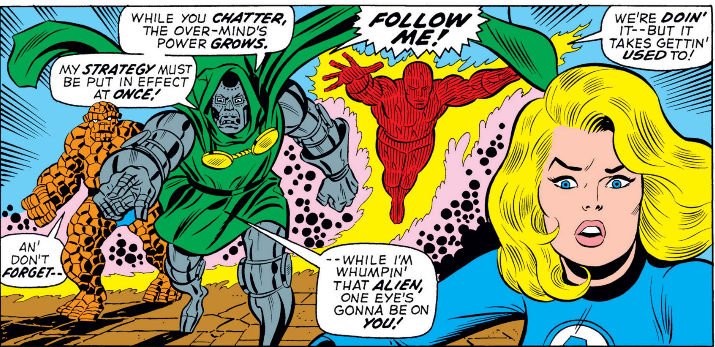
Overmind’s reaction to Victor’s arrogance is priceless.

For the record, the Psionic Refractor is an invention of Reed’s that Doom took from the Baxter Building and modified. Even in the greatest fight of his life, he can’t turn off his ego.
Unfortunately he also can’t win.

The fight, however, draws the attention of the Stranger, who has a score to settle with Overmind and crushes him like a bug. Doom, obviously stung by defeat, tells the FF he wants neither their thanks nor their sympathy — soon, very soon, they will face him as an enemy once again!

As far as I can see, from these seeds sprouted … nothing. Writing the first two issues of Super-Villain Team-Up (cover by John Buscema), Tony Isabella shows Doom reconsidering his approach to treating someone like Namor as a pawn — maybe an ally, even an equal, would work better? — but otherwise Doom remained the same arrogant, treacherous, ruthless shit he’s always been. When the “Doom is a man of honor” thing became accepted and based on what … well, you tell me.

I am fairly certain that it came from John Byrne’s treatment of the character. Specifically 1982’s “Fantastic Four #247”. By my reading, since that issue it has been more or less decreed out of the blue that Doom is a honorable man, even if the evidence on panel is… not the most consistent, shall we say. To this day I am scratching my head trying to find justification for that reevaluation of Doctor Doom. Not the last time, either.
You could also argue that some of the early issues of the mid-1970s series “Supervillain Team-Up” attempt to prepare that terrain.
Agreed on that last part. Like I said, Tony Isabella in the first couple of issues seems to be shooting for a more complex Doom. But it didn’t stick when he left the book.
And thanks for the added perspective. I was never much into Byrne’s run so I’m only peripherally aware of things in it.
A comment from MJ Hibbett on my own blog, regarding this post:
“Hi Fraser – I couldn’t work out how to comment on your Doom article, so I’m doing so here instead!
Just wanted to say I really enjoyed it – Doom in the late 60s/early 70s does sometimes seem to be two different characters, with the “good-ish” tortured soul version that we’re familiar with now alternating with a deranged lunatic dictator who seems to have disappeared. There’s a great example a couple of years earlier than this when in May 1969 when we’ve got the ranting, self-deluded dictator of Fantastic Four 86 on newsstands at the same time as the tortured soul trying to save his mother in “This Man… This Demon!” (which I would say is a prequel to “Though Some Call It Magic”) in Marvel Superheroes #20. I read every Doom appearance from 1962-1987 for my PhD thesis (yes I am a Doctor of Doctor Doom) and as you say, this is a real transition time for his character!”
I have to say, I love the idea of a Doctor of Doctor Doom
He’s not the only villain that got a bit of a nobility polish over the years– Magneto comes to mind too– but I prefer them as bad guys. Doom’s whole bit is he’s the most arrogant man in the world, and that is always his undoing. I don’t mind introducing some nuance into that, but the character should never lose sight of that core principle.
True. Him taking credit for Reed’s invention in the Overmind story is a good example.