

“I was walking in the park dreaming of a spark, when I heard the sprinklers whisper, shimmer in the haze of summer lawns”
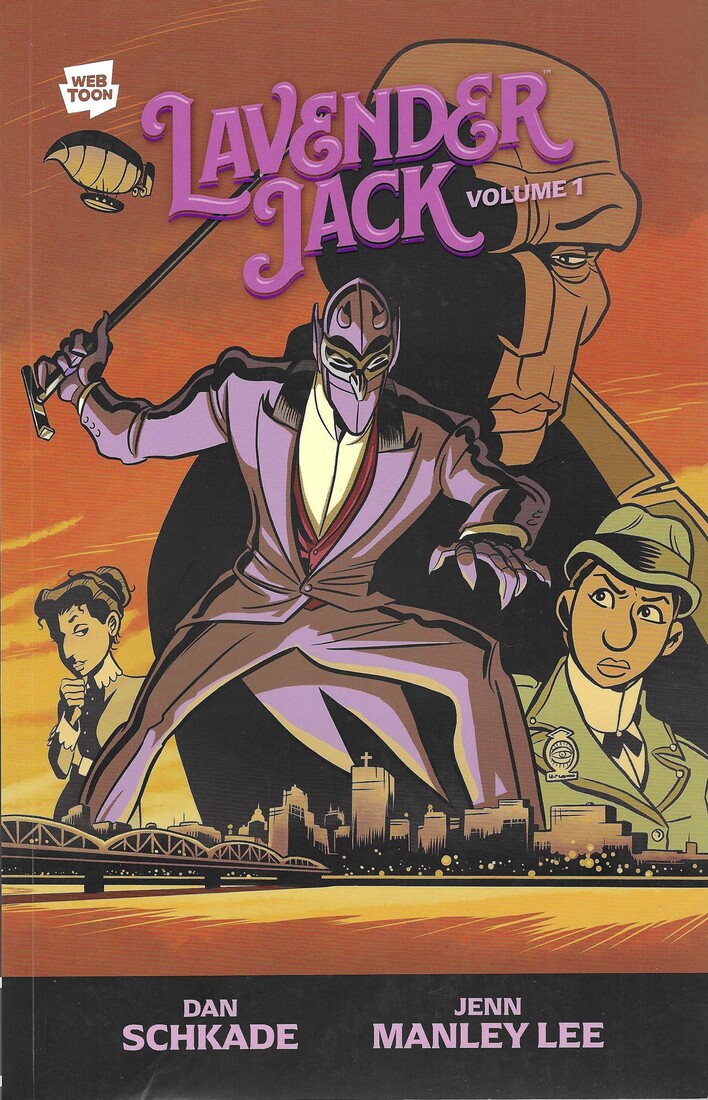
Lavender Jack is a webcomic, but I don’t have any truck with that sort of readin’, so I waited until they printed it on dead trees, the way it should be! Dan Schkade, who’s been an interesting if largely unheralded creator for a while now, writes and draws this, while Jenn Manley Lee colors it. 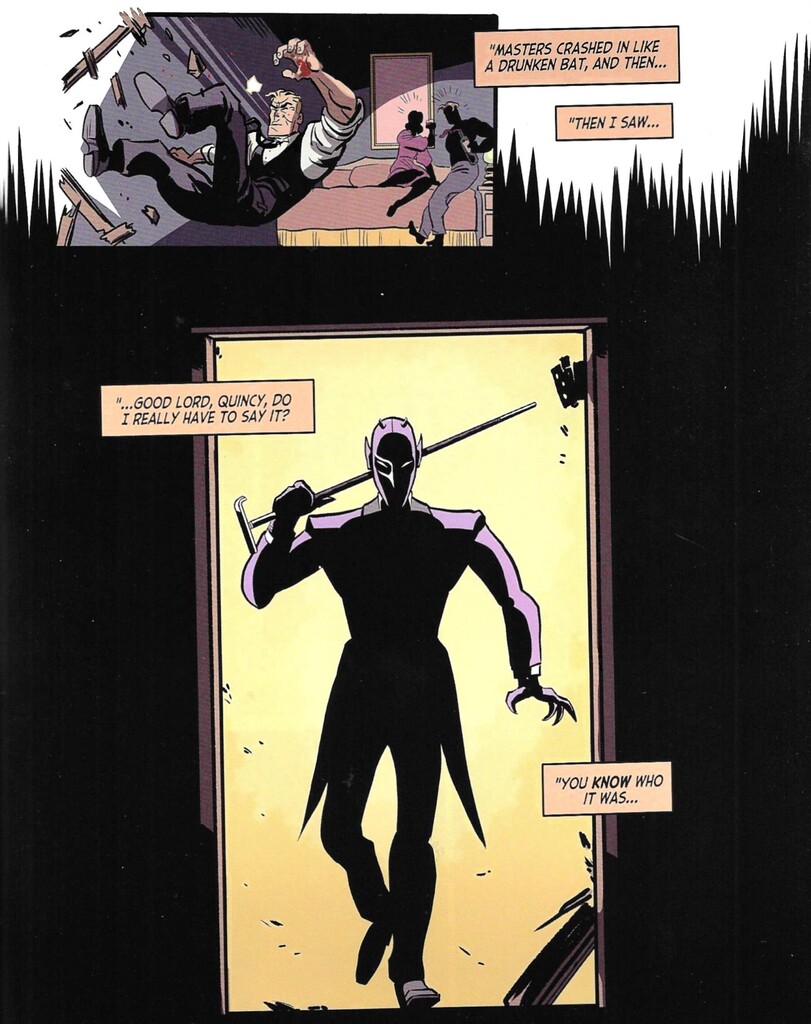 Dark Horse published it, charged us $29.99 for it, and gave us 334 pages of action! This comic is a few years old (it began in 2022), but as a printed unit, I can say it’s one of the best comics of this year (so far). Let’s take a look!
The action takes place in the city of Gallery, in the year “nineteen hundred something or other” — it’s clearly meant to be pre-World War I, so let’s just go with that, although in a couple of crucial spots, it’s far more advanced than the “real” pre-World War I world. Gallery (I could go on about that name, but I shan’t) is … well, it’s in Europe, probably England, but Schkade doesn’t commit to a place — suffice it to say it’s not in the United States. It doesn’t really matter that much. In this city is one Lavender Jack, a purple-suited and -masked vigilante who seems to — seems to, mind you — have some kind of magic power and is targeting some of the city’s rich elite. Now, in this day and age in popular fiction, we don’t really need someone to have a reason for going after the upper crust, but Jack actually does have a pretty good reason, so there’s that. We learn early on that Jack is actually the recently ennobled Sir Mimley Bastrop, who’s basically Bruce Wayne with flair (with flair, if you get my drift — the dude wears lavender for a reason, people!), and he and his faithful servant/sidekick/partner, Ducky (a maid who knows a lot of other servants around town, which allows her to gather good intelligence), are terrorizing the rich. The mayor hires Theresa Ferrier, the world’s greatest detective (although, as some people point out, she is a bit long in the tooth, and perhaps not as sharp as she used to be?), to figure out what’s going on and who Lavender Jack is, but she’s more interested in why Jack is going after the people he’s going after, because of course she is. 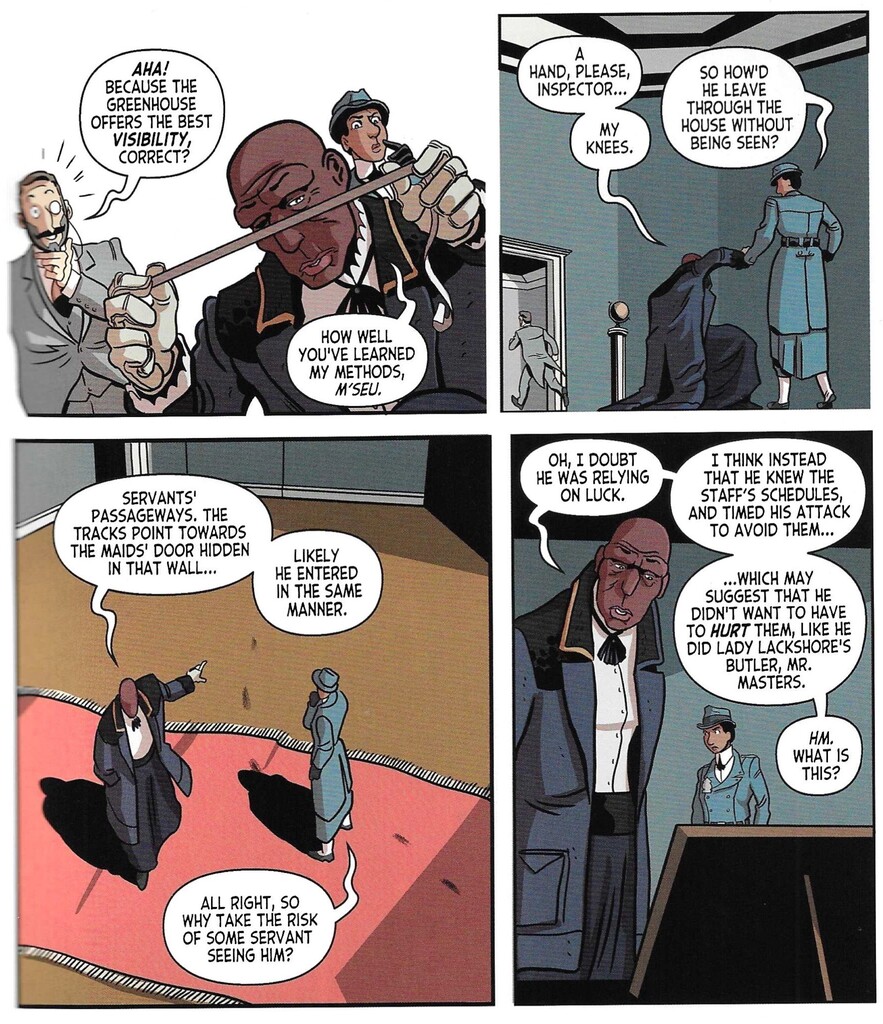 She and police inspector Honoria Crabb butt heads for a while, as Crabb wants to go after Jack, but Honoria’s a good egg, and she comes around to the fact that there’s something wicked going on in the city, and maybe Jack isn’t the problem (I mean, of course he isn’t, but it takes her a while to realize this). Meanwhile, reporter Abbey Quarrel is trying to figure out what’s going on, too. Oh, and there’s an Evil Tarzan in this book. It’s a lot of fun!
Schkade can move at a nice rhythm because he’s posting these in short segments and the entire epic is so long, so we get a fairly simple story (not a bad one, you understand, just not terribly taxing) with some very nice twists and turns, and he spends a lot of time with every character, so even the villains and minor characters get a good amount of character development (the main villain, oddly enough, doesn’t get as much as some others, but it feels like a very deliberate choice by Schkade, especially with a speech he puts in the villain’s mouth near the end). We know about the mayor and the servants and Evil Tarzan and the doomed genius and all the others because Schkade does an excellent job with the dialogue, revealing a great deal about the characters without being too pedantic about it. He balances the character moments very well with the action sequences, which, naturally, also reveal parts of the characters’ personalities. Another impressive part of the book is the diversity. Sir Mimsy, Ducky, Theresa Ferrier, Marguerite des Melbone, Abbey Quarrel, Honoria Crabb, and several other characters are dark-skinned (to varying degrees, another nice touch), and at least three of them are attracted to the same sex, but the nice thing about it is that Schkade does not make a big deal about it — it’s just the way it is. 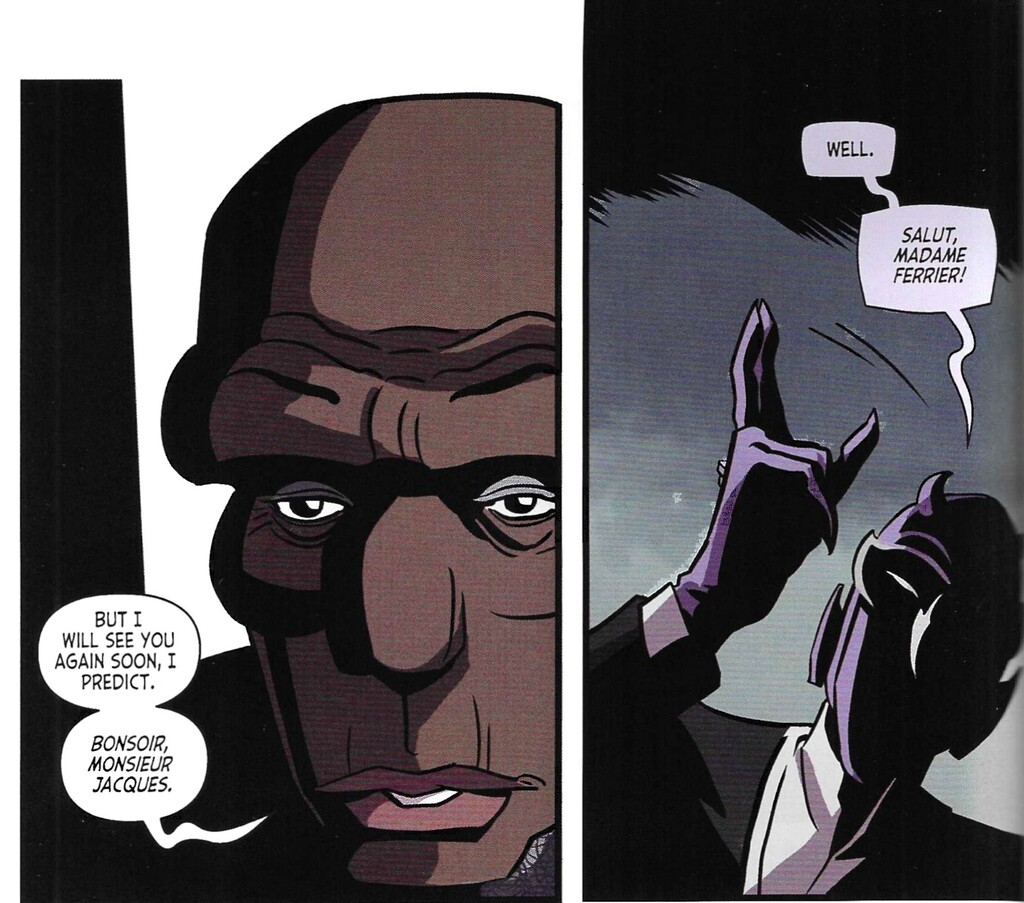 Even the villains don’t make a big deal about it — they’re villainous because they want something tangible, not because they’re prejudiced against darker-skinned people or gay people (I will point out that most of the villains are white, but such is life). Women are in positions of authority in the book and nobody cares. I’ve been noting this with DC and Marvel’s attempts to be more diverse — gay people don’t talk about being gay all the time, so why do they do that in DC and Marvel comics? — and Schkade gets that, as he simply writes characters who love each other, no matter their gender, and it makes the book more realistic (as much as a turn-of-the-century quasi-steampunk vigilante/superhero comic can be) and heartfelt. It’s definitely the kind of thing I’d like to see more often in the big superhero books, instead of what they’re giving us.
Schkade’s art has evolved over the years — he’s gotten a bit smoother and fluid, with fewer hard edges, which is fine with me (I like both styles). He creates a marvelous world of gorgeous buildings and dark but cozy Victorian rooms and populates them with beautifully dressed people — nobody is not stylish in this comic! Jack is a lithe, balletic figure, moving smoke-like through the world, and Schkade’s design, with his purple tuxedo and vaguely kabuki mask, is very striking. Sir Mimsy is a bit more languid and even decadent — it’s a façade, for sure, but Schkade does a nice job contrasting the two sides of his personality. Theresa is the subject of some ageism in the book, as she has been around for a while, and Schkade does a nice job showing how the years have worn on her. 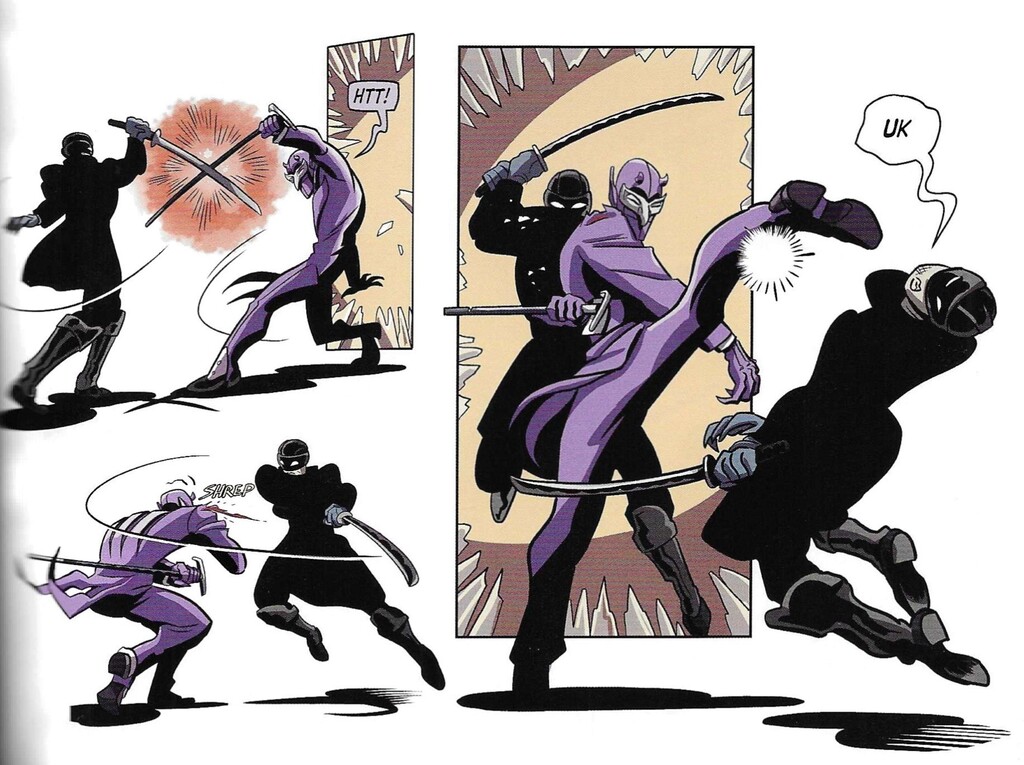 Schkade’s storytelling is excellent — it’s a crowded book, sure, but it’s never difficult to read, and his strong sense of laying out the page keeps things moving along but also makes sure we’re always right there with it. He uses spot blacks very well to oppose Lee’s bright but not overwhelming colors, and we get a lot of nice touches — newspapers that stand in for panels and convey useful information, panels without borders that make good use of negative space, tilted panels to “speed up” the action — to keep the visual part of the comic lively. The art goes very well with the story, which is kind of what you want with comics, right?
Schkade does set up a second volume (which should be out soon, I think), but this is a very standalone volume, so don’t think you will get it and only get part of a story. It’s an excellent comic, and as someone who’s been a fan of Schkade for over a decade, I’m glad he’s raised his profile a bit with this comic. Pick this up today!
Rating: ★ ★ ★ ★ ★ ★ ★ ★ ★ ☆

Yeah, I know it’s repackaged older material, but this is, so far, my favorite comic I read this year. Volume 2 should be out by the end of the month and the 3rd and final volume in the Spring.
Very inspired by pulps and classical genre lit, but, as you note, much more diverse in terms of race and sexuality. Lavender Jack himself is the Scarlet Pimpernel by way of Ncuti Gatwa’s portrayal of Algernon in the Important of Being Earnest. But my favorite character is Madam Ferrier, the aging, hulking Poirot figure.
I think/hope Hatcher would’ve loved this, and I think other folks reading this site would dig it.
I stay clear of webtoons as well, this looks pretty cool but I can’t seem to find a physical copy for sale.
Did you guys buy it online or brick & mortar store?
It was in whatever they’re calling Previews these days a while back, so I pre-ordered it and it showed up at my store. That’s weird that it’s hard to find. Come on, Dark Horse! 🙂
For me in Holland Amazon is the only option. After reading this review I ordered both volumes.
Managed to find it on eBay, thanks guys.
I love this series, genuinely one of my favourite comics and I’m just coming to the end of it on Webtoons and with this CE delivered last week, so really pleased to see you review it.
Because I am that type of person, I just wanted to slightly jump on your head and say that it’s clearly not meant to be in a fictional country in “probably England”. The way it is described is that it is a city-state on the mainland of Europe in the style of Luxembourg or Liechtenstein, which is reflected in the central European stylings of the military and police. It mentions land borders with other major European countries.
You wouldn’t have seen this, I guess, but in Season 3 you see a map where Gallery is clearly located in the location of [SPOILER] and east of [SPOILER]. (not really spoilers… but I just didn’t want to give information away that is relevant to future stories…
I agree with you that ‘Gallery’ is a NOT a good name for a country…
I must have missed the mention of borders with other countries. Whoops! I like the idea that it’s like Luxembourg — maybe even like Monaco? — and I will bow to your closer reading of it. I do get a European vibe from it, but also specifically an English vibe, but I’m probably just misreading it. I’m glad we get a map, because I love me some maps!