

[Folks, you know I love you guys here at the blog, and I’m happy writing away here instead of still toiling for the Valnet overlords over at CBR (for all I know, maybe Valnet is run solely by artificial intelligence these days, so who knows if I’d even be human anymore!), but whenever I come across a post like this from Mr. Hatcher, I do feel a twinge of jealousy. One hundred forty-two (142!!!) comments! Are you kidding me? Of course, this was at the height of the Golden Age of Blogging (Greg posted this on 26 February 2010), so even if Jonah had kept owning CBR instead of going off and writing plays (he’s a playwright now!), perhaps we wouldn’t be getting the number of comments anyway if we were still at CSBG. I don’t know. Of course, things got wacky fairly quickly, but you can go over and check them out yourself — it was always fun when people got grumpy with Greg because he dared suggest that racists were being racist. Enjoy!]
I really don’t want to beat this Captain America/Tea Party thing into the ground, but I keep thinking of stuff that I haven’t seen mentioned elsewhere …
It’s not the controversy, you understand, it’s Marvel’s apology.
Let’s recap. In the course of telling a story in the pages of Captain America, Ed Brubaker wrote a scene with protesters where the Falcon, in his civilian guise of Sam Wilson, said a black man like himself probably wouldn’t blend in with the angry crowd. It was a remark that was perfectly in character, and in finishing out the depiction of that scene, the letterer used photo reference that no one disputes is from a real protest with a similar theme and demographic makeup to the fictional one depicted.
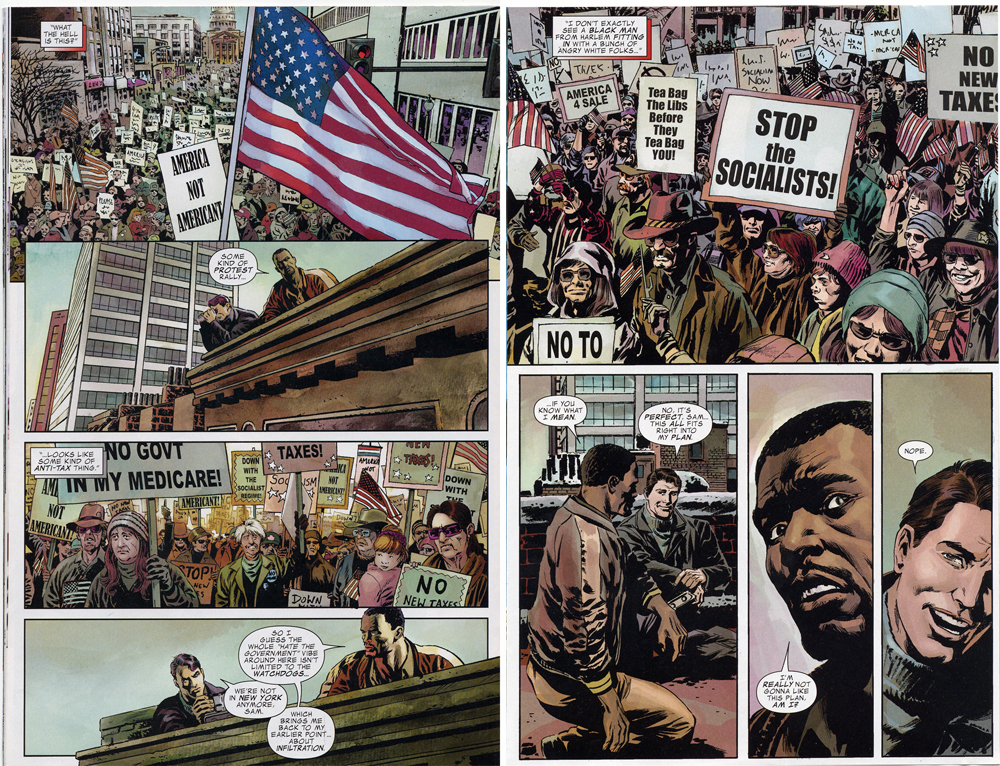
The scene saw print and members of that demographic threw a fit and accused Marvel of calling them racists, Fox News picked up the ball and ran with it, and Marvel hustled out Joe Quesada to apologize for Brubaker and the letterer’s “mistake.” That’s the sequence of events as I understand it.
Since the news hit the comics blogosphere I’ve read a lot of opinions on both sides of the issue, I’ve been up one side and down the other with this, and I keep coming to the same conclusion. For the life of me, I can’t see where anyone working on Captain America #602 did anything wrong.
Of course I understand why Disney and Marvel wanted to put it to bed quickly, no one ever wants to be a Fox News chew toy. But nevertheless I think it’s ridiculous to apologize for something that grows organically out of the creative process when you are designing storylines for long-running series characters.
I can feel some of you out there gearing up to yell at me and I’d ask you to hold on for a minute and walk through this with me. Let me give you an example of the process I mean.
We’ll take Superman as our test case and we’ll use a topic that’s even more allegedly radioactive than politics — religion.
Just hypothetically, let’s say you’ve been hired to write a Superman title. You’re not doing any revamp or any re-imagining or any of that stuff, you’re not doing the latest iteration of Birthright or Secret Origin or anything like that. You’re just going to take over one of the regular books. Your job is to come up with new Superman adventures.
Fair enough. So okay, what’s your starting place?
If you’re a conscientious writer of any talent at all, you would be asking yourself, okay, who is this guy Superman? What’s he made of? What’s he about?
Superman’s been in continuous publication since 1938. That mean’s there’s a lot of Superman lore out there and it’s ridiculous to expect anyone — well, except maybe Mark Waid — to be familiar with all of it.
So what do you do? You start with the basics.
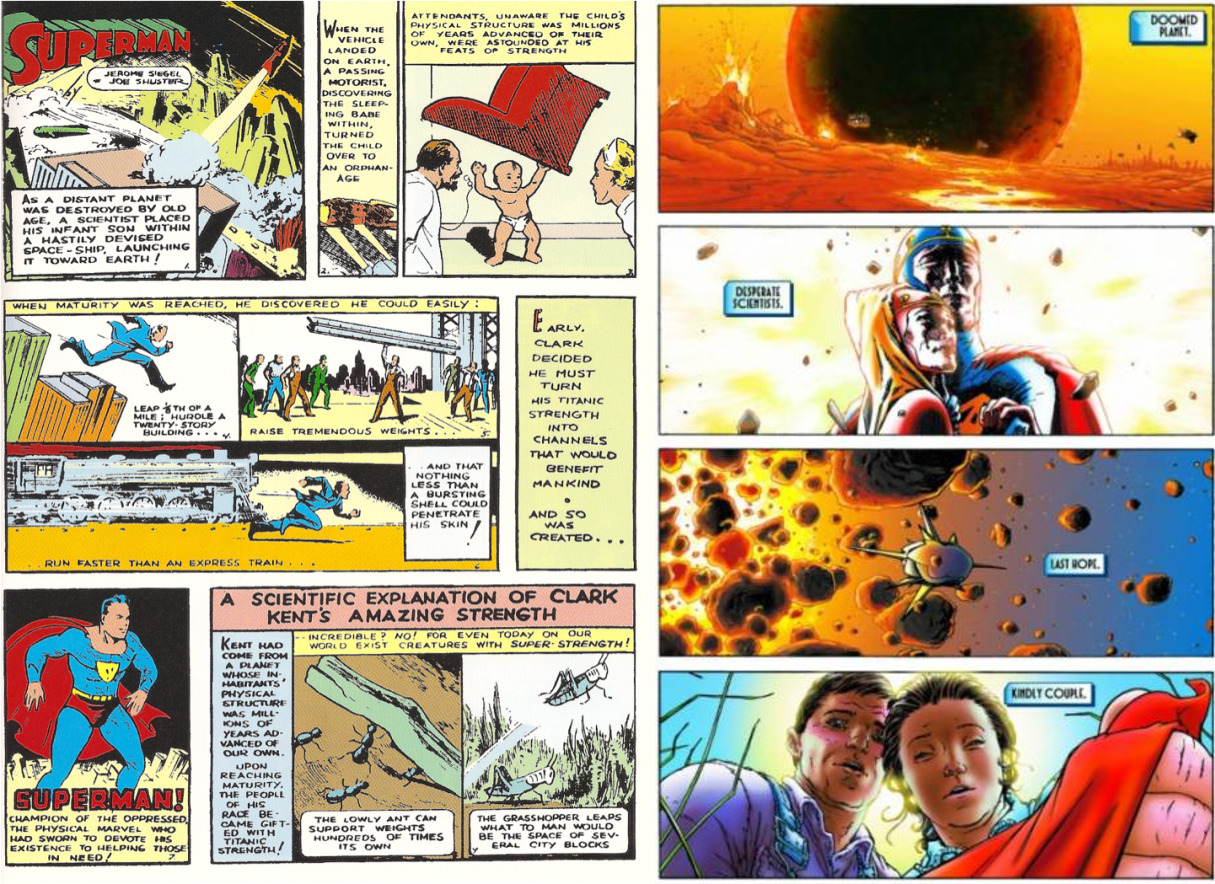
There are several varying versions of Superman’s beginning out there, but in every version there are things that don’t change. Baby Kal-El was rocketed to earth from the dying planet Krypton, where he was found and adopted by the kindly Ma and Pa Kent. They named him Clark and raised him to adulthood in Smallville, Kansas, teaching him their staunch Midwestern values of truth, justice, and compassion for all mankind. Eventually Clark moved to Metropolis where, after securing employment as a reporter for a great American newspaper, he adopted the identity of Superman and began to wage his neverending battle for … and so on. All that. The stuff we all know.
Now, if I was the one that drew the Superman assignment, I’d start with that basic character sketch. Specifically, Superman’s values. What shaped them? The Kents? If young Clark Kent was a typical kid then parental influence only explains so much. Wouldn’t teen Clark have rebelled a bit? Certainly keeping his secret must have chafed him, especially as his powers developed. Is there a story to be told there? (The TV show Smallville covered a lot of this years ago, yes, but just play along for a minute or two more.)
What about the rest of his environment? School? Church? What influenced Clark there? How did that actually play out? Let’s not forget that we’re talking about not just the Midwest, but small-town rural Kansas. Farm country.
Now, I’ve spent time in rural Kansas. I worked for a magazine firm that was based in Newton and they flew us out a number of times for conferences and such. And I’m telling you, that’s serious Bible Belt country. There’s a church every thirty yards. I’m not saying that as a pejorative, I’m just saying that’s what Kansas looks like.

As such, it’s inconceivable to me that young Clark Kent did not attend Sunday school. But we can go further. He probably was a member of the youth group, where he learned about mission work on the summer trips that church youth groups take. It might well have been on a mission trip to Mexico or something that young Clark first began to sense what his eventual purpose in life would look like.
Later, though, most likely in his teen years, Clark probably fell away from church though he still was treated like a member of the congregation by his pastor. This is such a common pattern in the Midwest, especially with guys, that I see no reason why it can’t apply to young Clark Kent.
I’m not just blue-skying all this. I’m applying what I know about Kansas from my personal experience and adding that to the established background lore of Superman’s character that I’m already familiar with. This is what writers do. Personal experience plus research equals story background. It’s what the job is.
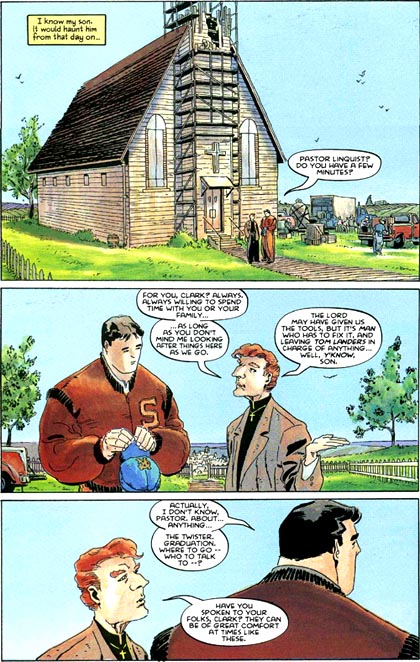
I can take it a little further even than that. We can even narrow down Clark’s church experience to the probable denomination. Mostly by eliminating the denominations we know are ruled out.
Just from the visuals presented in previously published Superman comics, we know certain things already. Clark’s clearly not attending Jewish or Mormon services. He’s not a Quaker or a Mennonite or Amish, despite those denominations’ prevalence in rural Kansas.
Moreover, we can see that during those past years in Smallville, young Clark had a pastor and not a priest. So Catholics and Episcopalians are off the table. I am pretty sure he’s not a Baptist or a Nazarene or a Pentecostal, or really anything in that whole fundamentalist neighborhood — those faiths are too emphatic about the necessity of bearing witness to one’s neighbors. From the tolerance and easygoing attitude Superman displays towards people of all faiths, that brand of evangelism was not part of his upbringing … I don’t think young Clark Kent ever went doorbelling.
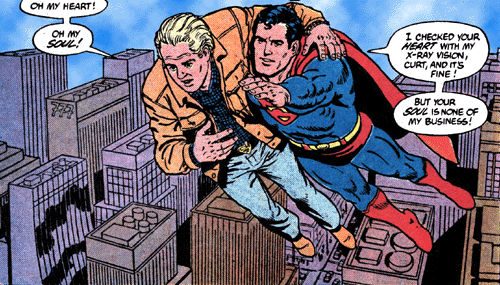
So what’s left? Bearing in mind that we’re still in rural Kansas, I’d put my money on the Methodists. I think Martha Kent was probably a pretty staunch Methodist and Jonathan Kent might have gone with her to church at Easter and Christmas. Clark probably faithfully attended Sunday School, maybe he was part of the youth group there for a while as well … then as he got older decided that he’d do better on his own.
That takes a long time to write, but it only took me a minute or so to reason it out. I hit Google for some images and look what I bowled out.
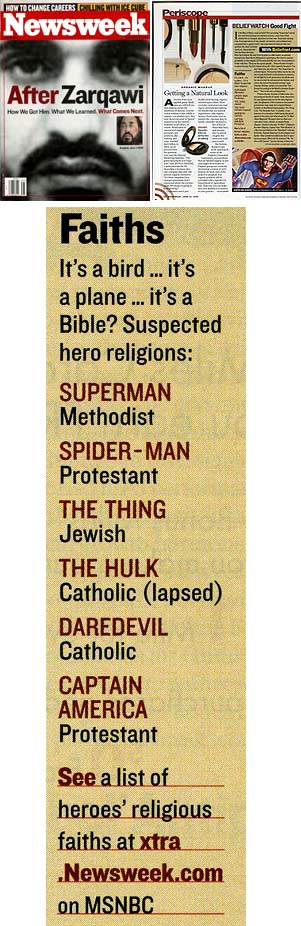
Turns out both Elliott Maggin and Newsweek are calling it for the Methodists as well. I feel ridiculously smug.
So what am I saying? Am I suggesting that the United Methodist Church should adopt Superman as their official mascot? Or that Jews or Buddhists should feel slighted? No, of course not.
Am I suggesting that this should be incorporated into the comics, that Clark Kent should start going to church? No, not really, though that might make for an interesting story, especially since I think Lois Lane is probably an atheist (really, I think Lois is one of those pragmatic workaholics who never considers questions of faith at all, her work is her religion.)
But it would be commercial idiocy to tie a character as popular around the globe as Superman not just to a faith but to a specific denomination. For DC Comics it makes much more sense to keep their flagship character as widely identifiable as possible.
So why bother with it at all then? Isn’t all this just idle speculation? Fanfic stuff?
No. You bother with it because you need to know who Superman is and where his personality comes from if you are going to write convincingly about him. Note the word ‘convincingly.’ Anyone who cares about Superman as a character at all, and certainly the people who read his adventures, have pretty strong ideas about who he is and what he would and would not do. If you’re writing about his adventures and trying to entertain those people, you need to stay ahead of them.
Additionally, you are going to have a hard time coming up with threats to Superman that are credible. After all, the guy’s invulnerable. So if you are going to test him — a requirement for creating engaging dramatic stories for him — you have to abandon physical jeopardy and focus on character instead. Easiest way to do that is to take what you know about Superman and throw him into situations where who he is as a person is tested.
So you have to know who he is as a person. What is a huge factor in defining that for people? Background and upbringing. So you have to know that about Superman, and because he’s a series character with a long history, you can’t just make it up out of whole cloth. Your long-time regular readers always hate that. No, you have to reverse-engineer it out of what’s been previously done.
Saying Clark Kent probably was raised Methodist, or at least bearing it in mind as one of the facets of his character when you are trying to come up with challenges for him … that’s not offensive. It’s not crusading. It’s not Making a Statement about church or religion. It’s extrapolation. It’s character work.
As such, for a writer it’s part of the job description. No, you don’t have to put it in the story, you don’t have to beat people over the head with it … but you should know it.
So … getting back to Sam Wilson, the Falcon. Look at his origins and background.
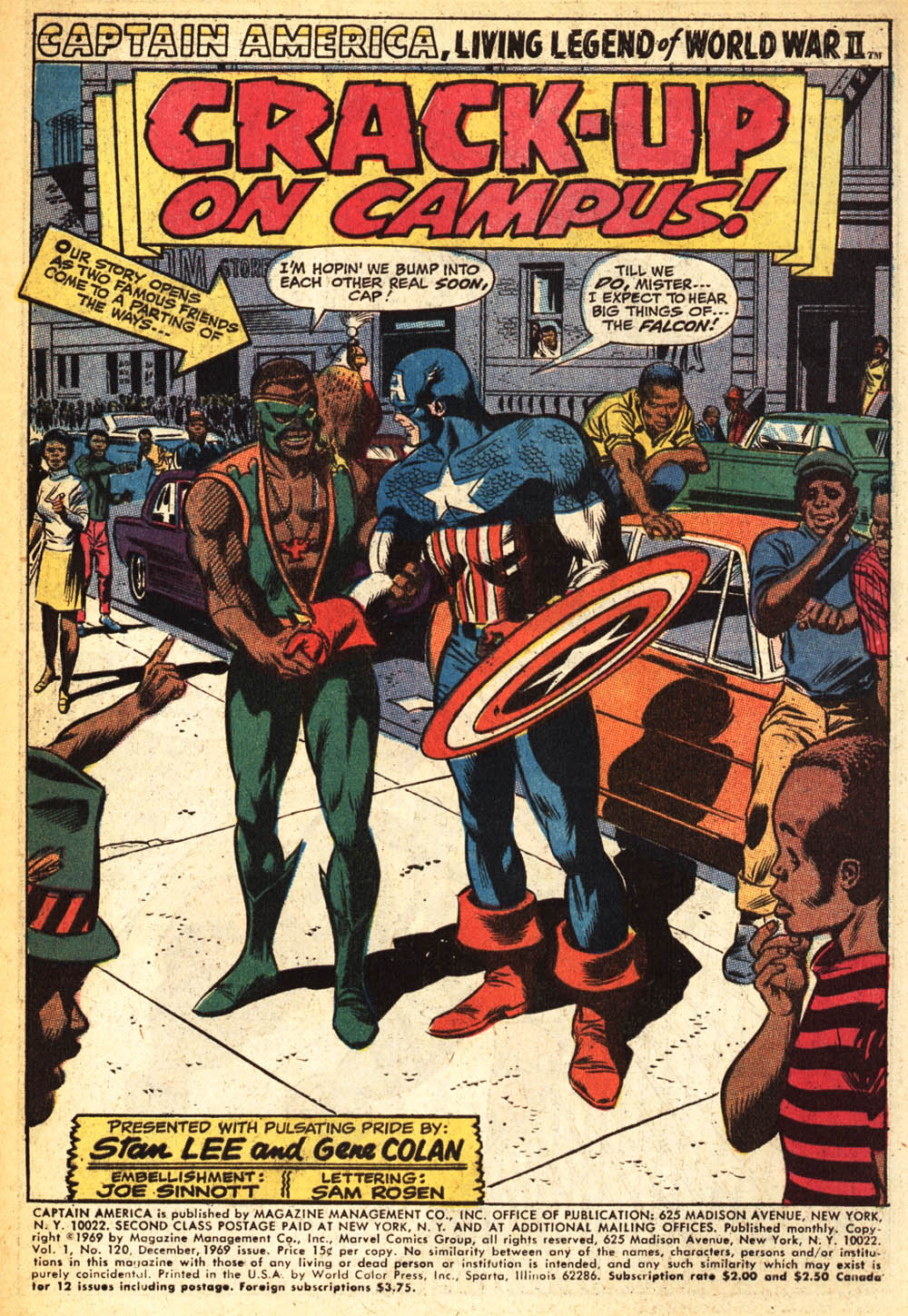
Is it really so inconceivable that the guy with a background of social work in the ghetto …
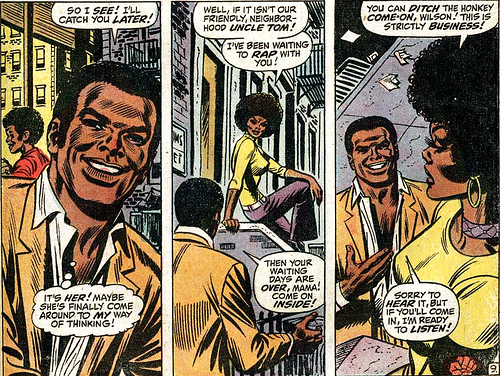
… who fell in love with a radical …
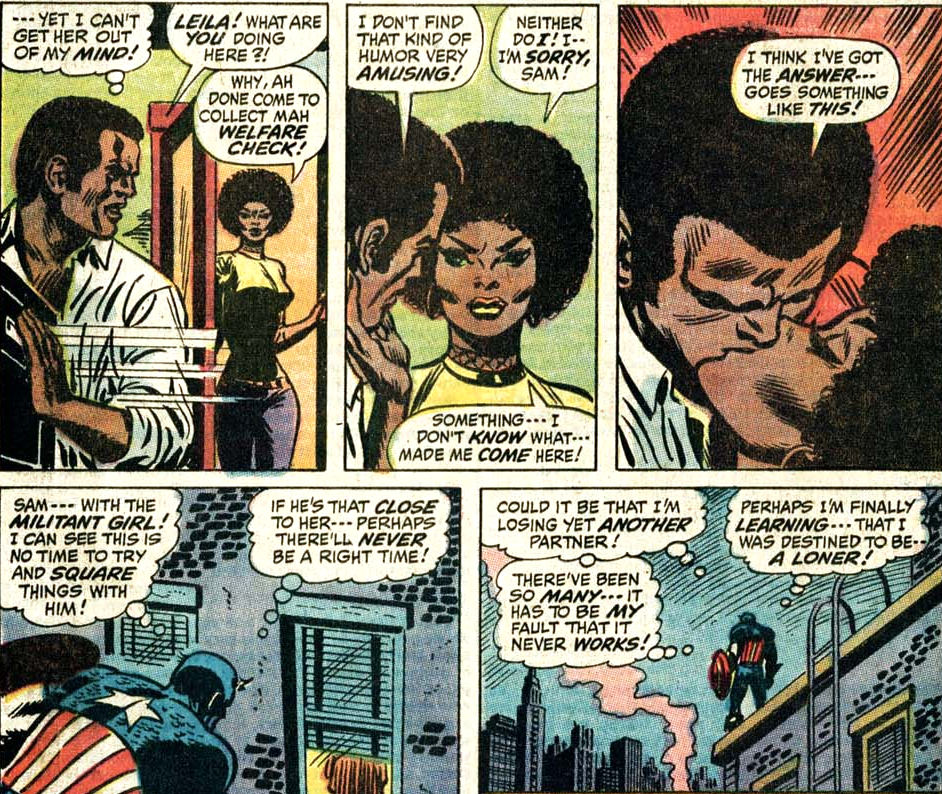
… would feel out of his element going undercover at a rally in Boise, Idaho?
Forget for a moment that the letterer dropped in the photo reference to the Tea Party protests by accident and that it wasn’t indicated in the script or the original art. Even if it was intentional on everyone’s part to evoke the Tea Party specifically in that scene …
… I’m still not seeing the slight.
I’ve been to Boise, I’m from the Pacific Northwest, and it seems perfectly plausible to me that there would be no black folks at that protest. Hell, outside of Portland and Seattle you don’t see that many African-Americans living anywhere in the Northwest. (When I was sixteen, a friend of mine observed wryly to me that when Dave Etherly graduated from our high school, the only black folks we’d ever see would be on TV.) Is acknowledging that really ‘racism’?
In my English classes, we called it verisimilitude. A ten-dollar word meaning “you’re supposed to make it plausible when you write.” That ‘controversial’ scene from Captain America is plausible to me and it was apparently also plausible to the Boise newspapers, whose reaction can be summed up largely as, Hey, check it out, we’re in a comic book! How cool is that?
From where I sit, everyone involved was doing their job and doing it well. I don’t see a problem with Ed Brubaker taking scenes from modern American politics and testing Cap and the Falcon against them. I don’t see a problem with a letterer using photos from real protests to depict that scene.
In short, I see no need for an apology and it annoys me that Marvel apparently did. If the Tea Party doesn’t think they’re being represented accurately, their beef is with the news services and photographers that cover them, not the people who take those news stories as jumping-off places to craft fiction.
The people that are currently depicting the adventures of Cap and the Falcon, as far as I can tell, are doing a fine job. From writer and artist on down to the letterer. I don’t regret for an instant spending money on their stuff and I imagine I’ll be continuing to purchase it as long as they’re on the book. If Joe Quesada needs to apologize to anyone, he ought to be apologizing to those creative people for publicly throwing them under a bus, for no good reason other than that Marvel apparently thinks Fox News is too scary to fight with.
I’m trying to let it go — hell, it’s just a comic book, right? — but I just can’t get over that. Backing away from basic principles simply to avoid inconvenience or difficulty is wrong. Period.
Know who taught me that, back when I was a little kid?
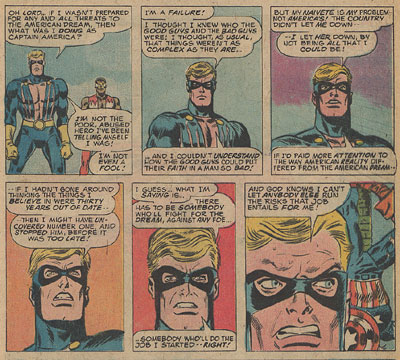
Captain frigging America.
See you next week.

An excellent post. It reminds me of Englehart figuring out what makes Captain America tick.
While I’ve seen many people say “Stan and Jack always intended Ben Grimm to be Jewish” I’m curious if there’s any record of them actually saying it or if it’s just one of those “everybody knows” things Brian Cronin has written so many columns about.
Re: “I’m from the Pacific Northwest, and it seems perfectly plausible to me that there would be no black folks at that protest. Hell, outside of Portland and Seattle you don’t see that many African-Americans living anywhere in the Northwest.”
Yeah, I grew up in there, too, and that was my experience as well. I only learned later that for Oregon at least, there was a very deliberate reason for that.
Anyway, yeah, great column, but I don’t know if the high number of comments is due to fact that it appeared during the ‘golden age of blogging’ as much as a reflection of the subject matter and the still topical ‘Tea Party’ protests of the time (after all, the bulk of those comments have almost nothing to do with either post itself or anything comics related in general).
Knee jerk reactions from ultra-conservative groups….go figure. Or extreme-Leftist, for that matter. Hence, the terms “ultra” or “extreme.”
I would suggest another congregation to Greg’s idea of Methodist, which would be plausible for Kansas and the Midwest and fit within the establish morals of the Kents: The Christian Church (Disciples of Christ). Sadly, it’s numbers have been declining; but, given the political spectrum of today, you might understand why. I’m an atheist, but I grew up in that church, in my small Illinois farm town. My father was a deacon and my mother was the organist and sang with the choir. I and my siblings were baptized there and went to Sunday school. Yet, I grew not to believe in the deity they acknowledged. However, that was not due to the church, itself. It was a veru moderate church, welcoming to all. In 1977, it’s parent assembly voted down specific condemnations of homosexuality and at, worst, a little later, said they didn’t think it fit within God’s will. Later further, they openly welcomed gay members and unions, stating it was really up to the local congregations. That was one of their tenets, that congregations were independent of a higher authority, allowing them to shape the church to reflect their community. That have a long tradition of promoting education and interacting with other faiths and communities. To me, that seems to be a great environment to have shaped both the Kent’s values and Clark’s both through their passing on those ideas and traditions and Clark seeing it firsthand. I never heard fiery sermons in the church, nor condemnation of anyone, no blatant political stance; just a message of following the Golden Rule and Jesus’ example of serving others because it is right, not because of reward. That sure seems the template of Superman’s values. granted, that is not unique to the denomination, but the C of C(D of C) seemed to have stripped it down to the core, in my experience. My parents did move to Methodist churches later, after moving to South Carolina, but mainly because there weren’t any CoC(DoC) churches in the immediate area.
I went with my parents a few times, to the Methodist church they attended, out of respect and because we were having dinner together, after. In one instance, I nearly got up and walked out, after the pastor condemned The Last Temptation of Christ, telling members they should not see it, ignoring the fact that theaters in the Charleston area were not showing it and would not book it. It was condemned, sight unseen. By contrast, the minister at our hometown church was quite a fan of the original novel, upon which the film was based. He didn’t have a problem with the idea of Jesus being tempted with a vision of a family life, which he would sacrifice, yet others seemed challenged by such an idea, despite the fact that the film and novel show he rejects the temptation to follow his path. Maybe those condemning it should have watched it and then judged.
I’m surprised that no one really made hay about Christopher Moore’s novel, Lamb, The Gospel According to Biff, Christ’s Childhood Pal. The novel is a satirical look at the youth of Jesus, as told by his friend Levi, known as Biff (the sound of his mother’s hand, smacking him upside his head). Biff and Josh (Joshua or Yeshua, the Hebrew name of Jesus) hang out in Judea, where Josh’s brother James smashes a lizard’s head with a rock and Josh brings it back to life. They are eventually forced to flee Judea, after pulling a prank on a Roman official, which leads to a collision with Zealots, on the run from Roman soldiers. Josh and Biff skip town and Josh searches to find the three magi. He finds each in a different Asian country and studies with them, one a Taoist, one Buddhist and one Hindu. They help coalesce the ideas in his head and he returns to Judea to start his mission and things play out. There is a love triangle between Josh, Biff and “Maggie” (Mary Magdalene) and the story is told by Biff, after he has been raised from the dust by the angel Raziel, to tell his gospel, while they are cooped up in a motel, as Raziel watches daytime tv. Biff eventually completes it and gets his reward. Wonderful book, very funny, but also very reverent to the core philosophies of Jesus, in the Bible, as well as similar beliefs in other cultures. Josh explores those societies and sees things he likes and things he doesn’t and it serves to compare those cultures and how the similar beliefs were often skewed within the culture. However, no one made a movie and to attack the book, you’d actually have to read it, which tends to be too much work for people who condemn books and ban and burn them.
Yes, much like Life of Brian it’s not at all dismissive of Jesus.