
“No one but the pure at heart may find the golden grail”
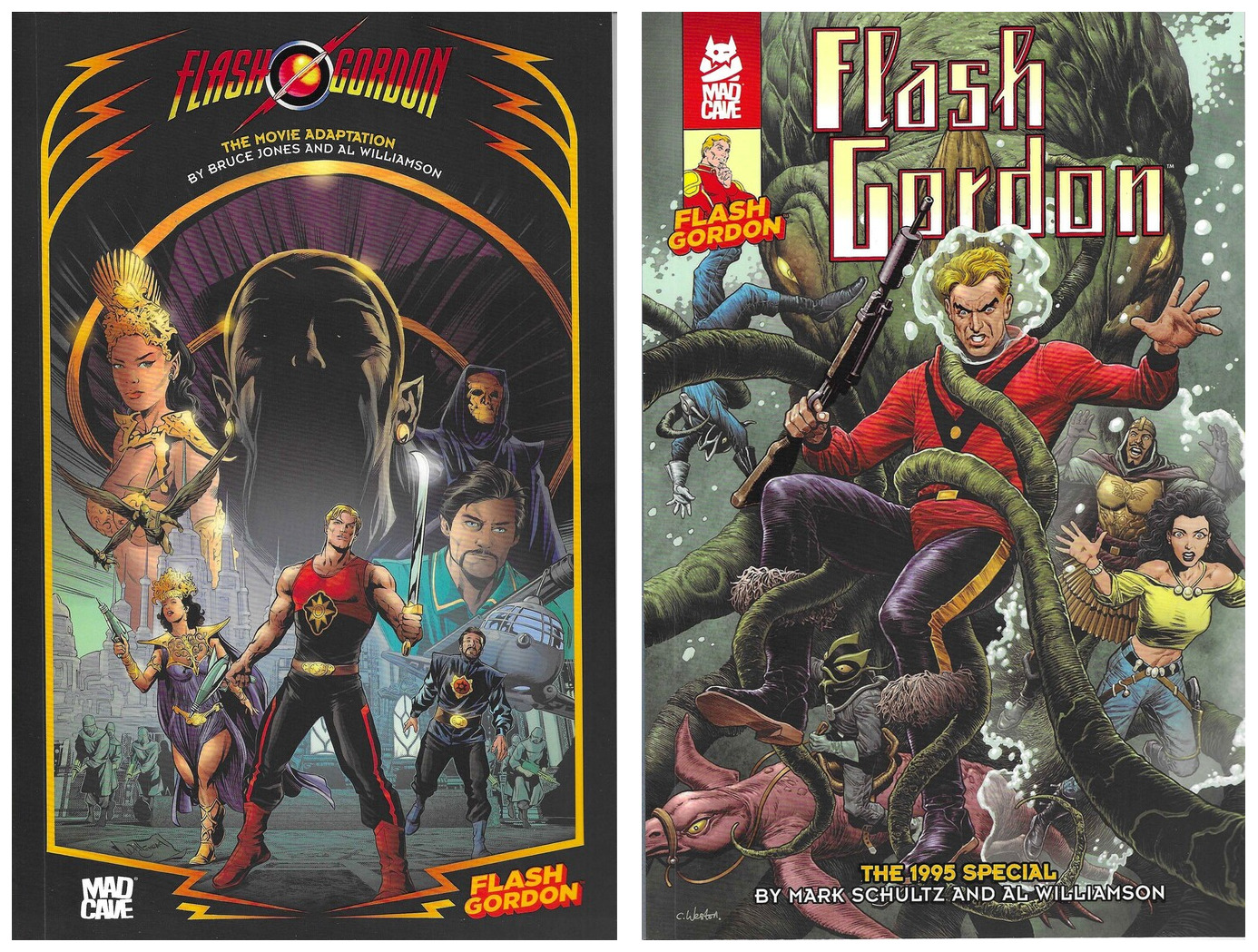
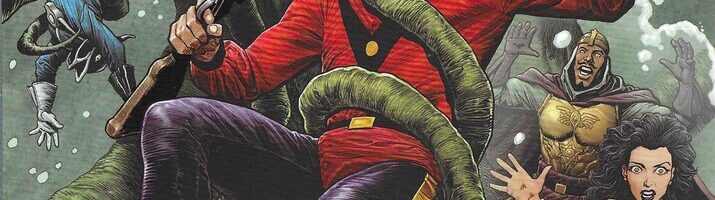
Mad Cave now has the Flash Gordon license, so they’ve been putting out some quality olde-tyme Flash stuff, and recently, they reprinted both the movie adaptation from 1980 (which was originally published by Whitman) and the two-part special from 1995 (which Marvel put out). The movie adaptation is 71 pages, while the special is 65 pages, and they both costs $17.99. Bruce Jones wrote the adaptation (based on the screenplay by Lorenzo Semple, Jr.) and Rick Veitch colored it. Mark Schultz wrote the special, with colors by Tom Roberts and letters by John Workman. Both of these are a bit pricier than you might want to pay, which is fair, but I got them because both are gorgeously illustrated by Al Williamson. To me, that’s worth the price.
I can’t say I love either one of the stories in these books. The movie, of course, is famously terrible, despite the presence of Max von Sydow, Topol, Timothy Dalton, and Brian Blessing Blessed (I mean, Sam Jones and Melody Anderson aren’t dazzling anyone with their acting abilities) and the Queen soundtrack. Jones doesn’t do much to make it any better — the comic is kind of a mess, with people just doing things for no reason and moments supposedly having importance but because they come out of nowhere, they really don’t hit. Characters seemingly switch allegiances at random, and everyone falls in love with Flash just by seeing his dazzling hair, I guess (which, as we know, is not unique to this story — people in pop culture fall in love in alarmingly easy fashion). There’s little tension because Flash is such a he-man that nothing fazes him, so there’s not even a shred of doubt about his ultimate victory. As this is not a movie, we don’t even get von Sydow’s ridiculous campy performance and Blessing’s wildly mirthful performance or Dalton’s suave performance — Williamson makes the character resemble them vaguely, sure, but they don’t move and talk, of course, so we lose that. In the 1995 Special, Schultz, freed from the constraints of trying to adapt a terrible screenplay, give us a fun story that ties into Flash’s childhood (a bit ridiculously, but what the hell) and takes him all over Mongo for, basically, shits and giggles (ultimately, it’s so Williamson can draw all this shit). Ming, who’s been vanquished for a while, shows up, because of course he does, and all’s well that ends well. It’s better than the movie adaptation because Schultz can do his own thing, while Jones was stuck with what he had. The 1995 Special is, at least, pretty entertaining.
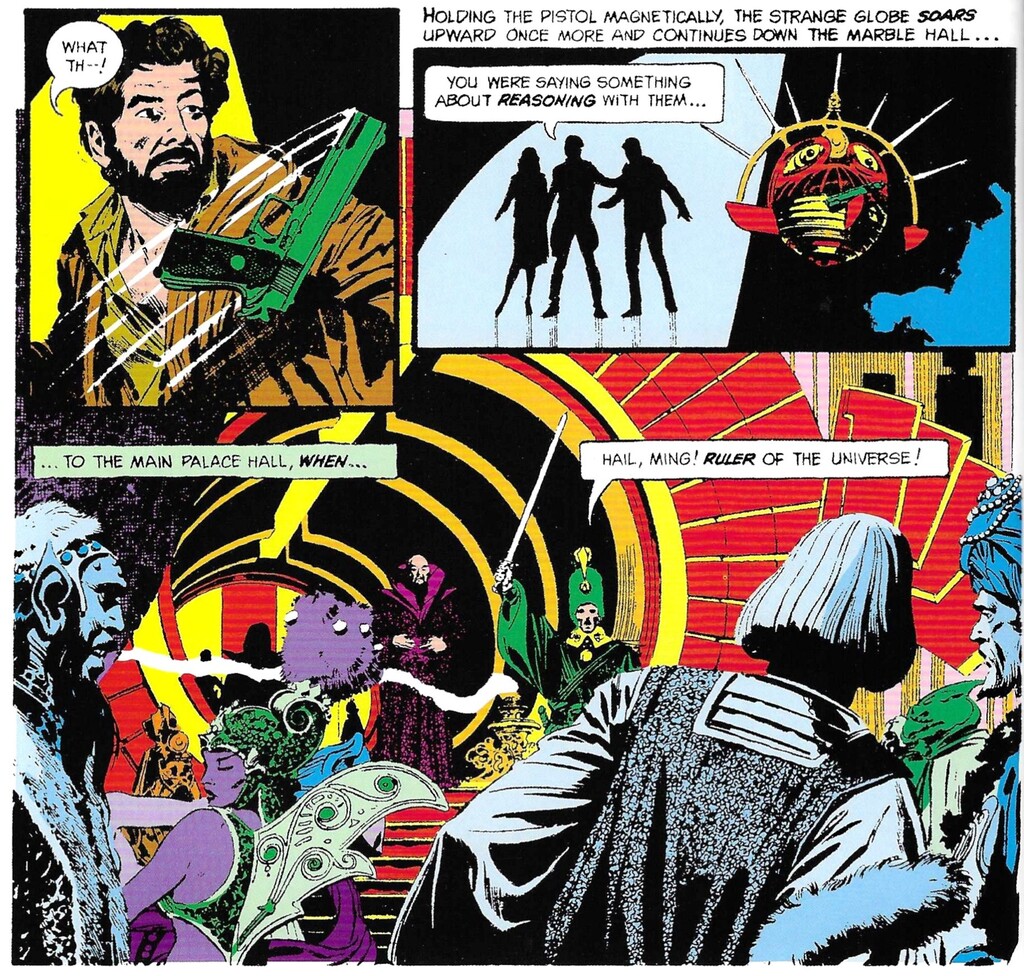
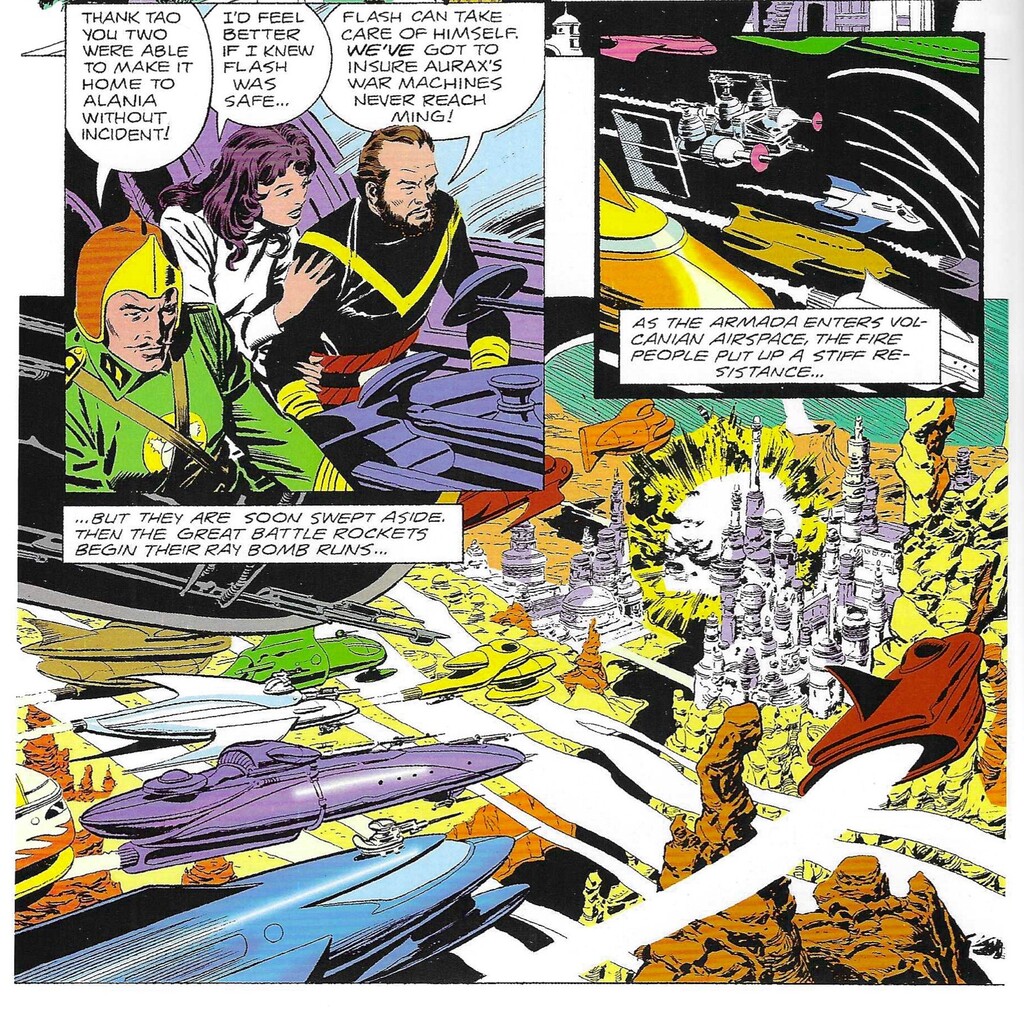
None of that matters, however, because Williamson’s art is so stupendous. In 1980, Williamson was 49, and he was still working steadily. He had drawn some Flash Gordon stories in the past (two of which are reprinted in these volumes, from 1966 and ’67), and in the absence of Alex Raymond (who would have been in his early 70s, so he might not have wanted to do it, but he had already shuffled off to that Great Drawing Studio in the Sky), Williamson was one of a handful of people who could nail the 1930s pulp aesthetic of Flash (Wood, of course, was another, but he had his own problems in 1980). His work on the movie adaptation is a bit rough and somewhat cluttered, but it’s still beautiful. I’m not sure why the lines are thick and inky — I don’t have access to the original issues, so maybe it was a problem with the paper, or maybe the reproduction is poor, but Williamson’s beautiful thin lines are often brutalized by the inks (some of which were done by an uncredited Alden McWilliams, so maybe that has something to do with it). It’s still a nice-looking book, certainly, but it’s not as crisp as some Williamson art (the art from the 1967 story in the back has some of the same problems, so maybe it’s just the reproduction). Williamson’s sense of design, however, still shines through, as his Mongo is a retro-futuristic wonderland, full of weird flying machines and robots and terrifyingly dangerous landscapes and garishly attired characters. Ming is deliciously evil, and Williamson does an excellent job making him haughty just by his body language. Even with the book being a bit sludgier than usual, he uses spot blacks very well to contrast to the relative gaudiness of Mongo, and his action scenes are terrific. Having cut his teeth on the short stories of the 1950s (EC, primarily, but not exclusively), he knows how to work in space, so while the book does feel cluttered at times, it’s never difficult to follow the layouts. It’s a very nice-looking comic, but it doesn’t quite overcome the weak story, which is too bad.
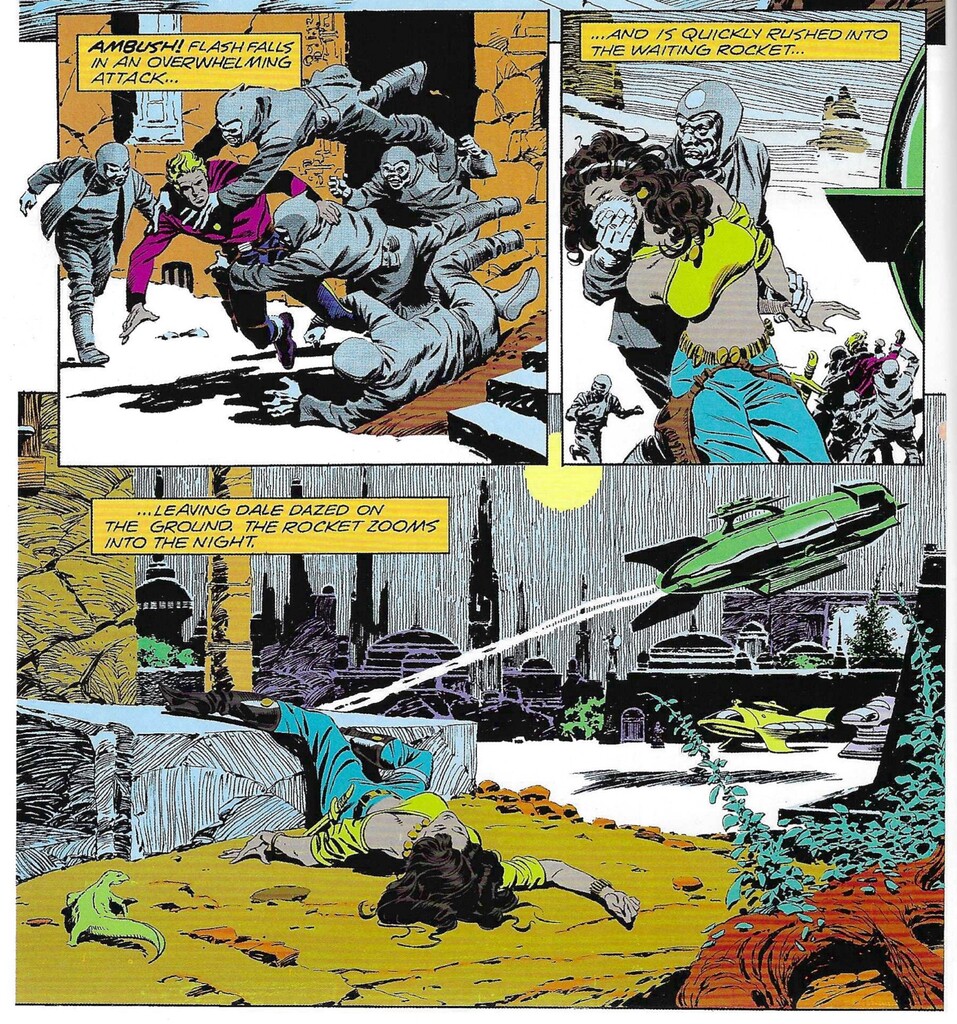
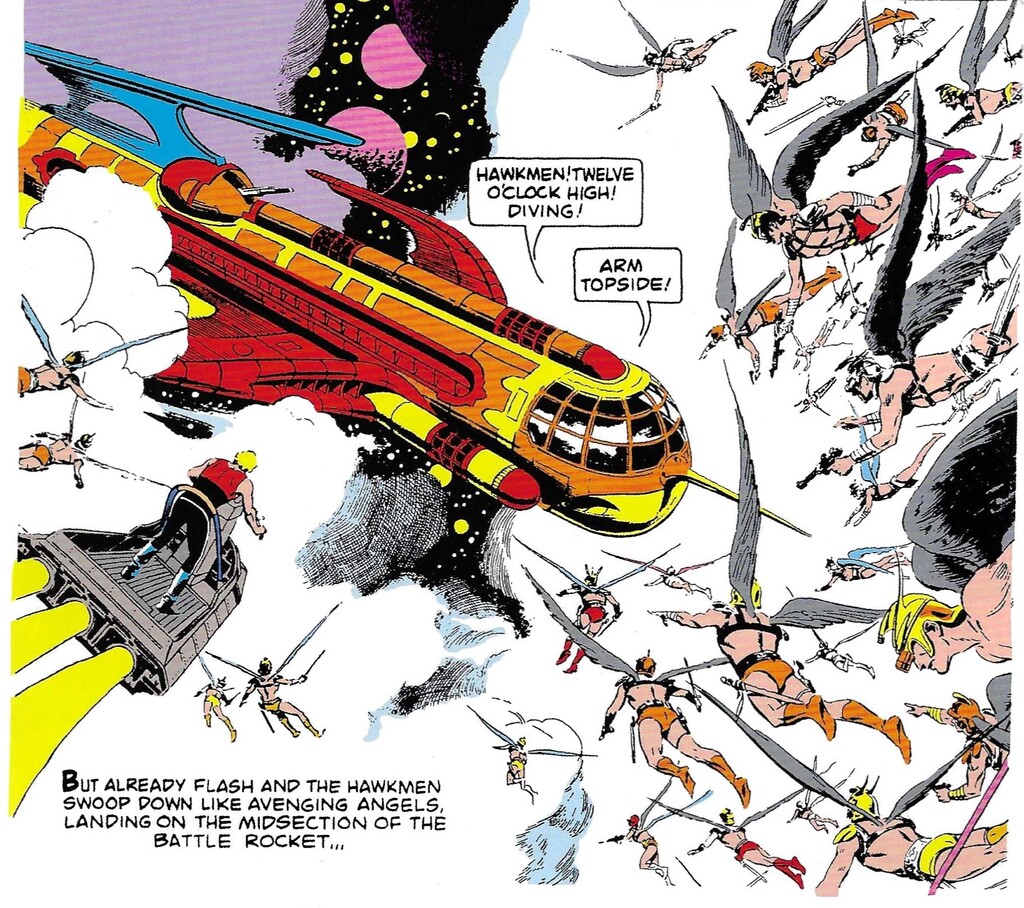
By 1995, Williamson was in his 60s and had been primarily an inker for several years (he’s one of the reasons why Daredevil in the late 1980s and early 1990s looked so good), and Mark Schultz notes in his introduction that it was Tom DeFalco who convinced him to return to penciling, which he would only do, it seems, to work on Flash Gordon again. His work on the Special, 15 years on from the movie adaptation, shows that he hadn’t missed a step (and perhaps inked himself throughout), because his work on this comic is marvelous. It has that gorgeous thin line for which he’s famous, with light and judicious hatching that adds texture with being overbearing. His use of blacks is amazing, creating deep shadows that add a creepiness to the gloriously weird world of Mongo, while Roberts’s vibrant colors off-set them nicely. Williamson gets to design wonderfully oddball creatures and he does an excellent job with the marvelous machinery and architecture of Mongo, while contrasting it nicely with the faux-medieval sections of the city. His women, naturally, are gorgeous as well, because you can’t do a 1930s pulp science fiction story without beautiful women inexplicably wearing far less clothing than they probably should! This is almost Peak Williamson, and it’s nice that he could still do such amazing work at 63, and it’s a nice cap to an excellent career (Williamson kept inking into the new millennium, but he penciled very little after this).
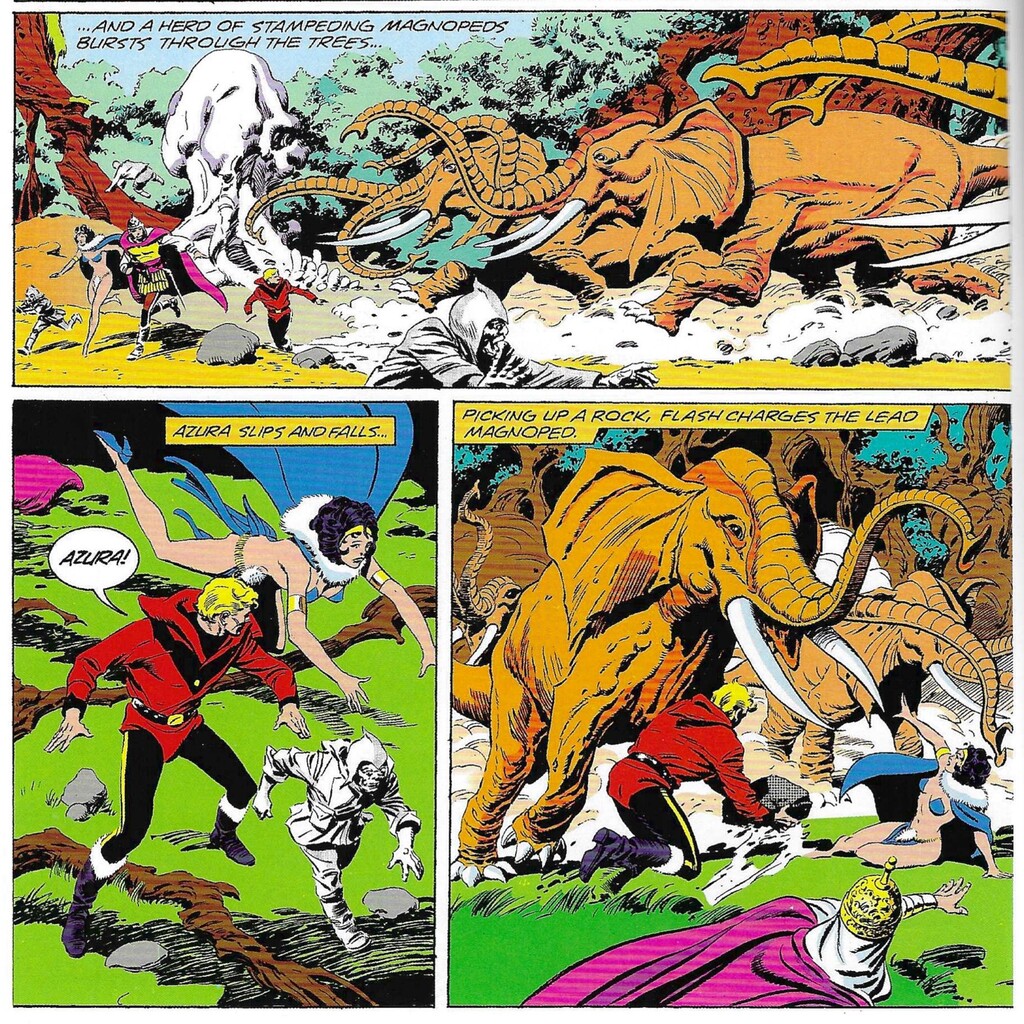
Now, some people will tell you that writing is more important than art in comics — they’re wrong, but they’ll tell you that — and if you’re one of those misguided folks, I can’t say these comics are really for you. The Special is certainly a lot better and more fun than the movie adaptation, but neither of them sets the world on fire with the writing. If, however, you’re one of those right-thinking people who relishes a chance to see Williamson’s art, no matter where it is, then these are cool books to have. They show an artist in complete control of his talents and abilities, working on a character whose world demands the skills that Williamson brings to the table, and they’re both very keen to see. If you have to choose one, definitely go with the Special, but both are very cool examples of a brilliant kind of comics art that we don’t see too often anymore, which is kind of a shame. Check them out!
Rating (for the movie adaptation): ★ ★ ★ ★ ★ ★ ☆ ☆ ☆ ☆
Rating (for the 1995 Special): ★ ★ ★ ★ ★ ★ ★ ☆ ☆ ☆

Was also tempted by these for that sweet sweet Williamson art, but as you said, too pricey! I’m not a big enough fan of Flash Gordon to go for it.
Yeah, I wish they had been slightly less money, but Mad Cave wants to milk the license!!!!
That is some very pretty art. A shame our library doesn’t have it.
It’s Brian Blessed, not Blessing. Now he’s going to come and shout at you!
I bought the Marvel books, as they came out and got the movie adaptation, later, as I figured it was going to be a similar mess as the Buck Rogers adaptation (that one looked like the artist had no reference whatsoever to anything but a Starfighter, Twiki and Dr Theopolis). I did see it later and was amazed that it was Al Williamson. Personally, I would have liked it to have been Al Williamson and Carlos Garzon. Their work on Star Wars was spectacular and Garzon had been working on the Gold Key/Whitman Flash Gordon series, prior to the movie adaptation (which was run across issues #31-33, as well as a single volume in hard and softcover) Western (the people behind the whole Gold Key/Whitman comics line and the Whitman coloring books and puzzles) got the license for Flash Gordon in 1978 (maybe 77, but the revived series began in ’78) and set about reintroducing old favorites. Ming is deposed, but returns to power within Mingo City, while the others rule their kingdoms. Barin and Aura have a son, who Ming covets, as his heir. It brought in a lot of the classic characters from the Alex Raymond days, Like Queen Fria and her consort, Ronal. #24 was my favorite, as Ming holds a tournament and Flash travels there, incognito and gets into trouble. Garzon did the solo art; but the pairing of he and Al would have made the movie adaptation better. John Warner scripted and he did an excellent job, across that series.
Bruce jones later took over writing the Flash Gordon newspaper strip, with art by Ralph Reese (and Gray Morrow, on occasion), at the start of the 90s.
In terms of the cinematic Flash, the best adaptation is still the Filmation features, Flash Gordon, The Greatest Adventure of All, which takes Flash from the bombing of Warsaw, in 1939, to Mongo, through the major kingdoms until he defeats Ming. It was a complete story. NBC loved the footage so much that they ask for a cartoon series and Filmation used the movie footage to craft the first 4 episodes (or so) and then reused scenes for later episodes. the series launched on Saturday morning before NBC aired the feature, in prime time. The cartoon series starts with the Earthlings in orbit around Mongo and only the opening titles hint at how they got there. The feature includes a sublplot that Ming was supplying advanced weaponry to the Nazis, as you see him viewing a Nazi rally and looking at a model of the V-2, with the swastika on it. Alex Ross later adapted this in his Flash Gordon: Zeitgeist, at Dynamite.
I wanted to pick up the Flash Gordon special but again it was far too expensive for the page count.
Maybe when it gets discounted on Amazon or eBay, then I’ll buy it.