

“We hate each other ’cause that’s what our parents taught us, we hate each other for no reason at all”
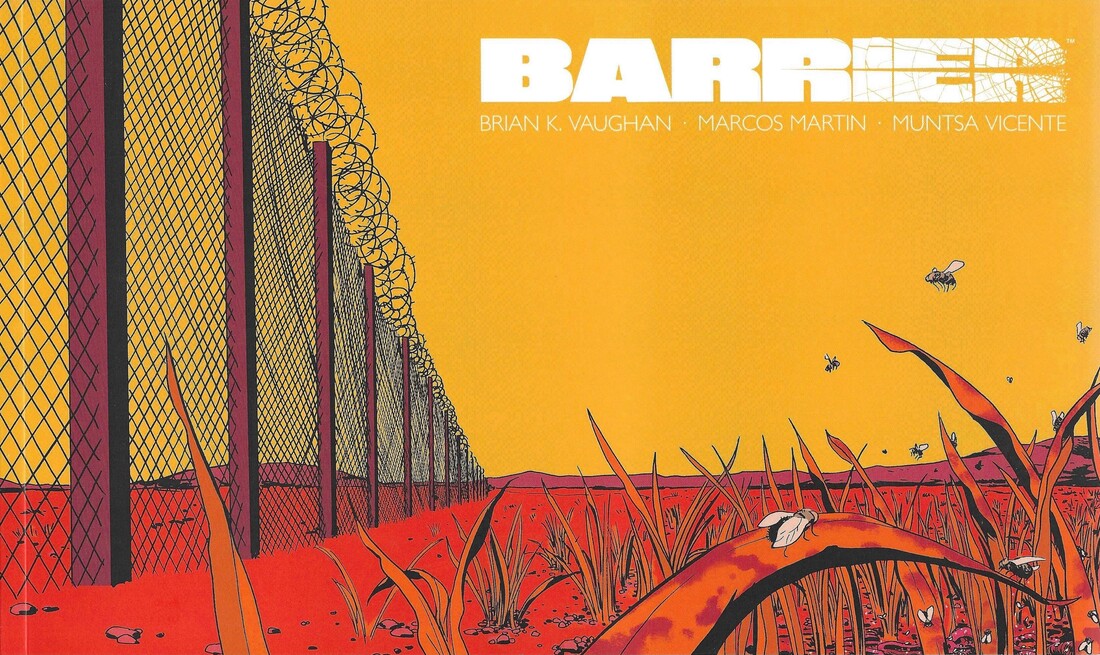
Back in the day, Brian K. Vaughan, Marcos Martín, and Muntsa Vicente did Private Eye (which, famously, they claimed would never be collected … until it was), and now they’re back for another crack at a landscape-oriented comic with Barrier, which is from Image, costs $19.99, and is 173 pages long. It’s also almost a decade old, so I guess they really didn’t want to collect this, either! Plus, if you think you’d be getting a Brian K. Vaughan book without some graphic sex in it, well, you might be disabused of that notion!
There are a few things notable about Barrier. One, of course, is the format — it’s landscape-oriented, which is fun but always is a pain in the butt to actually read. It does allow Martín to do some cool stuff with the art, but, of course, limits him in other ways, too. The biggest selling point, I guess, is that a good chunk of the book is in untranslated Spanish. Oscar, one of the two protagonists, is Honduran, and he speaks no English. He ends up on a ranch in Texas owned by the other protagonist, Liddy, and the two of them are abducted by aliens and taken far, far away. And they can’t really understand each other, so that’s a problem. I will discuss this language barrier (hey, there …) in a moment. First, the best reason to get this book:
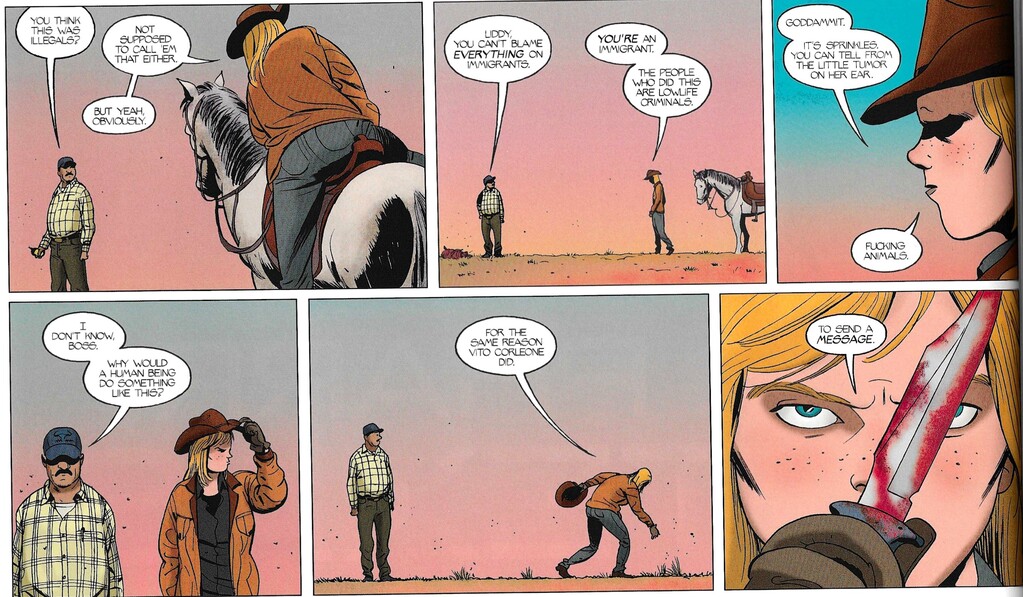
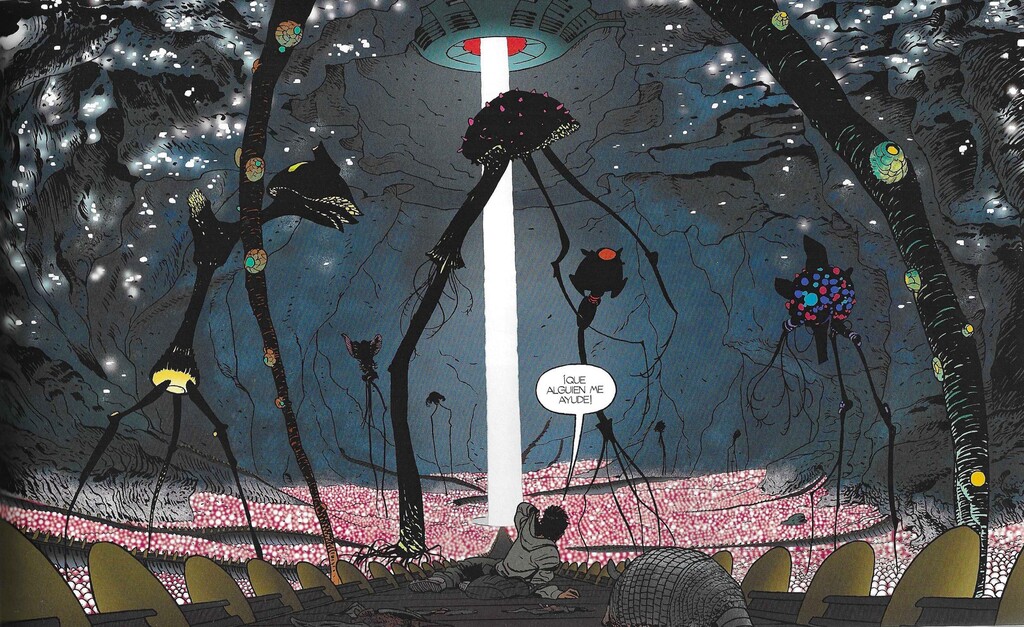
Martín’s art. I mean, we know Martín is a terrific artist, and he really shines here. He has that gorgeous but sturdy thin line that gives everything heft without being messy, and it works perfectly in the rough lands that Liddy oversees and the rough places Oscar travels through to get from Honduras to Texas. His characters are always sharply delineated, yet his judicious and spare hatching gives them just enough texture to add great emotion to their personalities. He draws people “normally,” meaning that they look like actual humans — Oscar is a bit leaner because he’s had a hard life and hasn’t always had enough to eat, while Liddy is still svelte but a bit more rounded than Oscar, as she has always known where her next meal is coming from. She’s naked in a few panels, and Martín draws her like a normal woman, which is nice to see. The other people in the story have a variety of body types and faces, and Martín is good at them all. Where he really goes nuts, though, is when Liddy and Oscar are abducted. The spaceship is odd and foreboding, seemingly carved from a planetoid, and it feels alien, which is a good vibe for the book. The creatures on the spaceship are terrifying, as they’re meant to be — the “worker bees” are long and spindly, with plant-like sprouts that shoot vile liquid and jagged teeth hiding among thick, almost sensuous leaves (in the backmatter, Martín shows some of the plants he used as models and he extrapolated from there). His main aliens, the two who run the ship, are brilliantly hideous, rising from trunks into branch-like structures that resemble rib cages, dotted with barnacle-like encrustations. They’re intelligent, but they can’t communicate with our human heroes, who of course recoil in fear and disgust from them as they’re pushed to the brink. Martín and Vicente work well together to make the book a colorful delight — when the vessel almost vibrates through space, the effects are wonderful, and the vibrancy of the colors on the ship are in stark contrast to the mundane and often dull coloring of the Earth scenes. Everything feels heightened and eerie on the ship, as Vicente uses regular colors, but in such a jarring way that it works on our senses as well as Martín’s creepy creatures do. It also stands in contrast to what happens on Earth. Oscar and Liddy are fighting for their survival in both places, but in space, it feels more like a gritty-yet-still-adventurous Flash Gordon story. On Earth, the stakes might not be higher, but the emotional toll feels more pronounced. The artists make that clear in the way they present the material.
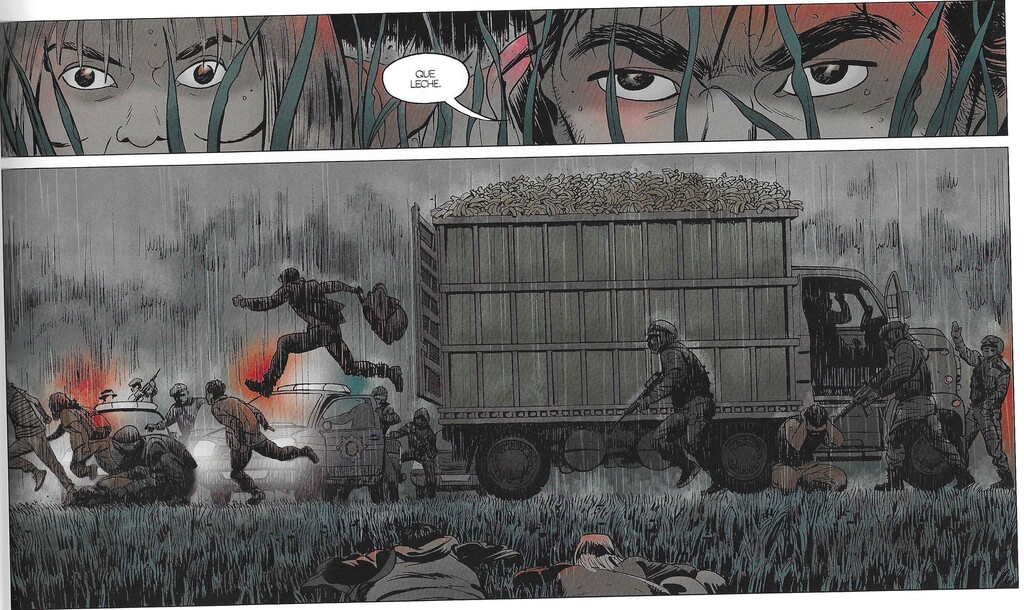
Vaughan doesn’t really have much heavy lifting to do, as this isn’t the most complicated story. Liddy believes gangsters from south of the border are moving onto her land, but, of course, it’s aliens. Oscar wants to get to Los Angeles, but he ends up on Liddy’s land (he’s only about 1500 miles off), and she finds him. Before she can shoot him, they’re both taken. They have to work together to get back to Earth, but, of course, they can’t understand each other. I would think that as someone who lives and works by the border and presumably has come across many, many Spanish-speaking people, Liddy might know a bit more of the language, and I would think as someone who lives on the planet and isn’t 90 years old, Oscar would know a bit more English, but such is life. Vaughan has his gimmick, and he’s going to use it! Liddy and Oscar manage to figure some things out about the aliens that help them, and eventually, they’re able to communicate a bit with their captors. We find out some things about their pasts that we could probably figure out, and then … well, that would be spoiling, wouldn’t it? Do they ever get back to Earth? You’ll have to read the book to find out!
There’s nothing wrong with the writing in the book, even though it’s not the best part of the comic. The title is fraught, as we might expect, and Vaughan pushes its meaning (without calling attention to it, which is nice) a lot. Obviously, this is a border story, but every character has barriers between them, from the language problem to the species problem. As we learn a bit more about the characters, new barriers become apparent. It’s fine, because, as I noted, Vaughan never has anyone state anything about it, but it is very evident, if you’re not in the mood for that sort of thing. In a story not about sex at all, Vaughan manages to get one extremely graphic sex shot into the book, which is very weird. Finally, Vaughan doesn’t have the courage of his convictions. The whole point of the story is that Oscar speaks no English and Liddy speaks no Spanish, but at a very crucial point in the narrative, Oscar and the Hondurans around him all speak English. It’s very frustrating, because Martín actually does a pretty good job letting us know what we need to know, and if we miss some of the nuance of what the characters are saying, that’s kind of the point of the book, ain’t it? I also get how it happens — it’s not just Vaughan choosing at that moment to “translate” what they’re saying — but that doesn’t mean I have to like it. I don’t know much Spanish at all, and it was kind of fun to go through the Spanish and see some words I knew and try to figure out what’s going on through looking at the pictures (it is, the last time I checked, a comic book) and using context clues. Vaughan chickens out at the last moment, and it’s a bit annoying. Maybe it’s just me.
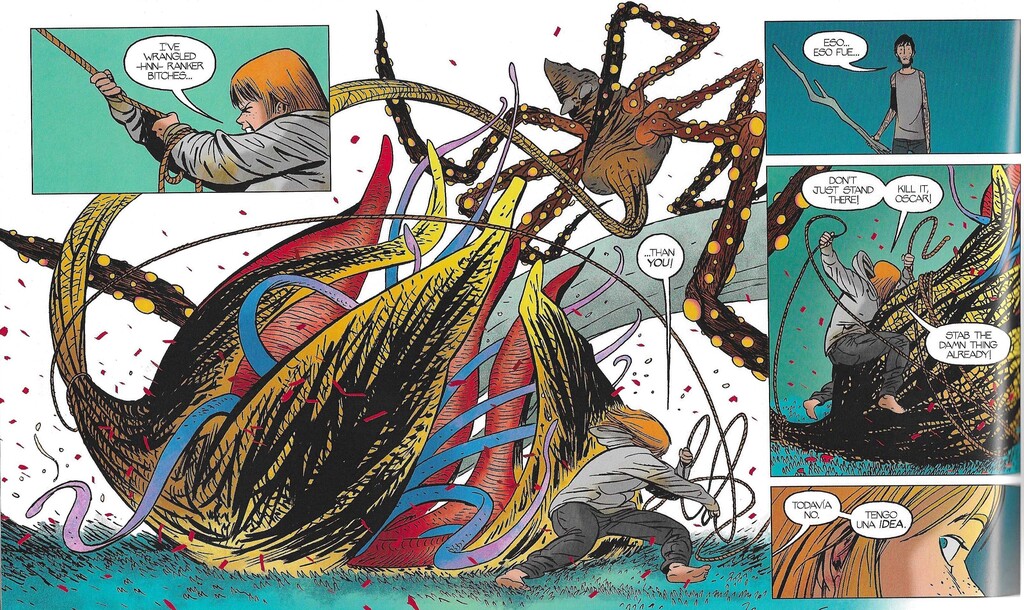
Barrier is a cool alien abduction story that (shocking!) has parallels in the real world, like all good sci-fi should have. It doesn’t quite rise to a masterpiece because Vaughan doesn’t do enough interesting stuff with the story, but it’s still a good, entertaining, interesting read. It’s a gorgeous comic, too, which is a big draw for me, at least. I wish it were a bit better, but that doesn’t mean it’s not a cool book!
Rating: ★ ★ ★ ★ ★ ★ ★ ½ ☆ ☆

Just finished reading this myself. Martín’s art is absolutely terrific, as usual. I like the central conceit, and I know enough Spanish to make it through those scenes. But I don’t know enough Spanish to know if the Spanish dialogue is as formal as it looks to me. I guess “que leche” is slang, but I don’t catch as much slang or cultural references as I do in the American dialogue.
This goes to some weird places I didn’t expect. Overall solid. What’s not solid is the book construction. As a very widescreen TPB, it’s awfully floppy, and I don’t know how I’m going to store it.
I’m just going to store it on my bookshelf in the “B”s, but I agree that it is very floppy and difficult to handle. Stupid landscape format! 🙂