
“I can cure the hunger that burns in your heart”
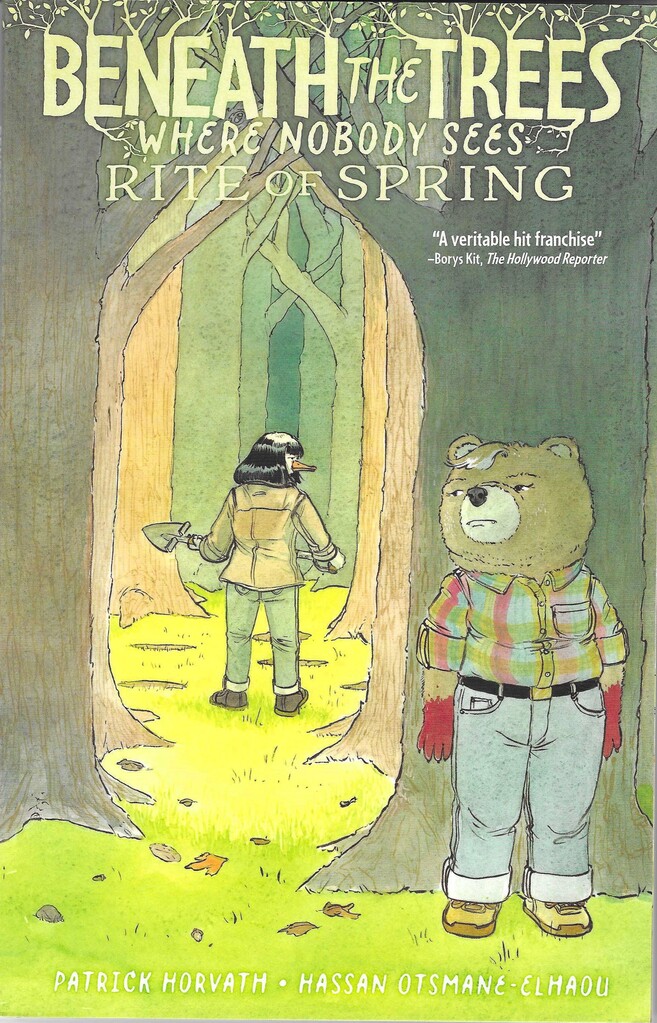
Patrick Horvath, who writes and draws, is back with a second volume of Beneath the Trees Where Nobody Sees, which is lettered by Hassan Otsmane-Elhaou and edited by Alonzo Simon. 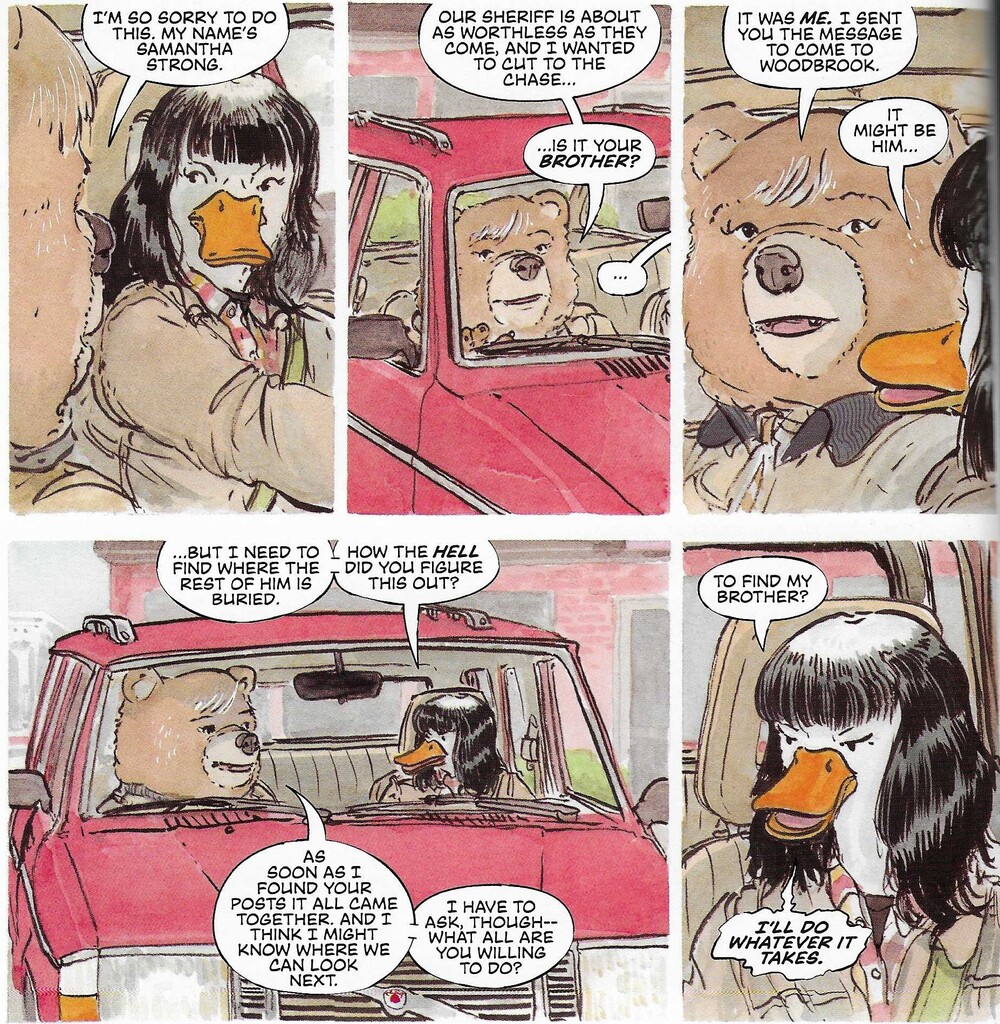 It costs $19.99, it’s 120 pages long, and it’s from IDW.
Two years ago, when I reviewed the first volume of this story, I did not write a lot about it because it came out in September 2024, and I was going through some things at that time. I did like it a lot, but I just didn’t write too much about it. So, when Horvath decided to do a second volume, I was on it, but this is a bit disappointing — it’s still a very well-done comic, and the art is exquisite, but … I’ve mentioned this before with regard to stories about serial killers: I don’t love writers making them, well, gods. Sure, serial killers can be interesting characters in fiction, but writers become really enamored with them, and Horvath really digs Samantha, his ursine killer. I mean, there’s not even much depth to her — she’s a psychopath who just likes killing and doesn’t really care who she kills. Horvath pretends that she cares about her small town and the people in them and goes far and wide to find victims because she wants to protect her town, but after this volume, he can’t really pretend that anymore.
Horvath does move the story forward several years, into the mid-1990s, and we get Monica, who’s the sister of the duck from the first volume, who’s been “missing” for 8 years. Monica hasn’t given up trying to find Daniel, and her life has kind of atrophied because of it. She has very little hope, but through the magic of the internet, she connects with someone who might have information about her brother. 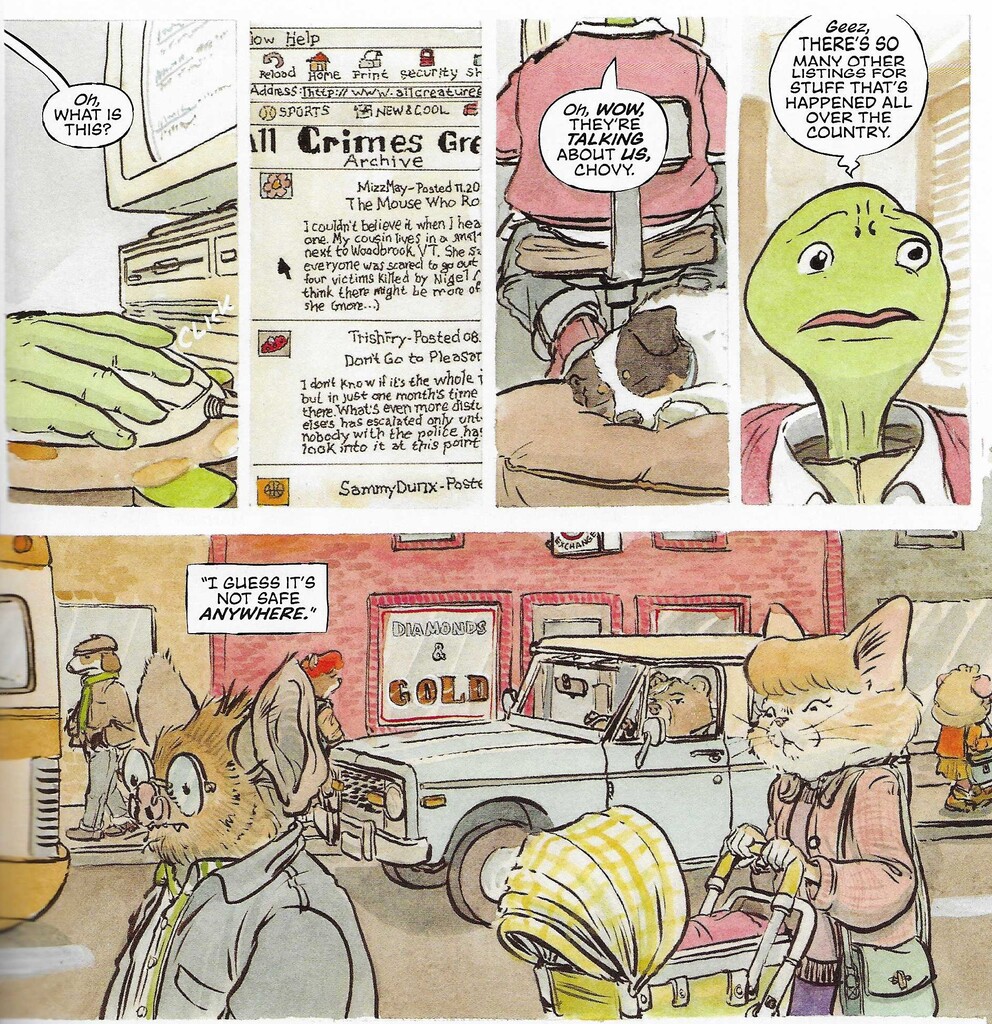 She heads off to the country, where she meets … oh dear, Samantha, our cheery serial killer. Samantha narrates that the internet has made her “job” harder because she has to work harder finding victims in this new world, but then she finds message boards and realizes there’s an opportunity here, and she lures Monica to her town and starts messing with her head. Horvath does a nice job showing how increasingly desperate Monica gets and how far she’s willing to go, and that’s actually kind of interesting — Samantha keeps pushing Monica to more extreme things, and she’s enjoying it as Monica does it, and it’s quite sad because Monica has completely divorced herself from reality in order to find her brother. That part of the book is good — Horvath gets into the way serial killers destroy not only the victims, but the families of victims, as Monica’s life ended when Daniel disappeared. Horvath also gets into what the internet can do to us — I always like when writers who use the internet a lot write about how vaguely evil it is — as one character discovers the internet and thinks it’s amazing, but as the book goes along, he realizes that getting out of the house occasionally isn’t too bad a thing. Meanwhile, there’s also some criticism (it seems) of over-medicating people, even though the person who is over-medicated seems to really need it. The theme of the book seems to be disconnectedness/connectedness and its consequences, which isn’t a bad thing to write about, and Horvath is good enough that he creates some very interesting characters and gives them interesting problems. When Horvath focuses on those themes, the book is quite good. But he can’t escape Samantha and her killing, and that’s where the book is a bit weaker. Samantha is kind of a blank slate, and when she begins to mess with Monica, we get a much flatter narration, even if Horvath tries to reveal some of her personality in it.
 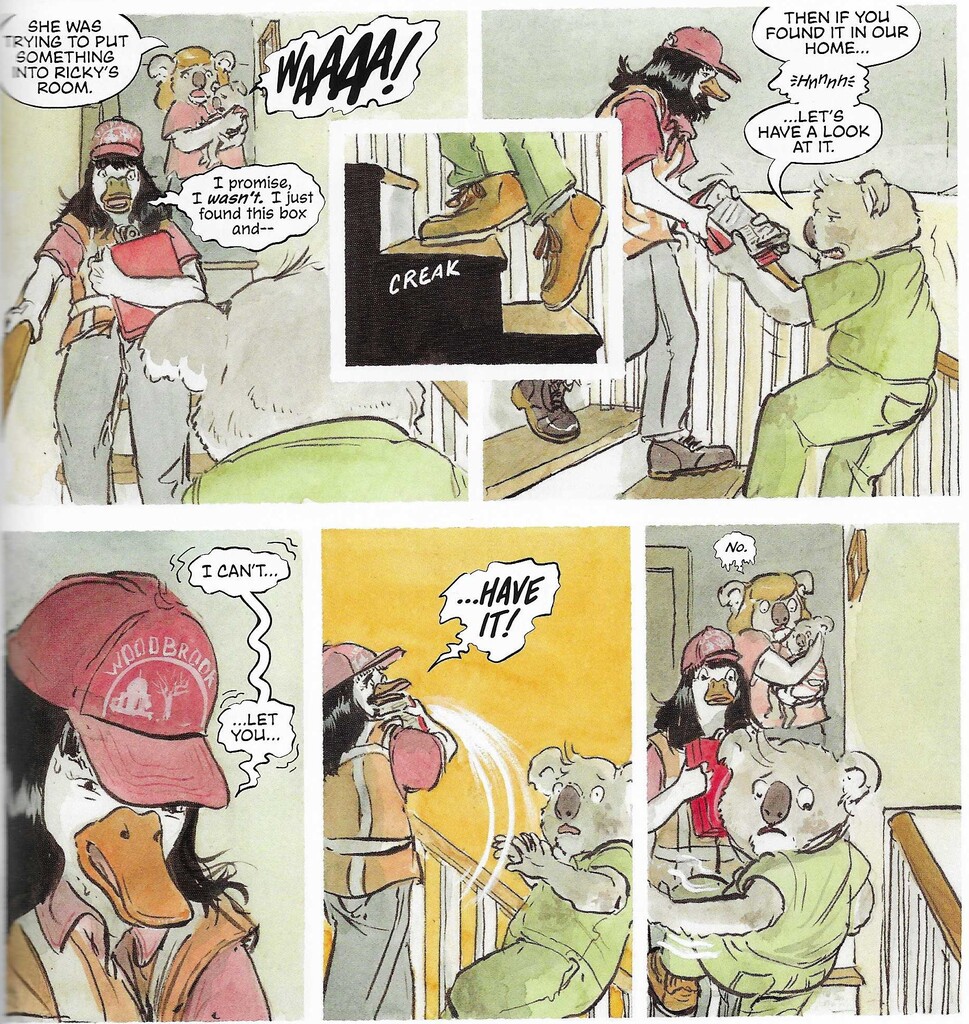 She has no personality, though, because she’s a psychopath, so it’s very clinical and doesn’t quite work. And, of course, she’s a supervillain — she anticipates everything, and it makes the story’s climax a bit boring, because it’s clear Samantha is a supervillain in a world of regular people, so she’s prepared for literally anything that might happen to her. In some stories in which the bad guy anticipates everything, it feels ridiculous, but it doesn’t here — Samantha definitely would be prepared and have the time to do what she does — but that doesn’t mean it’s good, because Samantha is such a horrible bear that I, for one, wanted her to die horribly, but Horvath is far too in love with Samantha to do that (I’m not going to say whether she actually dies, but she does not die horribly, is my point). I don’t get this fascination with serial killers, especially because usually the creators go out of their way to ignore any reasons they might be killers — they’re just psychopaths who like to kill. Samantha is a fairly dull character, because she’s just a killing machine.
Horvath’s art is very nice, though, and that’s another reason this is a fairly worthwhile comic. He uses anthropomorphic animals, as we know, but that’s not the only reason it feels like he’s channeling Juanjo Guarnido, the artist of Blacksad, as Horvath uses beautiful brushwork and watercolors to create his world. This makes the animals’ fur lush and thick, which works really well, and the colors are soft and comforting, which shifts the tone of the book nicely to a more bucolic feeling, belying the evil lurking in the town. The warmer colors contrast nicely with when the blood shows up, as the hotter hue pops well against the softer colors. 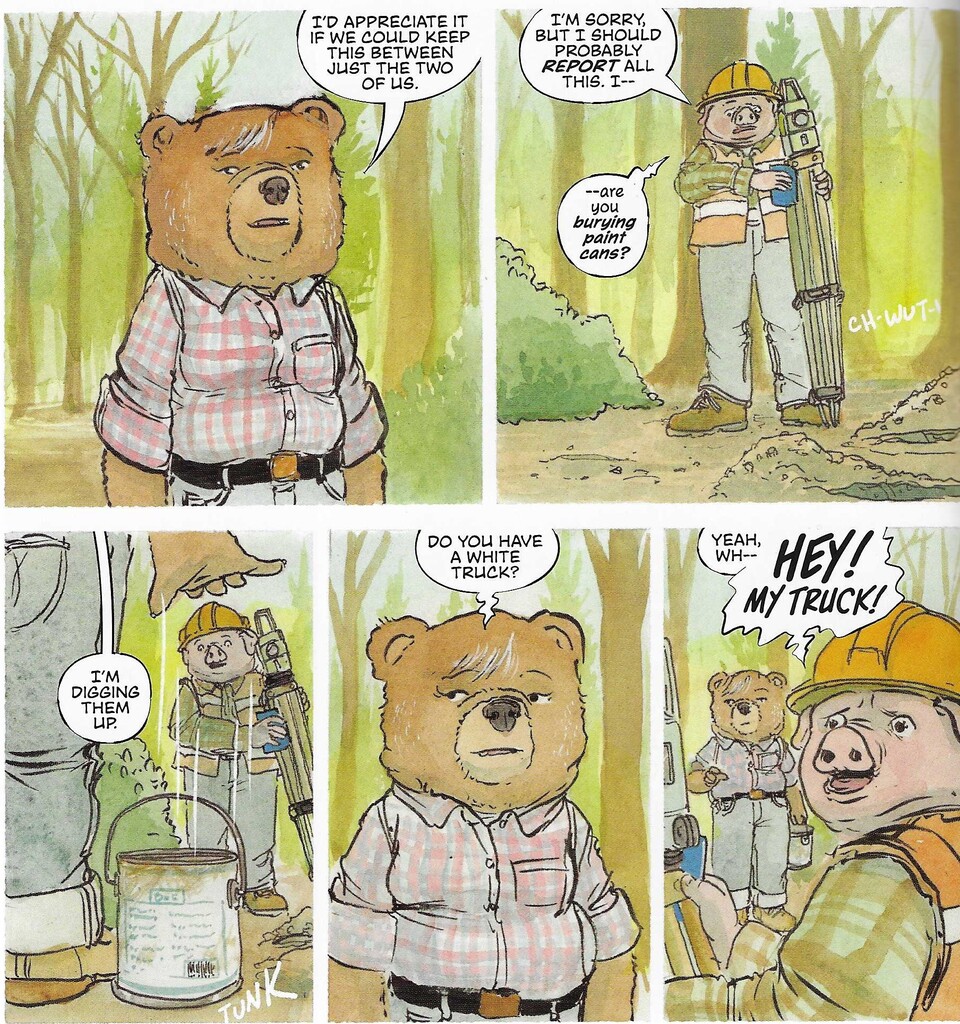 He also does a marvelous job with Samantha, as her face is usually blank as she constantly assesses, and when Horvath does give her expressions, it definitely feels (and looks) as if she’s trying hard to come up with appropriate reactions. He’s quite good at the gore, too, as the anatomy looks very precise and therefore even more disturbing — there’s not a lot of it, but it’s very effective. Horvath creates a wonderful small town, full of interesting characters who have distinctive looks — each animal fits the stereotype we have of the animals without being obnoxious about it, which is, it seems, what artists are going for when they anthropomorphize animals. In particular, he really nails Monica’s despair and desperation, which leads her to such dark places. She doesn’t hide her emotions well, which allows Samantha to play her like a violin. It’s a very good contrast to Samantha’s faux-friendly demeanor.
I liked the first volume better, mainly because my “serial killer fatigue” hadn’t set in yet and I thought that Samantha might be a more interesting character than just a generic serial killer. In this volume, it’s revealed that she’s really not, so while it’s a bit fun to read how well she lives with this secret, it’s also annoying because so many other people have to be, well, complete idiots. It’s still a decent series, but it’s just not quite as good as volume 1. But that’s just my opinion, man!
Rating: ★ ★ ★ ★ ★ ★ ★ ☆ ☆ ☆

The first volume was my favorite comic of whenever that was, and this one is also very good. Both of them lulled me into a false sense of security before pulling the rug out. It’s not just the bucolic Richard Scarry art and environment. We keep thinking Samantha is more like a Dexter– yes, a serial killer, but also ostensibly the ‘hero’. She’s our POV character, we are led to believe she wants to preserve the status quo, but it keeps surprising me how inhuman she is at each turn. This volume goes to some wild places.
Almost everything that happens here is fallout from the first volume, most of it leading to worse places for the characters. Except for the turtle guy. Good for him.