
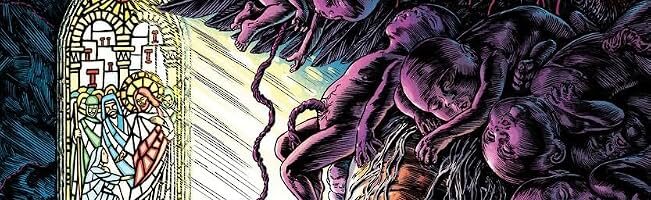
“Here on the ground, we’re reckless and hopeless, damned by the slip of a pen”

Storm King Comics, which is something that John Carpenter is involved in somehow (possibly he just lends his name to things, although Carpenter seems like someone who likes to get involved, so maybe he’s in this a bit more than we might expect), does some decent comics and some that seem not good at all, and this latest one, Chaplain, is a pretty good one. 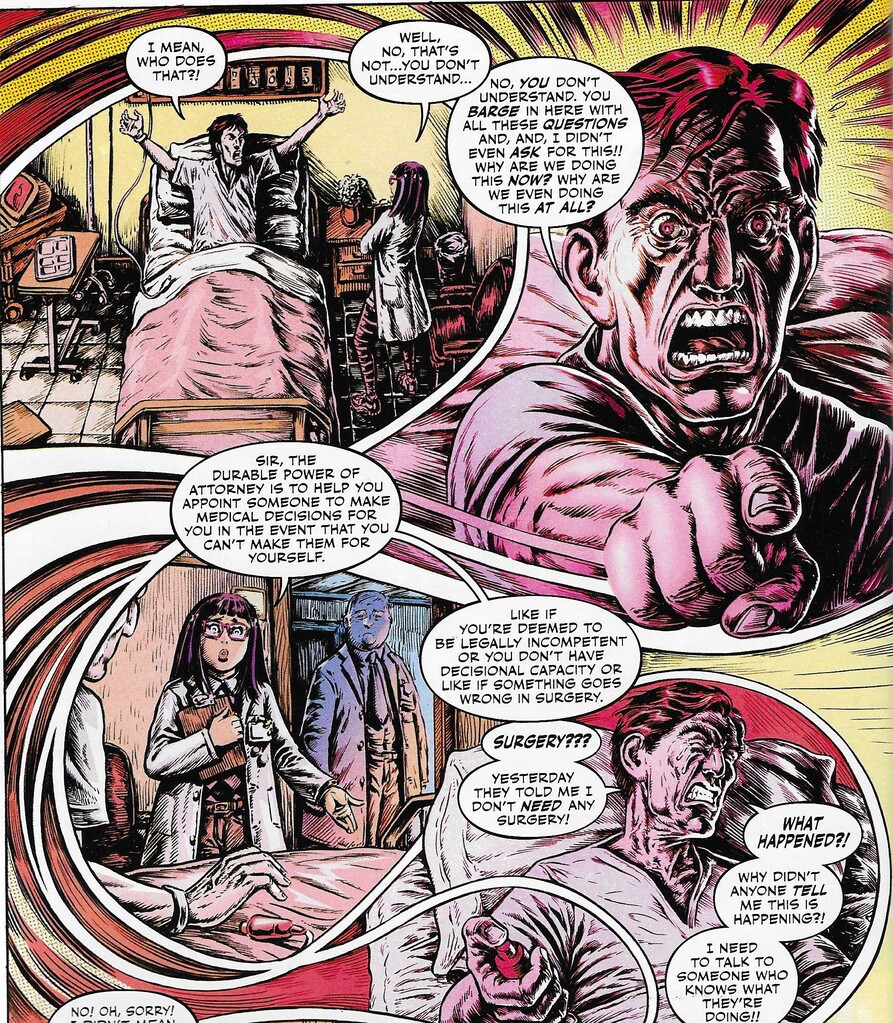 It’s by writers Brad and Wesley Sun (Wesley is a minister, so this seems a bit personal to him), artist Raúlo Cáceres, colorist Ryan Winn, letterer Marshall Dillon, and editor Sandy King (who’s the co-publisher of the company). It’s a bit spendy at $24.99, but it is 151 pages long, which is a bit longer than your standard trade, so that’s nice.
The book is set in a hospital, but what kind of hospital is a bit ambiguous — it seems often like a regular hospital, but there’s also a lot of seeming psych patients there, which doesn’t make it an exclusively psych hospital, but it does seem the lines are a bit blurred. It doesn’t really matter — our chaplain, Charlie (and yes, they do make a macabre joke about “Charlie the chaplain”), has a new protégé, Maria, and he’s trying to train her as a chaplain while trying to decide if he wants to retire. Maria is queer and Filipina (“half-Filipina,” as she says) and young, and she doesn’t quite know how to minister to the patients, but Charlie is trying to give her guidance. The patients range from fairly mundane to very strange, and Charlie tries to comfort them the best he can. It seems that he can see ghosts, maybe, although it’s always unclear whether he can see these things or if they’re his imagination, but he sees ghosts, which actually seems to help him be a better chaplain.  Maria, on the other hand, doesn’t quite have the hang of it, until she begins to speak about her own cultural history, which brings in Filipino monsters, something you probably shouldn’t talk about to, you know, the kids in the ward. She believes that an aswang could be haunting the hospital, and, eventually, Charlie starts to believe it as well. Things get very weird and horrific, as you knew they would!
It’s an interesting look at religion and faith and how that becomes part of the world, as Charlie, early on, seems to have a handle on how to deal with these sad people, but once his world starts to spiral completely out of control, he can’t deal with it anymore. He begins to wonder if anything in his life really means anything and how he can get back to a sane place, and it’s interesting because, due to the early parts of the book, we’re not sure what’s real and what’s not. He experiences a lot of horrors, but what’s neat about them is that they all fit into the theme of the book, and as cynical as some of the latter part of the comic can be, the Suns never let it become too bleak, as it’s clear Charlie is moving toward something, whether it’s a good thing or not, and will have to deal with his inner demons to overcome it. They do a good job examining other belief systems, too — or the lack of them — as Charlie and Maria meet people who might not seek out a chaplain but still might need some kind of spiritual guidance. As both of them are having crises of faith, the book is a nice look at how different crises present themselves and how different people deal with them. It’s still a wildly creepy book — Wesley Sun, according to the bios in the back, has worked in hospitals, jails, and homeless shelters, so he has a lot of experience with wayward people and knows how to twist things into horrific shapes — but the Suns never let it become one that doesn’t offer some hope. Whether Charlie and Maria can find that is, of course, what the plot is working on.  There are a lot of interesting characters in the book, too, from Charlie’s boss, who seems a bit off in the beginning and only becomes stranger, to the patients and their visitors, who have their own problems. Again, as the horrors take over, these characters become more twisted, but because we get a good foundation earlier in the book, they’re not just horror cartoons. This is a creepy comic, certainly, but it has a lot on its mind, like the best horror usually does.
Cáceres has been a good artist for a long time, but he doesn’t do a lot of ‘Murican comics, and most of what he did was for Avatar, which isn’t a thing anymore (they’re still around, but basically just to sell back issues), so his profile in the States isn’t very high, I suppose. He’s very good, though, and he does a marvelous job on this comic. His Charlie is a soft, rotund, sad-looking dude whose presence puts people at ease because he looks like a human squishmallow, which is a good quality to have for a spiritual adviser, I suppose. He’s drawn as very passive, which is clever, as later, Cáceres begins to show his mettle, and it’s a nice transformation. Cáceres also does a nice job showing Charlie’s subtle mental and physical degradation over the course of the book, as his chin becomes scruffier and his hair — thinning at the best of times — becomes more disheveled. His Maria is a terrific ray of sunshine, with her star hair clips, big magenta glasses, and oddly-matched outfits, but Cáceres also does an excellent job showing the little bit of hollowness in her eyes as she tries to figure out how to function in the hospital. She’s certainly not a fake, but she hasn’t yet learned that you don’t need to be bright and sunny all the time, and once she learns that, she becomes more of a person, artistically.  Cáceres’s horror work is spectacular, as he can be incredibly detailed, so his monsters and such look fully realized — this book doesn’t need subtlety in its monsters, and Cáceres, in general, doesn’t do subtle, so there’s no half-seen hazy things here, just full-bore creatures exploding out of bodies and terrifying religious imagery. His creatures look slimy, which adds a nice tactile element to the art, and as Charlie’s visions become more horrific, the very hospital takes on a more oozing aspect, as if he’s trapped inside a body and the walls are muscles and organs, and it’s both nauseating and fascinating, as Charlie moves forward into a heart of darkness. He does marvelous stuff with page design, too, creating twisting, swirling panels that lead us (and Charlie) through a labyrinth designed to drive us mad, and he incorporates mundane things into the designs that become creepier because of the context — the page that looks like a fly is viewing the characters is one such example, but there are many. Winn’s colors are stunning, too — the temptation in a book like this might be to go darker, but Winn makes everything somewhat bright, making everything a bit sickening and manic, as Charlie’s world becomes more insane. The book is tremendously weird to look at, but it’s absolutely stunning, too, and the weirdness continues to lead you into bizarre corners of the art.
Chaplain turns out to be a very good horror comic, which is neat. It has a solid, humanistic heart at its center, and both the writing and the art keep that front and center even as things get very, very weird. I’ve never been exactly sure what John Carpenter is doing producing comics, and some of them that I’ve read haven’t been great, but this one is quite good. Check it out!
Rating: ★ ★ ★ ★ ★ ★ ★ ★ ☆ ☆
