
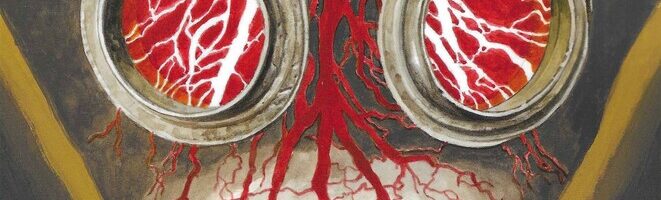
“Then one day they say the sky gave way and death rained down, and made a terrible sound”
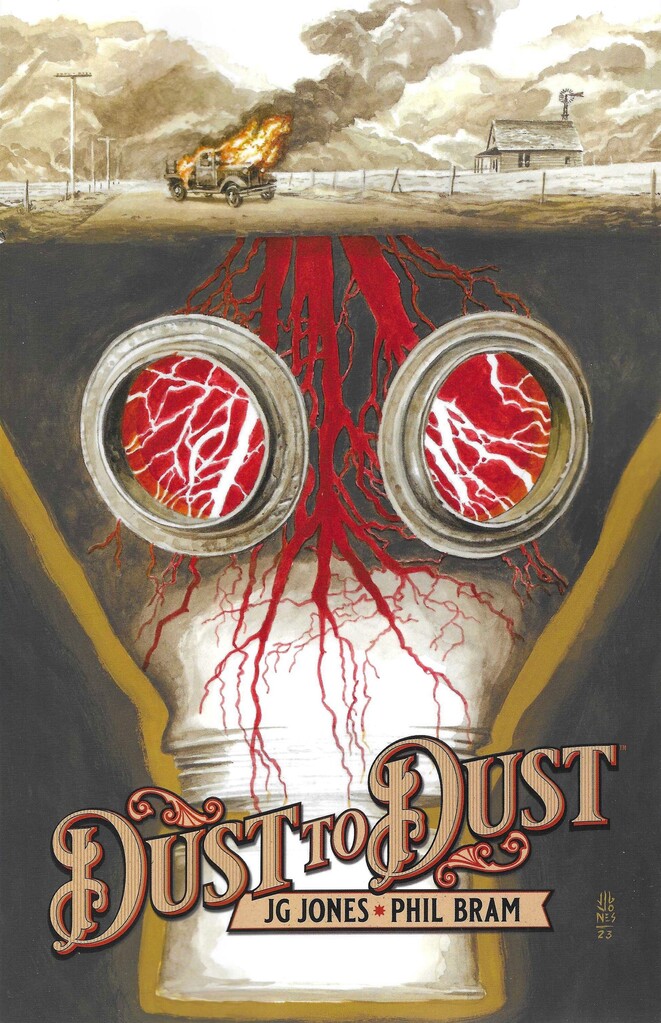
J.G. Jones is the big draw on Dust to Dust, as he arts it, of course, and co-writes it with Phil Bram (Jackie Marzan letters it, with Harper Jaten and Iván Brandon editing). 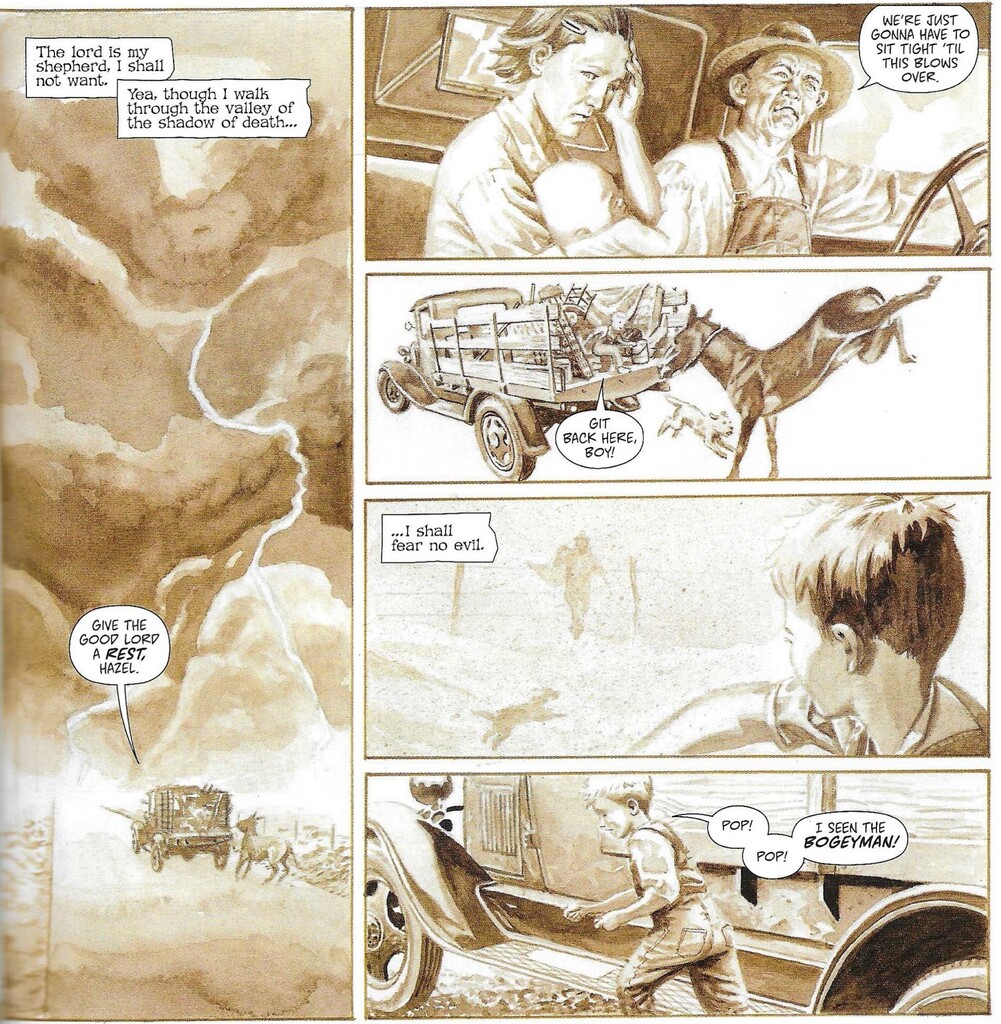 This is a nice big book, as it’s 176 pages long, and it’s priced to move by Image at $19.99.
I don’t know anything about Jones’s life, but from the few photos he posts in the back, maybe his grandfather lived in Oklahoma about the time this story is set (the 1930s, although we get two different years — 1935 and 1932 — so someone screwed up somewhere), and he got some ideas about doing this story from there? I don’t know, but it’s story set in the 1930s Oklahoma, and it feels like Jones has a personal stake in it. That’s all I can say.
Anyway, this is a bit of a mess, because it’s an Image book and not something from Drawn & Quarterly or Fantagraphics, so Jones and Bram have to add a thriller element when it feels like this would be a whole lot better without the serial killer. Oh, yeah, there’s a serial killer in this book — we’ll get to that. Anyway, Jones wants to look at life in the Dust Bowl (that’s why I think 1935 is the right date, because the drought hadn’t become horrific until 1934) in the Oklahoma panhandle, and he does that pretty well. We get people leaving for California, the inciting incident of the book (they do not, sadly, make it), and we get an alcoholic sheriff who has some PTSD from World War I, and we get a female reporter who’s trying to document the plight of the Plains farmers while pushing against the inherent sexism of the society in which she lives, and we have the Madonna/Whore issue when it comes to young, horny people, and we have the fundamentalist religion that always rises during bad times, and we have a bit about how black people are treated in 1930s America, and we have the petty local businessman/politician who wants power, for good or for ill, and we have the weather. It’s a lot, and for the most part, Jones and Bram do a pretty decent job with it.  But then they have to have a serial killer, and that throws the book out of whack a bit, and it isn’t quite able to make it a good comic. The serial killer dresses in a gas mask, so he (she?) is able to move through the storms and come upon hapless victims, and our hero, Sheriff Lawton Meadows (nice on-the-nose first name, there!), is trying to track them down even though the politician who runs the town is sure there is no killer. He and the reporter, Sarah Grange, are on the case, but it’s very difficult, considering they don’t have much evidence and huge dust storms keep coming through town, threatening to wipe them all out.
Here’s the problem: the killer doesn’t seem to have a real reason for killing, and that detracts from their rampage a bit. Plus, the focus on the killer takes away from the many other plotlines that are unspooling in this book, which is too bad. Plus, when we do find out the killer’s identity, we still aren’t sure why they went on a rampage, and it seems like Jones and Bram are saying that mental illness makes people killers (I know they’re not saying this, but it feels a bit too close to that). Plus, the pacing of the story feels off, so that the final issue feels very rushed, and it even looks rushed, as Jones starts using smaller panels to cram as much as he can into the issue. It feels like he came up with a killer, but then got interested in the other stuff in the book, until, in the last issue, someone reminded him that they should probably reveal who the killer is. “Whoops!” said Jones, and went back to the drawing board.
Now, the problem with this is that it’s a pretty good examination of small-town America in the 1930s, and it doesn’t really need the serial killer! 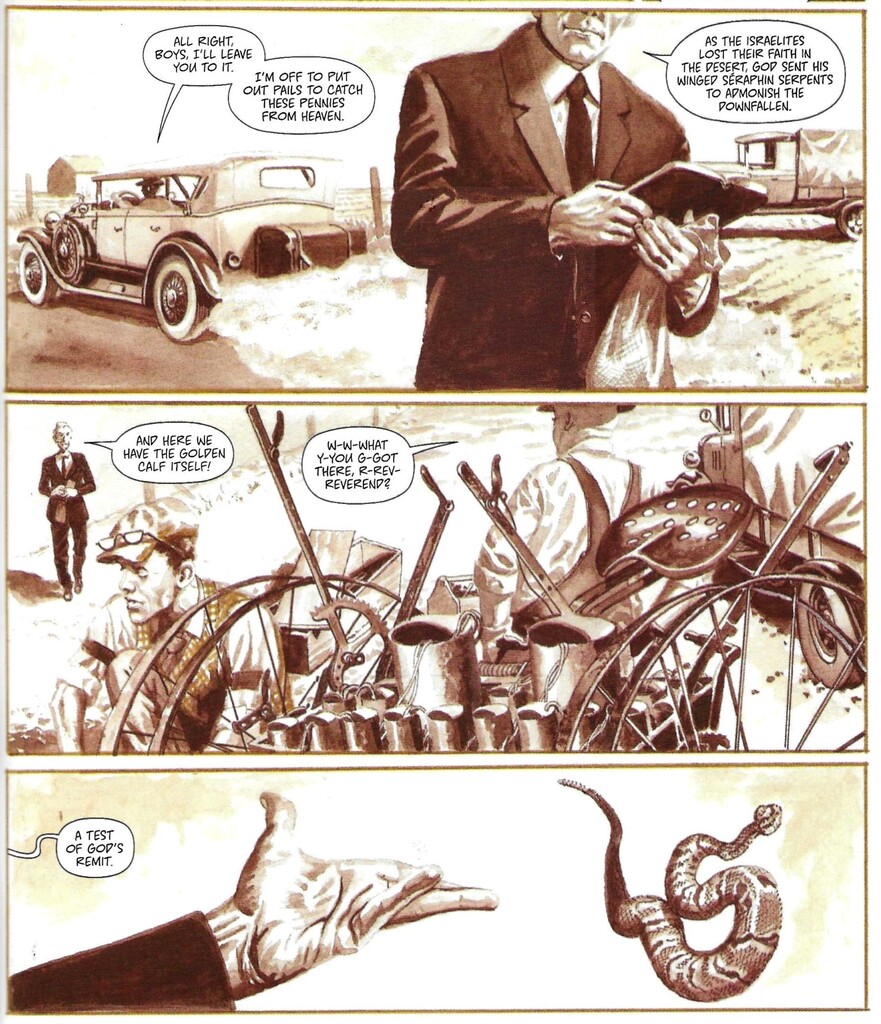 As I noted above, this is an Image book, not a book from one of those hoity-toity lit’ry publishers, so I assume Jones wanted to put some violence and blood in it, and I get that, but it’s too bad, because he and Bram take their time creating a whole host of characters and smashing them into each other. The sheriff is a decent man, brought down by the drink after a case a few years earlier went sideways on him, so the politician has something on him that he can use to bend him to his will. The politician’s daughter is engaged to a local baseball player who screams “douchebag” from the moment we meet him and then goes out and shows that he is, in fact, a douchebag. But the daughter — Jenny — and the baseball player do show a dichotomy in American society — Jenny has been taught to be chaste before marriage, while men are not held to the same standard, so what to do when you put two horny young people together and tell them they can’t, you know, fuck? Meanwhile, Sarah is bold and brassy, but she has to be in a male-dominated world, and it endears her to both the sheriff and Jenny, who sees her as a role model. The sheriff and the politician’s brother were both in the war, but the brother, Van, came back far more scarred than Meadows … or so we think, until we realize the sheriff is dealing with his PTSD in a different way than Van is. And, of course, there’s this sense that God is punishing them by sending these tremendous storms to wipe them out, and maybe they’re not wrong about that. In other words, there’s a lot going on, and it’s awfully compelling, as the pressure continues to get to these people and reveals who they truly are when the veneer of civilization starts to fall away. The killer really isn’t necessary, and it’s too bad they fumble it a bit, because it almost wrecks the book. Not quite, but almost.
Meanwhile, we get the art, which is the main draw of the book. Jones doesn’t do a lot of interiors anymore, possibly because he can make a good living doing other things and possibly because he’s slow. Whatever the reason, it’s always nice to see his interiors, and for the most part, he doesn’t disappoint. 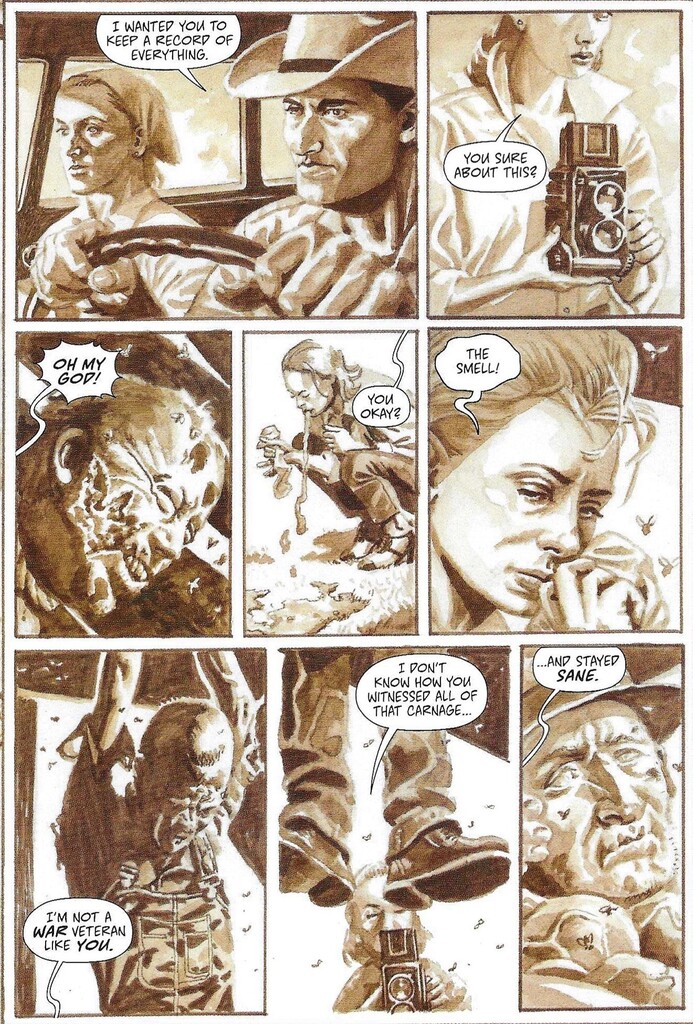 This is a beautifully rendered version of 1930s Oklahoma, and the sepia tones both place it in the past and in the bleak Dust Bowl world, and you can just feel the grit on your skin as you read this. The town of New Hope and the surrounding countryside (New Hope, I assume, does not exist, but the book is set in Cimarron County, which is the westernmost county in Oklahoma) is very nicely done, as Jones takes the time to fill in all the details, so we get a terrific sense of the isolation of the town as well as the fact that everyone would know everyone and rely on each other, even if they don’t like each other. Despite the fact that I don’t love the killer, the visual of a person wearing a gas mask and an overcoat is terrific and scary, so that part of the plot works. The violence in the book is generally kept off-page, but we see the aftermath, and it’s very effective, as Jones has a good sense of the creeping horror that attends the killer as they move through the town. The storms are done beautifully, too, as Jones gives us a wonderful sense of their power and majesty and terror as they bear down on the tiny humans in their path. Plus, Jones is very good at telling the story — even in the too-busy final issue, he has a good command of the layouts, so we’re always able to follow along even as things get frenetic. He uses models, though, and I’ve never loved that — I can’t tell who some of the “actors” are, but he uses Cate Blanchett for Sarah, and it’s a bit distracting, especially because it’s not consistent, so in some other places, she looks a bit different. His reliance on models leads to a couple of odd moments. First up is this panel:
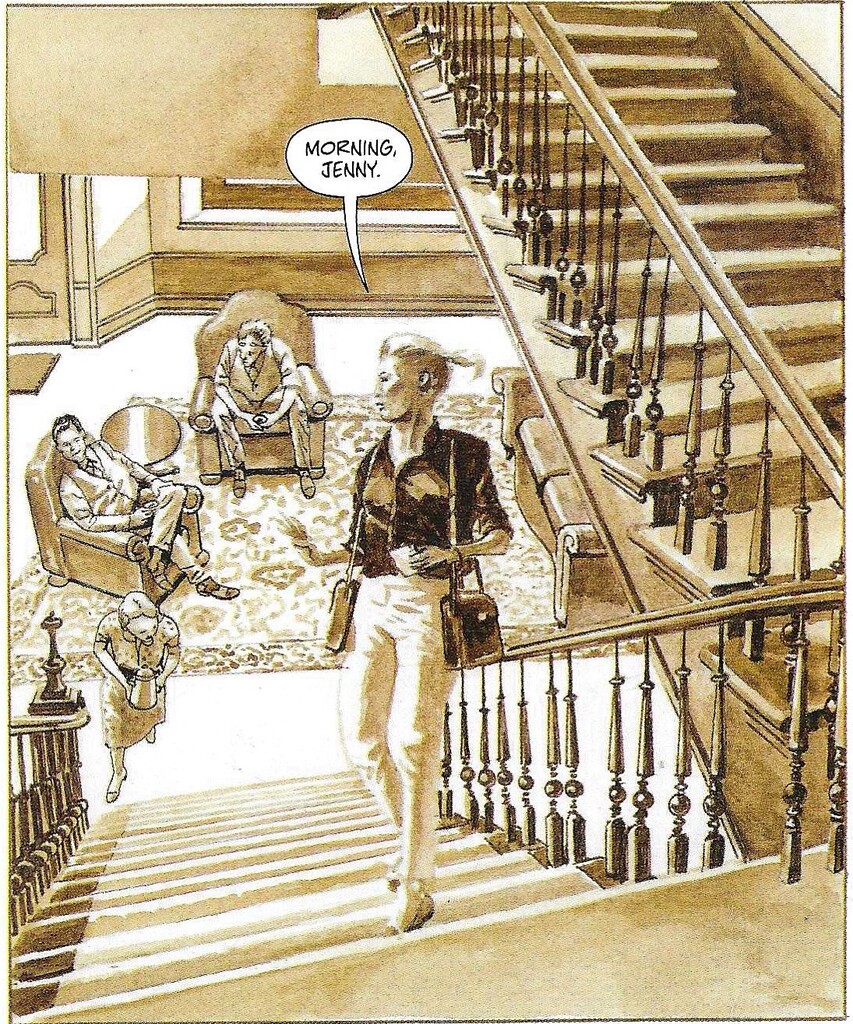
Sarah is coming downstairs, but that is not the way you descend a staircase. It’s strange that Jones would make that mistake. Next is this panel:
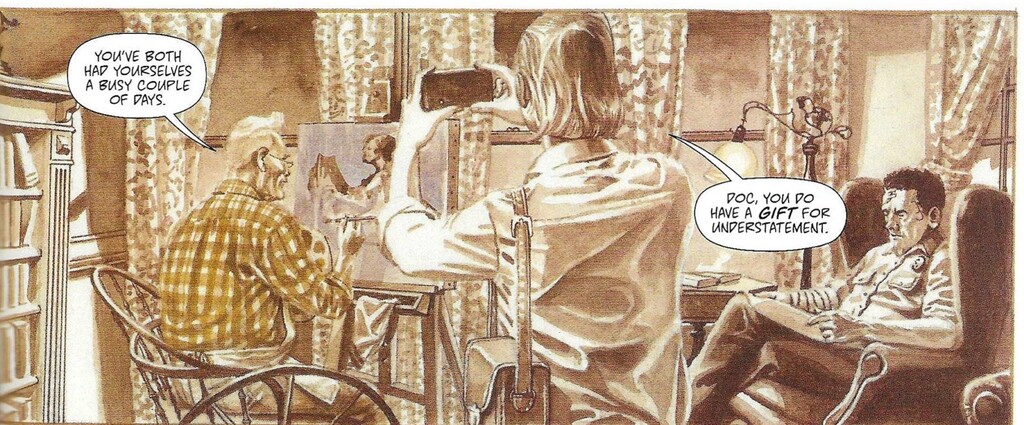
Is she taking photos with a cell phone? You be the judge!
Overall, though, it’s a gorgeous book, and Jones uses splashes of actual color to have a big impact, including one full-page spread that’s breathtaking. I’ll forgive the random weird panel if we get more Jones art!
I wish I liked this more, because a lot of it is really good. I do wonder why we have the killer, unless Jones just thought it needed some violence to sell better. That would be too bad, because a lot of this is a pretty good look at small-town America at a time when things were very dire in the country and what that might do to people. The serial killer aspect just overwhelms that a bit and makes it a slightly shallower comic, which is a bummer. Still, it’s a nice book to look at, of course, and it’s deeper than you might expect. Jones can certainly write more comics if it gets him to do interior art!
Rating: ★ ★ ★ ★ ★ ★ ½ ☆ ☆ ☆
