

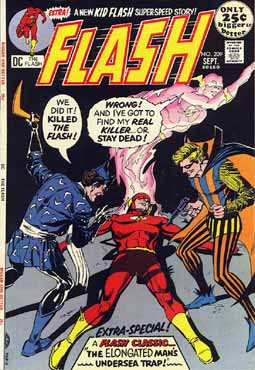
 A couple of months ago, I cited Flash #209 and Batman #234 as the beginning of what would become a Bronze Age trend — writers using supervillains again rather than “realistic” or “relevant” adversaries. And those are the two heroes to start with because Batman and Flash both have great Rogue’s Galleries. Writing Flash, Cary Bates would bring Barry Rogue’s Gallery back very quickly; on the Bat-books we’d have to wait for 1973 to see the Joker and 1974 for Penguin and Catwoman. Makes me wonder if Two-Face got to return first because he was never on the Adam West TV show. This was the era when we were all still embarrassed that campy show defined the medium for non-comics fans.
Not long after those issues came out, we get two more examples. World’s Finest #207 gave us “A Matter of Light and Death” by Lein Wein and Dick Dillin (cover by Curt Swan). A mystery villain equips some cheap thugs with a magic staff to kill Superman. It turns out the mastermind is Doctor Light, absent from comics since 1968 (1967 if you want more than a cameo). He’s figured out magic generates a small amount of light, and how to collect that energy — presto, a magic weapon of his own! Now he can resume his plan to wipe out the JLA one by one — and he’ll start with Superman!
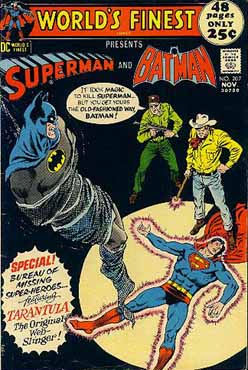
Needless to say, Batman and Superman are not down with this. It’s a solid, fun story by Wein, showing the talent he’d soon bring to Justice League of America and was already bringing to Phantom Stranger.
Meanwhile, over at Marvel, Archie Goodwin’s brief run on Fantastic Four brought back the Fantastic Four’s old foe, the 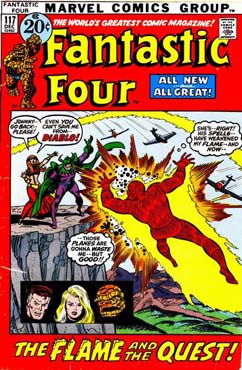 alchemist Diablo. Diablo’s a minor foe compared to Dr. Light; after a couple of clashes with the FF in 1964, he vanished until 1969’s Marvel Super-Heroes #20 [wrong! See John King’s comment for the two appearances I missed]. Now, in “The Flame and the Quest” (Goodwin, John Buscema, Buscema cover) he returns from the dead future Earth to which Dr. Doom exiled him in that third story. He also enslaves Crystal with an alchemical potion and starts taking over Central America. Johnny Storm, of course, has objections.
(I will note here my earlier assumption Crystal didn’t return to the series between Fantastic Four #99 and her meeting Quicksilver was dead wrong).
These are both good stories, though the Diablo one is more formulaic. And both Light and Diablo are decent foes. Nonetheless, these two issues foreshadow one of the downsides of the Bronze Age, a heavy reliance on the villains of the Silver Age, even the C-listers, rather than creating new ones.
Look at Fantastic Four, for example. Over the Bronze Age we’d see a few new foes such as Thundra (though she’s tied in to a story from Savage Tales #1, she stands on her own) but we’d a lot more Silver Age recyled villainy.
Galactus, with a new herald, returns yet again.
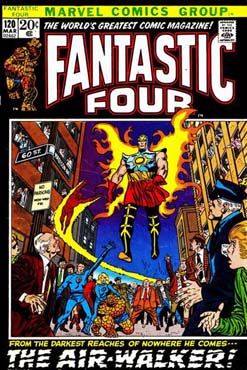
The Monster was a one-shot from Fantastic Four #97 (cover by Kirby) —
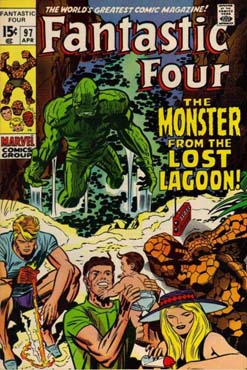
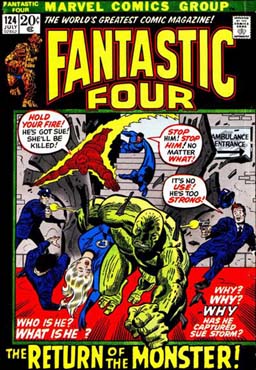
— who returns in #124.
Kala, a subterranean tyrant from 1963’s Tales of Suspense (Kirby cover)—
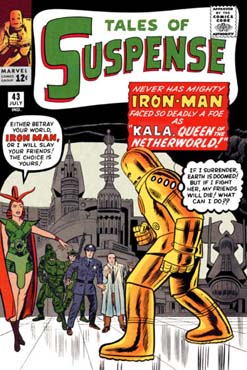
— returns in FF #127.
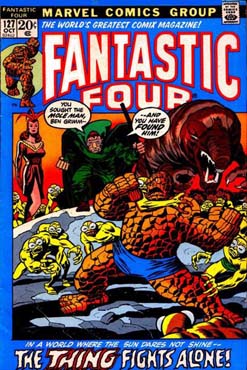
Fantastic Four #135 brought back Gregory Gideon.
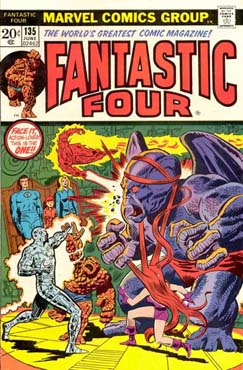
I enjoyed his original appearance eight years before but it worked perfectly as a one-and-done. No need to return him.
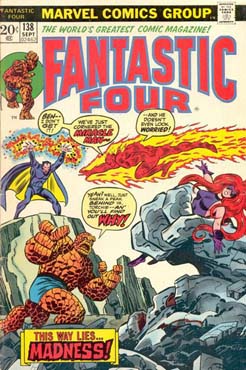
There was less need to return the Miracle Man in FF #138. In his original appearance (FF #3), he faked miracles with mass hypnosis; now though, he has real reality-warping power! It didn’t help.
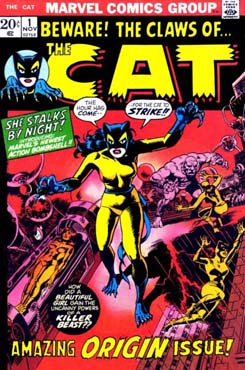 The FF wasn’t unique. After the first issue of The Cat (cover by Marie Severin), pitting Greer Nelson against a power-hungry millionaire, she ran into the Owl (covers below by John Romita)—
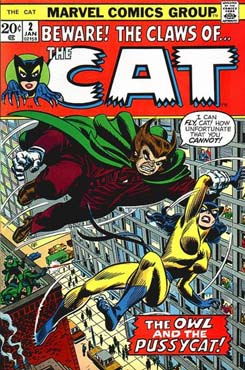
Commander Kraken —
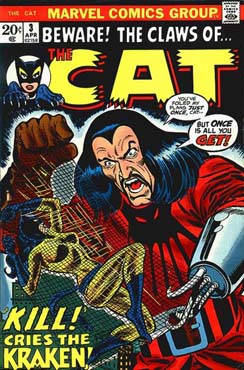
– and Man-Bull.
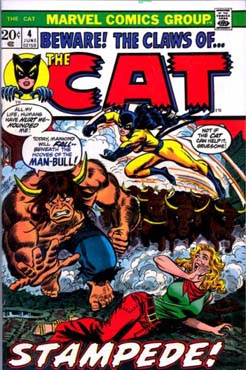
I suppose the Owl might have drawn in some Daredevil fans but the other two? I think not. #2, dealing with the fallout from the first issue, at least relates to the Cat’s world; #s 3 and 4 could have been the Black Widow or the Scarlet Witch just as easily.
All that said, I loved these returning rogues at the time (okay, not Man-Bull). Hell, I was absolutely thrilled when some obscure C-lister turned back up, though I’m not sure why. And no question Steve Englehart could take obscure figures like the Space Phantom or Deadshot and make them into B and A-listers. Most writers, though, didn’t do anything equally creative with their new-old toys. It feels closer now to them being self-indulgent, having fun playing in the sandbox they loved as kids or teens.
Rereading now, I’m thinking it was more fun for them than it is for me.
Flash cover by Neal Adams. FF covers by Buscema unless stated otherwise.

quick correction on Diablo
he did appear between 1964 and 1969
He crashed the wedding in 1965 (along with a lot of other villains)
and encountered the Avengers in 1967 (issues 41 and 42)
Thank you. Corrected accordingly. I’m not surprised I missed the wedding but I should have remembered the Avengers.
Very early on in Bates’ run — it may’ve been Flash #209 or slightly earlier — there was a lively letter column (the regular contributors were called LOC’ers: letter opinion column?) debate on which writer could take the comic forward.
As well as iconic artist Carmine Infantino (kicked upstairs), Julie Schwartz’s editorial stable stalwarts John Broome and Gardner Fox had also departed (the writer purge/Broome went to Japan), so the architects of the character in his revived solo book during the previous dozen years were keenly missed. Schwartz seemed to recognise this by carrying these letters which included summaries/reviews of prospective or recent writers.
Bob Kanigher was remembered as “dragging Flash through the bogs of human interest [ouch!]”. Denny O’Neil was nixed on similar relevance grounds: he would give Barry “too many hang ups”.
Mike Friedrich I think they said was too young and inexperienced; it’s easy to forget how young those ’70s guys like Friedrich, Bates, Shooter, Conway and Levitz were. My memory’s not so good on this point… so sorry, Mike.
The LOC hadn’t got around to Bates’ work yet due to time lag, but it is ironic many of the Schwartz LOC’ers went on to comics careers: Irene Vartinoff, Peter Sanderson, Martin Pasko, Mike W. Barr, et al.
I think I saw a letter from Bill Warren, who would later write the definitive book on 1950s SF films (Keep Watching the Skies) in an early 1960s Flash, too. Didn’t know Barr was a former letter hack. I have a lot of Flash issues from that era, I’ll have to look for the discussion.
And yes, they really were young.
… and the elephant in the room on why Marvel recycled so many villains and ideas post-1970. Kirby had left for DC. Of course, Ditko and Wood went four years earlier.
House of No Ideas/The House That Jack Built.
After writing the piece, it occurred to me Gerry Conway did better than many: the Jackal, the Punisher, Hammerhead, Mr. Kline and a few other new adversaries on the books he was writing on. Admittedly some of them, like Kline, were not good villains …
I always read “LOC” as “letter of comment”
Letter of comment. Of course!
I knew that I knew it, but not at the time I wrote it, if you see what I mean! That’s very frustrating.
Cheers for the reminder, Rob.
I believe that was correct.
And now I have to add another line because of our “no too short” comment rule.