


I put quotes around “derivative” in the title because as I’ve written about before, definitive is a subjective term. Someone like me who grew up with Silver Age Mort Weisinger Superman will have a very different perspective of “definitive Superman”—

— than someone whose first issue was Byrne’s Man of Steel.

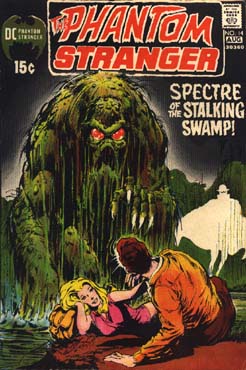 Definitive is always personal. And my personal definitive Phantom Strange run is by Jim Aparo, who began drawing the book with #7, and Len Wein, who became the regular scripter with “Man With No Heart” in Phantom Stranger #14.
(Side note, doesn’t the monster on that cover, from Wein’s Dr. Thirteen backup story, suggest a more menacing Swamp Thing? It appeared about a year before the original Swamp Thing story in House of Secrets #92).
Before we get to my definitive team, let us backtrack. The Phantom Stranger debuted in the early 1950s as a more uncanny version of Dr. Thirteen, exposing supernatural scams and frauds. DC revived him in 1969 in Showcase #80. In that story, he and Dr. Thirteen join forces against a seemingly supernatural threat, trade stories (“This tale proves the supernatural is real!” “Well mine proves it isn’t!”), chat with cute kids and finally expose the threat as a criminal scheme. 
Dr. Thirteen crows that his skeptical view has won — except the Stranger has mysteriously vanished! So he’s still playing the fake supernatural card, eh? Someday Terry Thirteen will rip the mask off the Stranger and prove he’s the man who runs the haunted carnival — no, wait, that’s some other ghost-buster, isn’t it?
I love that Neal Adams cover; I do not love the Mike Friedrich story — Dr. Thirteen’s outrage comes off quite unhinged — let alone the Bill Draut art. Still, this sold well enough to  launch a series. Maybe it was the timing, arriving as horror was beginning its Bronze Age explosion. Either way, Phantom Stranger#1 came out cover-dated May/June of ’69, not long after the Feb. ’69 cover date of Showcase. This was a period when DC was willing to try anything to shake off the late 1960s sales slump. They weren’t putting characters in multiple issues of Showcase they way they’d done a decade earlier. And in this case, they obviously made a good call.
Not that #1 had much to recommend it. Bill Draut’s cover isn’t bad but it’s no match for the Adams Showcase. Friedrich’s story sticks close to the structure of the first. We have the Stranger and Dr. Thiteen investigating a possibly supernatural threat, a cute kid witnessing everything, reprinted adventures of both leads. Though this time they’re simply placed up front, like a regular anthology book.
It’s weak stuff. Dr. Thirteen’s tale is a straight Hound of the Baskervilles knockoff. The new story “Defeat the Dragon Curse … Or Die” is forgettable. The PS reprint, “When Ghosts Walk,” is the only one that I think I’d have liked had I read it back then. Nevertheless, we got the same set up for the next couple of issues. Then came #4
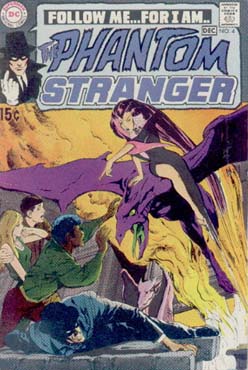 The scripting duties transfer to Robert Kanigher, plus we got Neal Adams drawing. Kanigher added some new elements to the mix: Tala, an ancient spirit of evil who was warm for the Stranger’s form, and four teenagers who just happened to be around whenever the Phantom Stranger does his thing (as in the opening for #6 below).
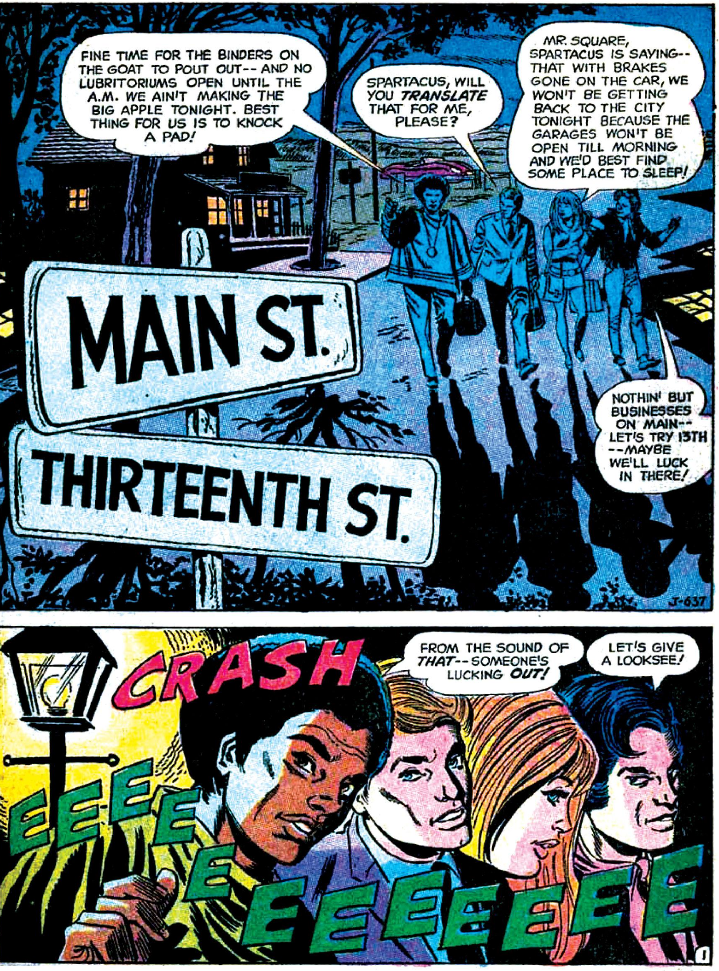
Spartacus, Attila, Wild Rose and Mr. Square never got an origin. They didn’t need one: college-age kids dropping out and drifting with the wind was a common enough thing at the time. While the quartet broadened the cast beyond the Stranger and Terry and Marie Thirteen, Kanigher didn’t put much thought into characterizing them. That said, I’m surprised nobody has ever brought them back or reused them — writers have mined the Silver and early Bronze Age for equally obscure figures.

The panel above from #4 shows what would be a standard element, having the Stranger introduce the stories. Kanigher’s Stranger, though, sounds more like a horror-comic host than the broody philosopher of Wein’s run. #5 had Sekowsky on art, then Sekowsky took over scripting as well for #6. This gives us the first cover to show the Phantom Stranger as a nebulous image in the background.
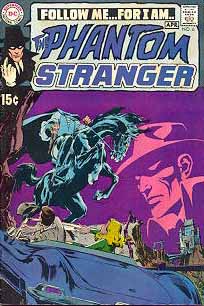 It’s also the first really fun yarn. The kids (who show more distinctive personalities than under Kanigher) stumble into a seemingly haunted house. It turns out two dotty old sisters are engaged in a feud (I wouldn’t be surprised if Sekowsky was a fan of 1962’s Whatever Happened to Baby Jane?), one of them using magic for practical jokes. This one has the Stranger and Thirteen once again swapping stories, though this time they’re new yarns.
#8, written by Denny O’Neil, has an unremarkable story but it does bring Aparo on board. #9 has Mike Sekowsky writing again. #10 has Gerry Conway scripting, giving us his take on the opening narration.
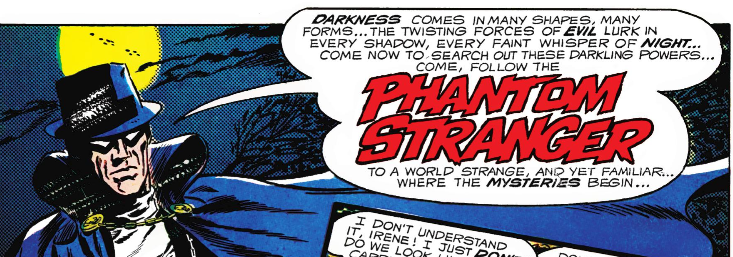
Conway also introduces Tannarak, a more interesting foe than Tala. A Middle Eastern kid who grew up hungry and desperate, he wants immortality more than anything on Earth. His appearances all revolve around allying with powerful players who may be able to grant him eternal life.
After Conway’s two issues, we got two more Kanigher stories. They’re unremarkable but happily Dr. Thirteen is now assigned to backup adventures. That puts an end to the PS/Thirteen squabbling and lets Thirteen show how capable he is, instead of looking like a clueless mook who doesn’t grasp the Stranger is the real deal.
Then, finally, we get Len Wein. His Phantom Stranger’s voice is what I think of as his “real” voice.
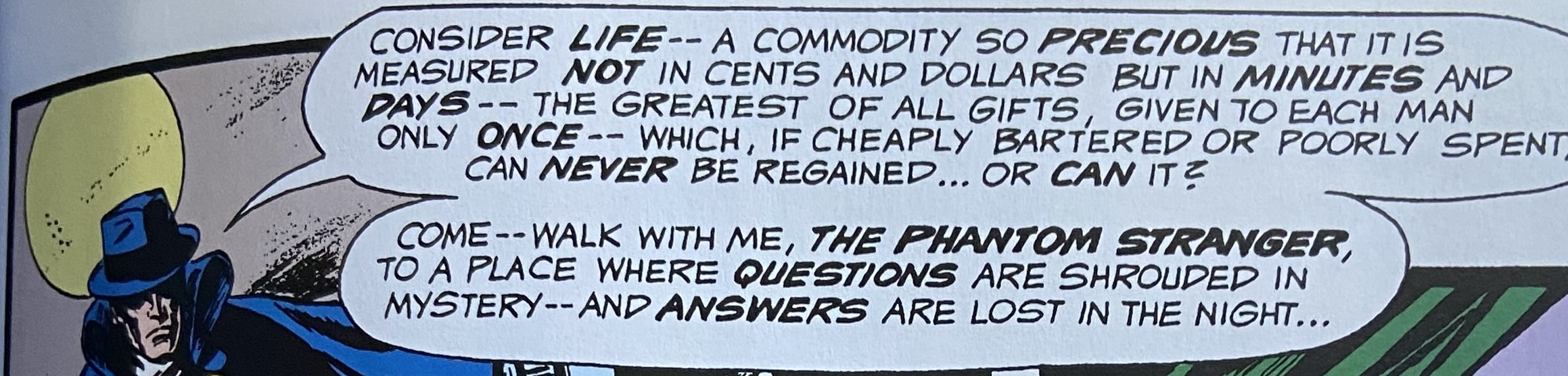
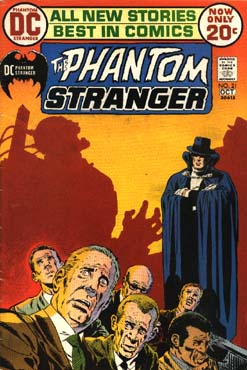
The Wein/Aparo run is easily the best stretch of this series (unfortunately for technical reasons I don’t have any Aparo art examples other than the cover below). It helps that they stayed on the book for thirteen issues because there’s a lot to be said for a consistent creative team. Wein gave the Stranger a quasi-love interest, Cassandra Craft, and a battle against the sinister Dark Circle that stretched over most of his run (though not in every issue). That’s harder to do if the writers rotate in and out. Thirteen issues is nothing compared to, say, Cary Bates on Flash or the three years Wein worked on Thor. But like I said, when I think of this character, Wein’s and Aparo’s work defines him.At least for me.
Art top to bottom: Curt Swan, John Byrne, Neal Adamsx2, Bill Draut, Adams, Sekowsky, Adams#2, Aparo x3

Ah, I get it. The Phantom Stranger is Rod Serling’s Twilight Zone host, if he was an active participant in the stories themselves. (At least, the Conway/Wein version, it seems.)
That’s not a bad analogy, at that.
Something I found interesting is that in many of the stories the Stranger was the only supernatural thing.
The early issues seem to be using the 1950s Phantom Stranger, Ghostbreaker series as a template. Once Tala shows up, things get more mystical.
You did not put quotes around “derivative” in the title of the post, because that word does not appear in the title of the post!!!! I’m just like Dr. Thirteen, debunking everything!!!!! 🙂
I debunk your debunking! You shall rue the day you questioned my genius!
I think the Phantom Stranger, like John Constantine, work best when it isn’t clear if they actually have powers rather than outright casting spells.