
As I blogged about last year, the Bronze Age horror-comics revival began in 1968 when DC rebooted House of Mystery into its definitive form, with Cain as caretaker, landlord to ill-fated tenants and EC-style storytelling host. My Silver Age reread has now reached late 1971 (there’s still stuff from earlier in the Bronze Age that I’ll have to go back and cover) and horror is booming.

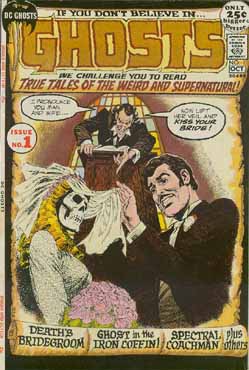
The success of House of Mystery (cover by Joe Orlando) convinced DC to reboot Tales of the Unexpected and House of Secrets into similar anthologies. Plus of course, we got new magazines: Witching Hour and in 1971, Ghosts (cover by Nick Cardy)
What I’m blogging about today, however, is the spread of horror into other genres.
Love comics, for instance. Dark Mansion of Forbidden Love and Sinister House of Secret Love both hit the stands in 1971. Gothic romance — beautiful young woman, spooky house with spooky occupants, sinister and possibly supernatural things happening — was a popular genre in paperback back then. It was also the set up for the initial run of Dark Shadows, as young Victoria Winters (Alexandra Moltke) becomes governess in the spooky mansion of Collinwood only to discover secrets and spooks abound. Though it took Jonathan Frid as Barnabas Collins to turn the show into a hit.

“Mystery of the Missing Bride” (Dorothy Woolfolk, Ethan Mordden and Tony deZuniga, cover by George Ziel) has a young woman, Erica, show up at the requisite dark mansion to find out why her best friend Bonnie mysteriously stopped writing to her. It turns out Bonnie’s dead, leaving a grieving husband, Michael, who soon decides that yes, perhaps he can love again! There’s a great deal of sinister goings-on swirling around the romance, including the cliche reveal that the wheelchair-bound paraplegic upstairs can walk. In the end Erica and Michael get to leave the darkness for the light of love. Which surprised me — him pitching woo at Erica seemed so suspicious I assumed he had to be one of the bad guys.
Much like Dark Shadows, both books soon shifted away from romance to straight horror, becoming Forbidden Tales of Dark Mansion and Secrets of Sinister House. The change kept them going but neither one made it past 1974.
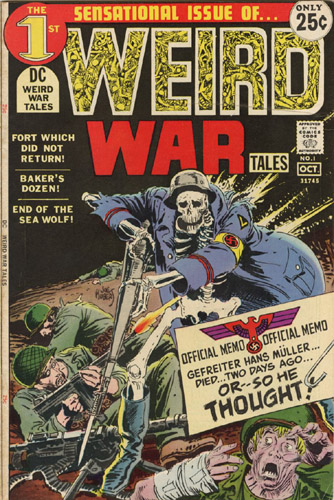
Weird War Tales did a lot better, lasting all the way into 1983. Perhaps that’s not surprising, as the war comics outlasted romance. Love comics’ death spiral ended in 1977. Sgt. Rock, to take just one example, kept going into 1988. As Jeff Nettleton has said a couple of times in comments, the mass audience for war comics isn’t there any more. In the 1970s, though, mashing up war and supernatural horror was a winning ticket (though not for Marvel’s War Is Hell a few years later).
Superheroes, of course, were becoming the top dog of comics genres. Even so, creators were finding ways to mix horror into the clashes of titans. Writer/artist/cover artist Mike Sekowsky did it in two stories that came out in May of ’71. First, Wonder Woman #195, “The House That Wasn’t.”

In this one, I Ching and Diana help out two stranded motorists during a snowstorm only to discover they’re escaped convicts. The quartet wind up at an old-fashioned inn whose owners are spirits preying upon travelers. Needless to say I Ching and Wonder Woman — mostly I Ching — put a stop to that.
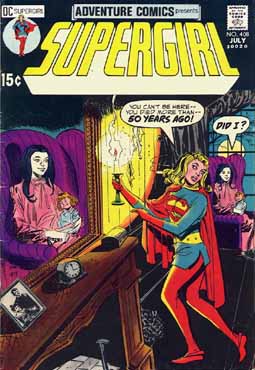
“The Face at the Window” in Adventure Comics #408 takes place while Linda Danvers is working as camerawoman for a San Francisco TV news show (I haven’t blogged about this era yet but I will). She spots a spooky face at the window — given the title, hardly a surprise — returns that night to investigate and discovers the face is the ghostly daughter of two murder victims. Justice, of course, is served.

 Neither series continued in that vein. Teen Titans did. The final 10 issues of the original run, by Bob Haney with various artists, all traded on horror tropes. Presumably it goosed sales, though not enough to keep the book going.
Technically it started with the cover of #33 (all covers are by Nick Cardy). What’s inside isn’t horror. Continuing the story from #32, it’s a bizarre mish-mash: repairing altered timelines, introducing the caveman Gnarrk as a new Titan and taking down a white politician who’s secretly the “king of the ghetto rackets.” #34, on the other hand …
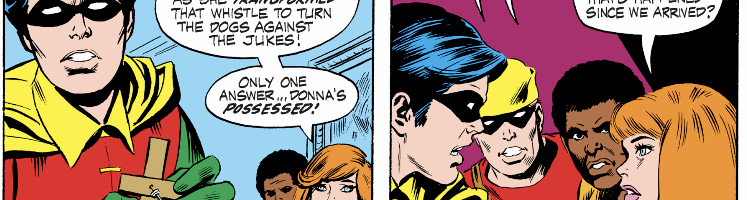
“Demon of Dog Island” (Haney and George Tuska) opens with Donna on the eponymous isolated island where she’s helping out an elderly woman. When the Titans drop in, weirdness and strange goings-on abound. It turns out the kindly old woman is a witch grooming Wonder Chick as her next host body. It’s not that different from something you could have found in House of Secrets.
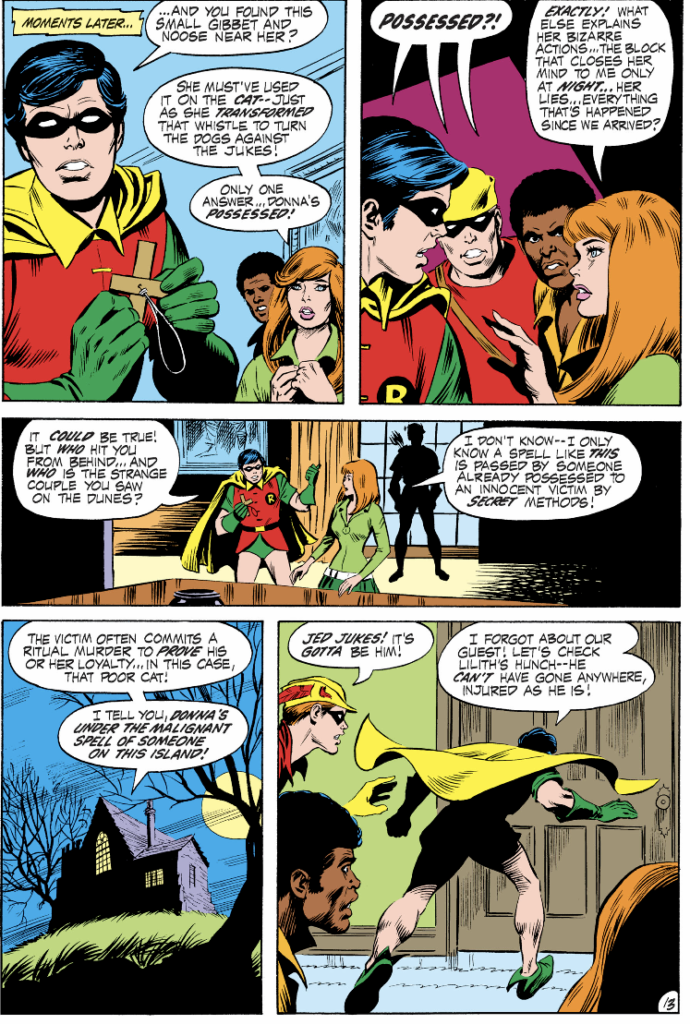
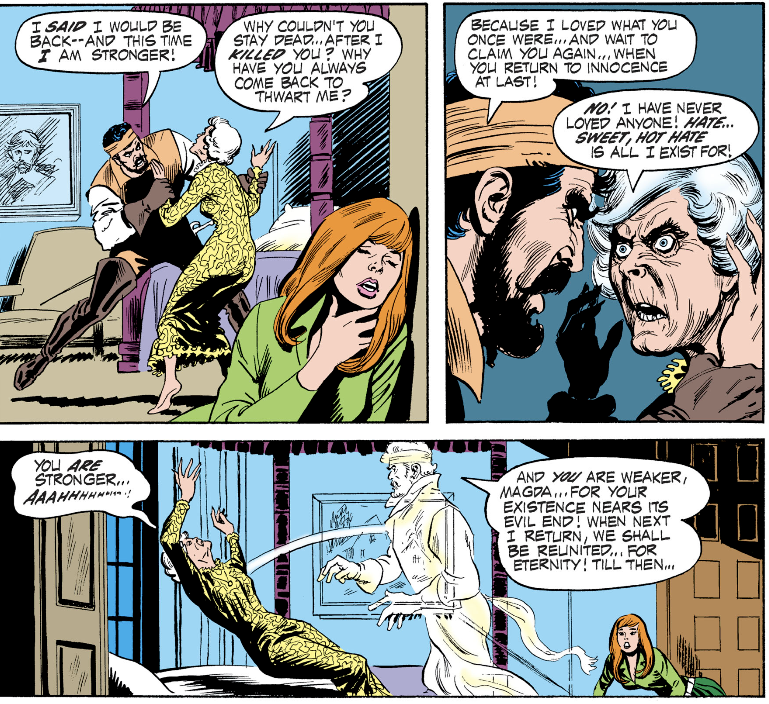
Spoiler: everything works out and Donna doesn’t turn into Ms. Black Magic of 1971. However this worked well enough that the Ginchiest Teens Of All kept running into more supernatural threats. Frequently the stories worked in paranormal romance as well; “Dog Island” has the old witch’s spirit, purged of evil, reunite with the lost love confronting her here.
The following issue, a trip to Italy has Lilith and a local boy fall wildly for each other.
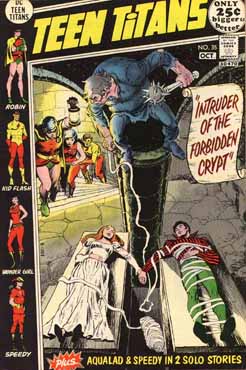
Is it possible they’ve been possessed by Romeo and Juliet? #40 brings Aqualad back to the team, mesmerized into evil by his love for an undersea sorceress.

The Phantom Stranger, of course, is even more a mash-up of horror and superheroics. While I blogged about his late 1960s revival, I’m now much further into his Bronze Age run. Hopefully I’ll find time to blog about it soon.

Yes, but was there ever any superhero in horror comics? 😛
Dark Mansion and Sinister House were interesting experiments – I read two of the stories from the latter, which were reprinted in DC Special Blue Ribbon Digest #20 (ironically under the title “Dark Mansions of Forbidden Love”) and which I quite liked. It’s too bad neither of these gothic romance series had a longer life.
They have Dark Mansion on the app. I can see the appeal.