
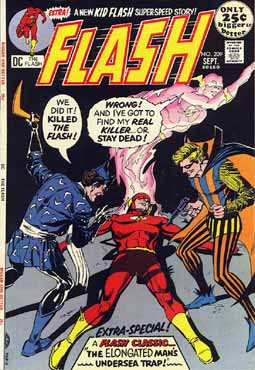
 Flash #209 (cover by Dick Giordano), cover-dated September, 1971, was a landmark issue. Not that I’d have known it at the time, even if I’d picked it up new (I was still a few months away from resuming my comics buying habit).
The cover story, “Beyond the Speed of Life,” (Cary Bates, Irv Novick) is no classic but it’s enjoyable. A mysterious force compels Captain Boomerang and Trickster to trip up their old foe with a rope, after which Flash skids, crashes and dies. The Rogues are exultant until reality sets in: Flash is too experienced not to have pulled out of that fall without fatal injury. What’s up?
It turns out an alien entity, the Sentinel, has drawn Flash’s life force out of his body so he can enter a realm where physical life cannot exist. An entity, the Devourer, is eating its way into our universe. Either Flash stops it or it goes Galactus on Earth-One and everything else.
Meanwhile the two Rogues discover the reason for that strange compulsion was Grodd, using them as tools to kill the Flash. Now he has no more use for them — fortunately Flash’s life force returns from defeating the Devourer and takes down Grodd. Figuring they can’t fight someone who comes back from the dead, Boomer-butt and Trickster throw in the towel.
To explain why it’s significant, let us rewind time to the late 1960. First Flash artist Carmine Infantino got promoted to DC publisher, leaving Ross Andru as the new penciler. Andru wasn’t even remotely right for the gig. A year later, DC fired a number of writers — John Broome, Gardner Fox, Arnold Drake — which hurt the Scarlet Speedster on the writing side. A pre-Batman Frank Robbins took over and sucked horribly. Mike Friedrich did better, but contributed fewer stories than Robbins or Robert Kanigher, whose most noteworthy story was the “Iris Allen is a time traveler” retcon.
Art started to pick up with #200, which introduced Irv Novick as the new regular penciler. With 209, Cary Bates takes over the  writing (he’d done one previous story, introducing Earth-Prime). Bates would continue speed-writing the book (ROFL. See what I did there?) until Flash’s death in Crisis on Infinite Earths. That’s an impressive run, even if the last few years were sub-par (Iris’ death, the Trial of the Flash, etc.). For most of the Bronze Age, much as Greg Hatcher wrote about Bates’ work on Superman, it’s “quiet, non-fanfare, craftsmanlike” — none of the drama and conflict we’d see in X-Men a few years later but solid dependable entertainment.
Bates had a few quirks, like having multiple villains find ways to use Flash’s aura as a power source of some sort. However he got Flash and Flash’s Rogues in a way neither Kanigher nor Robbins did — indeed neither one had much interest in Flash’s established foes. Which is the other thing that makes #209 standout — after two years of relevant stories, super-villains were coming back.
The minimal use of established supervillains was one of the things I hated about the Silver Age/Bronze Age transition period. I’m inclined to blame it on comics’ sudden desire to be relevant and serious — no silly clashes of titans here! We’re nothing like that campy Batman show with all those ridiculous costumed buffoons running around. Our villains are pollution, Satanism and campus unrest! It’s mostly a DC thing as Marvel seems to use its villain roster steadily despite being equally into relevance.
Thus Flash, a book known for colorful villains, largely stops using them after John Broome leaves. By the time of 209, Grodd and Captain Boomerang have been off-stage for four years. Trickster’s been gone for three. Most of the other rogues have faded similarly.
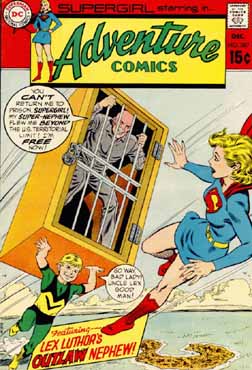
It’s not unique to Flash, either. Lex Luthor didn’t fight Superman in 1970 outside of an imaginary story, though as the Murphy Anderson cover above shows, he was active against Supergirl and Superboy. Batman has introduced some new foes — Man-Bat, R’as al Ghul and the League of Assassins, the 10-Eyed Man — but the regular Rogue’s Gallery faded away when the “New Look era” became the Old Look.
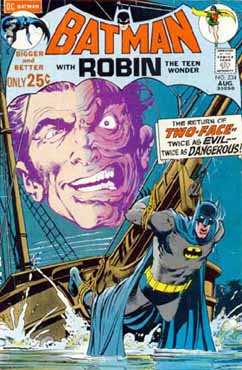
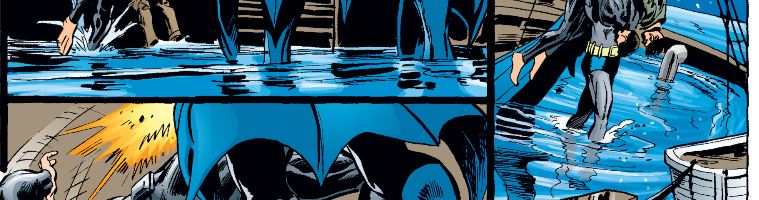
That’s changing too, though. Surprisingly the first classic villain to return in the post-TV era is one who hasn’t appeared since the 1950s, Two-Face. In Batman #234, “Half an Evil,” (Denny O’Neil, Neal Adams, who also did the cover), Harvey Dent matches wits with Batman once again. As so often happens, his compulsion for coin-flipping undercuts his plan.
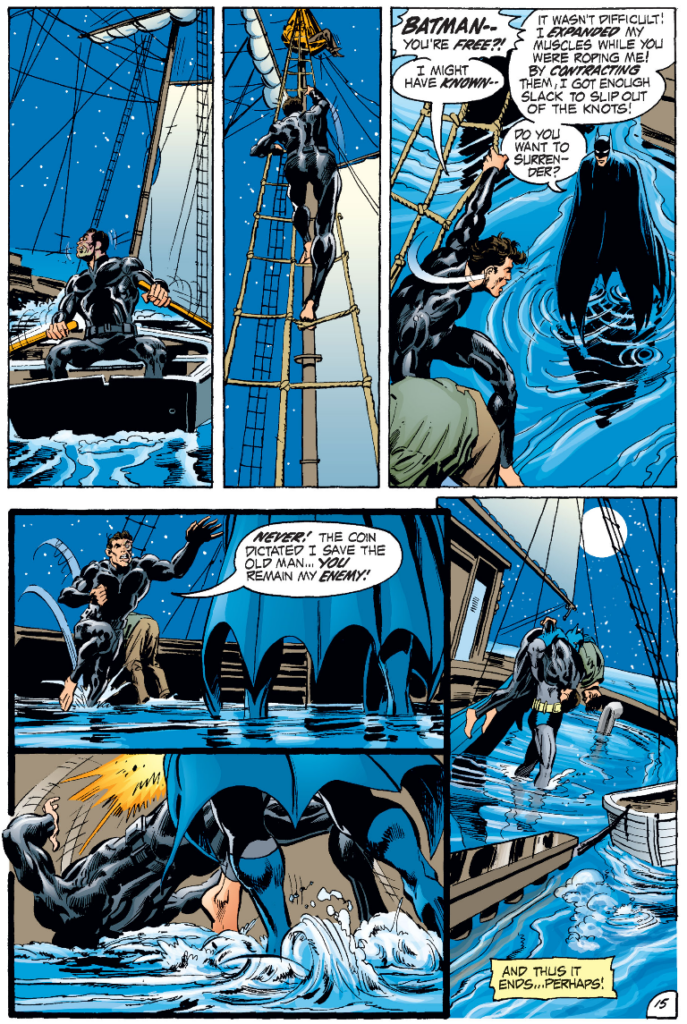
It’s a solid story, though it also reminded me of one reason I prefer the Golden Age Two-Face. The modern one flips a coin to decide whether he’ll kill you; the Golden Age version would flip it and do actual good deeds, like donating his latest loot to a children’s home. It made the division in his soul even sharper.
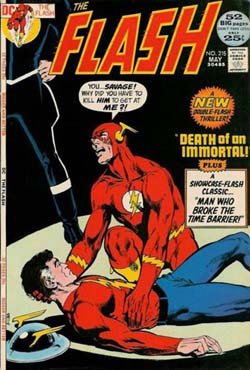 The Joker will be back in 1973 after a four-year absence from comics. Catwoman and Penguin return, as do the rest of Flash’s Rogue’s Gallery. Along with Two-Face, we’ll see other relatively obscure villains revived, such as Vandal Savage in Flash #215 (cover by Neal Adams). As I said a while back, a lot of the Bronze Age, in hindsight, is processed cheese. Bringing back the Rogues Galleries was a good deal better than that.

Bates was pretty good on Flash; I had a smattering of mid-’70s issues with Irv Novick doing the art (one of the better Flash artists in my opinion) and then became a regular monthly reader for a few years starting in 1979, when Saviuk and then the unfairly maligned Don Heck were handling the art. The stories were solid, I thought. I only started to lose interest when Infantino returned as the main artist (at that point, I kept picking up the series mainly because I liked the Firestorm and then Dr. Fate back-ups).
I really hated Saviuk’s run as artist. I agree Novick did a great job, very much the “definitive” Flash artist of my teen years, much as Infantino was in my pre-teen days.