

 (Another repost from my own blog) As the editor of Ballantine Books’ fantasy line in the 1960s and 1970s, Lin Carter had an unerring eye for great fantasy. In his own writing, he did little but second-rate knockoffs of other people’s creations. Thongor of Lemuria for Conan. Jandar of Callisto for John Carter of Mars. Nowhere near as good as the prototypes but also nowhere near as terrible as many knockoffs I’ve read. As I said in the earlier post, if you’ve read through all your Burroughs and Howard and then reread them, Carter will give you something familiar and readable, even if it’s a pale shadow of his predecessors.
I remembered Carter’s Zarkon, Lord of the Unknown series more fondly: very obviously modeled on Doc Savage and his team, but as a good deal more fun than Thongor. Plus Carter could work in Easter eggs in a way that’s harder to do in ancient Lemuria. Throughout the five-book series Carter’s cast has encounters with Doc Savage’s aide Renny, Nellie from the Avenger pulp series, a crippled newsboy named Freddy Freeman (he does not however, say any magic words) and several characters I’d never heard of (which is not a criticism). One of Zarkon’s aides, pilot Ace Harrigan, is a relative of DC Comics’ Hop Harrigan.
Back in 2019, I reread the first book, Nemesis of Evil, for the second time since it came out in 1975. I have to say, it’s less fun than I remembered.
We open on a meeting of the Lemurian Wisdom cult. Like countless cults in the pulps, it uses its apparent occult powers, mixed with murder, to drain money 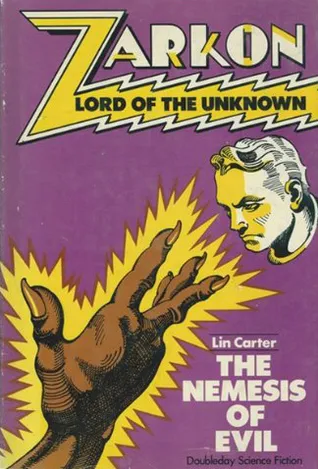 from wealthy suckers and intimidate anyone who snoops. One snooping reporter, however, has infiltrated the upper levels of the sect. Too bad he’s been made; after the meeting he dies in “invisible flames,” His publisher calls in Omega, a secret crimefighting NGO led by Prince Zarkon, former monarch of European Novenia.
Zarkon and his team soon identify Lucifer, the cult leader, as criminal scientist Zandor Sinestro. Reports of his death in prison have been greatly exaggerated; now he’s using the cult to build a network of followers with enough wealth and influence he can run the country. The cult’s mystical knowledge is pure snake oil, of course. So are Sinestro’s powers; the invisible flames are just an obscure, untraceable poison he’d dosed the reporter with.
When Nemesis of Evil first came out, reading a pulp pastiche was a novel experience, one reason I probably liked it more. Now, though, there have been many more pulp pastiches and even specifically Doc Savage pastiches (Doc Brazen, Doc Vandal, Doc Sidhe). Without the novelty, the flaws leap out at me more.
For one thing, the cast is way too derivative. Zarkon’s five-man team includes Scorchy, a two-fisted bantam redhead who constantly squabbles with his elegantly dressed buddy Nick. They’re an obvious riff on Doc Savage’s aides Monk and Ham,. Doc had a tough but puny-looking electrical expert on his team; so does Zarkon. The main female character has a lot in common with Pat Savage, wielding an old six-shooter and horning in on the action. Doc Savage was the Man of Bronze; Zarkon dresses in gun-metal gray to make a similar metallic fashion statement.
Carter’s also a much weaker writer than Lester Dent, Doc Savage’s chief scribe. If Dent had someone killed with invisible flames, it would be a great scene — the man’s clothes turn to ash for no reason, then the man’s body begins to burn … All Carter shows us is the reporter writhing on the ground screaming. After the initial murder, the next few chapters are exposition and talk, with no action and little suspense. Dent never lets things go quiet for that long. Scorchy spouts corny B-movie Irish dialog that wears out its welcome fast. Lucifer’s final defeat is a freak accident.
Another problem I didn’t notice the first time is the timescale. Zarkon’s adventures are set in the present of the 1970s yet Nick talks about performing with Houdini. That would put him in his seventies. A later book has Pat Savage and other women from the 1930s pulps hanging out, which is fun, but they’re all way too young.
Then there’s the introduction in which Carter asserts the book is a nonfiction novel a la Truman Capote’s In Cold Blood: events in the book are real but details and names have been fictionalized. I suspect Carter’s influence was less Capote than Philip José Farmer’s Tarzan Alive and Doc Savage: His Apocalyptic Life. Those books revealed Tarzan and Doc Savage were both real characters whose adventures were fictionalized by Burroughs and Dent respectively.
However claiming a popular fictional character is one thing; introducing a new character and claiming he’s new doesn’t have the same punch. It works against the most interesting detail, that Zarkon is a genetically engineered time traveler seeking to avert a nightmarish future. That’s an interesting idea — but maybe it’s just one of those details Carter made up.
Looking back at my reviews of the following four books, I found all of them but the fourth, Earth-Shaker, weaker than Nemesis of Evil. I don’t plan to reread them any time soon.

The ultimate pastiche, for me, is Paul Malmont’s The Chinatown Death Cloud Peril. It is a pulp mystery, featuring Walter Gibson (creator of the literary Shadow), Lester Dent (Doc Savage), L Ron Hubbard (charlatan), Robert Heinlein, Louis L’Amour, with an appearance by EE “Doc” Smith and a plot that revolves around the death of HP Lovecraft.
I’m quite partial to Kim Newman’s Anno Dracula and Diogenes Club books. The former has Dracula survive the ending of Stoker’s novel and become Prince Consort to Queen Victoria, while a serial killer is murdering vampire prostitutes in Whitechappel. The series then moves on to WW1 (The Bloody Red Baron), the 1950s (Dracula Cha-Cha-Cha) and the late 70s/early 1980s (Johnny Alucard) with some side journeys to turn-of-the century Japan and turn-of-the-millennium Japan. Lots of easter eggs through the series, such as a vampiric British secret agent, named Hamish Bond; a beagle that stalks the Red Baron, an American actor, named Clark Kent, who is starring in Italian Hercules movies; and, later, in Johnny Alucard, a team of government vampire super-agents, led by a soldier, named Grant Gardner (Captain America’s alter-ego in the Republic serial). The Diogenes Club stories features cameos and pastiches, too, such as the 1970s/80s agent, Richard Jeperson, who is an homage to both John Steed and Jason King, while his assistant, Vanessa, is all Emma Peel. Newman also did a Sherlock Holmes pastiche, The Hound of the D’Urbevilles, which features Prof Moriarty and Col Sebastian Moran as consulting criminals, as the antithesis of Holmes & Watson.
I’m quite fond of Farmer’s The Peerless Peer, where he teams up Tarzan and Sherlock Holmes, while throwing in some cameos, like The Shadow and the Spider. His Greatheart Silver stories have all kinds of pulp hero cameos. Not so wild about A Feast Unknown, Lord of the Trees and The Mad Goblin, with his Lord Grandraith and Doc Caliban stand-ins for Tarzan and Doc Savage.
I tried reading Tom Carson’s Gilligan’s Wake, where he uses the structure of Finnegan’s Wake to tell backstories of the castaways of Gilligan’s Island, with mixed results. The Professor worked on the Manhattan Project, Mrs Howell was a friend and confidant of Daisy Buchanan, Mr Howell was wrapped up with Alger Hiss, the Skipper served on PT Boats, along with Lt(jg) John F Kennedy, Gilligan was a beatnik (go figure), Ginger is a pastiche of Bettie Page and Marilyn Monroe and now from Alabama and Maryann is from a Kansas equivalent of Brigadoon and dates Jean-Luc Goddard. Pretty mixed results
The Malmont novel is a lot of fun. Absolutely hated Peerless Peer, a tedious mix of retconning with Farmer’s endless sniggering over sex.
Kim Newman falls in the middle — I liked Anno Dracula, could not get into Diogenes Club (it’s precisely the sort of thing that should appeal to me, but it doesn’t).