
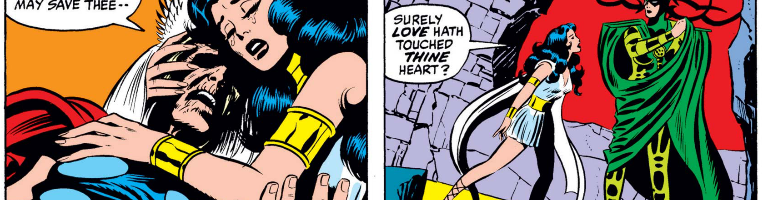
 Back in 2022, I settled on March 1972 as the cutoff for my ongoing Silver Age reread. In the grand scheme of things it’s not a particularly significant month. It doesn’t mark a sharp boundary between ages — I’d say the Silver Age ends earlier — which is why I now double-tag these posts as rereading the Bronze Age as well.
Nevertheless, it’s a significant turning point to me. March 1972 is when I returned to buying comics regularly after two years away. I bought Teen Titans #32 a year earlier than that but I count that as a baffling anomaly. That purchase didn’t bring me back to comics; JLA #97 and the other books I bought in the month of destiny did.
It was probably inevitable I’d reconsider my cut-off point and ask myself “Why not keep going?” Until I graduated high school in 1976. Until I graduated college in 1980. Or until COIE wiped out the original multiverse.
Doing so would be an entirely different experience than revisiting the Silver Age. I  started reading comics in ’64, when the Silver Age was more than half over. I was only able to buy two comics a week which discouraged me from reading Marvel — too many continued stories — and only gave me a glimpse of what DC was doing in any given month. As I said in my first reread post, I’ve read much of what I originally missed since then, but I reread in isolation: Silver Age Flash omnibuses or Spider-Man in Marvel Masterworks. That doesn’t show me the big picture. Reading month by month does.
I had the money to read a lot more in the 1970s, even with the increase in price. Not everything, but my brother picked up a lot of what I didn’t. I got Flash, Wonder Woman, Avengers, Justice League of America and others; he got Fantastic Four, Superman, Batman, Captain America and more. If I reread that era it would be a voyage more of nostalgia than discovery.
In any case, I’m thinking maybe I won’t do that. DC and Marvel published a lot more superhero stuff in the 1970s; a year after my cutoff date, March 1973, I’d have to reread around 40 books. It’s cool that thanks to TPBs and the app I can do that. It’s still a lot and there are other comics I’d like to read, many of them recommended here.
A second problem is that I’m not sure an exhaustive Bronze Age reread would be fun enough to justify it.

Don’t get me wrong, there is lots of stuff that would be fun to reread. Steve Gerber on Man-Thing. Steve Englehart writing anything. Jim Starlin on Warlock and Captain Marvel. The Goodwin/Simonson Manhunter. Eternals. Kamandi. Len Wein’s Justice League of America and Phantom Stranger runs.
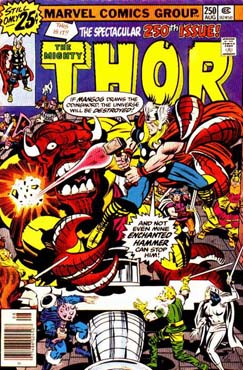 Alan Stewart blogging about Thor #250 and the stories leading up to it reminded me, however, how so many of the 1970s books fall short of their predecessors. Not horrible. Fun to read. Yet there’s a generic quality to many of them. If Stan Lee and Jack Kirby on Thor were a fine, aged cheddar, the Len Wein/John Buscema run (which included #250) is closer to processed American cheese. I enjoyed flipping through it on the stands and might have bought it if I’d had more money. I don’t feel any urge to reread it the way I do Walt Simonson’s later run – or for that matter, Wein on the JLA.
I’m currently up to fall of 1971 in my Silver Age reread (this year’s disruptions mean I’m months behind in reread-blogging, but I’ll catch up) and the bloom is already off the rose. There’s good stuff — Neal Adams’ art, Lee and Gil Kane on Spider-Man, the 100-Page Superspectaculars, Jack Kirby’s Fourth World books, Swamp Thing, the Aparo/Wein Phantom Stranger run.
On the other hand, Gerry Conway is writing Daredevil and Iron Man and as I’ve mentioned before, can’t seem to write either of them as anything but whiny and mopey — the processed cheese counterpart to the melodrama Lee/Kirby and Lee/Ditko usually pulled off (Conway’s now taken over Sub-Mariner — I’ll see how that goes). And when he hops on the 1970s “let’s make narrative captions fancy and poetic,” it falls flat. Sales were so bad that publisher Martin Goodman considered combining the adventures of Shellhead and Hornead into one book, like Amazing Adventures or Astonishing Tales (Head Comics, maybe?).
 Not that Stan Lee is covering himself with glory; his work on Captain America, Thor and Fantastic Four
 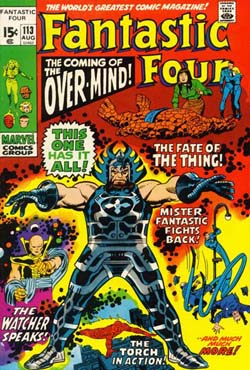 is recycling chunks of stuff he and Kirby handed better a few years earlier. Fantastic Four‘s Overmind saga, which I’ll blog about eventually, worked better out of context, when I had no knowledge of the issues that had come before.
I remember long stretches of processed cheese on some of my favorite books. After Len Wein left off writing the League, the series shuffled miserably through the hands of random writers before Englehart turned things around, followed by Conway (I really liked most of his run). When DC revived Green Lantern in 1976 I purchased it faithfully; in so doing, as Tom Brevoort has put it on his blog, I was “subsidizing mediocrity.”
I’m not sure the nostalgia is worth sitting through the mediocrity again, nor is any analytical insight I might game. So perhaps I won’t.
Covers top to bottom by Neal Adams, Carmine Infantino, Rich Buckler, Jack Kirby, Marie Severin and John Buscema.

When I was reading books in my younger years, a big part of their appeal is that other fans were experiencing them at the same time. What was happening in THOR and CAPTAIN AMERICA mattered much more when somebody else I knew was reading them, too. Re-reading some of these issues today, absent that simultaneous audience, makes the stories less appealing. The best ones still stand out, of course, but many are—as you note—processed cheese.
I knew almost nobody besides my brother but yeah, having them happen “now” was part of the excitement.
I love the Bronze Age, particularly the Marvel books. The duds are few and far between in my opinion.
I read them regularly and enjoy them far more than the current shit that Marvel is churning out.
DC on the other hand continue to be great for the most part.
That’s what makes horse races. I agree there was some great stuff — and I have a fondness for even some of the less good stuff. Just not enough for a full reread.