
“Connected lives overlapping, like a, like a hall of mirrors; lives lived and shed, affecting her now”
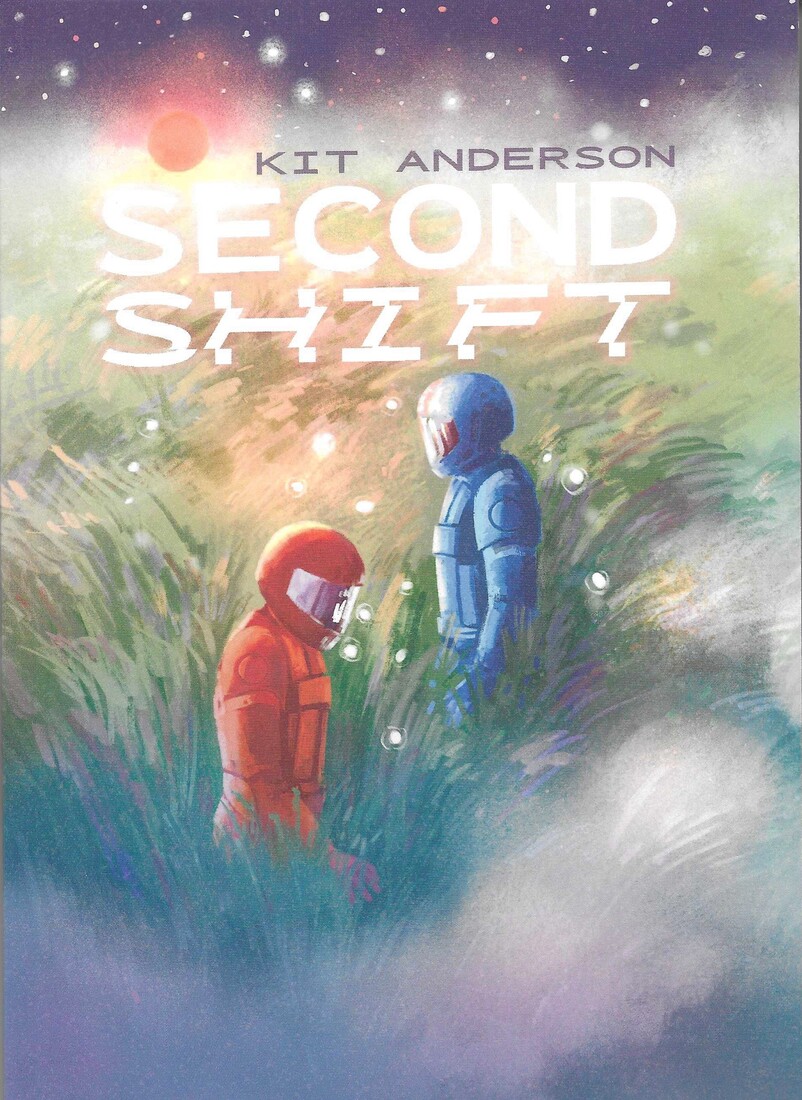
Second Shift, from Avery Hill Publishing, is Kit Anderson’s first graphic novel, which is nice for her. It’s 152 pages long, and my copy shows a price tag of £14.99. What kind of madness is this? 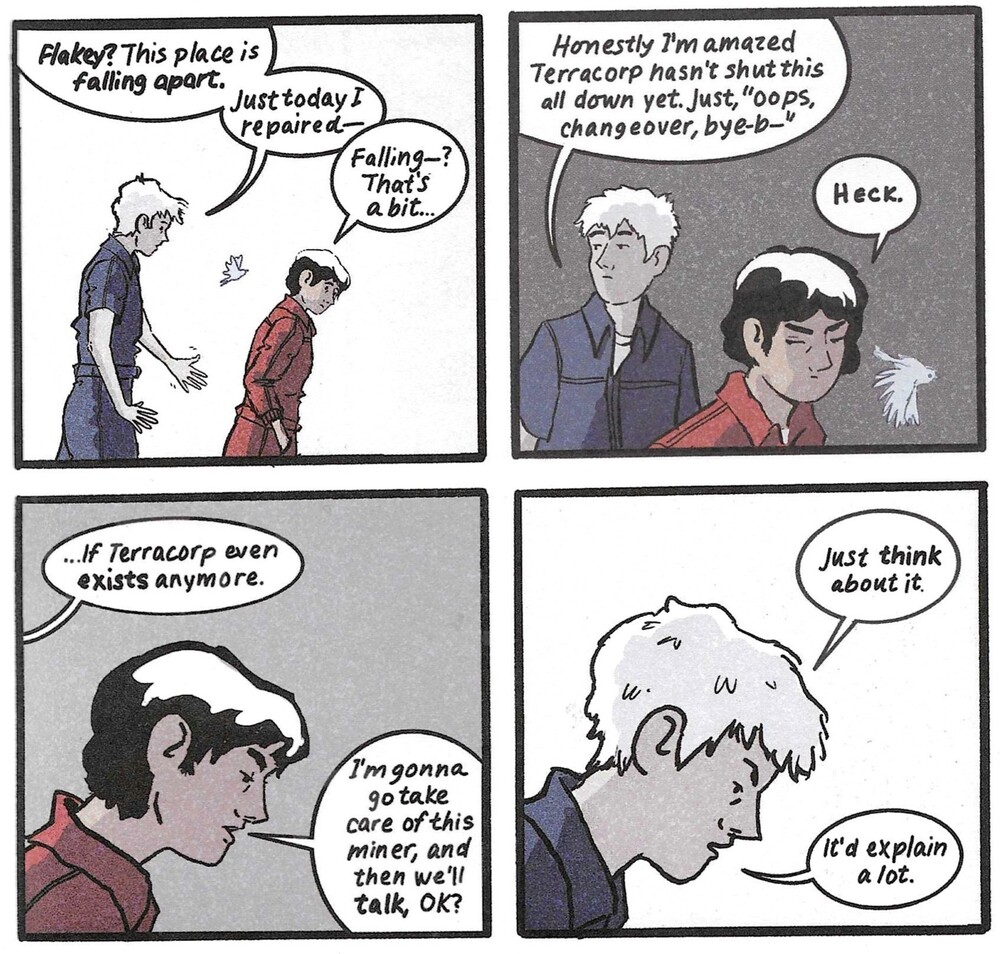 I forget how much good, wholesome, ‘Murican money I paid for it, but there you have it!
In the “Acknowledgements” at the end, Anderson writes that she was indebted to the movies of Andrei Tarkovsky, and while I’ve never seen a Tarkovsky movie (sorry, film nerds!), I know enough about him to know that it’s not surprising that Anderson feels indebted to them. Second Shift is a strange book, and, as I am quite dim, I’m not sure that I completely get it. Of course, it’s possible that I do get it and there’s just not much to actually get, but I feel that it’s more that I’m just not very bright.
The plot, such as it is, is pretty easy to unravel. Workers on a distant planet — Birdie and Heck — are awakened from suspended animation for their “shift” of toil, which seems to consist of making sure all the automation at their station is functioning properly. The job is a vast terraforming project, where materials are delivered by asteroids, which seem to be hurled at the planet, and which Birdie and Heck have to go scavenge afterward. The AI running the station — which they call, appropriately, Station — manifests itself as cute, blue animals, and Birdie and Heck go about their day. They play something like a real-life RPG game (as the AI can create environments for them to move around in) and Heck seems suspicious of the AI, because we should all be suspicious of AI, and life goes on. Then, one day, Heck hears a signal from somewhere on-world, so he goes off to explore, and Birdie feels compelled to follow him. They find what appears to be another, better-functioning station, with very realistic holograms and possibly better terraforming, and it throws them for a bit of a loop. Heck is already cynical about the company and what they’re doing, and this just makes him more so. 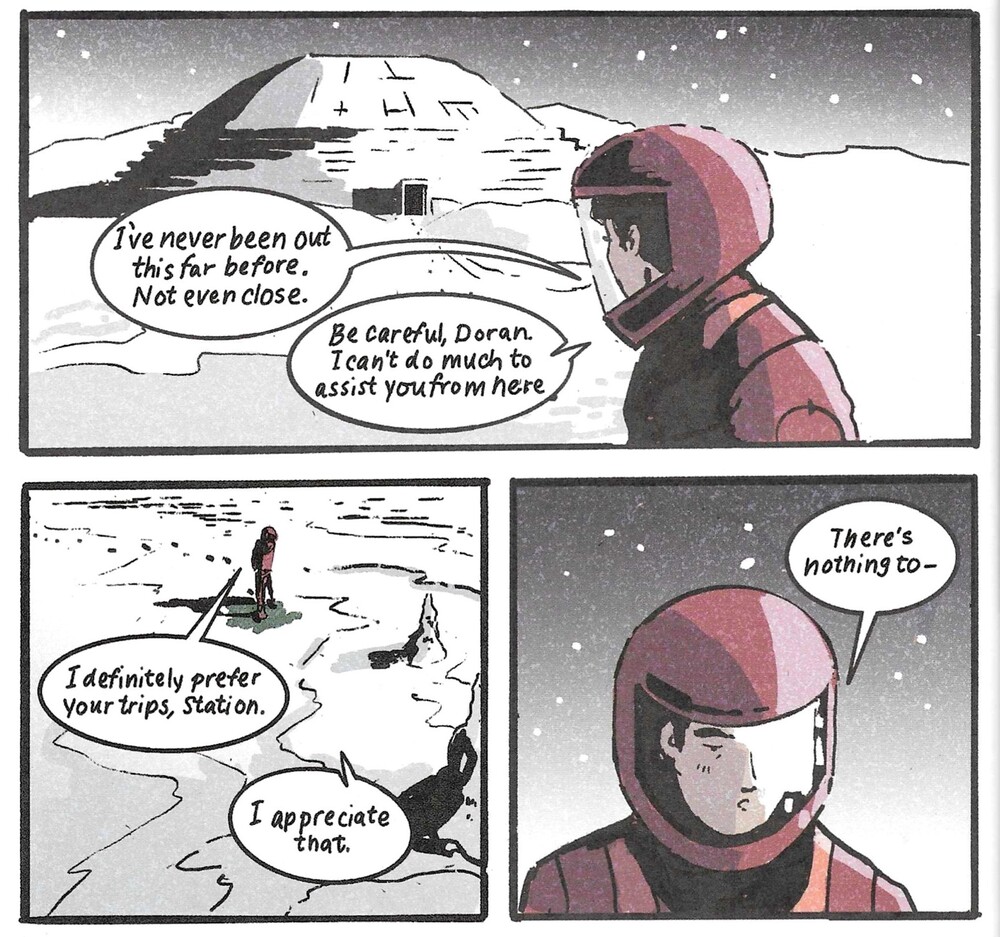 Heck wants to keep exploring, but Birdie thinks it would be better to simply do their jobs. Of course, things come to a head, but perhaps not in the way we’re expecting.
There’s a languid, casual pace to the book, as Anderson takes her time showing the world Birdie and Heck inhabit and what they do in their habitat. She doesn’t create a lot of tension, choosing instead to keep things at a very slow boil, as Birdie and Heck disagree, but not to the extent where it becomes a problem. The ending isn’t exactly a shock, but it is mildly surprising (when I can guess a good part of it, it’s not very mysterious, because I’m not good at that sort of thing), although it is possible I’m not quite understanding it. I guess my biggest problem with the course of the book — if I get it, that is — is that it doesn’t seem very compelling. Birdie is the main character (Heck is in it a lot, but it’s clearly told from her point of view), but she’s just not that interesting a person for me to really care what happens to her. Anderson is trying for a kind of tone of ennui and corporate disconnect and the loneliness we all feel even if we have someone who cares about us, and that’s fine, but because Birdie is kind of a blank slate, it doesn’t work as well as she wants it to. The other station has some possibilities, but it’s also not really dealt with in a satisfying manner, and the kind of insidious creepiness of Station is also ignored — it feels like a benign AI, but it also feels like there’s more to it, but Anderson isn’t interested in that. She’s going more for a vibe, it seems, than moving a plot along, and I can get behind that if it’s done well, but it’s hard to pull off. It feels like she sets things up well, but then just coasts, and the book bogs down a bit as we find out more about what’s going on. The payoff, such as it is, doesn’t feel earned, and the characters remain too opaque to overcome it.
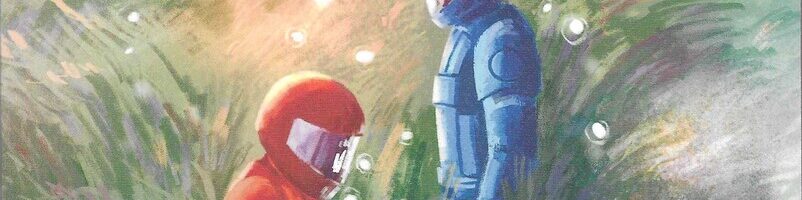
Anderson does decent work with the art. She has a rough, scratchy line that makes everything look a bit decrepit, which fits the tone of the story, and she does a very nice job with the RPG the characters play and the natural beauty of the other station. 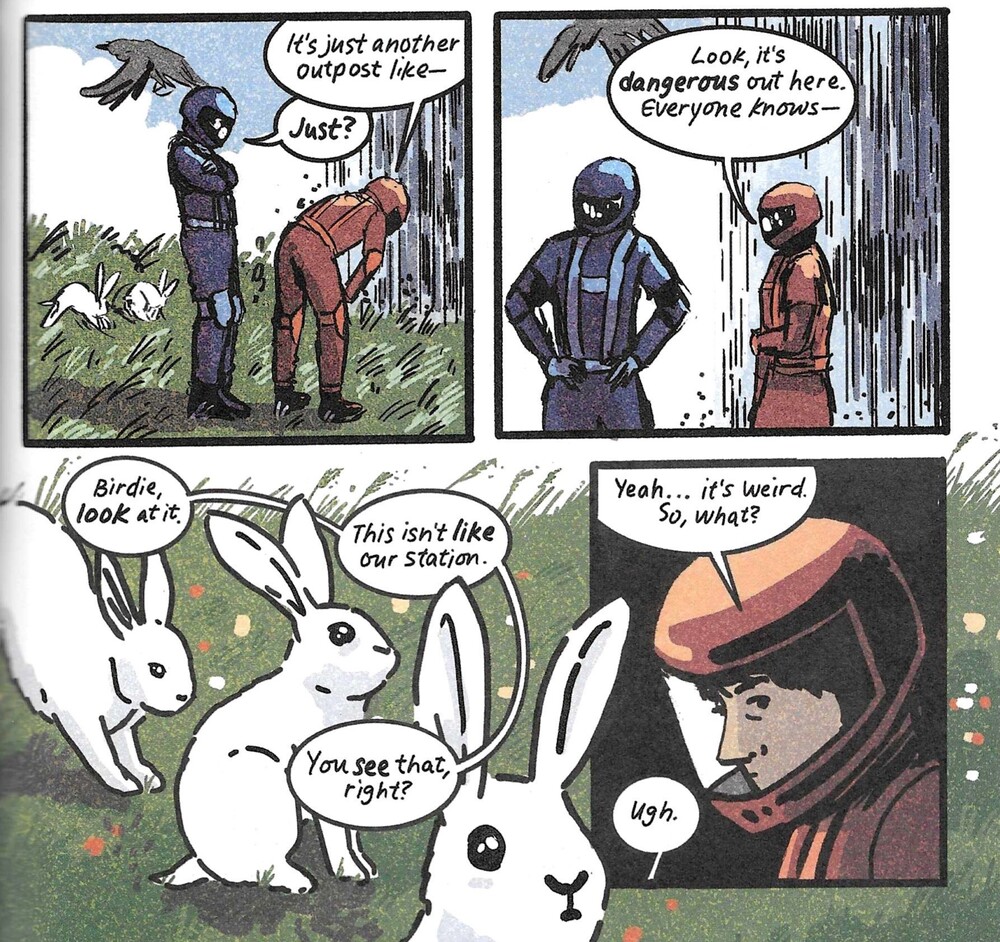 Her imagination runs a bit wild in some sequences, which is very neat, as it contrasts well with the fairly mundane existence Birdie and Heck live. She knows her way around perspective, which makes some panels a bit funky, as she tilts our perceptions of what’s going on nicely. Her colors are particularly nice — she uses splotchy watercolors to add some messiness to the panels, highlighting the difference between the antiseptic nature of Birdie’s station and the wildness of the new one, and she also spots blacks beautifully to add some dark corners to the world. The art is rough and a bit clunky, which is to be expected from a relatively neophyte artist, but it works well in the context of the book.
I’m always bummed when I don’t like a book more, especially when it’s by someone doing it on their own and doing something unusual. Anderson has the germ of a good idea and some decent storytelling chops, and I think her desire to be thought-provoking is admirable, I just don’t think she quite pulls it off. You may disagree — as with any book where the plot is secondary or even unimportant, you might have better thoughts about what she’s doing with the characters than I do. Either way, it’s an intriguing debut, even if I don’t love it. Such is life.
Rating: ★ ★ ★ ★ ★ ★ ☆ ☆ ☆ ☆
