

“Doesn’t take much to rip us into pieces”
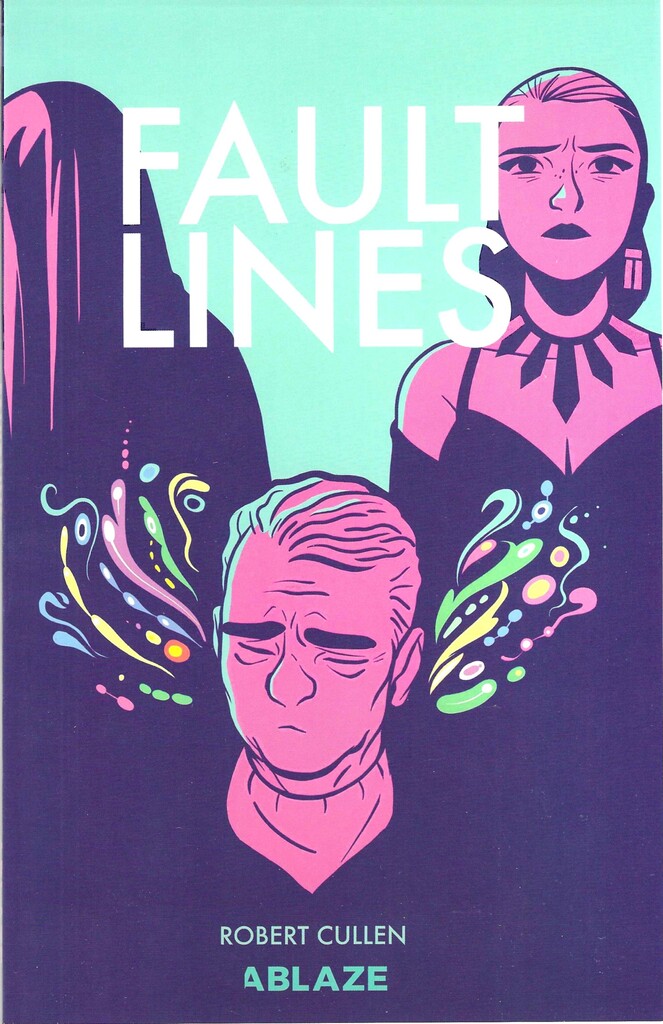
Ablaze is back, which is nice (they had some issues with distribution when Diamond imploded), as they often do some pretty good comics.  This time around we get Fault Lines by Robert Cullen, which costs $19.99 and is 114 pages long.
Fault Lines is a collection of three short stories that don’t have any connection to each other, except a bit thematically. The weakest one is the middle one, “How to Be a Ghost,” which is also the shortest one (22 pages) and it feels like the oldest one. It’s set in Vancouver in 1990, but it’s the only one that doesn’t feel like it’s in an actual setting — the others do feel like they’re in Blackpool and Glasgow/Edinburgh, but this one is just a wooded spot on a road and some generic places around a generic city. It’s also the most confusing one, as a woman and her daughter get in a car accident at the beginning, and Cullen tracks what happens after that. First, we believe that the mother died and, as a ghost, watched her daughter grow up, but then it switches, and perhaps it’s the daughter who died? Maybe? It’s a story about loss and how we process it, and it’s not bad at all, but it also feels a bit too perfunctory, which might be a function of its length. It feels like the twist is all, and while I don’t mind a good twist, there has to be something else there. The art is also a bit more rudimentary, as the faces are a bit more abstract and the backgrounds look a bit too sterile — Cullen uses thin, hard lines, so that’s not surprising, but with the other two, he varies his line weight a bit more and uses a tiny bit more hatching to add texture to it. Again, there’s nothing wrong with the artwork, but when we compare it to the other two, it feels a bit lesser.
The other two stories are more emotionally resonant and weighty, with some creepiness thrown in in the first story, “The Vanishing Act.” A young woman, Cathy, is an Irish girl in 1976 Blackpool, where she’s singing in a chorus line.  She’s saving money to move to London and becoming a singing star, but after she rejects two drunken dudes, they break into her flat and steal all her money (we don’t know it’s them, but it’s heavily implied). Desperate for money, she takes a job with Eric Cribbs, a magician who performs under the name The Great Dandini, whose big finale is when his assistant disappears from a box. As in, the woman disappears and never comes back. Cathy wonders why anyone would do it, and her friend who tells her about the job says that it doesn’t always work, and he pays really well, and you can quit anytime (she likens it to Russian roulette, which, yeah). So Cathy takes the job, and she finds out things are a bit weird — The Great Dandini performs to small crowds in private settings, and the audience is exclusively made up of men. This becomes an interesting take on the male gaze and how women are marginalized, and it’s pretty well done. Cathy figures some things out about what’s going on, and it’s nicely done, as Cullen does spell it out a bit, but kind of earns it anyway. The third story, “Siren,” begins in Edinburgh in 1981 and ends in Glasgow in the present day. In 1981, William Campbell and a friend, Andrew, are running out of a house that they clearly shouldn’t be in, and William gets hit by a car, lands on the side of his head, and loses his hearing. Forty years later, he’s an old man whose daughter, Abigail, takes care of him a bit as his wife, her mother, has died. One day, while he’s riding the bus, he begins hearing something — a “high pitched,” “sustained musical note,” that no one else can hear. He gets Abby to drive him around as he tries to pinpoint the source, and while she thinks he might be losing his grip on reality, she goes along with it. Unfortunately, the sound becomes cacophonous, but it does lead him to a place where he can figure out what the sound means. I’m not sure about the ending, which deals with guilt and how the sins of the past can affect the present and future, mainly because I’m not sure Cullen earns it, but it’s not a bad theme to work with. The question Cullen asks — Can we escape our past? — is certainly not a bad one, but I’m not sure if he quite gets to a point where he can end the story the way he does.
 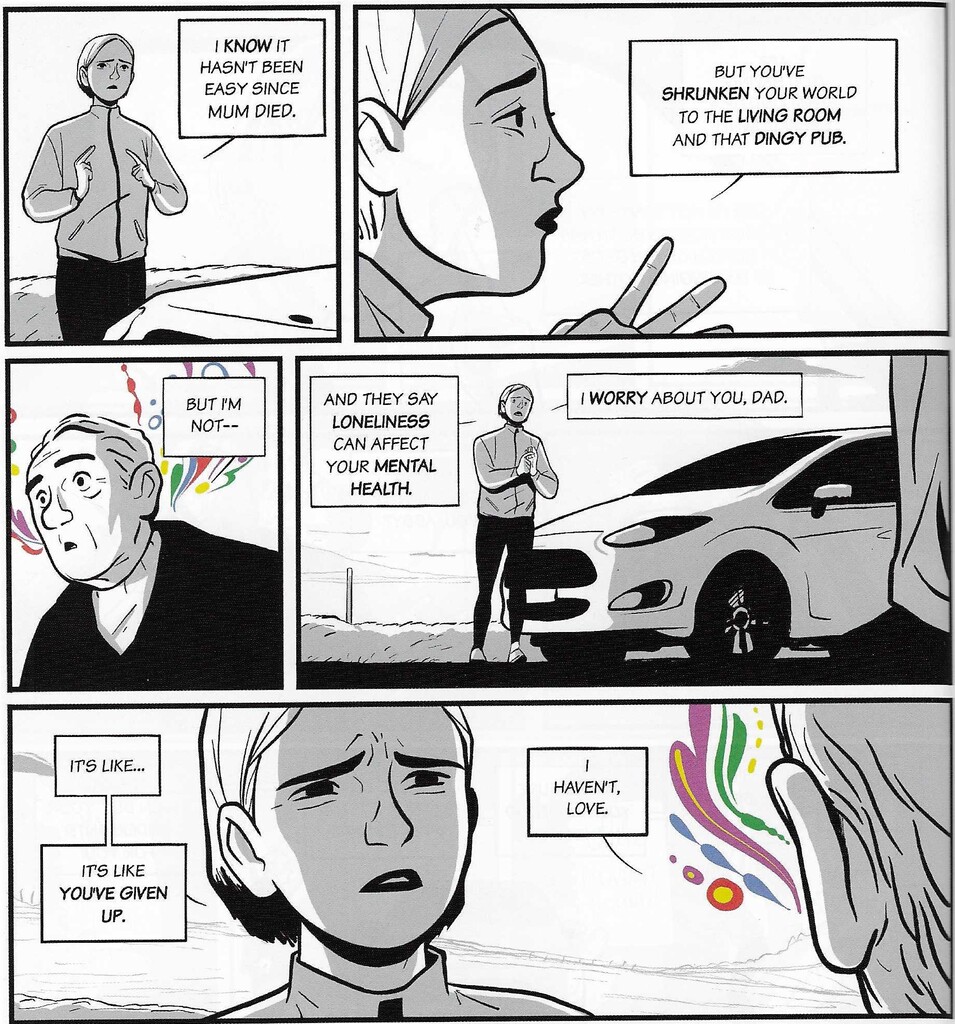 But it’s still a powerful story, as William and Abby come to a rather bleak crossroads that changes them deeply.
Cullen’s art is beautiful, too. I mentioned the middle story, which seems a bit more rudimentary, but there are neat ideas in it. The “negative space” of death is done well, and the way Cullen presents a “ghost” is interesting, as he simply colors an aura around the person to show that they’re out of step with the living world. In the first story, we get a lot of black, as the story is darker, and it makes Cathy’s journey inside the magic box — which is the fulcrum of the story — work very well, as Cullen uses the same “negative space” he uses in the second story to show that Cathy has stepped outside the world a bit. It’s also winter in Blackpool, and Cullen a really nice job of evoking the sadness of a summer resort town in the winter. The transformation of The Great Dandini from a mild-mannered magician into Ragey Dude is very nice, as Cullen does a good job showing the mask slip. In “Siren,” the use of color in what William is hearing is inspired, as is the cacophony that William begins to hear as they get closer to what he’s following. The ending, with Abby and William realizing the impact of what has happened, is brilliant, as William’s face remains set while Abby’s face changes a lot. The art is very nice, and it works very well for the understated tone of the stories.
Fault Lines is a nice, quiet comic about regular people experiencing some traumatic events and how they get through it. This is, as far as I can tell, Cullen’s first comic, and I’m looking forward to more!
Rating: ★ ★ ★ ★ ★ ★ ★ ½ ☆ ☆
