
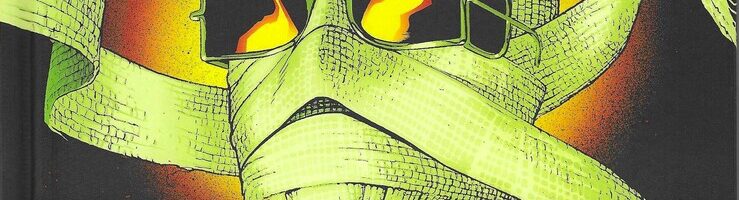
“I shout my name in the public places, no one seems to notice, no one understands”

As you might recall, these “Universal Monsters” books are comics based, not on the original sources, but the movies Universal made them into back in the 1930s, so The Invisible Man, for instance, is not based on the H.G. Wells book. It is brought to us by James Tynion IV, DaNi, Brad Simpson, and Becca Carey (with Alex Antone editing), and it’s 88 pages long and costs $24.99 (although it is a fancy hardcover, so I imagine the softcovers cost 20 bucks or so).
I’ve never seen The Invisible Man, but who can forget Ed Begley Jr. in the terrifying sequel …
… anyway, I’ve never seen it, but it seems like Tynion really went off-book here, which isn’t really a bad thing, but it still seems odd. The last comic in this series that I read, The Mummy, was very much aligned with the movie, but others, like Tynion’s Dracula, did not seem to follow the movie or book very much at all.  According to Wikipedia, this does not follow the plot of the movie at all, which is somewhat annoying. In fact, I wonder if Tynion has a sequel planned, because this seems to end where the movie begins, which makes this … ugh, an origin story. We don’t need an origin story, really — Jack Griffin is an egomaniacal scientist who goes nuts, and that’s all you really need to know — but at the same time, Tynion actually does a decent job with it. It’s not subtle, but he does some nice work with how some people feel invisible even if they’re, you know, completely visible. Griffin is a creep, sure, but he’s also a bit pathetic and sad, definitely a psychopath, but also someone who simply does not know how to function in society and believes he is therefore above it. People like this are sad because they believe that they embody the Nietzschean Übermensch, but they always allow their ego to get in the way and fail miserably. Griffin is a man who believes he is above the world and so can move invisibly through society even before he becomes physically invisible, but he also falls prey to base human emotions far too easily and we know he will eventually fail, although he does not in this comic (as it is an origin story, after all).
Tynion’s changes are interesting, because of what it does to the story itself. Griffin is a monstrous scientist, sure, but he never completely becomes a literal monster, which is an odd choice, as Tynion’s comic ends with almost a sympathy-inducing scene, which we should not feel for someone like Griffin. Despite his social anxiety and inferiority/superiority complex, he’s still a monster even without being invisible, and Tynion seems to be inviting us to feel some pity for him even though he did it all to himself and there’s no reason to blame his personality problems on it (I’m sure we all know someone — or are a person — who suffers from social anxiety and DOESN’T become an invisible monster). 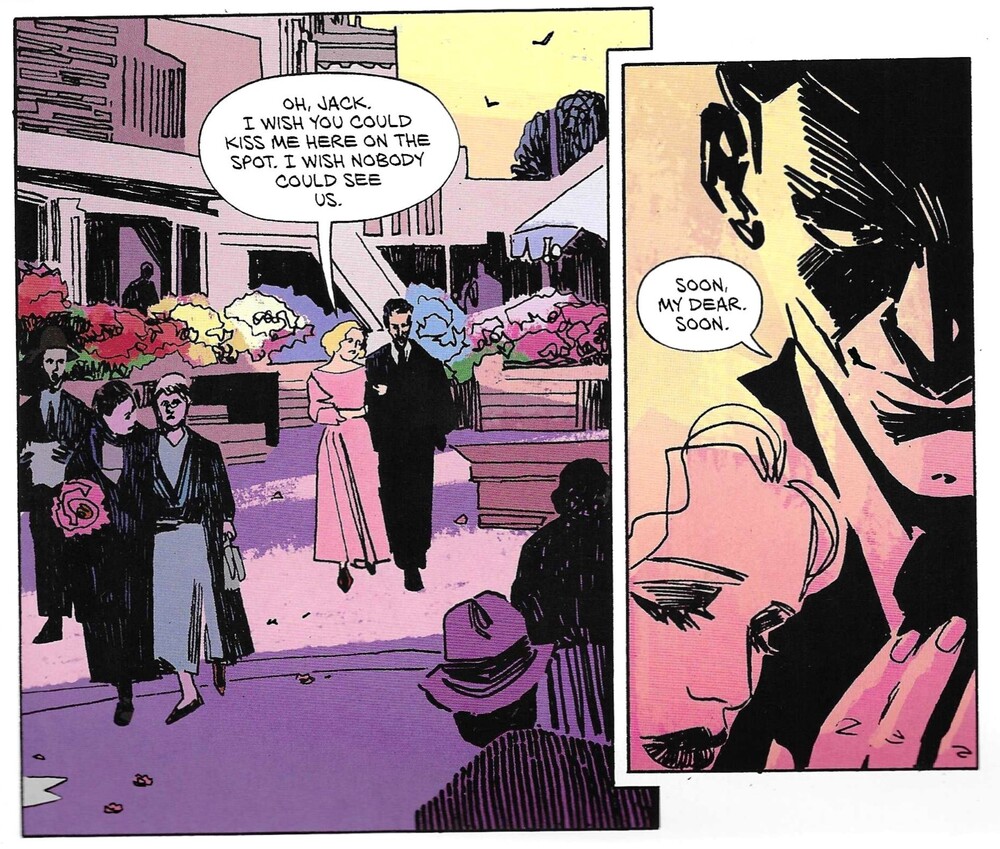 It’s an odd tone shift, but it does seem to fit with Tynion’s view that Griffin is part of a larger problem in society itself, that of people who can’t “play the game” and/or aren’t wealthy falling into invisibility. Griffin’s employer, Doctor Cranley, is wealthy enough to live in a nice house and employ two assistants to help him with his experiments, while Griffin notes that the other assistant, Kemp, has a “small family fortune,” the implication being that he’s just dabbling in the sciences, while Griffin is dependent on Cranley and his job. Cranley’s daughter, Flora, is an interesting character. She’s a daughter of privilege, obviously, and Griffin notes this: “I think what I liked most about Flora was that she didn’t quite see anybody around her. She made her decisions about them, and that was that. I can’t recall her ever asking me what I thought of anything. And I don’t think the answer would have particularly interested her.” Keeping in mind that Griffin is a highly unreliable narrator, this is still interesting because it implies that Flora, despite being his paramour, already thinks of him as partly “invisible,” and also that she can afford to ignore people as she chooses. However, she’s still a woman in a highly patriarchal society, so she herself is invisible — to Griffin, certainly, who doesn’t seem to extend her the same courtesy that he claims she does not extend to him, and to the other two men in the book, who think of her as an object. Again, Tynion is not subtle about this, but it’s still neat that he does this.
The lack of resolution of Griffin’s story is part of the “origin story” of it all, but it’s also because Tynion actually makes Griffin a more … responsible? scientist than the movie does (as far as I can tell from a plot summary). Griffin moves up the animal food chain until he reaches humans, and of course he wouldn’t test the formula on himself right away, so he finds a boy on the street and turns him into an invisible man (I guess this is a hint to the novel, where Griffin hires an assistant named Thomas — the boy in the comic is named Tommy — but he does not seem to experiment on Thomas in the book).  This is more scientifically believable than Griffin experimenting on himself, but Tommy, as we might expect, does not want to be invisible, so his invisibility — which doesn’t substitute for Griffin’s, but subsumes it a bit — has less of the atavistic power of Griffin thinking he’s a god among men. Tommy is terrified of his affliction, while Griffin revels in it … until, as I noted, the end, when he seems to come to some realizations about it that shift the tone a bit. Tynion turns Griffin almost into the hero, which is strange, as he baits a trap for his wayward experiment, doing it to save his own skin, naturally, in case Tommy’s invisibility comes to light, but also, in his mind, because he’s ridding the world of a menace (one he created, true, but a menace nonetheless). That Griffin is, once again, an unreliable narrator and there’s no indication that Tommy would do any of the vicious things that Griffin imagines he would do (and, in the classic and far-too-relevant example of “the accusation is the confession,” they are things Griffin himself would like to do) is certainly in the back of our mind, but it’s also true that Griffin believes himself the hero, and it’s a strange way for Tynion to write the climax of the book. The shape of the book and what Tynion is trying to do with Griffin is certainly not a bad idea — it turns the story from an out-and-out “mad scientist” one to a more psychological horror story, but I’m not sure if Tynion is skilled enough to pull it off. Violating Chekhov’s Gun can be fun, certainly, and I always appreciate it, but I’m not sure if you want to turn Griffin’s invisibility into a MacGuffin in a comic called “The Invisible Man.” It seems a bridge too far, even if for a lot of the book, it seems like Tynion can swing it.
There are, of course, no such issues with the art, because DaNi is just at the top of her game right now (although, of course, who knows what more heights she could reach as she continues!). She’s always had that rough look to her art that makes it work for dark and disturbing stories like this, but recently, it seems like she’s done a few neat things.  One, she’s added heavy hatching lines on faces and hair and clothes to add more texture. Two, she’s doing some thin line work on backgrounds where she does the thing where it appears she’s just using one line and never picking her pen up off the paper, which makes her backgrounds look a bit more impressionistic and unusual (I know she does take her pen off the paper, but the effect is there). Three, it appears she’s trusting the colorist a bit more and dropping more holding lines, which is always nifty to see. I don’t know if it’s a function of artists trusting colorists more, but it seems like some younger artists feel the need to use all the lines, when getting rid of some of them adds some cool atmosphere to the scenes. For all of these, I’m not sure if this is new for DaNi, because I’d have to go back to her earlier work to see, but it seems like, if it’s not new, she’s more confident with those elements. She also does a very cool negative space effect to show the invisibility in this book, which works superbly. DaNi has started working on what I imagine is her highest-profile book yet, Batwoman, and I hope it goes well for her, because she deserves a wider audience.
The Invisible Man is an interesting yet frustrating book. It really does feel like Tynion wants to write “part two” without telling us he wanted to, and I don’t know if Image will let him, as these “Universal Monsters” things all seem like one-story deals so far. There’s a lot of nifty stuff in here and the art is great, it just feels incomplete. That’s not a great vibe, man!
Rating: ★ ★ ★ ★ ★ ★ ★ ½ ☆ ☆

For the record, none of these Universal Monster books have come out in softcover yet. I’ve been tempted by previous series, but was hoping for paperbacks. I gave in and ordered this one, mainly for DaNi’s art– she’s quickly become one of my favorites. She’s going to make me buy Batwoman, too.
Weird that they haven’t done softcovers yet, as it seems these would sell fairly well. I should have put that in the future tense, though, so I apologize!
Yeah, DaNi is pretty great, and yeah, that first issue of Batwoman looked cool as heck.