
“It’s been my death since I was born, I don’t remember half the time if I’m hiding or I’m lost”

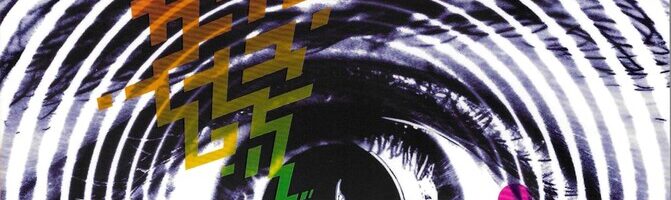
Mad Cave continues to crank out the comics (I heard something bad about Mad Cave, but it was very vague and I have no idea what it is and I’m not inclined to find out — as long as they put out comics that sound interesting, I’ll keep buying them!), as we get Wag, which is by Scott Hoffman (writer), Juan Bobillo (artist), Steve Wands (letterer), and Greg Lockhard and Will Dennis (editors).  It’s a Comixology book, so you can find it on Amazon, I guess, but you can get the trade, too. This is $19.99 and it’s 120 pages long.
I’m not sure why stories set after the apocalypse are catnip to writers. I don’t mind them, certainly, but I don’t love them, either. It seems like, recently, it’s for the same reason writers set comics in the 1980s — the lack of cell phones, which means that the characters can’t get information instantly and stay connected with each other. Writes like the idea of a sole character (or small group) battling against impossible odds, and that seems hard to do in the modern world, when you can get assistance in so many ways. I dunno. I’m not sure why sending people out into a world that has fallen apart is so enticing to writers — I mean, sure, that’s the stuff of fiction, I get it — but it does feel like it’s … easier somehow? You can kind of have a ready-made plot, which allows writers to be lazier? This book, for instance, doesn’t do too much with the post-apocalyptic setting besides allowing Bobillo to draw a lot of wreckage. There’s no reason why it happened (it just did) and as we move through the plot, it seems like Hoffman is trying to tie whatever happened to Wag, our main character, into what happened to the world, but he does it in such a vague and oblique manner and the “villain” kind of rambles about what happened, and it makes little sense. It feels like it’s supposed to be an indictment of the interconnectedness of the modern world, which, sure (ironic that Hoffman’s comic was available first on a digital platform), but it’s so imprecise that it doesn’t really land. Our guy Wag lives in a hut out in the wasteland, and one night three dudes wearing old-fashioned diving suits try to steal his nice roasted squirrel. Wag is a good fighter, though, so he kills two of them but spares the young woman who manages to get out that she was roped into the scheme against her will. 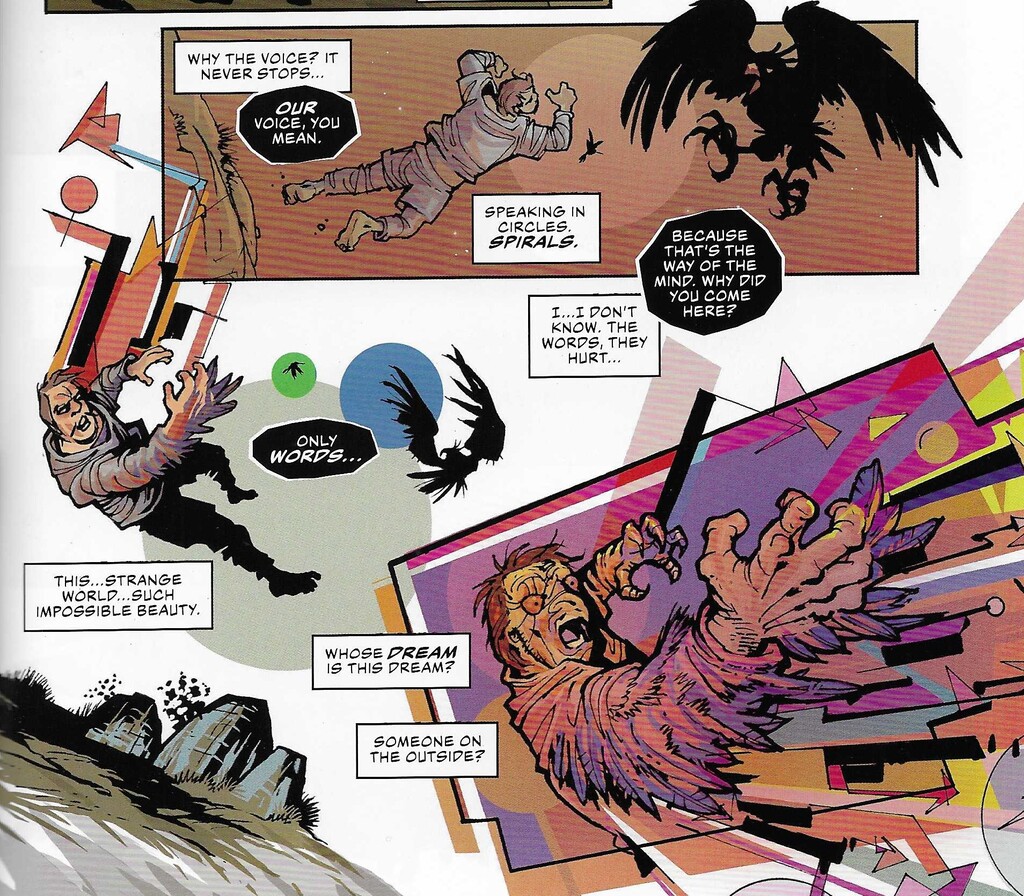 He spares Lin, and she tells him that she knows how to get some more of the medication he says he needs, so off they go. Along the way, they meet up with Guido, who’s says he’s a “healer” and knows how to get to the Big City to find meds for Wag, and then Sas, a girl who seems to have some interesting similarities, ability-wise, to Wag. Wag isn’t sure what happened to him when he was a kid, but something odd happened, and he’s beginning to remember as they get closer to the Big City, which is where he grew up. There’s something going on with birds, too, which comes into play. What is it? You’ll have to read to find out!
The problem with the story is that there’s nothing really new or interesting about it. The characters are fine, the plot is fine, the resolution isn’t great, but there’s some excitement in the story and Hoffman doesn’t screw it up too much, even if his ultimate point doesn’t really work. Wag’s weirdness works pretty well, and Hoffman does a decent job showing his sadness as he tries to figure out what happened to him and why he’s the way he is. Lin is kind of interesting, as she bonds in kind of a maternal or sisterly way with Sas. The villain is kind of creepy, sure, but they still don’t work too well. It’s not a bad story, you understand, but it is a bit limp.
For some reason, Bobillo never made a huge dent in the American comics scene, and I’m not sure if it was him or the American comics scene rejecting him. 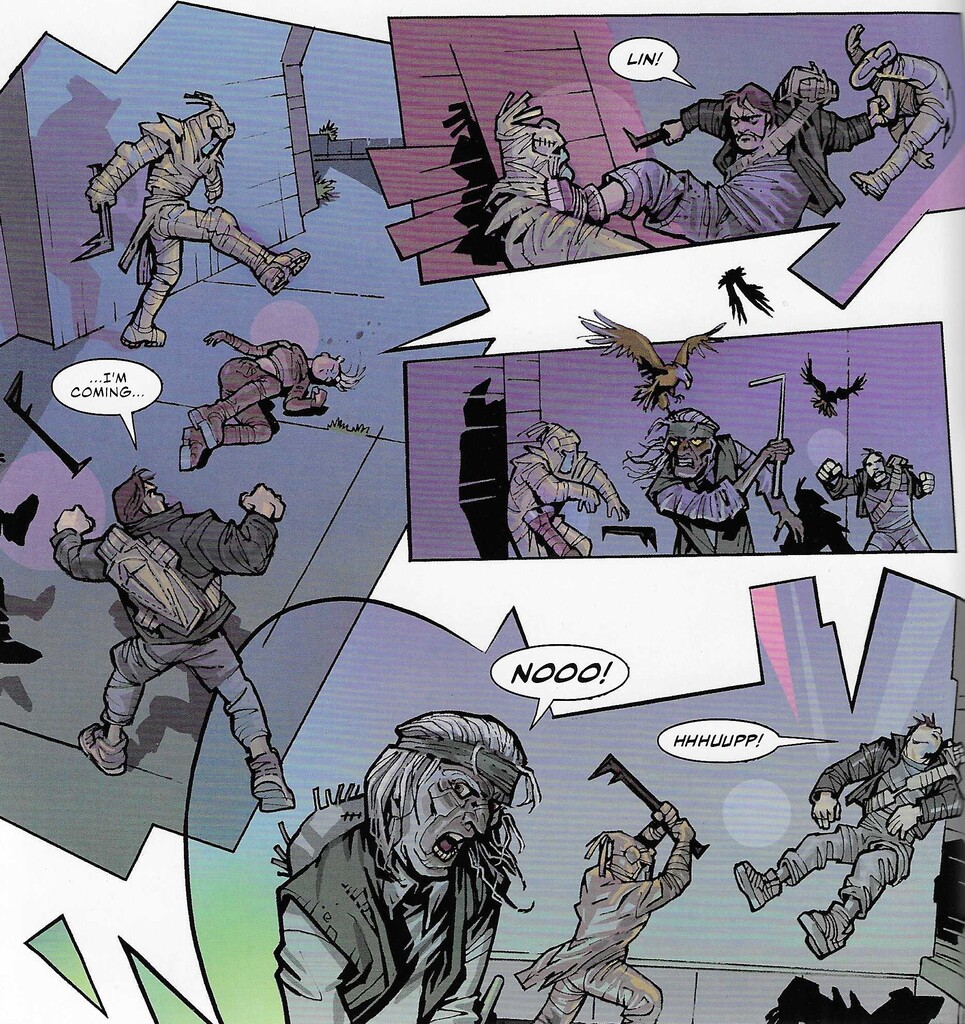 His work on She-Hulk is very good, and his European stuff is good as well, but he just didn’t become a thing in ‘Murica. His art on this book is magnificent, though, and a big enticement to get it. His wasteland is both horrible and fully realized, as humanity has begun to re-organize itself. While things look terrible, Bobillo does a nice job showing how the survivors have carved out a rudimentary civilization even as evil things roam the land. His characters are interesting, and the evil grunts that cause a lot of problems are weird and creepy, as well. Bobillo does a good job showing how new things have been cobbled together from the wreckage of the old, and he does a nice job contrasting it to Wag’s childhood, which shows a sleeker and more modern civilization. He does a really nice job with the birds and how they flock, as it’s both natural and unnatural — I mean, it’s how birds fly, sure, but because it’s in this story, the birds take on a sinister aspect, too. The violence and destruction is really well done, too, as Bobillo does an excellent job making it personal for Wag. He shifts the style at times, too, with odd panels and some neat coloring tricks to make sections of the story a bit more hallucinogenic. Bobillo is really good on this book, and it would be nice if he could do more comics that are more accessible here in the colonies.
Wag is a bit disappointing, because Hoffman doesn’t do enough with the post-apocalyptic setting. It looks great, and it’s not an awful story, but it is a bit of a letdown. Oh well.
Rating: ★ ★ ★ ★ ★ ★ ☆ ☆ ☆ ☆
