
Recently, I re-read White Noise, probably my favorite book, to my daughter at her bedtime, and I was reminded again why I love it so much and how freakin’ good it is. And over Christmas, my parents visited, and as they had moved out of their old house and into a smaller place, I had gone back a few years ago to find things that I might want (either old stuff of mine or theirs, as my father had collected a lot of books over the years and couldn’t fit them all into the new place), and they brought the last of that stuff out this time, and I saw some books that I did sort but hadn’t read since I was a kid. I started thinking about stuff I read many years ago, either when I was a kid or just a younger adult, and hadn’t revisited since, and I wondered what I would think of it now. And so a new category was born, where I read (mostly read, although I will probably try to watch some television from when I was a kid — I always watch old movies and read old comics, so they don’t really fit here) stuff I first read years ago and see what’s what. I’m going to try to post these on the Thursdays when I don’t do the Wizard posts, but we’ll see. First up: three (of the four, but I don’t own the fourth) of the novels of Ellen Raskin!
Raskin was an artist who designed dust jackets (including the original one for A Wrinkle in Time), wrote picture books for very young children, and illustrated others’ children’s books in her relatively short life (she died at 56). She also wrote four novels, which were published in 1971, 1974, 1975, and 1978, respectively. If you know Raskin, you probably know her from her final novel, The Westing Game, which won the Newbery Medal in 1979. That was the first one I read by her, but I don’t think it’s her best one. Let’s take a look at them!
(The fourth one, which I don’t own and have never read, is her second, Figgs and Phantoms. I’d like to get around to it one day!)
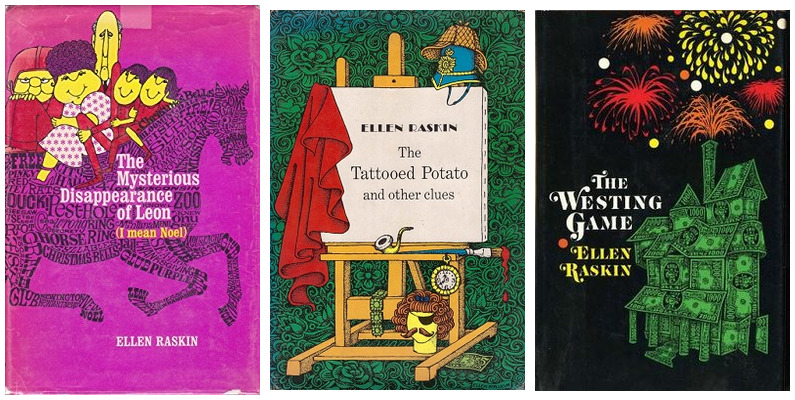
Her first novel, The Mysterious Disappearance of Leon (I Mean Noel), is clearly the roughest of the three I own. It’s not a bad book by any means, but it’s clearly pitched to a younger audience, and it shows. It’s a fun book to revisit, but it’s my least favorite of the three. In the two other books, Raskin still writes for kids, but her writing is much more assured and emotionally resonant, and her characters are much more interesting and multi-faceted. In this book, it feels like she had a goofy idea and tried to build outward from it. I imagine she had good ideas for the next two, as well, but they feel much more grounded and she allows the plot to come to them. In TMDoL(IMN), she almost bullies the characters into acting out the plot.
The plot is fun, though. Two farming families, the Fishes and the Carillons (the Fishes grow tomatoes, the Carillons grow potatoes), live next door to each other, and during one particularly difficult winter (well, Thanksgiving, but it was already snowy), the wives made a potato-tomato (or is it tomato-potato?) soup that the husbands agreed was marvelous and would make them millionaires. The husbands could not agree on what to brand the “pomato” soup (no one asked the wives, naturally), and so they did the only logical thing: married the Fish daughter, Caroline (also known as Little Dumpling) to Leon, the Carillon son. That the girl was five years old and the son seven didn’t seem to come into consideration. Once that happened, both kids were named “Carillon,” and the dispute was solved. Leon was sent away to school, Caroline was called “Mrs. Carillon” from then on (her father couldn’t pronounce “Caroline Carillon”), and the kids were separated until Leon would turn 21. He sent his wife some notes over the years, including one telling her he had changed his name to “Noel,” and when she went to finally see him, they had a boating accident and Leon (Noel) went into the ocean, spouting part of a cryptic message as he did. They were rescued, but when Mrs. Carillon woke up, Leon (Noel) had vanished from the hospital. She made it her life’s work to decode the message and find him.
Raskin has fun with the story, as Mrs. Carillon spends her days going to places where she thinks Leon (Noel) told her to go in his message, and eventually, she adopts a pair of twins who help her out and offer their own perspective on the message. She doesn’t need to work due to the profits from the soup, which is hugely popular, and she never once thinks her husband is dead, even though the company’s accountant tries to get her to admit that. She tries to interpret the message as best she can, and when she does, she hones in on what she thinks Leon (Noel) was trying to say, although the twins — Tina and Tony — eventually are old enough to help in her quest, and they’re not so sure she did actually interpret the message correctly. Mrs. Carillon continues in her quest, but the twins keep trying to figure out ways to get her to settle down, because they’re tired of the peripatetic life Mrs. Carillon (and now they) live. They figure out ways to interpret the message that will get her to stay in one place, and eventually, she does, and different people enter or even re-enter her life. Mrs. Carillon, of course, wants to find out what happened to her husband, but it’s because she is desperate for a family, having been treated so shabbily by hers. It takes her a long time to realize that she’s built up a family of her own, which is the entire point of the book, but she gets there eventually. We do find out what happened to Leon (Noel), but it’s almost — almost — incidental to the theme.
Raskin has fun with the writing — she has footnotes to note that on a certain page, you can find a clue to the answer to the mystery, and the mystery itself is pretty interesting (even if slightly incidental). It’s clearly written for a younger audience, but it’s not dumbed down at all, as Raskin expects you to keep up. She does circle back to things to explain them, of course, but not annoyingly so. It’s a nice amuse-bouche for her other books!
I’m going to skip the second book (her third) and go to The Westing Game next, because I want to write about my favorite last. The Westing Game, if you don’t know, is a marvelous mystery that works pretty darned well as a “fair play” story — if you re-read it knowing what’s coming, you can see the clues pretty clearly, but the first time through, it seems impenetrable (although maybe smarter readers than I sussed it out when they were young). A group of tenants of an apartment building in Wisconsin, who all moved in around the same time, are invited to the reading of the will of the industrialist who lived in the mansion on the hill behind their home, and when the will is read, they’re told they need to play the industrialist’s game to get their inheritance … and solve his murder! As the book goes along, we discover that many of the residents have connections to the dead industrialist — Sam Westing — and they were chosen to live in the building because of that. They are paired off, given clues, and told they need to figure it out. Some are very into the game — the main character of the book (as much as the book has one), is a girl named Turtle, who takes the game very seriously — and some are not, but they all play it in one way or another. Raskin does a really nice job with the characters — Turtle’s mother is a social climber obsessed with appearances, and her older sister is the perfect child who’s going to marry a doctor. The two restauranteurs — the Chinese man running a Chinese restaurant on the top floor, the Greek man running a coffee shop in the lobby — are engaged in a one-sided rivalry (the Greek man does not seem to know the Chinese man resents him), and their sons are friends with each other. The Chinese man’s son, Doug, is a world-class runner, while Theo is more studious, and he takes care of his younger brother, who has some form of epilepsy. There’s an obnoxious secretary who’s paired with Turtle’s sister and helps her come out of her mother’s shadow, there’s a judge who’s paired with the affable doorman, there’s the quiet cleaning lady who’s paired with an annoying delivery man, both of whom have a secret life. It’s a terrific book — Raskin takes these somewhat stereotypical characters and gives them real depth and emotional resonance, and it’s very neat to see them grow and change over the course of the book. What’s very neat about reading the book as an adult is how much subtext is in it. Raskin dives into things like how society dictates how we act, how we hide behind façades because we’re afraid of mockery, how childhood issues can form so much of who we are as adults, and how the wealthy believe they are above the law. Turtle’s mother is the most obvious example of trying to conform to what society says we should be, but she’s not the only one. I don’t know what books were considered for the Newbery Medal when it won, but it’s definitely worthy of the award.
However, my favorite Raskin book is The Tattooed Potato and Other Clues, which wrecks me every time I read it (which is often; these books are not super-long and, as I’ve noted, they’re written for a younger audience, so you can zip through them pretty briskly, and I do every once in a while). The protagonist, Dickory Dock, arrives at a brownstone in New York to get a job as an assistant a mildly famous society painter. Dickory wants to be a painter herself, so she thinks this will be good experience. The painter, Garson, rents out the ground-floor apartment to a couple of ugly and mean-spirited men, whom Dickory rarely sees but speculates about often. Also in the house lives a large, misshapen man, who was clearly in some kind of accident that left him physically scarred and mentally damaged. Dickory very much appreciates that Garson doesn’t make fun of her name, something that cannot be said for others in the story, and she comes to like him, even though she doesn’t think much of his painting talent. She also finds out early on that Garson is lying about his background, and she wonders very much about that. Early on in the book, the “Chief of Detectives” for the New York City Police Department shows up at their door and asks Garson to help him with a case. He returns for other cases, all of which are very strange and even a bit humorous. But Dickory knows there’s something weirder going on in the brownstone, she just can’t figure out what it is.
It’s a wonderful book. Dickory is an interesting character — she has her own trauma in her past, and that informs her present and makes it difficult for her to trust anyone, so even if someone is nice to her, she’s suspicious. The cases Chief Quinn brings to Garson are wacky, sure, but they also tie into the theme of the book, which is hiding who you are because being who you are is too painful. Dickory meets some of Garson’s clients, including a man who has an extensive modern art collection, which leads her to the tragedies in the lives of the characters. Garson and Dickory take on roles to play as they solve the mysteries, Garson becoming “Inspector Noserag” and Dickory becoming “Sergeant Kod,” which seems like an amusing game at first but Dickory realizes is just another way for Garson to hide … from what, she doesn’t know. Who is the accident victim in the basement? Who are the cruel men in the apartment? Of course, it’s all connected!
Raskin toys with secrets and hidden lives and deception in all her novels (well, the three that I’ve read), but in the other two, they’re not played as devastatingly torturous as they are here. In TMDoL(IMN), the deception is almost played for laughs, and while TWG is emotional at times, it’s much more about the puzzle box. The Tattooed Potato has its mysteries, certainly, but they’re in service to the tragedies that plague these characters, and it makes the moments when they come to light that much more gripping and horrible. As we learn more about Garson and Dickory and the other characters, we get so invested in them that even small moments hit hard. Raskin brings in the idea of art and what is true art and what it means and even how dangerous it can be, which is not something you usually read about in a book for younger audiences. Characters who begin as somewhat goofy side characters, such as Dickory’s classmate and the art collector’s wife, gain depth as we go along and help illuminate what Raskin is saying about art. The final pages are ultimately uplifting (I mean, it’s still a YA book from the 1970s, so it’s not going to be too dark), but they’re also powerfully honest about what art does for the soul and how important it is and whether it is important and what people want from it. Raskin’s descriptions of art and of Dickory’s emotional torment are very well done and tear at you, because they’re so real.
I still love these books, even if they’re written for teenagers (and even young-ish teens at that). They’re very clever, very intricate, and far deeper than you might think. If you only read one of them, I would read The Tattooed Potato, but why would you only read one? Get all three and buzz through them in a nice, long afternoon/evening of reading. You don’t have to watch another dull superhero movie, you know!!!!
Next time: Beats me. We shall see!
