

[You can find this column, from 4 July 2008, here, and you can be sure there are a bunch of comments! Also, this is the first of a kind of two-parter, as Greg was responding to Joe Rice’s column about kids’ comics (which I linked to below) and he went a little long with this, so he finished up the next week. I’ve already reprinted that column, back in 2023, because it was much more about “current comics” than Bronze Age ones, which I’m reprinting now. If you go to that link, you can get the link to the original column, which I could not find back in 2023 but managed to dig up this time. The comments on both columns (and Joe’s, too) are fast and furious! Enjoy!]
This is another one that bounces all over the place, so bear with me.
There’s a story that Lillian Hellman used to tell about Dashiell Hammett, a time when he was reading one of her early plays. As he read it, his scowl got progressively more fierce, until finally he hurled the manuscript down and cursed. She was horrified and asked him, “Was it that bad?”
“It’s worse than bad,” Hammett gritted. “It’s almost good.”
That’s how I feel in recent years, every time I see what Marvel and DC are trying to do as their “kid’s comics.”
I love that they are trying. Seriously, I do. There should be superhero comics out there that kids can enjoy. And to be fair a lot of the time DC and Marvel have the basic idea right. And then … they make a mistake so elemental, so maddeningly bone-stupid, that it negates the whole effort.
It’s at that moment that I completely understand Hammett’s annoyance. Because to get so close to something wonderful and then just boff it … that really is far more frustrating than to see someone who’s clearly messed it up from the get-go.
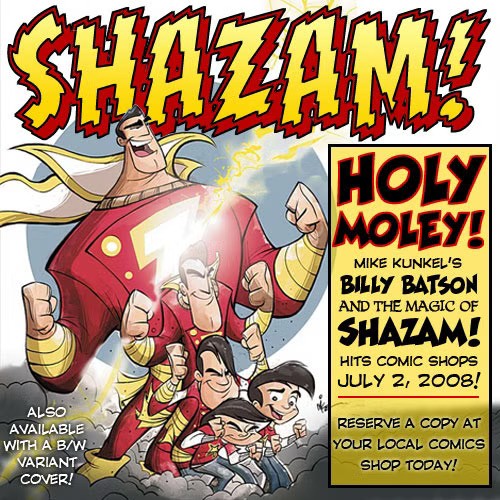
I’d been meaning to talk about this for a while anyway, but since Joe Rice clearly touched some kind of a nerve yesterday with his column about Mike Kunkel’s new Captain Marvel book, I thought I might as well get to it now.
But first, as usual, a brief reminiscence.
*
Seeing as how today is the Fourth of July, it’s oddly appropriate that Joe’s grumping about the new Captain Marvel book inadvertently reminded me of one of the most hellish of American family traditions … being forced to eat at the kids’ table.
In our family, when we’d go over to my grandparents’ house for the big barbecue on the Fourth, my uncle Vance would show up with this hideous yellow-and-orange flowered aluminum valise thing that unfolded into a rickety picnic table about two feet tall. That was the kids’ table.
I hated it.
Part of it was that I was the oldest of the ‘kids’ (my cousins Mike and Jim were in high school, they got to eat with the grown-ups and Jim was even allowed a beer.) So I was always held responsible for my brother and younger cousins. Part of it was just the damn table itself, which was cramped and uncomfortable if you were over the age of seven. Part of it was simply that in my family, gatherings always had a way of going sour no matter where you sat.
But the specifics don’t matter. I bet if you were ever consigned to the exile of the “kids’ table” at your family gatherings, you learned to hate it too.
Because if there’s anything that kids hate, it’s being told that they’re just kids.
This is the part where the wheels always come off the wagon for Marvel and DC when they are doing these ‘all-ages’/’Johnny DC’/whatever titles. Considering the entire superhero industry is run by aging fans, fans who are so obsessed with making sure superheroes get taken “seriously” that the sex and violence quotient of your average spandex book is through the roof … how is it that these same fans can’t remember what it felt like to actually be a kid getting into superheroes and fantastic adventure?
I’m assuming if you’ve gotten this far, you’re a comics fan. Okay. Think back, all of you reading this. What was your first experience with the Real Stuff, the comic that turned your casual reading/hobby/pastime into a passion?
I can tell you exactly what mine were. I’ve spoken before [Edit: We’ll get to that down the road!] of how TV’s version of the DC characters, and Batman in particular, were a gateway to the comic books for me. And make no mistake, I loved comic books from the moment I set eyes on one.
But there was also a time, in the early seventies, when I was thinking maybe I’d outgrown them.
This was back when comic books were considered fit only for ‘little’ kids, remember. And I was about to enter junior high, I wasn’t a little kid any more.
Apart from all that, comics were a liability for me in many ways, as much as I loved them. I was already one of those nerdy types that got picked on and pushed around at school, and I’d learned back in the fourth grade that taking a comic book to school was a good way to get it taken away from me and torn up by some playground thug. My parents were always after me to give them up too. As a result, my funnybook reading was a bit furtive, something I kept private so I wouldn’t have to defend it. The older I got, the more defensive I felt about it.
Watching the Adam West Batman surfing against the Joker in afternoon syndicated reruns, I couldn’t help but feel that maybe all those people jeering at superheroes had a point.
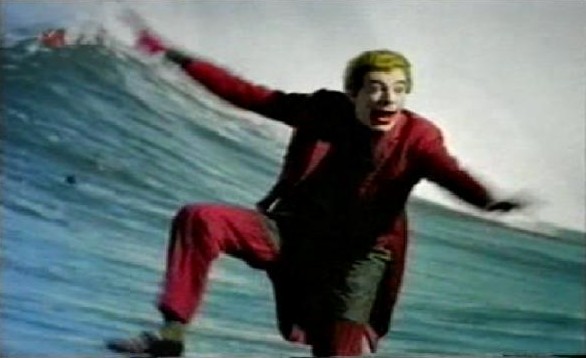
Maybe it was time to let Batman and the other super-guys go. Maybe … maybe I really was too old for them. After all, I was in double digits now … I was ten.
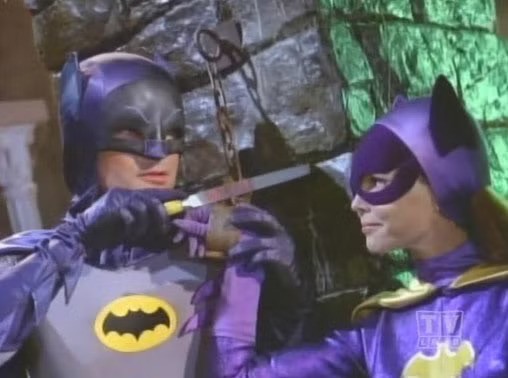
Actually, in June of 1971, I was ten and a half. (Remember how important it was when you were younger to get that half-year in there?)
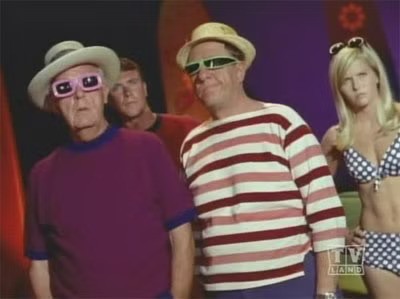
And at ten (and a HALF!) I had begun to think that yes, perhaps it was time to put such childish things behind me. How could I ever have thought this silly stuff was cool?
But then I found this comic on a spinner rack at a grocery store — and it made such an impression on me. We were on vacation in Oregon, up on Mt. Hood, and we had stopped at the Thriftway Market in Wemme. I had been given a quarter to spend and of course I sprinted for the comics. (I wasn’t quite ready to quit cold turkey, especially since I was far away from school where I might get laughed at. It was an oddly guilty moment, like sneaking a cigarette.)
Anyway, this caught my eye.

I saw this cover, I spent my quarter … and I fell and fell hard. This was my first encounter with what we Bronze Age kids learned very quickly to call “THE Batman.”
I sort of knew that Batman had gotten revamped with a longer cape or something from reading Justice League of America, but this was the first time I’d looked at a Batman solo comic in a while. And it was a revelation. This was everything that was cool about Batman, and all the corny parts were gone.
Of course, we all know now that “Half an Evil” is a Denny O’Neil/Neal Adams classic, it’s been reprinted all over the place. But let me add that a big part of the total impact this book had on me was due to the backup story by Mike Friedrich and Irv Novick, featuring Robin (the TEEN Wonder) in a solo adventure called “Vengeance For A Cop!” that had our boy all grown up and investigating a shooting on a hippie commune. There wasn’t a whiff of Burt Ward’s Holy Whatever about it.
That was it. I was in love all over again. I was back for the next issue, because I had to see how Robin worked it out with the hippies and who the killer was. And here again was another clearly non-kids’-table cover with a kind of Batman I’d never seen.

And the Robin backup was cool too. (I’m sorry I don’t have scans of the pages here, but you can find the stories, they’re reprinted in the Robin Showcase volume.) They haven’t aged quite as well as the O’Neil/Adams classics, it’s true … but try to imagine the way that stuff would read to a ten-year-old kid in 1971, living in a time when campus riots and hippies and teenage revolution were all front-page news. Robin the Teen Wonder, holding his own, in a story ripped from the headlines!
And the next month? This one.
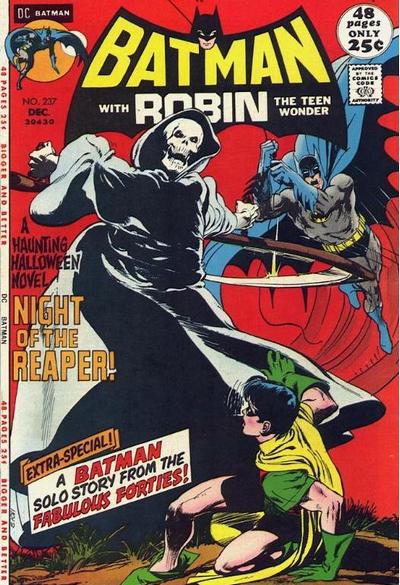
“Night of the Reaper.” A Batman and Robin story like I’d never seen before in my life.

I know I’m getting a little carried away, but I found some cool scans to refresh your memory if you haven’t looked at this stuff recently.
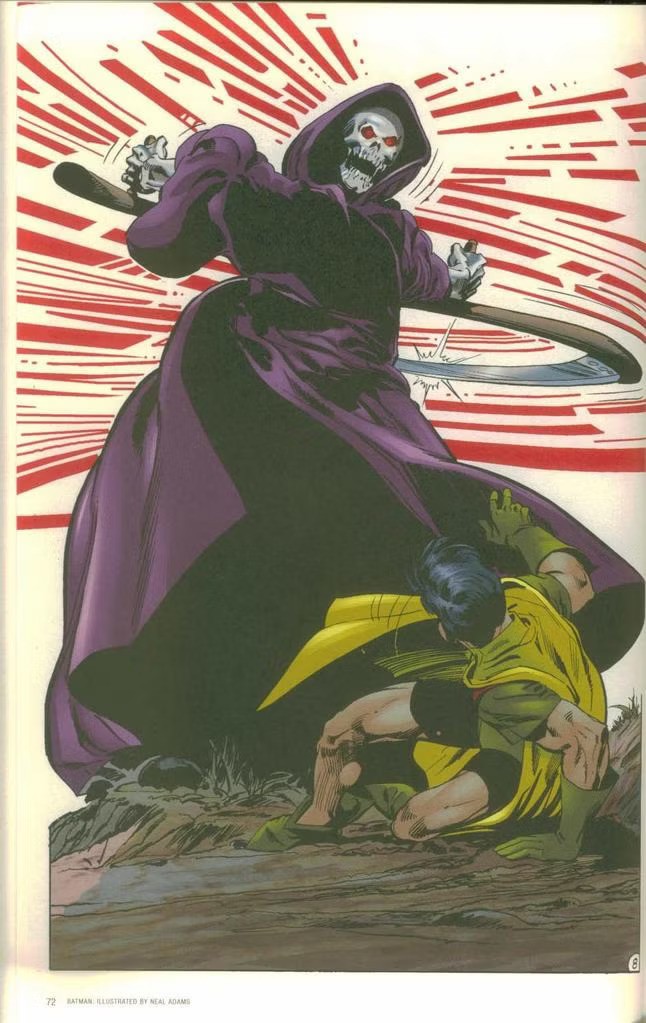
Still with me? Try to wrap your head around what it would be like for a ten-year-old boy, whose primary experience of Robin the Boy Wonder was Burt Ward, to be suddenly faced with this kind of approach. It was fresh, it was exciting, and it was definitely NOT the kid’s table.
That’s why it’s stuck with me for going on thirty-seven years, it’s why I remember the time and place so vividly. It was a big step forward. I had to struggle with it — some of the Nazi and concentration camp references were a little over my head — but that was also what made it cool.
The best kid’s stories, the ones that really engaged me, were the ones that were just a hair out of reach. Not so dark and nasty that they would upset me, but there was enough to them that they were a challenge.
Here’s another one, from 1973. I was twelve.
I was completely on board with this new version of THE Batman. And I was also digging the new 100-page format DC was experimenting with. So I’d been picking up Batman and Brave and the Bold pretty regularly. (And damn, those were some fine books … one of these days I’ll go through DC’s 100-page era in more detail, it deserves its own column.)
Detective was a lower priority because it was a kind of catch-as-catch-can book. Frank Robbins had been doing it, and his Batman wasn’t as cool as Denny O’Neil’s. Of the Batman books, Detective was kind of the oddball in the early 70’s. I could always count on a cool Bat story up front, but what went in the back of the book was anyone’s guess. Batgirl? Jason Bard? Whatever. Who knew?
Then I picked up Detective #439, my first try with the book in the 100-page format, and was blown away by “Night of the Stalker” — to this day, one of my five favorite Batman stories of all time — but the backup strip was something called “Manhunter” that was really fast-paced, very densely-written, and for me, a little hard to follow. Ninjutsu and clones and Interpol and all kinds of weird stuff … and the art was kind of strange-looking, too.

Simonson’s tightly-packed layouts were something of a puzzle to twelve-year-old me, who was used to the clean, open look of Jack Kirby or Curt Swan. Adams and Aparo on Batman was about as exotic as I had seen up to that point. And the writing was packed even tighter — this was the polar opposite of today’s ‘decompressed storytelling.’ If anything, Manhunter was ultra-compressed. #439’s story was chapter three, “The Resurrection of Paul Kirk,” and it was apparently an origin story. I reread it two or three times. It was kind of rough going for a twelve-year-old who didn’t know much history; I got a little lost in places.
But I was intrigued enough that when I saw the following issue, I grabbed it — and again, I remember this vividly. I was with some other kids on a church retreat, in Seaside, Oregon. And I saw Detective #440 on a spinner rack in a drugstore, we’d stopped on the way back to the hotel for … something or other. I forget.
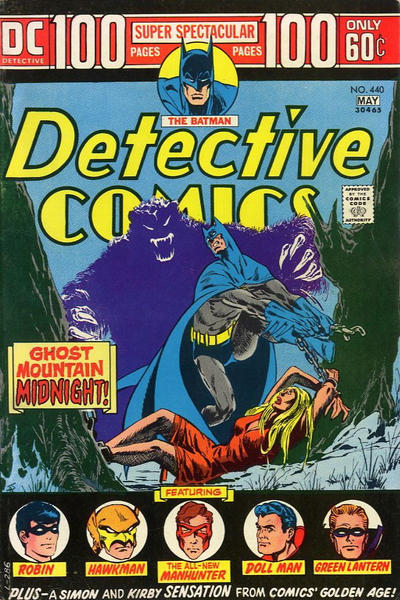
What I remember is the experience of reading that comic the first time. I bought it, and flipped to the first couple of pages of the Manhunter story … and it grabbed me. I understood it. It clarified the parts that I’d been sort of confused about in the previous issue … especially since the Simon and Kirby reprint happened to be one of their original Golden Age Manhunter stories, which helped a LOT in understanding some of the puzzling references in the previous issue’s story.
And it was just amazingly goddamned cool, too.

Walt Simonson’s visual storytelling tricks, that had seemed so jarring to me the previous month, suddenly became an extraordinary new way of doing this superhero thing. The pages still looked weird to me — the panel layout, the sound effects, none of it was like anything I’d ever seen. This wasn’t like what I thought of as a “DC comic” at all … but it was starting to dawn on me that it was that very weirdness that made it so cool.
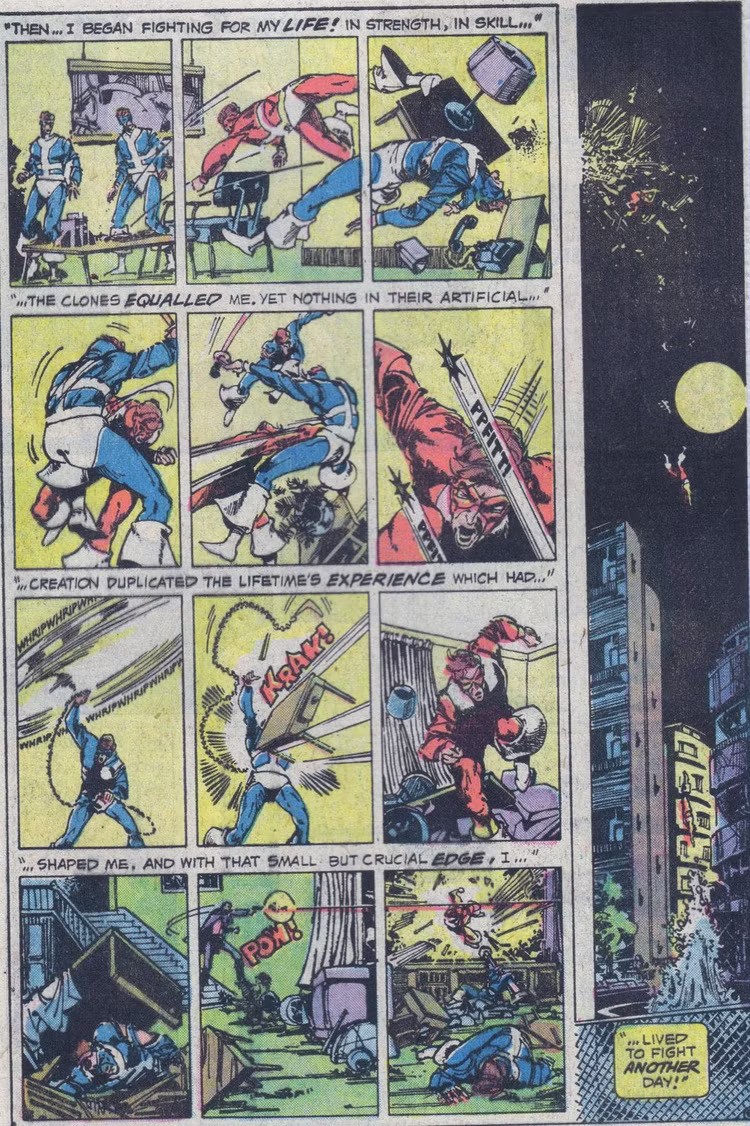
Again, remember two things — what this would look like to a twelve-year-old boy whose ideas about superhero stories had largely been shaped by the Mort Weisinger Superman and the Lee-Romita Spider-Man, and also that I had to work at this story a little bit to get it. When I did, the moment of epiphany got me so excited that when the other kids went off to an amusement park I opted to stay at the hotel and read. (I think the youth pastor wondered if I was sick or having a breakdown or something … I was, admittedly, kind of a misfit kid.) But I was just having a breakthrough moment and wanted to savor it. The rest of the comic was good too, and I’ll always have a soft spot for the Batman entry, “Ghost Mountain Midnight,” as well as the reprints in that issue — but Manhunter was the star. I think I reread that story three or four more times, and then I found some paper and tried drawing my own Manhunter pin-up. It grabbed me that hard. To this day, when people ask me what my all-time favorite comic book is, I reply, “Goodwin and Simonson’s Manhunter.”
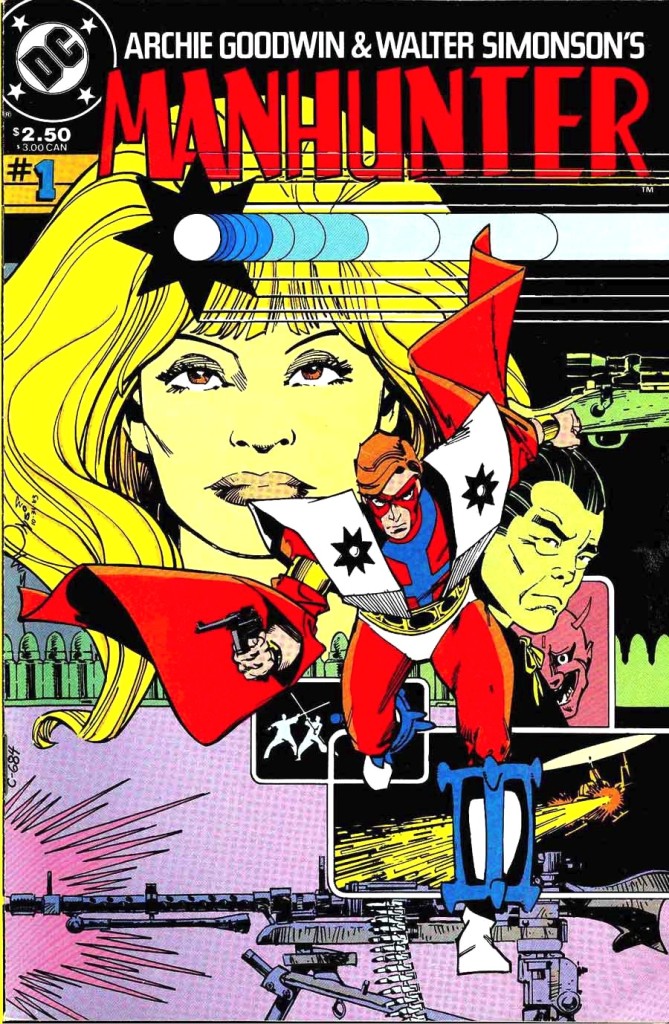
(Which you should all check out, if you haven’t already. Just saying.)
It was (The) Batman and Manhunter, respectively, when I was a kid, that turned me from a comics reader to a lifelong comics fan.
So what’s all this got to do with DC’s new Captain Marvel?
We’ll get to that, I promise. But this is already running kind of long, so I think I’ll stop here and we’ll pick it up again next Friday.
But here’s what I’d like you to consider in the meantime. Forget your opinion of Kunkel’s new book, or how DC needs to handle Captain Marvel, or whatever, for the moment. Put that off to one side. Or go back to Joe’s column and thrash it out in the comments there if you must, but for right here and right now, forget that stuff and just try to remember something for me.
Think back to when you were eight, ten, twelve years old. Think of that comic that really grabbed you. Not your first or your favorite but the one that was the … call it the tipping point, the one that made you a fan. If you’re one of those mutants that didn’t get into comics till you were a teenager then forget comics, you’ll skew the sample. It doesn’t have to be a comic. A book, a story. The important factor is the age. The thing that got hold of you and wouldn’t let go, that made you say, “Yes. I want more like this,” when you were between eight and twelve.
Got it? Good.
Now ask yourself — whether it was a children’s book or a ‘young adult’ book or whatever, the key thing is, was it something that made you feel like you were trapped at the kid’s table?
Think about it, list your particular choice in the comments if you are so inclined, and come back next time for part two, where we try and find the common thread …
… and, oh yeah, talk about Captain Marvel.
See you next week.

I agree that kids don’t want something that talks down to them. I definitely remember reading some comics and thinking I was too young for them, that I was being let in on some secret I wasn’t meant to know yet.
I think it was Grant Morrison that said they aim all their work at an intelligent 14 year old. The sweet spot.
I also treasure my Simonson-signed Manhunter collection.
I remember back in the 1980s (I was in my 20s) seeing the splash page for the Spirit story that introduced P’Gell: slit skirt, low-cut blouse, cigarette and a declaration “This is NOT a story for little boys.” I’m sure lots of little boys disagreed.
For me it was _T.H.U.N.D.E.R. Agents_. Partly because they were so hard to find!
I don’t know if I could say there was one; it was just the whole medium, as I seem to discover newspaper comics and comic books around the same time. For the strips, it was Peanuts and Alley Oop; for comics, it was either Uncle Scrooge or Super Goof, as those were probably the earliest I ever had. I have vague memories of a Fox & the Crow comic; but it was done before I would have seen it. Maybe it was an old one hanging around somewhere. It’s never been just superheroes, though, as I read things like Turok, Space Family Robinson, war comics, westerns (when I found them), Archie, Richie Rich and others. We also got the weekly Pix religious publication, at Sunday School, with comic adaptations of biblical stories, plus other adventures, like the Tullus series. I do remember the first one I got to pick out. It was Shazam #10. I was sick, with bronchitis and we had come from the doctor to get a prescription fulfilled. The drugstore had a handful of comics and I saw that one, with Aunt Minerva pointing a gun at the minister and Captain Marvel, to get him to marry her. It made me a lifelong Captain Marvel fan. The Kunkel book was okay; but, I just don’t think anyone at DC “got it.” It was the whimsical adventures, with a cast of weird and wild characters, good and bad, that made the Big Red Cheese so great. Doing it as a straight superhero doesn’t work and doing it as “just” a “kid’s comic” doesn’t work, either. You have to look at stuff like the Oz books or Winnie the Pooh; they are delightful as a kid; but they also bring out the kid in you, as an adult. Calvin & Hobbes had the same thing. Looney Tunes & Tom & Jerry have it. There is something there that appeals to any age. The most successful of modern memory is Bone. It wasn’t intended for kids; but, they love it and the adults devour it, too.
Comics grabbed me from the get-go, when I was 6 going on 7 and I got my hands on my first comic book – Marvel Tales #59, but initially I was pretty randomly picking up super-hero comics off of the spinner rack. (And then went on a detour into funny animal and Archie comics.) However, I had that “it grabbed me” moment when I was 10 and a half (yes, that ‘half’ was so important back then) and got my hands on X-men #120, and then Daredevil #158 (yes, the Miller run right at the start) and Iron Man #121 and immediately knew that I *had* to follow these (and a number of other) books every month.
Me likewise. Justice League of America #30 was a world five million times cooler than anything else in my life.