

[This is a weird one. It went up on 25 May 2007, and the original is here, but there’s a problem. Only one of Greg’s scans is visible on the old post. I can’t find the post on the Wayback Machine, so it’s possible the pictures would be there, but for some reason, they’re not showing up on the CBR version. It’s frustrating, because he had some pre-production photos for … the revival of The Bionic Woman, I guess, but because Greg was using pictures, which I hear are worth a thousand words, he was vague in the writing. DAMN YOU, HATCHER!!!!! I added a few that I found because I knew what he was putting there, but I don’t know what the “pre-release photos” are and where to find them, unfortunately. Still, I hope you enjoy this!]
I spend a fair amount of time here reminiscing about 70’s super-people. But in a discussion the other day about NBC’s new revival of The Bionic Woman, it occurred to me that my favorite 70’s superheroes weren’t from comics at all. They were from television.
Although they didn’t actually start on TV either — they had their beginnings with a series of novels from a noted military and aviation historian.
Martin Caidin already had an enormous body of work in print, and even some Hollywood success with his NASA space-suspense adventure Marooned, when he wrote his original Steve Austin novel, Cyborg, in 1972.

The book was very tough and cool and plausible … sort of like a cross between Tom Clancy and Michael Crichton in its tone, the story of test pilot crash victim Steve Austin being rebuilt with cybernetic bionics was a compelling read from start to finish. Caidin created Steve Austin as a Yeager-esque USAF lifer, bitter about his accident but slowly coming to terms with his new status as government secret agent, and the resultant uneasy relationships that created with everyone around him.
It was adapted as a made-for-TV movie in 1973, The Six Million Dollar Man, with Lee Majors starring as the somewhat embittered Steve Austin, and Darren McGavin as his ruthlessly manipulative government boss Oliver Spencer. Martin Balsam had a nice turn as Dr. Rudy Wells. The structure was essentially the same three acts as Caidin’s novel — crash, rebuilding, first outing as bionic superhero in the Middle East desert — but it cast Steve’s superiors as much more sinister, and the desert mission turns out to be ultimately pointless. This is a bit jarring, and was probably an outgrowth of Hollywood’s Vietnam-era distrust of all things military. (Caidin’s Austin was a smart aleck who would occasionally lip off to his superiors, but he was, on the whole, a good soldier who respected military protocol.)
Caidin followed it up with three more novels: Operation Nuke, High Crystal, and Cyborg IV. They are also very tough, plausible, military action thrillers with a slight overlay of Crichton-esque SF.

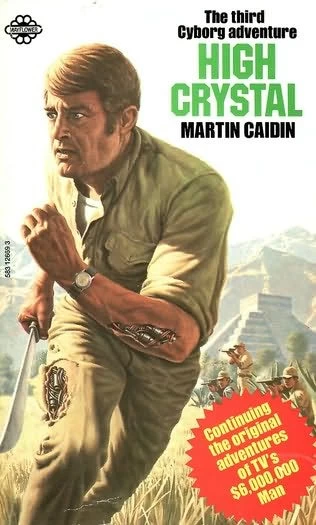
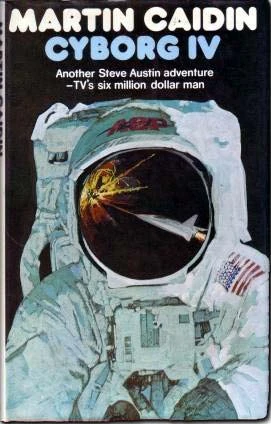
But by the time the fourth one had come out, Steve Austin was already a television and merchandising success.
Turns out the Cyborg TV-movie did well enough for ABC to take it as a series. Originally ABC envisioned Steve Austin as being one-third of a rotating series of 90-minute TV-movie adventures, similar to what NBC was doing with its “NBC Mystery Movie” lineup rotating Columbo, McMillan & Wife, and McCloud. There were two Steve Austin movies made after the Cyborg pilot, “Wine, Women and War” and “The Solid Gold Kidnapping,” and though there were hints of the good times to come, these two efforts seemed a bit too restrained and confused; they are trying way too hard to NOT look like science fiction or superheroics. The resultant split between sort of James Bond camp and sort of 70’s cop-show manages to be mostly just a mess. Plus they are saddled with quite possibly the worst opening-credits sequence ever assembled, with a horrible song by Dusty Springfield playing over a really wonky montage of scenes supposedly from Steve’s point of view. (There’s a blinking-eye oval frame to really hammer it home.)
Steve Austin as I (and most people) remember him showed up a few weeks later. The Six Million Dollar Man was retooled and reimagined as a weekly one-hour drama on Friday nights. With a MUCH better opening that I think is still imprinted in the American consciousness: “We have the technology. We can make him better than he was before. Better. Stronger … faster.”
And, incidentally, a helluva lot cooler. The first of these one-hour episodes, “Population Zero,” was my first encounter with Steve Austin and it blew my twelve-year-old self right out of the chair.
You have to understand, the television climate was very different in 1974. In particular, the hostility towards SF and superheroics was an almost palpable thing. The only real comic-book successes on television up until then had been the George Reeves Superman and the Adam West Batman, neither of which were known for their seriousness of approach. Star Trek was gone. Twilight Zone was gone. Even the Irwin Allen crap like Land of the Giants was gone. And none of them were regarded as ‘successful’ in Hollywood terms. Science fiction and fantasy was generally seen as a losing proposition on television. Anything that had even a whiff of comic-book superheroics about it was dismissed as ridiculous, and anyone actually daring to try a superhero series generally went for the big laffs.
Yet, at the same time, the superhero comics themselves were doing more amazing stuff than they ever had before. O’Neil and Adams on Batman and Green Lantern, Goodwin and Simonson’s Manhunter, Englehart-Brunner Dr. Strange, all of that stuff was blowing the doors off what people had thought was possible with traditional superheroes. The fundamental disconnect between what we fans thought of as ‘superheroes’ and what most people thought of as ‘superheroes’ had never been wider.
So as I watched that first hour, my jaw just dropped. It was a revelation. For those of you that aren’t familiar with it, here is a brief recap from a fan site:
“When a motorcycle cop discovers the twenty-three inhabitants of the small town of Norris lying in a death-like state, Steve Austin is called in to investigate. Donning a spacesuit, Steve enters the town limits, but is astonished to see the supposedly dead townsfolk suddenly come alive before his eyes. Shortly after, Oscar Goldman is contacted by Doctor Stanley Bacon, a bitter scientist who was dismissed from his work for the government due to unethical practices. Now determined to gain his revenge, Bacon demands the sum of $10 million – otherwise he will use his deadly sonic device to attack another town, only this time, he vows to kill every one of the inhabitants … “
Basically, it was The Andromeda Strain, but instead of a disease caused by an alien crystalline spore, the town was in trouble because of a pissed-off scientist and his sonic death ray. Now, let’s own up — a mad scientist is way more fun to take down than a bunch of meteorite spores, especially if he’s got a death ray. (I strongly suspect that it was ABC insisting that the town not actually die but just be in a coma … that felt like a second-draft fix.) Because everything else was just BADASS. The climax of the episode, with Steve Austin improvising an acetylene torch and breaking out of Dr. Bacon’s deep-freeze locker (Bacon knew that bionics don’t work in extreme cold) struggling to recover in time to race to the mobile-death-ray unit, and finally killing Bacon and his crew by ripping a steel-and-concrete post out of the ground and hurling it THROUGH Bacon’s van like a javelin, causing the whole thing to explode … that was awesome.
Yeah. THIS was the stuff. This was what superheroes looked like. Except for a costume, Steve WAS a superhero. He had powers, a secret identity, the whole ball of wax. He even had supervillains: Evil Dr. Dolenz, maker of killer androids (not to be confused with evil Dr. Franklin, maker of killer fembots.) Unstable race-car driver Barney Miller, the seven million dollar man. And of course, the alien spy enclave in the Cascades and their bionic Bigfoot.
These and many more recurring villains built the same kind of mythology and continuity that you saw from Marvel comics. It really was superheroics for television.
I was instantly a fan and had soon sought out all the Caidin books.
But Caidin was far from the only one shaping the character of the bionic superman and his world. The architect of a great many of the aspects of the Steve Austin TV mythology was actually a man by the name of Kenneth Johnson. He created many of Steve Austin’s recurring adversaries and supporting characters, as well as the love of his life.

Johnson actually can be credited with saving the show at one point. The script that kicked Steve Austin up into the ratings stratosphere was Johnson’s two-part “The Bionic Woman.” He solved a number of the show’s ongoing problems with that one episode and set the tone for years afterward.
Ironically, the difficulty that The Six Million Dollar Man ran into week after week was money. The kids like me wanted to see Steve Austin doing super stuff, but a weekly show in 1975 couldn’t really deliver the goods in those pre-CGI days. We were resigned to the slow-motion sequences when Steve was allegedly running at 60 miles an hour, but the lifting and jumping and breaking things were starting to look pretty damn cheap with all the budgetary cheats producers were forced to use. That left the show to be carried by the scripts — standard adventure plots, then, not a lot different than other cop shows — and the actors.
And that was a bad place to be. To be honest, Richard Anderson as Oscar Goldman was pretty stiff; but he looked like he was emoting hysterically next to Lee Majors. Majors’ Steve Austin had two expressions — deadpan, and deadpan with a raised eyebrow. In fairness, the scripts weren’t very emotional but for God’s sake, would it kill Austin to crack a smile once in a while?
So the show was desperate for people stories, something with a little more depth of feeling than the arms-dealer-of-the-week. The producers asked Johnson to come up with a story that would emphasize Steve Austin’s emotional life (one suspects that they really wanted him to demonstrate that such a thing was even possible) and Johnson delivered in spades.
Kenneth Johnson introduced tennis pro Jaime Sommers, an old flame of Steve Austin. On a visit to his parents in Steve’s old hometown of Ojai, Steve runs into his childhood sweetie, Jaime. Steve and Jaime rekindle their relationship, but then a skydiving accident leaves Jaime as destroyed physically as Steve had been in his crash. She loses an arm, both legs, and an eardrum is punctured. Steve begs his O.S.I. boss Oscar Goldman for help, and so Doctor Rudy Wells performs another bionic replacement operation. However, just as Steve and Jaime are making plans to get married, Jaime’s body rejects her cybernetics and she dies tragically. I assure you there wasn’t a dry eye in the house.
Looking back it really was a radical departure. We finally got to see Steve Austin as a regular guy, with parents and a home and a life. This was the episode when the show finally shucked off the whole faux-James Bond vibe once and for all. Steve Austin wasn’t a secret-agent type. He was a soldier, serving his country: one of Our Boys. In a weird way Johnson dragged the character back to his military-service Air Force roots and then upped the ante by making him a small-town hero coming home for a visit while he’s on leave. One could easily imagine Steve’s mother sending cookies to Steve care of the OSI, and a fruitcake for the whole staff at Christmas.
Best of all, the script gave us Jaime Sommers, a delightful young lady played by an actress who really knew what the hell she was doing. Lindsay Wagner raised Lee Majors’ game just by being in the frame with him. Jaime was so sure Steve Austin was a great guy that we all believed it too. Even the unfortunate decision to have Lee Majors sing a ballad over the titles couldn’t kill the new energy and good feeling Lindsay Wagner brought to the episode.
It was a smash. And it saved the show. Steve Austin became a top ten hit and a licensing juggernaut.
I actually am very fond of many of the licensed novels that spun out of the show’s new success. Michael Jahn, who has gone on to be a well-regarded mystery novelist, did a bunch of nice work and added a lot of Caidin-esque touches to the ones he did.
They brought Lindsay Wagner back as Jaime to open the following season (showing that the series had absorbed yet another tenet of comic-book superheroes, the idea of death being something you can get better from) and soon The Bionic Woman had its own place on the schedule, complete with the occasional Marvel-style crossover event with its parent show.
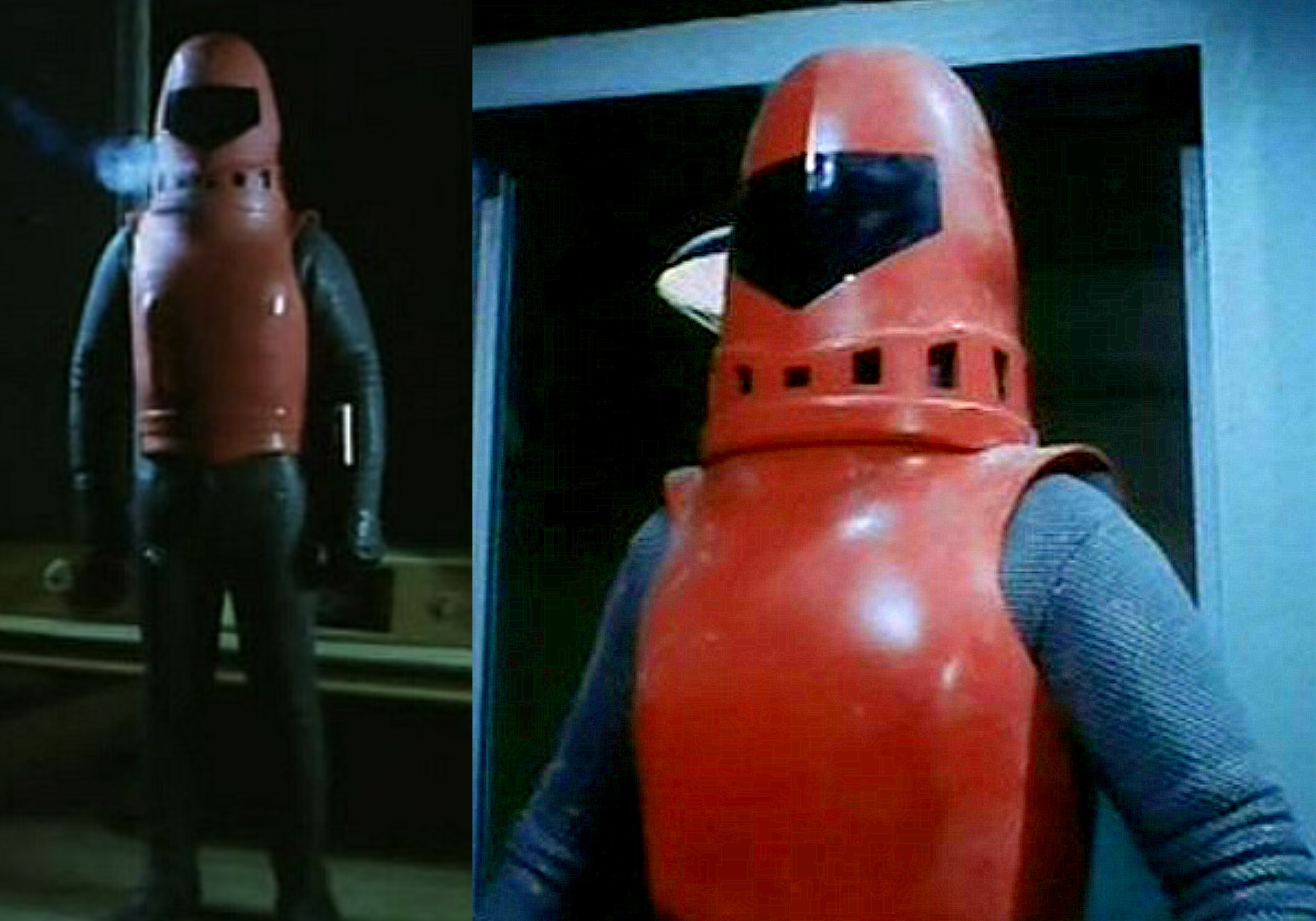
After that, the new school of superhero took off. Suddenly we started to see pilots for shows like Exo-Man, a made-for-TV version of Iron Man in everything but name …
And many of us have mildly fond memories of Patrick Duffy as The Man From Atlantis.
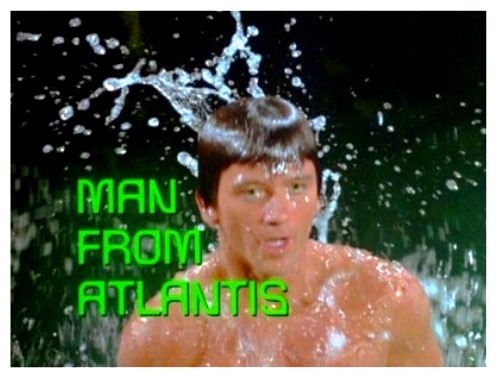
At least the pilot. The show was pretty awful. Though the Marvel comic had the dubious distinction of being better than the show it was spun out of, it seemed ridiculous for Marvel to even publish it when they already had Namor the Sub-Mariner.
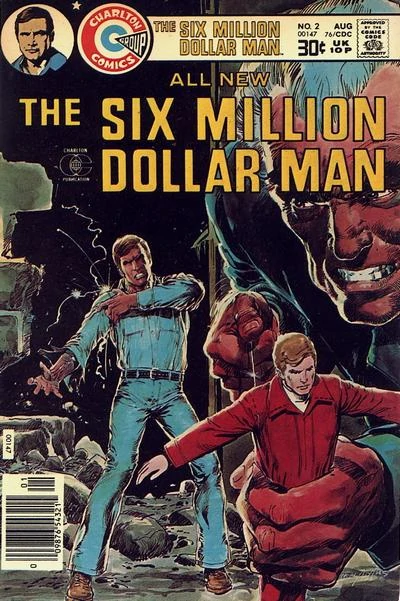
Oddly, the one place none of these new characters did well was in comics; any character who got a title out of this little TV-hero boom lasted less than a year. Even Steve Austin couldn’t carry a comics version into double digits as either a magazine or a standard-format book, despite some really amazing artwork from Neal Adams and the gang at Continuity Studios.
ABC and CBS were finally willing to go to the source and try adapting real superhero comics, too. ABC took a swing at Wonder Woman, first with a horribly wrong-headed Cathy Lee Crosby ‘update’ in the spirit of Steve and Jaime:

Then with a charming version starring Lynda Carter, now enjoying a second life on DVD. Although, God help me, if I ever saw the Crosby version at a convention I’d probably snap it up. I’m a big nerd that way.
Stan Lee had just moved out to Hollywood, and he was quick to jump on board. Soon he’d cut a deal with Universal to license several of the Marvel characters to television. Spider-Man, Captain America, and Dr. Strange all got TV-movie pilots, and Spider-Man even had a brief, stuttering tenure as a mid-season replacement series. But the real success of that deal was the incredible Hulk.
Not surprisingly, the success of that effort came from the guy that saved Steve Austin by giving him Jaime Sommers: Kenneth Johnson. For a classically-trained Carnegie grad, Johnson’s got great instincts for making silly pulp super-hero stuff work. Get the costumes out of the equation, give the characters an emotional life, get real actors who can deliver. I have been watching a number of these old shows recently and I am awed at how well they all still work: Bill Bixby as David Banner in the Hulk pilot is amazing.
There’s a DVD containing that pilot and the episode “Married” and I recommend that to you a million times more than the Ang Lee version. You get a great bonus with those — it’s not widely acknowledged, but Kenneth Johnson does absolutely the BEST DVD commentary in the world. His stories of making the original Hulk show are fascinating.
I might as well own up to it. I’m a big fan of Kenneth Johnson. I loved the original V and the television version of Alien Nation. In fact I think I’m the only guy that bought those comics, based solely on my affection for the television shows they sprang from.
Johnson fans — I know I’m not the only one out here –should check out his website. Certainly I was very excited to discover this —
[Edit: Yeah, not sure what went here. Sorry!]
Currently in development at Warner Brothers, apparently. Marc Singer had said something to Julie and I about it when we met him at a signing in San Diego a couple of years back, but we’d given up hope.
I admit I am looking forward to a V revival, and the new Bionic Woman. I guess Johnson’s not involved with it, which is a pity; though I hope they at least are giving him some money.
Certainly these pre-release photos are very promising.

But you know what my dream revival project would be? The League of Extraordinary Kenneth Johnson Gentlemen. Jaime Sommers, anxious to avenge the death of her husband Steve Austin, recruits Buck Francisco, David Banner, and fembot architect Dr. Franklin to assist her in throwing the Visitors the hell off our planet forever. Their first mission would be a journey to the Cascades, to find an abandoned alien installation in hopes of reconstructing the superstrong android Bigfoot … and unbeknownst to them, they are being pursued by reporter Jack McGee, who’s cut his own deal with the Visitors in hopes of getting the goods on the Hulk once and for all …
Now THAT would rock.
See you next week.

This is my wheelhouse. I had the paperback edition of Cyborg, shown at the top, with the Boris Vallejo cover (later got a copy of the hardback edition). The funny thing is, in the novel, Steve Austin had accessories for his bionics, to up his spy game; but, the series never really went there, even in the tv movies, with their spy-driven plots.
One of my fondest childhood memories is of being in the hospital (that part isn’t fondly remembered; I had to have a hernia repaired) and my dad positioning the electric hospital bed like an astronaut’s chair and watching the Six Million Dollar Man with him (my dad was ex-Air Force and an aviation and space buff) and seeing the episode with Gary Collins as a guest star, playing a Russian cosmonaut friend of Steve’s, who is visiting the US, but called back to the USSR after an earthquake has trapped his fiance in an underground complex, which houses a doomsday weapon. Great, tense little episode, written by Larry Brody.
We used to run around in slow motion, on the playground, making the special effect sounds…..tch-tch-tch-tch-tch ……….boopoopoopoopoopoopoop,,,,,,,,. I got the totally awesome action figure, for a birthday. My sister had Jaime Sommers and my neighbor had the rocket/bionics lab playset.
Greg is also spot on about Johnson, as all his shows were great, including the short-lived NBC series, Cliffhangers, where he tried to revive serial thrills, with modern touches. The show had three segments: Dracula (aka The Curse of Dracula), Stop Susan Williams, and The Secret Empire. Dracula was the most popular segment and got collected into a couple of tv movies, and featured the vampire masquerading as a professor of Eastern European history, in San Francisco, hunted by a Van Helsing descendent. The female partner goes undercover as a student and falls under Dracula’s spell; but much of that is charm and romance, rather than mesmerism. It was pretty well done. The second feature had Susan Anton as reporter Susan Williams, whose brother had uncovered evidence of a vast conspiracy to carry out a major terrorist action, though what that action entails is pretty vague until the end episodes, just that it is BIG. That was the weakest segment and Anton wasn’t much of an actress, but Ray Walston plays her editor and boss. The Secret Empire was an updated remake of the classic Gene Autrey serial, The Phantom Empire, about an advanced civilization, living underground, in the Old West (in the serial, it was near Gene’s Radio Ranch). Mark Lenard was the despotic ruler of the underworld, and played him rather like Ming the Merciless and his daughter was akin to princess Aura. They even borrowed a cliffhanger from Flash Gordon. Part way through, the actress playing the princess is replaced by Stephanie Kramer, of later fame in Hunter, after some plastic surgery. The underworld city set is some kind of shopping mall, with a lot of maintenance corridors. There was a cool matte painting of the city, as an elevator descended from the surface. The hero, a marshall, was a pretty decent actor and he got how to play it. peter Breck, of The Big Valley, played a villainous surface dweller, in cahoots with the ruler and his Shadow Riders. The Dracula serial wrapped up in the penultimate episode, which was the last to air, when it was cancelled. The final episode had been shot, with the resolutions to Stop Susan Williams and the Secret Empire; but, never aired in the US (it was aired in the UK, which is how it ended up in bootleg collections). Johnson wrote the opening episode, where all three stories start, already in progress, to give the feel of coming into a serial chapter, somewhere after the beginning. However, it does give an introduction to everything and the characters, but dumping you in the action kind of adds a bit of weight and history to it and makes you curious, though when I got a bootleg of it, I thought it was recorded out of order or missing a segment, until I paid attention to the plot unfolding.
Cliffhanger was a lot of fun (well, not the Susan Anton stuff). I didn’t know it was Johnson.
I agree with Greg on his commentary. His V commentary track is amazing.
Total agreement on the early TV movies. They try to make Lee Majors a suave Bond type and it’s not playing to his strengths, such as they are.
The series was indeed a lot of fun, Bionic Woman too.
I also enjoyed the three reunion movies which give Jaime and Steve a character arc ending in married. The second film, with some kid named Sandra Bullock as the new cyborg on the block and the villains fielding super-tough evil cyborgs is easily the best. Though i doubt Bullock’s feeling bad about it not getting picked up.
I don’t remember which Six Million Dollar Man story I first saw (and I did not see any of the revival) but the stories that stuck in my mind were the Death Probe 2-parters
I assume the missing bit concerned V the movie which has a section on the website
I thought that might be it but I couldn’t find it on the site. Your seach-fu is better than mine!
Here in the UK both Six Million Dollar Man and Bionic Woman had long-running (four years and three years respectively) strips in weekly anthology title Look-In. See https://bionic.fandom.com/wiki/The_Six_Million_Dollar_Man_(Look-in_strips) and https://bionic.fandom.com/wiki/The_Bionic_Woman_(Look-in_strips). An internet search should give you lots of art to look at.
Posting this column now is perfect timing for me. I just purchased the Six Million Dollar Man complete series blu-Ray set on a bit of a whim and am discovering it for the first time. It started the year I was born so I know very little of it outside the iconic intro. This article adds a ton of context for me.
For this interested, the blu rays themselves are cleaned up to near perfection. I’m partway through season two and one thing I’ve noticed is that the casting department had a real eye for talent – in almost every episode there’s at least one guest star I recognize who would later go on to have a strong acting career. And the casting of William Shatner as an astronaut of all things, years after he played Captain Kirk on TV and years before he would play Kirk in the movies was a joy to see.
Posting this column now is perfect timing for me. I just purchased the Six Million Dollar Man complete series blu-Ray set on a bit of a whim and am discovering it for the first time. It started the year I was born so I know very little of it outside the iconic intro. This article adds a ton of context for me.
For those interested, the blu rays themselves are cleaned up to near perfection. I’m partway through season two and one thing I’ve noticed is that the casting department had a real eye for talent – in almost every episode there’s at least one guest star I recognize who would later go on to have a strong acting career. And the casting of William Shatner as an astronaut of all things, years after he played Captain Kirk on TV and years before he would play Kirk in the movies was a joy to see.