

All right, more movies! And yes, I did watch some from this century, and even this decade! It’s a Festivus miracle!
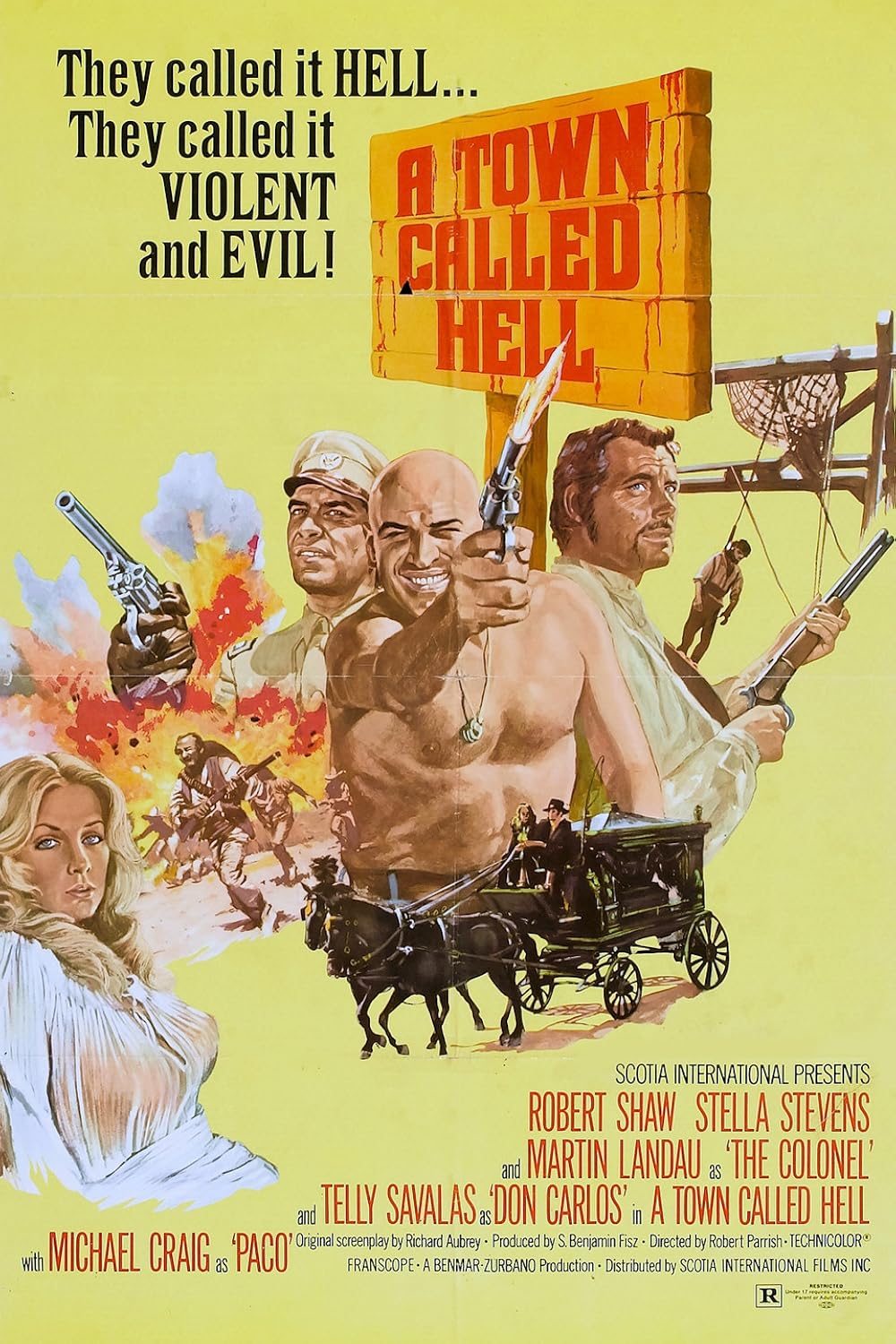 A Town Called Hell (1971). Presumably, after The Wild Bunch was a hit, movie people said, “We need more gritty Westerns with morally ambiguous characters, stat!” and this movie is the result. It’s certainly not as good as The Wild Bunch (even if I don’t think The Wild Bunch is as great as some), but it’s gritty and the characters are morally ambiguous, so mission accomplished!
This movie is a mess, though, which is too bad, because it looks pretty cool. It’s filmed in Spain, which stood in for Mexico and the Old West a lot (as did Italy, of course), and it’s in a beat-up town that the filmmakers really do a nice job with. But it’s still a mess. Robert Shaw and Martin Landau are revolutionaries in 1895, fighting against the regime of Porfirio Díaz. They arrive in town and kill everyone they find, including old women, inside a church, where some kind of ceremony is going on. Cut to ten years later, and Shaw is the priest in the same church, and Telly Savalas is running the town with his army of goons. Stella Stevens arrives in a black carriage that holds a coffin (the conveyance is, in fact, a landau), looking for the man who killed her husband some years ago and willing to pay gold to find him. The man who killed him is a mysterious revolutionary called “Aguila,” but nobody seems to know who he is. Eventually, Landau reappears — he’s now a colonel in the Mexican army, and he and Shaw no longer see eye to eye. Things, you might expect, do not end well.
That’s certainly not a bad set-up for a movie, but it’s just not told very well. It’s implied that Shaw stayed in the town to atone for the massacre, but that event is never referenced again after it happens. Stevens’s quest is put on the back burner as well after Savalas is killed. Savalas seems like he’s going to be far more important than he is, but he’s not. The whole thing with Landau selling out and trying to get Shaw to see the benefit of it is kind of the main theme of the movie, but it never really goes anywhere. There’s a very weird extended flashback that seems to occur before the massacre in the church, but maybe doesn’t? Both Savalas and Landau kill townspeople kind of willy-nilly, which seems counterproductive when you’re trying to get them on your side. Stevens has a dude helping her, and at one point he seems to be running the show and there’s some other reason for her presence in the town, but that never goes anywhere. It’s just a mess. Shaw does a decent job as a man tortured by his past, and Savalas and Landau are almost gleefully evil, but Stevens doesn’t do much with her role, and the many other cast members (most of them Hispanic, which is at least something, and Shaw is playing an Irishman who just happens to be in Mexico, not an actual Mexican, so there’s that) are fine but don’t have too much to do. It’s a decent-looking movie, certainly, but unless you’re really into Westerns, this isn’t really something you should seek out.
 Road House (2024). As I often do these days, I think about what Greg Hatcher would have thought of some things, and I definitely want to know what he would have thought of the Road House remake, as he was such a stan for the original. This is an odd movie, one with (surprisingly) too much CGI, which doesn’t look great, but it’s also kind of fun. Gyllenhaal is terrific, doing a nice remix of Swayze’s Zen thing, but with a wryer sense of humor (Swayze’s humor was more sedate in the original). He’s a disgraced UFC fighter who makes money by showing up at underground fights — he doesn’t actually fight, because people bet before they realize who he is, and once he reveals himself, nobody wants to fight him, so he just takes his money and leaves. Jessica Williams shows up at one of them, looking for a bouncer for her bar because things have gotten worse there in recent months, and Gyllenhaal decides to take her up on her offer after an aborted suicide attempt. Unlike the original, the bad guy is specifically targeting the bar (in the original, Wesley started messing it up because he was pissed at Swayze), and it’s an ill-defined but not-bad plot point, as Billy Magnussen, who’s quite good at playing a man-baby, wants the land on which the bar sits and wants to prove to his incarcerated father that he can handle the family business. The action is moved from Missouri to the fictional Glass Key, Florida (which is really the Dominican Republic), which works perfectly well. Gyllenhaal tries not to fight, of course, because he has anger issues, but, as usual, Magnussen and his goons — eventually led by Conor McGregor, whom his father hires when Magnussen’s guys can’t dislodge Gyllenhaal — push him too far, and things get bloody. Gyllenhaal is pretty great, honestly — he’s very low-key for the most part, which helps make the movie more interesting, and he’s a good contrast to McGregor’s chaos. Magnussen, as I noted, plays these kinds of characters well, and his goons are kind of fun — they don’t quite know how to deal with Gyllenhaal, who either doesn’t want to fight or doesn’t look like he’s particularly good at it until he gets going. The goons get some personality, too — Arturo Castro as the reluctant one is a highlight — which is nice (nobody says anything as iconic as “I used to fuck guys like you in prison,” though, which is a shame). Williams is pretty good, B.K. Cannon as the bartender is pretty good, Daniela Melchior as the doctor who stitches Gyllenhaal up and eventually falls for him is fine, Hannah Lanier as the kid Gyllenhaal befriends is good, and Joaquim de Almeida is always fun to see. I don’t know why they did the CGI stuff, which is frustrating. In some places, sure, I get it (some of the boat crashes, for instance), but there are computer effects in some of the fights, and it’s annoying. I’m not sure why they did it, but it does hurt the movie. Overall, though, this is a fun action movie that evokes the Golden Age of Stupid Action Movies (the 1980s) without being too slavish to it. A few things make it clear that we’ve become more prudish in our entertainment — the lack of nudity, of course, and the lack of cursing. There’s some mild cursing, but nothing like the good ol’ days, and while I do not mind the lack of nudity at all (the romance between Gyllenhaal and Melchior is definitely not the focus of the movie, so there wouldn’t be any point there), it’s funny that in 1989, of course women would take their tops off at a dive bar, but not today! This is just a nice punch-’em-up that is kind of aware of itself as one, which is always fun. It’s not a bad way to spend a few hours.
 The Beekeeper (2024). I like Jason Statham, going all the way back to Lock, Stock, and Two Smoking Barrels (which I don’t think I saw in the movie theater, but I did see very soon after its release), and I kind of wish he hadn’t slid into the world of B-movie action thrillers, which he has these days, because I think he’s a better actor than a lot of people give him credit for, and I wish he did do some other stuff, but such is life. I decided to check out a few of these B-movie action thrillers, because I imagine they’re still pretty good for what they are, and the first up was The Beekeeper, in which Stath is a retired member of a top-secret organization (of course) called the Beekeepers, and he’s working … as a beekeeper! Oh, snap! Stath is renting space on a bucolic Massachusetts farm owned by Phylicia Rashad, who gets scammed out of her entire savings and the operating budget of a charity she manages in the early minutes of the movie and kills herself from shame, which pisses Stath off. Her estranged daughter, FBI agent Emmy Raver-Lampman, is on the case as well, although she’s mostly chasing what Stath is doing. He starts moving his way up the ladder of the scammers, pissing off the head douchebro, Josh Hutcherson, who’s mad that his profits are down (Hutcherson plays the role hilariously, as he cultivates a public “hippie” persona but he’s, you know, a horrible scumbag) and scaring the shit out of Jeremy Irons, who’s been hired by Hutcherson’s mother to keep an eye on him and knows about the existence of the Beekeepers. I saw some people compare this to Jason Bourne (ignoring that Bourne himself is a cliché), but it’s much more like John Wick, as random people “killed” someone Stath loved and they didn’t realize they had pissed off the absolute wrong person. Irons even tells Hutcherson at one point that he’s basically a dead man. The twist about Hutcherson’s mother is fun, and Raver-Lampman does what she can to keep up, but this is basically Stath inexorably working his way through a bunch of dudes (and one fun chick) who try to kill him and fail spectacularly. It’s dumb and fun, in other words, and only one thing bugs me, and that’s Rashad’s suicide. It’s not that I’m offended by it, but I just wonder if she’d go straight to it. I get it — she’s embarrassed and thinks everyone will mock her. But, I mean, she seems to have a very good relationship with the hunky dude who lives on her property (even if she doesn’t know he’s a killing machine) and her daughter, while estranged, is an FBI agent, so you’d think she’d try to explain to someone what happened before taking such an extreme step. Scamming is, unfortunately, fairly common, so I can’t believe she’d be thinking, “I’m the only one this has ever happened to, and everyone will blame me!!!” It’s a minor point — something has to set our man off — but it’s a bit annoying. Anyway, this is a ridiculous but fun action movie. Everyone likes those!
 Shelter (2026). I skipped the 2025 entry in this Stath sub-genre (A Working Man; I imagine I’ll watch it eventually) and went straight to the 2026 one, as Stath again plays a retired killer, this time one for the British government who’s actually in hiding because he disobeyed orders and his boss (a suavely evil Bill Nighy) wants to kill him. He’s living in the Outer Hebrides on an island that gets supplied by an old army friend of his, whose niece, Bodhi Breathnach, comes along with him. On one run, a storm blows up, sinks the main boat (killing the uncle), and swamping the rowboat Breathnach is using to get back and forth to the island, so Stath rescues her. He has to go into Stornoway to get medical supplies for her, and a cell phone camera captures his image, and part of the plot of the movie is that MI6 is using every camera in Britian to track terrorists, so the image finds its way back to them, identifying Stath as a terrorist (because evil Bill Nighy jiggered the algorithm so the Brits would shoot to kill when they sent someone after him). Off they go to kill our dude, and Stath and Breathnach have to go on the run. Again, there’s a cop who’s sympathetic to Stath — Naomi Ackie plays the new acting head of the agency after Nighy is quietly packed off to retirement (but isn’t really, as he and the Prime Minister have a wink-wink agreement that he’s still in charge), and she doesn’t like what her mentor, Nighy, is doing, so she’s poking around into who Stath is and why Nighy wants him dead. It’s a bit more thoughtful than The Beekeeper, mainly because Stath has to take care of a teenager (Breathnach is playing about her age, which is 15) and she has no family, so they bond over that. It’s handled pretty well, as Stath knows she’s not safe hanging around with him, but he also might be the only one who can keep her safe, so he has a conundrum. The action is fine, and Stath is never seriously challenged, even by the other high-level assassin Nighy sends after him, but it’s good and fun. It’s better than The Beekeeper, but it’s still a B-level action movie. Beathnach (who was also in Hamnet) seems destined for bigger and better things, but come on, Stath — you have better things in you, too!
 Conclave (2024). This won the Oscar for Adapted Screenplay and was nominated for Best Picture, Best Actor (Fiennes) and Best Supporting Actress (Rosselini), and it’s pretty good. I don’t know if it deserved its win — I don’t see too many current movies when they’re current, so I haven’t seen the others that were nominated — but it’s the kind of movie that does win that award, because it’s very, very talky, and it has some cool, talky moments that, when people see them, think, “Well, that’s Oscar-worthy writing right there.” I hope I don’t sound cynical, because I’m not — this is well-written — but it’s also true that the Academy Award often goes to the movies that feel “Oscar-y” (Adrian Brody won over Fiennes for The Brutalist, for instance, which I would like to see but does not sound like a fun time at the movies). Anyway, you know the drill — the pope dies, the cardinals gather, there’s a lot of politicking, a new pope is elected. Fiennes is in charge of the conclave, and he has to deal with a wildly conservative cardinal who wants to drag the Church back to the Middle Ages (Sergio Castellito); a liberal cardinal who wants to win solely to thwart the conservative dude (Stanley Tucci); a black cardinal who’s fairly conservative but is, you know, black (Lucian Msamati); a Canadian cardinal who had the last meeting with the pope and might be somewhat shady (John Lithgow); and a cardinal from Kabul whom no one knew about but is definitely not a fraud (Carlos Diehz). Meanwhile, there is bombing in the city outside, which they don’t know much about because they’re sequestered (the conservative cardinal blames Muslim suicide bombers and uses it as an excuse to say they need to stop being so danged liberal, but they never actually say who’s doing the bombing, which is nifty), and Fiennes does have some access to the outside world through his aide, Brian F. O’Byrne, who keeps bringing him damaging news about some of the candidates that Fiennes isn’t sure he should use. It’s a decent enough movie, although the way the voting goes, it becomes clear who’s going to be elected, although there’s a decent twist at the end, so that’s nice. Fiennes does his usual good job, Rosselini doesn’t feel like she’s in it enough to get nominated (although other actors have won the award with less screen time, so there’s that), and the rest of the cast does well, too. The movie just moseys along, and while there are some intense parts, it’s a bit frustrating because nothing really happens that makes this different from any other conclave. I guess you could say the twist at the end is odd, but it’s not like it’s ever going to come out, because the Church protects its secrets, so this almost feels like a documentary about how a pope gets elected. It’s good, don’t get me wrong, but it also feels the slightest bit perfunctory. Still, it’s worth a look.
 Dragonwyck (1946). Gene Tierney stars as the daughter of a Connecticut farmer in 1844 who receives a letter from a distant cousin (they try to make a deal about them actually not being related, but presumably that was only for the censors, because they clearly are) who wants her to come take care of his young daughter for a while. She, of course, wants to get away from her boring farm life, and the cousin is from an old Dutch family who lives in a mansion on the Hudson, so she’s keen to go, although her crusty, God-fearing father (Walter Huston) thinks it’s foolish. The cousin, it turns out, is played by Vincent Price, 34 or so at the time of filming and looking decidedly scrumptious, as Price really wanted the part and slimmed down to do so because he didn’t want to be typecast as the somewhat rotund goofball (although, you could argue that this movie led to him being typecast in a different way, but such is life). Price is drawn to Tierney, of course, but does nothing untoward because he seems to like his wife (Vivienne Osborn in her final movie; she lived for another 15 years, but apparently just up and quit). There’s a haunted room in the mansion, of course, and Price is a somewhat officious landlord who thinks very little of his tenants (led by a 30-year-old Harry Morgan, two decades before Dragnet and three decades before M*A*S*H), and the daughter is a bit odd, and the young doctor is keenly interested in Tierney, and all goes along until the night Price’s wife dies. He declares his love for Tierney right away, but she freaks out and retreats to Connecticut. She can’t keep him out her mind, though, and eventually marries him, only to find that he’s a bit more unbalanced than she realized. I don’t want to give too much away, but Price is not the best dude in the world, and things get pretty bad for Tierney. Hilariously, after the wife dies, the daughter — always a MacGuffin anyway — simply disappears from the movie (poor Connie Marshall!). It’s a pretty good psychological drama, as Price becomes more unhinged and Tierney needs to figure out what to do about it and if she should stick by him. There’s a funny contrast between Huston’s hard-bitten farmer and Price’s effete aristocrat, as Huston can’t believe that farmers pay rent to Price to work his land, because according to Huston, everyone should own and work their own land, but, I mean, rent as always been a thing, both in the horrible Old World and in the good Yankee New World, so it comes off as silly by Huston even though it’s supposed to be a mark of ‘Murican independence and we don’t need no landlords (the movie does mention the “Anti-Rent War” of the 1840s, which is nice). The stress of the farmers being ungrateful, the death of his wife, and the stress of his marriage to Tierney all drive Price to become a “drug addict” — the censors wouldn’t allow them to say “opium,” which is what it is in the book — and Price does a nice job showing the moral degradation of the man, while Tierney does a nice job remaining steadfast even as Price falls apart. It’s not a great movie, but it’s pretty good, and it gave Price a template for the rest of his long career, so good for him!
 They Will Kill You (2026). I wasn’t sure what to expect when I started this movie — I had seen a preview, so I knew it looked like a standard “evil people try to kill a Final Girl in an enclosed setting” kind of thing, but director/writer Kirill Sokolov and writer Alex Litvak put a nice twist on things. In the beginning, Zazie Beetz and her sister are trying to get away from their abusive father, but he catches up to them and Beetz shoots him (not fatally) and panics, running away and leaving her sister. Ten years later, she shows up at The Virgil, a swanky apartment building in Manhattan, as the new maid. That night, a robed and hooded figure wearing a creepy pig mask gets into her room and accosts her, but she manages to knock him out, but collapses in the process. Others come in, too, but she manages to run into the closet. They think she’s trapped, but it turns out it’s exactly where she wants to be, because that’s where all her weapons are. You see, Beetz figured out that these people have kidnapped her sister, and she’s out for revenge. Unfortunately, what she didn’t realize is that everyone in the building has sold their soul to Satan, so they can’t die. Of course, this means that she can kill them in wildly and wonderfully gruesome ways, often more than once, because they keep coming back to life!
It’s a fun, gory movie, full of fun twists and turns, and it’s slightly under 100 minutes, so Sokolov gets his pedal to the floor quickly and keeps it there. Beetz does a nice job as the avenging angel (Myha’la, who plays her sister, is a bit dull, unfortunately), and the cultists are fun — they’re led by Patricia Arquette and include Heather Graham and Tom Felton. For a B-ish movie, the effects are pretty good, especially when Satan does show up. There’s a lot about how horrible the rich are, and of course all the people of color are good folk (including Paterson Joseph, Arquette’s husband, who simply decides to help Beetz for no reason, as he seemed perfectly happy sacrificing other young black girls for the past century) and all the white folks are evil, but such is life in the woke universe, amirite? It’s not a grand social statement, though, as Sokolov simply wants to show assholes getting killed in as fun ways as possible. I know it’s “heightened” reality, but I do wonder how Beetz survives, because she gets beat up a lot, but she never seems to lose any teeth or bleed to death or gets any disfiguring scars on her gorgeous face. We just have to accept that she’s living in an Action Star Universe and move on! This is a fun action-horror-comedy, so check it out if you’re in the mood for one of those!
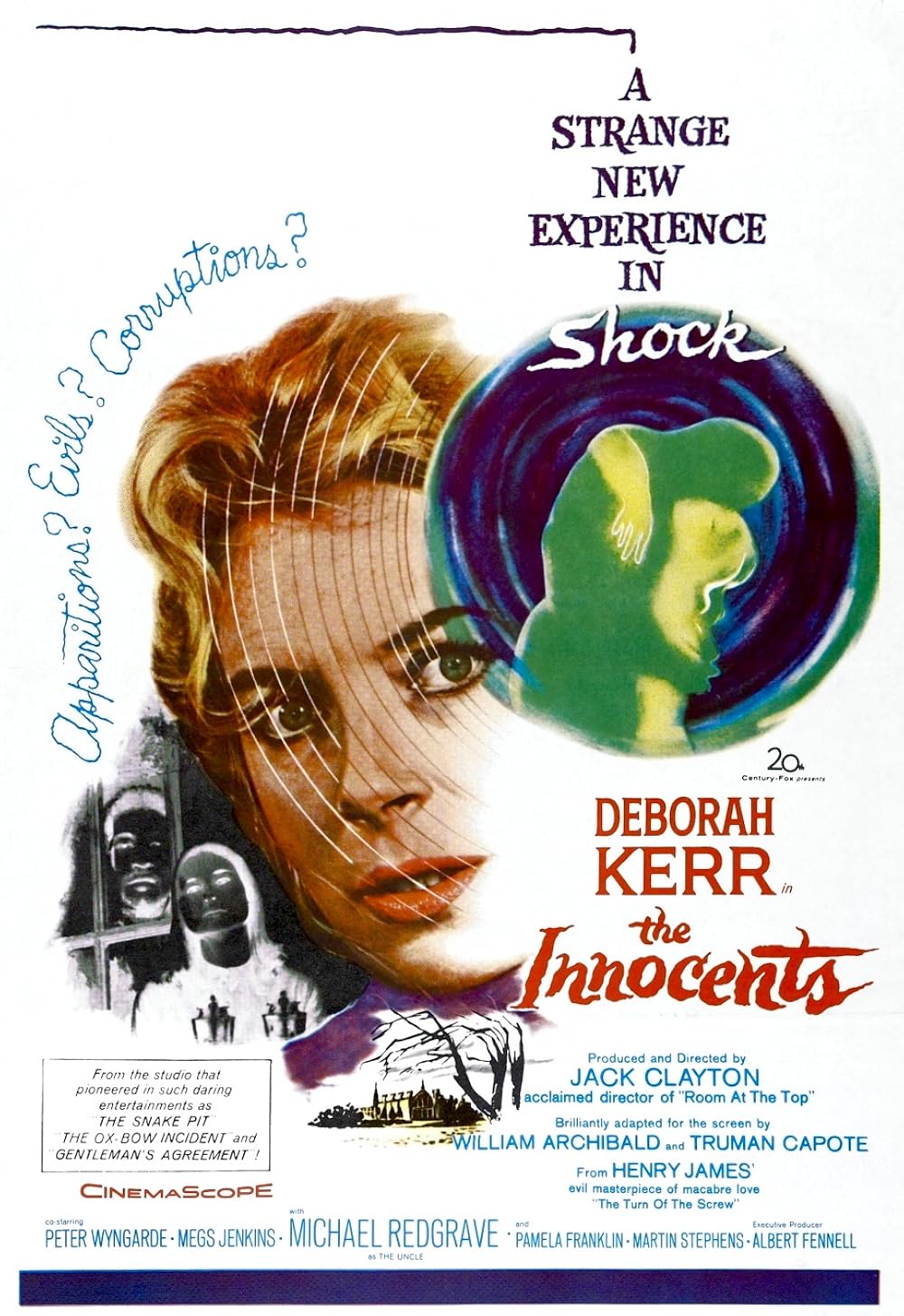 The Innocents (1961). A lot of famous people love this movie, so that’s neat, and I like it quite a bit … but I don’t love it. Still, it is an excellent “ghost” story, in that it can be as creepy as absolute fuck — when Quint appears behind Miles in the window late in the movie, it’s absolutely terrifying — and Deborah Kerr and the two children — Martin Stephens and Pamela Franklin — do an excellent job as a woman having a nervous breakdown and the kids who drive her to it! It’s based on The Turn of the Screw, in case you didn’t know, and follows the basic plot — party-boy uncle of two orphaned kids hires governess to care for them in his country estate so he can continue banging dance-hall girls, governess finds out that the previous governess died under extraordinary circumstances, as did the valet, with whom said governess was having a fling, boy gets expelled from his school for undisclosed but troubling behavior, governess begins to see dead valet and dead governess on the grounds, no one else sees said valet and governess, governess fears that ghosts are possessing the children, while everyone else thinks she’s gone a bit off her tree. You know the drill! Kerr, while sticking to the standard “women in the Victorian Age AND women in movies before the 1980s tended to be hysterical more than is necessary” script, sells Miss Giddens’s freak-out hard, and Stephens and Franklin do very good jobs making the kids far creepier than they have any right to be. Truman Capote rewrote the screenplay to make it more ambiguous, so we’re never quite sure if Kerr is seeing ghosts or if the valet and governess aren’t actually dead or if it’s all in her head, and that’s fine with me. I have other objections to the movie, but not its ambiguity. The movie looks amazing — the cinematography and lighting are superb, and the way director Jack Clayton shows the valet and governess is excellent, as there are no jump cuts but he still manages to scare the shit out of Kerr and the viewers. The main issue I have with the movie is the oddness of the ending — I don’t want to spoil it, but the fate of one of the characters seems very odd, and because the movie ends right after, we don’t have any idea of the aftermath. I don’t mind the movie ending kind of abruptly, but what happens right before is strange, and keeps with the ambiguity of the plot, so it’s not the worst thing in the world, just a bit odd. Worse is the way Kerr quickly becomes unhinged. She goes quickly to possession, and it seems like the movie could have been a bit longer (it’s about 100 minutes) to give us just a bit more of her not being freaked out. I get that she’s playing a Victorian woman, so there’s all sorts of sexual repression going on (Miles kissing her on the lips is the freakiest moment in the movie, I think) and there’s the cliché of Victorian woman being hysterical, but it seems to move a bit too fast. During the Victorian age, the idolization of children began, so it’s not terribly surprising we get it here, but the kids can be assholes, and it’s a bit disappointing that Mrs. Grose, the housekeeper (played by Megs Jenkins), doesn’t see that a bit more, to make Kerr’s wild accusations feel a bit less crazy. It just feels a bit rushed, and it’s too bad. For the most part, though, this is a very well-done psychological horror movie, and it’s definitely worth a watch.
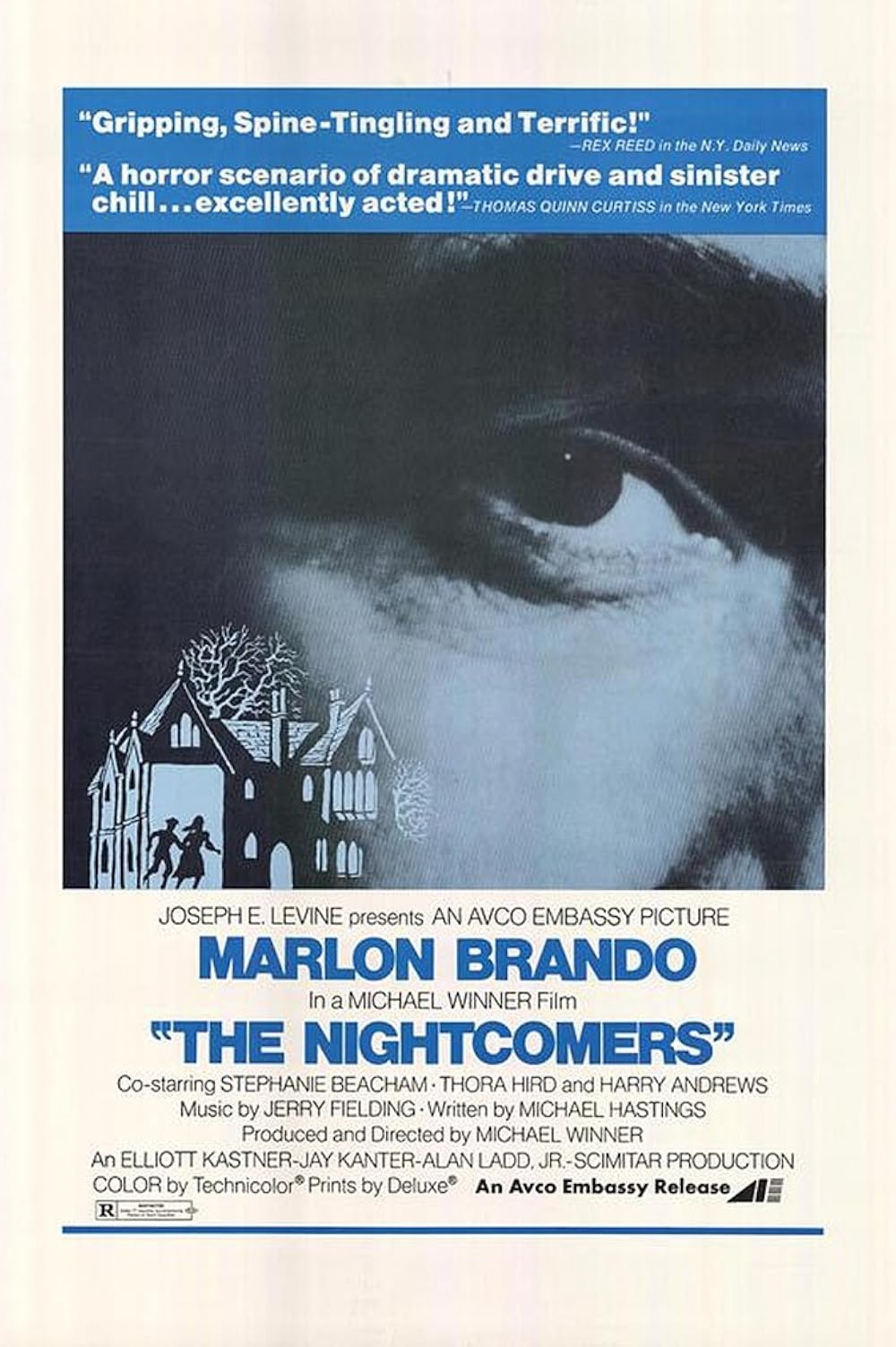 The Nightcomers (1971). Marlon Brando won an Oscar for a movie released in 1972, and … it definitely wasn’t for this one. Technically, this premiered in 1971, but it came out in the States a month before his more famous 1972 release, and I wonder if anyone watched this one and knew the other one was coming out and thought it would be a disaster, based on whatever the hell Brando is doing in this movie. I had heard not-very-good things about this movie, but TCM had it on, and it’s technically a prequel to The Innocents (actually, it’s a prequel to The Turn of the Screw, so the changes The Innocents made to that story are, I guess, not reflected in this movie), and boy howdy, it’s weird. Not very good, you understand, but kind of weird enough to be watchable. Brando, doing what sounds like a drunk buffoon’s version of an Irish accent, plays Peter Quint, the valet/gardener at Bly, the estate where the uncle in the story (played here by Harry Andrews) stashes Miles and Flora, his niece and nephew whom he has no intention of raising. Stephanie Beacham plays their nanny, Miss Jessel, with whom Quint is having an affair. In the James story, they’re both dead, so we know they’re not going to have a good end here. Quint spends a lot of time with Miles and Flora, indoctrinating them with his extremely jaundiced views of life and love, and eventually, of course, Miles eavesdrops on the lovers and sees them engaging in some fun sadomasochism, which he tries to recreate with Flora. Naturally, Quint’s cynical ideas about death and love make the children think it would be nice if both he and Miss Jessel were dead. It makes sense to them!
Friends, this is not a good movie. I mean, Beacham is easy on the eyes, and she gets naked more than you might think, so there’s that, but it’s the kind of movie that really wants to be deep but really isn’t. I get that it’s the Victorian era (the movie is set in 1901), and FSM forbid anyone actually talk to the children and try to teach them a decent way to live (did English parents 150 years ago just assume their babies were born with good English morals?), and there’s the subtext of the Victorian attitude toward sex and how it’s unhealthy and the kids don’t know any better, and it can be a creepy movie (the setting — it was filmed near Cambridge — is stunning but also eerie), but it’s just a bit too goofy to really land. Brando can’t really sell the half-baked cynicism, although his interactions with the children — Christopher Ellis and Verna Harvey (I can’t find out how old Ellis was at the time, but Harvey was 19, which adds a bit of retroactive creepiness to some of the scenes) — are actually pretty good when he’s just playing with them or showing them the world. It’s when he starts talking about love and hate and death that things get dumb. There’s a scene where Brando is telling the kids about his father, and I guess he was actually drunk during it (he told the director he wanted to be), and he kind of nails it, and you’re left wondering how someone that talented can be so untalented so often. It’s annoying. Obviously, there’s the hypocrisy of Victorian England in here, but what’s interesting about the housekeeper’s (Thora Hird) attitude toward Miss Jessel is that it’s more maternal and worrying rather than outright condemning. Mrs. Grose just thinks Quint is a scumbag and Miss Jessel should look out because of that, not because she’s having weird sex with him. Anyway, it just isn’t the best movie, and Miss Jessel does stupid things that lead to her death, while Quint dies in an interesting way. It’s less than 100 minutes long, so it won’t take up too much of your time if you’re really interested in it (and in watching Brando during what most people call a very low point in her career before that other movie revived it), but it’s just not that good, unfortunately.
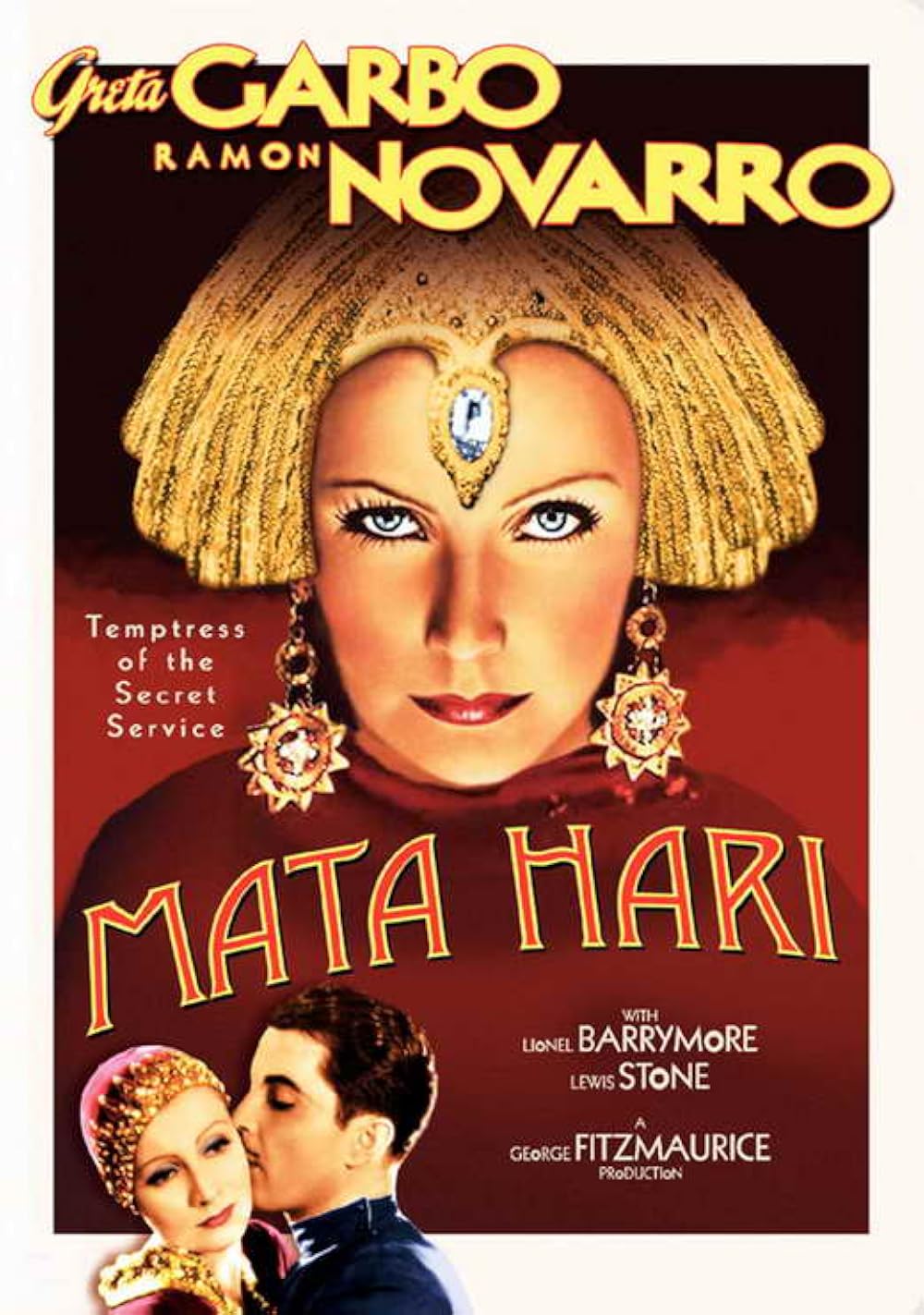 Mata Hari (1931). Garbo, who curiously never won an Oscar even though she always dominates whatever movie she’s in (she was nominated four times, twice in 1930, once in 1938, and once in 1940, and lost to Norma Shearer, Luise Rainer, and Vivien Leigh), dominated this movie, which isn’t very good, sadly. Garbo is excellent, of course, but if you’re making a movie about a notorious “spy” in 1931, you’re going to have to fictionalize it a great deal, and this movie does that a lot, to its detriment. It’s turned into a simple doomed romance between Mata Hari and Alexis Rosanoff (Ramon Novarro), and while in the real world, Margaretha Zelle did claim to have fallen in love with Vadim Maslov (the basis for Novarro’s character), it was much more complicated in real life than in the movie. In real life, Zelle was significantly older than Maslov, but Novarro was older than Garbo (who was much younger than Mata Hari would have been in World War I), so to see her take a slightly maternal tack with Rosanoff is a bit weird. The movie telescopes a lot to fit into a short-ish movie, as Garbo assists a German agent in his endeavors but doesn’t do a lot of actual spying. She strings Lionel Barrymore, playing a turncoat Russian general, along, she seduces Rosanoff so a fellow spy can get his plans that he’s supposed to fly to Russia, and she feels bad about it all because she falls in love with Rosanoff. The movie never really discusses the war too much, which is strange — her German handler is very vague about how they’re helping the war effort, and there’s no explanation for why Garbo is a spy in the first place. She just, you know, is. There’s a bit of danger in the movie, as the handler does not take kindly to his spies trying to leave the organization, and when Garbo starts falling for Novarro, things get a bit dicey for a short time. After Rosanoff is blinded (as Maslov was, but only in one eye, not both as Rosanoff in the movie), she goes out of her way to shield her fate from him, as she convinces her jailers to pretend he’s visiting her in a hospital before she heads out to be shot. As in real life, the trial in the movie is a farce, as nobody could produce any evidence against her, but the filmmakers never really make any comment about how she was a scapegoat for various French military failures. It’s frustrating. Garbo, as I noted, is marvelous, and director George Fitzmaurice does a nice job with shooting the film, using the black-and-white chiaroscuro to his advantage. Garbo, for someone who has the reputation of being an ice queen, oozes sexuality (the censors cut some of her famed “Shiva dance,” because apparently she was too sexy for 1930s audiences!), and she’s usually dressed stunningly, so that’s something to see. It’s a disappointing film, but it’s not a waste of time. I mean, Garbo is also good to check out!
Any thoughts? I’ve tried to watch more recent movies, but I still have to check out the oldies occasionally!

Jason Statham is not our most versatile actor, but he has a magnetic screen presence and can make any old hunk of junk or bad line of dialogue believable. I had initially written off the Beekeeper, but ended up loving it once I saw it. Fast-paced, increasingly ridiculous, lit like a real movie. That’s all I need.
They Will Kill You was fun. I would’ve liked to see more floors of the building, but maybe their ambition exceeded their budget. Still, we get a practically-done flaming ax fight, so who am I to complain? Shoulda thrown in an Oldboy-style hallway brawl, though.