

That is a universal law: the clueless obey the insane. (Albert Sánchez Piñol, from Pandora in the Congo)
COMICS
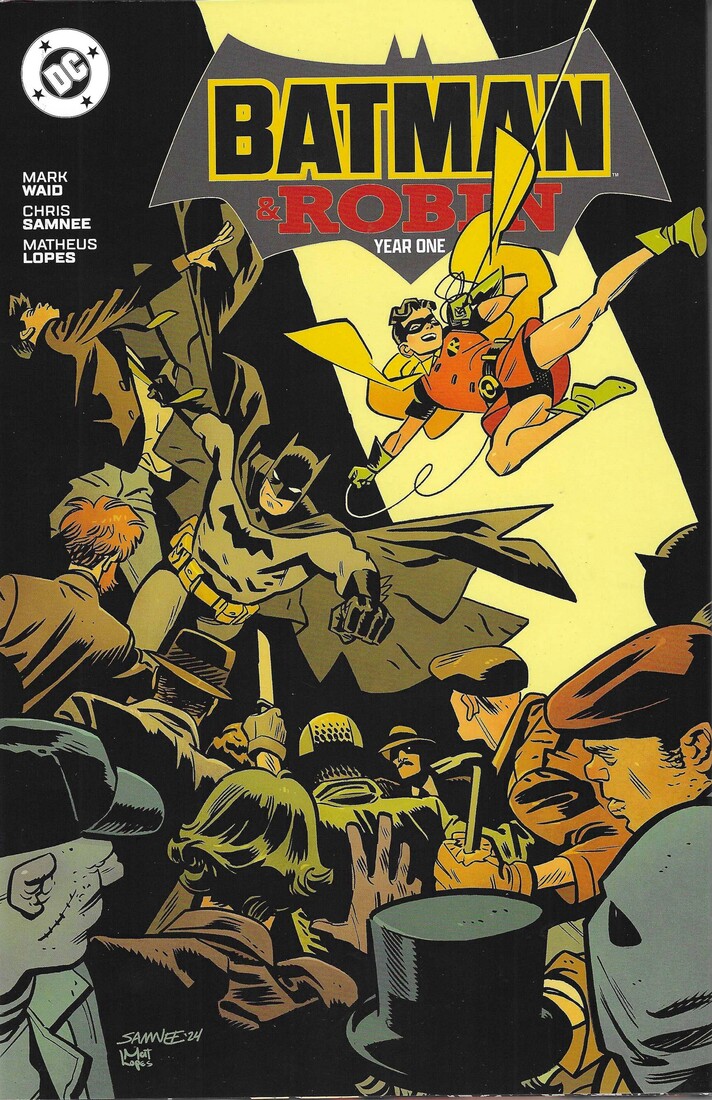 Batman & Robin: Year One by Mark Waid (writer), Chris Samnee (artist/letterer), Matheus Lopes (colorist), Giovanna Niro (colorist), Clayton Cowles (letterer), and Andrew Marino (collection editor). $39.99, 265 pgs, DC.
Everyone really dug this comic, because Waid knows how to write good superhero stories that are both serious but not bleak, while Samnee is just a superb artist, so the combination of those two is a slam dunk, right? Well, sure, this is a very good comic, but it’s not a great one, because it just feels off in places. Let’s get the bad out of the way. I dislike these “Year One” stories simply because DC and the writers can’t decide on when to set them, and for me, it creates cognitive dissonance that keeps me from enjoying it completely. This is clearly a modern story, yet all the cars look like they’re from the 1940s. Little things like that nag me, and while I get that they’re going for a “Gotham aesthetic” and Gotham is a bit weird, even in stories set in the “modern day,” it still bugs me. Waid creates an interesting bad guy — a disgraced U.S. general who decides to treat taking over Gotham like a military campaign, basically to stick it to his father, who’s in a wheelchair and seemingly not all there mentally but was once a crime boss in Miami who didn’t give li’l Anthony the love he needed — and he does a nice job showing how our general pits the crime families against each other (by using Matt Hagen to impersonate a lot of them and sow discord and confusion) and how he uses old-school Batman villains (Clayface, sure, but also Two-Face). Then, however, General Grimaldi kind of goes out like a chump, and while I get that Waid wanted it to be a good twist, it just feels like he does a lot of work for not a lot of pay-off and this turns into a standard Batman-versus-supervillains kind of thing. It feels like a missed opportunity. I don’t love that it’s one long story — it seems like it could have been several shorter stories, as Waid is good at that and the whole point of this book is that it’s Batman and Robin getting to know each other — but such is life.
There’s a lot of good stuff, too, and I wish Waid had leaned into that more. This is a story about Bruce Wayne and Batman learning how to mentor Dick Grayson and Robin, with Alfred thrown into the mix. The parenting stuff and the teaching Robin how to be a superhero stuff is excellent, and while Waid doesn’t get too deep into the idea of Bruce being kind of unfit to have a child, he does do more with it than you might expect, which is nice to see. The way Bruce doesn’t know how to handle Dick because he thinks they’re similar when they’re really not, the way Alfred has to be the adult in the room, and the way Batman has to rein in Robin without crushing his spirit are interesting aspects to the story and are the reason it works as well as it does. Waid writes a good Jim Gordon, who trusts Batman but isn’t sure about a kid being involved, and there’s a nice vein of comedy running through the book, as Bruce and Dick try to deceive the social worker who checks in on them (a very hot one, of course, because COMICS!) and Robin tries to enjoy being a vigilante. There’s a really good story in here, but DC (and Waid, I assume) couldn’t resist making it a big ol’ Batman fight, and that takes away from the cool parts. It’s not that the action-adventure part is bad, per se, it’s that we’ve seen it all before. The interaction between Bruce/Batman and Dick/Robin when neither is sure of the other is something we don’t see all the time, and it would have been neat to see more of it. But, then, I’m a bit weird, so your mileage may vary.
I don’t need to say anything about Samnee, do I? He’s great. The book looks phenomenal. You know it’s true!
I do like this, I just don’t love it. It feels like a slight missed opportunity, as it turns into just another Batman story. We have plenty of those, and it feels like this could have been something a bit different. Oh well. It’s still a fun comic!
Rating: ★ ★ ★ ★ ★ ★ ★ ½ ☆ ☆
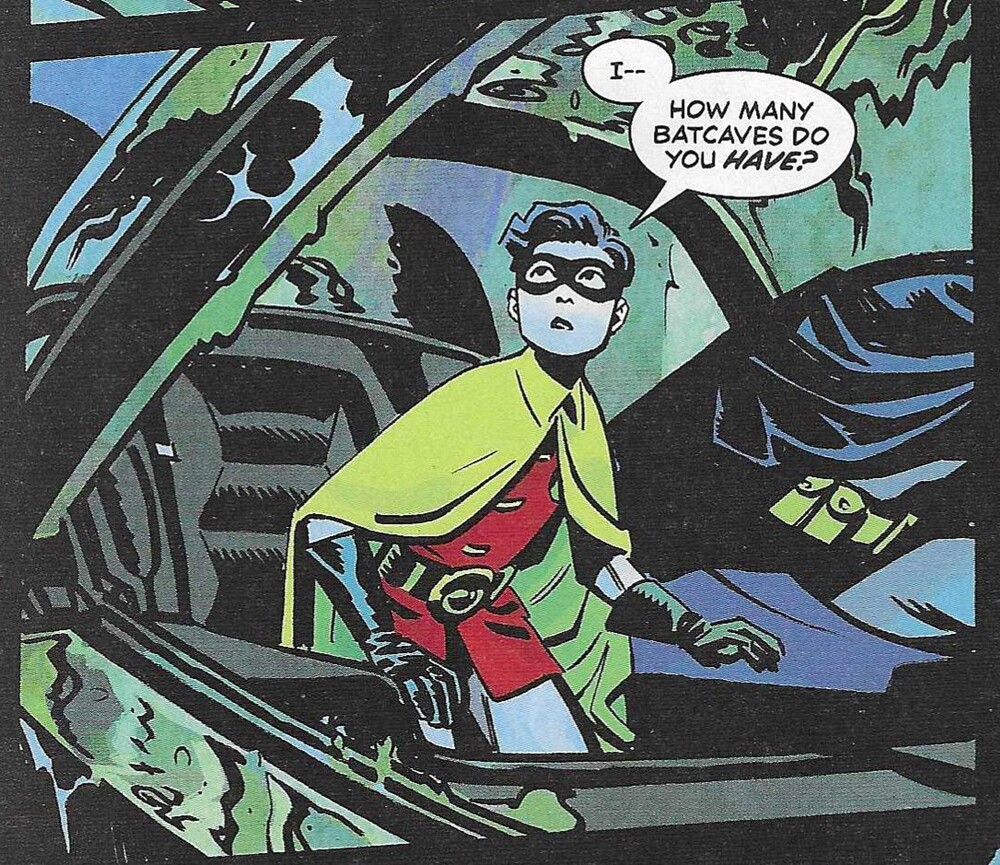
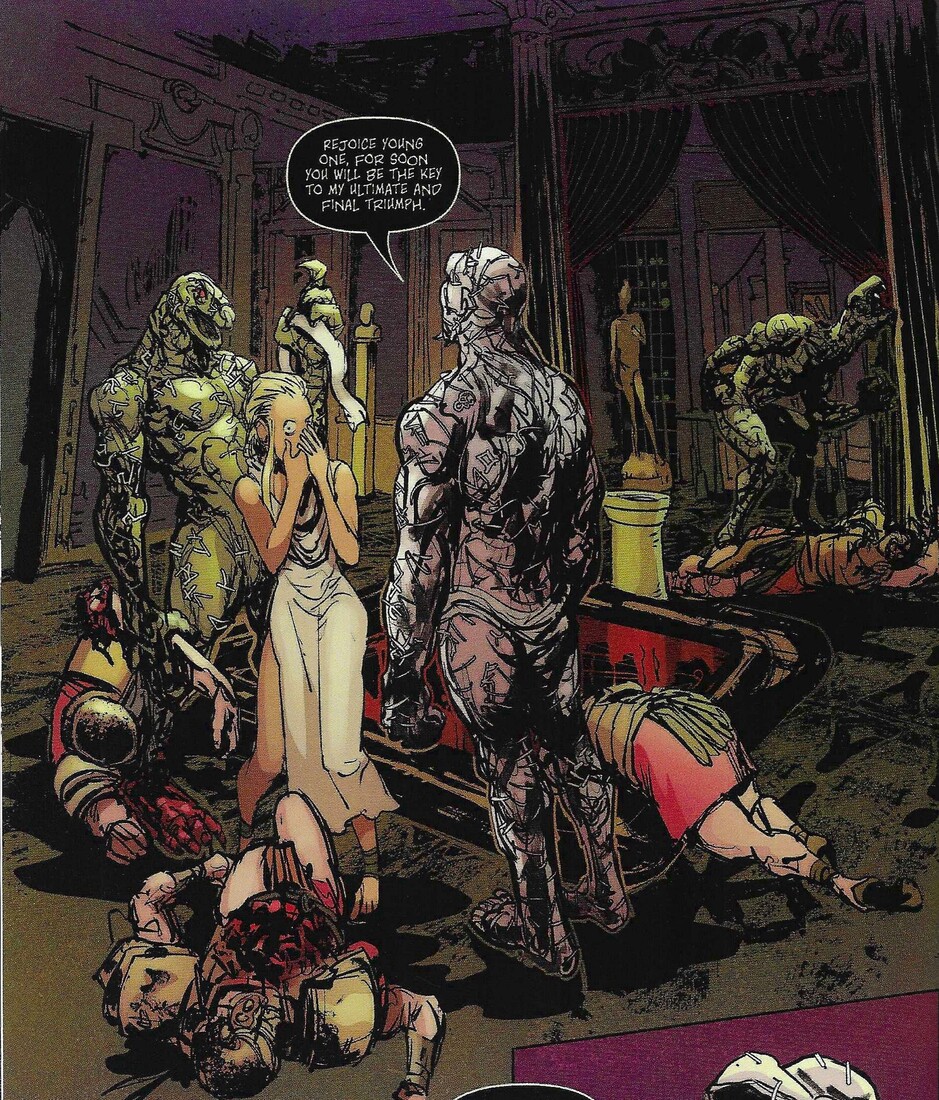
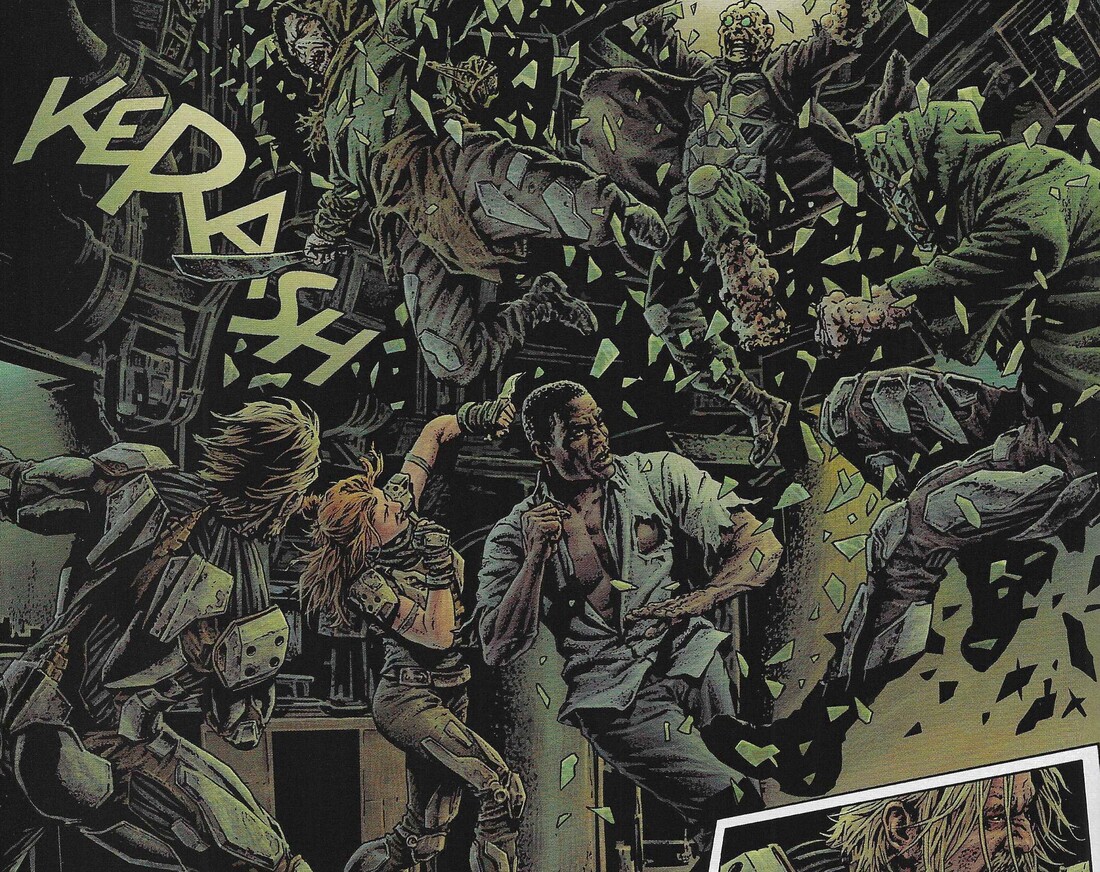
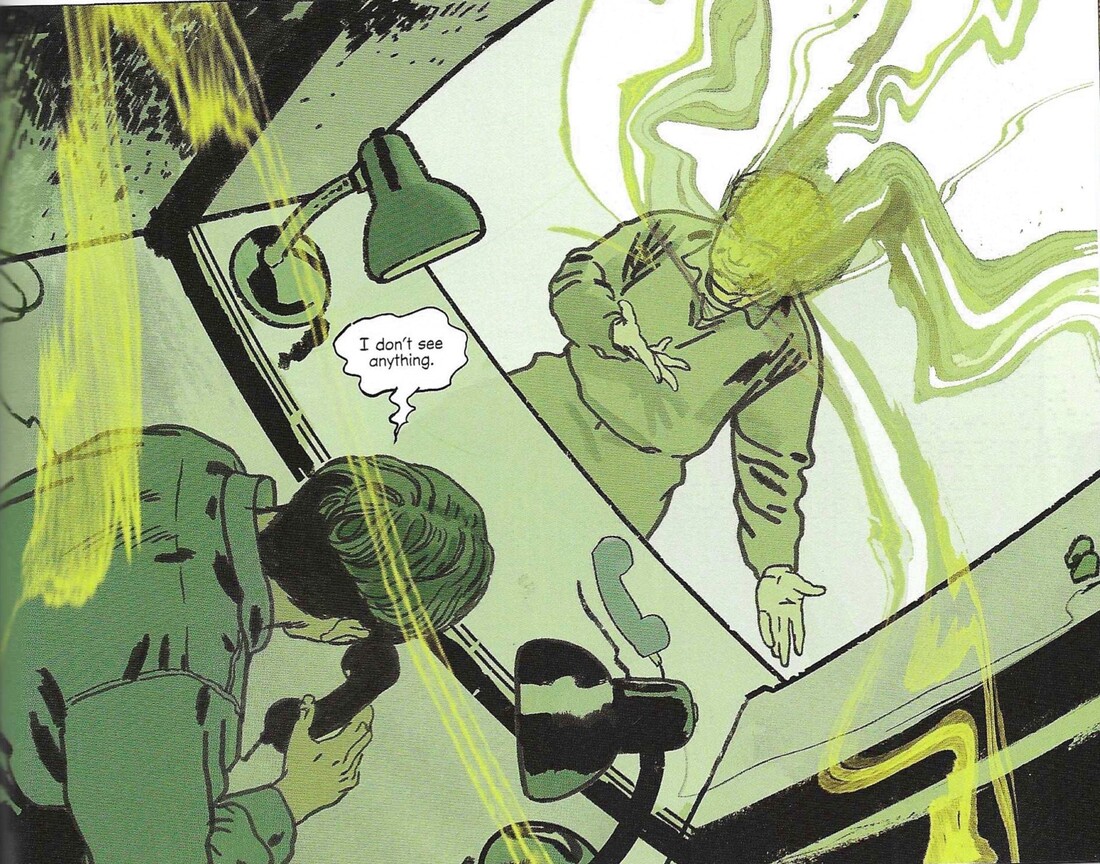
One totally Airwolf panel:
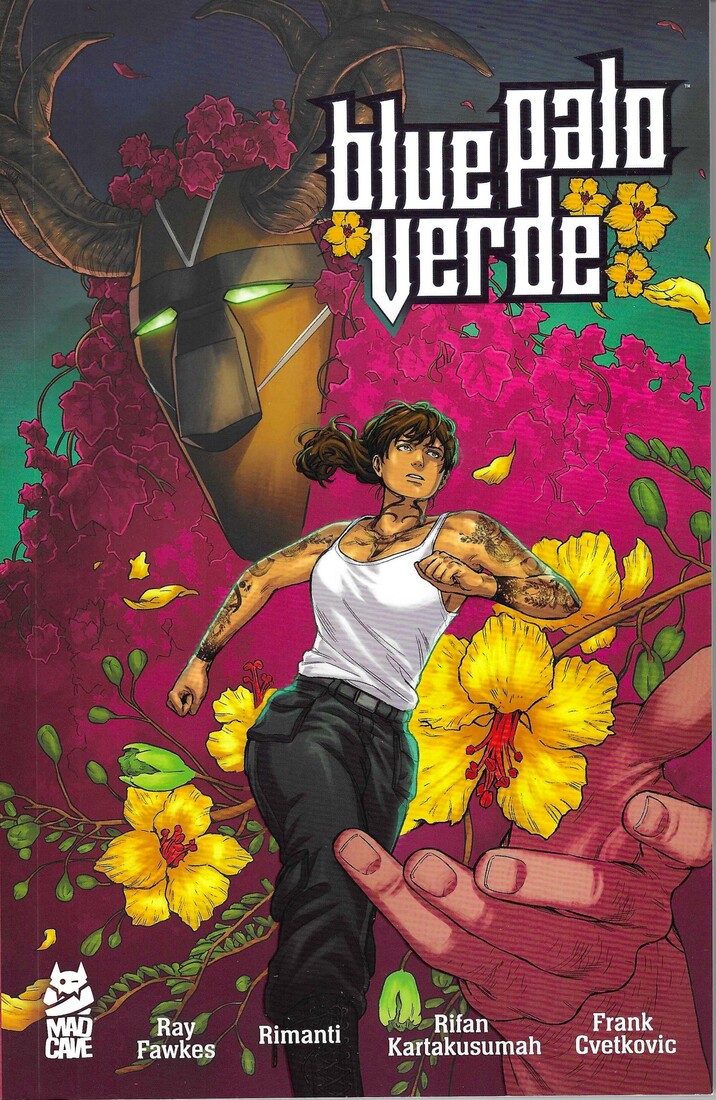 Blue Palo Verde by Ray Fawkes (writer), Rimanti (artist), Rifan Kartakusumah (colorist), Frank Cvetkovic (letterer), and James B. Emmett (editor). $17.99, 110 pgs, Mad Cave Studios.
I guess the theme of this month’s column will be characters in fiction doing stupid things, because down below, we have some characters in fiction doing stupid things, and we’ll begin with Blue Palo Verde, which features a character in fiction doing … somewhat stupid things? Fawkes is an interesting writer, but not always when he’s not drawing his own stuff, as he seems to lose his way a bit when someone else is handling the art chores, and he does a bit here. There’s a woman, Kristine, who gets released from prison after serving several years for an unspecified crime and sets out to find her father, who she knows is living in a small town in New Mexico (she’s in prison in Tucson). When she gets there, she finds out that the town is, basically, a cult, and there’s some weird supernatural stuff going on and she has to fight her way through it. I haven’t seen Midsommer, but I assume it’s kind of like that. I don’t want to spoil too much in case you like “innocent person who finds themselves beset by a cult”-type stories, but it doesn’t really unfold in any way you can’t see coming. It’s a bit frustrating. Kristine, unlike some other people we’ll meet below, isn’t exactly stupid, but she is presented with evidence that this is a cult very quickly and does nothing about it, she finds her father and immediately demands he leave with her without asking him if that’s what he wants (he doesn’t seem to be mentally incapacitated in any way, although he is in a cult, so there’s that), and when she finds out her father is ill, she doesn’t ask the doctor who seems kindly enough what’s going on, instead simply picking up her father (she’s strong and young, he’s old and a bit smaller than she is) and trying to get out of town. I mean, the instant she realizes she’s in a cult town, she should have become more circumspect, but that wouldn’t be good drama, so she china-shop bulls her way through the plot, and bad things happen immediately. I get that this is a classic example of The Person Who Is Ostracized By Society But Doesn’t Care Because She’s An Individual, Damn It! story, and no, I don’t think cults are good things, but I always find it hilarious that any example of a community in these stories is viewed with suspicion and needs to be rejected. Kristine never actually asks her father what drew him to the town, what he gets out of it, what he contributes to it, whether he’s happy there — she just assumes it’s horrific (they do a sacrifice at one point, but it’s not really clear if they sacrifice humans at all) and they need to leave. It’s frustrating that Fawkes never examines things more closely, but he’s not alone in this regard. This is mildly entertaining, but it’s also riddled with clichés. Too bad.
Rating: ★ ★ ★ ★ ★ ½ ☆ ☆ ☆ ☆
One totally Airwolf panel:
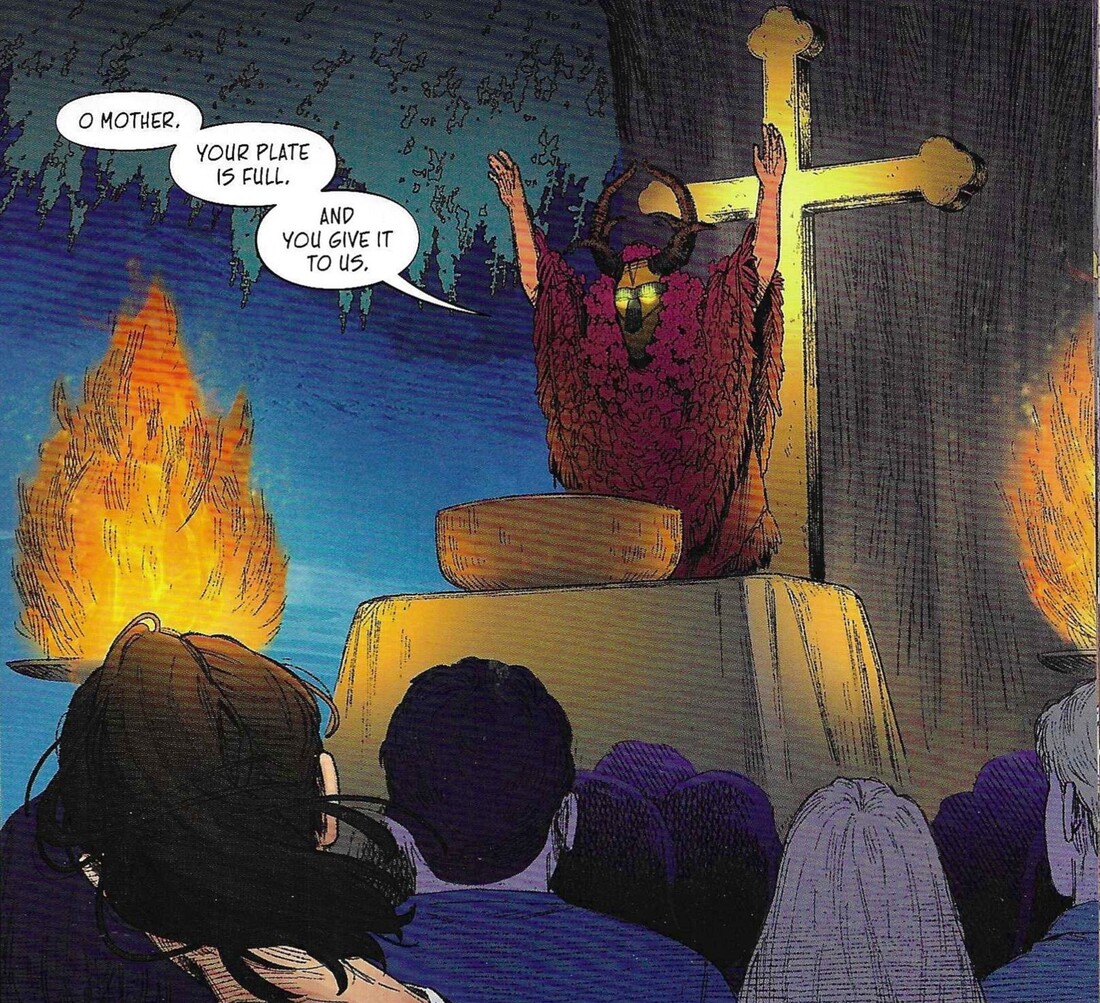
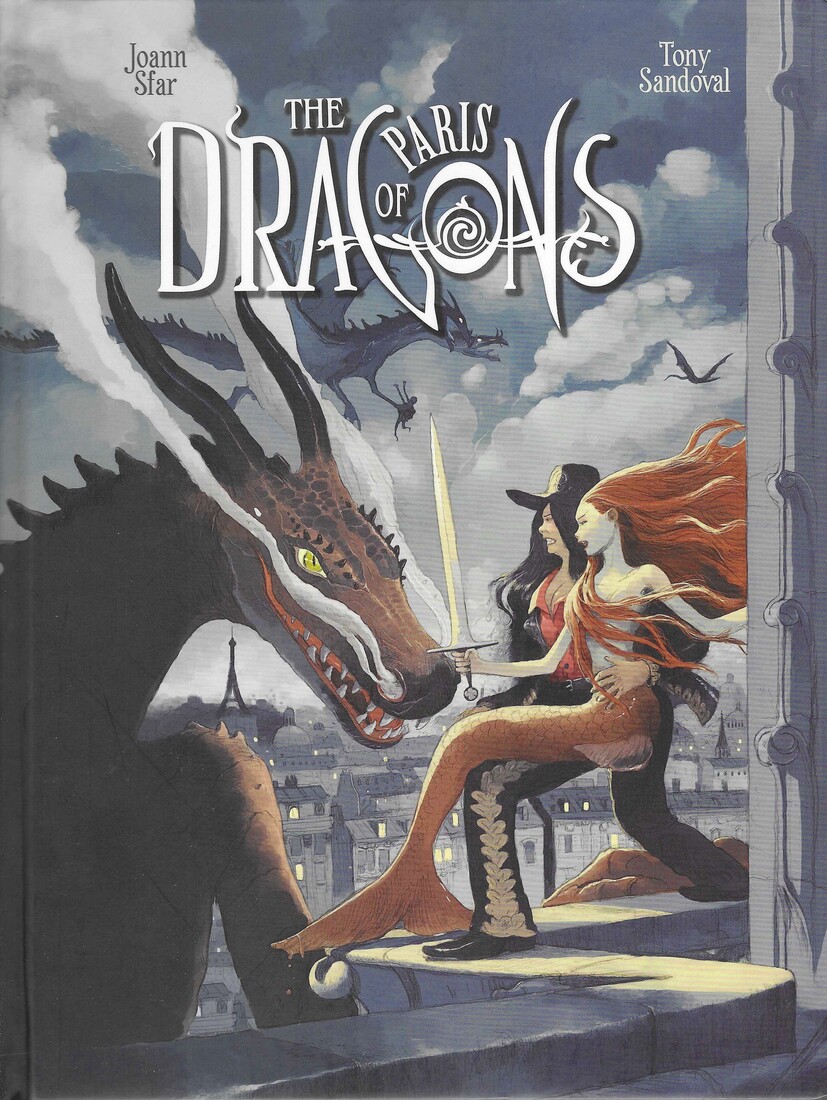 The Dragons of Paris by Joann Sfar (writer), Tony Sandoval (artist), Dan Christensen (translator), Chris Northrop (letterer), and Nike Kennedy (editor). $24.99, 102 pgs, Magnetic Press.
Some years ago, I reviewed Sfar’s The Professor’s Daughter on the old blog and got a snide comment about how he’s a dude, because I (not unnaturally, I thought, given his name) thought he was a woman. On that book, there was no biographical information about the creators, but on this one, there is, and it clearly states that Sfar is a man, and I like to think that the editor saw my review many years ago and thought, “We better make sure people know he’s a dude!” My wife, being the jerk that she is, noted the other day that “Joann” could just as easily be “Yo-Han” as “Jo-Ann,” but she’s a jerk anyway. What does she know?!?!?
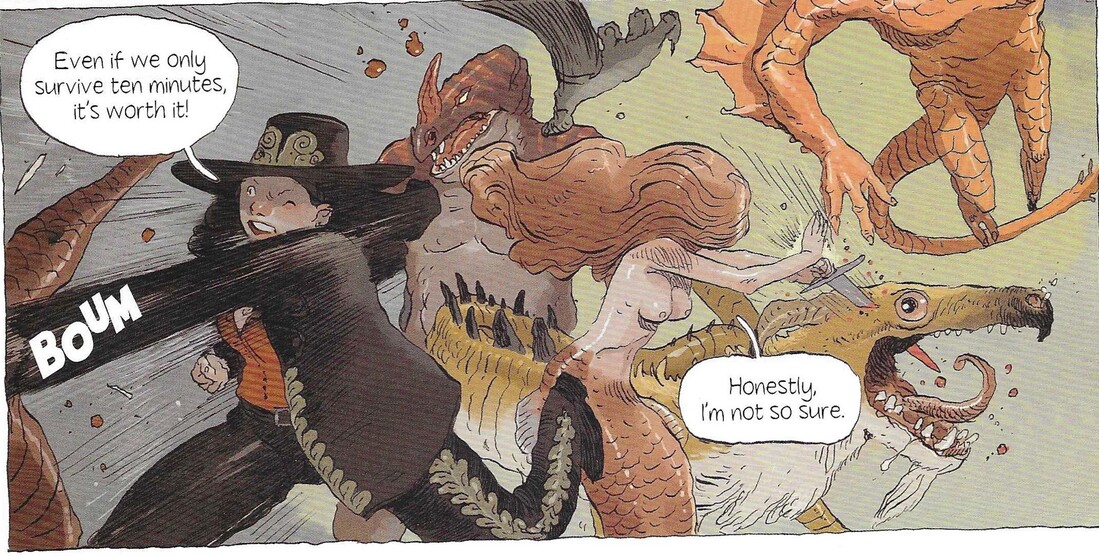
Anyway, yes, I suck, and I thought Sfar was a woman, which is meaningless anyway, because if I’m reviewing a comic, I don’t really care what gender the writer is, just if it’s any good, and Sfar’s a pretty good writer. The Dragons of Paris is not a great comic, unfortunately, but it’s still pretty good. The premise isn’t bad — in medieval times, dragons, with the help of a monk who does it for a petty and selfish reason, pose as statues around Paris, “sleeping” for centuries until, in 1900, they start to wake up. Their waking up involves a siren and a Hawaiian queen who’s in Paris making a living as a circus freak, and the two of them fall in love (well, the siren does with the queen, which is notable as everyone falls in love with sirens but sirens rarely fall in love with others) and fight back against the dragons. The monk is there, too, as he’s been in suspended animation for centuries, apparently just waiting until the dragons wake up again. The queen — her name is Kapa’akea — and the siren — who doesn’t appear to have a name — fight dragons, the monk tries to figure out how they can go back to sleep (dragons actually enjoy sleeping, it seems), and the dragons are busy destroying parts of Paris and eating people, and it’s all very fun. It’s just a bit odd. Sfar just throws things in there with very little explanation or even reasons, and while it makes the book a bit of a surreal masterpiece, it’s also kind of off-putting. I’ve often said that surreal paintings are fine, because the images linger with you and make you think, but surreal literature is harder to pull off, because simply making no sense isn’t enough. I doubt if Sfar wanted to make no sense, but he does, too often, in this book, and it makes the narrative just a bit wonky and unsatisfying. It is fun to see dragons who are so articulate and randomly funny, but it still feels a bit tonally bizarre and scattershot. Entertaining, but a bit of a trifle.
Sandoval does really nice work with the art. It’s what I think of when I think “European,” in that he uses thin-ish, precise line work with very precise hatching to add texture, not shading, and his characters are often a bit cartoonish but they retain their humanity nicely. It reminds me of Troy Nixey’s work, honestly, if you’re looking for comparison (Sandoval is Mexican, so he’s not European at all, but his sensibility leans that way). He does some nice work with painting to differentiate the “legends” about dragons with what’s actually happening in the Middle Ages and in 1900, and he does it again with some dramatic panels in the course of the main narrative to set them apart, which works really well. His character work with Kapa’akea and the siren helps their romance become more real, and he has entirely too much fun designing the dragons and turning them loose on the Parisians — this is a fairly bloody book (not too, too bad, but bloodier than you might expect), and Sandoval has a good time with it. Sandoval veers nicely from somewhat goofy humor to horror, and while it has that odd tonal shift of the writing, you can’t deny that it all looks very nice!
I don’t love The Dragons of Paris, but it’s still a pretty good comic. You have to support the work of non-‘Muricans — they don’t have the benefit of living in the Trumpian Paradise like us, so they’re probably bummed out a bit!
Rating: ★ ★ ★ ★ ★ ★ ★ ☆ ☆ ☆
One totally Airwolf panel:
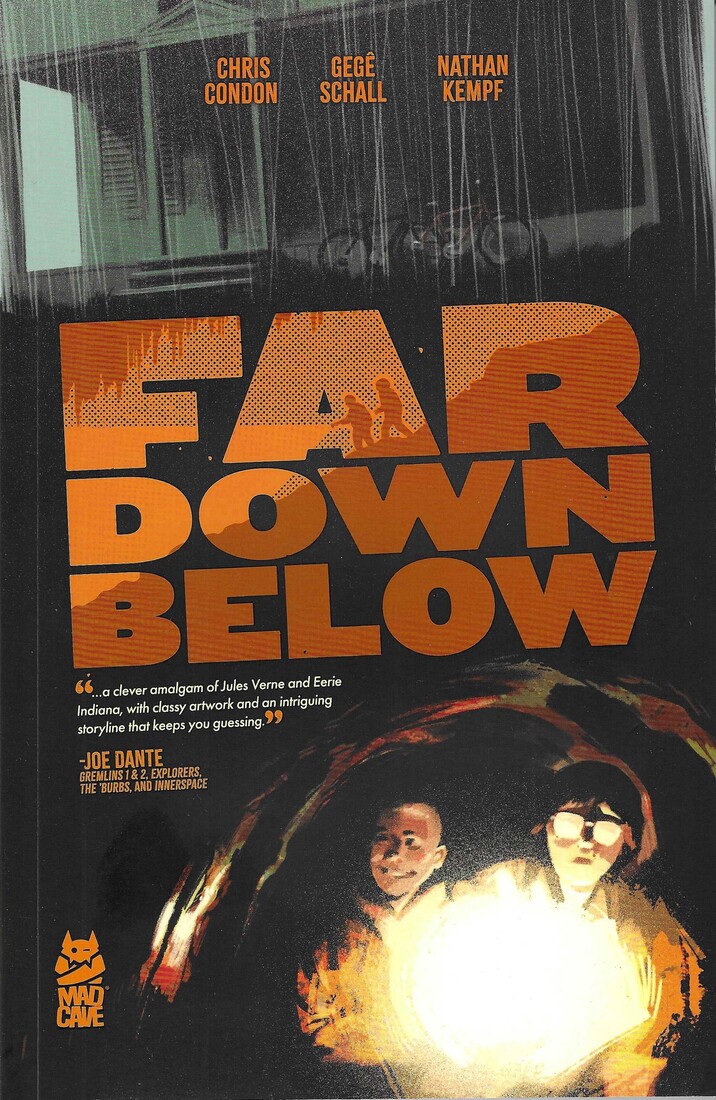 Far Down Below by Chris Condon (writer), Gegê Schall(artist), Nathan Kempf (letterer), and Marla Eizik (editor). $17.99, 114 pgs, Mad Cave Studios.
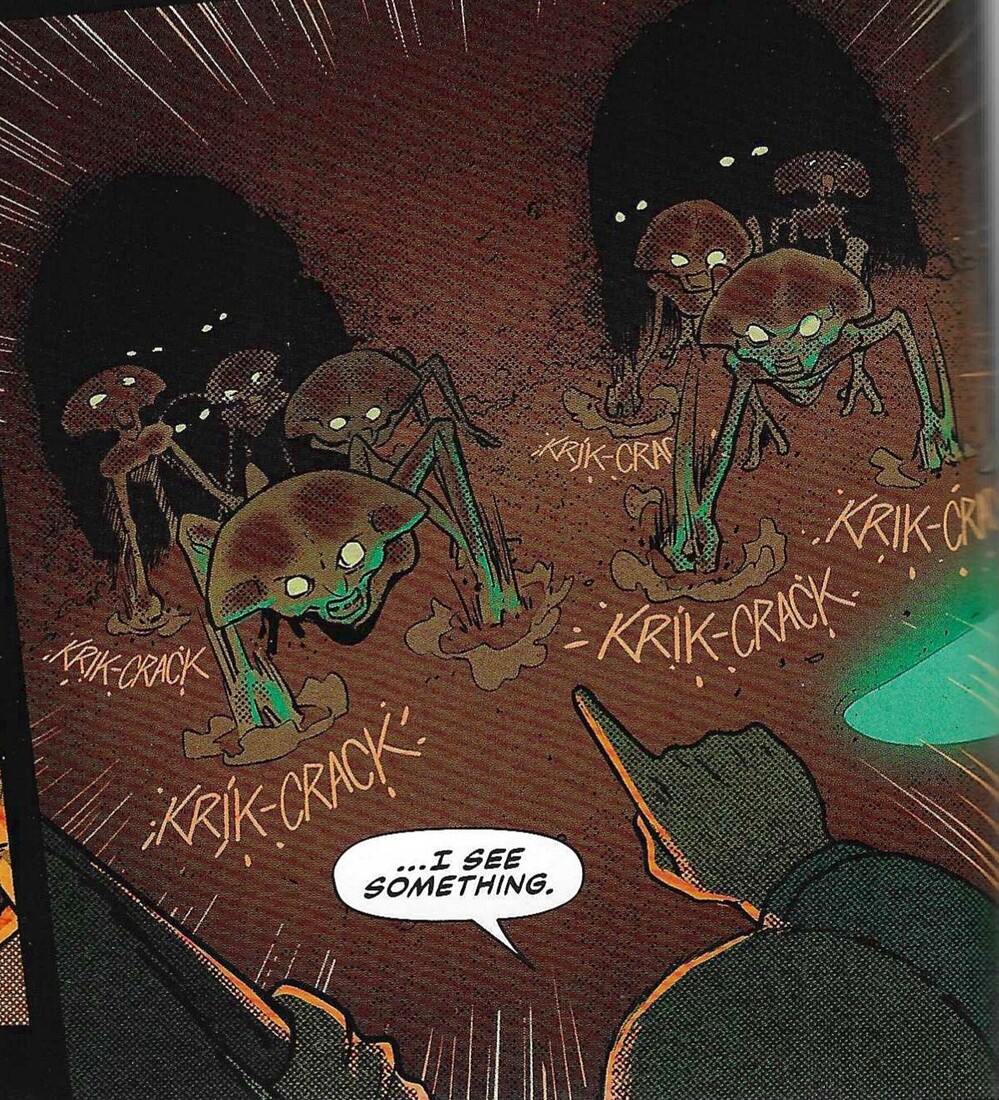
In the introduction to this comic, Condon writes that he dug 1980s movies even though he was born in 1991 (the curse of nostalgia extends even to those not alive during certain time periods!) and he used to watch The Goonies on the last day of summer every year, which is a nice tradition (even though The Goonies isn’t very good). He writes that he wants to evoke not only those kinds of movies, but the feeling of being a kid at a time when you can have adventures … something he heavily implies is not possible today, what with the homogenization of the landscape and the ubiquity of cell phones and why don’t those kids go outside sometimes?!?!? So he sets this book in 1983, which is actually not a bad time to set it, as the Cuban Missile Crisis is kind of a plot point, so setting it much later wouldn’t really work. He gives us two tweens, Brian and Jeff, who are best friends and, naturally, kind of nerdy. Brian’s family happens to own an old house that everyone thinks is haunted, and when Jeff finds some newspaper clippings about the house and the disappearance of Brian’s grandfather 20 years earlier, he insists they go to the house, where of course they discover not only Brian’s grandfather, alive and well, but a whole underground world, and they have a bunch of adventures. Condon points out that people might think it’s a bit silly, and it is, but that’s only because he sets the book in the “hollow earth” and puts some strange and unlikely things down there, but because everyone takes it seriously (and, I mean, people do die in this comic), it helps mitigate the silly aspects. Brian and Jeff are on that ledge of childhood — they’re still young, they’re still dumb (both kids do astonishingly stupid things in this comic), they’re still idealistic, and they still like playing with action figures … but Brian has a crush on a girl, which, of course, threatens their friendship just a little (Condon wisely does not dwell on the crush too much). A few things in the book make absolutely no sense (well, beyond the weird stuff that we have to accept exist in this world; I mean some of the motivations of the characters), but it’s a solid family drama, as Brian doesn’t understand why his grandfather has been gone so long (I mean, we find out, but Brian doesn’t think it’s a very good reason), so he needs to work through that, and the kids’ parents are, naturally, a bit worried by their disappearance. Schall’s art is fine — it’s a bit cartoony, but it works pretty well, and he gets to draw some fun, odd things, so that’s nice.
I don’t love stories like this, because often they simply tap into a nostalgia we’re all supposed to share and the writer doesn’t always do the heavy lifting required to make the characters real. Condon does a decent job, but this is really just a mildly entertaining adventure with a bit of heartfelt emotion thrown in. It’s fine, but nothing too special. Such is life!
Rating: ★ ★ ★ ★ ★ ★ ☆ ☆ ☆ ☆
One totally Airwolf panel:
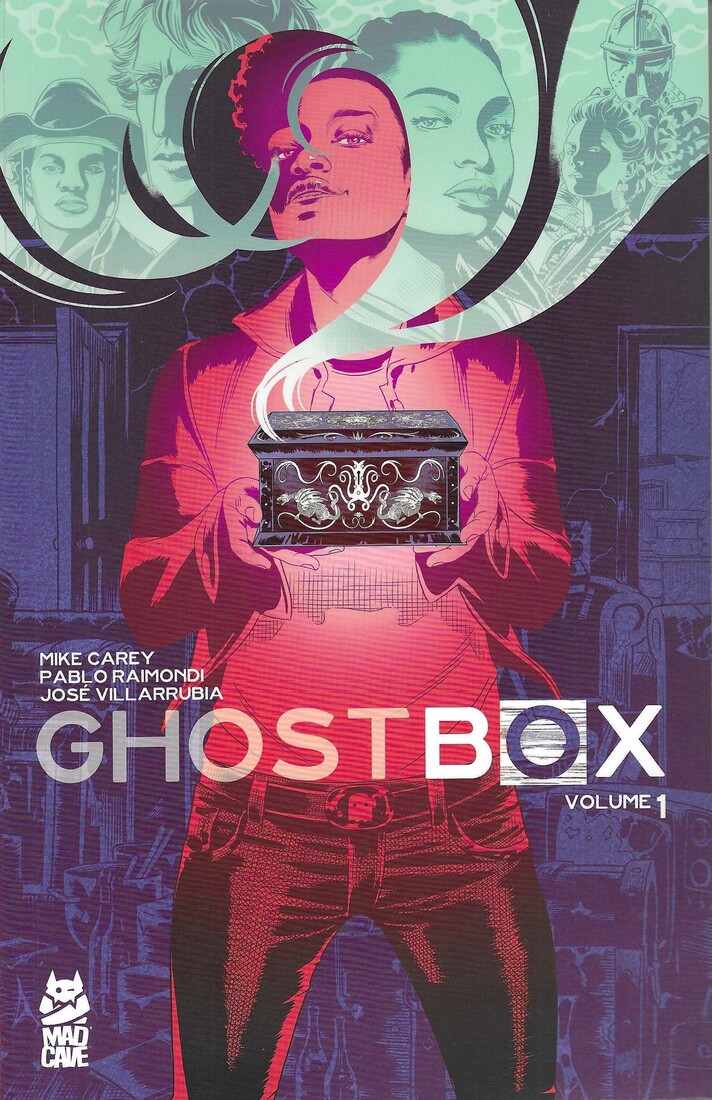 Ghostbox volume 1 by Mike Carey (writer), Pablo Raimondi (artist/letterer), José Villarrubia (colorist), and Sarah Brunstad (collection editor). $19.99, 133 pgs, Mad Cave Studios.
Some years ago, Raimondi did Sacred Creatures, which, as far as I recall, was something he really wanted to do and which did not quite finish, as it was clear Raimondi wanted it to be an epic. It’s a really good book, but since that first trade, there have been crickets on that front, so did it just not do well financially for Raimondi, or did something else happen? Because I’d like to read the rest of it! I would also like to read more of Ghostbox, which is Raimondi’s latest comic, because this first trade is pretty darned good (even though he didn’t write it). I’ve never been the biggest fan of Carey, but this story works quite well. So maybe Raimondi will get to continue this, because I’m unsure if we’re ever going to see more Sacred Creatures.
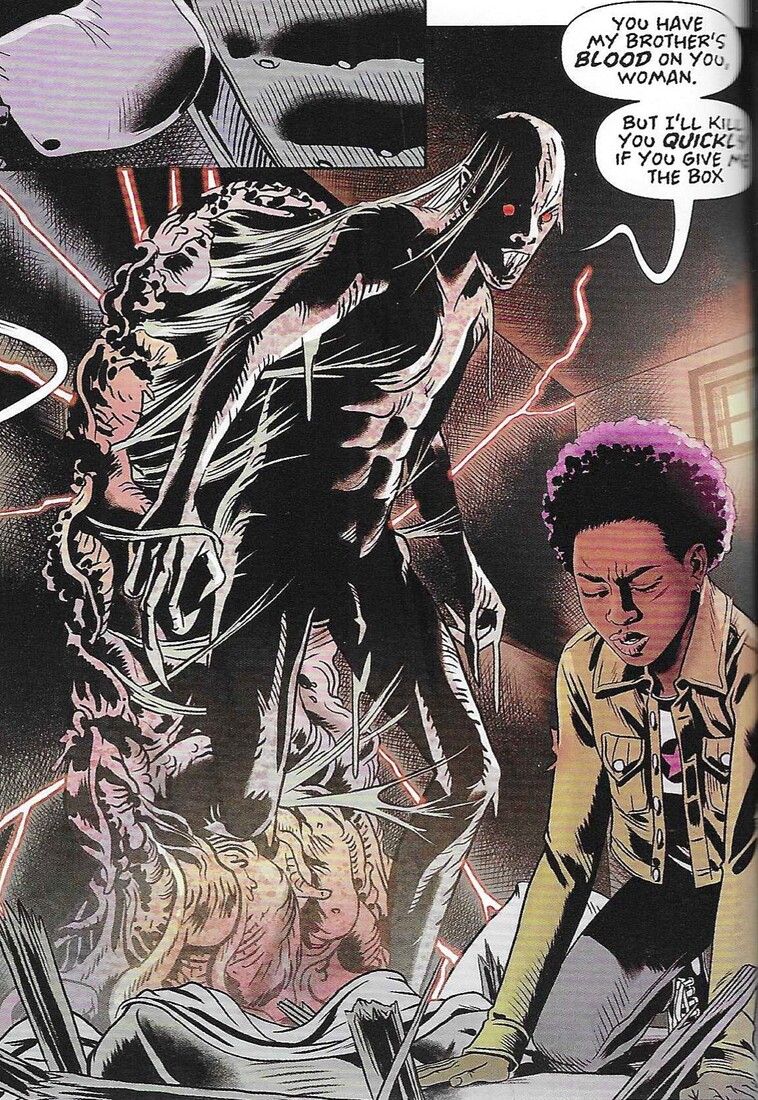
So this story is about two sisters who inherit a crappy old cabin from an unknown uncle out in Cornwall somewhere, and said cabin just happens to have an extremely dangerous artifact in it that now belongs to them. The so-called “ghostbox” contains a number of dead people in it who died “in its vicinity” (it’s never quite clear how close you need to be to the box to be “captured” by it), and of course nefarious forces are after it. One of the sisters — Jan, the one who has her life more together, of course — is killed when a bad dude tries to take it, and her spirit goes into the box. Meanwhile, Chloe, the big ol’ messy sister, has to figure out how to protect the box from the evil dudes while, unfortunately for her, running from the police, who think she killed her sister (plus, unfortunately for her, the other corpses that begin to pile up a bit in her wake, because the evil dudes don’t leave much behind and they’re, you know, supernatural). Jan, meanwhile, is inside the box trying to figure out what’s going on, and she has to deal with the spirits there, who are trying to stay safe themselves but aren’t necessarily concerned about Chloe’s safety (which Jan, naturally, is). As we go, we learn the secret of the box and what the deal is with the evil dudes trying to get it, and it’s a fairly satisfactory explanation. Meanwhile, Carey does a nice job with the ancillary characters, from the cop who hunts Chloe because she’s absolutely positive that Chloe is a mass murderer to the woman who takes Jan under her wing … but does she have the most honorable intentions or not?!?!? The bad guys are interesting, too — sure, they’re pure evil, but Carey gives them a bit more depth than you normally get with monsters, so that’s nice. I do like how everyone has their own agenda, so even though you’d think the spirits inside the ghostbox and Chloe would be natural allies, Carey doesn’t make it quite so easy. It’s always nice to get some nuance in your horror thrillers!
Raimondi is terrific, which isn’t too surprising. When he’s rushed, his work can look a bit artificial, as he has a very thin line and he often uses models in his backgrounds (which I assume he scans and traces, but still). However, when he has a bit more time, he’s able to incorporate the models more organically into the scenes, and his precision becomes more of an asset, as he’s able to contrast it with beautiful spot blacks, some clean hatching, and very nice special effects. His art is never going to be rough, exactly, but just using a bit thicker lines in some areas gives his art a weight that it doesn’t always have, especially when he’s working in the Big Two salt mines. He does a terrific job with the design of the world inside the ghostbox as well as the main evil dude, who’s truly horrific. Raimondi has been a good artist for a while, but I don’t think he got the credit when he worked for Marvel. Out on his own, his art has really shined. Villarrubia does his usual stellar job with the colors — Raimondi’s art lends itself to glowing or shiny colors, and Villarrubia puts them in at excellent spots to add a creepy atmosphere to the art. They’re a good team.
This tells a pretty good story that actually has an ending, but it’s clear Carey has more stories to tell with these characters. I hope he and Raimondi get the chance!
Rating: ★ ★ ★ ★ ★ ★ ★ ★ ☆ ☆
One totally Airwolf panel:
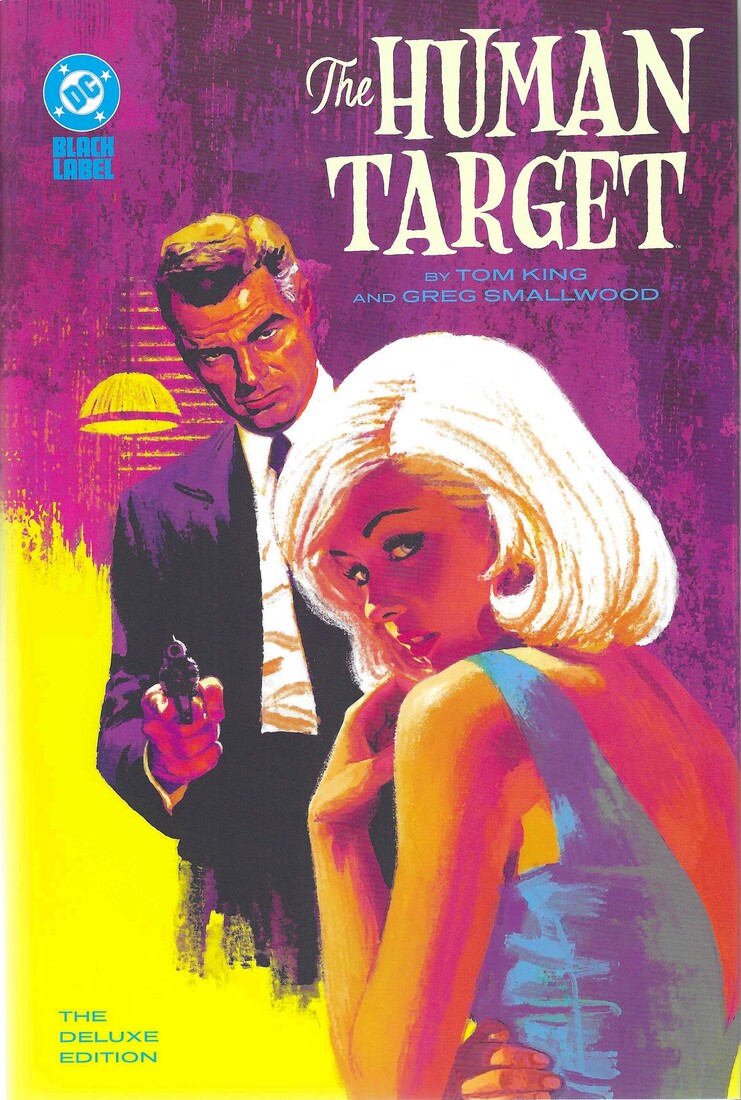 Human Target: The Deluxe Edition by Tom King (writer), Greg Smallwood (artist/colorist), Rafael Albuquerque (artist), Kevin Maguire (artist), Mikel Janín (artist), Dave Stewart (colorist), Alex Sinclair (colorist), Arif Prianto (colorist), Clayton Cowles (letterer), and Reza Lokman (collection editor). $49.99, 376 pgs, DC.
I guess it’s a testament to how good King can be that I keep getting his comics even though I know he’s capable of really, really bad comics, too. This is a guy who’s written, arguably, three of the best comics of the century so far (Vision, Supergirl, Helen of Wyndhorn, and if you want to count The Sheriff of Babylon, I’ll allow it), yet he’s also written comics that might be among the worst of this century, too (what I read of his Batman run, what I read of his Wonder Woman run, that Riddler “One Bad Day” thing). It’s very impressive, but when I do read something of his that’s actually good, it’s so good that I can almost forgive the utter garbage. Almost. But I always have high hopes when I pick up a Tom King book, and I guess the times when I don’t get my hopes dashed do make up (somewhat) for the times when I do.
King has done these 12-issue “maxi-series” for other DC characters, and they’ve been critically lauded but they seem to be not as good as everyone says they are. He failed to stick the landing on Mister Miracle, and Strange Adventures was good but messy. Now he’s turned his sights on Christopher Chance and the Giffen/DeMatteis Justice League, and … boy howdy, I might have to re-evaluate if I’m going to get Tom King books moving forward. This isn’t as bad as his Batman or his Wonder Woman, I would argue, but it is far more misguided and misanthropic. I have a soft spot for the “bwah-ha-ha” League, of course, and Beatriz DaCosta is one of my favorite comic book characters, so of course I’m going to look at this a bit more than if it starred, I don’t know, Roy Harper, but I still don’t know why DC allows King to basically shit all over these characters. You know how everyone claims that Alan Moore and Garth Ennis and Warren Ellis and Mark Millar hate superheroes? Well, they may, but they still write them very well and, when they’re writing corporate characters, they don’t wreck them. There’s a reason everyone thinks Ennis wrote one of the best Superman stories ever. If those guys want to shit all over superheroes, they go create their own, and while, yes, they’re absolutely analogs of the DC and Marvel ones, at least they’re not turning Batman into a pedophile. Yet DC allows King to do this comic (in which he does not, to be clear, turn Batman into a pedophile). I mean, he did work for the CIA — what does he have on the higher-ups at DC?!?!?
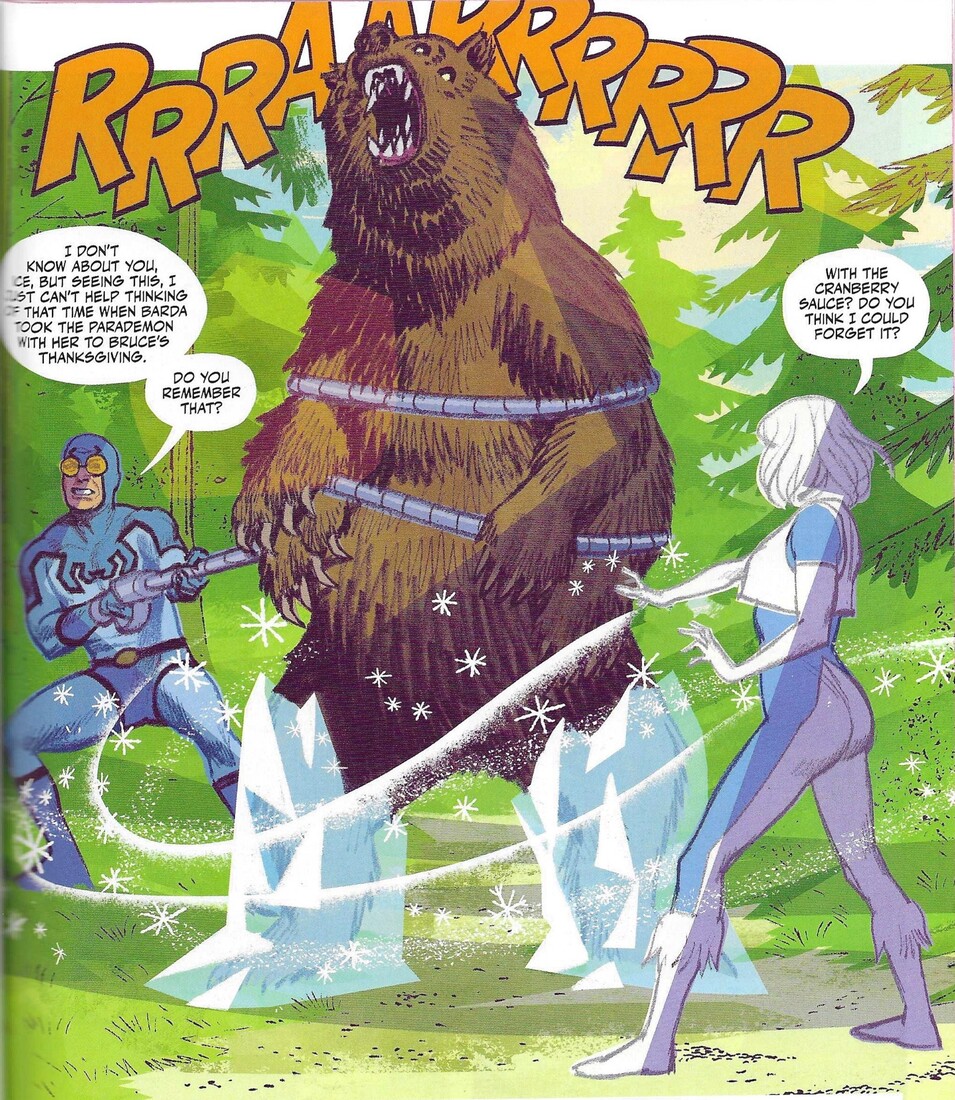
King wants to write a noir story — this is basically D.O.A. on a slightly longer timeline — but I guess he wants the fanboys to buy this, so instead of just making up characters, he forces the League into noir tropes. You can write different genres using superheroes — Brubaker turned Captain America into a spy thriller without shitting all over the characters, and Bendis kind of turned Daredevil into a villain without wrecking him — but King doesn’t seem to have any interest in trying to write the characters like they’ve been written for years and still putting them in a noir story, which might have worked. He even doesn’t really need Christopher Chance — the Human Target doesn’t do much human targeting at all in this book, and even though the inciting incident fits with his m.o., King could have had some random guy poisoned in any number of ways. He wants to do Christopher Chance because he blathers on a bit about identity, which is a staple in superhero comics, so it’s nothing new here, and I’d like to point out that Peter Milligan did it better in his Human Target, and that series had better action and didn’t, you know, shit all over other DC characters. Chance is impersonating Lex Luthor at the beginning of the book, and he gets poisoned, and so he decides to figure out who would want to poison Luthor, and that leads him to the Justice League. King’s god-awful Riddler story was, a dude at my comics shop argued, not in continuity, so who cares if the Riddler is completely out of character, but this story is clearly deeply set in DC continuity, which makes it … worse? Dr. Midnite determines that the poison could have only come from one source: the Giffen/DeMatteis Justice League. Oh dear. Ice comes to see Chance so she can … convince him they didn’t do it? It turns out Chance lured her there by pretending to be Dr. Midnite on the phone, and it’s unclear if she’s there to check his investigation or help him or what. King, of course, is writing a noir story, plus he, like a lot of male writers, doesn’t seem to think a man and a woman in a story can be in each other’s presence for more than a few minutes without falling into bed together, so of course Chance and Ice begin fucking. King turns Ice and Fire into femmes fatale, he turns J’onn into a pathetic loser who has an affair with Fire, he turns Guy Gardner into a domestic abuser (to be fair, not a long trip to make, but still), he turns Dmitri into a vengeful would-be murderer, he makes Booster even more idiotic than he usually is (again, not the longest trip), he turns G’nort into a drunk, and he turns Ted into a vaguely creepy CEO. These are all noir tropes, of course, and superheroes tend to be tropes, but this really does feel like King trying to put a square peg in a round hole, just because he wants DC to publish this instead of Image. This feels like the ultimate Johns-ification of the DCU, as if King can’t stand that someone once wrote a superhero comic that was full of action but featured characters who laughed a lot and said dumb things. So he makes Dmitri, one of the kindest superheroes you can find, drop Chance from a great height because he wants to kill him, and he makes J’onn a feckless fool who is led around by his dick, and he makes Ice a scheming femme fatale. “How dare those characters enjoy superheroing!” he says. “I’ll show ’em!”
Sigh. Sorry. It’s just so infuriating. Smallwood gives it this a gorgeous 1960s aesthetic, and it’s clear King still knows how to write — the chapter with Batman (who does not actually appear in the book) is terrific, as Chance thinks the Caped Crusader is after him and it becomes a wonderfully paranoid “chase” through the desert. King fails to give us a good solution to the mystery, because, and I can’t stress this enough, it’s based on the premise that the Giffen/DeMatteis Justice League might actually conspire to murder someone. Whether they do or not, I’m not going to say, but because it’s based on that ridiculous premise, it just never seems to cohere, as King is always there to remind us how stupid it is (I mean, he doesn’t think it’s stupid, which is probably why he keeps reminding us, but it is, so his reminders just reinforce the point). I certainly don’t mind if writers want to change characters — they’re fictional, after all — but this seems more mean-spirited than anything. It really does feel like King couldn’t handle a comedic Justice League, so he decided to turn them all into trainwrecks. Well, mission accomplished, I guess.
Tom King, I’m sure, can still write excellent comics. Let’s hope the next one is one of those! (Oh, and also: lots of grawlix, as usual. Use swear words or knock it the fuck off, Tom King!)
Rating: I don’t know. It’s a decent noir story, I guess? If you don’t care about the characters being shit on, I guess there’s that?
One totally Airwolf panel:
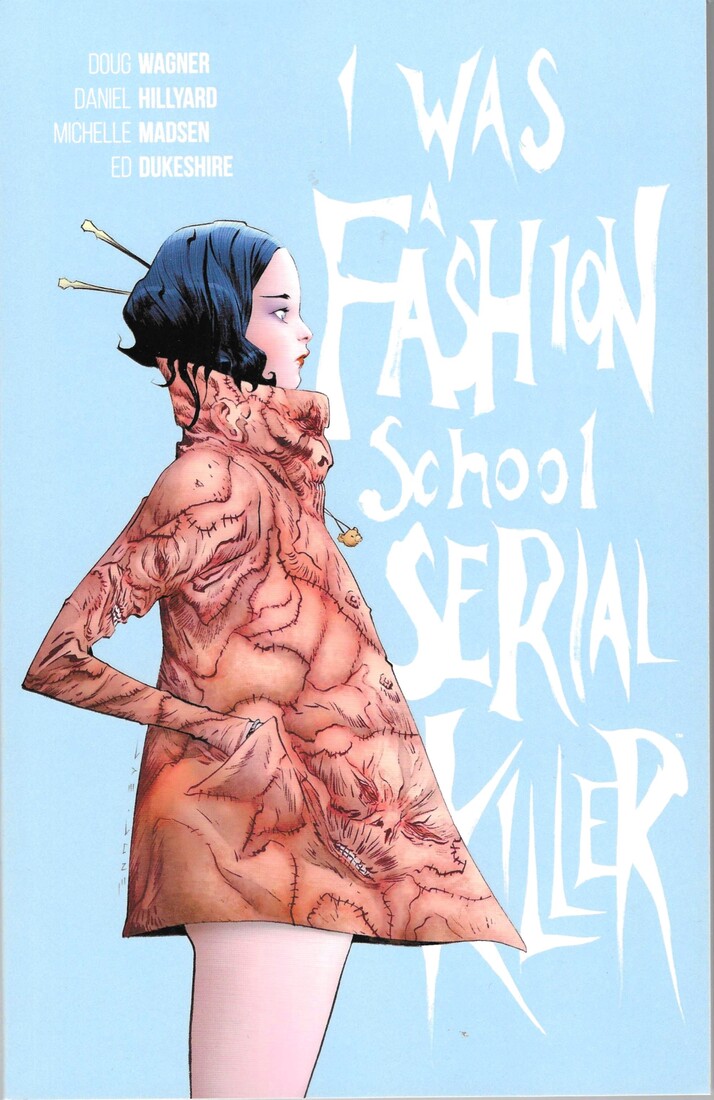 I Was a Fashion School Serial Killer by Doug Wagner (writer), Daniel Hillyard (artist), Michelle Madsen (colorist), Ed Dukeshire (letterer), and Kevin Gardner (editor). $19.99, 110 pgs, Image.
Wagner and Hillyard do comics about serial killers — I get that, but it still bugs me, not because I think they’re glorifying serial killers (although, because the serial killers are the protagonists, they’re never completely evil, which is a bit annoying), but because their serial killers are so amazing at everything. There are either never cops anywhere around, or the cops are just so dim that they can’t see the fact that these people are killers, even though the killers rarely do much to hide the fact that they’re killing a lot of people. Also, because the killers are the protagonists, they usually kill people who “deserve” it — in this comic, it’s a dude who wants to (but doesn’t!) cheat on his girlfriend, three dudes who would have (but didn’t!) rape a woman, and privileged rich girls who are rude to those less fortunate than they are. I mean, sure, they’re all “bad” people, but do they deserve to be slaughtered? Sure, some people in this comic are truly evil and get what’s coming to them, but some people … I don’t know if they deserve a horrific death. I know, it’s all kind of popcorn fun, but Wagner keeps doing it, and it’s getting a bit boring. Just changing the setting — in this case, a fashion school, which has some possibilities, story-wise, that Wagner only hints at — doesn’t really make it fresh. Our “hero” in this book — Rennie — is a killer before she gets to school, and Wagner hints around that having friends and creating fashion somehow calms the monster within her, but he never really gets into it because there are too many people to be butchered, so let’s get to that! I don’t need everything to be a deep examination of the human psyche, of course, but if you’re going to keep going to the serial killer well, you ought to do different things with it. Hillyard continues to be great, as he gets to draw all the carnage with such glee and verve, and Wagner is obviously having fun with the writing, but it feels a bit empty, simply because he’s done it before. Let’s hope their next work, while I’m sure it will be bloody, has something more on its mind than “Serial killers are the real heroes, because they cut — literally! — through society’s bullshit.” That’s getting a bit old.
Rating: ★ ★ ★ ★ ★ ★ ☆ ☆ ☆ ☆
One totally Airwolf panel:
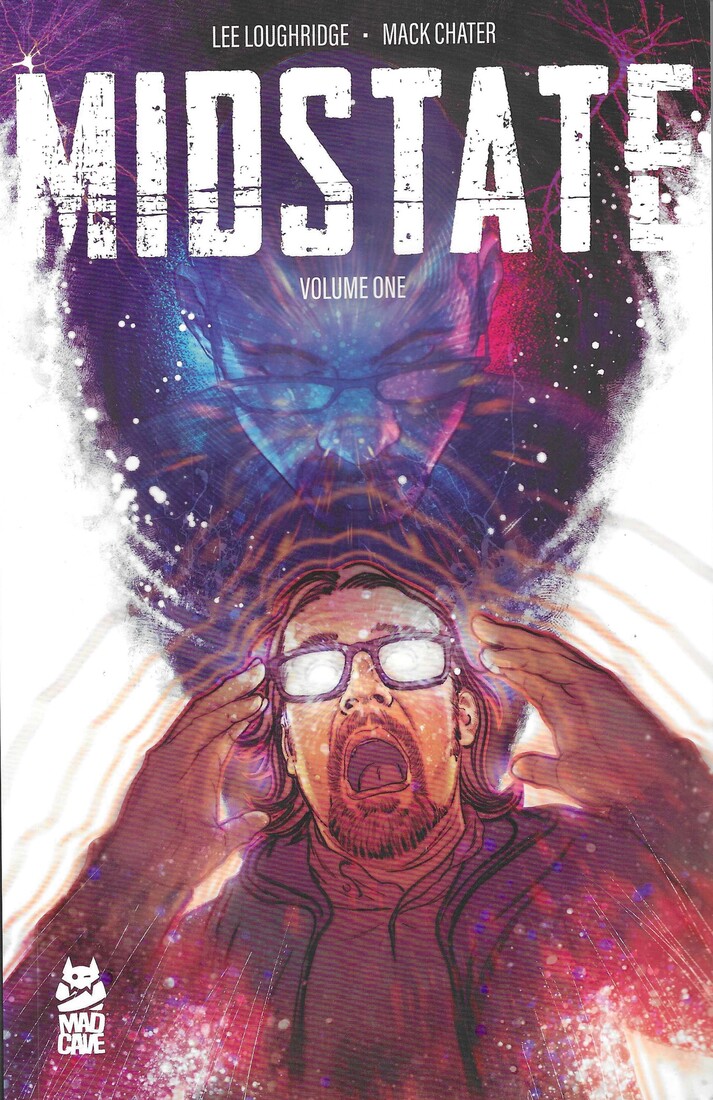 Midstate volume 1 by Lee Loughridge (writer/colorist), Mack Chater (artist), Rob Tweedie (letterer), and Will Dennis (editor). $19.99, 115 pgs, Mad Cave Studios.
Loughridge, colorist extraordinaire, writes this interesting tale that is actually NOT a complete story, so I hope he’ll get a chance to finish it. It’s not even like Ghostbox above, which tells kind of a complete story with possibilities for more. Anyway, Paul Rinaldi lives in a small town with his mother, and he has visions of the future. They happen in his dreams, and they’re kind of amorphous and vague and happen only occasionally, but everyone in town knows about it and mock him, because they’re not really very specific. Paul gets a vibe about someone in town, and suddenly, there are people being murdered, Paul is framed for vandalism, the new deputy sheriff knows something is going on but she doesn’t know what and it seems like Paul knows something about it but she can’t trust him. I don’t want to give anything away, because it’s kind of interesting, and Loughridge does a nice job leading us one way and then switching things up in clever ways. Paul, like many other people in this post, acts stupidly at the worst time, but Loughridge does a decent job setting him up as kind of a dummy, so it doesn’t feel as egregious as some other examples in this post. It’s a neat story, and it would be nice if Loughridge could keep going with it. Chater does a nice job with the art — it’s not a big action-packed story, so Chater does some nifty things with page layouts to make things more visually interesting, and he does a good job with how Paul and Abi — the deputy — relate to each other. The villain does not look like one, which is always appreciated. Chater doesn’t get to do too much weird stuff with the art, but he does a solid job.
We’ll see what happens with this. I hope I can read more of it!
Rating: ★ ★ ★ ★ ★ ★ ★ ☆ ☆ ☆
One totally Airwolf panel:
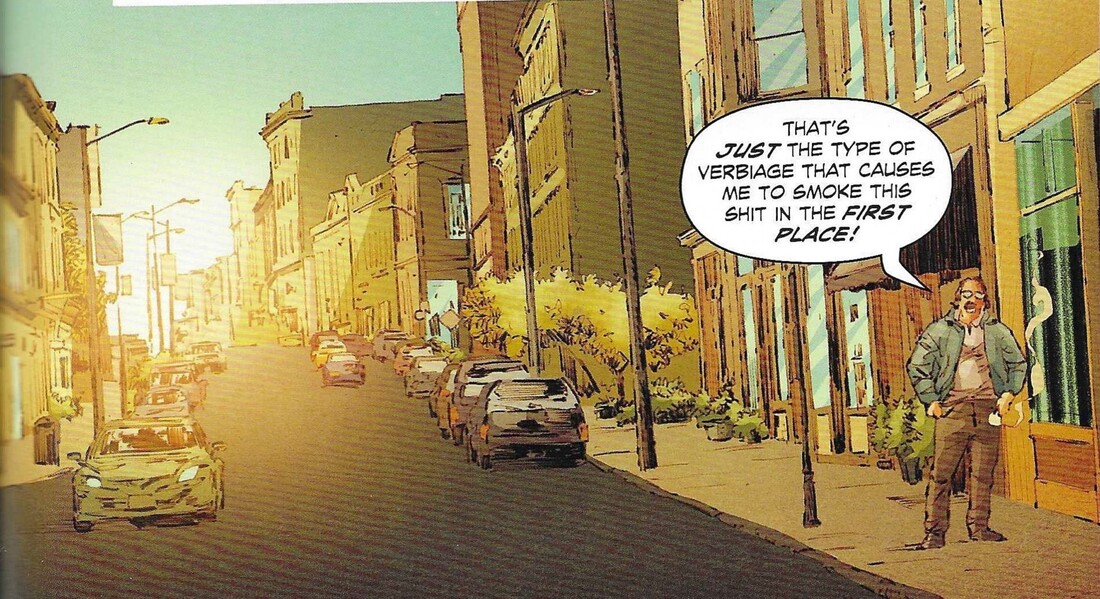
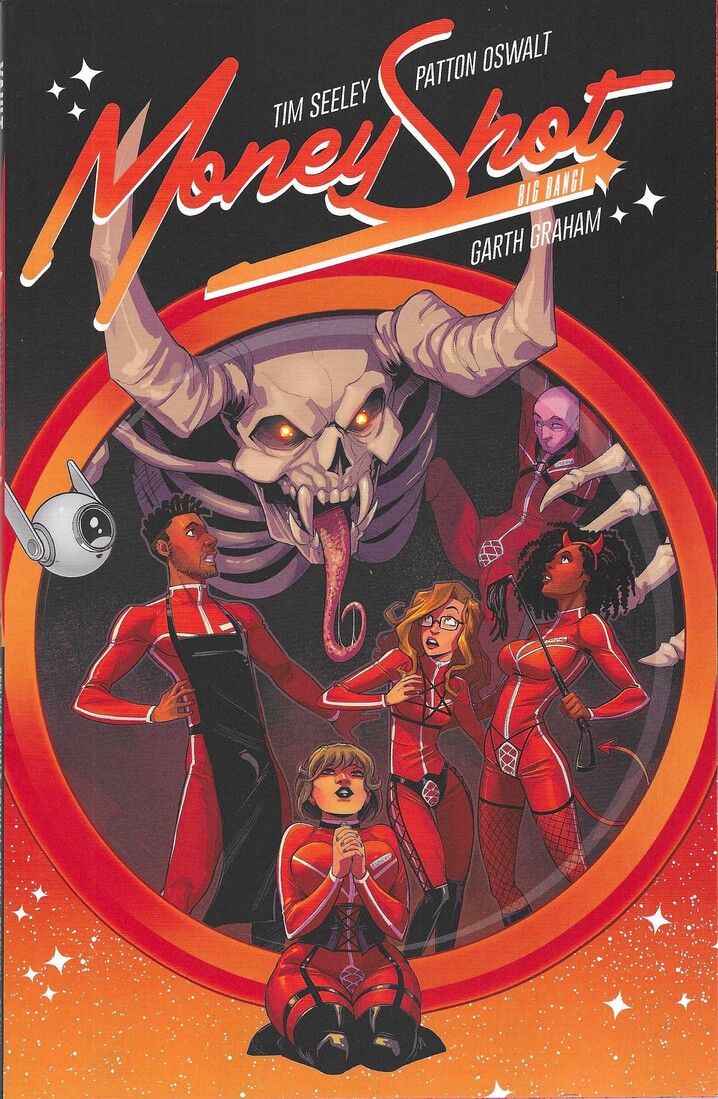 Money Shot volume 5: Big Bang! by Tim Seeley (writer), Patton Oswalt (writer), Garth Graham (artist), Maksim Strelkov (colorist), Kurt Michael Russell (colorist), and Crank! (letterer). $19.99, 101 pgs, Vault Comics.
Money Shot continues to be a fun, pretty good series, although it’s interesting how Seeley has shifted it. It seems that he had an end point in mind, after volume 3, but maybe it made sense, money-wise, to keep going, or maybe he just was having fun doing it, because volume 4 wasn’t exactly a reset, but it did feel like he had moved to a point where each volume was going to be a fairly standalone story, and while there was some continuity with previous volumes, they didn’t matter all that much. I might be misremembering the first three volumes, but whatever — with volume 4 and now volume 5, Seeley tells a story that needs very little prep on the readers’ part: scientists film themselves having sex with any alien race they can find to fund their experiments. Chaos ensues. In this volume, we start in the future, and only two of the scientists are still alive, as they’ve been chased down and killed by a creepy, mask-wearing dude called the God of Fucking Everything (Seeley and/or Oswalt always seem to think being blunt is funny and clever when that’s not guaranteed, and it seems like someone like the GoFE — which is what people do call him, and he seems to accept it — wouldn’t like the vulgar language in the name), who hates sex and wants to … well, I guess destroy it or something. They manage to send a message back in time to our heroes (all still alive!), and they decide to do something about it to stop the rise of the GoFE. Luckily for all involved, they know who it is, so they can nip his evil in the bud!
It’s not a bad plot, and Seeley and Oswalt do a decent job with it (there are lots of interested parties involved, which keeps things moving along), but it’s kind of strange that nobody thinks to just leave the dude alone and maybe just keep an eye on him to make sure he’s not becoming evil? In classic fashion, the Money Shotters’ intervention seems to push him toward being evil, and Seeley and Oswalt actually do a decent job showing that someone should maybe just listen to the guy instead of pushing him outside his comfort zone. For a group as sex-positive as the scientists are, they ignore the fact that the bad guy just isn’t interested in sex. Let the dude not be interested in sex, people! There’s some good interpersonal stuff (Chris, the “main” scientist, and Bree are living together and having issues with all that) that helps make the book work, and Graham does really nice work with the art (I mentioned in the last volume that the coloring didn’t seem to mesh with Gisèle Lagacé’s pencil work, but in this volume, that’s not a problem), and there’s more nudity than you can shake … a stick at. Money Shot continues to be a nifty comic. I will keep getting it if Seeley wants to keep doing it (so to speak)!
Rating: ★ ★ ★ ★ ★ ★ ★ ½ ☆ ☆
One totally Airwolf panel:
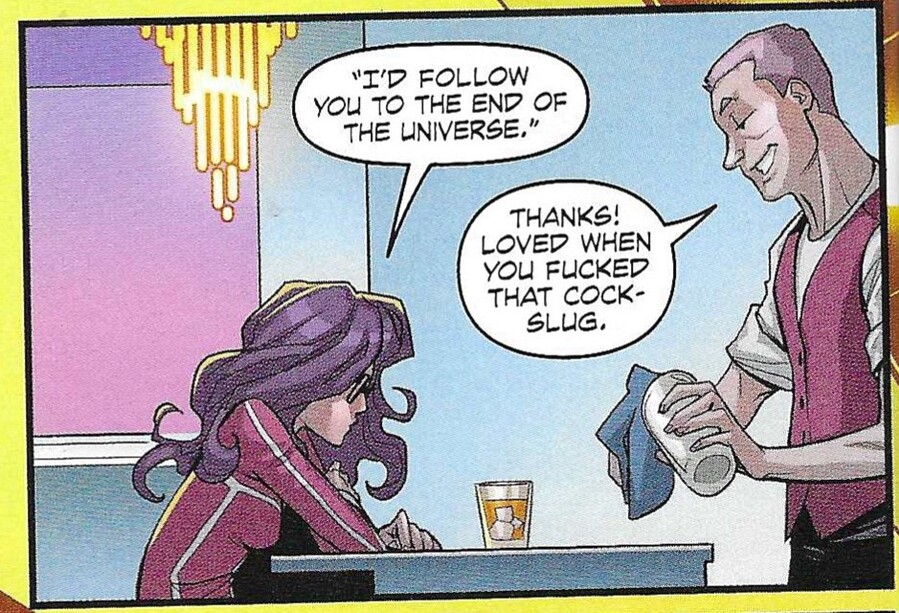
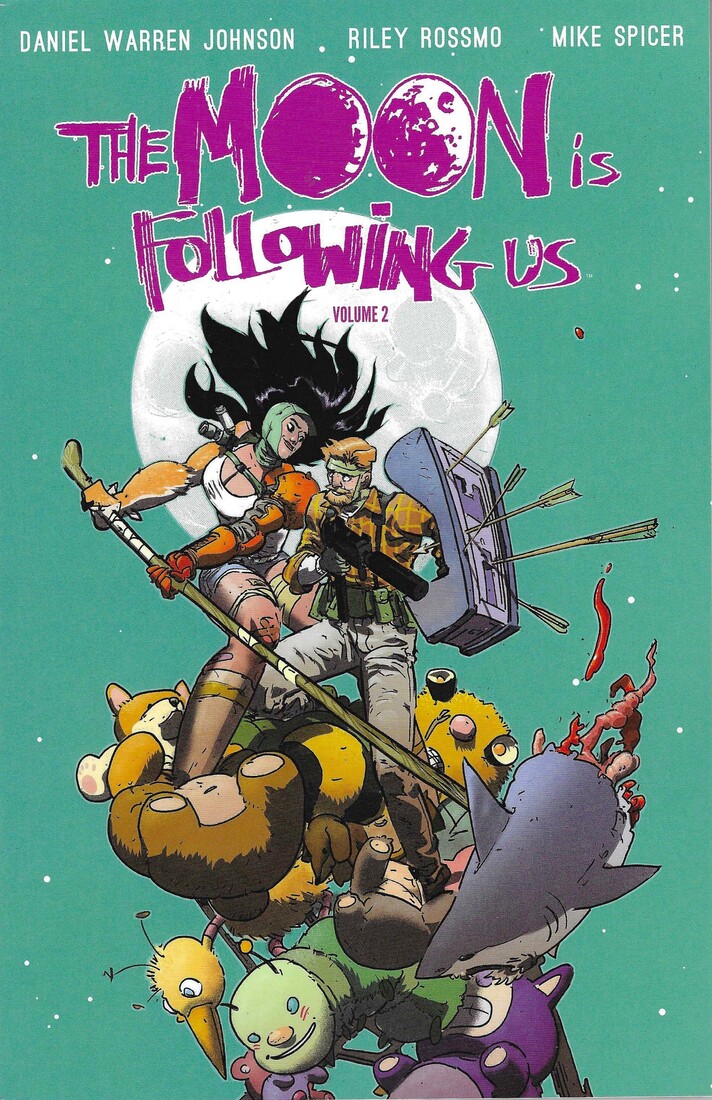 The Moon Is Following Us volume 2 by Daniel Warren Johnson (writer/artist), Riley Rossmo (artist), Mike Spicer (colorist), and Shawn Lee (letterer). $16.99, 110 pgs, Image.
As I noted with the first volume, I wish I had known this was a 10-issue series, because you know Image is going to come out with a really nice hardcover, and I would have gotten that. C’est la vie! This is still a very good comic, as Johnson does a nice job with the conclusion — it’s bittersweet, much like life, and it feels realer due to that. Duncan and Sam were betrayed at the end of volume 1, so they have to deal with that, and while I don’t want to give anything away, I do wonder about the bad guy’s motivation. I get it, certainly, and Johnson works hard to make the villain not as villainous as they might be, but as a parent, it feels both true and false … I don’t want to spoil it, but parents and their children are very important in this book, and Sam and Duncan do so much to save their daughter, but also … it feels like the villain might not do what they do because Duncan and Sam are parents? I’m not explaining it very well, because I really don’t want to spoil it. Perhaps the identity of the traitor will be obvious to you, but if you go into this cold, I don’t want to wreck it. Anyway, the story goes merrily along, as our heroes have to make specific choices and sacrifices, and Johnson does nice work with them — I was happy that he implied one thing, because it does border on cliché, yet simply implying means that he can leave it up to us, which, hey, he trusts the readers! How nice! The fact that this takes place in a dream world not only means that he and Rossmo (mostly Rossmo, as Johnson was drawing the “real-world” stuff in volume 1, and there’s very little of that in here) can go nuts with the art but also that mundane things can take on more mythic qualities, as the weapon that Duncan decides to use is very clever. Rossmo, meanwhile, gets to draw a ton of fun creatures (I assume he and Johnson co-designed this, but I could be wrong) and throw them into wild situations, and he does a wonderful job with it. There’s a double-page spread of Duncan and Sam and their allies turning the tables on the bad guys that puts most DC-related double-page spreads (which tend to be boring) to shame, as Rossmo crams the pages with marvelous details. When Johnson does his implying thing about what scares Duncan, he draws it beautifully, very much as a child who doesn’t understand things would see it. This book is a visual feast, and it’s nice to see.
If you haven’t gotten this yet, you should, but I would wait for the nice hardcover. YOU KNOW IT’S COMING!!!!
Rating: ★ ★ ★ ★ ★ ★ ★ ★ ★ ☆
One totally Airwolf panel:
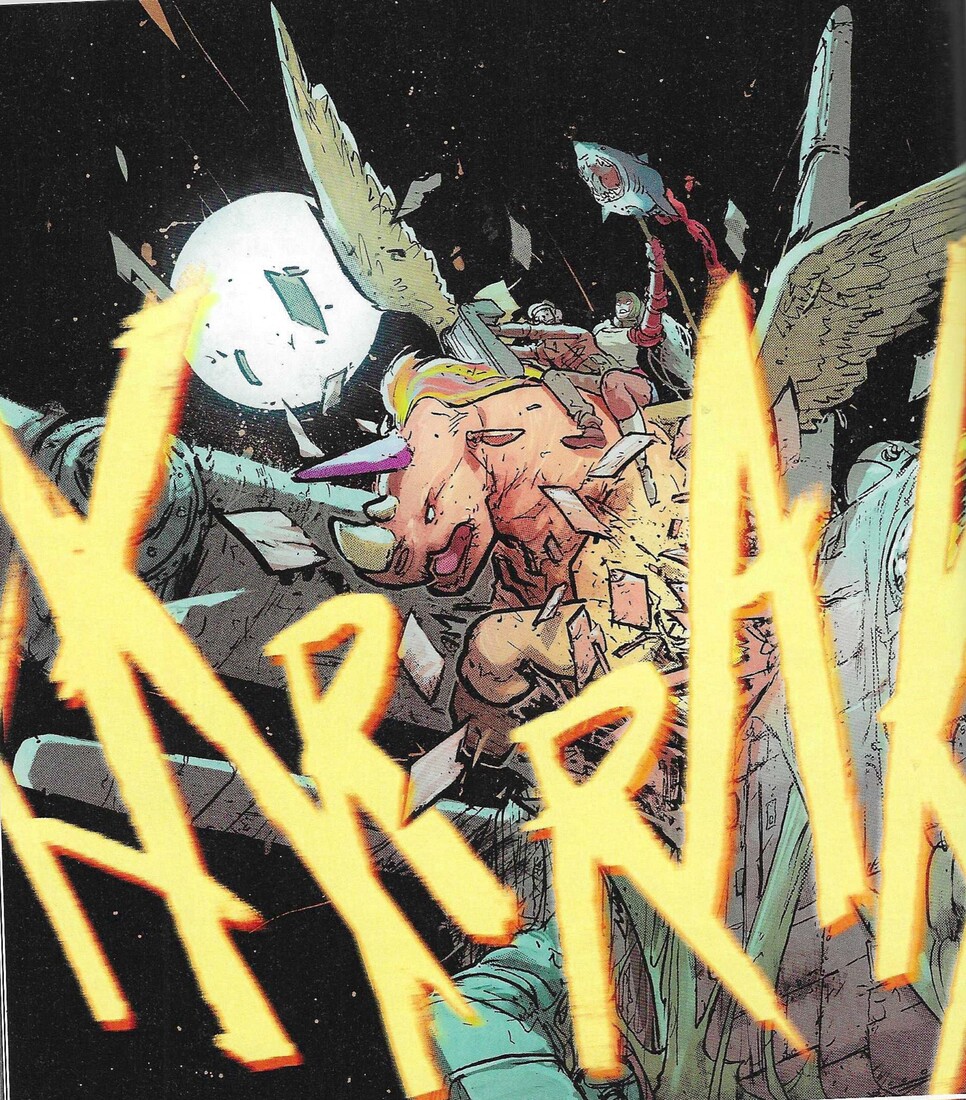
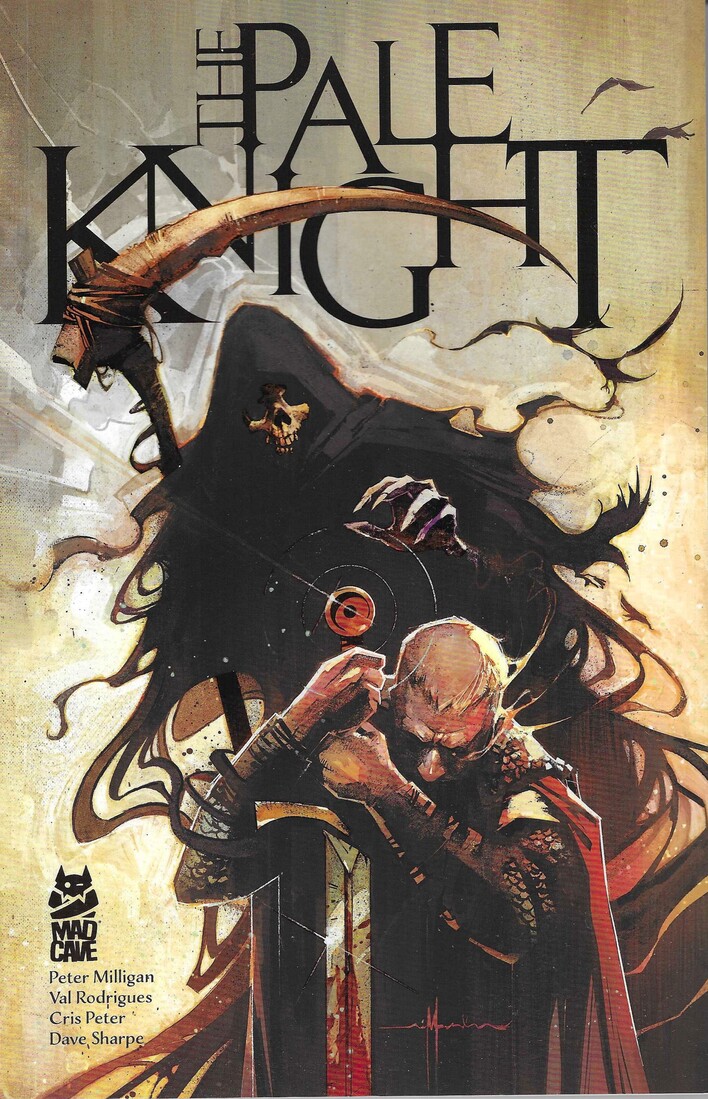 The Pale Knight by Peter Milligan (writer), Val Rodrigues (artist), Cris Peter (colorist), Dave Sharpe (letterer), Marla Eizik (editor), and James B. Emmett (editor). $17.98, 132 pgs, Mad Cave Studios.
Milligan decides to go all wacky with us, which is always welcome, as recently he seems to have been a bit more straight-forward with his writing, and it’s always fun when he gets weird. It feels like he’s channeling Luis Buñuel or Ingmar Bergman here, as we get Sir Hugh de Grey, the Pale Knight himself (a bit on the nose with the name, but oh well), who returns to England in, well, 1349, which was not a good time to be anywhere in Europe or, you know, most other places. Hugh and his company are returning from France (I mean, if you’re going to start a Hundred Years’ War, you gotta fight in it, right?), where Hugh and another knight, Maurice Beauchamp, almost came to blows because Maurice is, well, a douchebag. Hugh was ordered to slaughter women and children who were trying to flee into a church, and he didn’t want to … but he did eventually, because his lord ordered him to. So he’s feeling a bit of guilt. Of course, the bubonic plague is ravaging the countryside, and Hugh wants to get home to his wife and son. When he gets there, his son is sick, and Hugh makes a deal with Death itself to kill a man who’s been out alleviating the suffering of the people and for some reason Death can’t get to him. So Hugh has to kill him, and Death will spare his son. I mean, any idiot could see this will not turn out well, but Hugh makes the deal, and of he goes, with his squire Crispin, who has to be the worst squire in medieval history, in tow. Meanwhile, Maurice, having returned to his estate, employs a Jew he captured in France as a sorcerer to stave off the plague (as everyone knows the Jews created it), and the captive — Aaron — is desperately trying to fool Maurice so the knight doesn’t turn against him and kill him. Maurice is also planning to marry off his comely daughter, Joan, to the fat old lord nest door, so she ends up banging Aaron so that he’ll help her kill her father. Oh dear!
It’s a very bleak comic, naturally, but it’s also more phantasmagorical than straight-up nihilistic. Hugh comes across all sorts of people acting insanely, as they all truly believe the world is coming to an end (and given the mortality rate of the plague, they have good reason to think that). Most act very poorly, of course, and Hugh often steps in a rescues people from ugly fates, even as Crispin (and his own conscience) reminds him that he’s on a mission to kill a good man so that his son can live. He meets “high-born” and “low-born” people, and all of them have had the veneer of civilization stripped away, and things get very weird and dangerous for everyone. Maurice and his plots don’t intersect Hugh’s — they only see each other at the very beginning, then go their separate ways — but they do run parallel to Hugh’s, as Aaron is trying to fool his captor so he can survive, Joan is trying to get out from under her male oppressors and sees the plague as a way to do that but isn’t above using sex as a weapon, and the jester Aaron meets late in the book is both wise and mad, as jesters often are.
It’s a strange book — it’s certainly not plotless, and Milligan does keep on point, and we can see the final bit of irony hurtling at us from a thousand miles away, but Milligan also does some interesting things with the narrative, and because of the surreal nature of the story, even when things are a bit predictable, the tone is so haunting and eerie that it works. Not everyone who deserves it gets punished, not everyone who deserves it gets rewarded, and we’re left with a tragic feeling because sometimes, people trying to do the right thing are simply overwhelmed by the world. It’s certainly not a fun book, but it’s weird and occasionally creepy and it gets under your skin. Rodrigues, who usually does good work, matches the tone perfectly, with soft, scratchy, sketchy lines that create a dream-like atmosphere. He does amazing work with the eyes, as Hugh goes from hope to despair very quickly and Crispin constantly betrays his douchiness by the way he looks at Hugh or other characters. The faces of his characters are generally quite good, but the eyes are the highlights. He does a really good job evoking this rural England (estimates of the population of the country at the time are around 3 million, and less than 20% lived in cities), with people widely scattered and having no contact with others in the country and therefore not knowing much about what’s going on and they’re definitely not trusting outsiders. Rodrigues does a really nice job showing this, and it easily bleeds into the extra-natural spheres in which Hugh meets Death. He also creates disgusting corpses and plague victims, which is a pretty good thing when you’re drawing a plague book.
When Milligan gets weird, he can really bring it. The Pale Knight might not make you feel good, but it will stick with you. So there’s that!
Rating: ★ ★ ★ ★ ★ ★ ★ ★ ☆ ☆
One totally Airwolf panel:
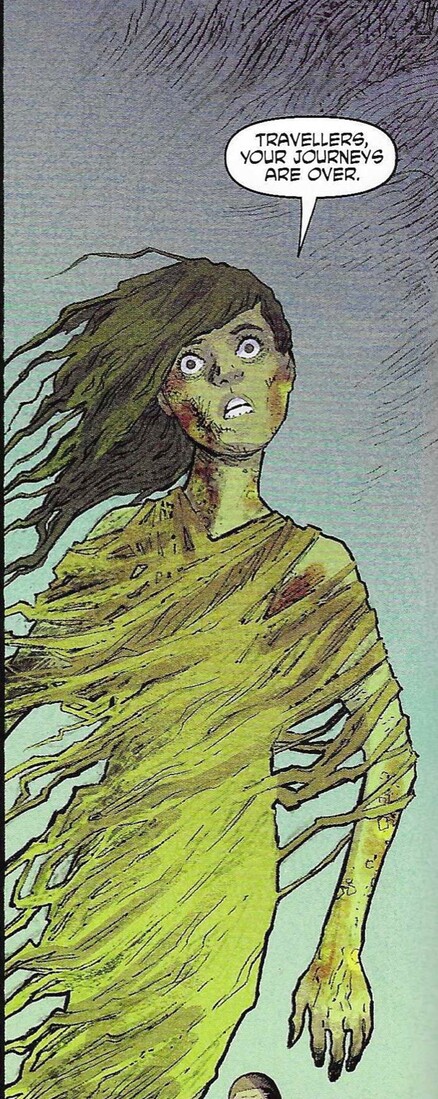
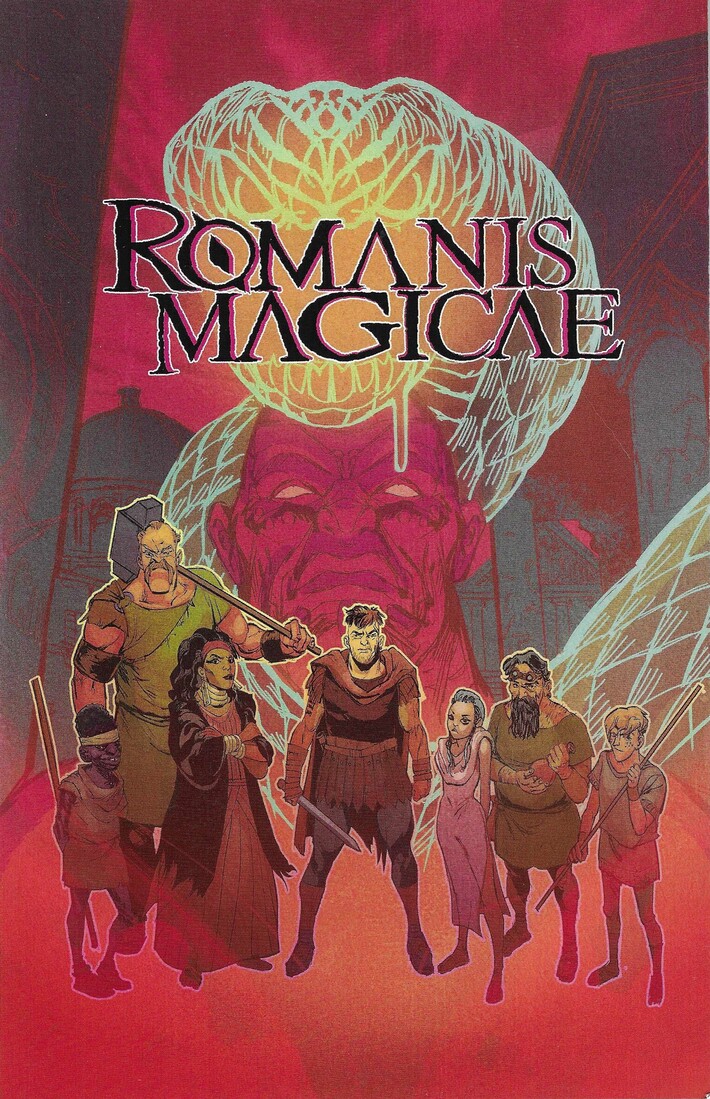 Romanis Magicae volume 1 by Matthew Blair (writer), Paul Peart-Smith (artist), Eva de la Cruz (colorist), and Daniel de la Cruz (colorist). $19.99, 92 pgs, Cambrian Comics.
The Latin in this title is pretty jacked up. It could mean the “magical women with the Romans” or something like that, but that doesn’t make much sense when you consider what’s going on in the book. I mean, there are two fairly magical women, but they’re specifically against the Romans, and while the ablative case (“Romanis” is ablative) does indicate a separation in some instances, it doesn’t really mean actively against something. It’s just a weird title that makes me wonder if the creators just thought it looked sufficiently “Latin” and didn’t worry about strict translations. I think “Magicae” is this case is supposed to be the feminine nominative plural. It could be the feminine dative singular, but that would make even less sense (the “Romanis” has to be ablative, which is why the “Magicae” is probably nominative).
Anyway, this is a fun series that I hope continues, not because it’s the greatest thing in the world, but because it feels like it has more potential which isn’t really fully developed in this short story. Blair wants to tell an apocalyptic, end-of-the-world kind of story here, which gets the series off to a rousing start, certainly, but is frustrating because we know the Roman Empire did not fall in 19 CE, which is when the story occurs, so it kind of feels a bit hollow. The actual characters are much more interesting, and I hope Blair puts them in more interesting situations if he and Peart-Smith continue with the series. The nominal hero is Marcus, a Roman soldier who fought in the Teutoburg Forest under Varus in 9 CE (when the Roman legions were destroyed and which basically stopped Roman expansion to the east of the Rhine forever) and who has PTSD as a result. Marcus wanders around Rome, drinking too much, and when he rescues a young woman from being kidnapped by strange-looking men, he falls in with a bunch of misfits who do not trust Rome or Romans at all. They’re fighting against evil, underground forces (the same people who were trying to kidnap the girl, who turns out to be an oracle), but it turns out they have to fight for Rome, too, because the evil forces want to destroy the city. Why don’t they help the evil forces? Well, the bad guy kind of wants to destroy the world, too, which sucks. The group Marcus falls in with are foreigners — there’s a dude from Gaul, a Greek dude, and the leader is Egyptian — and so we get an always-interesting “social outcasts versus the dominant power” archetype that can give us some good stories. This one has hints of it, because the Roman soldiers come to arrest our heroes but then realize they need their skills to fight the evil forces, and the Roman-in-Charge is smart enough to know it (and also, it appears, sensitive enough to understand Marcus’s problem, which is unusual for that kind of character). So it seems like Blair could do a lot with smaller stories, as the band of misfits fights injustice in an Empire that they do not like. There’s also the idea that Rome was far more multi-cultural than the misfits give it credit for, so it would be interesting to see, say, a Gaul who doesn’t think the Empire is all that bad (yes, Monty Python did a funny sketch about the Roman Empire and what it’s done for the people, but that doesn’t mean John Cleese and the gang were wrong). I’m curious to see if Blair goes in that direction if he decides to continue with this.
Peart-Smith does a solid job on the art — it’s not great, but it does work pretty well. The action is a bit stiff, which isn’t surprising, and the work is occasionally a bit sketchy, but he does a decent job with the surroundings of Rome, and his evil forces are pretty creepy, which goes a long way. The big battle at the end is a bit confusing, as Peart-Smith’s panel-to-panel storytelling could use a bit of work, but it’s not awful. The art does a decent job complementing the story, which is all you can ask for with relatively neophyte artists.
I’m always a sucker for weird historical fiction, so maybe I’m inclined to like this a bit more than others, but so what. I can only be me, people!
Rating: ★ ★ ★ ★ ★ ★ ½ ☆ ☆ ☆
One totally Airwolf panel:
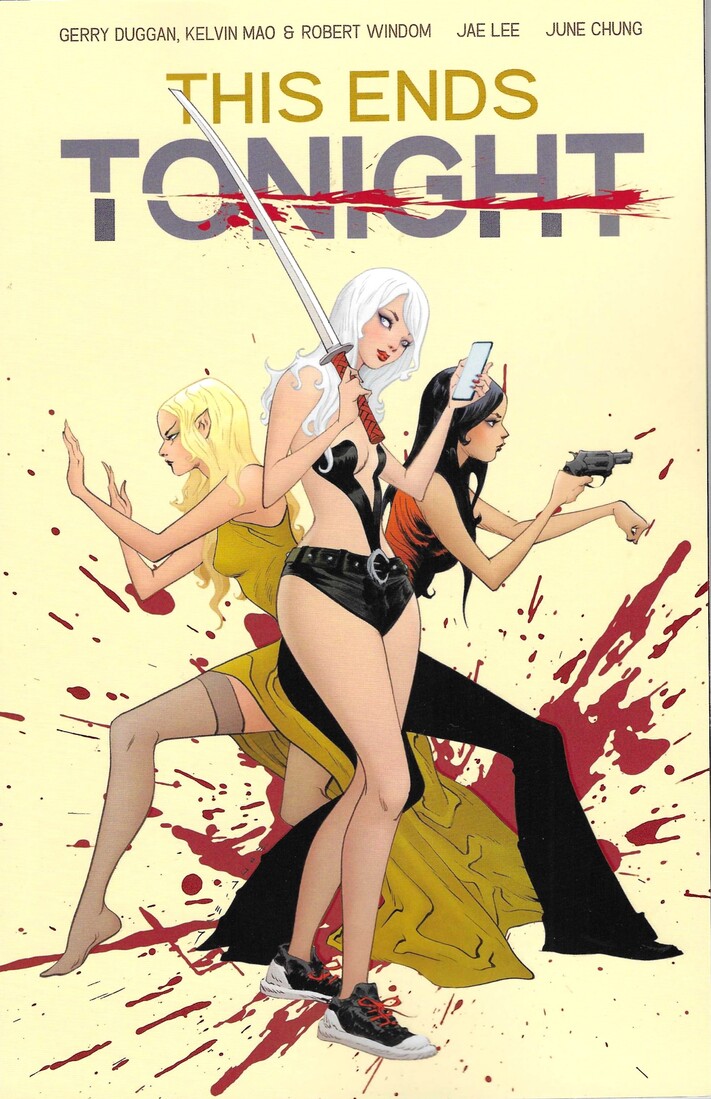 This Ends Tonight by Gerry Duggan (writer), Kelvin Mao (writer), Robert Windom (writer), Jae Lee (artist), June Chung (colorist), and Joe Sabino (letterer). $14.99, 87 pgs, Image.
Jae Lee decided to start doing interior work on comics again, and since then, he’s done … I think this is the second one, and both times, he’s worked with Mao and Windom, who … are not great writers. They’re fine, but nothing great, and I wish Lee would get with a really good writer so he can get a story worthy of his talents. I mean, this book looks great, because Mao and Windom are smart enough to give him lots of violence and hot girls to draw, but it’s kind of a weak story, even if they brought in a “real” comic writer in Duggan to help out. It sounds great — three somewhat interconnected stories taking place over one night in Las Vegas — but the writers don’t ever make it really work. In the first story, two sisters are attacked by many bad guys, and one sister clearly knows more about it than the other one, whom she’s trying to shield from her violent life. It becomes a weird, dark fantasy that hits all the beats of any standard “evil elf” tale, and it gets hallucinatory at the end without really coming to a decent resolution. The third story features the same bad guy, at a different point in the evening, and features more hot girls doing violent things and also ends oddly. The middle story features a girl who’s getting married in the morning and her sister is showing her a good time, and her sister just happens to be a member of some kind of all-chick assassination squad (someone just saw Kill Bill again!) who are being menaced by a tangential character in the first and third stories. It seems like the bride-to-be knows what her sister does for a living, but isn’t involved? Anyway, this story ends even more inconclusively than the other two, which makes it more annoying. It’s very weird, because it seems like there would be a fourth issue where everything comes a bit more together and the writers resolve things better, but nope, three inconclusive issues is all you get! I get that stories don’t necessarily need to have good resolutions, but when your plot is everything (the characters in this book are woefully underdeveloped), you better have good ones, and these are all a bit undercooked. It’s too bad — the bones aren’t bad, and the interconnectedness is a bit clever, but it just … peters out, kind of. Oh well. Lee is terrific, of course, with his weird page layouts and panel designs that somehow work, his delicate line contrasted with his nice use of chunky, ragged blacks, and his weirdo character design. All the women are hot, of course, and Lee draws women in a very specific way, but he does nice work with making them just different enough from each other, and his ancillary characters are fun to look at, as well. The book is very frenetic, and that’s partly because the writers never let up, but also because Lee is so good at smashing through the plot. I hope he continues drawing interiors, because they’re so much fun.
I just wish the story was better. So sad!
Rating: ★ ★ ★ ★ ★ ★ ½ ☆ ☆ ☆
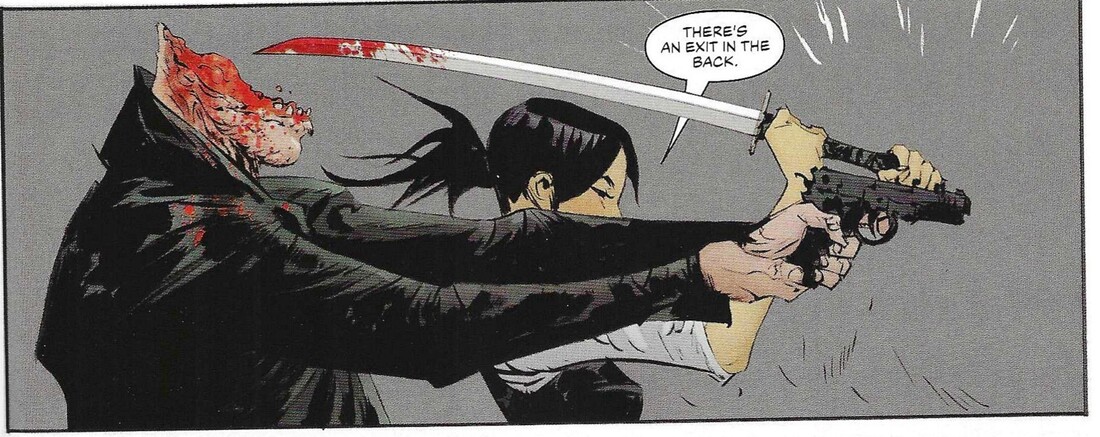
One totally Airwolf panel:
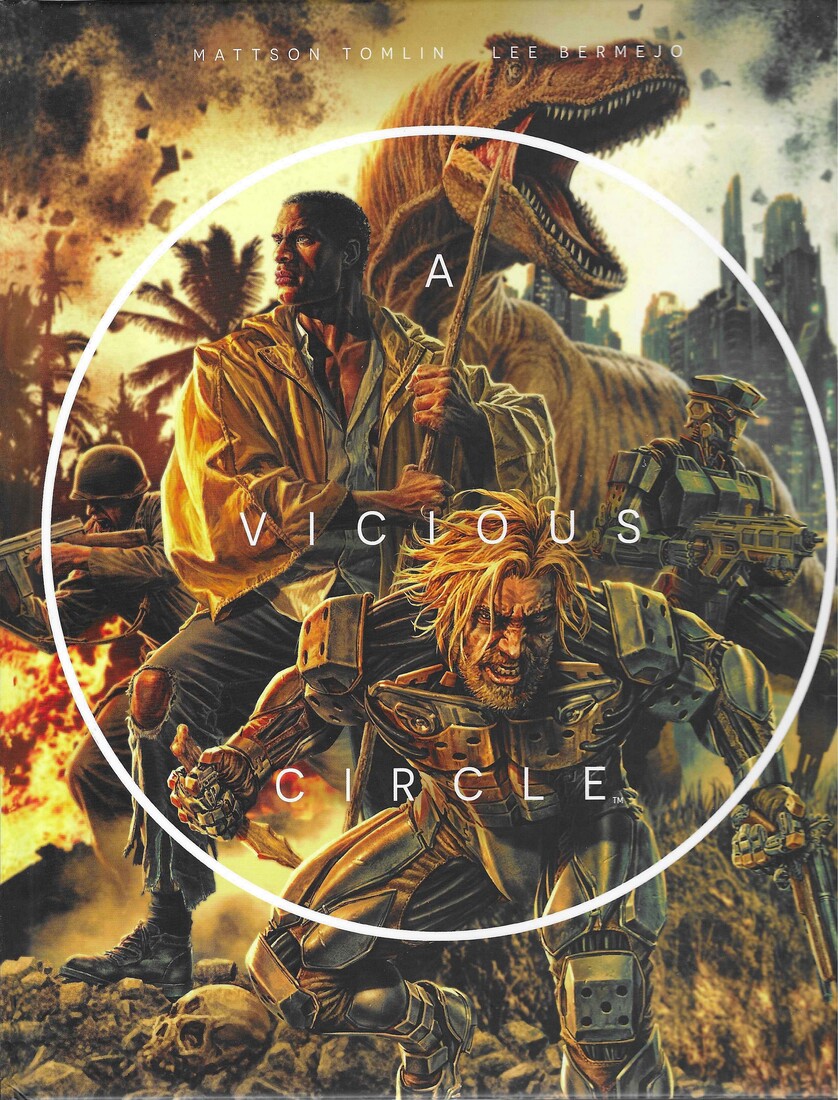 A Vicious Circle by Mattson Tomlin (writer), Lee Bermejo (artist/colorist), Grant Goleash (colorist), and Becca Carey (letterer). $29.99, 144 pgs, Boom! Studios.
The only reason to get this book is Bermejo’s absolutely stunning artwork, which is, well, stunning. It begins with his hyper-realistic style that I don’t love but which is tempered by his use of black-and-white (it’s set in the late 1950s), but he shifts between styles very well, as our hero, Shawn, zips into different times on his adventure (it’s a — sigh — time travel story). When Shawn is thrown into the future, Bermejo uses a much harder, “comic-booky” line, with rendered coloring that fits the style and even time period well, and as Shawn shifts time periods, Bermejo shifts with him, using his standard style (the kind he begins the book with) in some places (with color, though, but more vibrant colors than he usually uses) and a harder edge in others. In the section when he visits the future of his antagonist, Ferris (yep, Shawn and Ferris), Bermejo seems to be channeling Richard Corben just a bit, not in the cartoonish characterization that Corben uses, but in the line work softening and blending in with the colors to create a muddy mess … in the best sense of the phrase, as the future they’re visiting is an unpleasant, polluted one. There are sequences where the characters zip through history killing people, and Bermejo does a marvelous job switching the styles for each time period and also using the panel borders cleverly to distinguish both what they’re doing in those time periods and how they switch time periods so quickly. This is an amazing-looking comic, and it deserves to be gazed upon in a larger format, which you get from this hardcover. I don’t know if Boom! plans on releasing a softcover collection, but if they do, I hope they keep it in slightly larger dimensions, which it is here.
Unfortunately, Tomlin’s story just isn’t that compelling. We meet Shawn in the late 1950s, as I noted, where he’s married with a son and a prisoner locked in his basement. The prisoner gets out and kills his wife and kid, which sends Shawn spiraling into a different time. It turns out that in his “own” time, he was sent by his bosses to find a machine some corporation had invented (it seems he’s kind of a corporate fixer in a world that does not look pleasant). Of course, it’s a time machine, and Ferris is already there, trying to destroy it. An accident throws them both into the time stream, and they can only get to a different one if they kill someone, and they’re linked, too, so if one goes, so does the other. At the beginning of the book, Shawn had imprisoned Ferris because he was tired of zipping around, but he couldn’t kill Ferris because then they’d both end up in a different time, very much alive. Ferris thinks they can fix things, while Shawn just wants to hunker down in a time period and live his life, but Ferris won’t abide that. Eventually, they decide to go on a killing spree through time, just because … Tomlin thought it would be nifty? It doesn’t make much sense, and while I don’t like time travel stories because they rarely make sense, usually writers try to make them make sense, but Tomlin doesn’t do any of that. His big point — men are violent — isn’t that clever, and so when we get to the end, it’s very much a sense of “Is that all there is?” to it. It’s too bad, because I have to think it took Bermejo a long time to do this — he doesn’t seem like the fastest artist, but I could be wrong — and it’s a shame it’s not in service of a better story.
Still, if you can find it a bit cheap (my retailer was selling it for 40% off, so I paid less than $20 for this nice hardcover), you might want to take a look at it. Maybe you’ll disagree with me about the story, but even if you agree with me, Bermejo’s art really is amazing.
Rating: ★ ★ ★ ★ ★ ★ ύ ☆ ☆ ☆
One totally Airwolf panel:
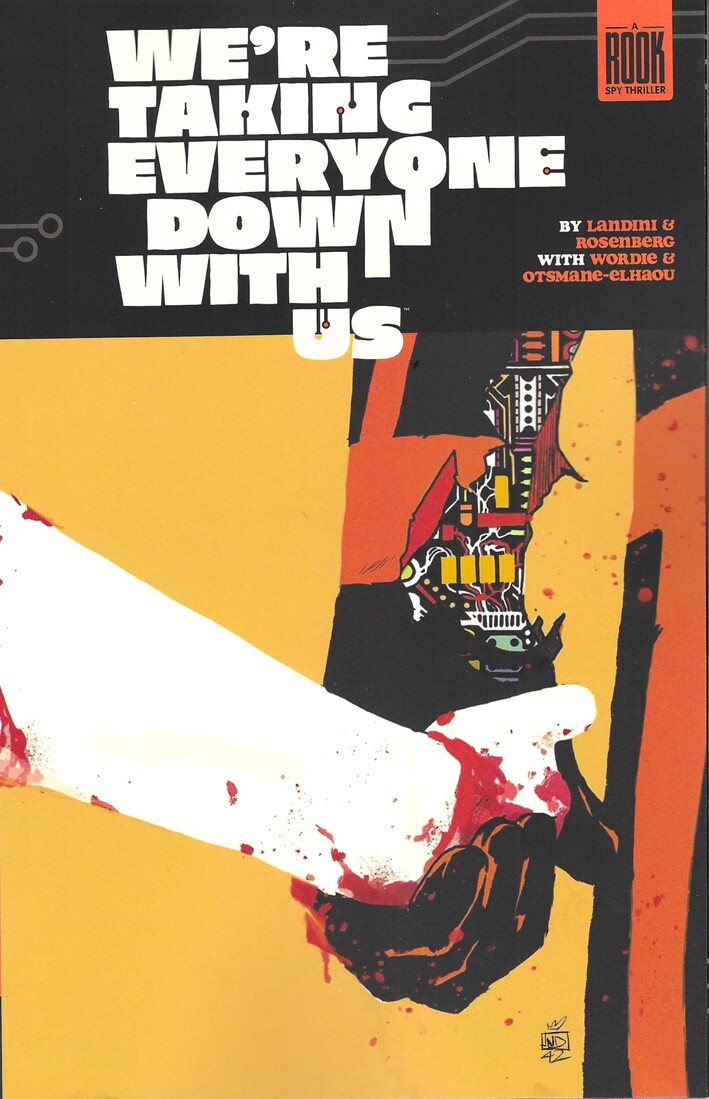 We’re Taking Everyone Down With Us volume 1 by Matthew Rosenberg (writer), Stefano Landini (artist), Jason Wordie (colorist), Roman Titov (colorist), Hassan Otsmane-Elhaou (letterer), Steve Foxe (editor), and Eric Harburn (editor). $19.99, 201 pgs, Image.
This is a strange comic — it’s very good, don’t get me wrong, but it is strange. It’s advertised as a “Rook Spy Thriller” — there it is in the corner of the cover! — and at the end of the book, Rosenberg promises the Rook will return! in a second volume, but … the Rook is not the main character, or even really A main character — he’s important to the plot, sure, but the book is not about him at all, plus … he’s quite a tool. I expect Rosenberg is having some fun with us, as he goes out of his way to position the Rook as this major player and then yanks the rug out from under us and makes his “star” a complete douchebag and not that great a spy, but it is odd. Plus, Rosenberg’s comics always have a wry and twisted sense of humor, which this does … but occasionally, it feels a bit too jokey? Like, it’s a thing now for super-villains to be somewhat pathetic, which is fine — the Sand-Blasted Fascist Wannabe in the White House has proven that you don’t need to be smart or even particularly competent at anything to seize power. However, in this book, the two main super-villains seem to know what they’re doing, but others — who occupy high positions in the villain hierarchy — don’t, and I wonder how they managed to reach those positions. Were they just willing to kill everyone who stood in their way? One of them, in particular, doesn’t seem like the kind of person to command the loyalty of a large armed force, yet he does. Rosenberg has fun with them and they’re not exactly a major threat (although they are one of the threats in the book), so I can let it slide a bit, but they are a bit incongruous.
Those small things aside, this is a very good book. A teenager, Annalise, is playing hide and seek … with a bunch of robots. Oh dear. It turns out that she’s the daughter of a super-villain, although it’s clear that in this world, there aren’t really heroes and villains, just horrible people doing horrible things to each other. Annalise’s father is killed when the Rook, who really does not like Annalise’s father, discovers where he’s been hiding for a decade and raids the place, blowing shit up in the process. One of the robots saves Annalise and takes her on the road, eventually ending up in the palace of her mother, who was estranged from her father. Things do not get better from there!
Rosenberg does a nice job with the plot, as it has some good twists and turns that keep us on our toes without being too convoluted. He does a very nice job with Annalise, who’s full of rage and a thirst for revenge against the people who killed her father. The robot is well done, too, as its function is to protect Annalise, but she very much wants revenge, which is not a safe thing to do, so the robot is always trying to steer her away from it. Meanwhile, it’s clear early on that Annalise is not a normal teen, as she seems to be very gifted in certain things, and Rosenberg does a nice job uncoiling that mystery. The book is very violent, of course, and Rosenberg does a good job making it both horrific and a bit goofy, as he gives henchmen lines that heighten the humor (often before they’re horribly killed) and he makes the violence a bit over the top anyway. The book never quite goes the way we think it’s going to, which is nice. Rosenberg doesn’t go nuts with plot twists, but he does confound our expectations enough to make it a lively story. It’s well done. Meanwhile, Landini does a marvelous job with the art — his characters look like regular people, which helps ground them in a world of weird inventions and, you know, semi-sentient robots. He does a really nice job with the action scenes, as he doesn’t shy away from the violence, certainly, but occasionally he’ll show just the aftermath of the violence or he’ll have the worst of it just off-panel, which makes it more widespread (as it implies a world beyond the panels) and also can make its impact hit harder, because we’re trying to figure out what happened and our imaginations can go a bit. He does some very cool stuff with designing pages — there’s one sequence where Annalise speaks to her mother while they’re playing chess that is excellent — and he manages to cram a lot onto each page without cluttering things up. His super-villains are just a touch goofy, which they should be, and his Rook is done well, as our “hero” is a bit older, still in fighting shape, but just a bit seedy, which fits into the world Rosenberg has created. I also appreciate that it’s a bright-ish book — there are a lot of cool colors, certainly, but they’re not muted and overwhelmed by murkiness, they’re just … cool. Coupled with Landini’s art, it makes the book look great.
I don’t know where Rosenberg is going with this comic, if indeed he is going further. In just six (to be fair, pretty long) issues, he’s created a weird world that I wouldn’t mind visiting again at all, and there are a lot of possibilities here. We shall see! In the meantime, this is a very good comic. Would I lie to you?
Rating: ★ ★ ★ ★ ★ ★ ★ ★ ½ ☆
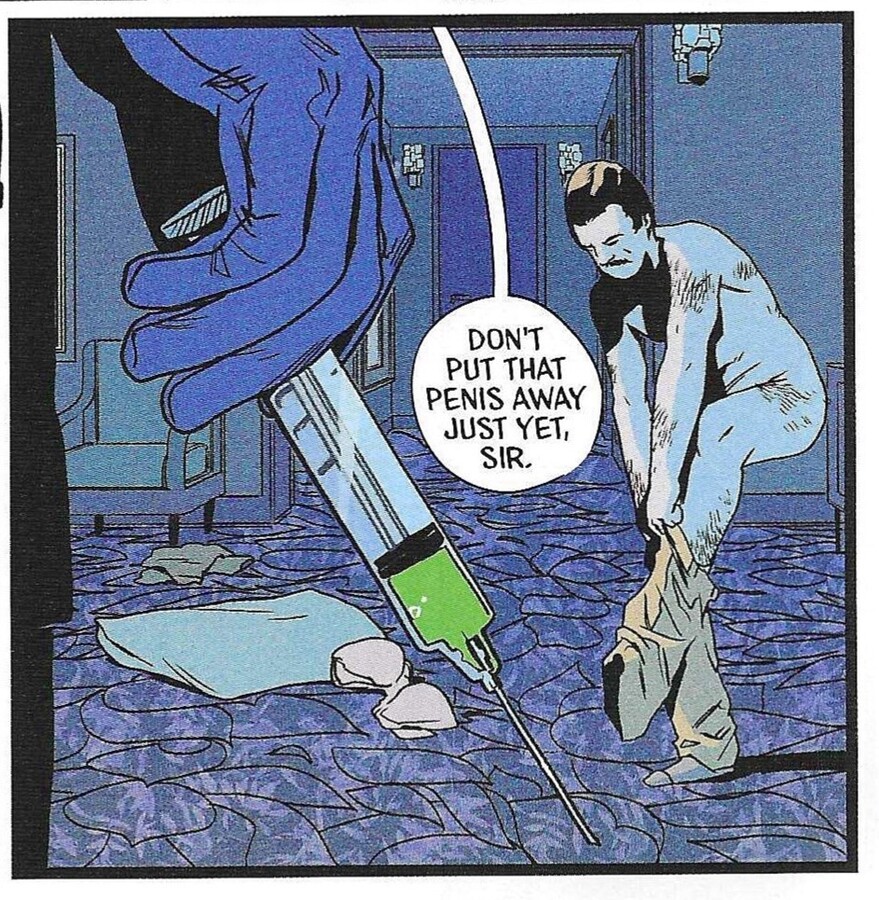
One totally Airwolf panel:
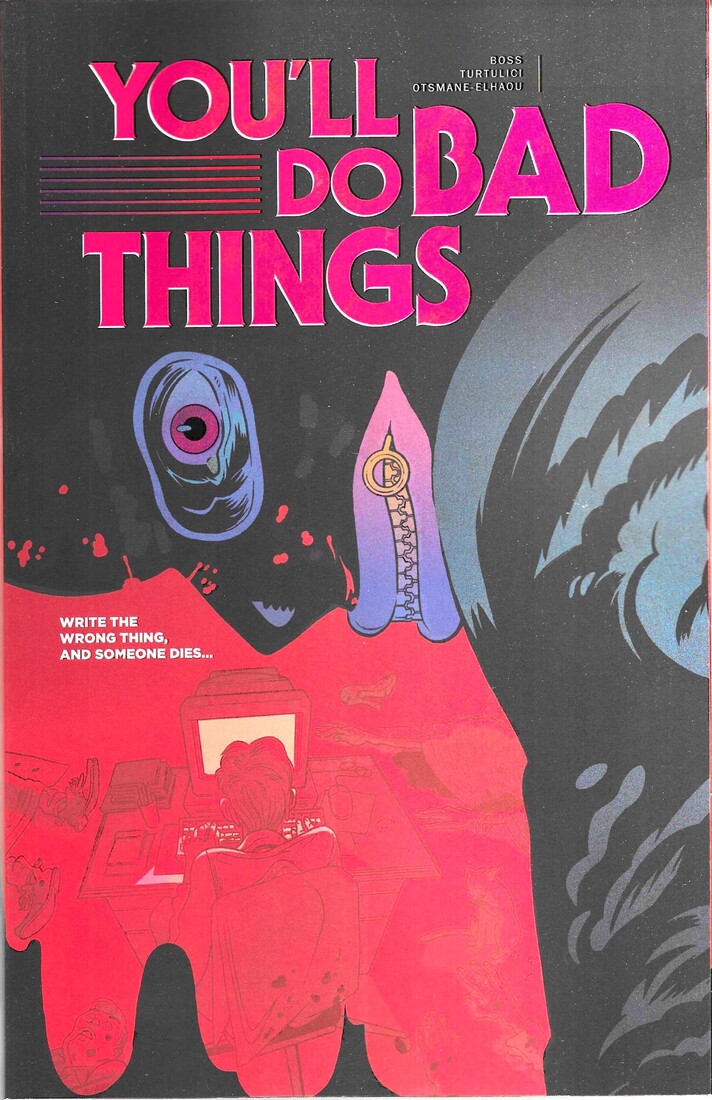 You’ll Do Bad Things by Tyler Boss (writer), Adriano Turtulici (artist), Hassan Otsmane-Elhaou (letterer), and Courtney Menard (editor). $16.99, 159 pgs, Image.
This is an interesting murder mystery with a clever hook that doesn’t quite stick the landing, but it’s still pretty entertaining. Seth Holms is the protagonist, a writer who has one true-crime book on his resumé, one that actually helped the police catch the killer, but who’s been stuck for a decade with the follow-up, because he wants to write a romance but his publisher wants another true-crime book, which Seth wants to avoid because he thinks it’s bad for his soul. Seth can’t quite get the romance, though, as whatever he writes turns dark and disturbing, and then, people start dying in the real world … in the exact same way he’s writing about in his books! Oh dear. Boss takes a bit to get going with this, as the first issue is a bit of a confusing muddle, but the book becomes a weird horror story with a dominatrix deciding to help Seth out (because why wouldn’t she?) and the murderer seemingly becoming more supernatural … until the end, where it’s all explained, and Boss biffs it just a bit. It’s certainly not a bad solution, it just doesn’t make as much sense as it should. The very end is very cynical, which I am totally here for, but the solution to the mystery is just … a bit lacking. I don’t want to spoil it, certainly, so I won’t, it just feels a bit too easy. But this is still a pretty entertaining story, and Turtulici does excellent work on the art — he uses thick lines and beautiful brushwork to create a harsh, scary world, and his abstract colors fit the tone of the story nicely. In some scenes, Boss doesn’t take things too, too seriously (it’s not a funny book, but it has moments of humor), and Turtulici does a good job matching the occasional absurdity of what Seth is going through. There are a lot of nifty sound effects in the art, too, which do well to heighten whatever mood Turtulici is going for at that particular moment.
This is an interesting comic. Sure, I wanted it to be better, but it’s certainly not bad. Murder mysteries are hard, yo!
Rating: ★ ★ ★ ★ ★ ★ ★ ½ ☆ ☆
One totally Airwolf panel:
BOOKS
 The Siege of Vienna: The Last Great Trial Between Cross & Crescent by John Stoye. 226 pgs, 2000, Pegasus Books.
I know some people aren’t into the books I read because they’re not into history in particular or even non-fiction in general, and that’s cool — I’m just doing my thing, and every once in a while, I have to acknowledge that taste is just that, man. I will say that if you’re mildly interested in history and are looking for something to read, you should probably skip this book. I am interested in the time and place it’s about — Vienna in 1683, when the Ottomans besieged for the second (and, as it turns out, final) time — and I have contradictory feelings about it. On the one hand, it’s very, very informative about an event that most historians pass by with a sentence or two, mainly (I think) because the Turks did not, in fact, take Vienna and wreck the Holy Roman Empire in the process. Also, it’s clear from our perspective that the Ottomans had entered their long, slow decline by this time, so it seems that historians do not take them as seriously in the 17th century as they do in the 15th and 16th centuries. Stoye ignores all that and gives us a very in-depth account of the year leading up to the siege and the siege itself, and he used a lot of Ottoman documents that earlier historians might not have had access to or simply ignored (Ottoman Turkish is famously hard to decipher). On the other hand, the book does drag a lot — Stoye is not the greatest writer — and it took me a long time to get through its relatively short length (the text is less than 200 pages, with the bibliography, notes, and index making up the rest), as Stoye goes over everything with a fine-toothed comb in possibly the most boring way he could. It’s very informative, don’t get me wrong, and Stoye gives us a look at the inner workings of the Empire more fully than most historians do, at least those looking at the Empire before the 19th century, when it became very bureaucratic, and the way Leopold I, the Emperor, had to finagle with his vassals for troops (the Empire was ramshackle at the best of times, and the various princes who owed allegiance to the Emperor were often more powerful than he was and didn’t feel the need to respond to his summons all the time) is fascinating, at least to me. Louis XIV, Leopold’s implacable enemy, was in the ascendant at this time, and it’s interesting to note that Louis, the supreme “Catholic” in Europe, did not much care about the Turks menacing another Christian state, except as it pertained to him getting the opportunity to nibble away at the Empire’s western edge. Stoye also does a good job showing why the Turks went to war in the first place, and how close their vizier, Kara Mustafa, came to taking the city before the Viennese bowed their backs and held out until the Empire’s armies could arrive. He gets into the conditions inside the city and the siegeworks and how the Austrians were able to fend off the attacks of the Ottomans and their allies, and he dives deep into the rival factions that made up the Christian armies, from King John Sobieski of Poland whining because he wanted pride of place in the attacking force to the Duke of Lorraine often ignoring Leopold’s directives. I have no problem with the depth of the research, and it’s nice to know that at least one historian takes the siege seriously. It was an important event, as Leopold and the Empire struck back and began a long war with the Ottomans that ended only in 1699, with a treaty that really began the end of the Ottoman Empire. Stoye makes sure to place it in its proper historical context, which is nice. It is kind of dull, though — dry and workmanlike, without any zazz to it. I know — it’s a history, and Stoye is just interested in the facts that he can find (he does mention some gaps in the Turkish record, which is too bad). But other historians manage to write books that are good history and fun to read … it just seems that Stoye isn’t one of them. If you really have a burning desire to learn about the siege of Vienna, then this is the book for you. But be warned! It’s kind of dull.
Rating: I mean, tough to say — it does what it’s supposed to do, so … good job?
 The Suspicions of Mr. Whicher: A Shocking Murder and the Undoing of a Great Victorian Detective by Kate Summerscale. 372 pgs, 2008, Walker Publishing Company, Inc.
When I search for Greg’s posts on the Wayback Machine, sometimes I check out my own just to see what the commenters were saying back then, and recently, I came across one where someone recommended this book. It was 2013, and I noted I already owned it. Yes, it has taken me 12 years from that remark to actually sit down and read this, but here we are. Yay, me!
This is a strange book, mainly because the central crime actually happened, and as we know, real-life crime is often messier than fictional crime. At the end of June, 1860, in a small village near Bath in England, the Kent family awoke to find the youngest child — there were a lot of children in the house! — missing. He was later found dead, stuffed in a privy, with a lot of cuts all over his body even though the cause of death turned out to be suffocation. After two weeks of futility in finding the culprit, the police called Scotland Yard and asked them to send a detective to take over. Detectives in Britain were a fairly new phenomenon (as was governmental policing, of course), and they had an aura of invincibility about them. Out to the west came Jonathan Whicher, the acknowledged best detective in the land, and he began working the case. Despite the two weeks in which evidence was destroyed and the utter futility and even malfeasance of the local police, Whicher managed to make an arrest … but failed to get a conviction. Five years later, the murderer turned themselves in. How weird.
The case is well known; you can Google it easily and discover all about it. Summerscale’s point is, ultimately, not who committed the crime, but what it did to Victorian England itself. This was a murder in a house, among a tight-knit family, and Victorians were notoriously aggressive about keeping their private lives private, so the fact that all the Kents’ dirty laundry got aired after the murder is a big deal. The Kents never quite recovered from the murder, nor did the Victorians’ notions of privacy, which began to get chipped away by the government and the press, which absolutely loved this story. When the murderer confesses, there’s a big part of the book about religion in Victorian England and the continuing battle between Catholics and Protestants, as the majority Anglican population did not think the Catholic seal of confession should be honored. As a social history, Summerscale does a nice job with the many facets of the story. Whicher’s life took a bad turn after the case, as the myth of infallibility of detectives took a major hit when he didn’t secure a conviction. Whicher eventually left the police force and became a private inquiry agent (basically a P.I.), and it’s clear his failure bothered him. What’s interesting about policing in 1860 is that Whicher arrested the person based on a hunch, and then had to convince the magistrates in town to hold the suspect for a week while he found evidence. I guess this was standard at the time, but it seems very odd. When he couldn’t pile up enough evidence, the suspect was freed. Whicher, interestingly enough, was friends with Charles Dickens, and he helped inspire the character of Inspector Bucket in Bleak House, as well as Wilkie Collins’s Sergeant Cuff. Plus, Paddy Considine starred in a series of television movies in which he played Whicher, so good for him!
The problem, such as it is, with the book is that real life gets in the way. Summerscale does a nice job with the bigger social aspects of the case, but the actual case resolves frustratingly, and there’s nothing Summerscale can do about that. It’s a worthwhile read, sure, and the early parts, when we’re not really sure what’s going on, are pretty gripping, but once the murderer confesses, it does lose a bit of steam. Not too much, but a little. It’s a good book to read, but I did want to warn you!
Rating: ★ ★ ★ ★ ★ ★ ★ ½ ☆ ☆
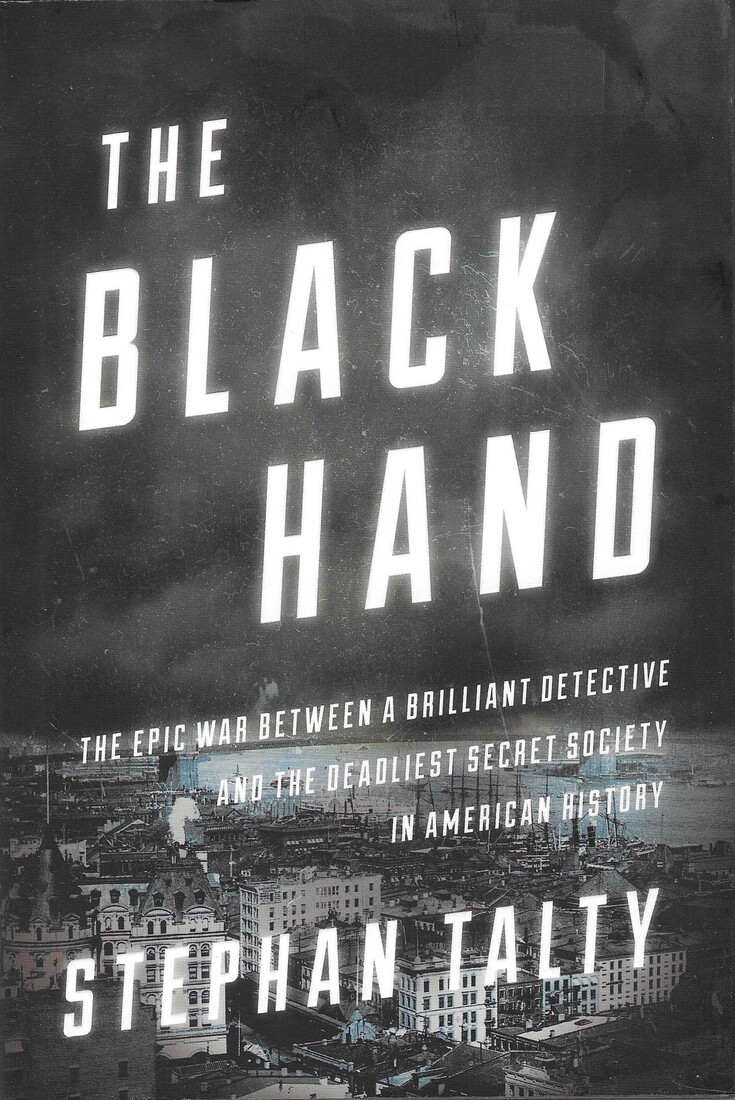 The Black Hand: The Epic War Between a Brilliant Detective and the Deadliest Secret Society in American History by Stephen Talty. 298 pgs, 2017, Houghton Mifflin Harcourt.
In the early 1900s, there was a “secret society” in America called the Black Hand, made up of Italians who basically preyed on other Italians. A proto-Mafia, if you will. The Black Hand probably didn’t care about this, but because Italians were relatively recent immigrants, they were not considered “real” Americans and the police, who were largely Irish in New York, could easily ignore the crimes. The Italians took a long time to integrate, too, and given the corruption of the police force in Italy (especially Sicily), they did not cooperate with the cops, so the cops ignored them. Talty tells the story of Joseph Petrosino, an Italian immigrant who became a cop and moved on up thanks to his amazing work ethic and his intelligence, and he became the first Italian detective in NYPD history. He was actually given the leeway to create a squad of Italian cops to investigate these crimes, but two different commissioners did not support them very well and the city and state did not give them enough money, so it didn’t work as well as they would have liked. Petrosino is a fascinating character, and Talty does a nice job sketching out his life. He banged his head against the racism of the day, and ultimately failed, sadly (you can Google what happened to him, or just read the book!), but what’s fascinating is that in the 1910s, the NYPD adopted many of his methods and became a better force.
I don’t want to give too much away about what happened to Petrosino, so I won’t, but it’s kind of weird to consider what was going on with policing back at the turn of the century. Petrosino got a bit lucky, in that Teddy Roosevelt became police commissioner in the 1890s and he realized that the cops had to be better at dealing with the immigrants, and Petrosino had a reputation as being as dogged as Roosevelt himself. Had T.R. hadn’t been commissioner, he might have stayed a patrolman for much longer. Petrosino tried to be a bit more modern — obviously, he wasn’t against tuning up suspects, but he also had an encyclopedic knowledge of the criminal underworld that he used well, and he was a master of disguise and he went undercover to ferret out information, which earlier cops did not do. He thought McKinley would be assassinated, but his warnings were ignored by Roosevelt and McKinley, and look how that turned out. He and the NYPD tried to get the Secret Service involved in the attempts to destroy the Black Hand, because the Black Hand worked in several states and the FBI didn’t exist yet, but the racism reached all the way to the top, and Secret Service only got involved in cases where Anglo-Saxon Protestants were threatened. Petrosino was actually sent to Sicily to discover more about the Black Hand members, which seems very weird for a metropolitan policeman. It’s interesting, because we really don’t consider the wide spectrum of racism in history — sure, the Anglo-Saxon/northern Europeans hated blacks, Jews, and Indians, but they hated southern Europeans, too! Talty gives us a nice overview of New York history at the time, which is nice. Petrosino seems like a fascinating dude. It would have been nice if he hadn’t been surrounded by racists.
Anyway, this is a keen book. It’s always good to get an unusual perspective on American history that you might not have considered!
Rating: ★ ★ ★ ★ ★ ★ ★ ½ ☆ ☆
TELEVISION
Alien: Earth season 1 (FX). Noah Hawley’s show is odd, as it’s clear he wants to do a show about artificial intelligence and what makes us human, but he didn’t have the cachet to do that, maybe, so he grafted it onto an Alien story in which the actual alien is almost an afterthought. When Hawley gets a chance to create shows, he uses existing IPs, whether because he likes them or because FX (with whom he’s worked exclusively since becoming an auteur) wants it that way, but maybe he could try doing something original if he’s going to be so uninterested in the actual xenomorph? This is not a bad show at all, but it does seem like he’s trying to fit a square peg into a round hole, and the finale (which is the 8th episode, and Hawley has mentioned that he’s used to 10 episodes, so maybe that’s it?) is overstuffed and directionless, as things just happen without anyone considering how dumb they are. But a lot of the season is very good, from the tense fifth episode, which is basically a homage to the original movie (maybe too much so, as the crew members of the Maginot are, like the crew members of the Nostromo, too stupid to live … and no, it doesn’t appear anyone realizes how dumb calling the ship Maginot was) to the second episode, in which several characters move through the Maginot after it crashes on Earth and discover that they’re not alone in it, to the penultimate episode, which seems to set up a slam-bang finale, but which kind of doesn’t. It’s very frustrating watching horror, because the writers have to figure out a way to make the characters believably stupid, and it’s fine line to walk. Hawley and his writers don’t quite always walk it, which leads to a lot of “Oh, come on, you can’t be that dumb!” from viewers (meaning, my wife and me). The ideas in the show are interesting, from the level of “soul” each different kind of person has — there are humans, there are cyborgs, there are synths, and the new characters are synthetic bodies with human consciousnesses — those of children — implanted inside them — to the new alien things, as the xenomorphs aren’t the only thing roaming around (the eyeball tentacle creature is, of course, the best one, but they all have their moments). However, Hawley crams so much of this stuff into the story that none of it gets a good focus, and the finale, particularly, ends up being a bit clichéd — the name of the episode is “The Real Monsters,” which already is a cliché, and it doesn’t get any better from there.
I don’t know — mostly, the cast is quite good: Sydney Chandler is the main “hybrid” — the human mind inside a synth body — and she does a pretty good job, and we can kind of believe her evolution throughout the show (although why she can talk to the alien and none of the other synths can is left unexplained), but because she’s a child, Hawley lets her act like a child, which makes some of her decisions really, really dumb, and I hope in the second season, some of those things come home to roost a bit. Samuel Blenkin as the trillionaire who creates the hybrids and wants to experiment on the aliens is also very good — he’s easy to hate, which is kind of the point. The two best acting jobs on the show are from Babou Ceesay as the cyborg who’s on board the Maginot and is the only survivor of their voyage, as he’s trying to retrieve the alien specimens for Weyland-Yutani and will do almost anything to achieve that; and Timothy Olyphant, having the goddamned time of his life as a synth who works for Blenkin’s childish mogul and cannot hide the contempt he has for his boss (I saw an interview with Olyphant in which he said that his character couldn’t kill his boss because of his programming, but that didn’t mean he couldn’t think about it). Ceesay and Olyphant have a contentious relationship, and, honestly, the show could have been all about them being bitchy to each other and it would have rocked (of course, they weren’t served well by the finale, either). The horror parts of the show work pretty well — all the alien creatures get their chance to do horrible things to the people in the show, so that’s fun. I just wish it had either been a bit longer or Hawley could have ditched some of the stuff, because it just feels like too much. Plus, it’s clear that, like too many shows, this first season is a prologue, and the second season is when we’ll get “the really cool stuff.” Showrunners need to knock that shit off, especially because of the gaps between seasons these days. It might be 2027 at the earliest before we get another season, and will anyone care by then? Sigh. This is a neat-looking show (it cost a lot, and it looks it) with some very good performances, but something just felt off about it. It’s frustrating. Such is life.
Talamasca: The Secret Order season 1 (AMC). AMC keeps mining the Anne Rice Universe, as this is the third series that is based on her works (she listed as executive producer, too, which is impressive given that she’s been dead for four years … or, given that she wrote about vampires, is she?!?!?), and it’s … fine, I guess. The Talamasca is a group that’s supposed to monitor and observe supernatural behavior in the world, but that’s boring, so in this show, one of their “houses” — the one in London — has come under the sway of a vampire, and they’re after a MacGuffin that other houses would like, as well. Elizabeth McGovern, inexplicably cast as a British woman (she’s from Illinois, and yes, I know British people get cast as ‘Muricans all the time, but it still seems weird to go the opposite way), tracks down Guy Anatole (who is played by Nicholas Denton, and yes, that’s the character’s name) and enlists him to go undercover in London because the house there doesn’t know who he is. Guy can read minds, so McGovern thinks he’d be an asset. It’s kind of hilarious, because he is the worst secret agent in history — to be fair, he didn’t get much training — and despite being telepathic all his life, he doesn’t seem to know how to handle that too well, either. Anyway, there’s all sorts of drama and excitement and betrayals and sex and danger, as Guy gets involved with a witch who wants to help him find the killers of her friend (whom Guy had sex with, because of course he did), while McGovern has her own secret agenda. Meanwhile, there’s a cop who’s far too smart for her own good poking around all these dead bodies. Denton is not the best actor, which is too bad, because he has to deal with the vampire in charge of the London house, played with excellent relish by William Fichtner, who’s having entirely too much fun. But it’s a decent diversion, although its “run” of six episodes feels a bit too short. I assume, as AMC has done multiple seasons of the other two shows in the Rice-verse, that this will at least get a second season (it doesn’t exactly end on a cliffhanger, but it certainly doesn’t wrap everything up), and I’ll probably check it out when it shows up again.
The Lowdown (FX/Hulu). There’s so much to like about this show, and I really want to love it, and I do love a lot of it … but I have to rant about the small thing that almost — not quite, but almost! — ruined it for me. Ethan Hawke, who plays a journalist in Tulsa, is really good as he tries to get to the truth about a man’s suicide, which he thinks is murder. The story is wonderfully convoluted, which kind of doesn’t matter because the show’s not really about the convoluted plot, and creator Sterlin Harjo just hires good actors and turns them loose. At the beginning, Tim Blake Nelson, playing one of the scions of a wealthy family, is dead, but did he kill himself or not? Nelson shows up occasionally in the show as kind of the narrator, perhaps a ghost (at one point it seems that Hawke and his daughter both see him), and he’s having fun with the role. His wife, played by Jeanne Tripplehorn, wants to move on and continue to shag Nelson’s brother, Donald, played wonderfully by Kyle MacLachlan, who’s running for governor. Hawke had written an exposé on the family, as they’d been in Oklahoma for a long time and had engaged in some shady dealings, naturally. He thinks there’s something hinky about Nelson’s death, especially when he’s snatched off the street by a couple of white supremacists who basically admit they had something to do with his death. There’s a construction company that might be up to something shady (I know, shocking!), there’s a church run by a white supremacist who wants to build a white paradise on some land near their church, land that they might not be able to buy and they might have to resort to nefarious means to get it. I know, shocking! Keith David, mellifluous as always (my wife says she wants him to read something — literally anything — and she can listen to it while she works, because his voice is like caramel), shows up and early on, it’s unclear what he’s exactly doing. So there’s this big plot, but the people who describe this as “Altman-esque” are not wrong, as Hawke kind of wanders around seeing what’s what, meeting unusual people and postulating about things. He owns a bookstore that he ignores, and his employee, played by Siena East, asks him to give work to a few relatives as bodyguards, and they’re absolutely the worst bodyguards in the history of guarding bodies. In one episode, Peter Dinklage, who’s Hawke’s frenemy, shows up, and the two have a day together (there’s a reason for it, but I won’t tell you what it is!). Hawke’s relationship with his teenage daughter, played very well by Ryan Kiera Armstrong, is at the heart of the show — his wife is engaged to someone Hawke considers “boring,” and Hawke is struggling with the idea of being a good father and how he can do that. When it’s just the characters bouncing off each other, the show is really nifty, as it’s odd, funny, and philosophical, but Harjo does have a plot to get to, and while it doesn’t quite go where you think it’s going to, because Harjo isn’t as cynical as some creators, there are some moments where Hawke acts so stupidly that it almost wrecks the show. It moves the plot along, sure, but Hawke is supposed to be a smart dude, and he does a few ridiculously stupid things that even when you’re watching, it’s clear it’s ridiculously stupid. It’s frustrating, because the show does so much that’s interesting, but it does bug me. Plus, while the many black and Indian characters in the show take Hawke down a peg or three throughout the show, because he does need it, he’s the protagonist, so far too much of the shitty stuff that Hawke does seems to be … excused? It seems like, despite his protestations, he doesn’t quite learn that he shouldn’t be so self-centered? Maybe. If the show goes to a second season, maybe Hawke will have learned things.
I don’t want to imply that I don’t like the show. The actors are great, weird, often funny, often violent things happen (I heard someone compare it to Twin Peaks, but it also feels a bit like a Coen brothers flick), and the plot is interesting, even if how Harjo resolves it is kind of wacky. Still, it’s a neat show. Check it out!
Happiness season 1 (PBS). I’m not sure if Happiness is going to do a second season or if this was supposed to be a one-off, but technically, this is the first season, so there!
Anyway, Harry McNaughton stars as a theater director who returns to his hometown of Tauranga, New Zealand, after some unpleasantness in New York (we don’t know what happened until the end, but it got him fired from Cats) and he promptly gets stuck there because his visa expires. His mom, played by Rebecca Gibney, is .. enthusiastic about him and the theater, to say the least, and she’s involved with the local amateur theater where he cut his teeth. She gets him to come back as a consultant for their first original production, a musical about the Trajan War written by a local high school music teacher. McNaughton ends up directing, of course, but things do not go smoothly, which is unsurprising. The show is pretty funny — it’s a comedy, sure, but it’s not a laugh-out-loud sitcom, and there are some sadder moments, but it’s still pretty upbeat. The cast, which is made up on Kiwis so I’ve never heard of them (Gibney and the original director of the show, Peter Hambleton, have been around and done some things that are a bit higher profile, but the rest of the cast is fairly inexperienced), does pretty good work, which is nice. The songs are quite good, and the actual musical looks fun as hell. It’s a fairly typical, goofy behind-the-scenes theater show, in that some actors aren’t very good, some are too good for the setting, things go wrong with sets and costumes, and it all feels like it’s going to fall apart at any moment, but because the cast is so engaging (Marshayla Christine as the music teacher who wrote the show is particularly good), it all works. It ends on kind of a cliffhanger, so I’m not sure if they’re planning a new season. If they’re not, the odd ending doesn’t really mess too much with the season as it is, just sets up a new storyline if they’re coming back. It’s a short show (6 episodes of 20-30 minutes each), so check it out in one or two nights of binging!
**********
Let’s take a look at the money I spent this month!
3 December: $156.97
10 December: $217.35
17 December: $167.38
24 December: $157.89
31 December: $36.42
Total for December: $736.01 (’24: $639.76; ’23: $375.54; ’22: $408.52; ’21: $728.89)
YTD: $6661.13 (’24: $7404.79; ’23: $6654.45; ’22: $10,604.06; ’21: $7535.93)
I managed to cut my spending back down pretty significantly, which is nice. I’m very much trying to winnow down what I’m getting, and I’m going to be even more careful this year, as our financial situation will probably not be quite as good as it has been. We shall see. But it’s nice to see the numbers going down, especially when prices continue to creep up. I still love the comics, but I just can’t get as many as I used to. And I’m slowly getting rid of some, too, which should help with storage a bit!
Let’s check out some numbers from this year. That’s always fun!
Here are the number of weeks I spent in dollar ranges:
$0-$99: 18
$100-$199: 27
$200-$299: 7
The most I spent in a week was $274.98, which sounds like (and, you know, is) a lot, but there have been times in past years when I spent over $300 or even $400 in a week, and not only once in a year, but a few times. I count my high total as a win! It must be said that Marvel, in particular, has been doing fewer omnibuses that I want to buy, so that helps. Perhaps they will start doing ones I want to get in the future, but that’s a big chunk of money I’m not spending. DC is doing fewer, too, but they still come up with some every once in a while. So my average per week is at $128.10, which I can live with. It’s not great and I do hope to get it down, but it’s not too bad. Let’s move on!
**********
I read only 14 books this year, which is way down from other years (I read 24 last year, in comparison, and usually end up between 20-25). I don’t know what it was about this year. I read two really long books — Drood and The Balkans Since 1453 — which took me a while to get through, so that ate up my time. I have mentioned before that I tend to read prose only at night before I go to bed, and I noticed that there were times this year when I was reading less or not at all at night because I was just too tired. Maybe I’m just getting old. I would certainly like to get that number back up, so we’ll see. That’s not to say those were the only books I read this year — I read to my daughter every night, and I probably got through 5-6 books with her, but they’re always books I’ve already read, so I don’t count them. And, of course, I read a shit-ton of comics. But this year was a down year for prose. I’ll get through more in 2026, I swear!
**********
I wanted to finish up the songs that everyone suggested for me back in March 2024 (man, I’m slow), but it was Christmastime, and my entire family was in town, and I just didn’t get a chance. I did listen to some, so here we go!
Jeff Nettleton, proud commenter, hits us with Wanda Jackson and “Hard-Headed Woman,” from way back in the day. This is a fun as all heckfire tune, and Jackson rips through it with her Brenda Vaccaro rasp. I’m loving the double-necked guitar, though — that’s pretty awesome. Who wouldn’t love this song?!?!? (My comics retailer actually saw Jackson in concert in 2014, when she would have been 76/77, and said she put on a terrific show. Good for her!)
He then offers up “Kung Fu Girl” by Blondie, which I’ve never heard (I’m woefully bad at 1970s/early 1980s punk/new wave music, but such is life). This is a fun song, although I’m always struck by how Debbie Harry seems to be in a different band than the rest of the group. She has a wonderful voice, but it seems like the group wanted to be a punk band, and her voice is, it seems, a bit too smooth for a punk band. It’s an odd dichotomy. Later in the band’s career, it seems the band didn’t want to be punk anymore, and the music fits the vocals a bit better, but it’s still strange to hear Blondie sometimes. For me, at least. Still, this is a terrific tune.
Jeff hits us with Los Fabulosos Cadillacs and “Matador,” the music of which is very cool, but it’s all in Spanish, and that might keep me from adding it to my song list. I like to sing along, dang it, and I don’t know if I can with it all being in Spanish! Still, listen to the drums on this song. They’re awesome.
“Teenage Enema Nurses in Bondage” by Killer Pussy is another fun song. I haven’t heard it in a long, long time, but it’s still fun. It has a very B-52s vibe to it, what with the male/female back-and-forth vocals and the staccato guitars/keyboards, but it’s still nifty.
Finally, we have “Echo Beach” by Martha and the Muffins, another fun new wave song. I really like this song, mainly because it’s a bit darker than your usual new wave song (musically, that is, not necessarily in the lyrics), and it has the cool flutey sound (I assume it’s a keyboard) and the saxophone — you really can’t go wrong with a sax! I’m definitely going to put this song into my rotation.
Those were neat, weren’t they? Thanks, Jeff!
**********
As I noted, my parents and sister (and bro-in-law) were in town for Christmas, and that’s always fun. My mom and dad drove out from Pennsylvania, because they both hate planes, but they’re also both 82 and my dad’s Parkinson’s isn’t getting any better, so my mom said that they’d fly the next time. He seems ok — not great, certainly, but not too bad — although he’s annoyed because he can’t really read anymore, as his sight isn’t great and it’s difficult for him to concentrate on the words. They got him headphones and loaded up some audiobooks on his phone, so he’s doing that, but he really likes reading, and I think it bothers him. He can’t walk all that well, but he can do better than my mom thinks — I was the point man to keep an eye on him when he walked to the bathroom or when he entered and left the house, and I didn’t have to help him at all. She seems to think he’s about to fall all the time, and while he has fallen, it seems like if you just keep an eye on him he can maneuver pretty well. Of course, I don’t have to live with him. My sister and her husband drove here from Oklahoma, and they weren’t here as long, but it was still nice to see them. We went to see A Christmas Carol at a theater in Gilbert, which my wife and daughter see every year but which I had never seen because I need to stay home with my other daughter (plus, I didn’t care that much — I mean, it’s A Christmas Carol), but this year I went because my dad was able to hang out at my house (my daughter was asleep, so he didn’t have to do anything), and it was fun. We went out to dinner a few times, and my wife and daughter did stuff during the day with my mom and sister, but I usually stayed home because I had to take care of my other daughter. No big deal — I’ve done it for years. We had a nice Christmas and a good time with them. I hope everyone’s holiday season was fun.
I mentioned that this year I was growing my hair, and I did — I haven’t cut it since 1 January 2025, and it’s been a trip, I’ll tell you that much. Here’s my completely shaved head and what it looked like on 1 January 2026:


Not too bad. I don’t know what I’m doing with it next — probably nothing, just cutting it back down short and leaving it. I wouldn’t mind it growing more, but it’s a pain to take care of, and it’s getting heavier, and I’m just not that committed to it. We shall see. My daughter is getting a haircut this week and I’m taking her, and the partner of the woman who cuts it says she wants to give me a mullet, so maybe I’ll let her. Who knows. It’s been fun having longer hair, but I don’t think it’s worth it all that much.
I was going to mention the celebrity deaths we had recently, as not only Rob Reiner died (and how horrible was that story?), but also Anthony Geary and Gil Gerard. Geary, of course, was Luke on General Hospital, who raped Genie Francis but then fell in love with her. Great guy, Luke! In the 1980s, I watched GH very briefly (my sister was a fan, and I watched with her for about a month one summer), and I don’t recall if Geary was still on the show — he left in 1983, came back briefly in 1984, then left again — but I know that Tristan Rogers, who played Robert Scorpio, was there, and Rogers also died this year, back in August. So sad! Gerard, of course, was Buck Rogers, which I’m sure we all watched when we were little nerds-in-training. I loved Buck Rogers (even the second season), and Gerard was always very suave in the role. RIP, Mr. Gerard.
How I wish we could end this with celebrity deaths, but of course, our Stupid Orange Overlord went and fucking kidnapped the president of Venezuela!!!!! I can’t even with this guy. Why won’t he fucking die?!?!?!? He’s a physical and mental wreck, yet he keeps clinging to life like the fucking Crypt-Keeper, and I’m sick of it. What a fucking joke this country is. I love all the douchebros who claimed we should vote for the pedophile because he’d keep us out of foreign wars are now high-fiving themselves around the circle-jerk because it’s so fucking cool to bomb the shit out of a country that is literally not doing anything to endanger the U.S. Jeebus. Can’t NATO just invade us and do a regime change? Motherfucker — I had a tiny hope that 2026 would be better than the shitstorm we endured last year, and Fucknuts McGee ruined it two days in. Fuck that fucking cunt. He can’t die quickly enough. (I did read a conspiracy theory that says Maduro was looking for a way out, and dealt with the U.S. to “kidnap” him before his country turned against him. It’s possible. He was not popular, he is a dictator, and the Bunghole-in-Chief loves him some dictators, so this might be a way for Maduro to “plead guilty,” get a very light sentence at a country club prison, and ride off into the sunset. We’ll see, of course. Even if that’s true, someone should be drafting impeachment articles against Douchebag Donny anyway, because it’s all very illegal.)
Oh well. Hey, to get the thought of our “president” out of your mind, enjoy this very weird news story with the excellent headline: Sex toy shoplifter threatened man with leg of lamb before swiping money box from bus. Now that’s how you write a headline!
Sigh. I hope you’re all doing well. It can’t last forever, can it?!?!?

What a start of 2026 indeed.
Mister “I want the Nobel peace price” invading Venezuela. He also talked about Colombia and Mexico. What a guy… 🙁
COMICS:
I got a few nice omnibuses in december: Spectre, Secret Six 2 and Hitman 2. Now I can finally see if The Spectre is indeed a comics I should own. 😉
I’ve seen the first episode of Alien Earth and was not sure if I wanted to see the rest and your view didn’t help. 2 great movies and after that meh.
I got tour-shirt 102 in december with a concert of Katatonia. Now we have to wait until february to see some bands.
At the moment it’s snowing a lot in Holland. So a lot of delays for planes and trains and traffic is stuck. Luckely I can work from home.
Nicoline is off medication and has good and bad days. We manage to walk about 1 mile before she is too tired. It will take a lot of time before she’s able to get back to work.
Well, I certainly hope you enjoy The Spectre! So much pressure on me!!!! 🙂
Thanks for the update on Nicoline. I wish her well!
No pressure Greg.
Ostrander is/was great. Suicide Squad, Spectre, Manhunter and Firestorm (a few Firestorm omnibuses would also be great).
Kisses from Nicoline.
Of these, I’ve only read Human Target. I agree with you. Lovely art, and some clever formalist stuff, but as a huge fan of the JLI and (Milligan’s) Human Target, I just could not get on board with any of the character stuff. They all felt “wrong.” (Okay, I kind of liked J’onn and Fire hooking up.)
I caught up on Absolute Martian Manhunter, which is one of the best books of the year, a beautifully illustrated, phantasmagoric adventure about the death of empathy in modern society. Absolute Green Lantern is interesting, doing a sort of manga/anime GL that rewrites all the mythology, but I’m not crazy about it. The first volume of the new Aquaman was a damp squib. The new Return of The Blues Brothers graphic novel co-written by Dan Aykroyd’s daughter and John Belushi’s widow’s son, drawn by Felipe Sobreiro, looks great and is enjoyable enough, but doesn’t have enough Jake and Elwood for me (it’s more a passing-of-the-torch thing that ignores Blues Brothers 2000, but adds new bits of lore and backstory cribbed from old Dan Aykroyd screenplay drafts, IIRC).
I also tracked down Athanasia per your recommendation. Solid story, but the art is the star here– gorgeous, gorgeous work from DaNi.
Alien: Earth was fine. Very reverent production design to the original movie. I dug the eyeball creature. I have already forgotten how it ended. Hawley is sort of doing something similar to his Fargo series– that’s ostensibly based on just the Fargo movie, but he also slips in a lot of material that echoes other Coen movies. Here, it’s an Alien show, but there is definitely some Blade Runner influence.
I liked The Lowdown, but with that cast, I expected to be blown away.
I will have to check out this Whicher show.
Greg, when you “get rid” of comics, how do you do it? I am rapidly running out of space.
I haven’t gotten rid of any single issues yet, but I assume I can sell them on eBay pretty easily — my retailer doesn’t want anything newer than the 1960s, so he’s not taking them. With trades, I take them to my comics shop (he will take those), and he gives me credit … not as much as I could have made selling them, probably, but it’s nice to have credit at the store. Perhaps I will do that this time, or I might try just selling them on eBay. I haven’t gotten rid of too much over the years, but when I do, my retailer is happy to take them!
I picked up This Ends Tonight, a total hot mess. I’ve read it twice and I still couldn’t tell you what it’s about.
It sure looks pretty though.
Thank you for saying “kidnapping” instead of “captured” or whatever other bullshit some news say. I think that Maduro is, at least, a really, really, REALLLLY, sketchy guy and probably really bad, but come on, are you going to kidnap presidents? And every nation just…..shrugs? That’s some scary stuf. I mean, the orange turd at least is going to croak real soon(There is no freaking way that dude lasts until 2035) so that will “rebalance” things a little bit, but that’s just because no one in the republican party has his followers. If someone else had the same amount of followers, the US would be fucked beyond repair(I mean, with this you guys are fucked almost beyond repair, but still)
I didn’t read that many books this month due to work and stuff(and January looks like it will be a busy month too) but at least I got money to buy some manga(I got some Gundam the Origin volumes, yay me). Well, I got money unless the orange baboon decides to nuke Mexico.
Yeah, I could write a 10,000 word screed on how insane everything the demented old imbecile shitting in his diaper all day is doing while all of his enablers in gov’t, the media and a part of the public are abetting it, but I’ll spare everyone…
So, anyway. Yeah, I love the Vorvon episode of Buck Rogers – although parts of its scared the crap out of me the first time I watched it. But I otherwise unironically love the first season of that show in particular. RIP Mr. Gerard.
I posted about it on Facebook a few years ago, and famed comics writer Jason McNamara commented that he was watching it for the first time based on the post, and it freaked him right out — he was impressed we watched it when we were kids! 🙂
HNY everyone and best wishes to Nicoline, Eric (hey I spelled your name correctly!).
This festive period seemed pretty shitty as both my Uncle (my last remaining one) and former boss, the most I’ve worked under during my career, about 10 years, passed away in the last month or two; plus my sister’s husband’s mum is on her final days with “Big C”.
A dear friend of the family, my brother’s bestie of the past two decades, passed away exactly a year ago and my Mum passed away at this time of year (few years ago). So Eff off, 2025.
**
Blimey! Brad Meltzer was slated by fandom, by all accounts justifiably, for his JLA foray (not read it), but that Tom King work sounds as though it could be worse!
**
Good luck on eBay, Greg, it’s slow, steady but rewarding selling.
I’m very sorry to hear that, Pete. That sucks. I hope your 2026 is better, certainly.
The few Meltzer JLA issues I read were just lousy. Human Target is more infuriating, because parts of it are very good, but the bad parts are not only bad, but a bit “offensive” (I know it’s not the best word to use, but it just feels like King is deliberately screwing with the characters for no reason).
I quite like Human Target!
That said, I don’t have any real attachment to the JLI or Chance…and I did nope out on Danger Street after two issues, because nobody does Mikaal like that, so I get where you’re coming from!
I also managed to pick up the first Ostrander/Mandrake Spectre trade – absolutely stunning stuff, with brilliant art!
My younger brother got my Ionheart, an interdimensional, medieval cyberpunk romance from Lukas Kummer, a German cartoonist – absolutely lovely and devastating stuff with brilliant art.
Lazarus Fallen is absolutely stunning – I’m so happy to have Rucka and Lark back and firing on all cylinders.
I also got Blighty Valley – described the premise, and my younger brother immediately said “Ennis, right?”
The Knives was just as devastating and wonderful as I expected – BruPhillips really are unmatched.
Lastly, got around to Sentinels – so excited for Paknadel’s Cyclops mini in the New Year!
(Other trades I picked up include Preacher Book Two, Incognito, Goldfish, along with the gorgeous oversized hardcover of Gillen/Wijngaard’s Peter Cannon: Thunderbolt, continuing to build out my back catalogue of classics)
Look at you, getting all these interesting comics! 🙂
I’ll add that I think The Lowdown does a good enough job of establishing Tulsa’s favorite caring white boy as a smart, perceptive, reckless, willfully blind idiot with delusions of grandeur to justify THAT moment of obscene dumbassery…but I also agree that the show is less than the sum of its parts, if only because the parts are so goddamn good.
I didn’t have a problem with Human Target. Yes, it was obvious the JLA weren’t in character but I just assumed this was out-of-continuity as it seems that’s the norm these days. I enjoyed it. Mister Miracle not only didn’t stick the landing, it didn’t stick anything. Hated it with a passion.
Meltzer, by contrast, was in continuity and affected it.
These Black Label books are annoying, because DC doesn’t know what they’re doing with them. This is clearly the same League from the late 1980s — King makes the point explicitly several times. I know that continuity doesn’t matter in the least to anyone at DC these days, but if that’s true, then I expect my story about Superman the Rapist to get approved any time now. Just because the characters aren’t A-listers doesn’t mean they deserve this shit.
I just treat the usage of existing characters as a cowardly/lazy shorthand for their power set and personality archetype…except when he does it to Mikaal, in which case I’m furious, ahaha.
They’re all being crucified by the nine-panel grid, but I can usually enjoy it on its own terms.
Fair enough.
Getting it on the app I didn’t notice it was Black Label, which I associate with the atrocious Three Jokers.
Ha! I associate Black Label with the Bat-penis, which seems to be the only reason they created the imprint (before chickening out in subsequent printings).