

[Once again, not a lot of comments at the original post, but it’s there if you want it! Enjoy!]
You know what you want from this issue: Chick Fight! Ah, that Morrison — indulging our inner pervert!
Someone should probably point out that there are SPOILERS in this post! Oh, it should be me? Okay, there are SPOILERS in this post!
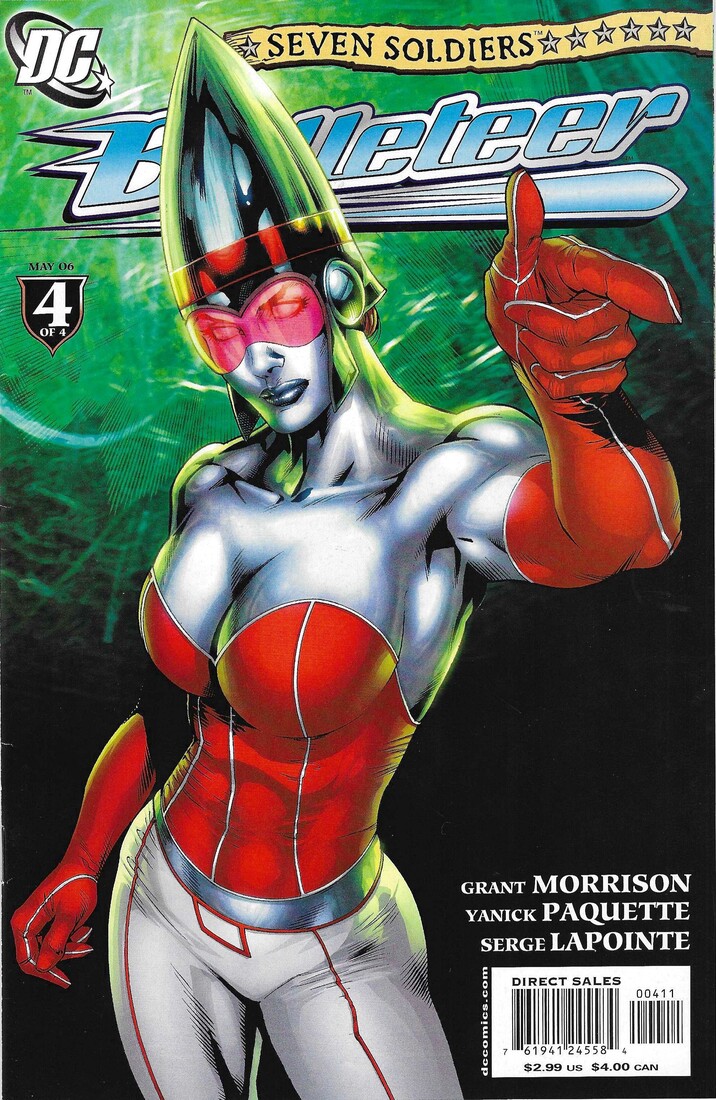
Alix Harrower judges us on this cover! “Yes, you want to see scantily-clad chicks fight each other, fanboy! Yes, you do! For shame!” We’re sorry, Alix!
We begin with a bucolic woodland scene, in a lonely farmhouse. And old woman tells a young girl that she’s so happy the girl rescued her cat from “those terrible boys” that she’s going to give her a present: “the whistle of the wind kings,” which tunes “your whole being to magical, super-sonic vibrations.” Er, if you say so. 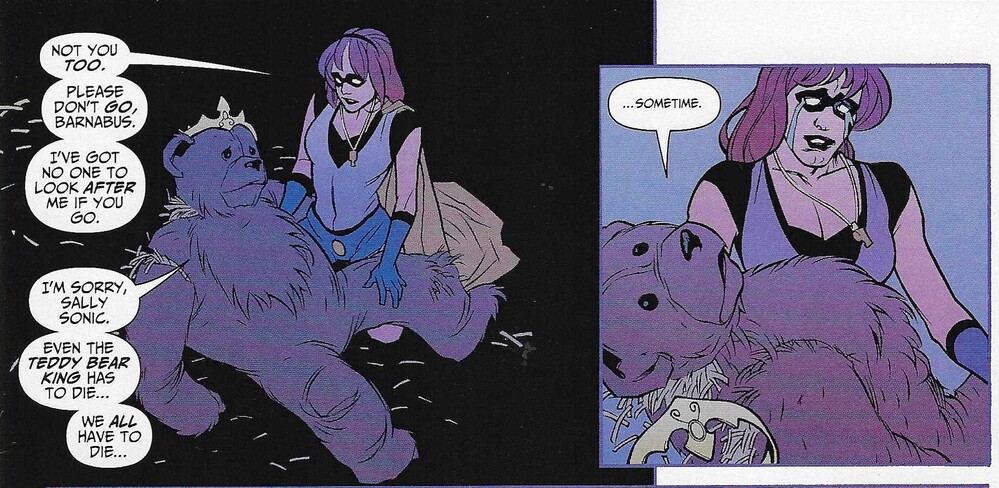 The girl, Sally, blows it, and we next see her as a superhero, fighting alongside a giant teddy bear, Barnabus (on page 2, she thwarts Dennis and his brother, Chris, which comes up later in the issue). But there’s a dark side: her parents tell her that she’s not aging like everyone else,and that she’ll always be young. Sally exclaims that this is a good thing … right? The Peter Pan complex that several characters suffer from in this epic is back, and Sally is its most tragic, perhaps, manifestation of it. Yes, Alix has no sympathy for her later, but it really is a tragic story, unlike the other characters who suffer from it. Lance is just a tool, Gloriana Tenebrae wants to remain young so badly she’d kill her stepdaughter, and Klarion revels in his undying youth. The idea of not growing up is everywhere, and it always ends up costing the person who believes in it. Sally’s situation is the most tragic because it’s not her fault. She desperately wants to grow up, but fate has conspired against her. First her parents die, then Barnabus, then the state takes her house away because she’s too young to own it. I’m not entirely sure why her looks trump her birth certificate, but that’s just a minor point. She is sent to the “Bleakdale Home for Bereaved Children,” which is run by Madame Eva Martinette. Boy, that’s quite the place! Madame Martinette is perfectly named, by the way. We then get a scene from the present, as Sally stands over the refrigerator she used to beat Alix into submission, crowing that she’s in charge, which is what Madame Martinette said in the flashback. Sally is obviously a bit unhinged from reality. [Edit: The nurse at my daughter’s high school’s last name is — I assume she’s still there — “Martinet.” I asked her once if she knew what it meant, and she ruefully answered that she did. Her father (or grandfather?) changed it from “Martinez” when he came to the States, presumably to avoid racist stuff, but didn’t know what it meant, and by the time people began to question it, she said it was kind of embedded in their family. Another reason why racism sucks!]
Sally monologues for a bit, telling Alix that men “love it when you do the change” from meek housewife to sexy superperson. She says that Lance told her all about their boring life together, and that Alix didn’t even want to dress up like a superhero on Halloween. She is utterly scornful of both Alix and Lance — Alix for refusing to indulge his fantasies, Lance for having them in the first place. 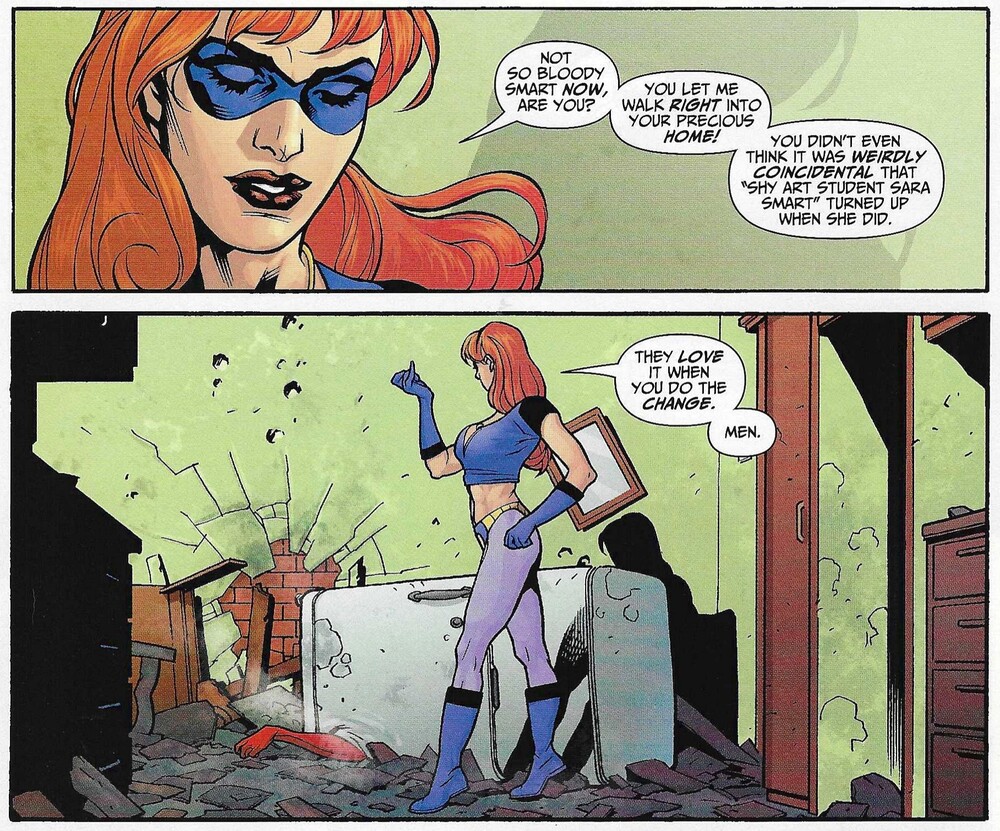 Alix recovers and bashes the refrigerator over Sally’s head, which doesn’t hurt her at all. She grabs Alix’s arm and snaps it in two, then tells her that she has to know how to fight. Alix continues to tell her she doesn’t want to fight, but help — we get back to Alix’s pre-SmartSkin vocation, and how she has no interest in being a superhero. Sally is unimpressed, and flashes back to Madame Martinette’s home. She is being put in the Wardrobe of Solitude because she’s been sneaking out to help people. While she is in there, she ponders the fact that all she’s ever done is try to help people, and the world keeps spitting on her. By the time she fights Alix, she’s telling her that “the world’s rotten and evil to the core.” This is where she begins to formulate that idea. Significantly, she is kept in the wardrobe for three days, the length of time Christ spent in the tomb (a reach, you say? not with Morrison writing!), and when Madame Martinette comes to get her out, she has blasted through the back of the wardrobe and the wall and escaped the home. The wardrobe reminded me of Lucy’s in The Lion, the Witch and the Wardrobe, as I’m sure it was meant to, but we can also find an allusion to Ali Ka-Zoom’s cabinet, as both are places where children who did wrong according to others were put. Sally escapes into “Narnia,” away from the horrible real world and into a Britain where fabulously good-looking men offer her a “cuppa” and help her out. Except, of course, he’s a scumbag.
Dennis, the man who takes her home, tells her that he’s a superhero himself. He tells her he has “Vitamin X” powers, and when he first got them, he was a “bit of a bad lad.” But during the war (which is World War II), he got a glimpse of the “Yank superheroes” (the Justice Society, presumably), and now he’s met Sally, and she believes in him, which turns him on. Shocking — all he wants is to get in her pants, which he does. We have reached a point in the series, and the overall saga, where superheroing, or the thought of it, leads directly to sex. It’s not surprising that Sally, later, equates her powers with sex. She loses her virginity (it’s not stated, but it’s fairly clear) to a man who is turned on just by the thought of fighting crime with her. Back in the present, Alix still wants to know why Sally did what she did, and Sally tells her because she wanted what Alix had, except she would have dressed up for him. 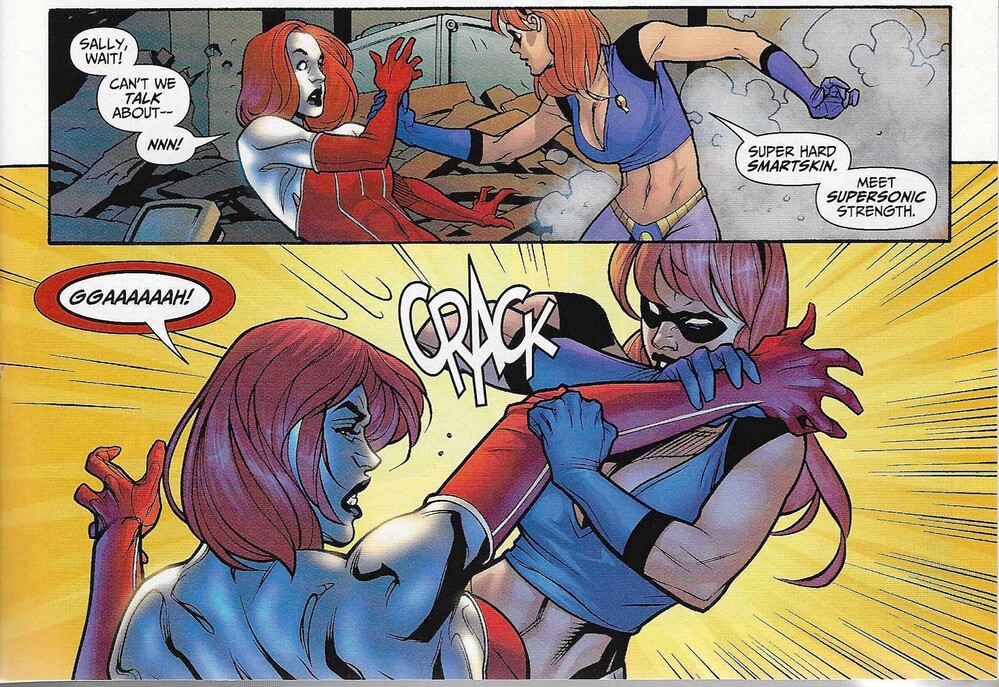 Sally cannot relate to a lover except in a fantasy role. This is interesting, because fantasy is not a bad thing in a relationship, but Sally takes it too far — she is lost in the role, and Alix recognizes this. We flash back again, as Dennis takes pictures of her and sells them to the Kingpins of England’s Criminal Underworld (there are seven of them, by the way). I’m not entirely sure why the criminals would want them — shouldn’t he be selling them to skin mags? Dennis tries to convince Sally that it’s a good thing, because fighting crime doesn’t pay the bills. Sally can’t get a job because no one believes she’s old enough, and Dennis convinces her that she can make good money selling pictures of herself. Even though, you know, I doubt she saw much of the cash. Finally, Dennis gets her to inhale “Doctor Hyde’s evil serum.” I can’t believe that not a reference to Edward Hyde, but I could be wrong. No, I can’t be wrong on this!!!!
So Sally is now evil, but that seems like a bit of a cop-out to me. I mean, “evil serum”? Really, Grant? Like the water in Frankenstein #3, this is a bit of a stretch. I know they’re both perfectly goofy, comic-book kind of things, but they bug me. Sally is a horribly damaged girl, and she has no need for external prompts to get her to go all evil. It’s far more boring than the arc that her character was already on. So the evil serum bugs me. She even kind of admits it wasn’t the serum. She has thrown Alix onto the street, and she floats down and tells her that the world swallows you and changes you, whether you want it to or not. She is not necessarily happy with who she is, but she has done what she did in order to survive. Alix hits her and says she doesn’t care what her sob story is, but she really does, because if she didn’t, she wouldn’t try to save her. She knocks Sally unconscious and then gets a phone call on her cell.
Who calls Alix?
That minor mystery aside, before Alix can take Sally to the hospital, Greg Saunders shows up. 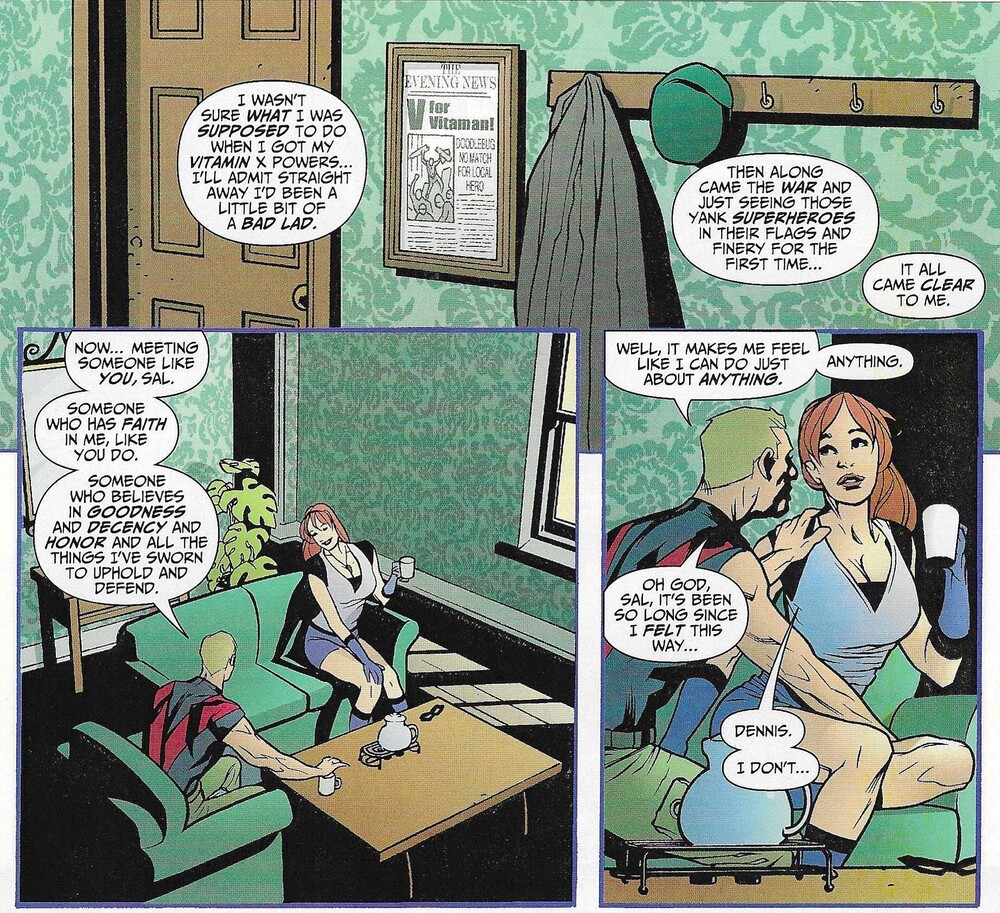 She says he’s dead, and he says there are all kinds of death. He tells her that she’s the seventh soldier, the spear that was never thrown. He says she is descended from Earth’s first superhero — Aurakles — and that’s why “they” sent him to recruit her. “They” are the Seven Unknown Men, by the way. He tells her that “the future of every living thing depends on you coming with me right now.” Alix tells him to shove it. Go, Alix! She says she’s heard schizophrenics talk like he does, and like Sally did. She tells him that she has to quit because she can no longer tell the difference between paranoid schizophrenia and the reality of a “costumed crimefighter.” Saunders tells her it’s her destiny, and she again tells him to shove it. In familiar words, she tells him she’s tried to use her powers for good — like Sally — and she obviously wants to get out before she turns into Sally. She tells him he’s on his own, because she has to get Sally to the hospital. She remains the spear that was never thrown, because she won’t fight! Yay, Alix!
There’s a lot to like about this issue, not the least of which is Paquette’s art, which not only is perfectly suited for chicks in spandex, but is perfectly suited for those chicks to fight each other! I’m not bashing the art, believe me — there are a lot of artists who couldn’t make this work, either because they just can’t draw superheroes all that well, or because they draw females too slutty. The nice thing about Paquette’s art throughout this series is that he draws the women as sexy, not slutty. When he wants to make them slutty, he does so through body language, which is far more difficult than putting them in clothing that is several sizes too small. He does a great job with Sally Sonic in this issue, as we believe that she looks like a teenager even as he gives her, in the present-day scenes, a world-weariness combined with that insane light in her eyes. It looks like a superhero comic, which it should, but it’s more subtle than what we usually get in one.
We also have the culmination of the two themes Morrison has been exploring in this series: the idea that being young is the only way to stay sexy, and Alix’s rejection of the superhero lifestyle. 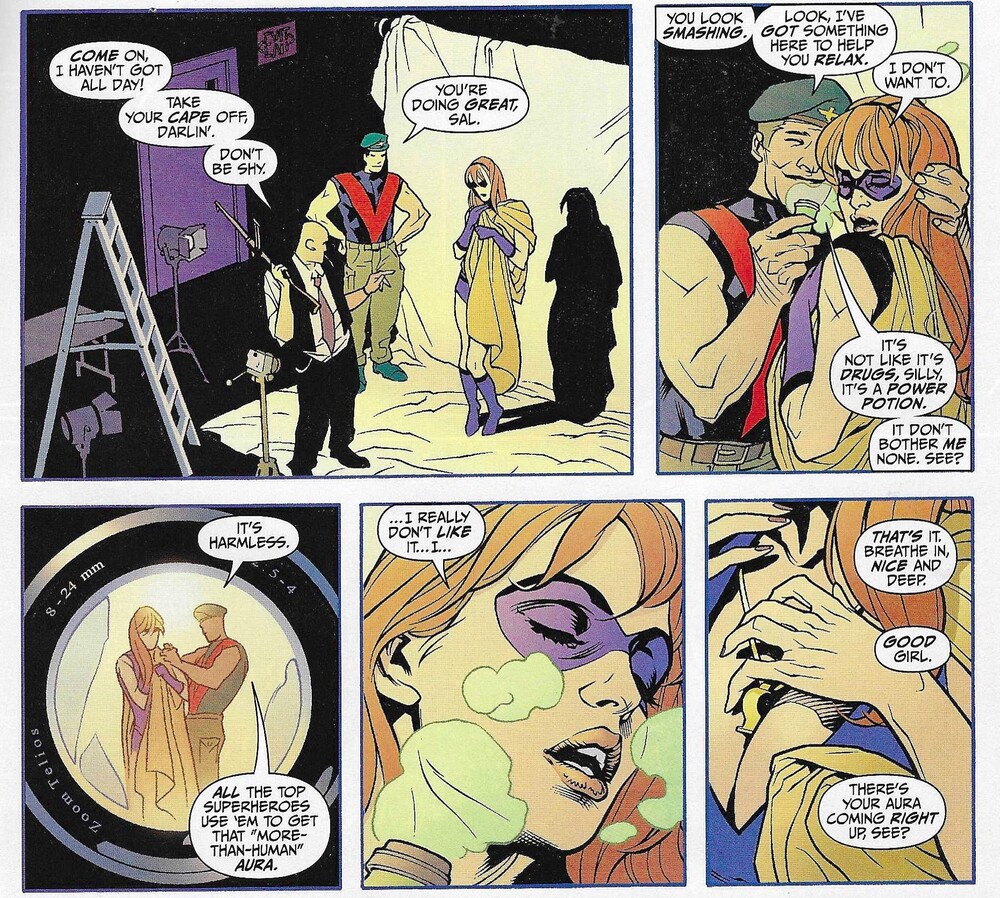 Sally Sonic is the metaphor of superheroes staying young forever — she’s been around for over 60 years, but she still looks like a girl! As I mentioned, she is doubtful about whether this is a good thing or not when her father tells her about it, unlike others in the epic, for whom eternal youth is the goal. Sally has only herself to blame for her later bad deeds, but we have to admit that she has been messed up by society in general and men specifically, and her response is to turn her disadvantage to an advantage. She decides that since she is always young, she should make money from it. But even though she “grows up” because her personality changes as she “ages,” she remains in many ways a child, and being a child forever drives her insane. We see this in the first issue of Zatanna, when she shrieks that she can’t get a drink in a bar. We see this in her desperate need to destroy “happy” families — the men in those families obviously want her, a person who looks like a teenager but know “adult” things. Morrison shows us the old saying is true: be careful what you wish for. If Lance had seen what has happened to Sally, would he still want it? Probably, because he’s a tool. But Alix now has what Sally has, and she desperately wants to avoid making the same mistakes. Which brings me to her rejection of the superhero life.
We have seen this before, of course. Throughout the series Alix is simply trying to make sense of her life, and she wants nothing to do with anything that will make it more senseless. We come back to her work with kids with autism — she wants to help Lucian in issue #3, she wants to help Sally in this issue. She goes along with Helen Helligan in issue #2 because she wants to help. She has the perfect makeup to be a superhero — she is compassionate and humble. But she also realizes that superheroes don’t really do anything that is positive in the long term — her battle with Sally has destroyed her apartment and a good part of the street below, and who’s going to clean that mess up? She wants to be heroic in a different way — instead of going off and saving the world, she wants to help Sally, because she obviously needs it. Alix is all about the small contribution to society, because even before she hears Sally’s story, she realizes that trying to help everyone at once leads only to heartbreak. It’s ironic, because I’ve been watching Heroes recently (I recorded them all when they first showed up, so don’t ruin anything for me!), and Peter quits his job as a caregiver because he’s “destined for bigger things.” He doesn’t get that we can only help the world get better one person at a time, and that is what makes us a hero. Ironically, that episode was written by Jeph Loeb, who might be the anti-Morrison.  Alix is a hero because she rejects the superhero life, while Peter ditches an old man who wants to die with dignity so he can go flying. [Edit: Wow, a Heroes reference. How 2006 of me.]
The ending is nicely done, too, because it follows the rest of the series. Alix is not suddenly going to have a change of heart just because Greg Saunders tells her it’s her destiny. The Seven Soldiers, after all, each reach their destiny in separate ways. Alix reaches hers through, really, ignorance of it. But because she is doing something that is heroic on a small scale, she ends up doing something heroic on a large scale — killing Gloriana Tenebrae. Who knows where she would have been and what she would have been doing during Seven Soldiers #1 if she had taken Saunders up on his offer? Fighting the bad guys, no doubt. But there’s only so many bad guys you can punch before it becomes stupid. Alix decided to save someone instead of beating on them. Therefore, like only some of the other soldiers, she has grown up — that is, gotten past the point where she feels sorry for herself and does something about it. What she does is no less heroic than Jake Jordan or Sir Justina or Frankenstein. It’s just a different path, and we have seen throughout this saga that there is no one clear path to true heroism.
And so we reach the end of another series, the sixth of seven. One of the better ones, I think, although you may disagree. If you care to, check out the annotations, where there is a lot about Dennis’s Vitamin power. Jog has his usual good thoughts, including some comments about the art that I didn’t consider. They’re valid concerns, but they didn’t bother me all that much. And Ragnell has a good piece on Alix and Helen Helligan, which concerns the entire series, so I didn’t link to it until we were done, even though Helligan went to the great beyond two issues ago.
Coming soon: Neh! Buh! Loh! Only he’s kind of a paper tiger, isn’t he?
