

[The original post is here, and you’ll notice that it went up on Fred van Lente Day, which Brian, for some reason known only to him, always celebrates on 6 December. It’s a mystery! Enjoy!]
Here’s my contribution to Fred van Lente Day: Buy Action Philosophers! Seriously, it’s a great comic book. And then maybe Fred and Ryan Dunlavey will make enough money so Fred can pay Ryan the ten bucks he owes him.
Okay, moving on to what might be the most important mini-series. Why? Well, when I SPOIL it for you, you’ll see why. Seriously, people. SPOILERS abound, including SPOILERS for future issues!
I don’t see how I can make it any clearer.
So why is Klarion the most important series? Well, it certainly ties into the other series somewhat more than the others, even though they all do eventually (we’ll get to the strange Mister Miracle in due time). It’s important, too, because of Klarion’s connection to the Sheeda, which is less direct but more subtle than Justin’s. Klarion and his people have a very intimate connection to the bad guys, and this makes it very interesting to watch the story unfold and also to go back and make connections. Which is what I am going to do as we consider this series. Of course, the revelation about Klarion in Seven Soldiers #1 is important, as well, and it’s another I want to consider as I look at this series. So, I’ll warn you again: There are many SPOILERS to discuss.
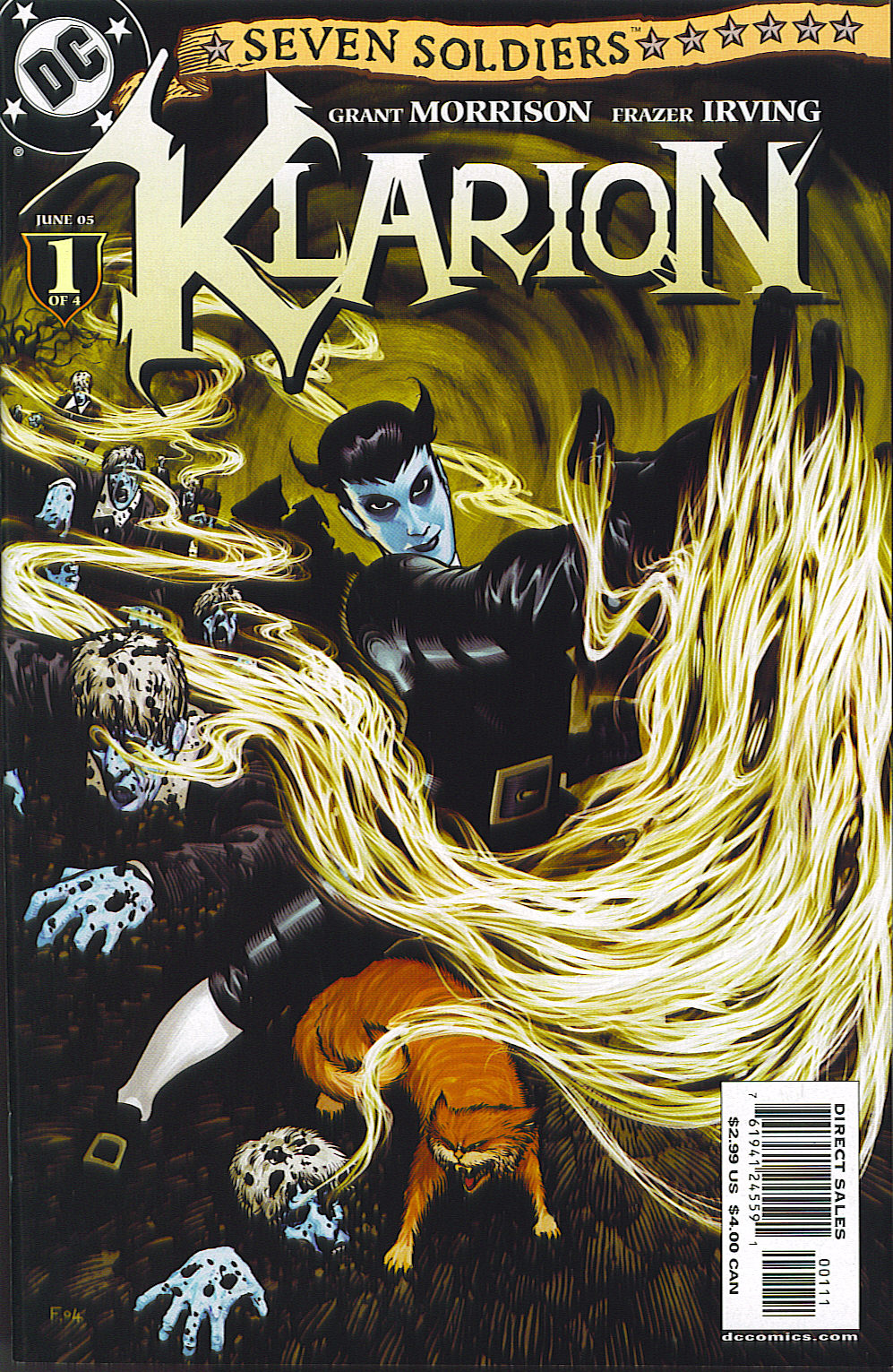
We start with Solomon Grundy [Edit: So we think, as one of the commenters pointed out that it’s not him, but we think it is!] coming out of the swamp. Readers unfamiliar with Solomon Grundy won’t know who it is, of course, and I certainly don’t know a lot about him, but I know a few things: Grundy was originally Cyrus Gold, who was accused of killing kids, chased into Slaughter Swamp, and killed there. 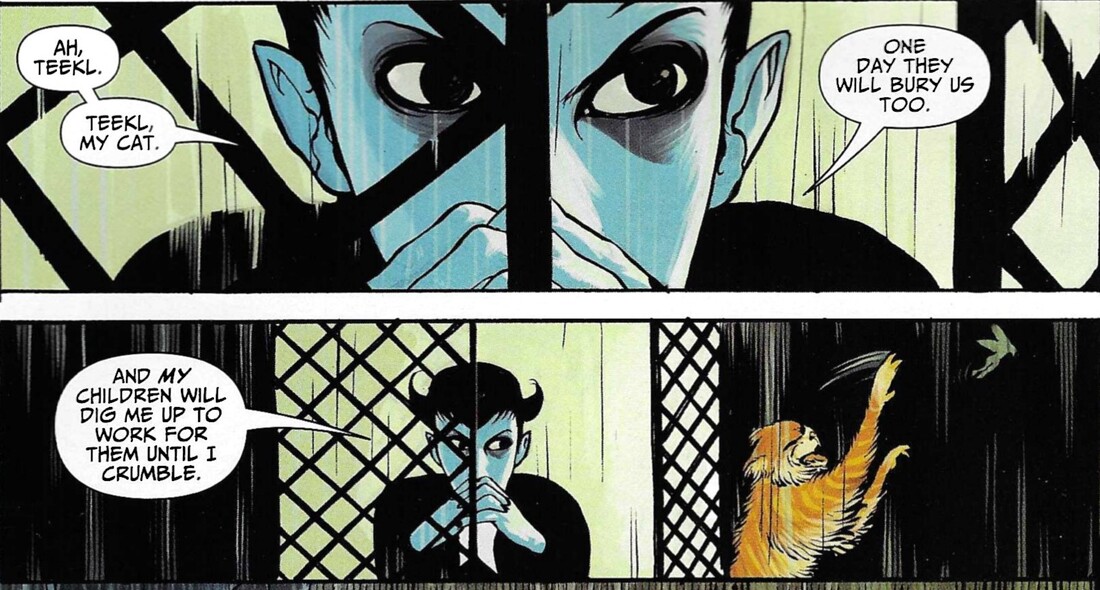 The swamp changed him and he became a zombie-like creature who occasionally menaces DC heroes (and sometimes allies with them, when he’s in a good mood). With just one panel, Morrison ties Klarion to Seven Soldiers #0, with its framing sequence in Slaughter Swamp, as well as places Limbo Town near the swamp (as it turns out, Limbo Town is beneath New York, but that could be close to the swamp, which is near Gotham City). More importantly, just by referencing Solomon Grundy and by showing this creature and its rebirth, he reminds us that this series is, ultimately, about transformation — whether good ones or bad. Grundy has been transformed by the swamp, and it’s a nice reminder to us that we should keep the transformation theme in mind when we’re reading Klarion.
On the next page, we see our hero, talking to his cat, Teekl. We gives us some good information — the Solomon Grundy we see is the dead father of the person digging him up, and his people use them as workers. He thinks that this too will be his fate, and he wonders what the point of being born is. His sister, Beulah, overhears him, and gives us more crucial information — their father went “beyond High Market” and never returned, and Submissionary Judah is going to perform a ceremony in which the “Grundy’s” head is branded. Klarion, like the snot-nosed punk he is, says maybe he’ll be there if he wants to be, and Beulah says he’ll be there because the Book of Shadows says so. Then the splash page shows a tall man — Submissionary Judah — striding along the street in a driving rain (or is it?). 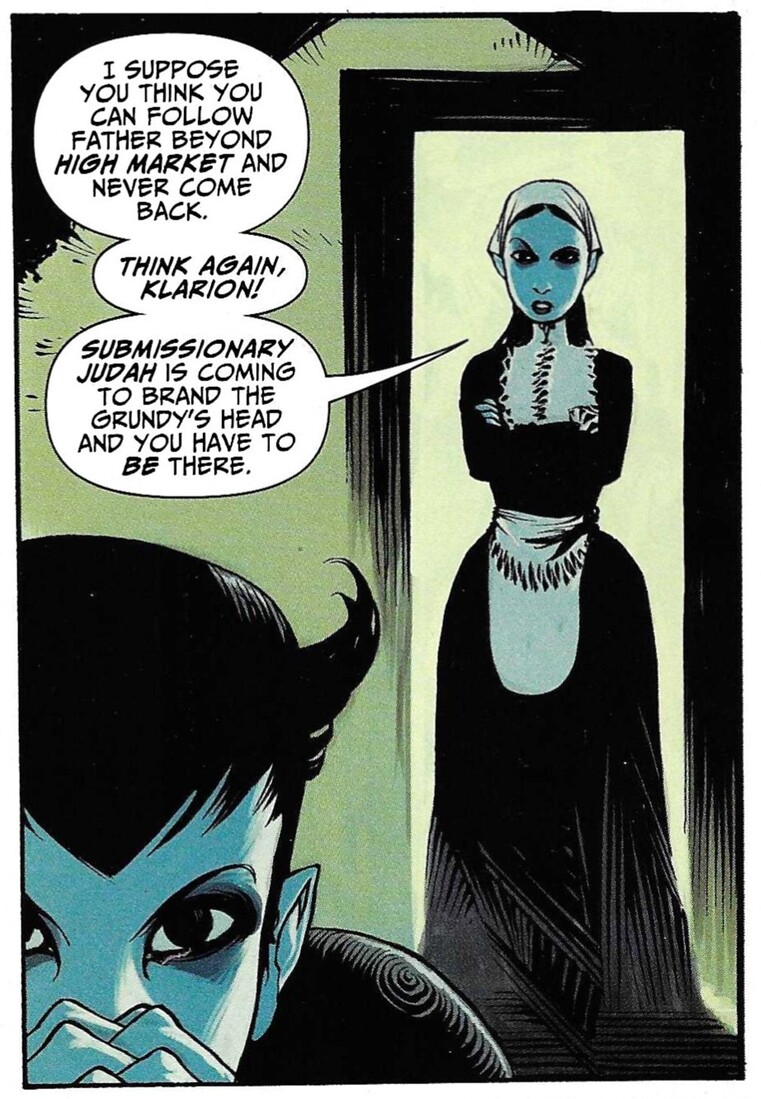 All the characters are dressed as Puritans. And they’re blue-skinned. What the hell?
Judah brands the Grundy’s body with a complicated hex and gives us some more information. They are reluctant to be stirred (well, they are dead, after all), but the “septic mire” gives them life. Another reference to Slaughter Swamp, presumably. Judah swears by “Great Croatoan,” which sounds like a god. Anyone with any knowledge of American history knows the significance of Croatoan, and we will learn why Morrison uses it in due time. Judah says that everyone’s fate is to become a Grundy, but the zeal of the people means that they accept the rather horrific fate. As he stands in the square, Teekl runs forward clutching something in his mouth. Judah takes it and sees that it’s a tiny Sheeda rider — and he knows what it is! Good job, Judah! He gets a mite angry, saying “Pollution! Pestilence! Our sins have found us!” He tells the man who dragged the Grundy out of the ground, Ezekiel, that his “Witch-Man Parliament” can debate while Croatoan falls. Here it seems that Croatoan is a place, not just a god. Hmmm … Klarion asks Judah if he can touch the Sheeda, because he’s never seen a real one. Judah is scornful of Klarion, because he’s, well, kind of a jerk. Klarion sits with Ezekiel in the “rock fields,” where the Grundys work, and we learn that they need the Grundys to do the work so that the living can praise Croatoan, and Klarion asks why they need to do what the Book of Shadows says. Ezekiel says they have to preserve Croatoan against the taint that condemned their fathers to Limbo Town in the first place. The use of the word “taint” is significant, as we’ll see — and not for any yucky reason, so get your mind out of the gutter! Klarion wonders about Blue Rafters, the place from which their fathers came, and says the book doesn’t make a lot of sense. Blue Rafters is easily identified as the world with a sky, but we’re still unsure where the heck Limbo Town is. 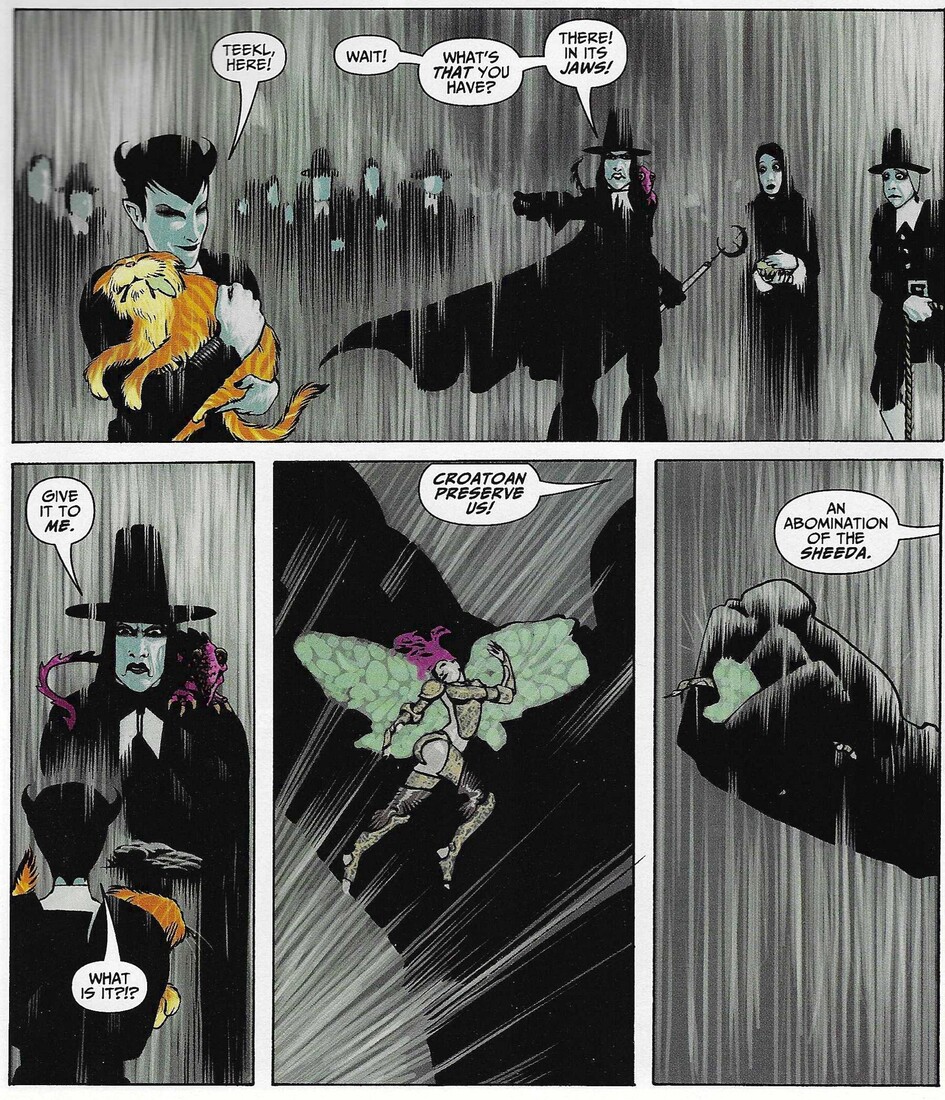 Ezekiel tells him that soon he’ll be a witch-man, and he’ll learn the sad truth behind the stories. Then Ezekiel, who’s a bit of a rebel himself, shows Klarion a Kit Kat wrapper. He says, “There’s not much to see past High Market, just tunnels and rails and stone and more tunnels.” This sounds suspiciously like a subway system. He continues that when they searched for Klarion’s father, one of the trolley men gave him food, the wrapping of which he kept to recall its sweetness. Klarion is mesmerized by it, and the scene has an interesting The Gods Must be Crazy vibe to it. Ezekiel mentions that when Klarion becomes a witch-man, he can help break the “superstitious” hold of Judah and the Submissionaries. Ezekiel mentions that another Submissionary, Shadrach, has told him that they might seal the Wicket Gate and cease trading with the world above and keep the stone harvest for themselves. This is an important speech for understanding the mini-series and, by extension, the rest of the saga. Ezekiel says that if they wait until the “Sheeda storm” passes, they can leave Limbo Town and return to Blue Rafters, where their sins will be wiped out and they will inherit wonders. Judah fears that trade with the higher towns might make them impure. We have already seen that the Sheeda come to destroy civilizations, and if the Limbo Town denizens are underground, perhaps they will be spared. A theory I saw in the annotations (link below!) posits that Judah keeps the civilization of Limbo Town deliberately “medieval” (even though it’s not really medieval, more early modern, but whatever) so that the Sheeda spare them. This is why I don’t read things about the issues beforehand, because that theory has contaminated me, much like the blood of the Above-Worlders will contaminate the Puritans! It’s a very good theory, though, and I’m grumpy I didn’t think of it on my own. I can’t figure the significance of the “Wicket Gate.” A wicket is the thing in cricket that the bowler tries to hit. It’s also, interestingly, a web application framework. Anyway, the gate doesn’t look like a wicket. Cricket existed in the 16th century, so the Puritans certainly could have known about it, but why they called it the Wicket Gate I don’t know. Any ideas? (Incidentally, I once scored a cricket match. It was complicated but fun. It was much harder than scoring a baseball game. But as I have not seen a match in over a decade, my knowledge of it has atrophied.)
  [Edit: The first commenter on the old post made the point that a “wicket gate” is just a narrow gate, and oddly enough, if you Google it today, you can find that, but when I first did this, I saw no references to it. Strange.]
Judah is rendering the judgment of Croatoan, which is that they must close the Wicket Gate and that the people must hide. The people in the congregation are in some kind of strange ecstatic state, except for Klarion, who looks upon the proceedings with a jaundiced eye. Later, Klarion is quite peeved that he can’t go past the Wicket Gate now, and he sends Teekl to “make mischief” with Judah. Ezekiel consoles him, saying that the Parliament will soon take over because Judah can’t hold back progress. Klarion makes an interesting statement: “But the lawbook says Sheeda won’t harm our folk come the harrowing.” Why not? Why would the Sheeda leave them alone? We assume it’s for the two reasons mentioned above: they’re far underground, and they’re not technologically advanced enough. We will learn in future issues that it’s for another reason, one far more interesting than either of these. Ezekiel tells him that one of them “thinks” he has invented a steam-driven engine, which would seem to argue against the lack of technological advances. Ezekiel, before he leaves with the stone harvest, tells him that he’s more afraid of his own people than he is of the Sheeda. Ah, more irony from Grant Morrison!
Klarion finds Teekl, who has been spying on Judah. Although we could have suspected from all the witch talk, this is the first time we realize that Teekl is Klarion’s familiar. 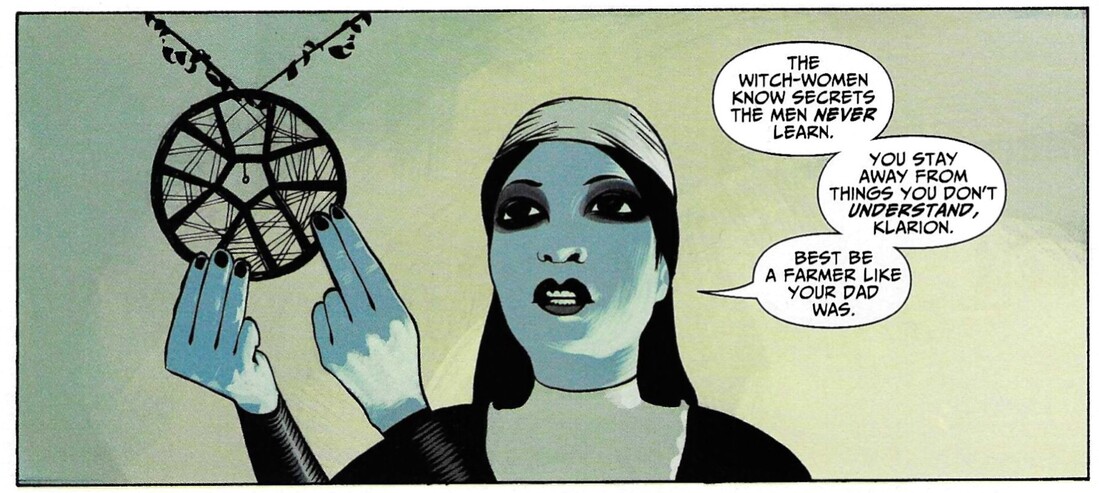 Klarion is able to see through his eyes, which is an important fact later on. He sees Judah and the two other Submissionaries (we learn later that there are three of them, but the third never gets a name) standing in front of what looks like a 16th-century map of the world, transforming (there’s that word again) into a “Horigal,” which Morrison, I understand, did NOT invent. Keen. They are going to “destroy the enemies of Croatoan,” which Klarion takes to mean Ezekiel and the men going past the gate, because he runs to warn them. He’s too late, though, as somehow, the Horigal gets in front of the transport. Klarion pauses at the Wicket Gate (which, again, looks nothing like a wicket), but then goes through it into the unknown. But he’s too late — everyone is dead, and the Grundys are just standing around stupidly. The Horigal stands in front of him, ready to do some killing. Oh no!
There’s a lot of information in this issue that is very pertinent to the saga itself. The previous two issues had no Sheeda in them at all (with the exception of Zatanna’s strange dreams), and here we see them again, and unlike in Shining Knight, we presume this takes place in the present. We know, of course, that the Harrowing has begun, because of Seven Soldiers #0, but here we get some more information about the Sheeda, even though it raises more questions than it answers. The people of Limbo Town know a great deal about the Sheeda, obviously, and are justifiably frightened of them. 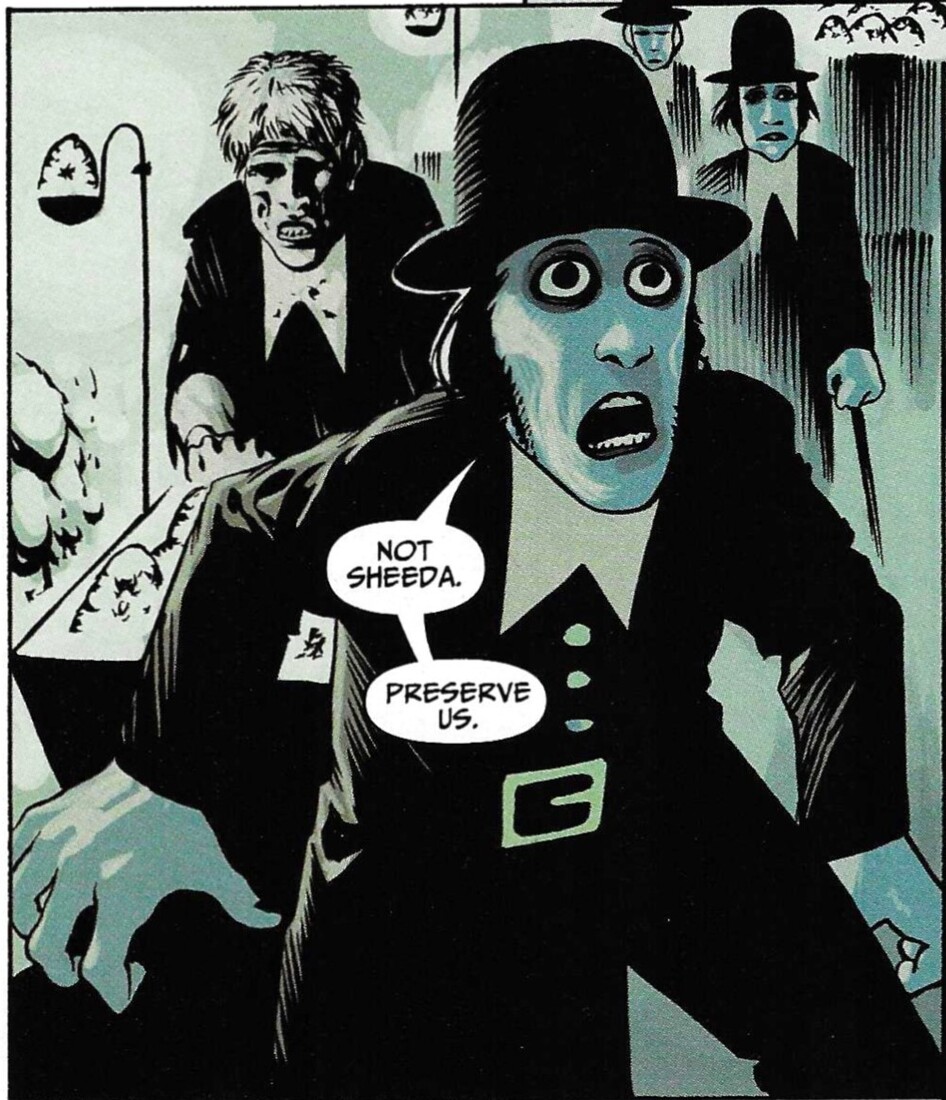 But what is the Sheeda doing in Limbo Town, which is obviously underground somewhere? Teekl simply catches it; it hasn’t landed on anyone and poisoned them. Is it there on a reconnaissance mission? The fact that the Puritans of Limbo Town are blue-skinned is nice foreshadowing, as well. We don’t really think much of it, because Frazer Irving, who colored the issue, gives everything a weird hue, making this issue’s art the strangest we’ve seen so far in the epic. However, the blueness of the Puritans is very important, as we’ll see.
The theme of transformation raises its head again in this issue. I mentioned above that the first image we get in the book is one of transformation, as the Grundy comes out of the ground changed. The transformations in this book are not pleasant ones, much like Thomas’s transformation in SS #0. The issue is bookended by these transformations, and in each instance, we watch, horrified, as something is made that is distinctly unnatural. There is much about the Puritans that is unnatural, and it can’t be a coincidence that Morrison, with their adherence to what its practitioners would call a “natural” religion, is using this book to show how unnatural other religions are. I’ll get to that in a little bit. The transformations are interesting. The first one ties into DC history, and gives us a strange new take on the one Grundy we know about — Solomon. He was named so by a bunch of hoboes, because all he could remember was that he was “born on a Monday.” Interestingly enough, in looking at the Wikipedia entry on Solomon Grundy, it’s believed the name is derived from the name of a salad. Solomon Grundy, of course, was created in a plant-filled place. It has to be a coincidence! [Edit: It is, as the new Wikipedia entry tells us it should NOT be confused with Salmagundi, which is the salad. It’s also a magazine by Washington Irving and friends, who used it to satirize early 19th-century New York society.] Anyway, this prototypical Solomon Grundy can now be seen as perhaps a rogue zombie from Limbo Town — even though Cyrus Gold was not a Puritan. Or was he? Klarion’s father went rogue and reached the world of Blue Rafters — why not Cyrus? His ancestry might explain why he became a vicious killer — if indeed he was guilty. Anyway, the mind reels at the possibilities for Solomon Grundy, none of which, I’m sure, DC will explore. The second transformation is more horrific, as the three Submissionaries become the Horigal. There is probably a subtle twist on the Trinity here, because it’s just wacky enough for Morrison.  The Horigal is what protects Limbo Town from its enemies, and here, the “enemies” are its own people, the “heretics” of Limbo Town, if you will. The three Submissionaries are changed into something new, something that is powerful to contain the threat posed to Limbo Town. Much like Thomas was changed into something that should have been powerful enough to oppose the Sheeda. Klarion, too, is going through a transformation, as we’ll see. Yes, he’s a little snot in the beginning of the book, but his desire to escape the rigid conformity of Limbo Town complements his snottiness, so at the end of the book, his yearning coincides with the Horigal’s awful mission of destruction, and concern over his fellow “heretics” prods him into action and gets him beyond the Wicket Gate. His own transformation, which begins at the gate (a not-too-subtle metaphor) has begun, and it will lead him to a place that is unexpected but perhaps we should have seen coming.
This issue is a rather broad statement on religion, and it is, perhaps unfortunately, typical of a comic book’s ideas on religion. The Puritans have changed from rigid adherents of Christian doctrine (which they must have been in the 16th century) to rigid adherents of witchcraft doctrine. The critique of Christianity that Morrison gives us is dull simply because it doesn’t offer us anything terribly insightful. These are people who are completely cowed by superstition and ritual, and only by escaping Limbo Town itself can any of its denizens be free. There are no truly spiritual people in Limbo Town, which is a shame. Judah, obviously, is manipulating the people for his own selfish ends, and Ezekiel, who is a progressive politician, is cynical about Croatoan and the faith. Klarion, who is as unlikable as hero as we’ve seen in comics in a long time (even the Irredeemable Ant-Man is more pleasant!), has no faith whatsoever, except faith in himself. The split between the Submissionaries and the Witch-Man Parliament is much more interesting, but Morrison doesn’t devote as much time to it. The faith of the Puritans is rooted in actual physical objects, as Klarion discovers in issues #2 and 3, but it has still become steeped in superstition and mystery. I have no problem with showing a religion that has become calcified to the point where anything that even questions it must be stamped out, but it would have been nice if Morrison had shown us that some Puritans actually do believe in Croatoan yet are still able to question the Submissionaries. 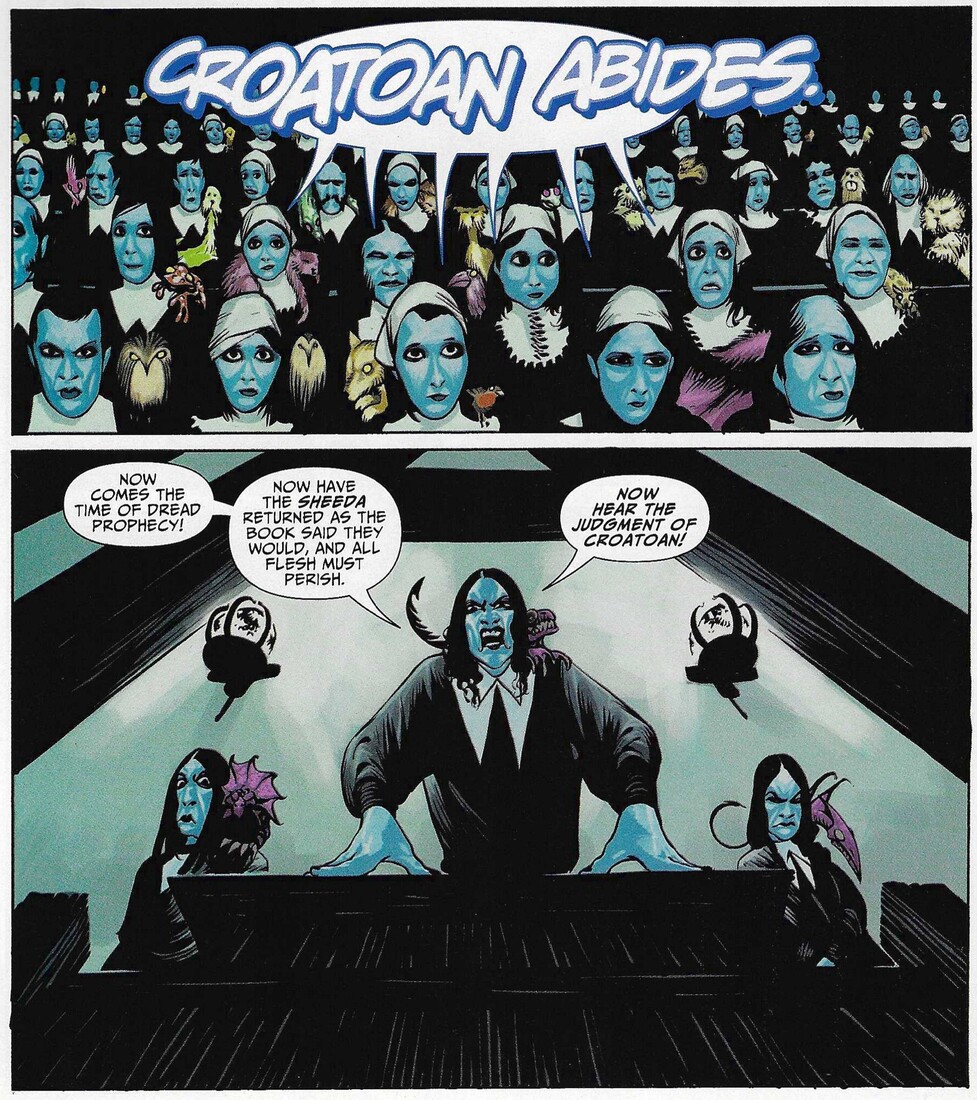 Klarion and Ezekiel have lost all faith, and the rest are enraptured to the point of mindless obedience. There’s no middle ground.
Frazer Irving’s art makes this a far more surreal reading experience than it would be otherwise. It’s excellent, as we get a true sense of claustrophobia and the horror of living in Limbo Town. I know the inhabitants probably don’t feel like it’s horrific, but Irving does a wonderful job showing how the environment itself is poisoned. There’s also the curious part in the square, when Judah brands the Grundy and finds the Sheeda. It looks like it’s raining, but nobody appears to get wet. At times it looks like sunlight streaming down. And how could it rain underground, anyway? It’s a strange phenomenon, and it adds to the feeling of horror. I mentioned that Irving is the colorist, too, and everything takes on that weird blue hue (except for Teekl, who remains comfortingly orange), which makes the book all the more creepy. Like the other books, it fits the story wonderfully. Irving even makes Klarion look more impish and less like a snot, which belies his dark heart. It’s a beautiful book to look at, but how is that any different from what has come before in the epic?
As usual with these issues, there is a lot more going on than we suspect. With Klarion, however, we sense that there is more to it, so that even though it works well in the context of a four-issue mini-series, we are looking for connections before we even consider what’s going on in the book itself. We have now gotten through the first four ”number-one” issues of the Seven Soldiers saga, and four of our soldiers are in place. The neat thing about reading them this way is we can see how Morrison sets each series up and also, subtly, links them. It makes reading them even more interesting.
You’ll notice that as Morrison didn’t invent Klarion, I’m not even getting into the definition of the actual word! It can’t have any connection to Boy Blue’s horn and the mission bells, could it????
Of course, it wouldn’t be a post without linking to the annotations for this issue. Any good reviews out there? Let me know!
Next: Second issues! Can you stand the suspense????
