
[Here’s the original post, with comments, where you can get a nice discussion of faerie under the hill, which I would have incorporated into this post except I’m trying to keep them as close to the original as possible — much like my Comics You Should Own posts, I don’t really want to do a lot of rewriting to fit in new data. That’s why we have comments! Enjoy!]
[I’m not sure why I switched to large images between paragraphs to smaller images inserted into paragraphs. I did these over the course of a few months earlier this year, so maybe I took a bit of time between the last one and this one and forgot I was doing large images and reverted to smaller images. Sorry about that — but you can still click on the images to see them bigger!]
Oh, Zatanna — that little vixen! Yes, it’s time for the first issue of the next mini-series, as Morrison sticks his tongue out at Alan Moore and says, “Anything you can do I can do better!” Let’s gear up for the weirdness!
Oh, by the way: SPOILERS!!!!! One of our fine commenters pointed out that I’m not too specific with the warning — if it’s relevant, I will talk about future issues in the mega-epic, so I might SPOIL those too! I had forgotten that DC’s policy of releasing trade paperbacks is glacially slow, so I hadn’t considered that these wouldn’t be all collected yet. How many are out? Is Seven Soldiers #1 going into a collection any time soon? I will try to be careful, but you’ve been warned! As usual with Morrison books, some things that take place in an early issue only make sense when you read the later ones. Blame him, not me!
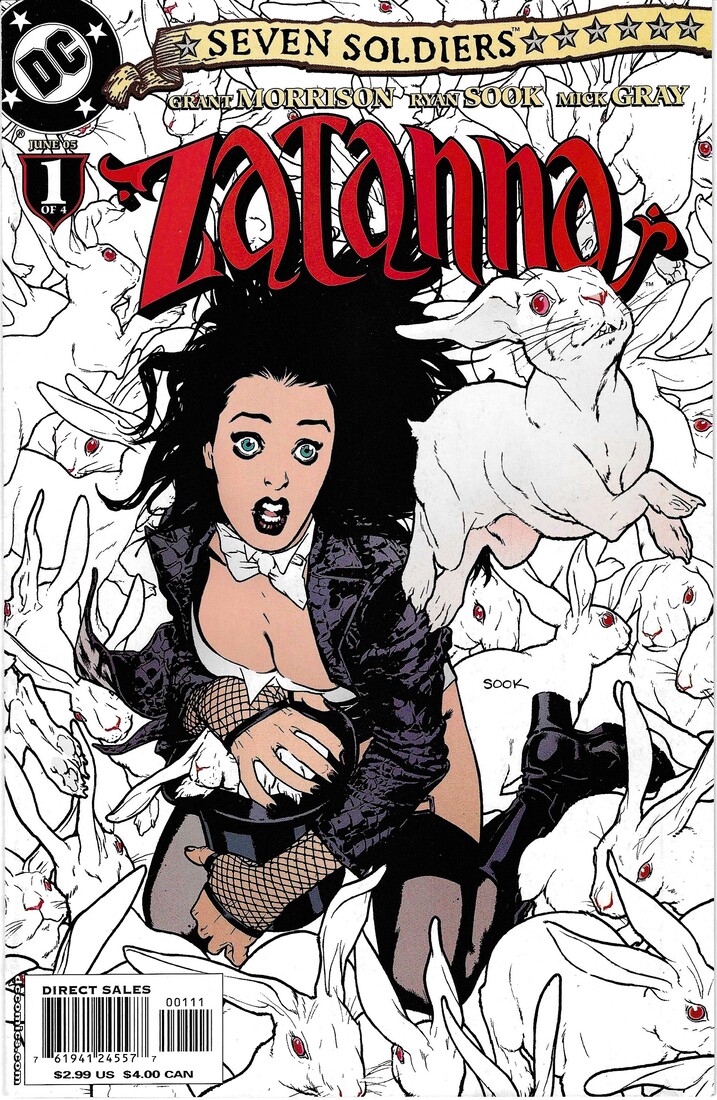
It doesn’t start out weird, of course. Page one of “Talking Backwards Sdrawkcab Gniklat” is Zatanna sitting in a metal folding chair and saying, “You want guilt? My name’s Zatanna Zatara. I’m a spellaholic.” Ryan Sook’s gorgeous art shows us a young woman who looks weary, even though there are no lines on her alabaster face. Her hair is just ragged enough, her posture is just slumped enough, and her eyes are just vacant enough that we understand the strain she’s under, even though she’s still beautiful. She clutches keys in her hand, and we can visualize her stroking them nervously if absent-mindedly the whole time she’s talking. 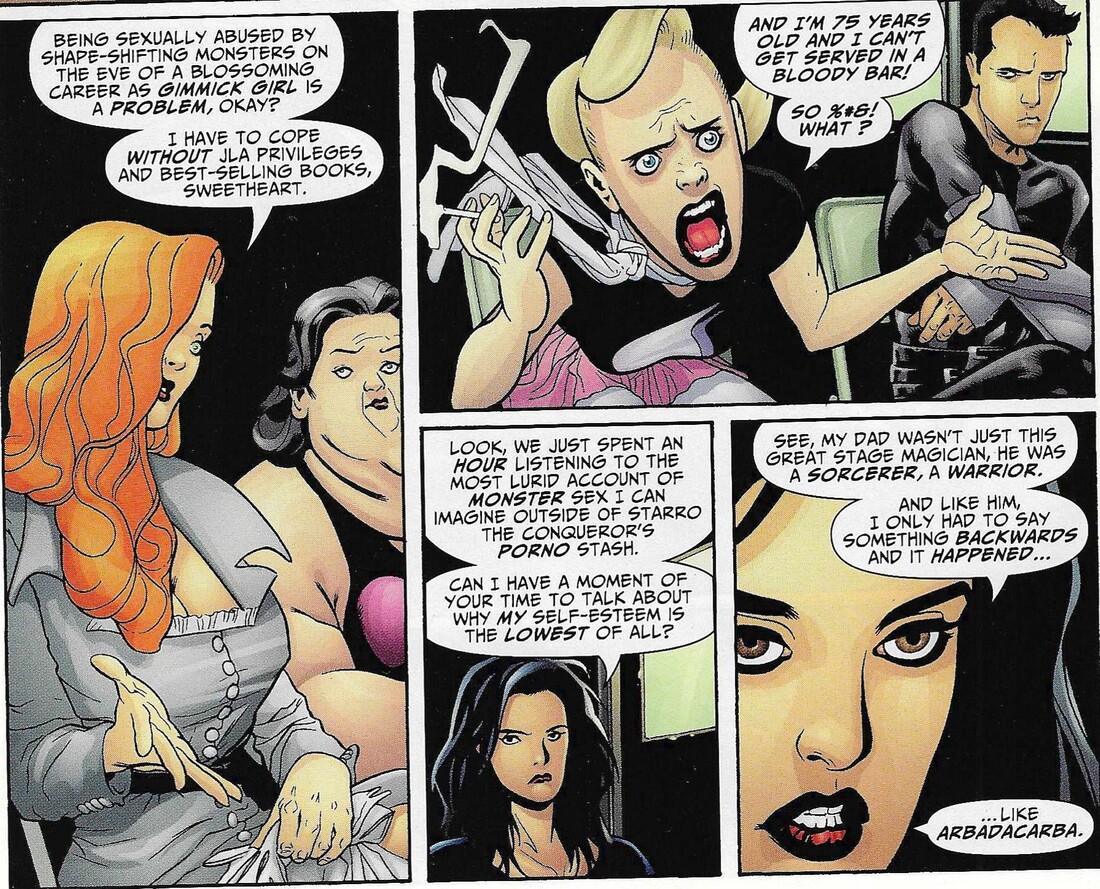 In one beautiful splash page, Sook shows us that this is a woman on the edge, and she’s barely said anything. This is why comics are awesome, by the way. Words and pictures, people, can show wonderful things.
We jump right into a two-page flashback with Zatanna and her father, which is relevant only for a few things: Giovanni mentions that his whole act is falling apart, which is one of those portentous things Morrison likes to throw into their writing, and then Giovanni follows it up by saying, “It’s not easy being a single dad, fighting crime one minute, performing the next, making ends meet.” This goes back to Morrison’s more grounded script in The Manhattan Guardian, as Jake worries about making ends meet too. It also returns to the idea of heroism — is Giovanni being an irresponsible father for going around fighting crime instead of getting a real job? Morrison, and every other comic book writer, would say no, because you have to chase your dreams, man! Zatanna herself wanders around fighting crime and performing, and look at her — she’s in therapy because she’s a spellaholic. So despite the protestations of comic book writers, who are artists, man! Giovanni’s statement is more weighted than we might initially think.
We return to the present, and Zatanna says that Giovanni never used magic (without the “k,” mind you, because it’s not the kind that needs a “k”) irresponsibly. She is interrupted by our old friend Jackie Pemberton, aka Gimmix, who’s not dead! Yay! Okay, this issue takes place before Seven Soldiers #0, so Jackie is, sadly, still dead, but at least we get to see her in all her bitchiness one more time. She’s complaning about the fact that Zatanna, who’s a member of the Justice League, should just shut up and let people with real problems have the floor.  She mentions that she has real problems — without JLA privileges or a best-selling book, she was “sexually abused by shape-shifting monsters,” which some have read (according to the annotations, to which I’ll link at the bottom) as her transformation at the hands of the Seven Unknown Men of Slaughter Swamp. Hmmm. It’s certainly something to consider. Sally Sonic, from Bulleteer, is also in the support group, whining about being 75 years old and not being able to get served in a bar. Misty is there, but according to what she says later, no one can see her except Zatanna. The fat woman is, according to Morrison, Etta Candy — the original. I miss the Pérez version. That’s all I’m saying. Before Jackie can take over the group, Zatanna mentions that her father died “fighting the forces of evil,” an event which took place in Swamp Thing #50, written by the Great Crazy Bearded One of Northampton. Zatanna mentions that she also has fought the forces of evil, with mixed results (at least her father died saving the world).
Another flashback takes us to Baron Winter’s house, where Giovanni met his fate. Zatanna mentions that it was the SEVENTH day of ARACHNE, the secret 13th month of the sorcerers’ calendar. Seven, of course, is self-explanatory. Arachne, for those of you who don’t know your Greek myths, was turned into a spider by Athena, and I think we’ve seen that spiders are significant in the Sheeda world (although they’re machines, not real, which is probably important). Zatanna tells the baron that everyone is gathered because they’ve been having bad dreams — not unlike the police officer in Shining Knight #1! The dreams are obviously of the Sheeda, but they’re worth looking at. Zatanna mentions dreams of three things: “little people from under the hill, locust armies with tiny riders, a queen on an eight-legged horse.” 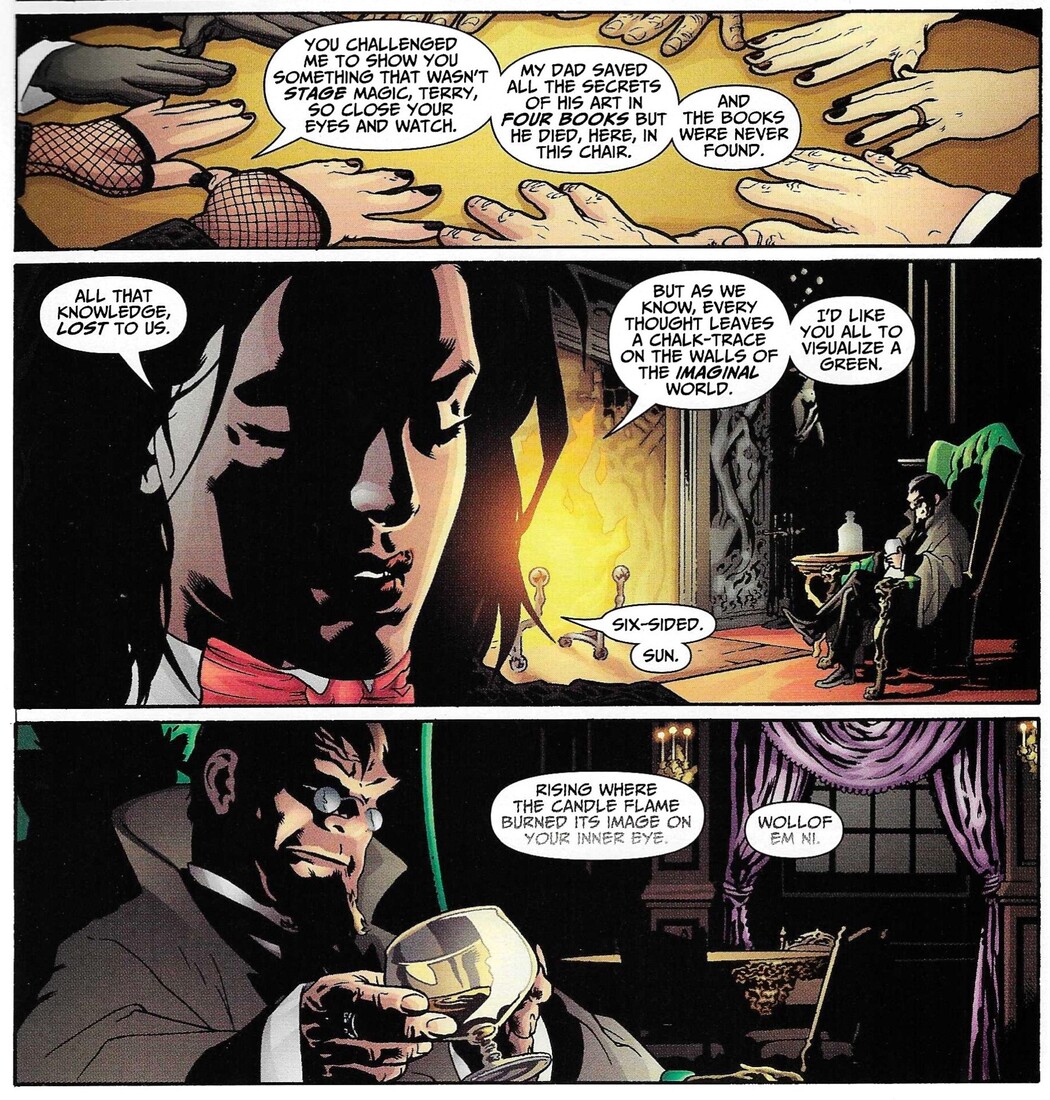 The last one is obviously a reference to Gloriana Tenebrae, although why the dreams show her riding a horse rather than a spider is interesting. Could it be a reference to one of the Horses of the Apocalypse? Given Morrison’s fascination with that sort of stuff, it wouldn’t surprise me. I honestly can’t remember the Queen riding any sort of steed during the series — I suppose we’ll see as we go along. [UPDATE: The first commenter here points out that Odin rode an eight-legged horse. I saw that while I was checking things out, but wasn’t sure if it was relevant. He (I guess it’s a “he,” but it could be a girl) provided a link. Go check it out if you’re interested!] The locust army is also easy to decipher – locusts, after all, were the eighth plague to strike Egypt in the Book of Exodus. What does Zatanna mean by the little people from under the hill?
I’m not sure, and theories are welcome. It echoes the motif of “the king under the mountain,” the sleeping hero who will awaken during a time of stress and redeem mankind. Significantly, one of these heroes is King Arthur (and this idea was used in the 1980s mini-series Camelot 3000, by Mike W. Barr and Brian Bolland — read my critique here!). Morrison certainly is cognizant of this legend, and probably wouldn’t have any problems fitting it into the story, but is that really what they’re doing here? The reference to “little people” from below the ground probably means the people from Limbo Town, where Klarion lives, but those people aren’t any smaller than normal humans. Are they? They don’t look smaller than normal humans when they show up, nor do they live specifically under a hill. And why are all the magicians dreaming specifically about the lost Puritans?
Anyway, Zatanna and the others sit at the table, Zatanna at the very spot where he father died (we see the shadows of his burned arms on the table — one would think Baron Winter could have found some good furniture polish in the intervening years!). The others introduce themselves: Timothy Ravenwind, Ibis the Invincible and his wife Taia (who have traveled seven times around the world), and Terry Thirteen. Does Baron Winter count as the sixth member, and is that why things go horribly wrong? They are looking for the Liber Zatarae, the four books of secret magic that were lost when Giovanni died. She wants to go looking for them in the Imaginal World, which means they get to go on a wacky psychic journey.  Yes, even Dr. Thirteen, who has to be one of the more annoying characters in DC history. How much freakin’ evidence do you need, Terry????
Anyway, they enter the astral plane and the interreality of Ra, where they meet King Ra-Man, who apparently died during Crisis on Infinite Earths. But you can’t keep a good Ra-Man down! Ra-Man is sitting on a diamond-shaped object, which is not a six-sided sun like Zatanna described, but what the hell (six-sided like the cube of the infant universe of Qwewq, and the die that both Misty and Klarion have). Ra-Man mentions that “the eternal enemies of my realm have joined forces to attack the monasteries of the exalted ones.” He is going to change to his wrathful battle aspect, and suggests they leave because they might not survive the experience. I have no idea what the hell he’s talking about, but then again, I’m not as brilliant as Morrison. So he helps them along to the next stage, which I’m sure has some connection to Buddhism or Jewish mysticism, but is it really that important? Let me know, people!
So our explorers head into the weirdness that is Grant Morrison’s response to Alan Moore’s Promethea. Luckily for everyone, this doesn’t last long. Sook does a marvelous job following Morrison’s script and making the pages flow, as Zatanna and her bunch climb through cubes in space and see themselves in the future and the past and worry about the fact that they’re not walking on anything. It’s a fun little four-page trip, and there are some things of interest. I refuse to even consider Terry’s comment about ”brane universes,” because theoretical physics make my head hurt. Here’s what a Google search turned up — go nuts if you want to learn more! Ravenwind disappears, briefly, when he realizes that “space has an edge.” When he comes back, he says the place is hungry, like the ghosts on the Daathian frontier. Taia says the realm is called “Never-Be-Found” and that they should probably leave. Zatanna agrees, and they move across the gulfs of Ys. There they see the “red god of Ys,” (who might be Satan), and Ravenwind mentions that he looks how he’s described in the “omninomicon” — the Book of Everything, presumably. Ibis tells Zatanna it’s good that her father trapped the beast, but Zatanna points out that he’s just frozen and will swallow the universe in the end, and she just hopes they find a bigger place to stay before that happens. The “red” links the beast to Mars, where Melmoth has his mining operation, but also could be a metaphor for a red sun, which is old and dying and would, indeed, ”swallow” at least the earth and the solar system. 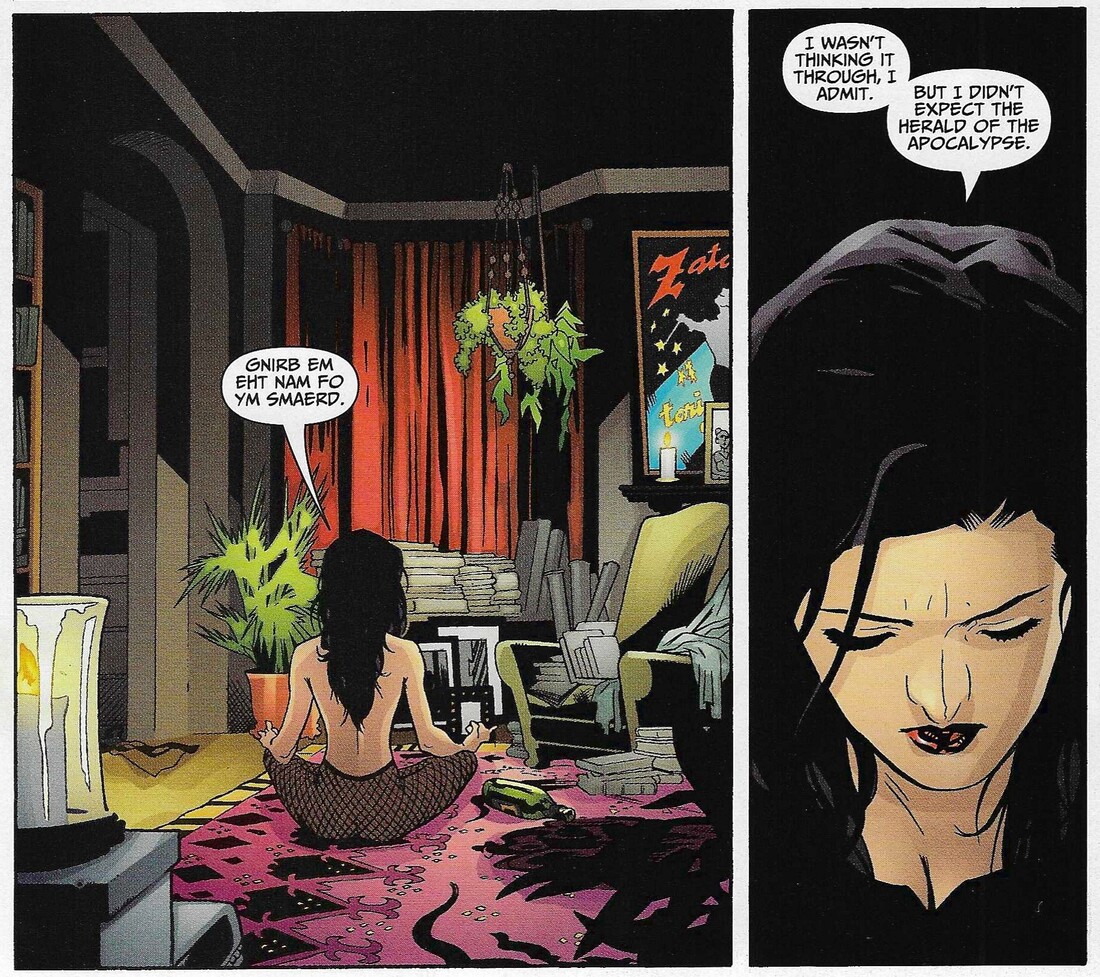 Suddenly “Never-Be-Found” attacks, trying to consume them and the very fabric of their reality (as Ravenwind points out, the panels of the comic start to erode). So Zatanna gets them out of there, to an idyllic scene where stands a tree with books for leaves — “all the books that were ever written in anyone’s head.” Hey, where’s
 Lucius Lucien? The tree certainly has meaning, either as the Tree of Life in the Bible, or perhaps the world-ash Yggdrasil. Taia suddenly becomes old, then young again, and says, cryptically, “He goes in many shapes, many likenesses … He is a thought we must not think …” Oh dear, Taia. Didn’t you see Ghostbusters? That’s not going to work. To quote Gozer: “The choice is made!” Zatanna goes to the tree to find the four books of the Liber Zatarae, and sees a rather evil-looking face in the bark. We quickly jump back to the present, and Zatanna tells the group a pretty crucial piece of information: three nights before the ritual (the time Jesus spent in the tomb?), when she should have been purifying herself, Zatanna went home and said a spell wishing for the man of her dreams. She says she didn’t expect the Herald of the Apocalypse. But that’s what she gets, as a smiling burning man comes walking over the water, with the tree burning behind him. Zatanna says she always falls for losers, and she was hoping for a great wizard or a crime-fighter. Etta asks her what happened next, and Zatanna says she got her bad wish, just like always. She’s back at the table, and all the others have been burned to death, clean down to the bone. Baron Winter is amusingly ironic: “Oh, not again, my dear.” This is, unsurprisingly, exactly what happened to two of the people (including Giovanni Zatara) at the table back in Swamp Thing #50. Good job, Zatanna!
We jump back to her therapy group, and Zatanna tells them that Ibis had identified the figure as ”Gwydion” before he, you know, burned to a cinder. Gwydion is a name that is full of import, both as a magician and as the birth name of King Arthur, according to Marion Zimmer Bradley. 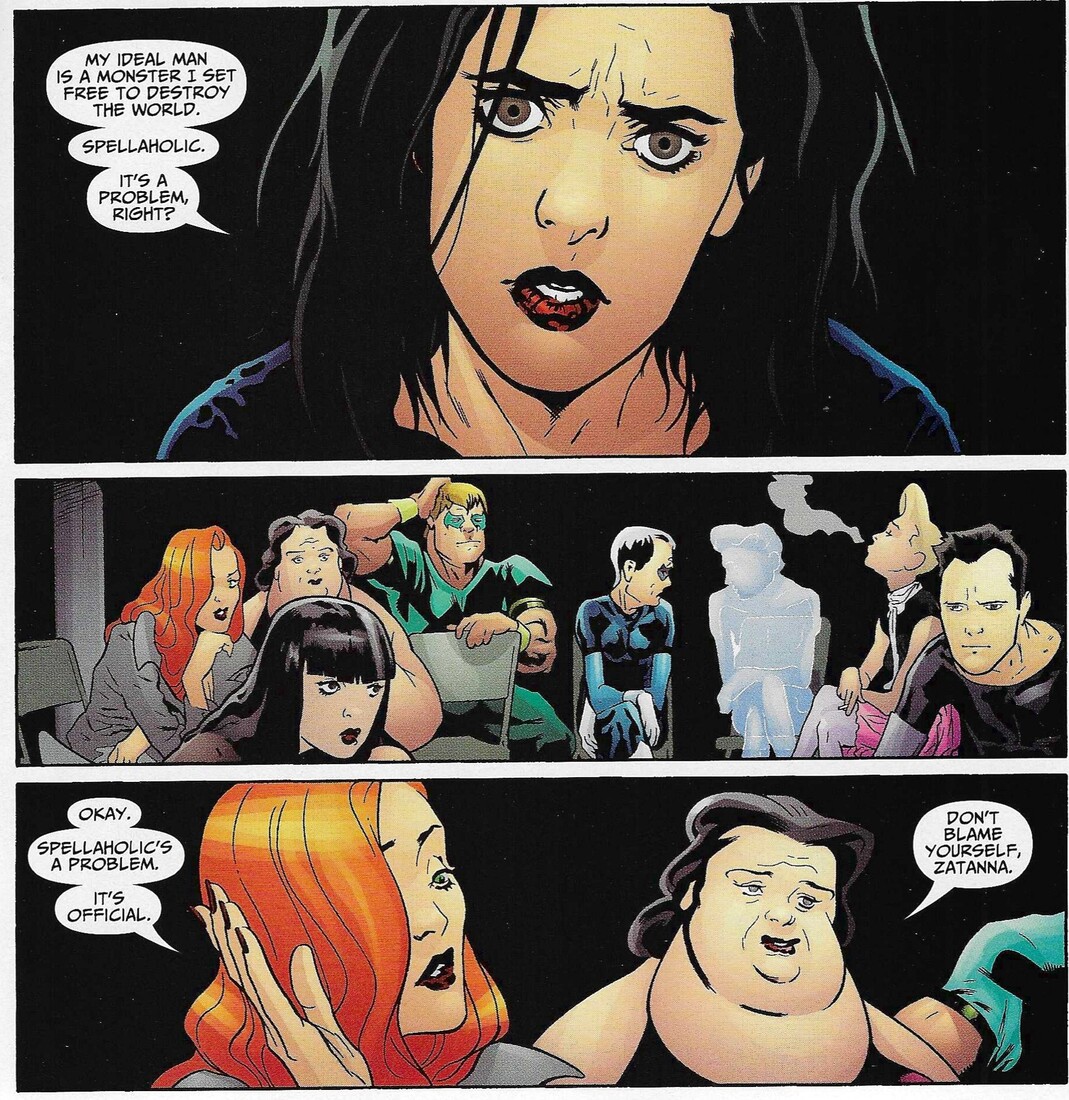 Baron Winter told her that he senses the end of humankind’s reign on earth. Zatanna, understandably, is upset, and says that magic can bring them back, but she can’t talk backwards anymore. She sums up: “My ideal man is a monster I set free to destroy the world. Spellaholic. It’s a problem, right?” Even Jackie is impressed and admits she has a problem. Etta, speaking the language of therapy, tells Zatanna not to blame herself. Well, why the hell not? She did just get four people killed, after all. (Speaking of which, Terry Thirteen isn’t dead anymore, I guess. How the hell did that happen? Anyone?) As she leaves the group, Mind-Grabber Kid mentions it all fits in with his “two-dimensional plate holographic theory.” Of course it does. He drives away, and Jackie comes out and tells Zatanna that she might miss the next group because she “scored a major team gig out West.” Poor Jackie. She won’t be coming back from that team gig, will she? Misty finally shows up and gets Zatanna to sign an autograph on her (Zatanna’s) book. Misty wants to be Zatanna’s apprentice, but Zatanna says she’s done with superheroics, and it’s moot anyway, because she lost her magic powers. Misty, luckily enough, can talk backwards, and calls for a taxi. When one appears, it seems like Zatanna has picked up a new student. The cab company is “Gypsy,” which seems fitting somehow.
So far, this is the weirdest issue of the saga, as Morrison indulges their love of way-out science and people speaking in cryptic fashion. Considering that Zatanna often speaks in a cryptic fashion (not what she says, obviously, but the fact that she says it backward), it’s perhaps fitting that others speak cryptically. Despite all that, Morrison doesn’t allow the strangeness to overwhelm what is, at its heart, a sad little story.
Consider: Zatanna is lonely. Her father, despite her love for him, was not a model of stability, and he died doing something grand and meaningful, which shadows her life as she searches for something grand and meaningful. She mentions guilt on the first page, and guilt is, after all, a crushing emotion throughout the series. 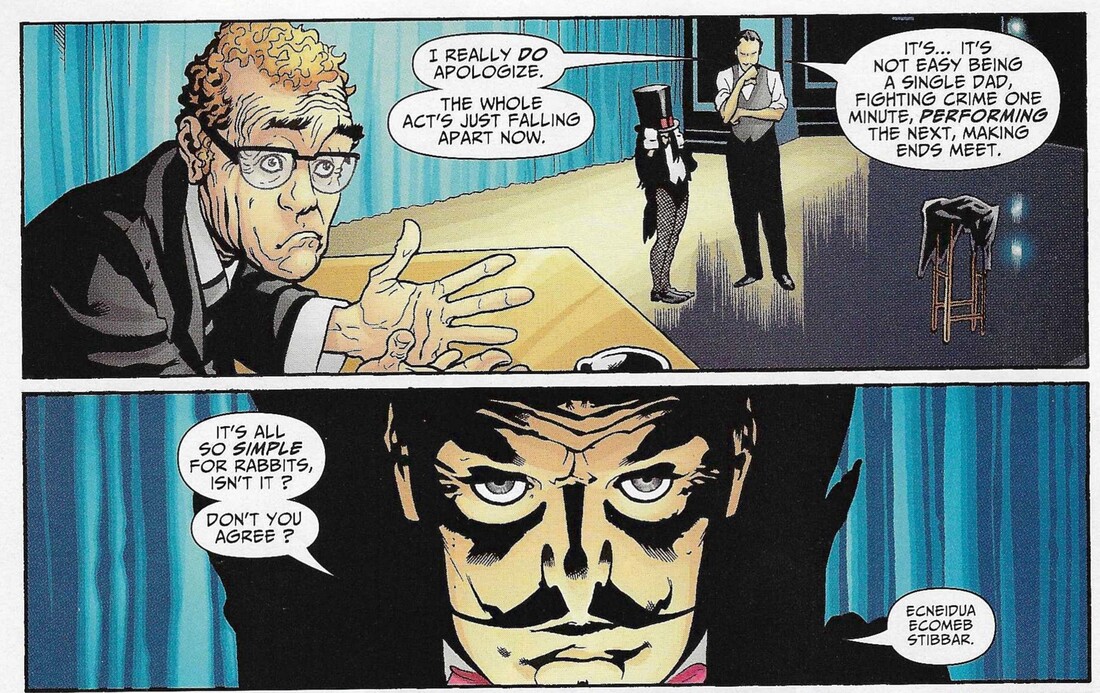 Justin(a) will actually meet a big ugly Guilt monster. Jake feels guilt over killing an innocent boy. Other members of the non-team will feel guilt, which we’ll get to. Zatanna feels guilt, but not only because she unleashed Gwydion into the world. She feels guilt because she has never lived up to the example set by her father, even though, if we look at it objectively, her father wasn’t a terribly good parent and he failed at what he was trying to accomplish when he died. That doesn’t matter to Zatanna, who has turned her father into a great hero that she can’t hope to compete with. Again, the notion of heroism rears its head, and we’ll get back to it. As this takes place in the DC Universe, Zatanna’s hidden guilt is also playing a part in the story — the guilt she feels over her actions during Identity Crisis, when she messed with Batman’s mind to make him forget the initial messing with Dr. Light’s mind. Everyone makes a big deal about poor Ollie and his guilt, but what about the person who did the actual messy work? Zatanna might feel guilt, but she obviously hasn’t learned her lesson, as her actions in this story are possibly more reprehensible than what she did in IC. Meanwhile, the guilt she feels over not living up to her father’s example leads her, in her words, to “fall for losers.” No man is good enough to be Daddy, so she doesn’t even try to find one. How’s that for pop psychology?
The tragedy at Baron Winter’s place shows again that Morrison is dealing with this notion of heroism and how people can be heroes despite themselves. 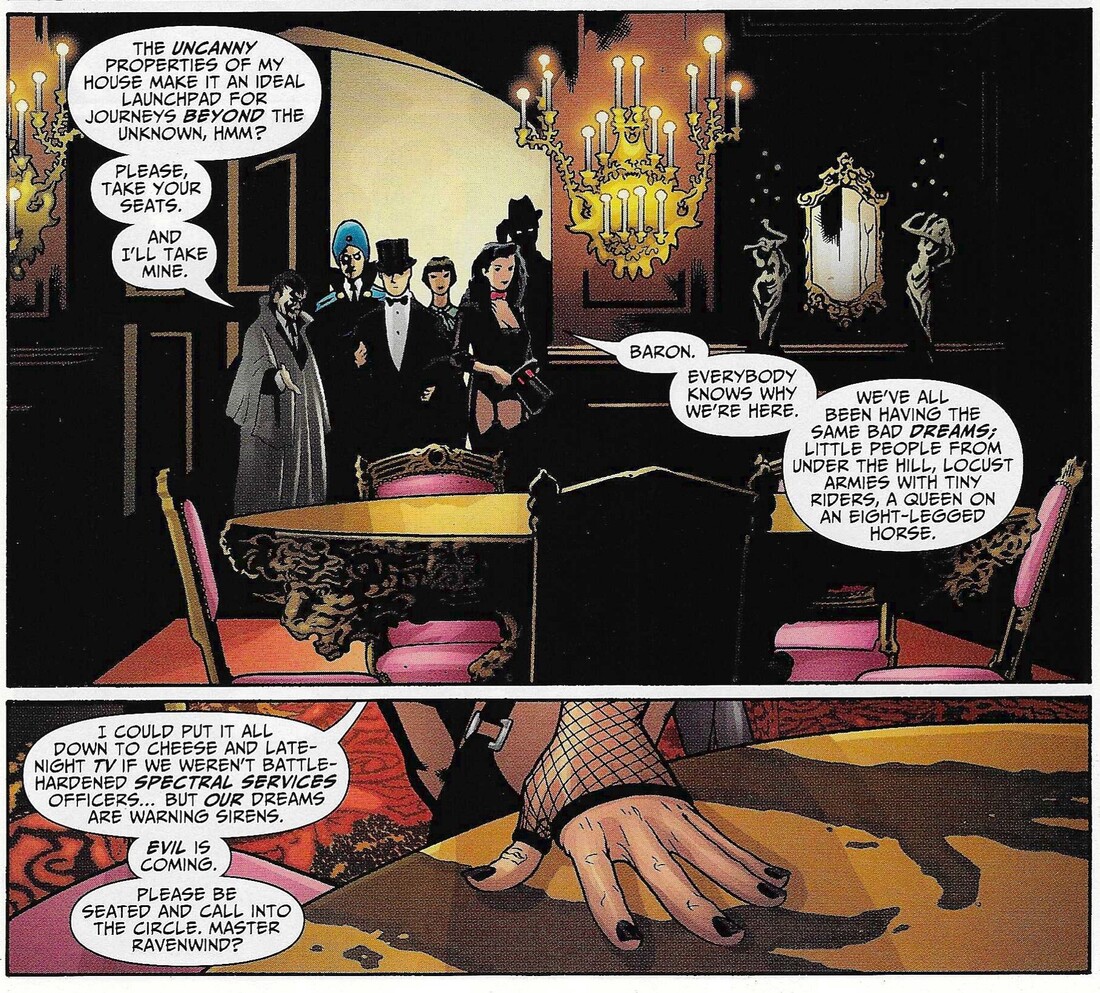 Zatanna is the most known superhero in the Seven Soldiers saga, and she has certainly done plenty of heroic things in the past. She is still not a member of the DC Pantheon, or even in the second tier of heroes, and although this probably doesn’t weigh on her mind (why would it?), we, as readers, understand that this means she is not as confident in her heroism as someone like, say, Superman. Why isn’t she as confident? Because of the guilt. Because of the nagging feeling that something like the disaster at Baron Winter’s house could happen at any moment. Because she allows her feelings of insecurity to take over sometimes, which leads to unleashing Gwydion. Insecurity is just another aspect of guilt — she doesn’t trust herself to do the right thing, because she knows she’s done the wrong thing in the past. This guilt and insecurity have finally manifested themselves in the loss of her powers. Zatanna is not yet a true hero because when faced with adversity — adversity that is, after all, her fault — she shuts down. Only when she owns up to her guilt in what has happened — which won’t happen in therapy, as two different people tell her it’s not her fault — can she move past it and become a hero. Being a hero isn’t doing great things, it’s overcoming obstacles and doing the right thing. Zatanna screwed up, and she has to make it right. “Losing” her magic powers is just another way of saying “It’s not my fault.” And that’s not good enough for a hero.
I briefly mentioned Ryan Sook’s art, and it is truly stunning. The trippy sequences get all the love, but what makes the book are the therapy scenes, as Sook shows us a horribly vulnerable and emotionally shattered Zatanna, which makes Morrison’s words hit home even more. When she tells them about setting Gwydion free, she looks directly at the reader, and her ragged hair and worry line between her eyebrows convey such failure that we can hear the weariness in the lines, even though they’re written on the page. We can also contrast Zatanna with Jackie, who looks plastic throughout, even though she has her own problems. 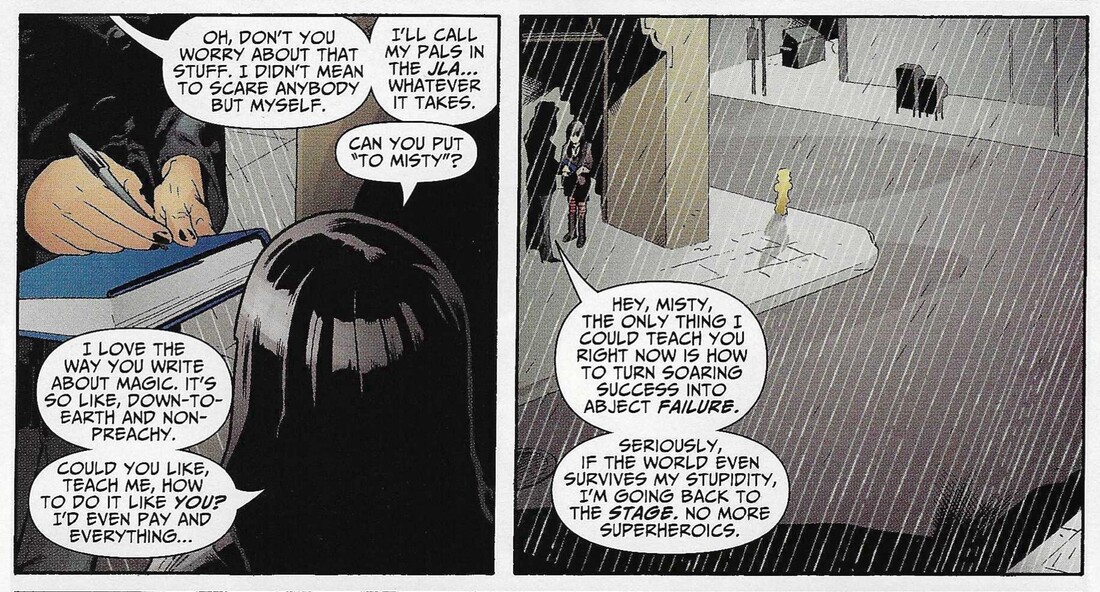 Jackie is obsessed with fame, as she climbs the ladder, and Zatanna is on the opposite end of the spectrum, understanding that what Jackie wants might not be exactly what she’s going to get. Jackie’s presence, of course, lends a bit of poignancy to the story, as we know she’s a goner, and Sook makes her a bit more golden and seemingly “with it” than the others, so that her fate feels a bit sadder now. It’s a marvelous-looking book, and fits the story well (shocking, I know, as Morrison hand-picks their artists).
As we move through these introductory issues, we get a glimmer of what Morrison is doing, and with Zatanna, we get the fallen hero. Justin(a) was the defiant hero, to the point where (s)he was thrown through time. Jake was also fallen, but he is more the neophyte hero, who was down but does not know what his purpose is until he puts on the uniform. Zatanna was a hero, but now it’s over. She too must begin a long climb back, but it’s interesting that Jake has someone to fight for, while Zatanna has only an apprentice. Misty, of course, is more important in the grand scheme of things than Carla, but is she more important to Zatanna than Carla is to Jake? I doubt it.
As usual, you can check out the annotations for this issue here. They aren’t bad. Jog chooses to focus on Morrison’s “challenge” to Moore, and makes some good points that I ignored. And, of course, any links you know about will be appreciated.
Next: Klarion! The weirdness gets weirder!
