

(A repost from my own blog)
While I was rereading the complete Doc Savage paperback reprints, I discovered Doc Savage: The Man of Bronze (1975) was streaming free on Amazon Prime. How could I resist? Not that I remembered the movie with any fondness. When I saw it as a teen, I was thrilled to see Doc Savage on screen. At the same time, the execution seemed … lacking.
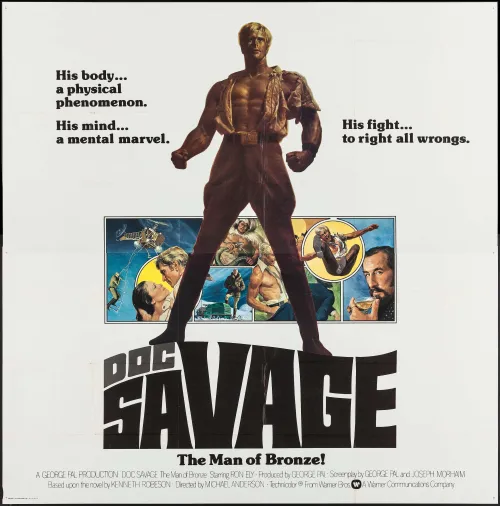
My memories were charitable. George Pal has directed classics, including the 1950s War of the Worlds and The Time Machine. This is not one of them.
For starters, while Ron Ely as Doc does look like the physical phenomenon promised on the poster, he’s not even remotely bronze. He’s buff, sure, but he has normal, pink flesh tones and blond hair instead of bronze hair and a permanent bronze tan. Nor does he have Doc’s distinctive eyes, described as whirling pools of flake gold. Instead we get an odd F/X sparkle in his eyes when he smiles at someone.
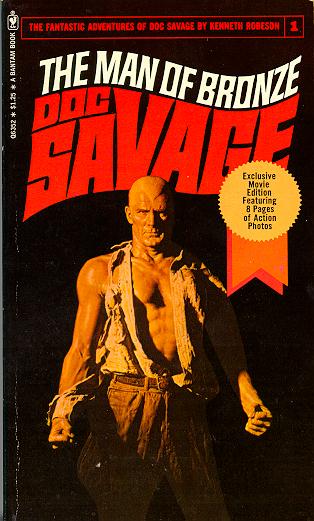
The script, cowritten by Pal and John Morhaim, starts out as a fairly faithful adaptation of The Man of Bronze, Doc’s debut adventure. In the March, 1933 novel, Doc returns to New York from his secret Arctic research lab, the Fortress of Solitude, to learn his father died of a mysterious disease. Doc and his five friends suspect murder related to an inheritance his father left him in Central American Hidalgo.
They’re right, of course. Clark Savage Senior struck a deal with King Chac, ruler of the series’ first lost race, the Mayans of the “Valley of the Vanished” (Mayans were not a lost race, living in Central America in the millions). If Chac approves of Doc Savage, he’ll provide enough gold to underwrite Doc’s heroic career. The bad guy, the Son of the Feathered Serpent, thinks the gold would be better used financing his takeover of Hidalgo. He is not willing to share.
The film opens with Doc (Ron Ely) at his Fortress of Solitude. He psychically senses something bad has happened (hey I only said “fairly” faithful), rushes back to New York and learns about his father’s death from a mystery disease. As in the novel, a Mayan killer shoots at Doc from a neighboring skyscraper. Doc and his crew rush over, trap the man, only to have him kill himself by leaping to his death. Returning to Doc’s headquarters they discover some documents his father mailed him have been reduced to ash.
Doc and his crew set out for Hidalgo. Another assassin shoots down their plane, unaware it’s a remote-controlled red herring (this happens in the novel, and in many later novels). He reports back to the big bad, Captain Seas (Paul Wexler) that Doc and his crew have joined the choir invisible. When they show up in Hidalgo anyway, Seas — so named because of his globe-trotting quest for riches — murders his henchman for failure, using flying snakes composed out of poisonous gas (something borrowed from another novel, The Mystic Mullah).
Doc discovers his father left him a few acres in the center of Hidalgo but the property deed has vanished. Seas invites Doc & Co. to dinner on his yacht, where he attempts to have his hired guns kill them. The good guys survive, natch, and a young Hidalgo woman, Mona, leads Doc to the Valley of the Vanished. In the novel, Monja was a Mayan princess; here she’s just an ordinary woman, played by Pamela Hensley (much less glam than she’d be a few years later in Buck Rogers).
The Mayans show Doc his deed holds a pool of molten gold, something they deeded to Doc’s father in gratitude for his medical work. Captain Seas wants it; instead he ends up getting a free trip to Doc’s crime college for brainwashing. Doc gets enough gold to finance his war on evil, kisses Mona and promises to return.
 That sounds like a serviceable plot, no? The execution was not so serviceable. It’s at the level of the TV superhero pilots I wrote about in Cyborgs, Santa Claus and Satan, my book on made-for-TV speculative fiction films. Actually a little worse. Most of those pilots handled the material with a straight face, even the execrable 1970s Captain America TV movies. This one hovers right on the edge of Batman ’66 camp, making me think Pal and Morhaim (and Ely) were self-conscious about working on a pulp superhero. Kenneth Johnson felt that way about The Incredible Hulk and made it work. Not Pal and Morhaim — it feels like they’re trying to signal the audience that they know how silly this stuff is. I mean come on — lost races, ghost snakes, molten gold pools, you think we take this film seriously?
There’s the John Phillips Sousa march used as Doc Savage’s theme (“Have no fear/Doc Savage is here.”). The climactic battle between Doc and the bland Seas, played pointlessly for comedy and way too drawn out. Ely adds little to the lead role though the actors playing Doc’s aides are decent. The f/x, such as the deadly vapor snakes, are unconvincing. There’s also a lot of “as you know” exposition. The team discuss in one scene how the distorting glass in Doc’s office windows saves him from the shooter, even though they all know about the glass.
And while the crime college is canon, it’s not something that aged well. I roll with it in the pulps; here it came off creepy.
The proposed sequel, Archenemy of Evil, sound more promising. Even so, I don’t feel disappointed we didn’t get to see it.

I caught the opening few minutes of this on tv, back in the day, but didn’t see it until the home video days, in its entirety. Whoof! Batman level camp would have been a step up!
Ely was fine as Tarzan and had a nice pilot film for a series, The Seal, that wasn’t picked up; but, yeah, he’s not doing much. He’s not given much, to be fair. I’, less enthused by the Famous Five. The actors are find, but the characterization is bland as all hell, even Monk & Ham. I had seen Pul Gleeson in other things before, including The Breakfast Club and you kept waiting for him to channel that character. The fight, with the subtitles for the fighting styles, was at least a bit amusing, though the fight/stunt coordinator talked a better game than delivered, as some of them are wrong (the depiction of gung-fu/kung-fu is karate, Tai Chi Chuan is the Snake Style kung-fu,, etc). If they had really wanted to be funny, they would have put up a caption “Hockey Fight”, when Seas pulls Doc’s coat over his head and tries to shove him into the molten pool ; and, “Pro Wrestling,” when Doc hits Seas with a dropkick. Doc also needed to get his hands up higher during the Fisticuffs sequence. 😉
I definitely agree about the tv pilot look. I suspect the budget was small, but I have trouble believing it was that small. I suspect someone was cooking the books.
Personally, I hope the project with Dwayne Johnson never sees the light of day (and I suspect it won’t), as I don’t see him pulling off a serious version and a comical would likely fail
From what Johnson’s said about Doc, I think you’re right.
Your idea for the fight is way better than the one we got.
I was at a science fiction convention in Los Angeles around 1977 or ‘78, at which George Pal was a guest and had a spotlight panel. I felt bad for the guy. For about 45 minutes, he and the interviewer discussed his career and showed clips from his films, starting with his Hungarian Puppetoons, then through all the great sci-fi films like War of the Worlds, the Time Machine, and The 7 Faces of Dr. Lau. Finally, he opened up the Q & A, and the very first question hit him like a slap in the face….
“You’ve made a lot of great movies; what the hell happened to Doc Savage?”
He looked sick for just a moment, then, with a strained smile, explained that the first thing they filmed was Ron Ely’s speech about what Doc Savage believes in and stands for, which he played seriously. When they looked at the dailies, they thought it was hilarious, so the studio pushed them to make it a comedy. But everything they played for laughs fell flat and everything they played straight was funny. He actually apologized for the movie.
Interesting. And yeah, given his track record (War of the Worlds and Time Machine alone are faves of mine) it’s a shame he got saddled with this on his CV.