
“When is the final curtain? What can I do to set me free?”
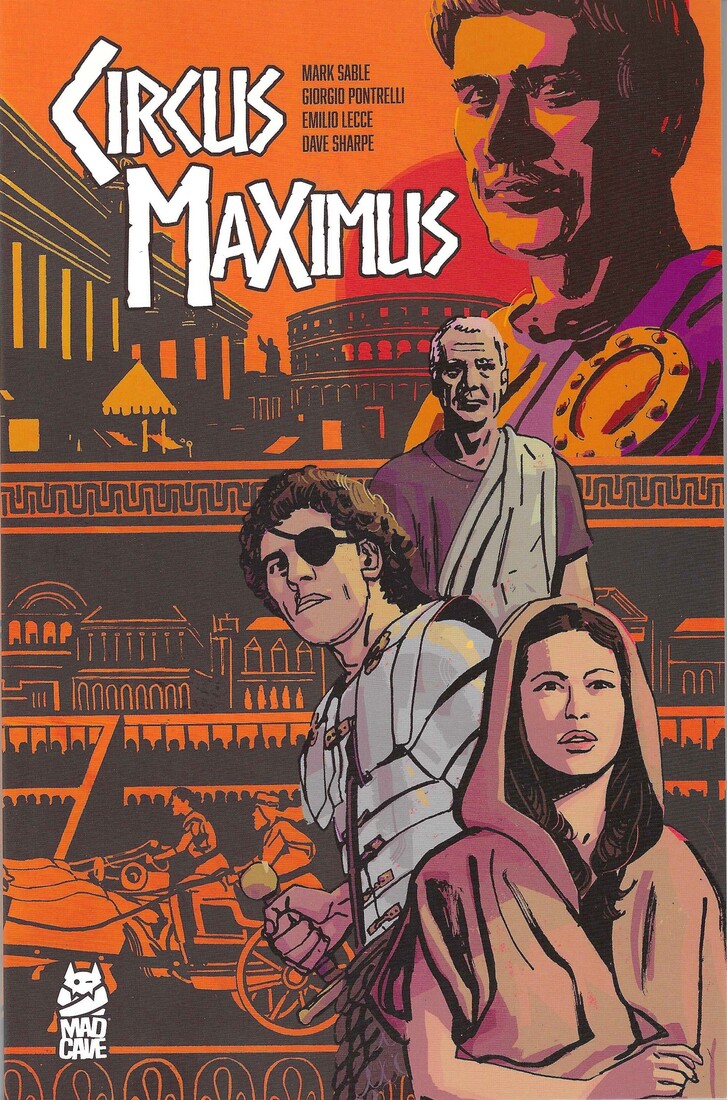
Circus Maximus is a heist comic set during the Great Fire of Rome in 64 CE, so of course I’m going to like it — it’s a heist, and apparently, men think about the Roman Empire all the time, so here we go! 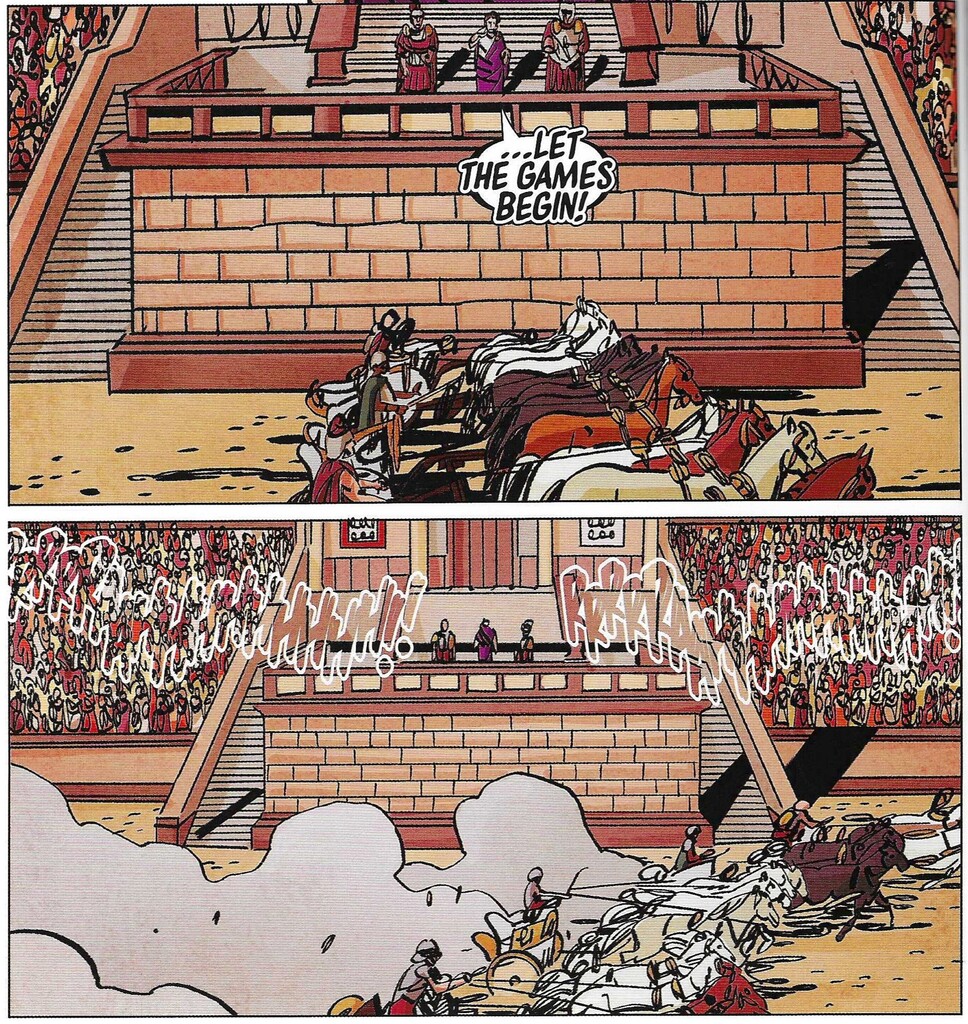 This is written by Mark Sable, drawn by Giorgio Pontrelli, colored by Emilio Lecce, lettered by Dave Sharpe, and edited by Ryan Carroll and James B. Emmett. It’s from Mad Cave, 110 pages long, and it costs $17.99.
Unfortunately, despite being a heist comic set during a time that I should really dig, it’s a bit disappointing. Sergius, a slave in Nero’s Rome, is in love with Hippolyta, whose father, naturally, disapproves. She’s sent off to be a Vestal Virgin, because why not, and years later, they get back together when Hippolyta gets some information about how to break into a treasure vault beneath the temple of the Vestals. They rope in a charioteer and a disgraced architect, and the heist kind of goes off without a hitch. Unfortunately, included among the treasure is a plan of Nero’s to build his Domus Aurea — his golden palace. They realize that Nero will have to destroy a lot of the city to build it. Oh, how might he do that? Yes, in this story, Nero has his people start the Great Fire so he can clear space for his decadent construction. Sergius does not care even a little bit, but the architect wants to blackmail Nero with the plans, which Hippolyta tells him is a terrible idea. Meanwhile, others appeal to Sergius’s basic decency to get him to help fight the fires. This is where the story goes off the rails a bit. The heist is accomplished by the end of issue #1, and then Sergius and Hippolyta spend the rest of the comic trying to get out of the city as events keep conspiring against them. I don’t mind that too much, but the problem comes when the characters act so stupidly. 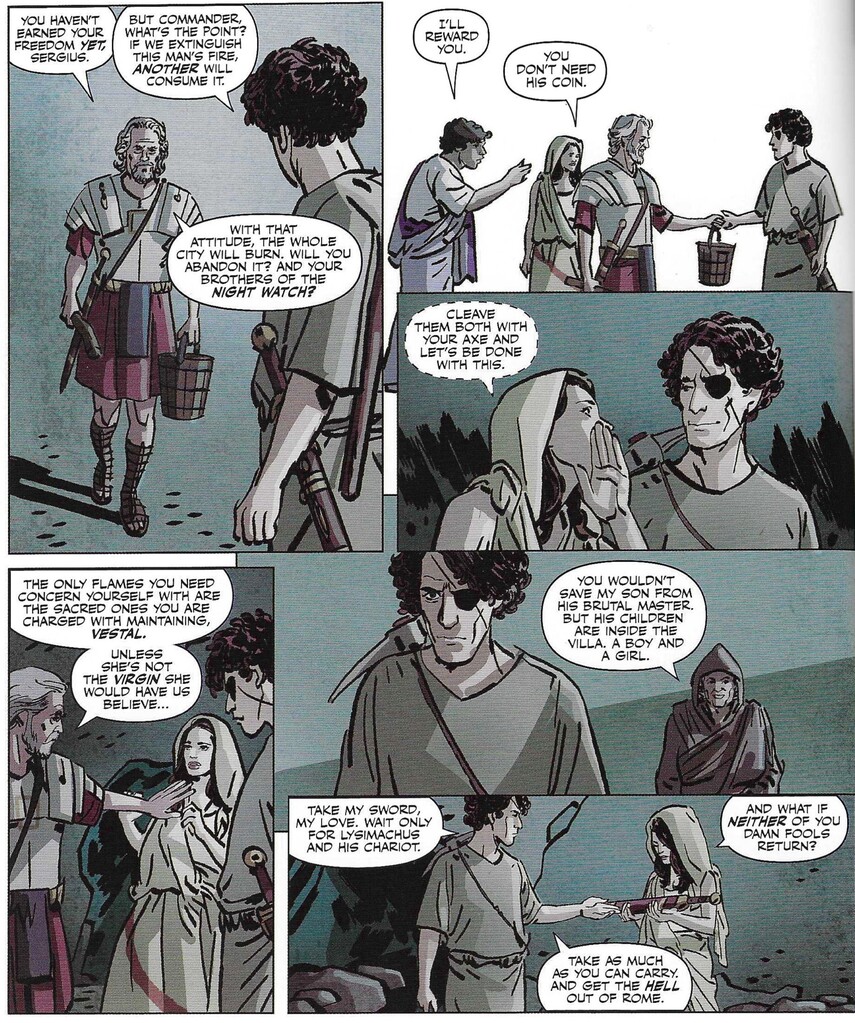 Nero had spent some years proving that he was sliding into insanity, so the idea that he’d be ok with some rando trying to blackmail him is a bit much. Sergius has some reasons to be resentful of Rome, yet when someone tells him that kids are at risk (and he doesn’t know if that’s true), he drops everything and saves them, which causes more problems. They lose the architect in the chaos, and so Sergius realizes that if he manages to get to Nero, they’ll never be safe anywhere in the empire, so they have to go stop him (which, I mean, they really don’t — it’s not like they couldn’t live in places outside the empire, and even if they’re still in the empire, it’s not like there aren’t places to hide — the empire’s communication network wasn’t that efficient), which delays them even more. It’s frustrating, because it just feels like Sable knew he couldn’t have them leave, so he comes up with some lame excuses to make them stay. I would get it if the fire itself was causing them to rethink their plans, but it seems like they could still easily get out even with the fire, and other things keep blocking them. It strains credulity a bit, and because we don’t know enough about Sergius and Hippolyta, we don’t know how characteristic of them this is. I mean, sure, Sergius is a decent fellow who wants to save children, but that feels like a cheat by Sable to get him to stay.
Pontrelli’s art is fine, but nothing spectacular. He does a good job with the city, as we get a good sense of Rome as a place and how the people move around in it. He does a decent job showing the divide between the richest classes and the poorest ones, both in the architecture and in some scenes in which he shows the rich idling while the poor are trying to escape the flames. 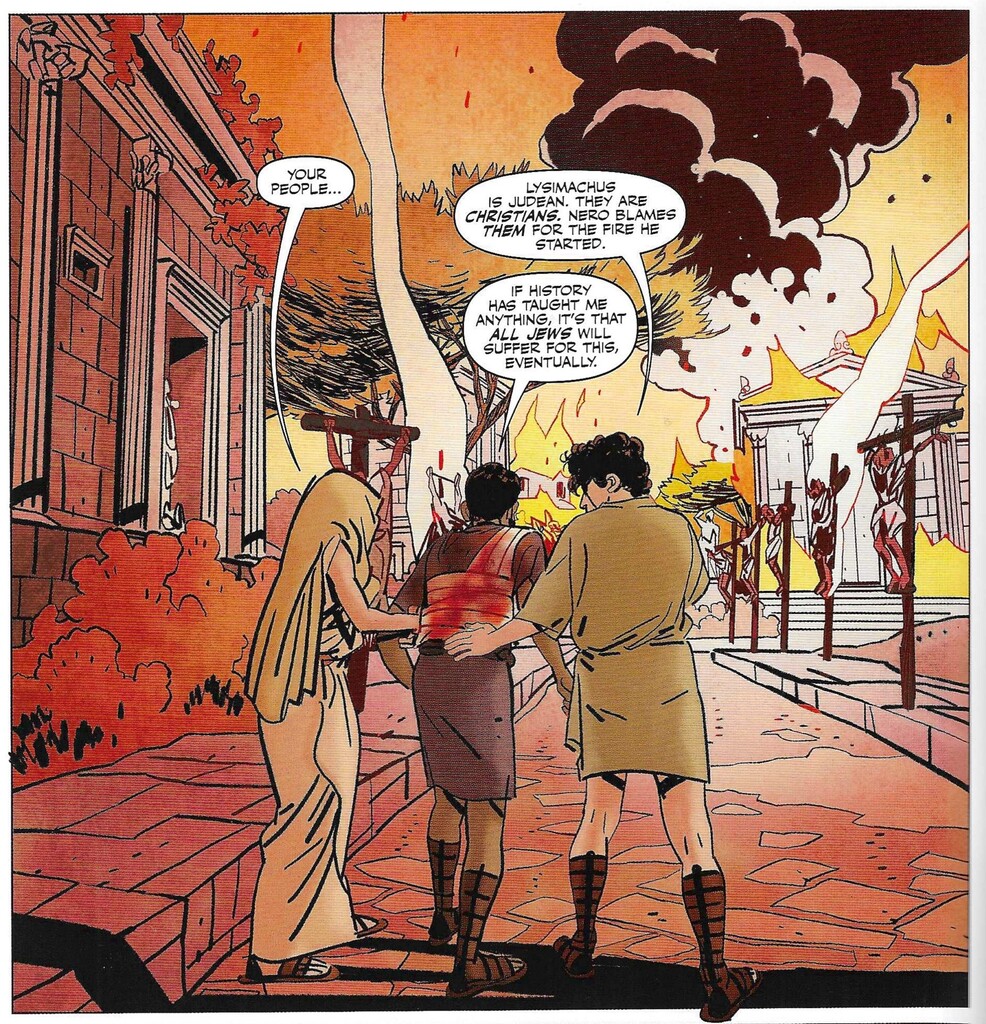 He’s not as good with the action, as his figure work is a bit stiff and the fights look a bit stilted, and while it’s easy to keep Sergius (who has an eye patch) and Hippolyta (who’s basically the only woman in the book) clear, some of the other characters blend into each other, and it’s partly the art’s fault and partly Sable’s fault, as Pontrelli doesn’t do enough to distinguish them and Sable doesn’t identify them as well as we’d like. It’s a decent-looking comic, to be sure, but it doesn’t enhance the writing as much as you’d want.
There’s nothing terribly bad about Circus Maximus, but the nagging problems with the story tends to bring it down for me. Sable wants to cram a lot into the story — the Christians, who were scapegoated by Nero as the ones who started the fire, show up late in the book — but it feels like there’s just too much, and I wonder if this had been six issues and 22 extra pages if it might have worked a bit better or if Sable would have just tried to cram even more into it. It just feels like a relatively entertaining but kind of messy heist story, with characters doing things that feel dumb simply to get them to a point that Sable wants them to reach. Both the story and the art are fine, but nothing amazing. But hey, it’s a heist story set in the Roman Empire. That’s still fun!
Rating: ★ ★ ★ ★ ★ ★ ☆ ☆ ☆ ☆

I loved the premise on this one but ended up skipping it (I really gotta cut down). But I had a feeling you’d take a look at it!
I’m too predictable in my choices!!!! 🙁