
“Them delta blues still kicked out on transistor radios; raised on love of Jesus and rock n’ roll”
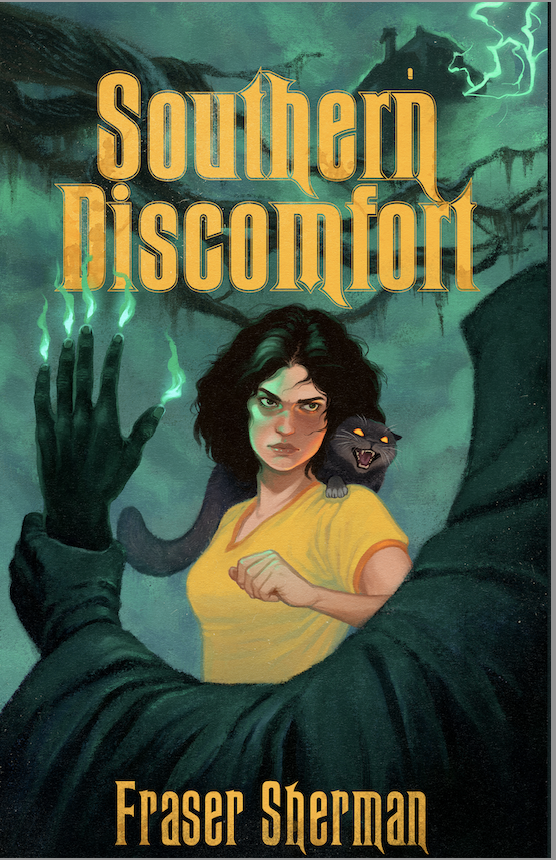
Back in July, when Fraser announced that he had published his second novel, Southern Discomfort, I mentioned that I picked it up and planned to read it. And guess what? I did! Let’s take a look at this bad bear, which is self-published and clocks in at 316 pages.
As Fraser noted in that post above and the back cover tells us, we’re in May 1973 (the book’s climax occurs on my second birthday!) in Pharisee County, Georgia, where Maria Esposito, fugitive from Johnny Law, finds herself trapped as she’s trying to flee New York. She took the bus south and was heading for Atlanta, but a torrential downpour washed out the roads in the county and the bus got stuck there. It turns out the rain isn’t exactly natural, and Maria — cleverly calling herself Mary, no one would suspect! — is trapped there. Unfortunately, there was an explosion a few days earlier that killed the county’s leading citizen and two black men, one of whom was running for Senate, so the FBI shows up, and Maria finds herself in a pickle. Oh, and there’s the fact that the “leading citizen” and his widow, Olwen, are elves. The explosion was not a hate crime against the black men, but an assassination of the elf, and Olwen decides that Maria is a champion who can help her find and defeat the culprit. It’s kind of hard to explain that to the Feds.
Maria discovers this pretty early on, and she resists her “destiny” for most of the book, as she doesn’t think she’s a champion. She’s a nurse who served in Vietnam but then protested it when she got home, and things got out of hand and people died, hence her fugitive status. She wants to keep her head down and off the radar of the FBI, which doesn’t work, and even after she realizes she’s in the thick of it, she doesn’t think she’s much of a champion. She takes the elvish stuff in stride — it helps that her Sicilian grandmother believed in all sorts of things, and it helps that most of the old families of the county know all about Olwen and Aubric, as it would be hard to keep it a secret for 300 years. It’s a refreshing change from the usual kind of these stories, where the supernatural is kept secret at all costs — Olwen and Aubric are just “people” who live in the county and keep it relatively safe, and the humans there are glad they’re there but aren’t too dazzled by it. Fraser does a good job making the magical parts of the book feel mundane — that’s not, I hope, a criticism, as I mean that he blends it well with the “real world” parts of the book, as it would be after centuries of the elves and humans living side by side. It’s a nifty conceit.
The villain, Gwalchmai, is another decent character. We don’t get quite as much about him as we do about Maria and some of the others, but he’s still interesting, as he’s that best of all kinds of villain, the villain who thinks he’s a hero. He has what he believes is a legitimate grievance against Aubric and Olwen, and Fraser does a good job showing that he doesn’t really have a leg to stand on, but he really believes he does. It’s a nice dichotomy — he does some horrific things, but he’s also careful about not hurting people with whom he has no issue, and it’s a nice touch. We’re not exactly sympathetic to him, but he is more complex than you might expect, and toward the end of the book, there’s some nice moments of pathos with him.
The plot is interesting, as Olwen has to figure out what Gwalchmai’s deal is, Maria tries (and fails) to elude the FBI, and the townspeople have to decide how they’re going to help either one of these people — they know Olwen, of course, but should they help Maria, too, who’s a fugitive and whom they don’t know, but seems to have Olwen’s trust? Fraser gives us a bunch of characters, and he gives them all good viewpoints, as they come from different generations and different cultures, so their responses to Olwen and her history and Maria and her history are going to be different. We get two interesting FBI agents, too — this is set right after Hoover’s death, and the Bureau is trying to repair their image after years of repression under J. Edgar. Rachel Cohen, one of the agents, is indicative of this attempt — she’s a Jewish woman, so of course Hoover wouldn’t have been a fan — and both she and Dini, her partner, have more depth than you might expect. They don’t have much sympathy for Maria, as she’s a federal fugitive, but they’re not unaware that she might have a point, either. Fraser does this a lot — he makes sure that his characters aren’t just stereotypes, which makes the plot work better and the stakes feel a bit higher. By doing this, too, he makes the magic — and there is magic in the book! — feel a bit more grounded, as the people employing it don’t feel like plot devices.
I have a couple of nit-picky things about the book before I get to more general issues. At one point, the term “Hail Mary” is used in the way we often use it today, meaning something done in desperation with little chance of success. I actually looked this up, because I was under the impression that the term wasn’t used in that context until 1975, when the Cowboys beat the Vikings in a playoff game with a “Hail Mary.” It turns out that it had been used since the 1930s, but only in a very limited context, by members of the Notre Dame football team, and it was definitely not in common usage until after 1975. It’s not anachronistic, in other words, but it felt that way to me, and you could probably say it is. Then, at one point, Fraser mentions a Toyota. This is another not-anachronistic usage, but it still feels that way. Toyota made in-roads into the States in the 1960s, but it just feels like 1973 is too early for them to be showing up in rural Georgia. It does seem odd that Fraser would be so specific about the car brand, but oh well.
My main issue with the book is that it’s too crowded or too short. There are a lot of characters, and because Fraser does such a good job with the characters, we spend a lot of time with a lot of them, and I’m not sure it’s necessary. If the book had been longer, maybe he could have gotten away with it, but we move away from Maria and Olwen a bit too often, and it’s frustrating. Fraser wants to dig into the racism of both the past and the present of 1973, and he does, but not enough, and maybe it would have been better to leave it out? I don’t know — you can’t really set a book in 1973 Georgia and NOT write about racism, I get that, but it feels too shallow a consideration. There are black characters in the book, one of whom is angry that Aubric and Olwen didn’t do more during the slave period or the Jim Crow period — they kept the county from turning into every other place in the South, and the Klan, for instance, never set up shop in the county because they wouldn’t allow it — but that feels like a grumpy young person who doesn’t understand the situation, and Olwen kind of just takes it instead of saying “What, exactly, would you have us do?” Pharisee County, we’re told, is a paradise in terms of whites and blacks getting along and blacks having the same opportunities as white people — and the small rumblings about that possibly not being completely true are just that, rumblings, and Fraser doesn’t really have time or space to get into it. It’s the same thing with some of the other characters, without the racial underpinnings. The sheriff and his two children are certainly important, as are the two FBI agents, but I’m not so sure about the pastor of the church, for instance, or the two young ladies who can’t quite get out of the hospital. It’s not that they’re bad characters or even not interesting, it’s just that they distract from the main plot and they take space away from developing the more important characters, especially Olwen and Gwalchmai, who are, after all, far more crucial to the story. It feels like this book, with its societal takes and its anti-war message and its generational conflict and its, you know, fantasy stuff, could have been much longer and still been a good read. Or, because 316 pages is a decent length, Fraser could alloted space a bit differently. It makes the book fun to read but still a bit frustrating.
I enjoyed Southern Discomfort, don’t get me wrong (I don’t love the title — of course, I get the pun, but what the characters go through is far more than just “discomfort”!) — it’s a cool fantasy book set in a time and place that we don’t usually see, and I appreciate that Fraser does try to dig into the culture of 1973 quite a bit. I certainly think you should read it, not only because it’s written by one of our humble bloggers and that’s nifty, but because it’s a neat book. What are you waiting for?!?!?
Rating: ★ ★ ★ ★ ★ ★ ★ ☆ ☆ ☆

The focus on the broader cast is partly because I see it as an ensemble story, one that’s affecting the whole Pharisee community and I wanted to capture that. And partly because I have a hard time not adding more detail to background characters than necessary — I want a bunch of individuals, not a generic “crowd.” My writing group has pointed out sometimes that overloads readers with a lot of detail even when the characters are just bystanders.
Thanks for the review, Greg!
Oh, sure, I get that, and I think it’s groovy — I’m a big proponent of large casts! I just thought some of them weren’t as developed as they could have been, which is why I wanted the book to be longer, because when you did develop characters, they were pretty interesting.
Still, a neat book! 🙂