

“Half awake and half in dreams, seeing long forgotten scenes … so the present runs into the past”
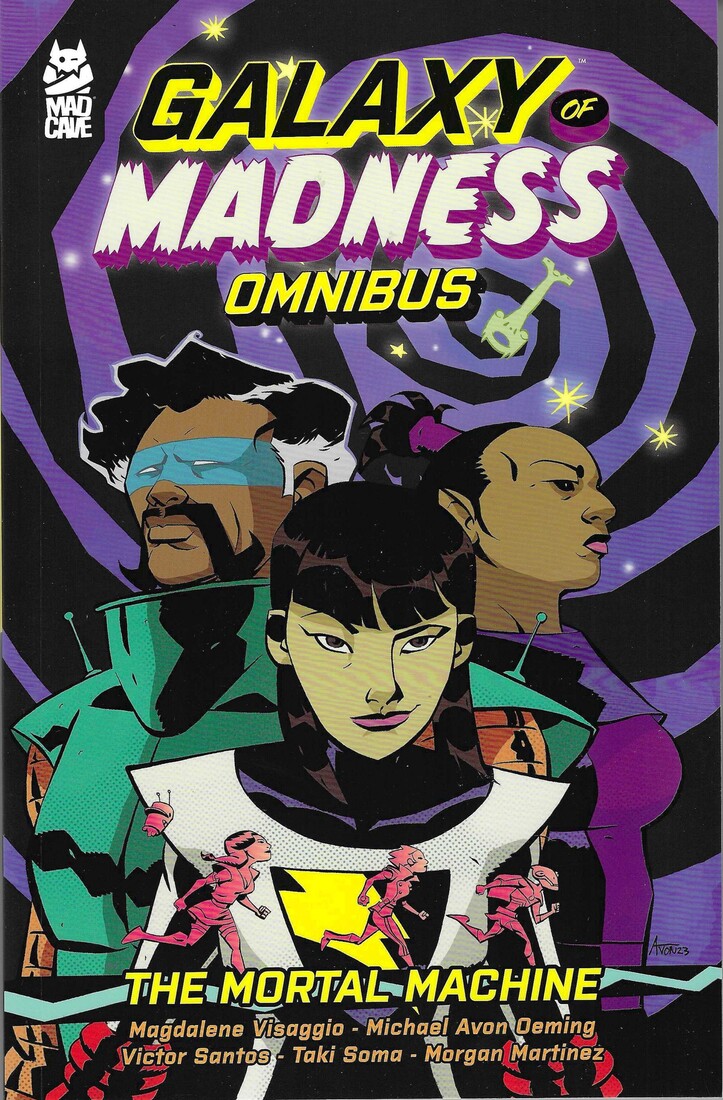
Mad Cave has a nice complete collection of Magdalene Visaggio’s Galaxy of Madness, which has all ten issues in it. It’s drawn by Michael Avon Oeming (the first five issues) and Victor Santos (the second five issues), with Taki Soma coloring Oeming’s work (Santos does his own coloring, I guess), Morgan Martinez lettering it, and James B. Emmett editing it. It’s $24.99 and it’s 230 pages long (oddly, the first five issues are 118, the second are 112, but that’s just the way it is — it’s still a nice, thick hunk of comics). 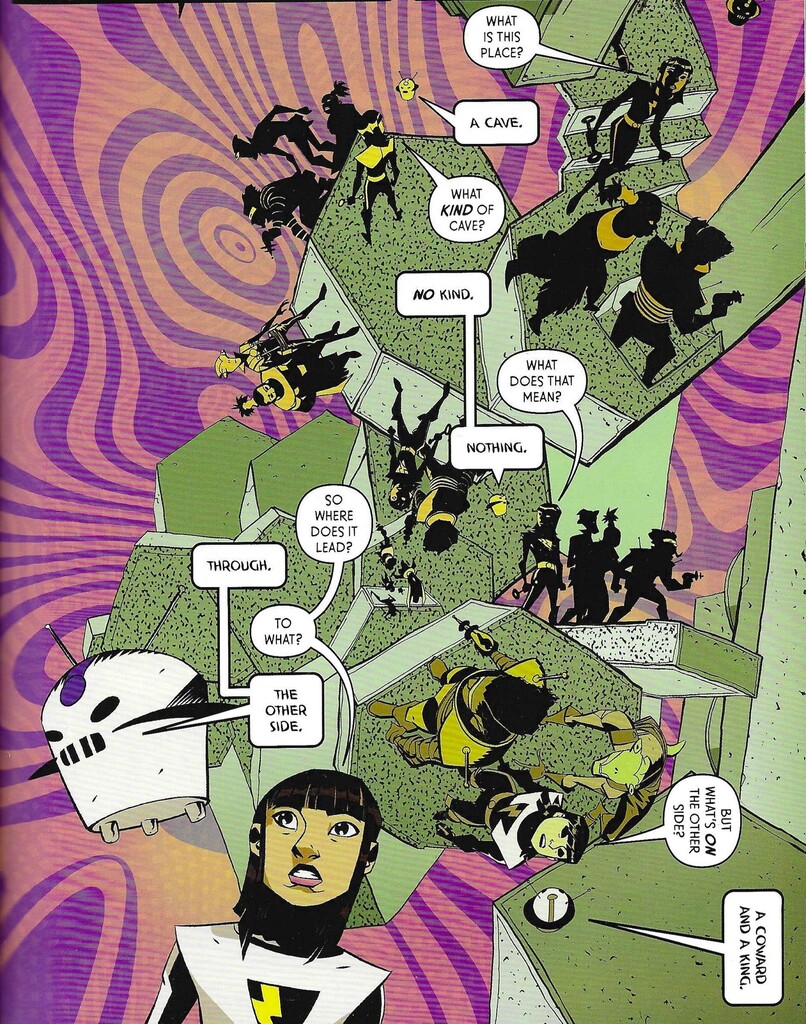 Let’s dive in!
I’ve read a lot of Visaggio’s comics, because they always sound interesting, and early on in her career (which wasn’t that long ago, to be sure), I didn’t love her work because it felt like she was trying too hard to make it, for lack of a better term, “woke.” As I always say, I’m perfectly fine with diversity in comics themselves and in the creators bringing us the comics, but some creators ignore the actual story in order to make their points, and that’s kind of dull. But Visaggio always had interesting ideas, certainly, so I did look out for her books, even if I looked a bit askance at them. The last one I bought, I think, was The Ojja-Wojja a few years ago, which I really liked, because she put the story first and didn’t put the identity politics front and center, so the characters became far more interesting. In Galaxy of Madness, she continues that trend — the characters are an interesting, diverse group, but the weird story is paramount, so it works better than some of her earlier work.
The story itself is dressed up in weirdness, but it’s not terribly complicated. Odysseus Rex is the captain of a 41st-century spaceship, leading a team of archaeologists across the galaxy to dig stuff up. Fifteen years ago, his best friends, the Virgos, were exiled for their heretical views about the universe — they believed it was created as a computer by an ancient civilization that subsequently abandoned it. 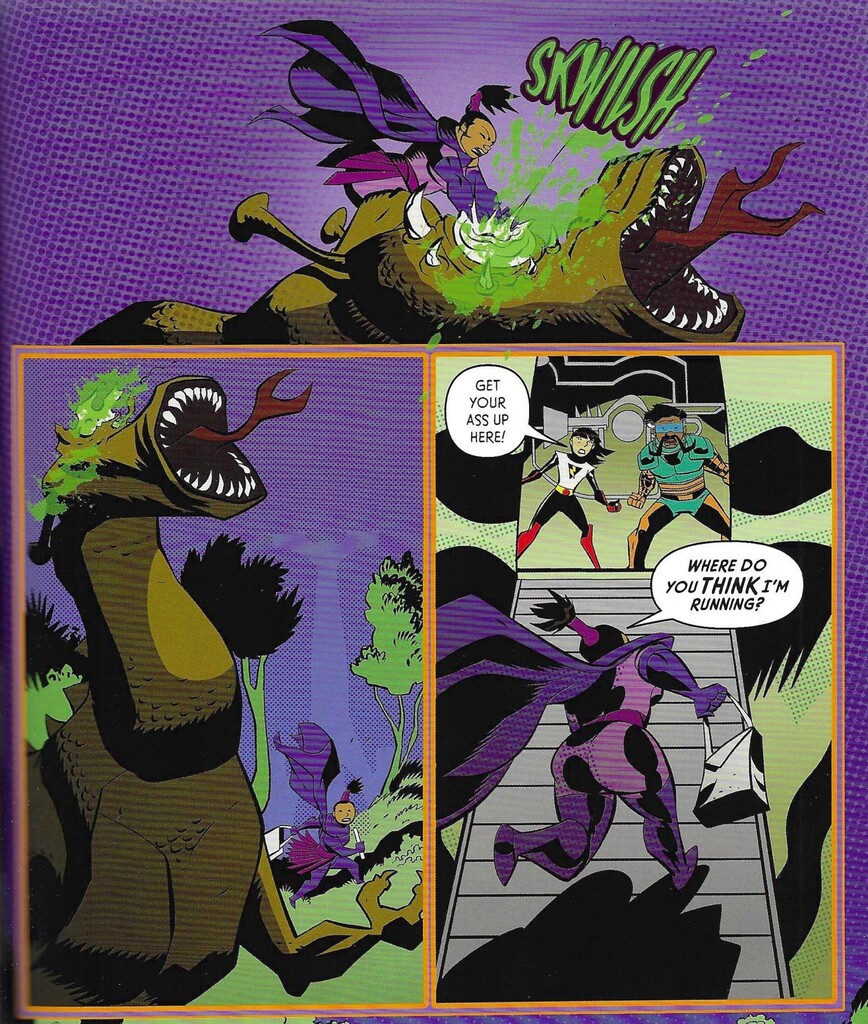 The people that are in charge of things in this book don’t want to hear that, so they banish the Virgos, and Odysseus takes on their daughter, Vigil, as a ward, and now that she’s grown up, she wants to find out more about what happened to her parents, who died after their exile in strange circumstances. For some reason, Odysseus does not think this is a good idea, and the crux of the book is Vigil learning more about her parents and Odysseus and what’s really going on. You might think, with a premise like that, that the plot will get really odd, but, honestly, the “origin story of the universe” turns out to be a bit of MacGuffin. The story is really about secrets and power and what we will do to gain one and keep the other. Things do get very bizarre, but only because Visaggio has fun coming up with alternate dimensions to play in, not because she wants to answer the fundamental question posed by the Virgos. A key plot point early on is that the Virgos — and anyone else who does this — changes the past by studying it. This becomes important as the group tries to figure out what happened to Vigil’s parents and whether their ideas had merit. Of course the past is going to be important, but if you change it by studying it, what happens to the present?
Visaggio has fun with the concept — because alternate dimensions exist, we see some different versions of the main characters, including one who simply seems to multiply in their own dimension as different aspects of themself and another who’s confronted with miniature versions of themself. Visaggio gives us a dimension like a 1950s comic book, a noir story, and a dimension that looks like a Frankenstein movie, and while they’re all interesting, they all do move the plot along and give us different aspects of the main theme. 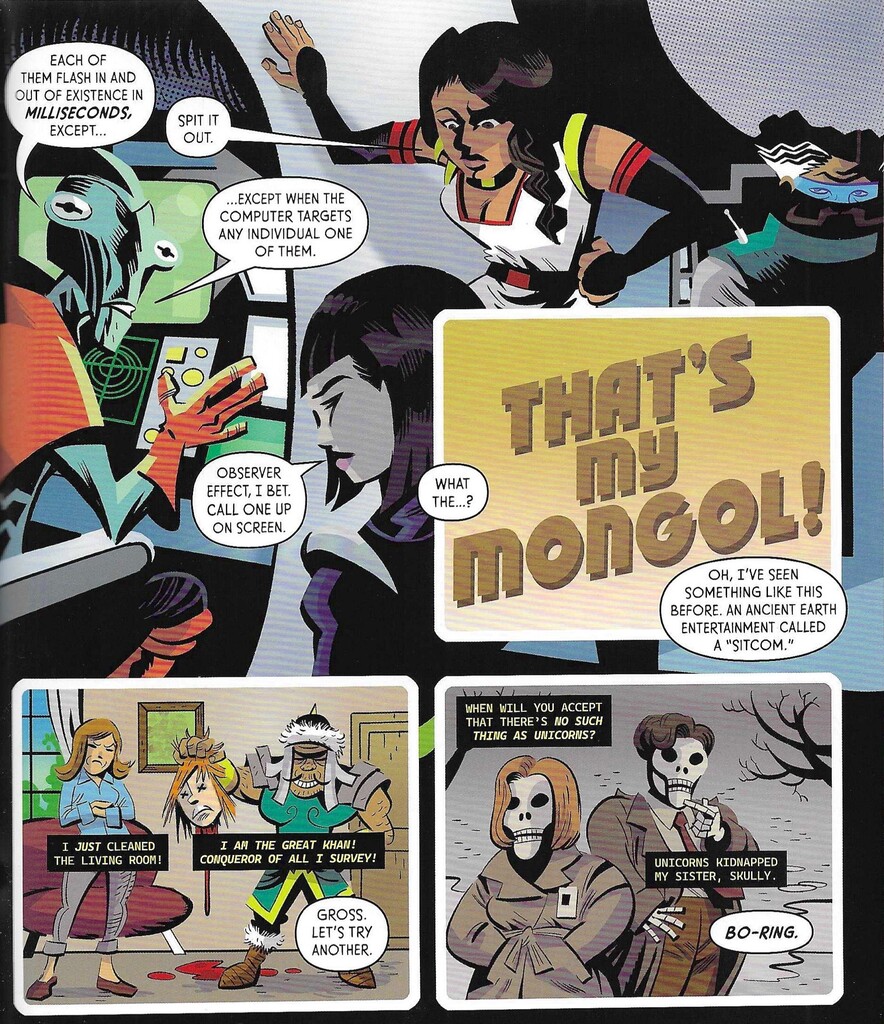 Because the actual plot isn’t as deep as it appears, she has fun with the other dimensions, adding a veneer of depth to it all. I’m not saying the plot isn’t worthy of your time, because it does deal with primal emotions, but it’s not quite as complex as it seems early on in the book, so the wacky way Visaggio actually tells the story becomes a nifty part of the book. I don’t want to give too much away, but it is a more personal story than it seems at the beginning, even though we know early on that Vigil misses her parents and wants to know what happened to them. As we go, it becomes a bit more than that, but Visaggio never loses that focus.
She is helped, naturally, by the artists, whose styles are similar, which makes the transition from Oeming to Santos fairly seamless (Santos is slightly more cartoonish and the tiniest bit less angular than Oeming, but not much), and both artists have shown in the past a wonderful ability to shift genres and visualize abstract things in a way that makes sense. Oeming doesn’t have to be quite as versatile as Santos in this book, because it really starts getting weird in the second half, but he does get to have some fun. First of all, he has to envision a universe 2000 years in the future and what it might look like, so some things are, naturally, going to be odd. He has some fun with page layouts, tilting or compressing panels to disorient the reader, messing with perspective, and using silhouettes very effectively, as he always does. As good as his negative space/silhouette usage is in his more noir work, it’s striking here, in such a colorful comic. 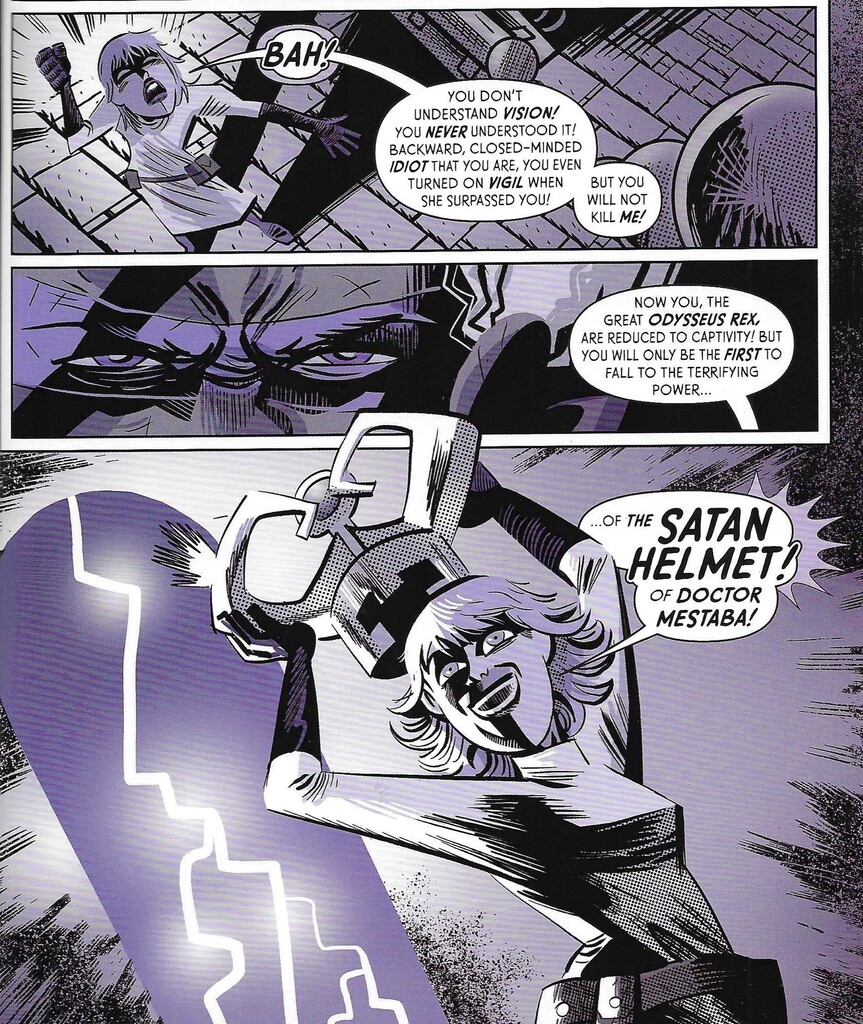 He uses Benday dots more than Santos, who tends to simply hatch a bit rougher to give his work more texture. Santos tends to spot his blacks a bit more than Oeming, and he drops holding lines more often, so his work isn’t quite as crisp as Oeming’s, but that’s nothing to worry about. He also does some neat things with page layouts, as Visaggio twists the characters’ perception of things, which Santos shows on the page. He also has fun shifting his style — there’s a Kirby page and some black-and-white-and-red noir pages that are just a lot of fun. Both artists also get to design some strange alien creatures, which has to be fun for them. It’s a cool-looking book, which is always a plus.
Galaxy of Madness is a pretty keen adventure comic. On the one hand, I kind of wish Visaggio had been even more ambitious with the plot, because it does promise some things that it does not deliver, but then, on the other hand, maybe she wouldn’t have been able to pull it off? Or maybe she wanted to, but sales weren’t great, so she couldn’t? (I don’t know if she planned this as ten issues or not — it feels complete, but maybe she reworked some of it?) Either way, while that’s the tiniest bit disappointing, overall, this is a groovy comic with groovy art. That’s not a bad thing!
Rating: ★ ★ ★ ★ ★ ★ ★ ½ ☆ ☆
