
“He said you’re really an ugly girl, but I like the way you play”
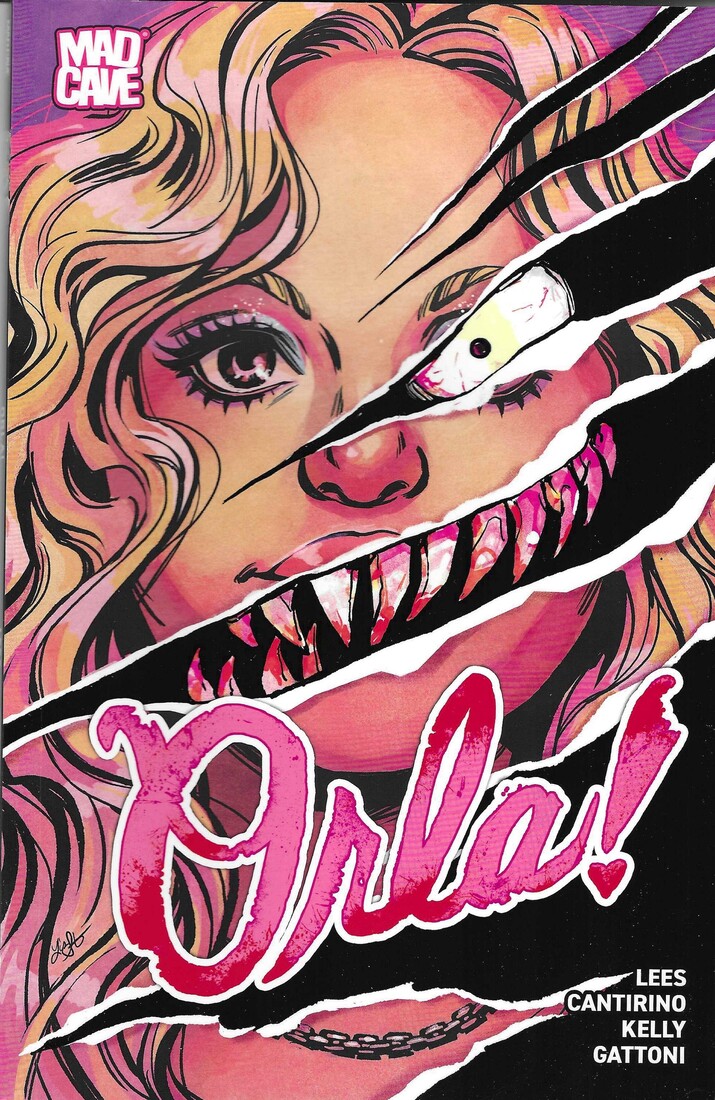
John Lees has proven that he can write an excellent horror story, so when I saw he was writing Orla!, I knew I’d have to pick it up. This is drawn by Sally Cantirino, colored by Dearbhla Kelly, lettered by Lucas Gattoni and Shawn Lee, and edited by Marla Eizik and Jon Moisan. 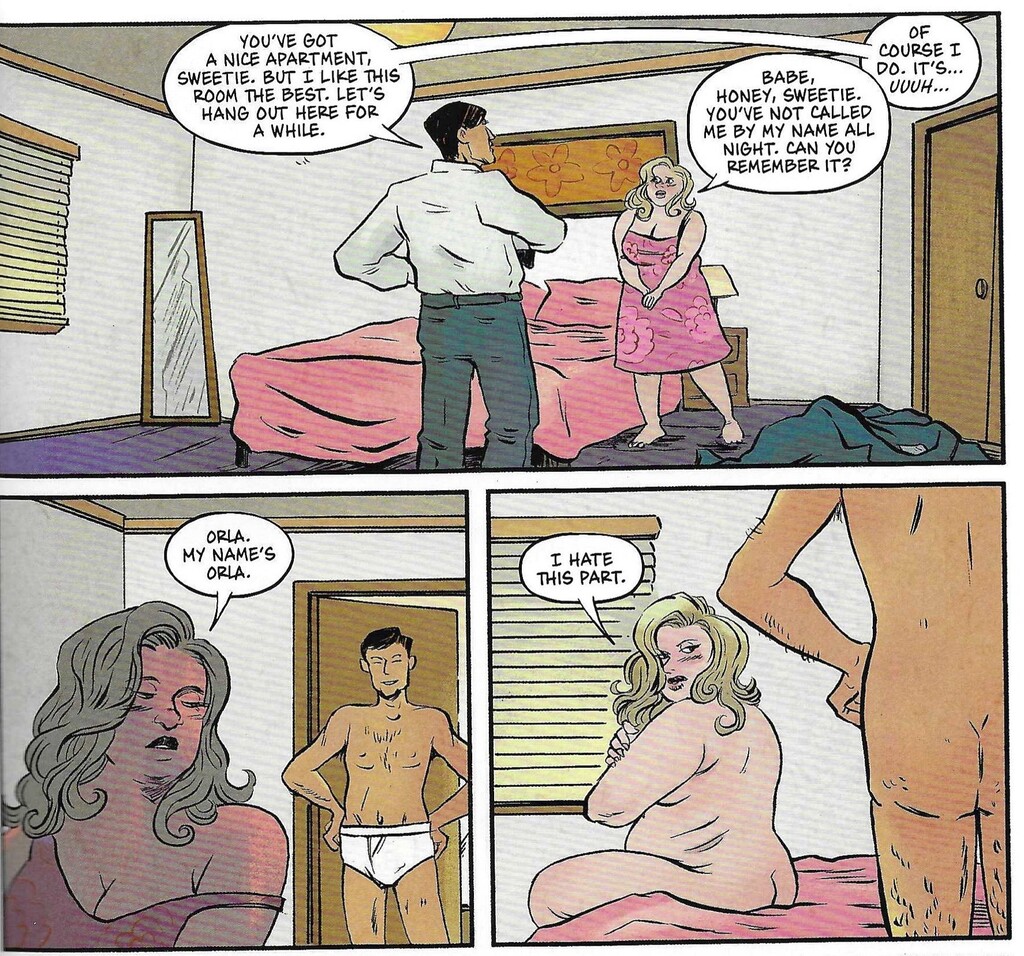 It’s published by Mad Cave, has a $17.99 price tag, and it’s 119 pages. Let’s see what we see!
I’m a bit torn about this book, unfortunately. Lees can create good characters, and his work with them is usually pretty stellar, so this book’s main characters are pretty interesting. Orla is a young woman with some pretty severe body image issues and a lot of bad dates in her life. Unfortunately for her (and the jerky men who happen to be around her), whenever she becomes emotionally unbalanced, she turns into a giant monster and kills and eats said men. Yeah, it’s a pickle. She reads trashy romance novels that she gets at a bookstore near her restoration and repair shop, and the dude who works at (owns?) the bookstore is a nifty dude whom she digs. They do start dating, but Orla is afraid to go any further because of the whole “turning into a monster” thing when she becomes sexually aroused, which is part of that emotional response. Gwyn (the dude’s name is Gwyn) is very patient with her, and he does learn her secret, but he sticks by her because he tries to see the good in everyone, even women who turn into monsters and eat dudes. Meanwhile, there’s an evil-looking older woman stalking Orla, and it’s unclear what she wants or who she works for. So, as you can see, there’s a lot going on. It’s not the most unique plot in the world, but Lees makes Orla and Gwyn’s romance the center of it, and that works very well, so I can forgive the more mundane parts of the plot. I also appreciate that Lees never feels the need to explain everything in his stories — he knows that some things are more fun if they’re left unexplained, and Orla turning into a monster seems to demand an explanation, but Lees doesn’t necessarily think it does (I won’t say how much he does explain, so there!).
As I noted, the romance between the two main characters drives the plot, and Lees makes it feel real (or at least realer than you might expect when one of the participants turns into a monster). 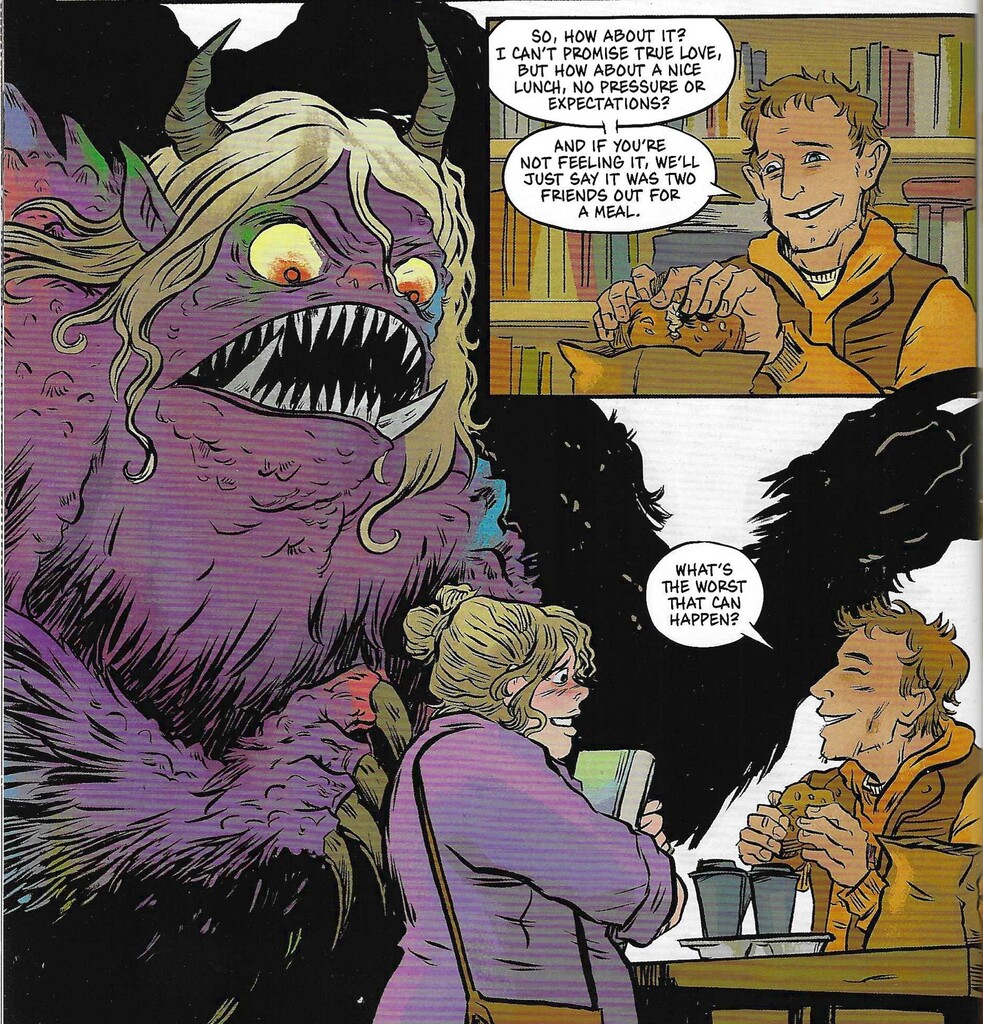 Gwyn is patient with Orla, but he is always trying new sexual things with her to make her loosen up (before he knows about the monster, it seems like Orla is just nervous because she’s inexperienced). Because there’s no sex for a long time, Lees instead shows them talking, and he writes good dialogue for them as they get to know each other. Gwyn has his own problems, of course, and as he talks about them, he makes it easier for Orla to open up to him … except about her real problem, which he discovers by accident. It makes the climax of the book work better, because we have seen how solid their relationship is, so when Orla has to make some hard choices about her predicament, we can buy that Gwyn will be there for her. There’s a nice contrast to Orla’s best friend, Harriet, who’s dating and eventually marries a douchebag, Josh (who’s cheating on her, but she doesn’t know that). Lees does nice work showing the opposite poles of a romance with Orla/Gwyn and Harriet/Josh. It sets up a decent dichotomy in the book and makes us appreciate Gwyn a lot more, which is important because he’s the one who is trying to make it work with Orla. It’s nice to see a romance that could go sideways at any moment just … not. There’s a lot of drama in the story, certainly, but it’s not because Gwyn turns out to be a secret douchebag or anything. It’s refreshing!
I do have some issues with the comic, though, and it’s frustrating because I can’t quite claim it’s bad, just annoying. The men in this comic annoy me, because Orla has dates with just awful dudes, and they feel wildly over the top, but then if you speak to literally any woman who’s been on a date in the past decade, these are exactly the kinds of men they date. 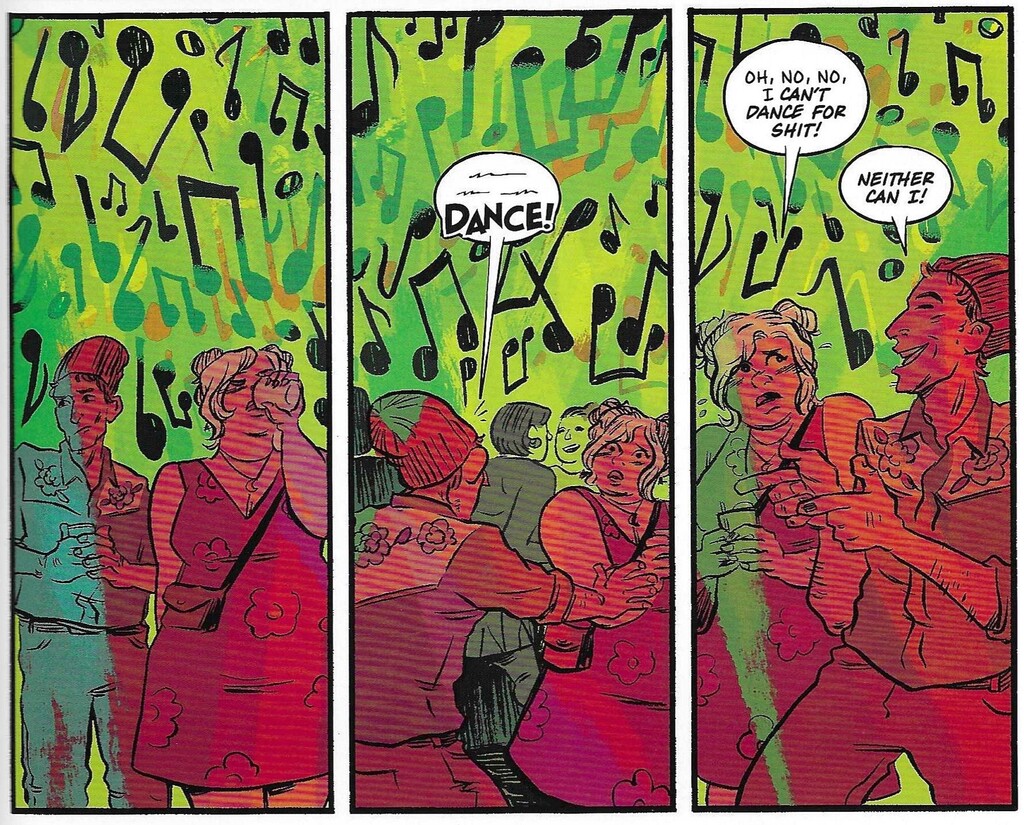 Lees is making a point about society, sure, and Gwyn even mentions the “loneliness” epidemic that seems to strike not only men but women, too, but these men feel so ridiculous that they seem to undercut his point. The fact that they do exist and go on dates and actually say these things to women is insane, but like a lot of what has happened over the past decade in this country, it happens in real life but feels very weird in fiction. The “manosphere” guy whom Orla wants to kill is such a cliché, too, and while, again, I don’t doubt that they’re like that, it just feels wrong for fiction. On the other hand, Gwyn is so teeth-achingly earnest that he almost becomes annoying, too (it doesn’t help that one of the worst people I’ve ever known was named Gwyn, so it makes me twitchy when I see that name). He and Orla are really, really politically correct (or, I guess, “woke”), and while, again, I don’t doubt that people like them exist, it feels like Lees is giving them these characteristics to make his societal point rather than to make them real people. His writing is good enough to overcome it, but it’s still a problem because they’re just so twee. The contrast between Gwyn and Orla and all the evil men she meets is stark, and I get why Lees does it, but it’s a bit over the top. The loss of subtext in fiction continues apace!
I do like Cantirino’s art, though. She makes Orla attractive but also a bit larger than what we usually see in comics, so we can see why she has lower self-esteem but also why it’s ridiculous for her to feel that way. Cantirino does a terrific job with the way Orla and Gwyn relate to each other, as she does very good work with their facial expressions as they navigate their relationship. Orla’s self-esteem issues come out well with the way Cantirino shows how embarrassed she is often, while she does a good job making Gwyn unsure of himself as he’s trying to figure Orla out. Her monster is very neat, too, as Orla keeps her blonde hair when she transforms, which adds a weird aesthetic to her when she does. 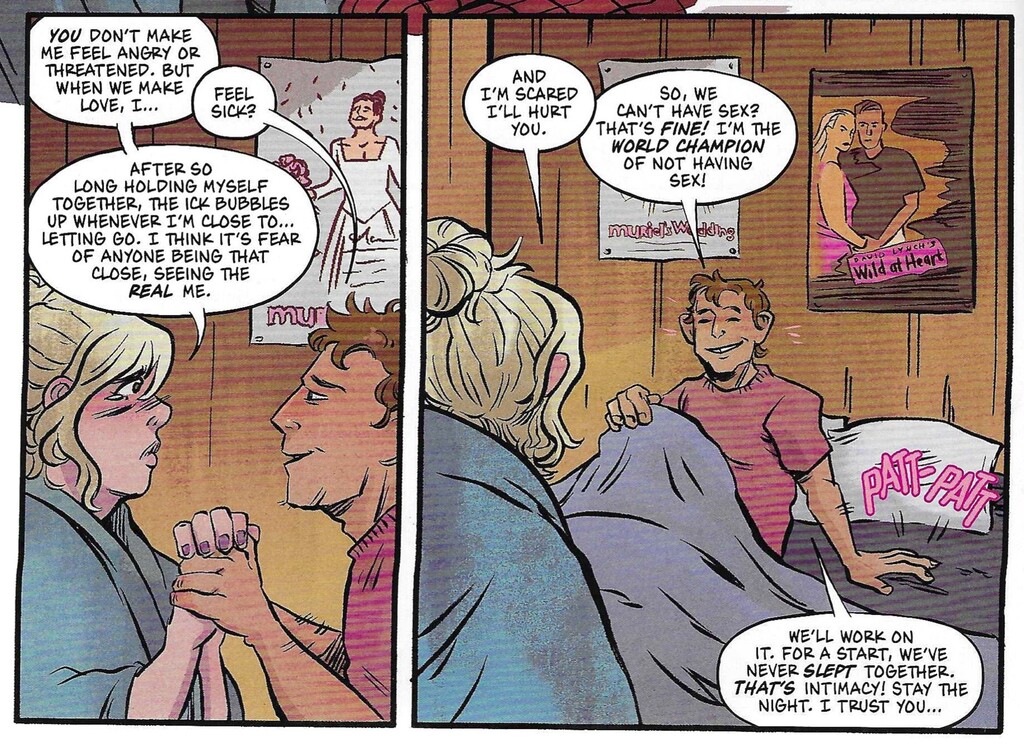 She gets horns and long claws, and Cantirino gives her spikes down her back. Cantirino has a slightly cartoonish style, so her monster doesn’t look too, too horrific, but she’s still scary enough that when she transforms, it shows how bad the men are going to get it. Cantirino makes sure that even as a monster, Orla still doesn’t have a lot of self-esteem, so when Cantirino draws her as a monster, she kind of shrinks into herself, which is a nice touch. She adds some odd cartoonish touches, like when Orla and Harriet cry together in ridiculous fashion, and overall, it’s a nice-looking comic.
Orla! is a pretty good comic, but it feels like it could have been better. Lees has shown that he can write a very good horror story, and this isn’t quite one of them, but it’s still kind of neat. I wish it hadn’t been so very obvious, but such is life in our strange new world of society. Anyway, it is nice that this isn’t as bleak as some horror stories, and Lees does a nice job making it sweet even within all the people-eating. That’s not a bad job!
Rating: ★ ★ ★ ★ ★ ★ ½ ☆ ☆ ☆

I get the part about Orla turning into a monster, but there’s no way I’m swallowing that she buys novels from an actual bookstore.
I mean do they even exist anymore? Talk about far fetched.
I bought books at an actual bookstore less than a month ago. Keepin’ the flame burning! 🙂
Our modest East Anglian town (pop. 2025: c.11,000 to 12,000; nearest branded book/comic shops are in Cambridge, ie Forbidden Planet or Waterstones, 40mins on train or an hour by car to the south) even has a combined book and second hand shop. It has a few UK and US back issues as well as a decent array of books, DVDs, CDs, etc.
The town a dozen miles above us has a geek collector’s shop that does some nifty vintage toys, games & comix run by a guy who knows his stuff; quite a coup. I have no idea how he and his partner get by, let alone make a good profit.
Given how comic shops have declined, I’m surprised we’ve got even that much.